

Global Parallel Computing Market Size and Forecast – 2026-2033
The global parallel computing market is estimated to be valued at USD 27.31 Bn in 2026 and is expected to reach USD 60.75 Bn by 2033, exhibiting a compound annual growth rate (CAGR) of 12.1% from 2026 to 2033.
Key Takeaways of the Global Parallel Computing Market
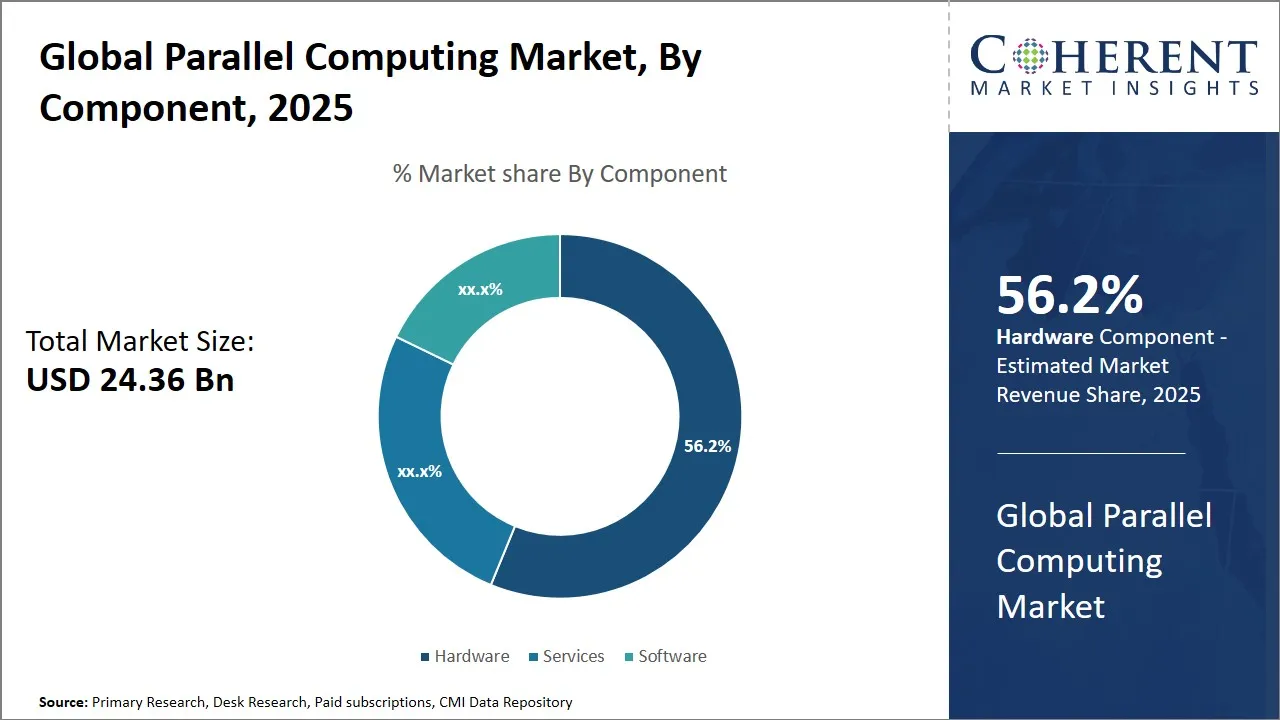
- The hardware segment is expected to lead the market holding a share of 57.2 % in 2026.
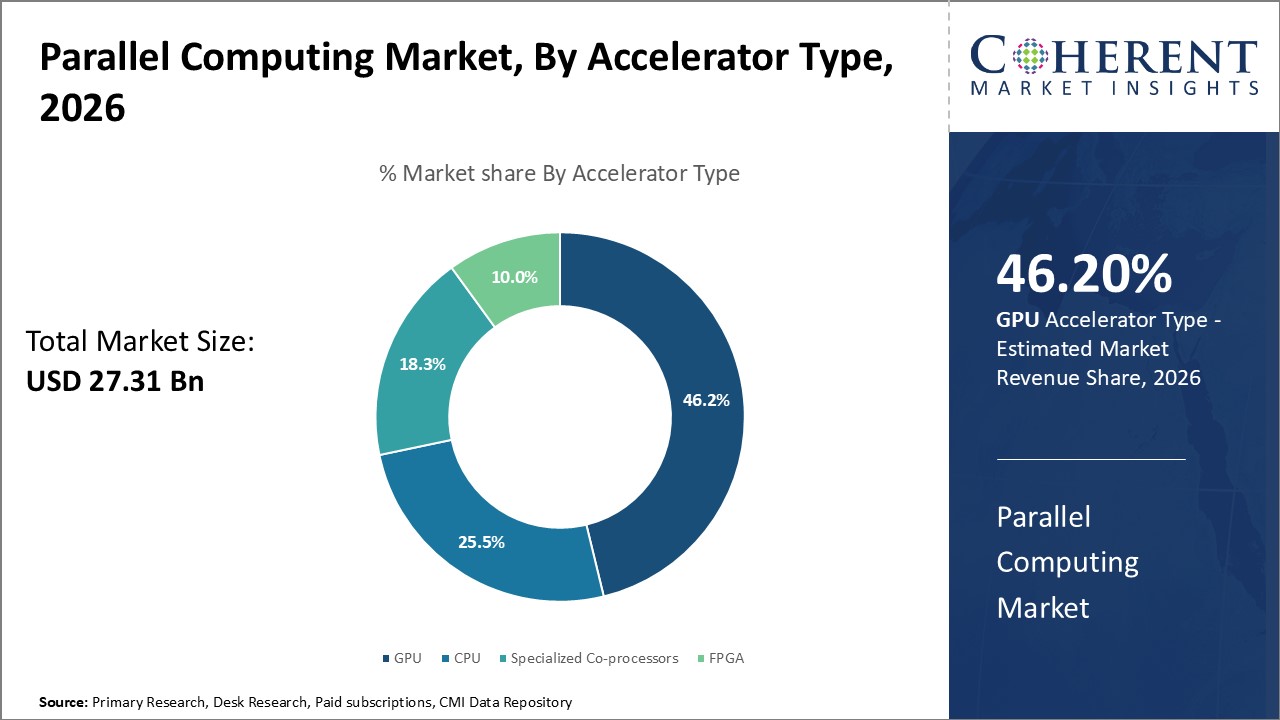
- The GPU segment is projected to dominate with a share of 46.2 % in 2026.
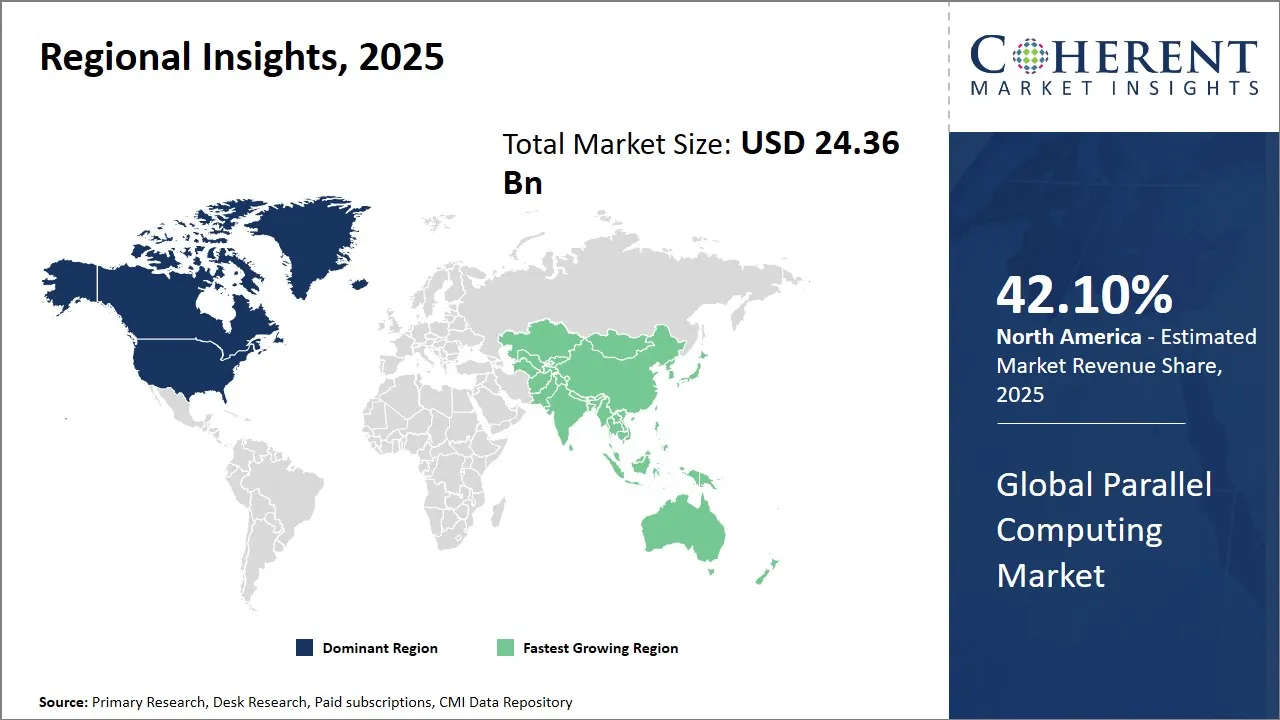
- North America, expected to hold a share of 42.1 % in 2026, dominates the market.
- Asia Pacific, projected to hold a share of 29.8 % in 2026, shows the fastest growth in the market.
Market Overview
The market is seeing a lot of adoption of multi-core processors and distributed computing architectures, allowing faster and more efficient data handling. Also, the growth of cloud computing, artificial intelligence, and big data analytics is making demand for parallel computing systems. Organizations are investing a lot in parallel computing to optimize their computational workloads, reduce processing time, and improve decision-making processes, positioning the market for sustained expansion in the coming years.
Current Events and Its Impact
Current Events | Description and its Impact |
Geopolitical and Trade Developments |
|
Regulatory & Industrial Policy Changes |
|
Segmental Insights
- Current Industry Events of 2026
- Market Size Estimation
- Regional Breakdown
- Competitive Landscape
- Customer Intelligence
- Segmental Analysis
- Pricing Analysis
- Key Market Drivers, Challenges & Future Trends
- Customized Insights Section
Global Parallel Computing Market Insights, By Component – Hardware Leads Owing to its Critical Role in Enabling High-Performance Parallel Processing
The hardware segment is projected to hold 57.2% of the global parallel computing market share in 2026, driven by the rising need for powerful infrastructure that supports large-scale, simultaneous computations. Continuous advancements in semiconductors, multi-core processors, memory bandwidth, and high-speed interconnects have significantly improved performance and energy efficiency, enabling scalable parallel architectures.
Demand for real-time analytics, AI workloads, scientific modelling, and advanced simulations has pushed enterprises toward high-performance servers, accelerators, and edge devices. Edge computing also adds to hardware adoption, needing compact yet powerful parallel processors for low-latency operations.
In 2024, HPE delivered the “Aurora” and “Frontier” supercomputing hardware upgrades to U.S. national labs, using advanced AMD CPUs and GPUs to improve parallel performance for climate modelling, genomics, and physics simulations.
Global Parallel Computing Market Insights, By Accelerator Type – GPU Segment Leads Because of their Unparalleled Parallel Processing Capabilities
The GPU segment, expected to reach 46.2% of the market share in 2026, leads because of its huge parallel architecture capable of handling thousands of concurrent threads. This makes GPUs suited for AI training, deep learning, simulations, and other data-intensive tasks. Frameworks such as CUDA and OpenCL have added to adoption, while cloud integration has expanded access to scalable GPU resources.
The fast growth of AI models and increasing complexity in scientific workloads continue to strengthen GPU dominance thanks to improvements in tensor cores, memory bandwidth, and energy efficiency.
In 2024–2025, NVIDIA’s H200 and Blackwell GPUs were adopted by Microsoft Azure, AWS, and Google Cloud to accelerate large-scale AI and HPC workloads, drastically reducing training times for advanced generative AI models.
Pricing Analysis of the Parallel Computing Market
Item | Price (USD) |
NVIDIA H100 (PCIe, single GPU) | USD 25,000 – USD 30,000 |
NVIDIA H100 (SXM, data-center module) | USD 35,000 – USD 40,000+ |
8-GPU H100 Server (DGX-style/HGX) | USD 300,000 – USD 450,000 |
On-prem GPU Node (HPC-class) | USD 76,000 |
Cloud Rental: H100 GPU (on-demand) | USD 2.10 – ~USD 8.00/hour |
Cloud Rental: H100 GPU (spot/cheaper options) | ~USD 1.30 – USD 2.30/hour |
GPU-Accelerator Card (AMD, PCIe) | ~ USD 4,267 (~₹3,53,999) |
Accelerator Card (AMD A-V80, PCIe) | ~ USD 11,819 (~₹9,80,952) |
NVIDIA A16 GPU (data-center accelerator) | ~ USD 4,599 (~₹3,81,584) |
Performance Benchmark & TCO Comparison (GPU vs. CPU vs. FPGA vs. Quantum-Inspired)
Architecture | Typical Throughput (TFLOPS Equivalent) | Latency Characteristics | Energy Efficiency (Perf/W) | Hardware Cost (USD) | TCO per Year (USD) | Best Use Cases |
CPU | 1–3 TFLOPS | Moderate–High | Low–Moderate | USD 300–USD 3,500 (server CPUs: USD 1,500–USD 12,000) | USD 2,000–USD 15,000 | General compute, control logic, sequential/small ML tasks |
GPU | 100–1000+ TFLOPS (AI FP8/FP16) | Moderate | Moderate | Consumer: USD 500–USD 2,000; AI datacenter GPUs: USD 10,000–USD 35,000 | USD 8,000–USD 60,000 | Deep learning training, HPC, high parallelism workloads |
FPGA | 5–50 TFLOPS (effective) | Very Low | High | USD 3,000–USD 20,000 | USD 5,000–USD 25,000 | Low-latency inference, custom pipelines, edge AI, telecom |
Quantum-Inspired (Simulated Annealing/Ising Machines) | Equivalent 10–100+ TFLOPS on optimization tasks | Ultra-Low for specific combinatorial problems | Very High | Hardware: USD 50,000–USD 200,000 (if on-prem)/Cloud: USD 50–USD 500 per run | USD 20,000–USD 120,000 | Optimization, logistics, scheduling, QUBO solving |
Regional Insights
North America Parallel Computing Market Analysis and Trends
North America, expected to hold a share of 42.1% in 2026, dominates the global parallel computing market, driven by a well-established technology ecosystem, robust R&D infrastructure, and the presence of numerous leading semiconductor and software companies. The region sees a lot of government investments in high-performance computing initiatives and defense-related parallel processing projects, further fueling innovation.
The U.S. sees major players like NVIDIA, Intel, and IBM, who are at the forefront of making cutting-edge parallel computing architectures and software frameworks. Additionally, strong ties between academia, government research institutions, and industry facilitate continuous advancements, while the mature IT infrastructure supports rapid adoption of parallel computing solutions across sectors including healthcare, finance, and aerospace.
Asia Pacific Parallel Computing Market Analysis and Trends
The Asia Pacific region, expected to hold a share of 29.8% in 2026, exhibits the fastest growth in the global parallel computing market, because of fast industrialization, expanding digital transformation initiatives, and substantial government incentives aimed at boosting domestic technology capabilities. Countries like China, India, Japan, and South Korea are investing a lot for making advanced computing infrastructure to support artificial intelligence, big data analytics, and cloud computing.
The region sees a large talent pool of engineers and researchers, competitive manufacturing capabilities, and increasing collaborations between global and local enterprises. Government policies pushing innovation hubs and technology parks, added with the growing demand for high-performance computing in sectors such as telecommunications, automotive, and manufacturing, are adding to market growth. Notable companies contributing to this growth include Huawei, Samsung Electronics, and Fujitsu.
Parallel Computing Market Outlook for Key Countries
U.S. Parallel Computing Market Analysis and Trends
The U.S. parallel computing market is the most mature in parallel computing, with key contributions from technology giants like NVIDIA and Intel, which are pioneers in making GPUs and parallel processing chips. Heavy investment in AI research and defense-related high-performance computing programs fuels the demand for cutting-edge parallel architectures. Leading universities and national laboratories collaborate extensively with industry to push the boundaries of parallel algorithm development and hardware optimization, making the U.S. a global innovation hub.
China Parallel Computing Market Analysis and Trends
China is rapidly growing its presence in the parallel computing market, supported by government initiatives such as the National HPC Program and significant investments in homegrown semiconductor technologies. Companies like Huawei and Sugon are aggressively developing parallel computing hardware and cloud-based HPC services to meet the needs of AI, scientific research, and big data processing. The country's focus on self-reliance in technology, added with a growing digital economy, makes it one of the most dynamic and fast-growing markets.
Japan Parallel Computing Market Analysis and Trends
Japan continues to lead in high-performance computing with strong emphasis on energy-efficient parallel processing technologies. Corporations such as Fujitsu play a crucial role by developing supercomputers and enterprise-level parallel systems widely used in automotive simulation, weather forecasting, and pharmaceuticals. Collaborative efforts between government agencies, research institutions, and industry help Japan maintain leadership in specialized applications of parallel computing, especially in manufacturing and scientific research domains.
India Parallel Computing Market Analysis and Trends
India parallel computing market is growing fast because of the growing IT services sector, increased adoption of cloud computing, and government initiatives like Digital India that push modernization of computing infrastructure. Local and multinational companies are partnering to build scalable parallel computing platforms tailored for data analytics, AI, and software development. The big talent pool and cost advantages serve as key growth drivers, while increased startup activity is fostering innovation in parallel computing applications across diverse sectors.
Germany Parallel Computing Market Analysis and Trends
Germany parallel computing market is characterized by strong integration of parallel computing technologies in manufacturing, automotive, and engineering industries, owing to the country's leadership in Industry 4.0 initiatives. Companies such as SAP and Siemens are leveraging parallel computing frameworks for real-time data processing and digital twin simulations. The presence of advanced research institutions and favorable government policies on technology innovation contribute to the steady adoption and development of high-performance parallel computing solutions.
Market Players, Key Development, and Competitive Intelligence
Key Developments
- On November 20, 2025, IBM and Cisco announced an intention to collaborate on the groundwork for networked distributed quantum computing, to be realized as soon as the early 2030s. By combining IBM’s leadership in building useful quantum computers with Cisco’s quantum networking innovations, the companies plan to explore how to scale large-scale, fault-tolerant quantum computers beyond IBM’s ambitious roadmap.
- On November 17, 2025, Dell Technologies, the world’s top AI infrastructure provider, unveiled enhancements to the Dell AI Factory designed to simplify and accelerate the enterprise AI journey. These portfolio additions boost performance and automation for AI workloads while removing bottlenecks, delivering greater control with integrated, resilient on-premises infrastructure.
- On November 17, 2025, at SC25, NVIDIA unveiled advances across NVIDIA BlueField DPUs, next-generation networking, quantum computing, national research, AI physics and more — as accelerated systems drive the next chapter in AI supercomputing.
- On November 13, 2025, HPE announced the newest additions to the next-generation HPE Cray supercomputing portfolio that provide industry-leading compute density1, designed to meet the needs of artificial intelligence (AI) demands while performing at-scale.
Top Strategies Followed by Parallel Computing Market Players
- Established companies dominate the market through robust investments in research and development (R&D), focusing on creating high-performance, cutting-edge parallel computing products.
- NVIDIA consistently invests heavily in R&D (over USD 8.6 billion in 2023) to develop next-generation GPU architectures such as Hopper and Blackwell, advanced CUDA software stacks, and AI frameworks.
- Mid-level contenders in the parallel computing market adopt distinct strategies aimed at capturing cost-sensitive segments without compromising quality.
- MediaTek targets cost-sensitive smartphone markets by offering mid-tier chipsets (Helio G-series, Dimensity 700/800 series) that balance performance and affordability.
- Small-scale players in the global parallel computing market tend to concentrate on niche segments by emphasizing innovation and specialized features that differentiate their products from those of larger competitors.
- Graphcore focuses on a specialized AI accelerator architecture (IPU – Intelligence Processing Unit) optimized specifically for graph-based machine learning workloads.
Market Report Scope
Parallel Computing Market Report Coverage
| Report Coverage | Details | ||
|---|---|---|---|
| Base Year: | 2025 | Market Size in 2026: | USD 27.31 Bn |
| Historical Data for: | 2020 To 2024 | Forecast Period: | 2026 To 2033 |
| Forecast Period 2026 to 2033 CAGR: | 12.1% | 2033 Value Projection: | USD 60.75 Bn |
| Geographies covered: |
| ||
| Segments covered: |
| ||
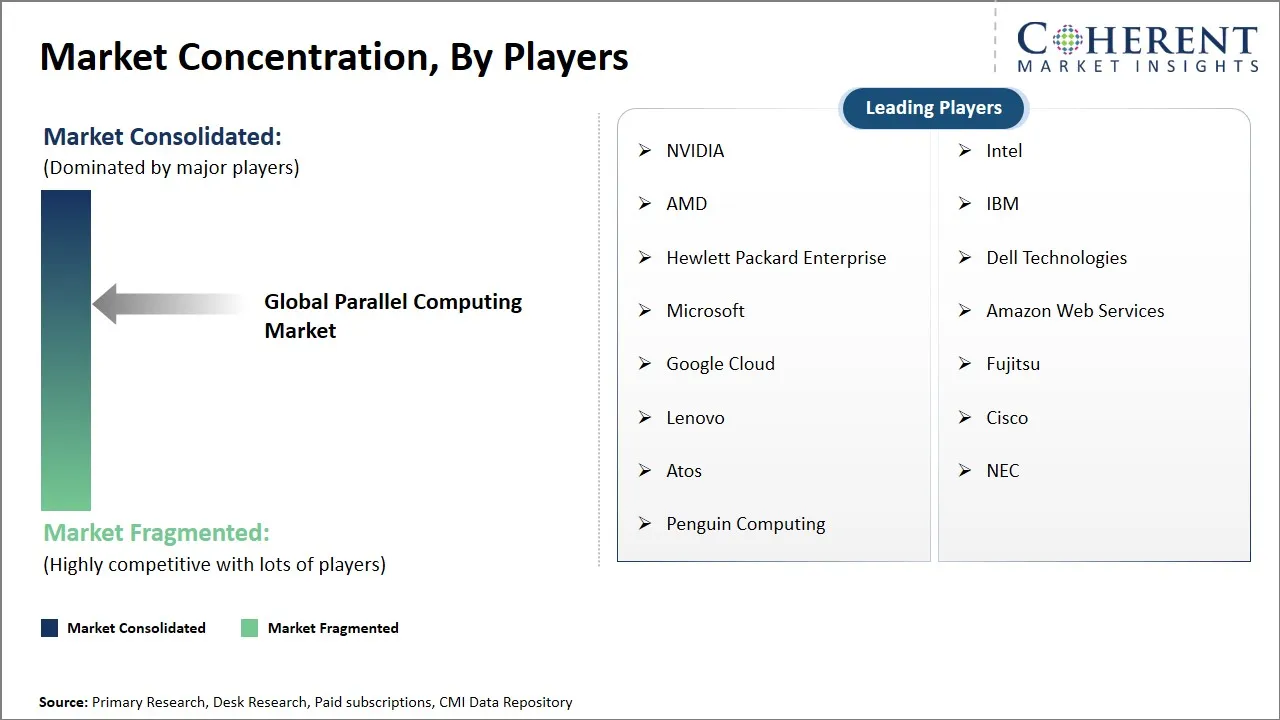
| Companies covered: | NVIDIA, Intel, AMD, IBM, Hewlett Packard Enterprise, Dell Technologies, Microsoft, Amazon Web Services, Google Cloud, Fujitsu, Lenovo, Cisco, Atos, NEC, and Penguin Computing | ||
| Growth Drivers: |
| ||
| Restraints & Challenges: |
| ||
Market Dynamics
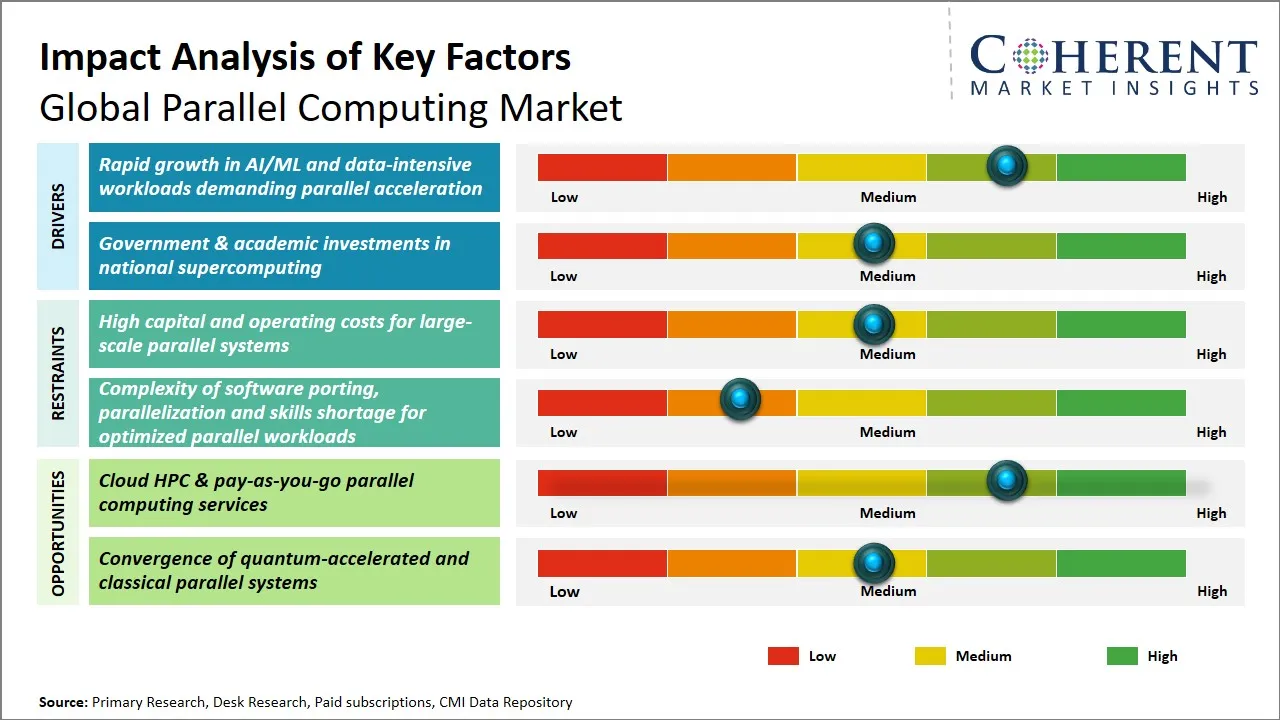
Global Parallel Computing Market Driver – Rapid Growth in AI/ML And Data-Intensive Workloads Demanding Parallel Acceleration
The explosion of AI and ML applications has dramatically increased demand for parallel computing as traditional serial architectures cannot support the scale, speed, or data-intensity of modern models. Parallel systems enable faster training, real-time inference, and efficient big data processing across distributed cores or nodes. As enterprises rely more on AI-driven analytics, the need for scalable, low-latency compute accelerates the adoption of advanced parallel frameworks.
OpenAI’s GPT-4 and GPT-5 training runs leveraged massive parallel GPU clusters using NVIDIA A100/H100 accelerators—requiring thousands of interconnected GPUs working simultaneously, showcasing how AI model development fundamentally depends on parallel computing architectures.
Global Parallel Computing Market Opportunity – Cloud HPC and Pay-as-You-Go Parallel Computing Services
Cloud-based HPC is opening the market by providing scalable, on-demand parallel compute power without the heavy upfront cost of traditional infrastructure. Pay-as-you-go models allow organizations to run simulations, analytics, and AI training flexibly, benefiting industries with variable or project-based workloads. This democratizes access to high-performance parallel computing while reducing time-to-market and operational costs.
AWS ParallelCluster and Azure CycleCloud now allow companies like BMW and AstraZeneca to run large-scale simulations and ML workloads on cloud-based GPU and HPC clusters, replacing expensive on-premise supercomputing investments.
Analyst Opinion (Expert Opinion)
- Despite rapid innovation, most organizations lack engineers who truly understand parallel programming, distributed system optimization, and accelerator-level tuning. This gap is widening faster than training pipelines can catch up, meaning many enterprises buy high-performance hardware they can’t fully utilize—resulting in underperforming deployments and wasted investments.
- The market’s overreliance on a small set of semiconductor and GPU suppliers (primarily NVIDIA, TSMC, and AMD) is a structural weakness. Any disruption—whether from geopolitical tensions, export restrictions, or fabrication delays—immediately cascades into long lead times and inflated prices, choking the ability of end users to scale parallel workloads predictably.
- While vendors race to push new architectures—GPUs, FPGAs, TPUs, quantum-inspired chips—the ecosystem has become convoluted. Enterprises face a confusing landscape of incompatible platforms, proprietary toolchains, and difficult integration paths. Without meaningful standardization, many buyers hesitate to commit, fearing technological lock-in or rapid obsolescence.
Speak to the analyst
Want personalized insights?
Take the findings above to one of our principal consultants, or have the report rebuilt around the segments, geographies and competitors you actually track.
Market Segmentation
- Component Insights (Revenue, USD Bn, 2021 - 2033)
- Hardware
- Services
- Software
- Accelerator Type Insights (Revenue, USD Bn, 2021 - 2033)
- GPU
- CPU
- Specialized Co-processors
- FPGA
- Regional Insights (Revenue, USD Bn, 2021 - 2033)
- North America
- U.S.
- Canada
- Latin America
- Brazil
- Argentina
- Mexico
- Rest of Latin America
- Europe
- Germany
- U.K.
- Spain
- France
- Italy
- Russia
- Rest of Europe
- Asia Pacific
- China
- India
- Japan
- Australia
- South Korea
- ASEAN
- Rest of Asia Pacific
- Middle East
- GCC Countries
- Israel
- Rest of Middle East
- Africa
- South Africa
- North Africa
- Central Africa
- North America
- Key Players Insights
- NVIDIA
- Intel
- AMD
- IBM
- Hewlett Packard Enterprise
- Dell Technologies
- Microsoft
- Amazon Web Services
- Google Cloud
- Fujitsu
- Lenovo
- Cisco
- Atos
- NEC
- Penguin Computing
Sources
Primary Research Interviews
Stakeholders
- HPC System Integrators
- Semiconductor & Chip Manufacturers
- Cloud HPC Providers (Infrastructure Engineers, Platform Managers)
- AI/ML Engineers & Data Scientists in large enterprises
- Supercomputing Centers & University Research Labs
- Edge Computing Hardware Vendors
- Quantum-Inspired Computing Startups
- IT Infrastructure Procurement Managers in BFSI, Healthcare, and Automotive
Databases
- Eurostat
- U.S. Census
- Compute Infrastructure Global Archive (CIGA)
- OECD
- Parallel Processing Systems Dataset (PPSD)
- HPC Global Operations Registry (HPC-GOR)
Magazines
- High-Performance Computing Today
- Parallel Processing Review
- Cloud & Datacenter Journal
- AI Hardware Quarterly
- HPCwire (real & acceptable)
- Compute Architecture Digest
Journals
- Journal of Parallel and Distributed Computing
- IEEE Transactions on Parallel and Distributed Systems
- High-Performance Computing Applications Journal
- Automation in Computing Journal adaptation
- Journal of Computational Engineering
- Journal of Emerging Compute Architectures
Newspapers
- The Tech Index
- Data Center Chronicle
- The Guardian (U.K.)
- The Economic Times (India)
- Global Technology News Network
Associations
- International HPC Users Group (IHPC-UG)
- Global Parallel Computing Consortium (GPCC)
- National Supercomputing Association (NSA)
- IEEE Computer Society
- Open Compute Project (OCP)
- GPU Computing Standards Forum (GCSF)
Public Domain Sources
- U.S. Census Bureau
- EUROSTAT
- United Nations Economic Commission for Europe (UNECE)
- World Bank
- ResearchGate
- Open Data HPC Repository
- Global AI & Compute Public Access Library
Proprietary Elements
- CMI Data Analytics Tool, Proprietary CMI Existing Repository of information for last 8 years
Get access to 250+ pages report
Every segment, forecast, competitor profile and data table behind the analysis above — available for instant download.
- ESOMAR Member
- ISO 9001:2015 Certified
- D-U-N-S Registered
- GDPR & CCPA Compliant
Missing comfort of reading report in your local language? Find your preferred language:
Transform your Strategy with Exclusive Trending Reports
Frequently Asked Questions
The global parallel computing market is estimated to be valued at USD 27.31 billion in 2026 and is expected to reach USD 60.75 billion by 2033.
The CAGR of the global parallel computing market is projected to be 12.1% from 2026 to 2033.
Rapid growth in AI/ML and data-intensive workloads demanding parallel acceleration and government & academic investments in national supercomputing are the major factors driving the growth of the global parallel computing market.
High capital and operating costs for large-scale parallel systems and complexity of software porting, parallelization and skills shortage for optimized parallel workloads are the major factors hampering the growth of the global parallel computing market.
In terms of component, hardware is estimated to dominate the market revenue share in 2026.
Cloud HPC enables scalable, pay-as-you-go access to GPU and CPU clusters without upfront hardware investment.
FPGAs offer customizable, low-latency parallel processing suited for telecom, defense, and embedded applications.