

Global Parcel Delivery Logistics Market Size and Forecast – 2026-2033
The Global Parcel Delivery Logistics Market is estimated to be valued at USD 547.14 Bn in 2026 and is expected to reach USD 775.03 Bn by 2033, exhibiting a compound annual growth rate (CAGR) of 5.1% from 2026 to 2033.
Key Takeaways of the Parcel Delivery Logistics Market
- The B2C segment leads the market holding an estimated share of 55.3% in 2026.
- The air segment is projected to dominate with a share of 46.2% in 2026.
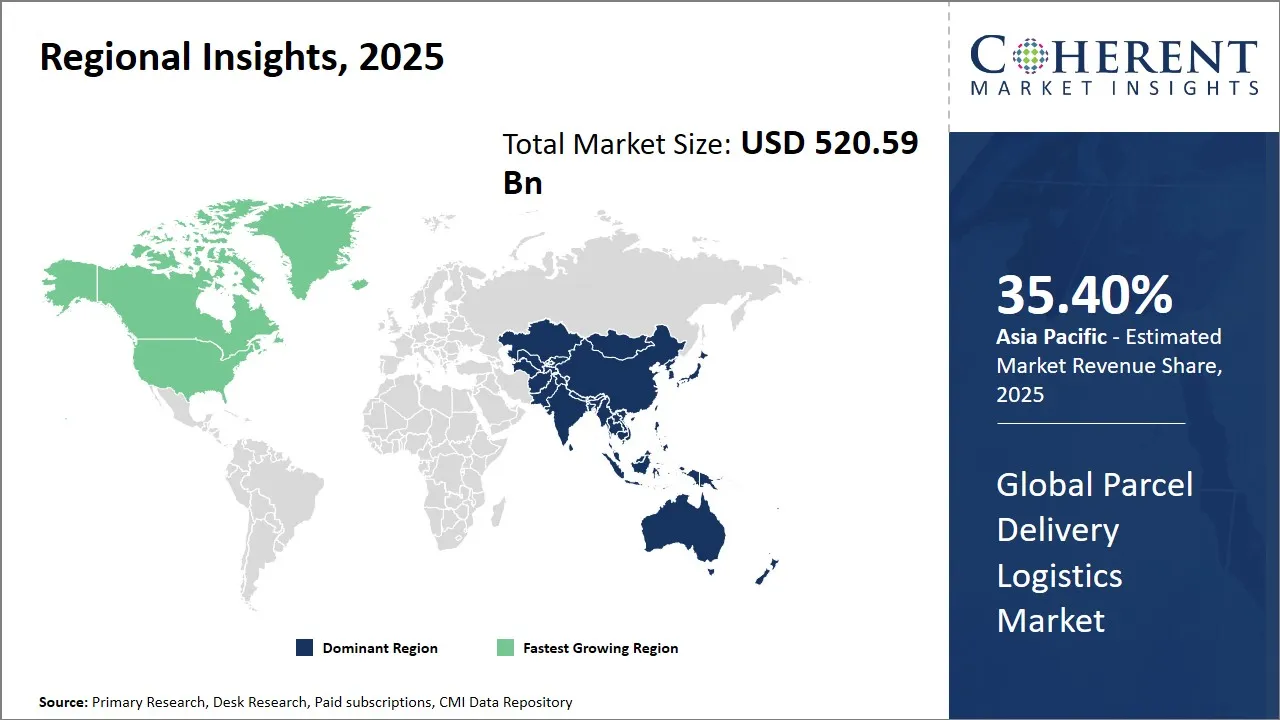
- Asia Pacific is estimated to lead the market with a share of 35. 4% in 2026.
- North America, holding a share of 29. 1% in 2026, is projected to be the fastest growing region.
Market Overview
Current market trends emphasize the integration of automation, artificial intelligence, and real-time tracking systems to enhance operational efficiency and customer experience. Sustainability is also gaining prominence, with companies adopting eco-friendly packaging and electric delivery vehicles to reduce carbon footprints. Additionally, last-mile delivery innovations, including drones and autonomous vehicles, are reshaping parcel logistics, enabling faster delivery times and greater cost effectiveness. These trends collectively position the parcel delivery logistics market for sustained growth and technological transformation.
Current Events and Its Impact
Current Events | Description and Impact |
Geopolitical & Trade Developments |
|
Postal & Regulatory Changes |
|
Sustainability & ESG Focus |
|
E-commerce Platform Growth |
|
Segmental Insights
- Current Industry Events of 2026
- Market Size Estimation
- Regional Breakdown
- Competitive Landscape
- Customer Intelligence
- Segmental Analysis
- Pricing Analysis
- Key Market Drivers, Challenges & Future Trends
- Customized Insights Section
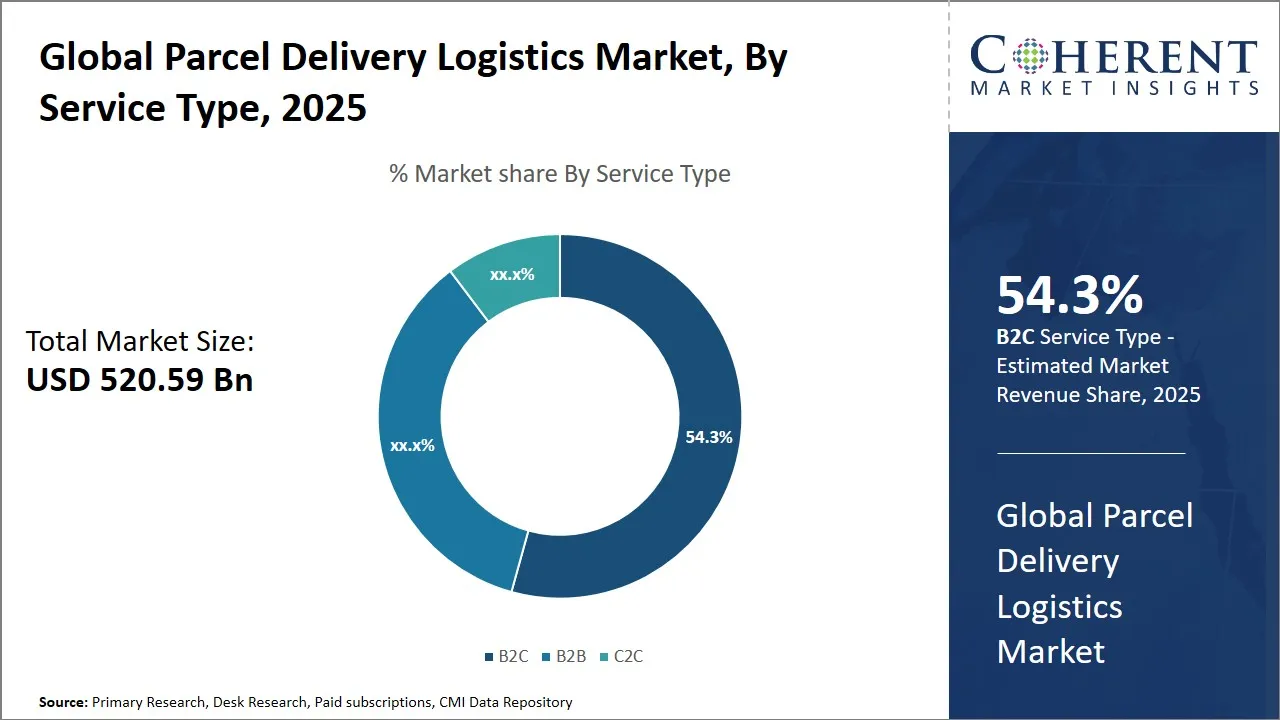
Global Parcel Delivery Logistics Market Insights, by Service Type – B2C Leads Due to the Rapid Expansion of E-commerce and Changing Consumer Behaviors
The B2C segment dominates the global parcel delivery logistics market, holding an estimated share of 55.3% in 2026. Increasing internet penetration, smartphone adoption, and the convenience of online shopping have fundamentally shifted consumer purchasing habits.
This increasing demand for expedited delivery requires logistics firms to optimize last-mile delivery operations, often leveraging advanced technologies such as route optimization software, real-time tracking, and automated sorting centers. The need for enhanced customer experience has encouraged firms to innovate in packaging, delivery scheduling, and flexible drop-off or pick-up points to meet consumer expectations effectively.
Moreover, the B2C segment benefits from a growing urban population and the digitalization of retail channels. With consumers seeking personalized and hassle-free shopping experiences, logistics providers are expanding their service portfolios to include same-day delivery in metropolitan areas and contactless delivery options, especially in response to global health concerns. This responsiveness to shifting consumer preferences ensures sustained demand for B2C parcel delivery.
Another driving force is the increasing variety and volume of products being ordered online, ranging from apparel and electronics to groceries and personal care items. This diversification necessitates a robust parcel delivery network capable of handling different product categories with varying storage and handling requirements. Consequently, logistics companies continue to invest heavily in scalable infrastructure and partnerships with e-commerce platforms to capture B2C parcel shipments.
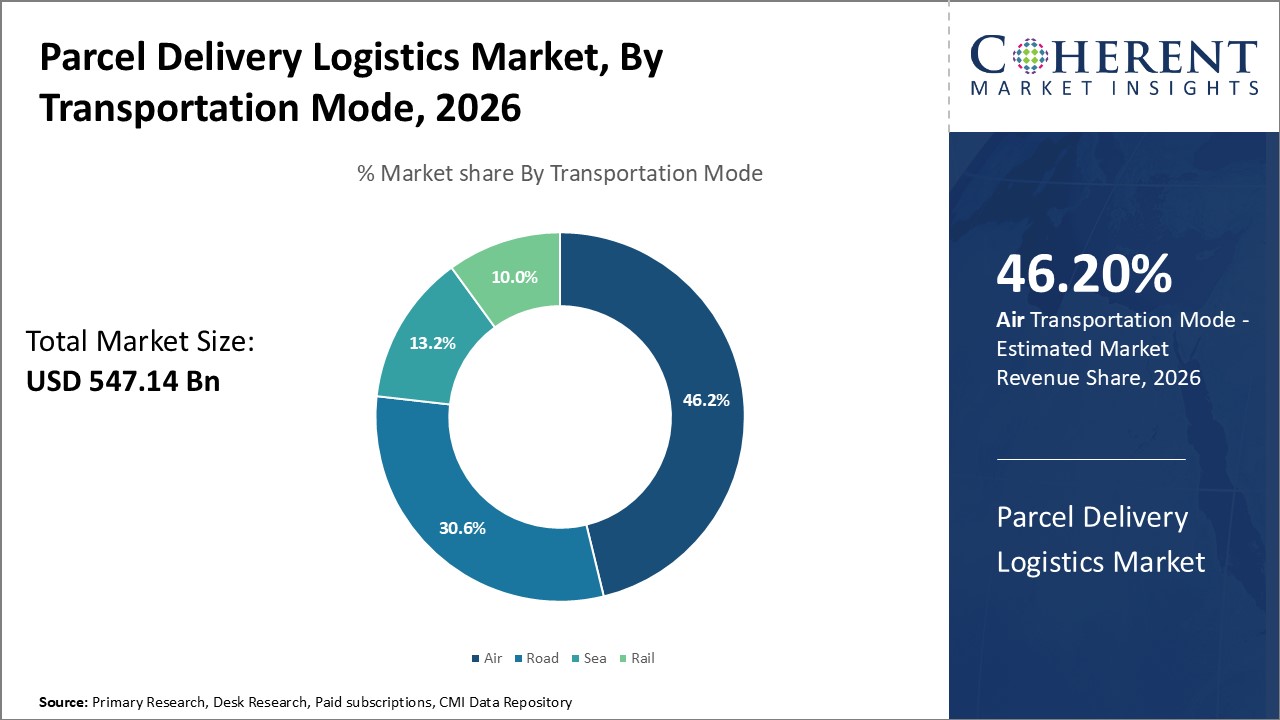
Global Parcel Delivery Logistics Market Insights, by Transportation Mode – Air Leads Due to its Unmatched Speed ad Global Reach
The air segment stands out as the dominant mode in the global parcel delivery logistics market, holding an estimated share of 46.2% in 2026. As businesses and consumers engage in transactions worldwide, the need to transport parcels quickly between continents has become paramount. Air transport facilitates this by significantly reducing transit times, enabling goods to move from manufacturers, warehouses, or sellers to end users within the shortest possible timeframe.
Additionally, the rise of express courier services and premium shipping options has propelled air transportation demand within parcel logistics. Companies increasingly offer overnight or next-flight-out services supported by a network of airports and air hubs, allowing for flexible and frequent shipments. Technological advancements in cargo handling and aircraft efficiency have further bolstered the use of air transport. Automated sorting facilities at airports, improved tracking systems, and dedicated air freight flights tailored to parcel delivery have optimized operations and lowered transit delays.
Impact of AI on the Parcel Delivery Logistics Market
Artificial Intelligence (AI) is significantly transforming the global parcel delivery logistics market, optimizing everything from sorting to last-mile delivery. AI-powered algorithms are being used to streamline warehouse operations, predict parcel volumes, and automate route planning for delivery drivers, leading to improved efficiency and reduced costs. Companies are also using AI-driven chatbots for customer service, enhancing user experience with real-time tracking and support.
One key example is UPS, which uses its proprietary AI system On-Road Integrated Optimization and Navigation (ORION) to dynamically optimize driver routes, saving the company up to 100 million miles annually, thereby reducing fuel costs and carbon emissions.
Regional Insights
Asia Pacific Parcel Delivery Logistics Market Analysis and Trends
The Asia Pacific, holding a share of 35.4%, is expected to dominate the global parcel delivery logistics market, due to rapid urbanization, rising internet penetration, and expanding middle-class consumer bases fueling e-commerce demand. Government initiatives aimed at improving transport infrastructure, such as China’s Belt and Road Initiative and India’s logistics reforms, have further strengthened the region’s logistics capabilities. The market ecosystem is supported by burgeoning startups and tech innovators alongside global logistics giants like SF Express, ZTO Express, and Amazon India.
SF Express (China) has developed and deployed autonomous delivery robots and drone-based logistics systems for last-mile deliveries, particularly in urban and hard-to-reach rural areas. Robust domestic trade coupled with increasing international trade volumes drives the expansion of parcel delivery services. Investments in last-mile delivery innovations, such as drone logistics and automated warehouses, underpin the dynamic evolution of the market in this region.
North America Parcel Delivery Logistics Market Analysis and Trends
North America, holding a share of 29.1% in 2026, is expected to exhibit the fastest growth in the global parcel delivery logistics market, stemming from a well-established market ecosystem characterized by advanced infrastructure, high consumer demand for e-commerce, and a mature logistics network. Government policies in the region support efficient trade through strong customs frameworks and investments in transportation infrastructure.
The presence of large multinational logistics companies such as FedEx, UPS, and DHL's North American operations contributes significantly. These companies have heavily invested in technology integration like automation, AI, and route optimization, enhancing parcel delivery speed and reliability. FedEx (U.S.) introduced its “Roxo” SameDay Bot, an autonomous delivery robot designed to handle last-mile deliveries on sidewalks and urban streets. Additionally, the region benefits from strong trade dynamics, driven by cross-border e-commerce and trade agreements that facilitate smooth logistics flows across the U.S., Canada, and Mexico.
Global Parcel Delivery Logistics Market Outlook for Key Countries
U.S. Parcel Delivery Logistics Market Analysis and Trends
The U.S. is characterized by the presence of major players like FedEx and UPS, who dominate through extensive networks and technology-driven operations. High consumer adoption of e-commerce and advanced logistics infrastructure support efficient parcel delivery services. The U.S. government also promotes supply chain resilience and investment in innovative transport models, ensuring the market remains competitive and responsive to changing demands.
China Parcel Delivery Logistics Market Analysis and Trends
China is propelled by leading companies, such as SF Express, ZTO Express, and JD Logistics, which benefit from vast domestic demand and government-backed infrastructure projects. The country’s strategic emphasis on digitalization and automation in logistics, including use of AI and big data, enhances operational efficiency.
Germany Parcel Delivery Logistics Market Analysis and Trends
Germany continues to lead in Europe by leveraging its integral position in the European logistics network. Companies like DHL (Deutsche Post DHL Group) and Hermes have a strong foothold, supported by robust transport infrastructure and extensive rail and road connectivity. Government policies focused on sustainability and green logistics shape the market.
India Parcel Delivery Logistics Market Analysis and Trends
India is marked by rapid expansion driven by domestic e-commerce growth and improving road and warehousing infrastructure. Key players include Amazon India, Delhivery, and Blue Dart, which are increasingly adopting technology enhancements to handle complex delivery challenges. Government initiatives like the Logistics Ease Across Different States (LEADS) help streamline interstate transport, enhancing parcel delivery efficiency.
Brazil Parcel Delivery Logistics Market Analysis and Trends
Brazil benefits from a rising number of online shoppers and expanding urban centers. Companies such as Correios, DHL, and local players play important roles in parcel delivery, albeit navigating challenges like infrastructure limitations and regulatory complexities. Government investments aimed at improving connectivity and customs processes are gradually supporting smoother logistics operations.
Market Players, Key Development, and Competitive Intelligence
Key Developments
- On July 7, 2025, InPost Group finalized the acquisition of Sending, a Spain-based courier and fulfilment provider. 155 Sending logistics centers joined InPost's network, bringing the total to over 170 in Spain.
- In May 2025, Evri, one of the U.K.'s largest dedicated parcel delivery companies, and DHL eCommerce, the e-commerce logistics specialist of DHL Group, announced a strategic transaction that will see the merger of DHL eCommerce UK with Evri. The merged Evri business will deliver over 1 billion parcels and a further 1 billion business letters annually.
- In May 2025, parcel locker company, InPost, partnered with British online fashion retailer, ASOS, to introduce a next-day out-of-home (OOH) delivery service. The addition of the D+1 delivery service gives InPost the largest network of parcel lockers in the U.K., with a total of 12,800 locations.
- In April 2025, the U.K. parcel delivery company, Yodel, was acquired by the Polish parcel locker firm, InPost, in a USD 142.67 million (£106 million) deal that will create the third-largest independent delivery business serving online retailers in U.K.
Top Strategies Followed by the Global Parcel Delivery Logistics Market Players
- Established market leaders primarily invest heavily in research and development (R&D) to drive innovation in high-performance delivery solutions, including advanced tracking systems, automated sorting technologies, and eco-friendly transportation methods.
- DHL is heavily investing in AI, robotics, and green logistics through its DHL Innovation Centers in Germany and Singapore. In 2024, it launched a fully autonomous sorting system in Singapore to enhance parcel processing speeds by over 30%.
- Mid-level players in the parcel delivery logistics market adopt a differentiated approach focused largely on delivering cost-effective solutions that strike a balance between quality and affordability.
- Delhivery focuses on asset-light models and automated fulfillment to keep logistics costs low. It uses cloud-based tracking and modular warehousing to provide scalable, affordable solutions to e-commerce platforms and small sellers in India.
- Small-scale players in the global parcel delivery logistics market often operate within narrowly defined niches by offering specialized services or innovative products tailored to specific customer segments or industries.
- Ninja Van has carved a niche by focusing on last-mile delivery for small e-commerce sellers in Southeast Asia. It offers custom APIs, real-time SMS updates, and cash-on-delivery services, which are crucial for local SMEs.
Market Report Scope
Parcel Delivery Logistics Market Report Coverage
| Report Coverage | Details | ||
|---|---|---|---|
| Base Year: | 2025 | Market Size in 2026: | USD 547.14 Bn |
| Historical Data for: | 2020 To 2024 | Forecast Period: | 2026 To 2033 |
| Forecast Period 2026 to 2033 CAGR: | 5.1% | 2033 Value Projection: | USD 775.03 Bn |
| Geographies covered: |
| ||
| Segments covered: |
| ||
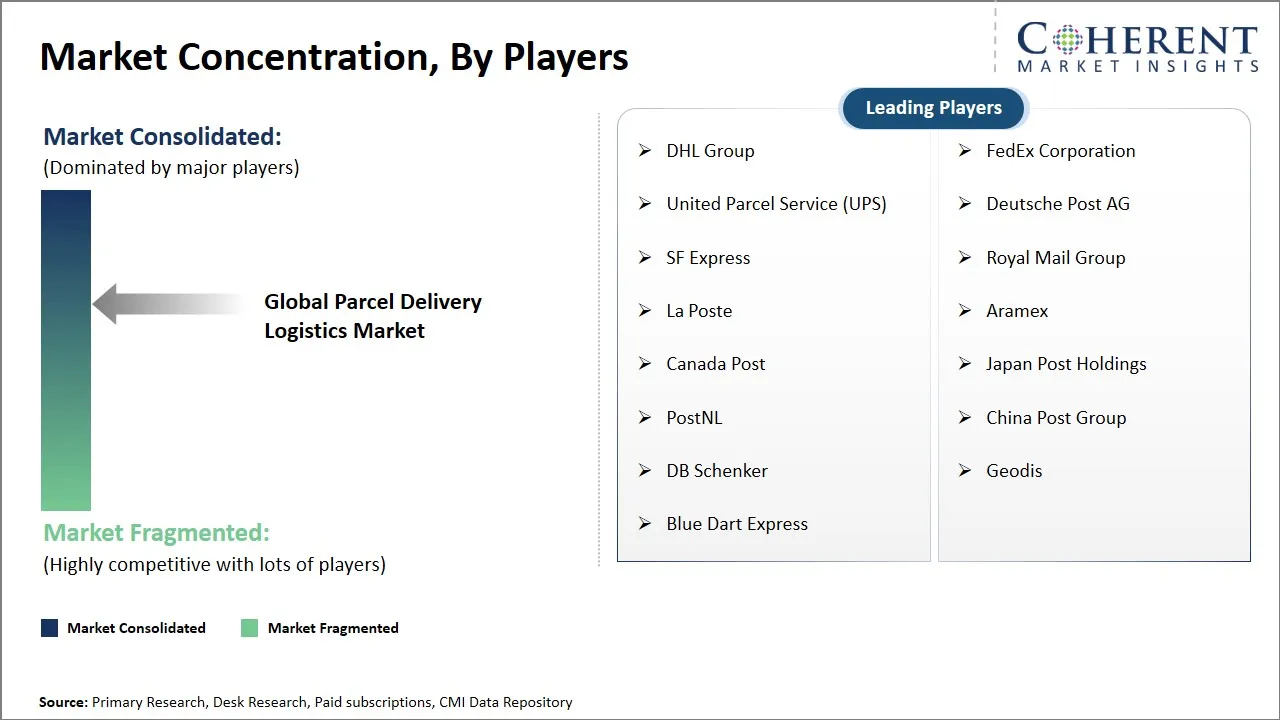
| Companies covered: | DHL Group, FedEx Corporation, United Parcel Service (UPS), Deutsche Post AG, SF Express, Royal Mail Group, La Poste, Aramex, Canada Post, Japan Post Holdings, PostNL, China Post Group, DB Schenker, Geodis, and Blue Dart Express | ||
| Growth Drivers: |
| ||
| Restraints & Challenges: |
| ||
Market Dynamics
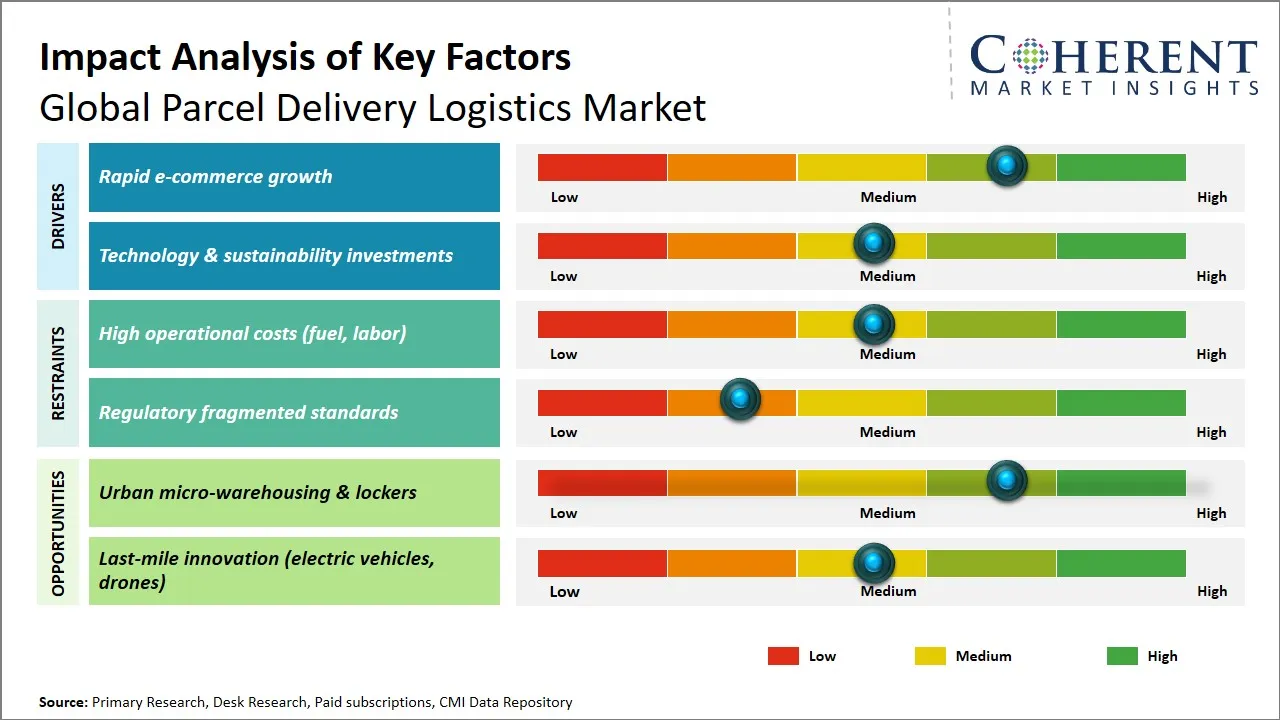
Global Parcel Delivery Logistics Market Driver – Rapid E-commerce Growth
As consumers increasingly prefer online shopping due to convenience and a broader product selection, the volume of small to medium-sized packages requiring efficient last-mile delivery has escalated dramatically. This shift has compelled retailers and logistics providers to enhance their distribution networks, adopt advanced tracking technologies, and optimize delivery routes to meet growing customer expectations for faster and more reliable service. Amazon has significantly scaled its logistics infrastructure across India and Southeast Asia to match surging e-commerce demand. In 2024, it added five fulfillment centers in India, expanding total storage capacity by over 2 million cubic feet.
Global Parcel Delivery Logistics Market Opportunity – Urban Micro-Warehousing and Lockers
As e-commerce continues to grow exponentially, consumers expect rapid delivery, often within the same day, creating pressure on logistics providers to optimize their distribution networks. Urban micro-warehousing, which involves establishing smaller storage facilities closer to end consumers, enables companies to reduce delivery times and transportation costs by decentralizing inventory and enhancing inventory visibility. These micro-fulfillment centers can be strategically located in city centers, utilizing underused retail or industrial spaces to streamline operations. Poland-based, InPost, has deployed over 35,000 automated parcel lockers across Europe (especially in the U.K., France, and Poland), enabling secure 24/7 pickup and drop-off in dense urban zones. Throughout 2025, InPost has expanded its U.K. network through acquisitions (e.g., Yodel and Sending), aiming to reduce last-mile costs and congestion.
Complementing this, the deployment of smart parcel lockers offers secure, flexible, and contactless delivery and pickup options for consumers, minimizing failed deliveries and reducing the carbon footprint associated with multiple delivery attempts.
Analyst Opinion (Expert Opinion)
- Demand from e-commerce players remains the backbone of parcel logistics, driven by rising consumer expectations for same-day and flexible delivery. However, growth is shifting toward value-added services like returns management, real-time tracking, and sustainable packaging, pressuring providers to innovate beyond basic delivery.
- The post-pandemic emphasis on cold chain logistics and the rise of direct-to-patient delivery models are expanding parcel demand from the healthcare industry. Temperature-sensitive deliveries, regulatory compliance, and time-critical shipments are prompting specialized service development by major logistics players.
- Manufacturers and small businesses increasingly rely on just-in-time delivery and micro-logistics solutions to reduce inventory costs. Parcel delivery providers are responding by offering B2B express services, customized pickup options, and integrated supply chain platforms to serve fragmented industrial demand efficiently.
Speak to the analyst
Want personalized insights?
Take the findings above to one of our principal consultants, or have the report rebuilt around the segments, geographies and competitors you actually track.
Market Segmentation
- Service Type Insights (Revenue, USD Bn, 2021 - 2033)
- B2C
- B2B
- C2C
- Transportation Mode Insights (Revenue, USD Bn, 2021 - 2033)
- Air
- Road
- Sea
- Rail
- Regional Insights (Revenue, USD Bn, 2021 - 2033)
- North America
- U.S.
- Canada
- Latin America
- Brazil
- Argentina
- Mexico
- Rest of Latin America
- Europe
- Germany
- U.K.
- Spain
- France
- Italy
- Russia
- Rest of Europe
- Asia Pacific
- China
- India
- Japan
- Australia
- South Korea
- ASEAN
- Rest of Asia Pacific
- Middle East
- GCC Countries
- Israel
- Rest of Middle East
- Africa
- South Africa
- North Africa
- Central Africa
- North America
- Key Players Insights
- DHL Group
- FedEx Corporation
- United Parcel Service (UPS)
- Deutsche Post AG
- SF Express
- Royal Mail Group
- La Poste
- Aramex
- Canada Post
- Japan Post Holdings
- PostNL
- China Post Group
- DB Schenker
- Geodis
- Blue Dart Express
Sources
Primary Research Interviews
Stakeholders
- E-commerce Retailers and Online Marketplaces (e.g., Operations Managers, Fulfillment Heads)
- Parcel Delivery Providers (e.g., Last-Mile Coordinators, Logistics Directors)
- Warehouse & Fulfillment Center Managers
- Third-Party Logistics (3PL) Providers
- Transportation Fleet Managers
- Technology Vendors Specializing in AI/Automation for Logistics
- Postal and Courier Associations
Databases
- Global Transport Data Exchange (GTDE)
- Parcel Movement Analytics Network (PMAN)
- International Freight Insights Bureau (IFIB)
- U.S. Department of Transportation (DOT) – Logistics Division
- EU Cross-Border Delivery Dashboard
Magazines
- Logistics Today
- Parcel & Post Review
- E-Commerce Delivery Digest
- Modern Carrier & Courier Weekly
- Smart Logistics Magazine
Journals
- Journal of Logistics and Transportation Technology
- International Journal of E-Commerce Logistics
- Journal of Last-Mile Delivery Systems
- Urban Mobility and Logistics Journal
- Journal of Digital Supply Chains
Newspapers
- Logistics Business Daily
- Asia Delivery Times
- North American Freight News
- The E-Commerce Courier (UK)
- Delivery Express Tribune (India)
Associations
- Global Parcel Logistics Association (GPLA)
- North American E-Commerce Freight Association (NAEFA)
- Urban Logistics Innovation Network (ULIN)
- International Association of Courier & Express Services (IACES)
Public Domain Sources
- U.S. Census Bureau
- EUROSTAT
- United Nations Economic Commission for Europe (UNECE)
- World Bank
- ResearchGate
Proprietary Elements
- CMI Data Analytics Tool, Proprietary CMI Existing Repository of Information (8-Year Archive)
Get access to 250+ pages report
Every segment, forecast, competitor profile and data table behind the analysis above — available for instant download.
- ESOMAR Member
- ISO 9001:2015 Certified
- D-U-N-S Registered
- GDPR & CCPA Compliant
Missing comfort of reading report in your local language? Find your preferred language:
Transform your Strategy with Exclusive Trending Reports
Frequently Asked Questions
The global parcel delivery logistics market is estimated to be valued at USD 547.14 billion in 2026 and is expected to reach USD 775.03 billion by 2033.
The CAGR of the global parcel delivery logistics market is projected to be 5.1% from 2026 to 2033.
Rapid e-commerce growth and technology & sustainability investments are the major factors driving the growth of the global parcel delivery logistics market.
High operational costs (fuel, labor) and regulatory fragmented standards are the major factors hampering the growth of the global parcel delivery logistics market.
In terms of service type, B2C is estimated to dominate the market revenue share in 2026.
DHL Group, FedEx Corporation, United Parcel Service (UPS), Deutsche Post AG, SF Express, Royal Mail Group, La Poste, Aramex, Canada Post, Japan Post Holdings, PostNL, China Post Group, DB Schenker, Geodis,and Blue Dart Express are the major players.
Asia Pacific is expected to lead the global parcel delivery logistics market in 2026.