

Global Pasta Machine Market and Forecast – (2026-2033)
Coherent Market Insights estimates that the global pasta machine market is expected to reach USD 1.80 Bn in 2026 and will expand to USD 2.50 Bn by 2033, registering a CAGR of 6% between 2026 and 2033.
Key Takeaways of the Pasta Machine Market
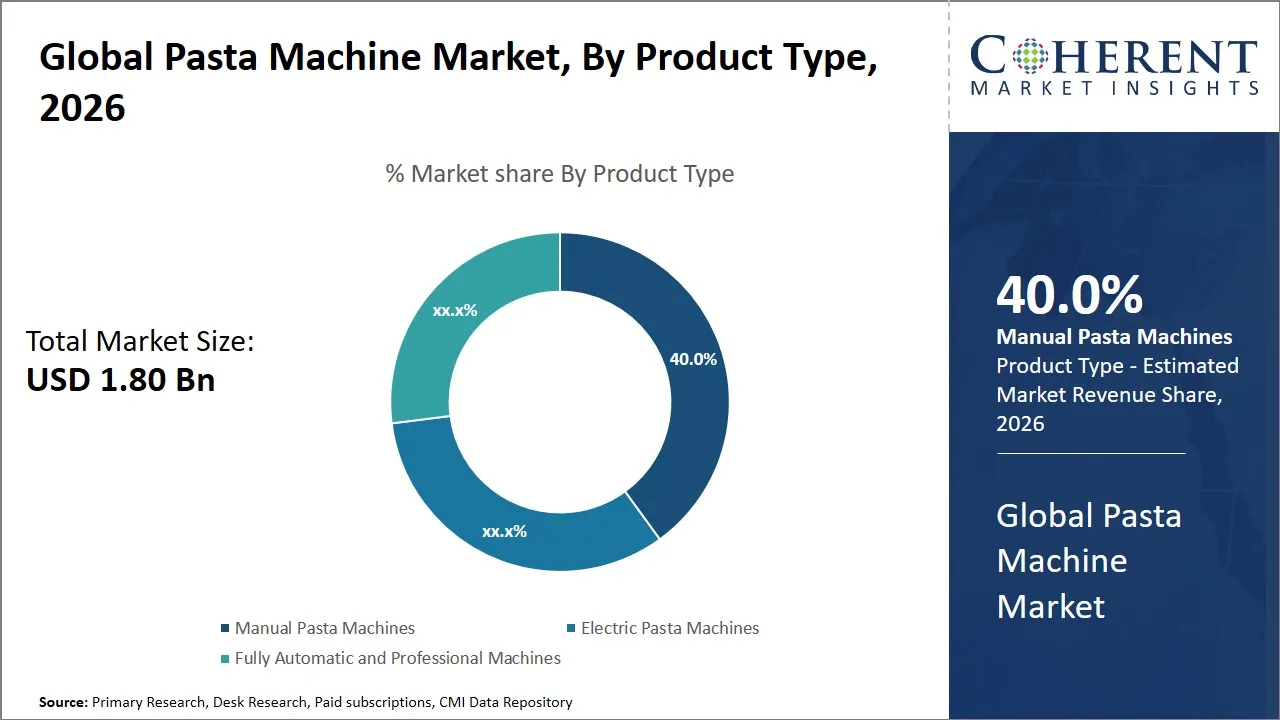
- The manual pasta machines segment is expected to account for 40% of the pasta machine market share in 2026.
- The residential use segment is projected to capture 31% of the market share in 2026.
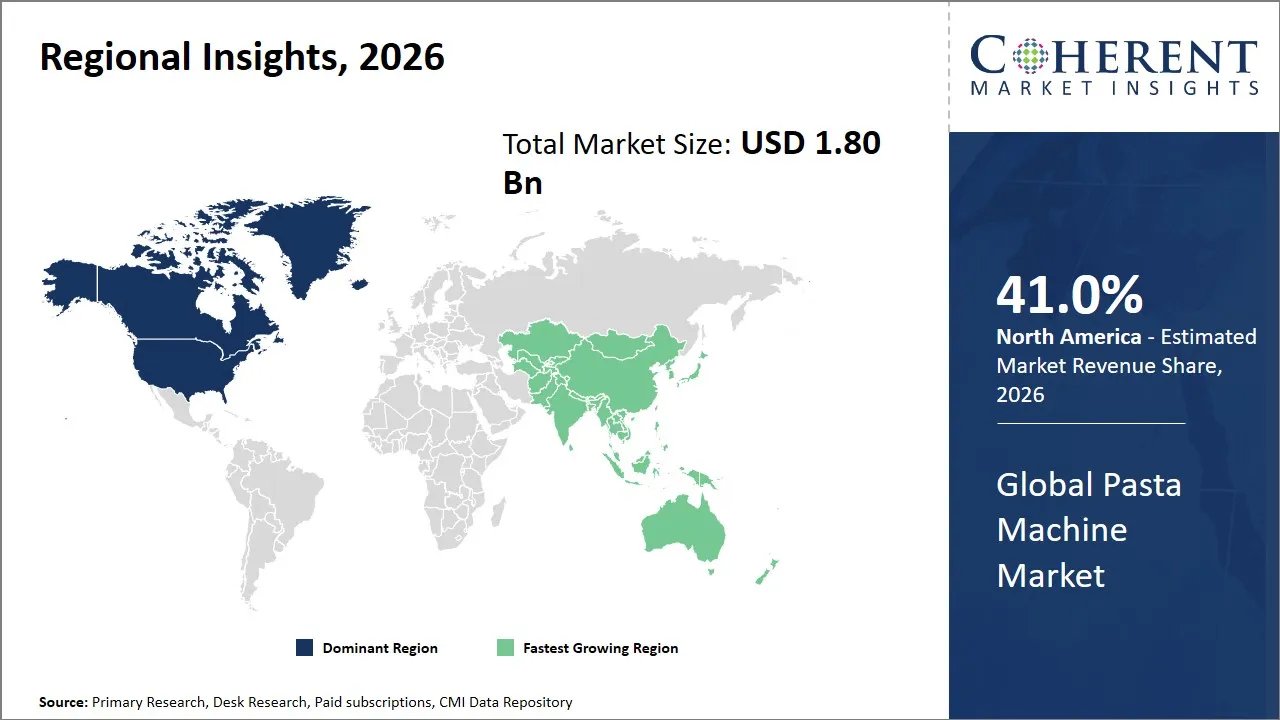
- North America will dominate the pasta machine market in 2026 with an estimated 41%
- Asia Pacific will hold 21% share in 2026 and is expected to record the fastest growth over the forecast period.
Currents Events and Its Impact
Current Events | Description and its Impact |
Buhler Group and Azim Group Collaboration |
|
Segmental Insights
- Current Industry Events of 2026
- Market Size Estimation
- Regional Breakdown
- Competitive Landscape
- Customer Intelligence
- Segmental Analysis
- Pricing Analysis
- Key Market Drivers, Challenges & Future Trends
- Customized Insights Section
Why Does the Manual Pasta Machines Segment Dominate the Global Pasta Machine Market in 2026?
The manual pasta machines segment is expected to account for 40.0% of the global pasta machine market share in 2026. One reason behind the rise lies in low costs paired with straightforward design. As they are priced within reach, individuals cooking at home often choose them when crafting pasta by hand matters more than spending extra. Quality remains steady even as expenses stay minimal, which keeps interest consistent among those who value practicality.
Residential Use Segment Dominates the Global Pasta Machine Market
The residential use segment is expected to hold 31.0% of the pasta machine market share in 2026. The main reason for the growth is that more people are interested in cooking at home and trying new recipes. More and more people are buying pasta machines because they want to make fresh, healthy food at home. Residential customers care more about convenience, versatility, and size than commercial or industrial customers do. This makes pasta machines perfect for home kitchens.
Pricing Analysis
Home/Domestic Pasta Machines | Commercial Pasta Machines |
|
|
Regional Insights
North America Pasta Machine Market Analysis and Trends
North America region is projected to lead the market with a 41% share in 2026. The North America pasta machine market is a significant regional segment, with a strong presence in the U.S., Canada, and Mexico driven by high consumer interest in homemade and fresh pasta, growing foodservice demand, and the popularity of Italian and artisanal cuisine; the market includes both manual and advanced electric/automated machines and is projected to grow at a moderate CAGR through the late 2020s, supported by innovation in machine features, e‑commerce expansion, and increasing culinary experimentation among consumers and commercial kitchens.
Asia Pacific Pasta Machine Market Analysis and Trends
Asia Pacific region is expected to exhibit the fastest growth in the market contributing 21% share in 2026. The growth is driven by rapid urbanization, rising disposable incomes, and increasing adoption of western eating habits, including pasta consumption. Across China, India, and Japan, shifting lifestyles in growing cities have led to higher interest in varied meals that require little preparation. Not just desire drives this trend, supporting systems operate within quiet policy environments. In India, Philips maintains wide reach while firms based in China produce pasta-making devices at lower costs for local buyers. Availability of these appliances increases gradually due to such efforts. Market expansion follows from access rather than novelty alone.
Global Pasta Machine Market Outlook for Key Countries
Why is Italy Emerging as a Major Hub in the Pasta Machine Market?
Home to centuries of culinary tradition, Italy shapes global pasta habits through craftsmanship. Rather than chasing trends, firms such as Imperia prioritize resilience in every product they build. Endurance defines machines, simple or electric, building reliability across borders. Quiet backing appears where government choices uphold traditional makers, silently. Consistency overseas grows from repeated actions, rather than fresh concepts. From each wide link, hidden frameworks operate without pause. Steady effort remains out of view. Goods move easily between countries because of long-standing deals. Far-off systems function quietly when they work well. Cultural preferences keep domestic demand high, and a strong tourism industry boosts pasta cuisine around the world.
Is U.S. the Next Growth Engine for the Pasta Machine Market?
Driven partly by home cooks, demand rises alongside restaurants expanding their menu variety. Shifts in consumer preference draw attention from international companies, leading some, like KitchenAid, to release items such as pasta attachments. Oversight by regulatory bodies, along with decisions made by large retailers, ensures product standards stay steady across markets. Innovation thrives under government frameworks that encourage small businesses; these conditions foster niche appliances built for home or professional settings.
China Pasta Machine Market Analysis and Trends
Growth in China's market accelerates as eating habits move past traditional noodles. Driven by state-backed programs, economic activity strengthens in food production sectors. At firms such as Joyoung, new methods emerge alongside regional equipment builders. Household needs shape these developments; businesses benefit too. The growth is based on a strong online retail infrastructure and the fact that more and more middle-class people in cities are trying international foods. Trade policies that encourage the exchange of technology also help improve the quality and variety of products.
India Pasta Machine Market Analysis and Trends
India has a growing market because more people are moving to cities and young people are changing the way they eat. The rise in consumer spending power and the focus on convenience foods are both driving up the demand for pasta and related kitchen tools. Two global firms, Philips alongside Morphy Richards, operate prominently within this sector. Their product range includes motorized as well as hand-driven pasta equipment, adapted according to regional preferences. Backed by state initiatives aimed at boosting food production and streamlining commercial operations, factory investments have increased - fueling further expansion of the market.
Germany Pasta Machine Market Analysis and Trends
Germany's market is different because it has a strong industrial base and people there prefer high-quality, long-lasting kitchen tools. Well-known companies like Graef and Zassenhaus focus on combining precision engineering with designs that are easy to use. This makes them popular with both professional kitchens and home cooks. Germany's strict rules make sure that products are safe and reliable, and strong policies that focus on exports help keep Germany's position as a major supplier in both the European and global markets. The steady demand in the market is also helped by the growing popularity of different types of pasta
Market Players, Key Development, and Competitive Intelligence
Key Development
- On October 20, 2025, KitchenAid announced the launch of its new 3-in-1 Pasta Attachment, designed to transform any KitchenAid Stand Mixer into a pasta-making powerhouse. This all-in-one innovative attachment allows home cooks to effortlessly roll and cut fresh, homemade pasta from scratch, achieving consistent results every time.
Top Strategies Followed by Global Pasta Machine Market Players
- The global pasta machine market is dynamic and competitive, with key players at all levels of the industry using a variety of strategies. Investment in innovation drives top firms to explore fresh approaches for advanced pasta equipment. Instead, they refine operations through smarter automation systems. Performance gains emerge when energy use drops without sacrificing output quality. Distinctiveness appears via multi-function capacity across machine lines. Customer demands shift - equipment evolves accordingly behind the scenes.
- A shift occurs among mid-tier firms in the pasta machinery sector - value meets reliability without premium pricing. These brands target budget-conscious buyers through thoughtful product positioning, blending cost efficiency with solid build quality. Accessibility expands into segments like emerging eateries and compact producers seeking dependable tools. Performance does not come at the expense of reach; practical design supports broader market entry. Collaboration becomes a quiet engine for progress, as alliances form to strengthen manufacturing depth. Innovation enters quietly through joint efforts, avoiding fanfare but enabling steady upgrades behind the scenes.
- Despite limited budgets, small pasta machine makers remain competitive through innovation. Where larger firms overlook details, these businesses thrive by serving precise customer demands. One example is equipment crafted for homemade artisan noodles, another focuses on space-saving models for kitchen counters. Instead of broad appeal, specialization becomes their strength. Technology adoption helps too - some integrate smart sensors, others experiment with modern materials. Connectivity features, such as IoT capabilities, appear in select designs. Niche positioning allows them to stand apart without mass production. Success emerges not from scale but from targeted solutions few consider.
Market Report Scope
Global Pasta Machine Market Report Coverage
| Report Coverage | Details | ||
|---|---|---|---|
| Base Year: | 2025 | Market Size in 2026: | USD 1.80 Bn |
| Historical Data for: | 2020 To 2024 | Forecast Period: | 2026 To 2033 |
| Forecast Period 2026 to 2033 CAGR: | 6 % | 2033 Value Projection: | USD 2.50 Bn |
| Geographies covered: |
| ||
| Segments covered: |
| ||
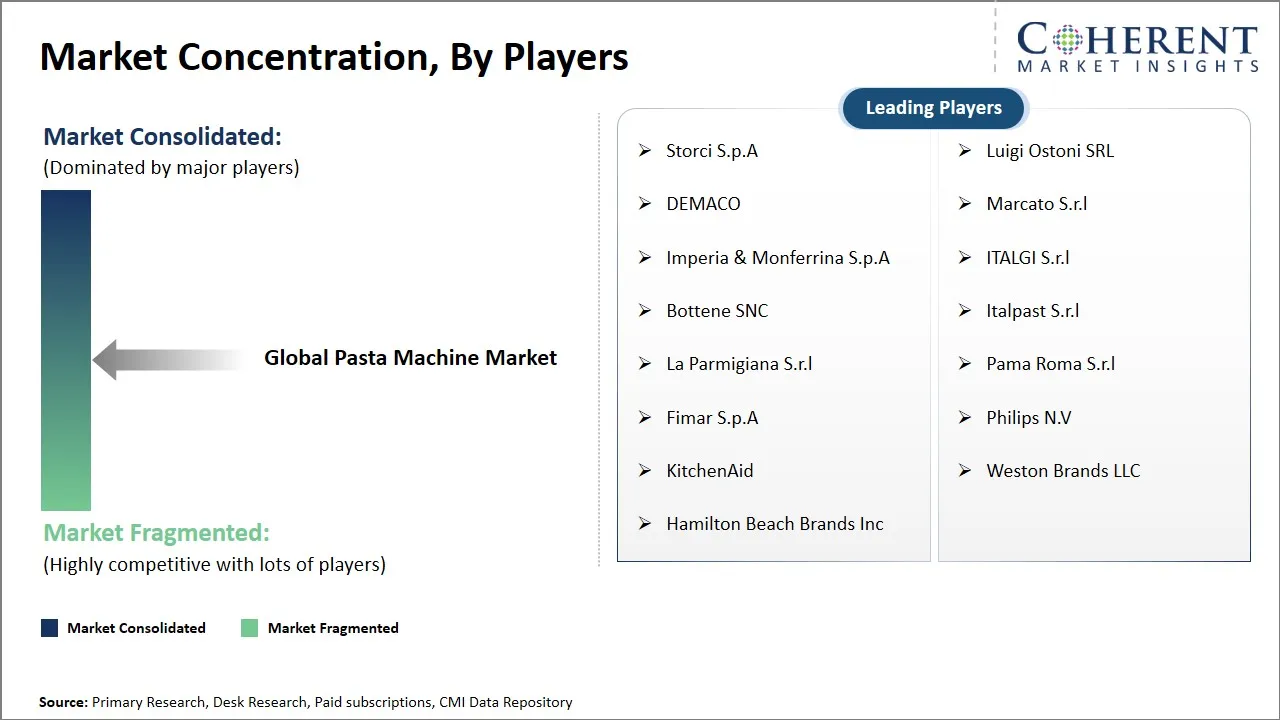
| Companies covered: | Storci S.p.A, Luigi Ostoni SRL, DEMACO, Marcato S.r.l, Imperia & Monferrina S.p.A, ITALGI S.r.l, Bottene SNC, Italpast S.r.l, La Parmigiana S.r.l, Pama Roma S.r.l, Fimar S.p.A, Philips N.V, KitchenAid, Weston Brands LLC, and Hamilton Beach Brands Inc | ||
| Growth Drivers: |
| ||
| Restraints & Challenges: |
| ||
Global Pasta Machine Market Dynamics
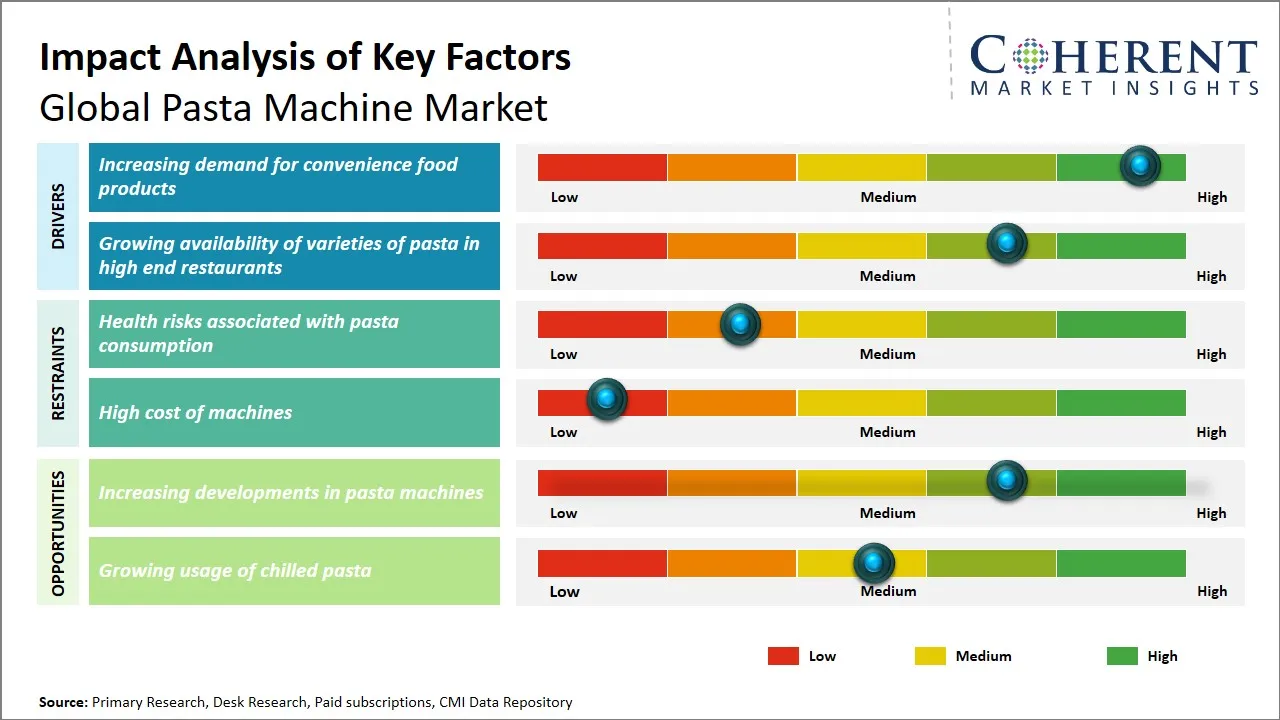
Global Pasta Machine Market Driver - Increasing Demand for Convenience Food Products
The growing consumer preference for convenience and ready to eat food products is a significant driver propelling the global pasta machine market. As life gets faster, people and families want meals that are quick and easy to make but still taste good and are of high quality. Homemade pasta is a fresh and customizable option compared to store-bought pasta, which makes people want to buy pasta machines that make the process easier. Fewer meals now come from packages as personal cooking grows common due to health focus. With homemade dishes, ingredient choices remain in one's hands. Store shelves hold many pastas laced with substances some prefer to avoid.
For instance, on July 15, 2025, McLane Company Inc announced the launch of its National Commissary program, a groundbreaking extension of its McLane Fresh programs, delivering fresh, never-frozen, grab-and-go foods with a seven-day refrigerated shelf life to convenience stores.
Global Pasta Machine Market Opportunity - Increasing Developments in Pasta Machines
Emerging tools reshape production speed within global pasta machine market. Efficiency shifts follow updates like automated workflows, sharper shaping parts, stronger material control. Wider varieties emerge with fewer hands needed during output phases. Demand for unique forms finds support through these adjustments. Speed gains assist both eateries and mass producers alike. Live tracking enters via connected modules, embedded detection units. System checks happen earlier now, reducing pauses, lowering expenses over time.
Analyst Opinion (Expert Opinion)
- Steady expansion marks the worldwide market for pasta machines. Fresh, handcrafted pasta gains favor among consumers, contributing to upward trends. Industrial output increases at a parallel pace. Automation finds its way into manufacturing through intelligent systems. Firms focusing on adaptable, energy-saving equipment with artificial intelligence integration may position themselves ahead of others. Advantage often follows those aligning with such innovations. They also say that new markets in Asia Pacific, Africa, and Latin America offer big opportunities for both commercial and home-use pasta equipment. To keep growing, companies need to focus on innovation and expanding into new regions.
Speak to the analyst
Want personalized insights?
Take the findings above to one of our principal consultants, or have the report rebuilt around the segments, geographies and competitors you actually track.
Market Segmentation
- Product Type Insights (Revenue, USD Bn, 2021 - 2033)
- Manual Pasta Machines
- Electric Pasta Machines
- Fully Automatic and Professional Machines
- Application Insights (Revenue, USD Bn, 2021 - 2033)
- Residential Use
- Commercial Use
- Industrial Use
- Regional Insights (Revenue, USD Bn, 2021 - 2033)
- North America
- U.S.
- Canada
- Latin America
- Brazil
- Argentina
- Mexico
- Rest of Latin America
- Europe
- Germany
- U.K.
- Spain
- France
- Italy
- Russia
- Rest of Europe
- Asia Pacific
- China
- India
- Japan
- Australia
- South Korea
- ASEAN
- Rest of Asia Pacific
- Middle East
- GCC Countries
- Israel
- Rest of Middle East
- Africa
- South Africa
- North Africa
- Central Africa
- North America
- Key Players Insights
- Storci S.p.A
- Luigi Ostoni SRL
- DEMACO
- Marcato S.r.l
- Imperia & Monferrina S.p.A
- ITALGI S.r.l
- Bottene SNC
- Italpast S.r.l
- La Parmigiana S.r.l
- Pama Roma S.r.l
- Fimar S.p.A
- Philips N.V
- KitchenAid
- Weston Brands LLC
- Hamilton Beach Brands Inc
Sources
Primary Research Interviews
- Pasta machine manufacturers and suppliers
- Commercial kitchen equipment distributors
- Restaurant and foodservice industry professionals
- Food processing industry experts
Databases
- Euromonitor International
Magazines
- Food & Beverage Magazine
- Commercial Kitchen Equipment Magazine
- Restaurant Business Magazine
- Food Processing Magazine
- Foodservice Equipment & Supplies Magazine
Journals
- Journal of Food Engineering
- Food Science & Technology International
- International Journal of Hospitality Management
Newspapers
- The Wall Street Journal
- Financial Times
- Food Business Magazine
- Restaurant News
- Industry Week
Associations
- North American Association of Food Equipment Manufacturers (NAFEM)
- Foodservice Equipment Distributors Association (FEDA)
- International Foodservice Equipment Manufacturers Association
- Commercial Food Equipment Service Association
Public Domain Sources
- U.S. Census Bureau Economic Data
- European Commission Trade Statistics
- World Trade Organization Database
- Government Statistical Offices
Proprietary Elements
- CMI Data Analytics Tool
- Proprietary CMI Existing Repository of information for last 8 years
Get access to 250+ pages report
Every segment, forecast, competitor profile and data table behind the analysis above — available for instant download.
- ESOMAR Member
- ISO 9001:2015 Certified
- D-U-N-S Registered
- GDPR & CCPA Compliant
Missing comfort of reading report in your local language? Find your preferred language:
Transform your Strategy with Exclusive Trending Reports
Frequently Asked Questions
The global pasta machine market stood at USD 1.80 Bn in 2026 and is expected to reach USD 2.50 Bn by 2033.
The CAGR of global pasta machine market is projected to be 6 % from 2026 to 2033.
Increasing demand for convenience food products and growing availability of varieties of pasta in high end restaurants are the major factors driving the growth of the global pasta machine market.
Health risks associated with pasta consumption and high cost of machines are the major factors hampering the growth of the global pasta machine market.
In terms of product type, the manual pasta machines segment is estimated to dominate the market revenue share in 2026.
Storci S.p.A, Luigi Ostoni SRL, DEMACO, Marcato S.r.l, Imperia & Monferrina S.p.A, ITALGI S.r.l, Bottene SNC, Italpast S.r.l, La Parmigiana S.r.l, Pama Roma S.r.l, Fimar S.p.A, Philips N.V, KitchenAid, Weston Brands LLC, and Hamilton Beach Brands Inc are the major players.
North America is expected to lead the global pasta machine market in 2026