

Global Patient Experience Technology Market Size and Forecast – 2026 to 2033
According to Coherent Market Insights, the global patient experience technology market is estimated to be valued at USD 0.6 Bn in 2026 and is expected to reach USD 1.20 Bn by 2033, exhibiting a compound annual growth rate (CAGR) of 11.4% from 2026 to 2033. This steady growth trajectory underscores increasing investments in digital healthcare solutions aimed at enhancing patient engagement, satisfaction, and outcomes. The market expansion is driven by rising healthcare consumerism and growing need for personalized care experiences across healthcare providers worldwide.
Key Takeaways of the Patient Experience Technology Market
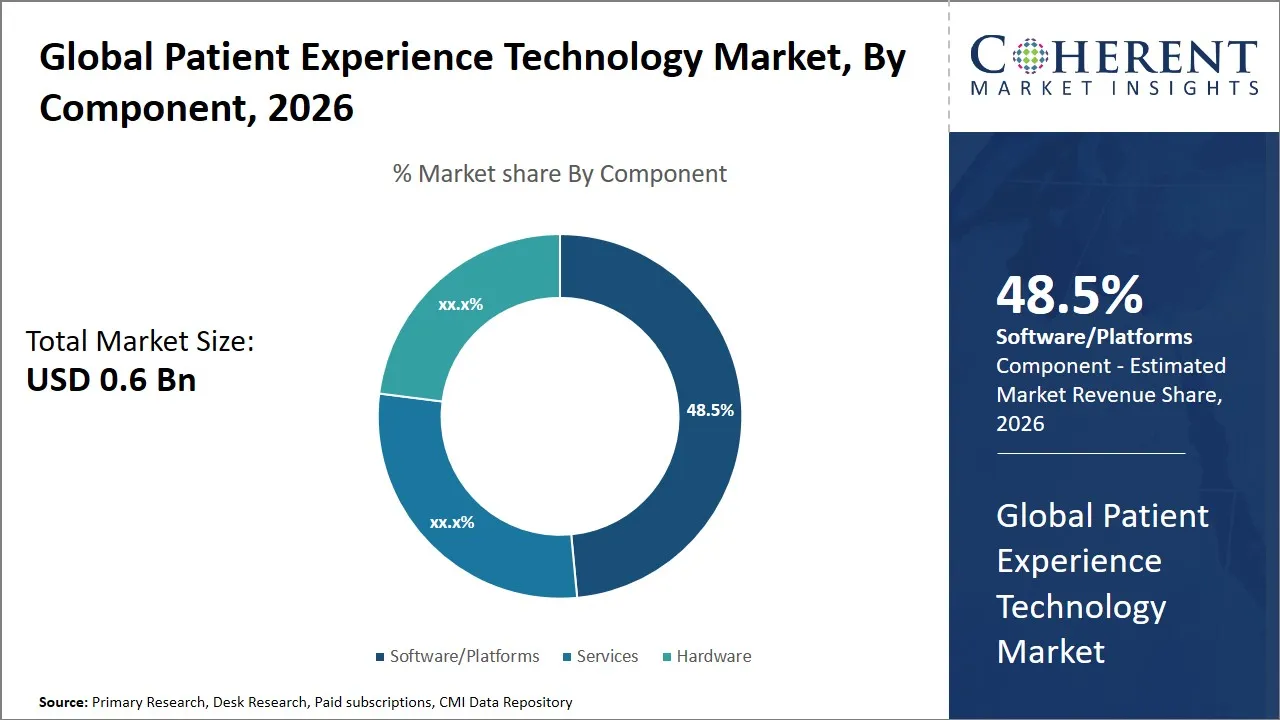
- Software segment is expected to lead the patient experience technology market, capturing a 48.50 % share in 2026.
- AI & chatbot-assisted communication segment is estimated to represent 33.5 % of the global phototherapy treatment market share in 2026.
- Hospital segment is projected to dominate with 24.5 % of the market share in 2026.
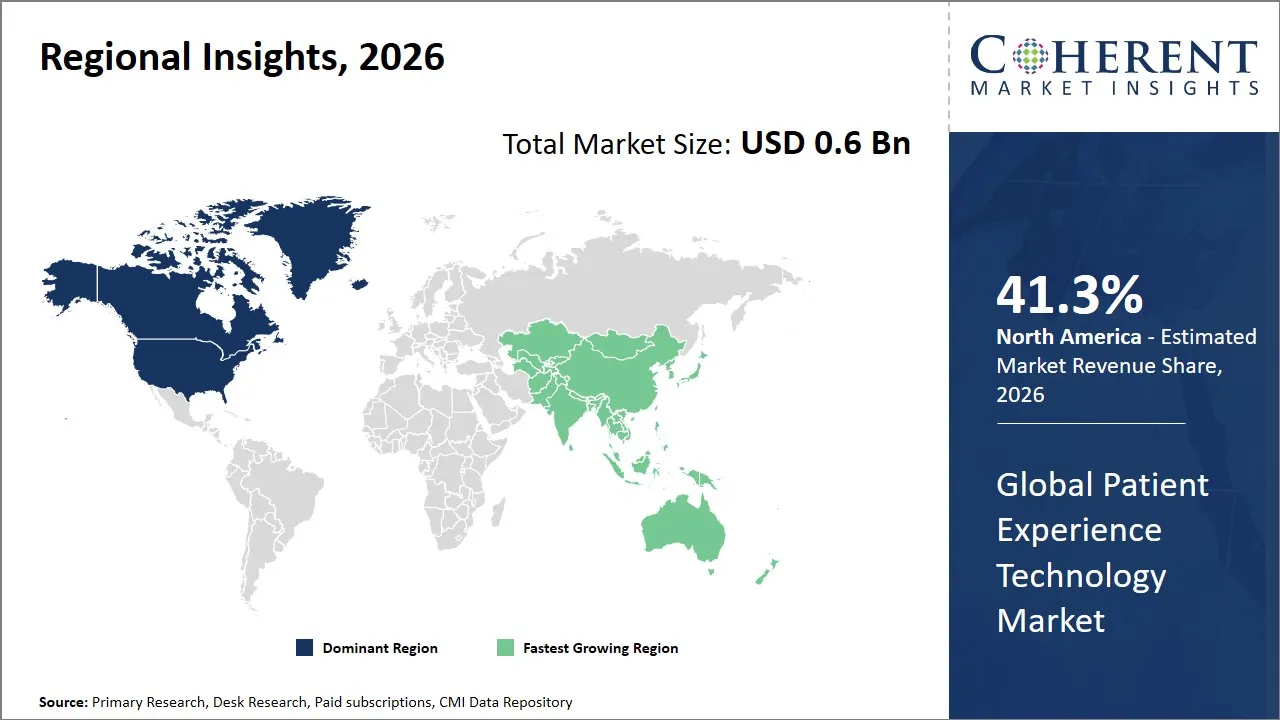
- North America is expected to lead the market, holding a share of 41.3 % in 2026. Asia Pacific is anticipated to be the fastest-growing region, with 25.4% share in 2026.
Market Overview
- The normalization of telemedicine and virtual care tools has increased the demand for patient experience systems that support remote appointments, self-service portals, and digital triage.
- Major technology releases, such as Microsoft’s Dragon Copilot for clinical documentation and administrative automation, underline how AI is shaping digital care workflows.
- Healthcare organizations throughout the world are investing in smart hospital technologies that incorporate sensors, automated systems, and real-time data to improve patient outcomes and experiences. The adoption of patient experience technology is in line with the broader demand for them.
Current Events and Its Impact
Current Events | Description and its Impact |
Rapid Advancement of AI in Healthcare |
|
New AI Healthcare Products (OpenAI & Anthropic) |
|
Segmental Insights
- Current Industry Events of 2026
- Market Size Estimation
- Regional Breakdown
- Competitive Landscape
- Customer Intelligence
- Segmental Analysis
- Pricing Analysis
- Key Market Drivers, Challenges & Future Trends
- Customized Insights Section
Why Does the Software/Platforms Segment Dominate the Global Patient Experience Technology Market?
The software/platforms segment is expected to hold the largest share of 48.5% in 2026, owing to increasing demand for patient experience technology, which encompasses digital patient portals, engagement solutions, analytics, and mobile applications. Patient experience technology is based on software platforms because they allow healthcare providers to collect, analyze, and process patient feedback in real time.
The popularity of this segment can be largely explained by the ubiquity of electronic health records (EHRs), patient portals, and mobile health applications that can be used to establish a personalized communication between patients and care providers. These platforms enable patients to manage their health records, make appointments, get reminders and call clinicians directly, therefore, improving the overall patient satisfaction and involvement.
For example, in October 2025, Qualtrics, a software company, agreed to buy Press Ganey Forsta for USD 6.75 billion to deepen its healthcare presence and strengthen AI-enhanced patient experience offerings. This consolidation signals growing demand for comprehensive analytics and engagement platforms that combine patient feedback with experience management at enterprise scale.
(Source- Qualtrics)
Why is Cloud-based/SaaS Solution Widely used in the Global Patient Experience Technology Market?
The cloud-based/SaaS segment is projected to dominate the market, accounting for 52% of the market share in 2026, primarily fueled by the increasing demand for flexible, scalable, and secure healthcare IT solutions. Implementation of cloud has notable advantages over the conventional on-premise systems such as lower initial cost of infrastructure, shorter implementation time and ease of maintenance. The mentioned advantages are especially crucial to health professionals that seek to improve patient experience management without hindering their routine operations or necessitating high IT skills.
Cloud solutions allow access to real-time data, regardless of location, which allows the clinician and administrator to access patient feedback, respond to concerns quickly, and dynamically based on their needs. This urgency will be crucial in enhancing patient satisfaction since the medical staff will be able to solve problems before they develop leading to trust and loyalty.
AI & Chatbot-Assisted Communication Leads the Patient Experience Technology Market
In terms of technology integration, AI & chatbot-assisted communication is expected to capture the highest share of 33.5% in 2026 of the global patient experience technology market, propelled by the remarkable capability of artificial intelligence to transform patient-provider interactions. Chatbots and other virtual assistants powered by AI offer 24/7 service and process normal queries, schedule appointments, remind about medications, and triage symptoms without the need to involve the human factor. Besides improving the efficiency of the operations, this automation can greatly increase the level of patient accessibility and satisfaction as the system ensures that they receive a prompt response and individual attention.
The increasing number of patients who are digital and expect to communicate easily and quickly is the force behind the need of AI-based solutions. Chatbots with natural language processing (NLP) help to have a human conversation, allowing patients to communicate their concerns and get information based on this specific case in an easily accessible format. The technology is also multilingual enabling the communication to take place even where language is a barrier leading to poor healthcare delivery particularly in multicultural markets.
Data privacy and security constraints
- Data privacy and security are top priorities for hospitals, insurers, and public healthcare organizations using patient experience technology. Users generally appreciate platforms that build strong security—like encryption, role-based access, and audit trails—into everyday workflows without adding friction.
- Large hospital systems, in particular, report positive experiences with cloud-based tools that help meet compliance needs while letting staff work as usual. Smaller providers and publicly funded facilities often struggle with complex integrations between patient experience tools, electronic health records, and third-party systems, which can increase security risks.
- Frequent updates and changing compliance rules also add pressure, requiring more training and IT support than some teams can handle.
- These issues highlight clear unmet needs. Organizations want security solutions that are consistent, flexible across regions, and easy to manage. There is also growing demand for simple consent tools that give patients more control over their data. Addressing these gaps—through privacy-by-design, easier integrations, and scalable security support—can build trust, reduce burden, and encourage wider adoption of patient experience technologies.
Regional Insights
North America Patient Experience Technology Market Analysis and Trends
North America patient experience technology market, holding an estimated share of 41.3% in 2026, is largely driven by an advanced healthcare infrastructure, robust technological advancements, and the presence of numerous key industry players. The region benefits from high healthcare IT and patient-centered care models investments that are as a result of strict government policies that are intended to enhance healthcare outcomes. Programs such as the Health Information Technology to Economic and Clinical Health (HITECH) Act have enhanced the use of electronic health records and patient engagement systems.
The presence of large players like Epic Systems, Cerner Corporation (since acquired by Oracle), or Allscripts support the ecosystem with innovative technologies in patient experience, which have patient portals, telehealth innovations, and AI-based analytics. Besides, well-established collaborations with tech companies and healthcare organizations in North America contribute to the easy adoption of patient experience tools into the existing healthcare systems, which result in increased patient satisfaction and productivity. The well-established reimbursement systems and large healthcare IT expenditures are further supporting the leading position of North America.
In November 2025, Phreesia, a major patient intake and engagement software provider, was named to the 2025 Deloitte Technology Fast 500 list for North American technology growth underscoring strong demand for digital patient experience tools that streamline administrative processes and patient workflows.
(Source-https://www.phreesia.com/news/phreesia-named-to-the-2025-deloitte-technology-fast-500/)
Asia Pacific Patient Experience Technology Market Analysis and Trends
The Asia Pacific region is expected to exhibit the fastest growth with a market share of 25.4% in 2026 driven by rapidly expanding healthcare access, increasing digital literacy, and government-led digital health initiatives. The countries in this region are putting a big investment in health IT infrastructure and promoting the use of telemedicine to reach out a large number of digitally knowledgeable populations. India’s National Digital Health Mission along with China’s Healthy China 2030 scheme are both initiatives by the governments that heavily focus on patient-centric healthcare delivery, which drives the use of advanced technologies in managing patient experience. The focus on the quality of patient care and engagement solutions is further enhanced by increasing middle-class and the burden of chronic diseases.
The most significant market participants like Ping An Good Doctor, Teladoc Health (with growing services), and Philips Healthcare are currently implementing AI-based symptom checkers, mobile health apps, and digital patient monitoring solutions that meet the demands of the region. The variety of healthcare ecosystem and the increased partnership between private or commercial technology companies and governmental health care bodies produces a conducive climate of quickened adoption of patient-experience innovations.
Patient Experience Technology Market Outlook for Key Countries
What are the Current Trends Shaping the U.S. Patient Experience Technology Market?
The U.S. continues to remain the leader in the global patient experience technology market because of its highly digital healthcare system and proactive regulatory frameworks. Epic Systems and Cerner are two of the biggest businesses that offer full patient engagement systems that work with electronic health records. This makes it easier for data to be shared and for patients to have individualized communication. The country's focus on value-based care pushes healthcare providers to use technology that make patients happier and improve their health.
The COVID-19 pandemic sped up the growth of telehealth, which has also made it easier for patients to get care and talk to their doctors. The U.S. is at the forefront of improving the patient experience because of government incentives and investments from the business sector that keep coming up with new ideas.
How is Germany Helping in the Growth of Patient Experience Market?
Germany’s patient experience technology market is thriving due to its robust healthcare system with universal coverage and a commitment to digital health transformation, led by initiatives like the Digital Healthcare Act (DVG), which encourages patients and healthcare professionals to use digital applications. Firms such as Siemens Healthineers and CompuGroup Medical are crucial in creating patient experience solutions, like digital therapy apps and patient portals, tailored for the German healthcare ecosystem.
Germany's long-standing healthcare providers are adopting these technologies to enhance patient involvement and make service delivery more efficient. The rise in patient awareness regarding data privacy and informed choice is another factor promoting the adoption of transparent, patient-friendly technologies.
Key Drivers for the Growth of China’s Patient Experience Technology Market
China is a key driver of growth in patient experience technologies due to expansive government health reforms and widespread smartphone penetration. The Healthy China 2030 initiative emphasizes digital healthcare innovations and patient empowerment, propelling investments in mobile health apps, telemedicine, and AI-based diagnostic tools.
Market leaders like Ping An Good Doctor and AliHealth have pioneered user-friendly platforms that enhance patient access and automate appointment scheduling, health consultations, and follow-ups. The country’s large population presents enormous scalability prospects, encouraging continuous innovation and market expansion in urban and rural healthcare settings alike.
India Patient Experience Technology Market Trends
India’s patient experience technology market is also rapidly developing in India, driven by government initiatives, including the National Digital Health Mission, whose goal is to establish an integrated digital health environment. The increased use of telemedicine devices and mobile health applications counteracts the issue of healthcare access, especially in the rural population. Local competitors such as Practo and 1mg offer a patient-centric online platform of digital solutions that support online consultation, health record management, and medication delivery.
These efforts are supported by the growing use of smartphones and the rising quality of the internet infrastructure in the country, increasing patient engagement and experience technologies in a variety of socio-economic settings.
End User Feedback and Unmet Needs in the Patient Experience Technology Market
- End users of patient experience technology, particularly hospitals, outpatient clinics, payer organizations, and public health systems, consistently highlight the value of tools that simplify communication and reduce administrative burden. Many providers report strong satisfaction with platforms that combine digital intake, automated reminders, and two-way messaging, noting measurable improvements in appointment adherence and patient satisfaction scores. For example, mid-sized hospital networks have shared positive feedback on AI-driven patient communication systems that proactively update patients before and after visits, reducing call center volume and improving care coordination. At the same time, recurring concerns emerge around system integration and usability. Healthcare staff often cite difficulties integrating patient experience platforms with existing electronic health records, leading to duplicate workflows and fragmented data visibility. Smaller clinics and government-funded facilities also report that some solutions feel designed for large enterprises, making them complex to deploy and difficult for non-technical staff to manage.
- These challenges point to several unmet needs shaping the next phase of market growth. End users continue to seek more flexible, interoperable platforms that adapt to different care settings without costly customization or lengthy implementation cycles. Affordability remains a key issue, particularly for community hospitals and public health providers operating under tight budgets, along with the need for stronger onboarding and ongoing support. There is also growing demand for configurable tools that reflect local regulations, language preferences, and patient demographics. Addressing these gaps could unlock new adoption among underserved healthcare segments, improve long-term customer retention, and encourage innovation around modular, scalable solutions. For developers and policymakers, aligning product design with real-world clinical workflows and funding realities will be critical to ensuring patient experience technologies deliver both operational value and meaningful improvements in care delivery.
Market Players, Key Developments, and Competitive Intelligence
Key Developments
- In October 2025, Actium Health launched an AI-powered patient communication automation platform. The platform streamlines outreach, personalizes messaging, and improves real-time engagement across care journeys. It supports better care coordination by integrating data, automating workflows, and reducing administrative burden.
- In August 2025, PEP Health reported the peer-reviewed release of its AI-powered patient experience platform. The platform demonstrated 99 percent accuracy in predicting patient satisfaction using online review data. This validation strengthened confidence in AI-driven analytics for real-time patient experience measurement.
- In June 2025, Microsoft launched Dragon Copilot as a next-generation AI clinical assistant.
The solution focuses on automating administrative tasks and reducing clinician documentation workload. It aims to improve efficiency while allowing providers to spend more time on patient care.
Top Strategies Followed by Global Patient Experience Technology Market Players
Player Type | Strategic Focus | Examples |
Established Market Leaders | Predominantly, established market leaders pour substantial resources into research and development (R&D), with the goal of creating innovations and high-performance, user-friendly products that meet the changing demands of healthcare providers and patients. These firms are dedicated to enhancing patient engagement and refining healthcare delivery by incorporating cutting-edge technologies like artificial intelligence, data analytics, and IoT-enabled devices. | Leading companies in the patient experience technology sector, such as PEP Health and Press Ganey, have formed strategic partnerships with industry giants like Cerner Corporation and Epic Systems to co-develop integrated healthcare solutions. These collaborations enhance patient experience management through advanced technology and seamless data integration, improving care outcomes and operational efficiency. |
Mid-Level Players | Mid-level players in the patient experience technology market take a distinctly pragmatic approach, focusing on providing cost-effective solutions that strike a balance between quality and affordability. Understanding that a large portion of healthcare providers, especially in developing regions, is sensitive to pricing, these companies adapt their product offerings to address the essential needs of patient experience without sacrificing functionality. | Mid-level patient experience technology companies such as Luma Health exemplify this approach by offering affordable patient communication and scheduling platforms designed for small and mid-sized healthcare practices seeking operational efficiency without high implementation costs. Similarly, Solutionreach focuses on cost-effective patient relationship management tools, enabling clinics and outpatient centers to improve engagement, reminders, and follow-ups while maintaining budget control. |
Small-Scale Players | Small-scale players in the global patient experience technology market typically concentrate on carving out specialized niches by developing innovative products with unique features that address specific unmet needs or regional demands. | Small-scale players such as PEP Health focus on niche innovation by leveraging AI to analyze online patient feedback, addressing unmet needs in real-time experience measurement. Companies like Avaamo differentiate themselves by developing conversational AI platforms tailored to patient engagement and virtual care interactions. |
Market Report Scope
Patient Experience Technology Market Report Coverage
| Report Coverage | Details | ||
|---|---|---|---|
| Base Year: | 2025 | Market Size in 2026: | USD 0.6 Bn |
| Historical Data for: | 2020 To 2024 | Forecast Period: | 2026 To 2033 |
| Forecast Period 2026 to 2033 CAGR: | 11.4% | 2033 Value Projection: | USD 1.20 Bn |
| Geographies covered: |
| ||
| Segments covered: |
| ||
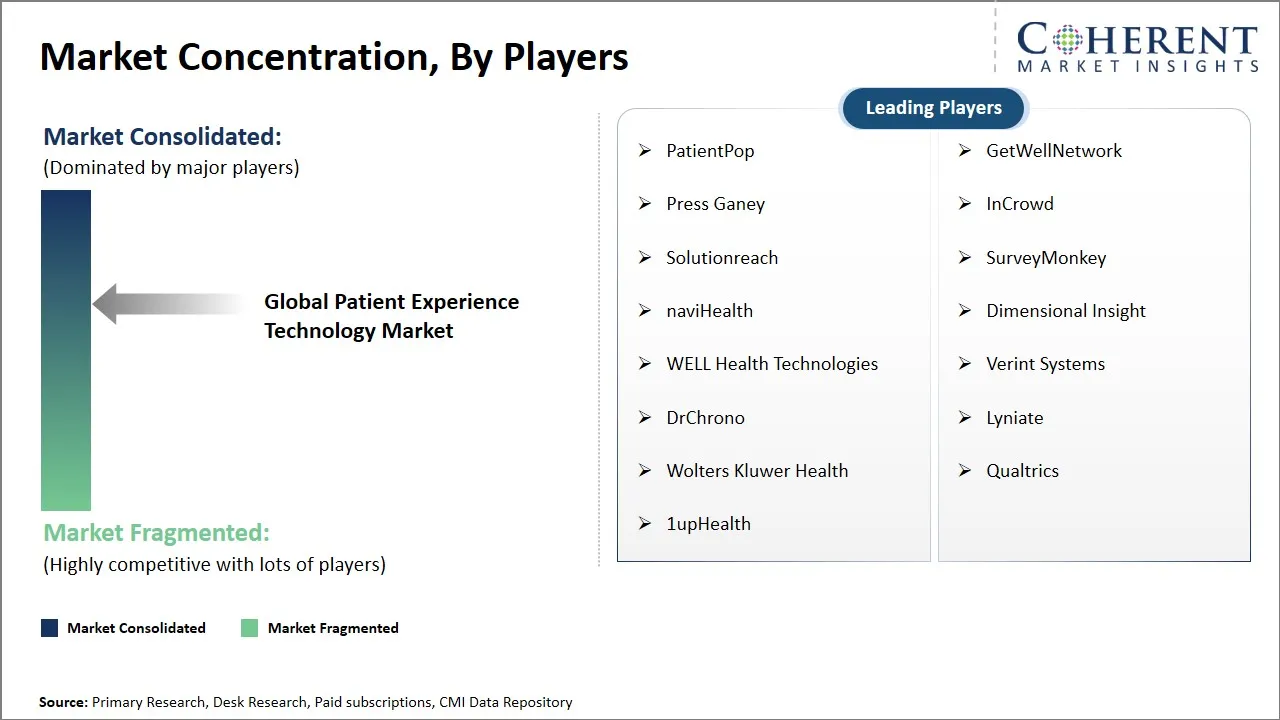
| Companies covered: | PatientPop, GetWellNetwork, Press Ganey, InCrowd, Solutionreach, SurveyMonkey, naviHealth, Dimensional Insight, WELL Health Technologies, Verint Systems, DrChrono, Lyniate, Wolters Kluwer Health, Qualtrics, and 1upHealth | ||
| Growth Drivers: |
| ||
| Restraints & Challenges: |
| ||
Patient Experience Technology Market Dynamics
Patient Experience Technology Market Driver - Shift to Patient-Centric Care Models
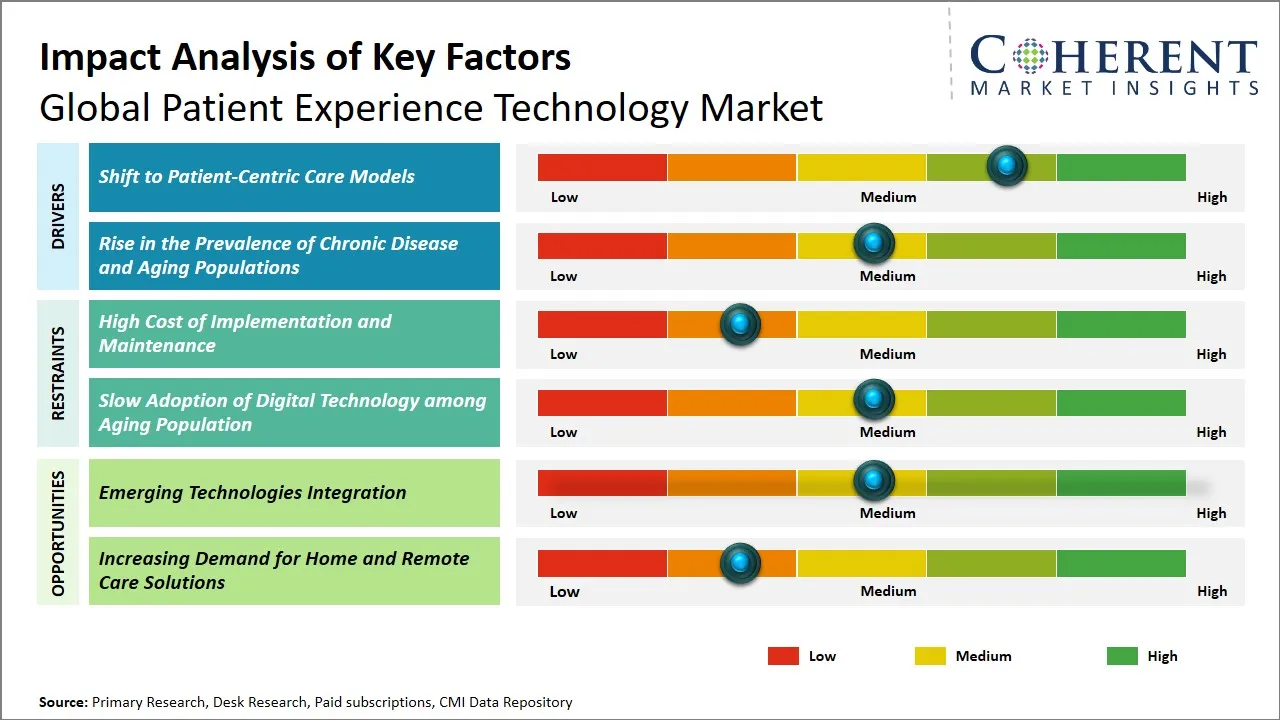
The increased interest in patient-centric models of care is contributing greatly to the deployment of patient experience technologies across the world. Giving personalized care that can meet the needs, preferences, and outcomes of individual patients is becoming a clearer concern of healthcare providers. This change is entrenched by a wider transformation in the healthcare industry which puts more emphasis on interaction, openness as well as cooperation between patients and care teams. These transitions can be achieved with the help of patient experience technologies, which allow improving the communication process using digital platforms, providing feedback in real time, and an integrated health information system that empowers patients to be actively engaged in the care process.
In addition, regulatory systems and reimbursement plans are becoming more in line with values of care and promote providers to concentrate on better satisfaction and clinical results instead of service quantity. The way patients are becoming more educated and require more control in making their own medical choices is pushing the institutions to invest in the technologies to help streamline interactions and provide insights into personal health and constant monitoring, pushing the rapid adoption and innovation in this area.
In August 2025, PEP Health, a provider of patient experience technology, was validated in the Journal of Patient Experience. The study confirms that PEP Health’s real-time patient experience scores (PEP Scores) align with HCAHPS ratings, a key indicator of hospital quality. PEP Scores offer a timely, reliable measure of hospital performance, giving leaders an early warning months before official HCAHPS results. By capturing more patient feedback daily, PEP Health helps hospitals improve care, protect reimbursements, and enhance patient trust.
(Source: https://pephealth.ai/pep-health-leading-indicator-hospital-quality-hcahps-validation/ )
Patient Experience Technology Market Opportunity - Emerging Technologies Integration in the Global Patient Experience Technology Market
The adoption of new technologies is a great prospect to the global patient experience technology market and will help transform the way health professionals connect with and perceive the patient. More personalized, efficient, and secure healthcare delivery is being facilitated by the current and advanced technologies like artificial intelligence (AI), machine learning (ML), Internet of Things (IoT), and blockchain that are progressively gaining role in patient experience platforms. AI-driven analytics are capable of processing a large amount of patient data in real-time to provide an opportunity to implement proactive interventions based on the specific needs of patients, which improves the level of satisfaction and outcomes.
IoT devices such as wearable health monitors and remote sensing tools enable patient engagement at all times, extending the experience management to the non-clinical environment. Moreover, blockchain technology provides a possibility to strengthen data security and transparency that will cope with the increasing concerns regarding patient privacy and the trust in digital healthcare solutions. The interplay of these technologies also makes it possible to come up with new products such as virtual health assistants, predictive health modeling, and immersive virtual reality experiences to educate patients and therapy, which expands the reach of the market.
In August 2025, PEP Health, a leader in AI-powered patient experience technology, released a peer-reviewed study confirming its platform's 99% accuracy in predicting patient satisfaction levels from online reviews. This breakthrough demonstrates the platform's ability to provide real-time, actionable insights, helping healthcare providers enhance patient care and satisfaction.
Analyst Opinion (Expert Opinion)
- The development of new technologies, including artificial intelligence (AI) and machine learning (ML), cloud computing, and automation, is rapidly transforming the sphere of patient experience. Virtual assistants, predictive analytics, and chatbot enabled solutions powered by AI can be used by healthcare providers to personalize their interactions, automate administrative operations, and address the needs of patients proactively, greatly enhancing patient satisfaction and operational efficiency. An example is that alone, AI & chatbot assisted communication had a contribution of about 29% of the market in 2024, which demonstrates the value of these in supplementing real time interaction and automation of communication.
- Patients are demanding convenient, transparent and individualized healthcare experiences. This anticipation is leading towards the use of digital engagement tools that ensure online booking, encrypted messages, telehealth appointments, and real-time communications. Expanding digital engagement with patients in mobile application and portal technology points to an ever-growing trend of shifting patients-centric models to institutions-centric, which cement the growth of the market.
Speak to the analyst
Want personalized insights?
Take the findings above to one of our principal consultants, or have the report rebuilt around the segments, geographies and competitors you actually track.
Market Segmentation
- Component Insights (Revenue, USD Bn, 2021 - 2033)
- Software/Platforms
- Services
- Hardware
- Deployment Mode Insights (Revenue, USD Bn, 2021 - 2033)
- Cloud-Based/SaaS
- On-Premises
- Hybrid Models
- Technology Integration Insights (Revenue, USD Bn, 2021 - 2033)
- AI & Chatbot-assisted Communication
- IoT-enabled Patient Rooms/Smart Beds
- Blockchain for Secure Patient Feedback
- Big Data Analytics & Predictive Modelling
- End User Insights (Revenue, USD Bn, 2021 - 2033)
- Hospitals
- Ambulatory Surgical Centers
- Clinics & Physician Practices
- Rehabilitation Centers
- Long-term Care Facilities/Nursing Homes
- Home Healthcare Providers
- Regional Insights (Revenue, USD Bn, 2021 - 2033)
- North America
- U.S.
- Canada
- Latin America
- Brazil
- Argentina
- Mexico
- Rest of Latin America
- Europe
- Germany
- U.K.
- Spain
- France
- Italy
- Russia
- Rest of Europe
- Asia Pacific
- China
- India
- Japan
- Australia
- South Korea
- ASEAN
- Rest of Asia Pacific
- Middle East
- GCC Countries
- Israel
- Rest of Middle East
- Africa
- South Africa
- North Africa
- Central Africa
- North America
- Key Players Insights
- PatientPop
- GetWellNetwork
- Press Ganey
- InCrowd
- Solutionreach
- SurveyMonkey
- naviHealth
- Dimensional Insight
- WELL Health Technologies
- Verint Systems
- DrChrono
- Lyniate
- Wolters Kluwer Health
- Qualtrics
- 1upHealth
Sources
Primary Research Interviews
Industry Stakeholders
- Hospital Chief Information Officers
- Healthcare Digital Transformation Leads
- Health IT Product Managers
- Clinical Operations Directors
- Patient Engagement Program Heads
- Health System Innovation Officers
End Users
- Hospital Administrators
- Physicians
- Nurses
- Care Coordinators
- Patients
- Patient Advocacy Representatives
Government and International Databases
- World Health Organization
- OECD Health Statistics
- U.S. Centers for Medicare & Medicaid Services
- European Commission Health Data
- UK National Health Service Digital
- World Bank Health Data
Trade Publications
- Healthcare IT News
- Modern Healthcare
- Health Affairs
- Becker’s Health IT
- Fierce Healthcare
- STAT News
Academic Journals
- Journal of Patient Experience
- Journal of Medical Internet Research
- BMC Health Services Research
- The Lancet Digital Health
- Health Informatics Journal
- International Journal of Medical Informatics
Reputable Newspapers
- The New York Times
- The Guardian
- The Wall Street Journal
- Financial Times
- The Washington Post
- Reuters
Industry Associations
- HIMSS
- American Hospital Association
- International Society for Quality in Health Care
- Healthcare Information and Management Systems Society Europe
- Digital Health Canada
- Institute for Healthcare Improvement
Public Domain Resources
- ClinicalTrials.gov
- Data.gov
- EU Open Data Portal
- OpenFDA
- WHO Global Health Observatory
Proprietary Elements
- CMI Data Analytics Tool: Proprietary analytics tool to analyze real-time market trends, consumer behavior, and technology adoption in market
- Proprietary CMI Existing Repository of Information for Last 8 Years
Get access to 250+ pages report
Every segment, forecast, competitor profile and data table behind the analysis above — available for instant download.
- ESOMAR Member
- ISO 9001:2015 Certified
- D-U-N-S Registered
- GDPR & CCPA Compliant
Missing comfort of reading report in your local language? Find your preferred language:
Transform your Strategy with Exclusive Trending Reports
Frequently Asked Questions
The global patient experience technology market is estimated to be valued at USD 0.6 Bn in 2026 and is expected to reach USD 1.20 Bn by 2033.
The CAGR of the global patient experience technology market is projected to be 11.4% from 2026 to 2033.
Shift to patient-centric care models and rise in the prevalence of chronic disease and aging populations are the major factors driving the growth of the global patient experience technology market.
High cost of implementation and maintenance and slow adoption of digital technology among aging population are the major factors hampering the growth of the global patient experience technology market.
Key functions include appointment scheduling, registration, virtual care, communication, and patient feedback management.
AI enables real-time insights, empathetic messaging, and predictive engagement features that improve satisfaction outcomes.
In terms of component, software/platforms are estimated to dominate the market revenue share in 2026.