

Global Pickled Cucumber Market Size and Forecast – 2026-2033
The Global Pickled Cucumber Market is estimated to be valued at USD 2.67 Bn in 2026 and is expected to reach USD 3.61 Bn by 2033, exhibiting a compound annual growth rate (CAGR) of 4.4% from 2026 to 2033.
Key Takeaways of the Pickled Cucumber Market
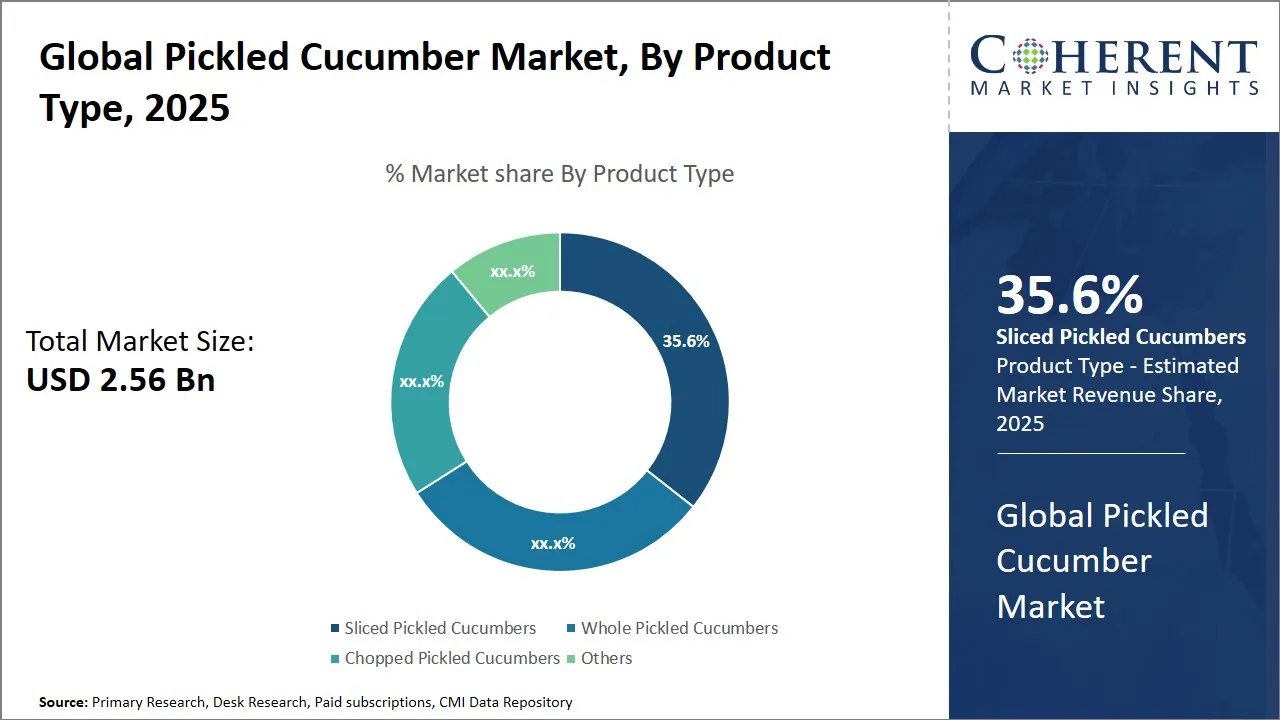
- Sliced pickled cucumbers are projected to hold 36.6 % share of the global pickled cucumber market in 2026, driven by their convenience and versatility across a wide range of culinary uses.
- The retail segment is expected to account for 53.8 % of the global pickled cucumber market by application in 2026, driven by increased consumer accessibility and evolving buying patterns.
- The glass jars segment is projected to hold 32.4 % share of the global pickled cucumber market in 2026, led by advantages in product preservation and consumer perceptions of quality.
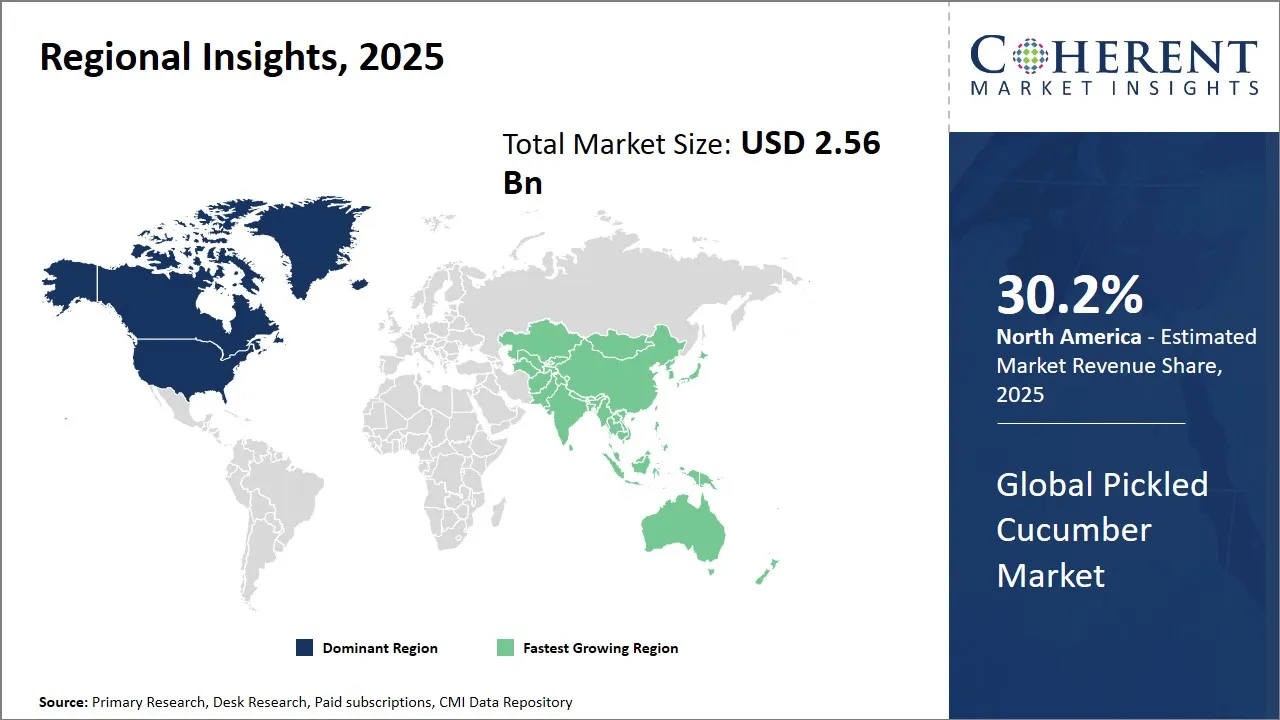
- North America is anticipated to lead the global pickled cucumber market in 2026 with a 30.2 % share, driven by strong consumer demand, well-established retail networks, and increasing preference for pickled products. Asia Pacific, with a 17.5% share in 2026, is expected to be the fastest-growing region, fueled by rising disposable incomes, evolving culinary preferences, and expanding distribution channels.
Market Overview
Market trends reveal increased demand for natural and organic pickled cucumber products driven by health-oriented consumers looking for probiotic benefits. Furthermore, innovation in flavor diversity and eco-friendly packaging is drawing in a larger population, supporting market growth. The increasing popularity of convenience food and the incorporation of pickled cucumbers into fast food and gourmet food further drive the market's uptrend.
Current Events and Its Impact
Current Events | Description and its impact |
Consumer Preference for Organic and Low-Sodium Options |
|
Expansion of Distribution Channels |
|
Segmental Insights
- Current Industry Events of 2026
- Market Size Estimation
- Regional Breakdown
- Competitive Landscape
- Customer Intelligence
- Segmental Analysis
- Pricing Analysis
- Key Market Drivers, Challenges & Future Trends
- Customized Insights Section
Pickled Cucumber Market Insights, By Product Type - Sliced Pickled Cucumbers Segment Drives Market Growth Due to its Convenience and Versatility
The sliced pickled cucumbers segment is expected to command 36.6% share of the global pickled cucumber market in 2026, due to their unrivaled convenience and versatility in different gastronomical uses. Consumers increasingly demand ready-to-use food products, and sliced pickled cucumbers seamlessly integrate into this trend by removing preparation from the process and enabling rapid insertion into recipes. Their pre-slice convenience improves user experience through consistent texture and size, appealing to both home preparation cooks and foodservice professionals seeking to optimize kitchen workflow.
In addition, sliced pickled cucumbers are versatile across various cuisines and product forms. They are used as sandwich and burger toppers and deli tray toppers and are staple items for fast casual and quick service restaurants, as well as home meal kits. Its layering and evenness are responsible for greater distribution of flavor and texture balance, all very much valued in food product development. Its versatility finds its way into snack foods, salads, and charcuterie plates, all popular among health-conscious buyers looking for low-calorie yet flavorful choices.
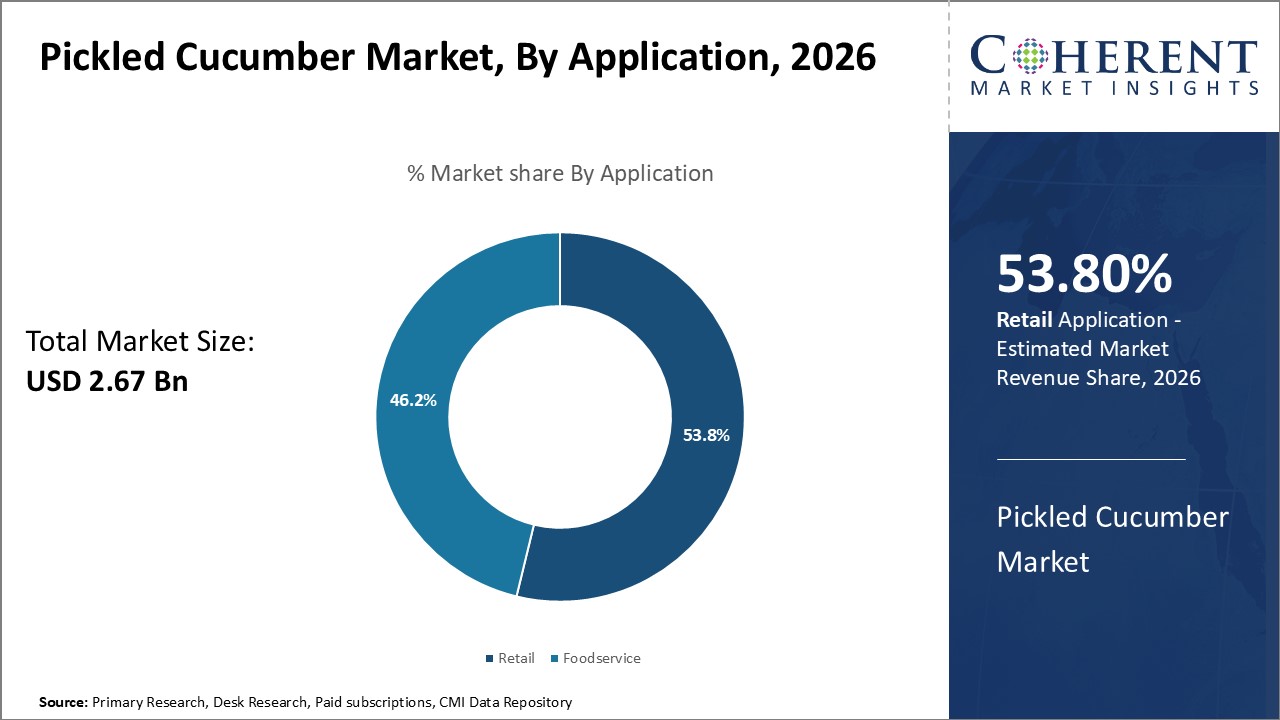
Pickled Cucumber Market Insights, By Application – Retail Segment Dominates the Market Fueled by Expanding Consumer Access and Purchasing Preferences
The retail segment is projected to hold 53.8% share of the global pickled cucumber market in 2026 highlighted by increasing consumer access and changing purchasing habits. Growing urbanization and hectic lifestyles have increased the need for easy, shelf-stable food items that can be rapidly incorporated into home meals. Retail stores, from supermarkets to specialty grocery chains, are key points of access where customers look for known, reliable brands of pickled cucumbers in a variety of formats, indicating a desire for ease of access.
Retail channels provide broad product choice, allowing consumers to sample various forms of pickled cucumbers, such as sliced, whole, or chopped, plus alternative flavors and packaging. Being able to handle products and choose favorite sizes or jar types is crucial in building confidence and providing incentives to purchase repeatedly.
Pickled Cucumber Market Insights, By Packaging Type - Glass Jar Segment Dominates the Market due to its Preservation Quality and Premium Perception
The glass jars segment is expected to hold 32.4% share of the global pickled cucumber market in 2026, with glass jars leading, supported by product preservation factors and consumers' perceptions of quality. Glass packaging has better barrier properties that ensure pickled cucumbers are shielded from air, water, and foreign particles, preserving flavor, texture, and freshness for long durations. In contrast to plastic or pouches, glass does not chemically react with acidic pickle solutions, thus guaranteeing that the sensory properties of the cucumbers are not compromised.
Regional Insights
North America Pickled Cucumber Market Analysis and Trends
The North America region is projected to lead the market with a 30.2% share in 2026, driven by the increasing demand for pickled foods spurred by both traditional consumption and contemporary health-oriented trends. The area has an extensive retail network, including supermarkets, hypermarkets, and convenience stores, guaranteeing extensive product availability.
Demand for healthy low-calorie snacks has strengthened the popularity of pickled cucumbers as they are seen to be a healthy substitute for processed snacks. Dominant companies like Vlasic (USA), Mount Olive (USA), and B&G Foods (USA) are instrumental in propelling market growth with ongoing product innovation in the form of organic and low-sodium variants. The strong distribution networks in North America, supplemented by online channels, help ensure the availability of pickled cucumbers throughout the region.
Asia Pacific Pickled Cucumber Market Analysis and Trends
The Asia Pacific region is expected to exhibit the fastest growth in the market contributing 17.5% share in 2026, due to growing consumer demand for international and fusion foods, changing lifestyle trends, and a growing penchant for convenience and ready-to-eat foods. The region enjoys a young and big population with increasing disposable incomes and growing urbanization, which increases the demand for preserved and pickled vegetables.
China, India, and Japan are among the nations with a mix of traditional preservation techniques and modern production, allowing for a varied market offering. Initiatives by governments to develop agriculture, promote food processing industries, and enhance cold chain facilities drive market growth. Dominant players like Amoy Food (China), Mother's Recipe (India), and Maruha Nichiro (Japan) consolidated their market position through focused product innovation and localized taste suits that suit local tastes.
Pickled Cucumber Market Outlook for Key Countries
U.S. Pickled Cucumber Market Trends
The U.S. market for pickled cucumber is dominated by the trend of high demand from health-aware consumers for natural and organic foodstuffs. Leaders, such as Vlasic (a ConAgra Brands company) and Claussen (a Kraft Heinz company), have driven product innovation into low-sodium and preservative-free pickled cucumbers. The market is supported by sophisticated retail infrastructure and extensive supermarket chains enabling broad product availability. Food safety regulations and government policies promote sustainable packaging innovations, which then drive product innovation and marketing strategies.
Germany Pickled Cucumber Market Trends
Germany remains the dominant force in the Europe pickled cucumber market, driven by a high level of consumption and entrenched culinary traditions of pickled vegetables. These include players like Kühne and Develey, which hold sway in the local market with a wide range of products tailored to suit both domestic and foreign palates. High food quality standards encouraged by Germany's strict regulations ensure strict adherence to industry levels, while streamlined manufacturing and logistical strength ensures consistency of supply and availability. Additionally, the nation is a leading export base for pickled cucumbers across Europe.
China Pickled Cucumber Market Trends
China's market for pickled cucumbers is growing steadily with an increase in urban middle-class consumers adopting traditional pickled cucumbers and new ready-to-eat products. Local manufacturers such as Amoy Foods combine long-standing recipes with advanced food processing technology to satisfy quality requirements. Government incentives supporting agricultural modernization and increasing cold chain logistics facilities allow year-round supply of fresh and processed cucumbers. China's growing e-commerce penetration is also critical in reaching different consumer segments.
India Pickled Cucumber Market Trends
India's pickled cucumber market is supported by a strong cultural preference for pickled and preserved foods, particularly in its regional cuisines. Business players like Mother's Recipe and Tops Pickles employ local recipes and sourcing to gain market share. The government support of small and medium-sized food processing businesses and rural agricultural development schemes makes raw material availability and product innovation more feasible. Increasing urbanization and increased health consciousness are propelling the demand for hygienically processed pickled cucumbers in urban areas.
U.K. Pickled Cucumber Market Trends
The U.K. pickled cucumber market is defined by an increasingly multicultural consumer base with varied taste buds, supporting the demand for a variety of pickled cucumber products, ranging from products for ethnic cuisine. Branston (owned by Princes Group) players have made impacts in convenient packaging and flavor profile innovations. Promotional campaigns and strong retailer presence further drive consumer appeal. Post-Brexit adjustments to trade in the U.K. have impacted import channels, with local manufacturers streamlining supply chain efficiencies and looking for new export markets.
Consumer Behavior Analysis For the Pickled Cucumber Market
- Consumer trends in the pickled cucumber industry have drastically changed, mirroring the increasing need for nutritious, tasty, and easy-to-consume food items worldwide. Consumers looking after their health are increasingly in search of natural, additive-free, and probiotic-laden foods, which has driven the popularity of pickled cucumbers owing to their fermentation and assumed gut health benefits. Millennials and Gen Z, in turn, are propelling market growth by actively looking for new flavors and varied product forms, and expressing interest in organic and sustainably sourced pickles.
- The adaptability of pickled cucumbers has established them as a staple in many cuisines, utilized in sandwiches, salads, and as individual snacks, that has increased their consumption in home and foodservice segments. With growing retail infrastructure and the proliferation of e-commerce, availability of gourmet, artisanal, and premium pickled cucumber products is more accessible than before, favoring their wider adoption in emerging as well as developed markets.
Market Players, Key Development, and Competitive Intelligence
Key Developments
- In September 2025, McDonald's purchased 54 million pounds of cucumbers from Michigan, U.S. McDonald's and Mr. Chips Inc, based in Pinconning, U.S., emphasized that cucumbers are purchased from Michigan on an annual basis for use in the production of pickles and other menu items for the worldwide fast-food chain. The company affirms that the organization of purchasing cucumbers adds USD 2.2 billion to the Michigan economy, supports 42,100 jobs, and is responsible for generating USD 720 million in state tax revenue.
Top Strategies Followed by Global Pickled Cucumber Market Players
- Key market players focus their efforts on building up their expenditures on research and development (R&D), which means to develop new and high-performance products for the changing consumer landscape. These companies introduce changing flavors, healthier pickled cucumber products, and pickled cucumber products with a longer shelf life (or pickled cucumber shelf-life expansion). This normally means localizing products, while keeping to the same quality standards, in relation to palette, input sourcing costs, packaging, etc. for the local region, which engages and assures the scope of their brand and strengthens their position across geographies.
- For example, Mizkan Asia Pacific Pte. Ltd. has successfully introduced organic pickled cucumbers and reduced-sodium pickled cucumbers to satisfy the health-oriented consumer trends.
- Mid-level players in the pickled cucumber sector identify themselves based on solutions that deliver the most acceptable quality for price. Acknowledging the size of the price-sensitive consumer market worldwide, these operators participate in the right level of support to provide acceptable quality products for less. Mid-level players often work with technology providers and larger operators to increase production but use technology to upgrade handling and processing efficiencies into their solutions.
- For instance, The Real Dill is able to take advantage of making artisanal, hand-crafted pickles with locally-sourced ingredients appealing to consumers focused on sustainability and authentic food products.
- Small-scale operators in the pickled cucumber segment find their niche by focusing on unique product attributes or development and focus on engaging with a unique consumer segment. Generally, these operators will have unique strategies like organic or artisanal preservation methods to offer a source of solution that is distinct from mass market offerings for people who are willing to pay for "different" or "better" experiences.
- For example, Bubbies Pickles is utilizing organic and traditional fermentation processes that separate its pickled cucumbers from true mass market products. Bubbies’ focus is on small batch production and emphasis on authenticity has provided a loyal base of consumers willing to provide quality and naturally fermented products.
Market Report Scope
Pickled Cucumber Market Report Coverage
| Report Coverage | Details | ||
|---|---|---|---|
| Base Year: | 2025 | Market Size in 2026: | USD 2.67 Bn |
| Historical Data for: | 2020 To 2024 | Forecast Period: | 2026 To 2033 |
| Forecast Period 2026 to 2033 CAGR: | 4.4% | 2033 Value Projection: | USD 3.61 Bn |
| Geographies covered: |
| ||
| Segments covered: |
| ||
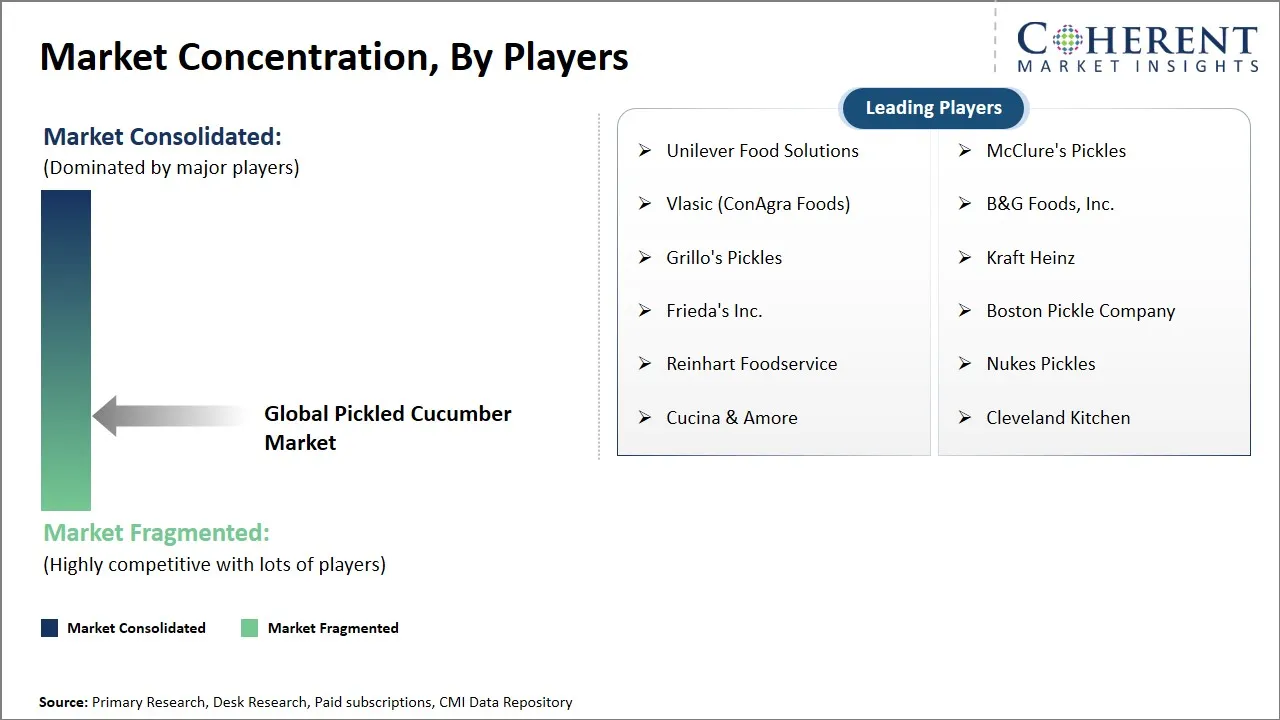
| Companies covered: | Unilever Food Solutions, McClure's Pickles, Vlasic (ConAgra Foods), B&G Foods, Inc., Grillo's Pickles, Kraft Heinz, Frieda's Inc., Boston Pickle Company, Reinhart Foodservice, Nukes Pickles, Cucina & Amore, and Cleveland Kitchen | ||
| Growth Drivers: |
| ||
| Restraints & Challenges: |
| ||
Pickled Cucumber Market Dynamics
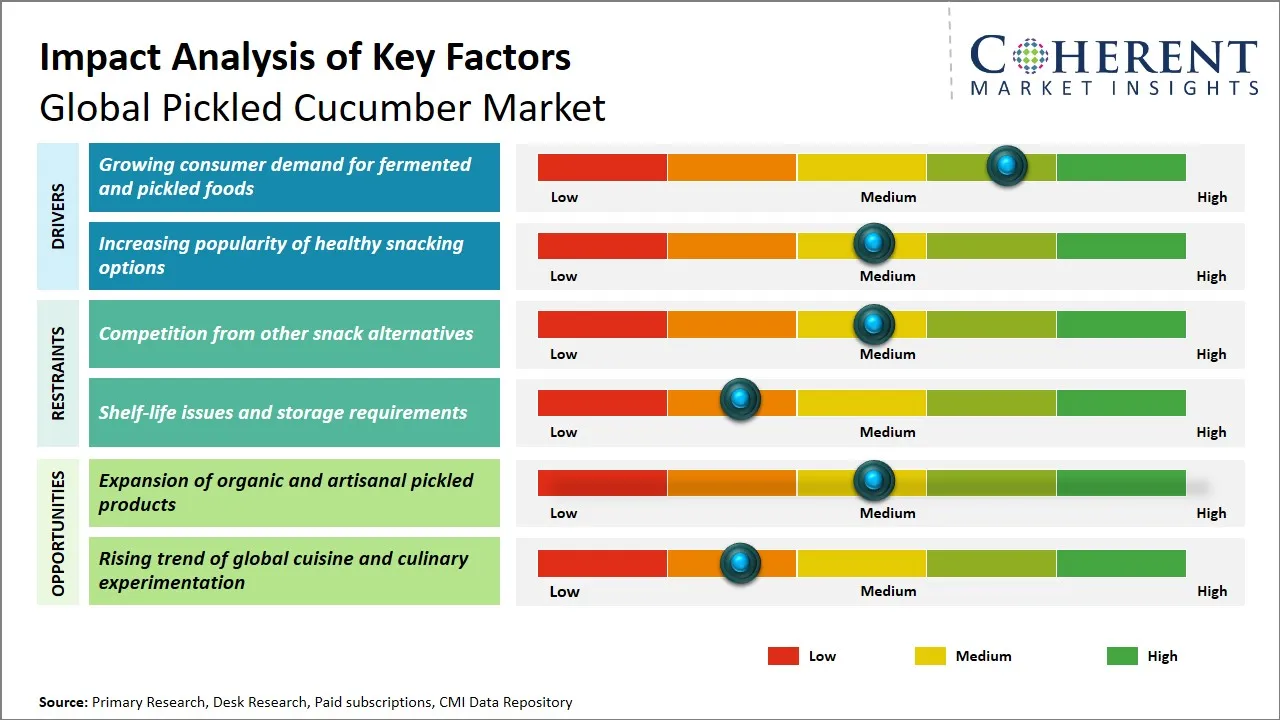
Pickled Cucumber Market Driver - Growing Consumer Demand for Fermented and Pickled Foods
The rise in consumer preference for fermented and pickled foods is a prominent driver for the global pickled cucumber market. Pickled cucumbers are fashionable for health-savvy customers, paired with culinary mavens, as accessible pickled vegetables. Furthermore, trends towards clean-label and natural food preservatives are congruent with the appeal of pickled cucumbers, as they are generally regarded as minimally processed and not chemically altered or artificially flavored.
Recent instances involve Grillo's Pickles’ increasing market share in the U.S., as it encourages naturally fermented cucumbers and the probiotic value of pickled cucumbers to health-conscious buyers.
Pickled Cucumber Market Opportunity - Expansion of Organic and Artisanal Pickled Products
The growing consumer uptake of organic and artisanal food items provides a crucial opportunity within the global pickled cucumber market. As health-conscious consumers increasingly demand food products free of synthetic pesticides, preservatives, and without genetically modified organism (GMO) use, organic pickled cucumbers have continued to gain favor.
For instance, The Real Dill specializes in utilizing organic cucumbers and fresh, locally-sourced non-GMO ingredients to craft distinctive, hand-made pickled cucumber types. Its small-batch preparation and conventional fermentation process resonate with consumers who demand quality, true-to-type tastes.
Analyst Opinion (Expert Opinion)
- The quantity of pickled cucumbers continues to expand as consumers change their taste preferences for exciting flavors, and seek healthy snacks. According to the International Pickle Festival (2023) and the Food & Beverage Innovation Conference (2022) reports, consumer demand is in the direction of product innovation from established brands, such as Vlasic and Grillo's pickles, as they develop products aligned with the trend of clean-labeled.
- Grillo’s has launched an organic, clean-labeled, small-batch pickles product line to accommodate the growing adventurous eaters' demand. Consumers are opting for new flavors instead of traditional classic pickle flavors. They are leaning into exciting flavors like a garlic-infused dill, or spicy pickles featuring chili peppers or fermented hot sauce. There will also be an increase in financial success from pickle producers, increasing preparedness for distribution in food stores, as well as rising social media platform usage to create exposure and sales.
Speak to the analyst
Want personalized insights?
Take the findings above to one of our principal consultants, or have the report rebuilt around the segments, geographies and competitors you actually track.
Market Segmentation
- Product Type Insights (Revenue, USD Bn, 2021 - 2033)
- Sliced Pickled Cucumbers
- Whole Pickled Cucumbers
- Chopped Pickled Cucumbers
- Others
- Application Insights (Revenue, USD Bn, 2021 - 2033)
- Retail
- Foodservice
- Packaging Type Insights (Revenue, USD Bn, 2021 - 2033)
- Glass Jars
- Plastic Containers
- Pouches
- Others
- Distribution Channel Insights (Revenue, USD Bn, 2021 - 2033)
- Offline
- Supermarkets/Hypermarkets
- Convenience Stores
- Others
- Online
- Offline
- Regional Insights (Revenue, USD Bn, 2021 - 2033)
- North America
- U.S.
- Canada
- Latin America
- Brazil
- Argentina
- Mexico
- Rest of Latin America
- Europe
- Germany
- U.K.
- Spain
- France
- Italy
- Russia
- Rest of Europe
- Asia Pacific
- China
- India
- Japan
- Australia
- South Korea
- ASEAN
- Rest of Asia Pacific
- Middle East
- GCC Countries
- Israel
- Rest of Middle East
- Africa
- South Africa
- North Africa
- Central Africa
- North America
- Key Players Insights
- Unilever Food Solutions
- McClure's Pickles
- Vlasic (ConAgra Foods)
- B&G Foods, Inc.
- Grillo's Pickles
- Kraft Heinz
- Frieda's Inc.
- Boston Pickle Company
- Reinhart Foodservice
- Nukes Pickles
- Cucina & Amore
- Cleveland Kitchen
Sources
Primary Research Interviews
- Procurement Head – Leading Pickled Vegetable Manufacturing Company
- R&D Manager – Fermented Foods Producer (Specializing in Pickled Cucumber Lines)
- Supply Chain Director – Large-Scale Food Processing Firm
- Product Innovation Manager – Global Condiment and Sauce Brand
Stakeholders
- Manufacturers: Pickled cucumber processors, condiment producers, and fermentation-based food companies
- End-use Sectors
- Food and Beverage (Ready-to-eat, sauces, condiments)
- Retail and Foodservice (Restaurants, catering, supermarkets)
- Packaged Foods and Snack Industry
- Regulatory & Certification Bodies: Food Standards and Safety Authorities, HACCP and ISO-certified food quality organizations
- Distribution Channels: Retail, supermarkets, convenience stores, online grocery platforms
- Technology Integration Players: Automated pickling, brining process machinery producers, and smart packaging solution providers
Databases
- FAOSTAT – Global cucumber and gherkin production and trade data
- UN Comtrade Database – International trade statistics for pickled foods (HS codes 2001, 2005)
Magazines
- Food Business Review – Trends in processed vegetables and pickled products
- The Grocer – Insights on retail and private-label pickled cucumber sales
- Processed Food Industry Journal – New processing technologies and product safety innovations
- Packaging Strategies – Advances in packaging for acidic, fermented, and brined products
Journals
- Journal of Food Processing and Preservation – Studies on cucumber fermentation and preservation methods
- LWT - Food Science and Technology – Research on nutritional content and shelf stability of pickled cucumbers
- International Journal of Food Microbiology – Microbial dynamics in fermenting cucumbers
- Food Research International – Quality, flavor, and texture analyses for pickled vegetable products
Newspapers
- The Financial Times – Global export performance of processed and pickled vegetables
- The Guardian – Consumer health perception and sustainability in fermented food segments
- Asia Food Journal – APAC market growth and changing consumption trends
- European Food News – EU policies on product labeling and food safety standards for pickled goods
- The New York Times – Evolving American consumer preferences toward fermented and probiotic-rich foods
Associations
- Pickle Packers International, Inc. (PPI) – Global trade data and standardization guides
- Food and Drink Federation (FDF) – UK market insights and regulatory environment
- European Food Safety Authority (EFSA) – Guidelines for additives and preservatives
- All India Food Processors’ Association (AIFPA) – Regional processing and quality regulations
- National Food Processors Association (NFPA)
Public Domain Sources
- Food and Agriculture Organization (FAO) – Pickled vegetable production and processing safety standards
- World Health Organization (WHO) – Food safety and permissible preservative levels
- U.S. Food and Drug Administration (FDA) – CFR Title 21: Regulations for pickled and acidified foods
- European Commission – Regulation (EU) No 1169/2011 on food labeling for preserved vegetables
Proprietary Elements
- CMI Data Analytics Tool, Proprietary CMI Existing Repository of information for last 8 years.
Get access to 250+ pages report
Every segment, forecast, competitor profile and data table behind the analysis above — available for instant download.
- ESOMAR Member
- ISO 9001:2015 Certified
- D-U-N-S Registered
- GDPR & CCPA Compliant
Missing comfort of reading report in your local language? Find your preferred language:
Transform your Strategy with Exclusive Trending Reports
Frequently Asked Questions
The global pickled cucumber market is estimated to be valued at USD 2.67 Bn in 2026 and is expected to reach USD 3.61 Bn by 2033.
The CAGR of global pickled cucumber market is projected to be 4.4% from 2026 to 2033.
Growing consumer demand for fermented and pickled foods and increasing popularity of healthy snacking options are the major factors driving the growth of the global pickled cucumber market.
Competition from other snack alternatives and shelf-life issues and storage requirements are the major factors hampering the growth of the global pickled cucumber market.
In terms of product type, sliced pickled cucumbers are estimated to dominate the market revenue share in 2026.
Unilever Food Solutions, McClure's Pickles, Vlasic (ConAgra Foods), B&G Foods, Inc., Grillo's Pickles, Kraft Heinz, Frieda's Inc., Boston Pickle Company, Reinhart Foodservice, Nukes Pickles, Cucina & Amore, and Cleveland Kitchen are the major players.
North America is expected to lead the global pickled cucumber market in 2026.