

Global Port Cranes Market and Forecast – 2026-2033
Coherent Market Insights estimates that the global port cranes market is expected to reach USD 1.85 Bn in 2026 and will expand to USD 2.70 Bn by 2033, registering a CAGR of 6% between 2026 and 2033.
Key Takeaways of the Port Cranes Market
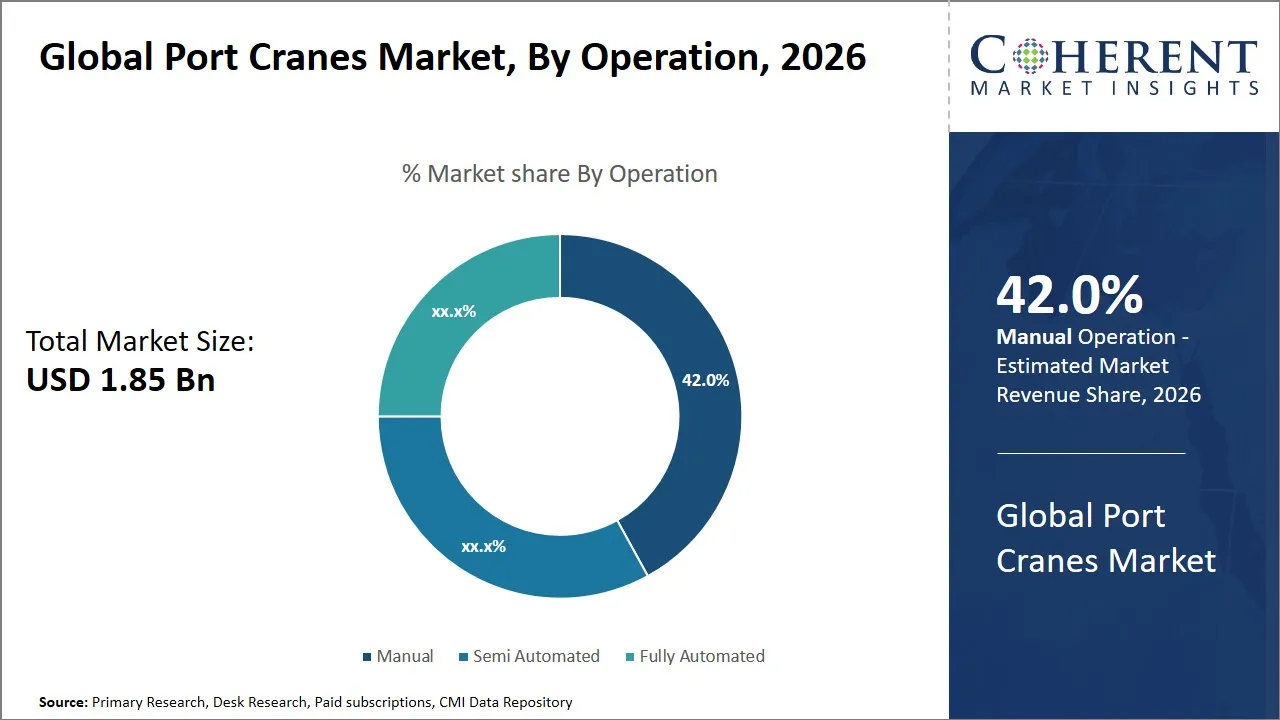
- The manual segment is expected to account for 42% of the port cranes market share in 2026.
- The Ship to Shore (STS) cranes segment is estimated to hold 25% of the market share in 2026.
- The sea ports segment is projected to captures 44% of the global port cranes market share in 2026.
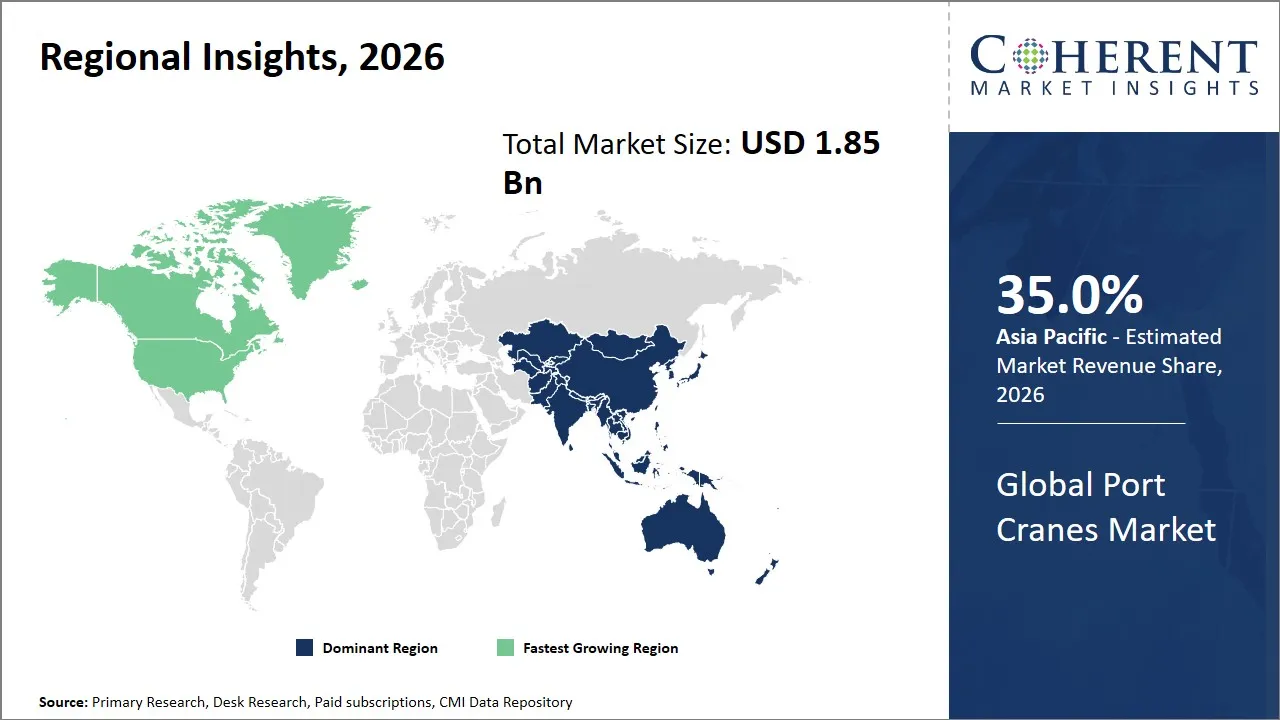
- Asia Pacific will dominate the port cranes market in 2026 with an estimated 35%
- North America will hold 26% share in 2026 and is expected to record the fastest growth over the forecast period.
Segmental Insights
Why Does Manual Segment Dominate the Global Port Cranes Market?
The manual segment is expected to account for 42.0% of the market share in 2026. Primarily, expansion stems from adaptability along with reduced initial investment and upkeep demands. In locations rich in workforce but low in cargo throughput, preference leans toward manual port cranes instead of automated systems. Control stays closer at hand when human operation manages loading tasks - this allows quick adjustments if storms arrive early or deliveries shift without notice. Infrastructure needs tend to stay simpler under manual setups; integration hurdles fade as a result. Especially within economies still building industrial capacity, these solutions fit better than complex robotic networks that demand higher funding and expertise
- Current Industry Events of 2026
- Market Size Estimation
- Regional Breakdown
- Competitive Landscape
- Customer Intelligence
- Segmental Analysis
- Pricing Analysis
- Key Market Drivers, Challenges & Future Trends
- Customized Insights Section
Ship to Shore (STS) Cranes Segment Dominates the Global Port Cranes Market
The Ship to Shore (STS) cranes segment is projected to hold 25.0% of the global port cranes market share in 2026. As they move containers between ships and land areas, their role explains the growth. With sea commerce growing steadily, transferring freight quickly plus securely gains greater importance, making these machines vital components at docks. Built to manage huge vessels accurately, such equipment influences how much a harbor processes along with daily performance levels.
Why is Sea Ports the Most Preferred Port Type in the Port Cranes Market?
The sea ports segment is expected to capture 44.0% of the port cranes market share in 2026. Growth follows their role in global cargo movement. Where significant commerce converges, seaports demand strong infrastructure. Vessels of vast size can offload only where waters run deep. This drives need for lifting equipment suited to heavy workloads. Positioned where land meets sea, these sites link economies. Movement of goods in and out depends on reliable transfer tools. Various types of hoisting machines are essential for smooth operations across transport networks.
Pricing Analysis
Ship-to-Shore (STS) Container Cranes |
Rubber Tired Gantry (RTG) Cranes
| Rail Mounted Gantry (RMG) Cranes |
|
|
|
Regional Insights
Asia Pacific Port Cranes Market Analysis and Trends
Asia Pacific region is projected to lead the market with a 35% share in 2026. Originating in high shipping activity, growth is tied to continuous upgrades in harbor structures across the area. Shipbuilding holds steady where strong industries exist, including countries such as China, Japan, South Korea, and India, along with extensive metal manufacturing and broad transportation networks. With government initiatives turning toward modernizing port functions through investment and infrastructure development, demand increases for advanced lifting equipment. As trade routes shift, prompted by strategies like Beijing’s international corridor plan - regional connections deepen, calling for better cargo handling solutions.
Notably, firms such as ZPMC from China, alongside Konecranes, with strong regional activity, and Hyundai Port Equipment drive progress in durable crane systems designed for vast port zones and bulk handling sites. Because of aligned industrial clustering and governmental backing, the Asia Pacific area remains central in this sector. Despite shifts elsewhere, its lead persists through sustained investment and focused development efforts.
North America Port Cranes Market Analysis and Trends
The North America region is expected to exhibit the fastest growth in the market contributing 26% share in 2026. Despite rising trade flows, ports across North America are updating infrastructure in quiet but meaningful ways. Expansion depends on vessel size along with improvements at port facilities in locations such as Vancouver, Montreal, while Long Beach adapts similarly. Power systems in machinery increasingly shift toward electric models because of stricter emissions rules.
Although fully self-operating ports do not yet exist, partial automation supports efficiency using reduced staffing levels. What happens behind the scenes is monitored through software platforms replacing routine manual checks. Progress unfolds quietly where technology meets infrastructure demands. Remote operation capability reduces risk during peak activity hours. Modern STS cranes appear more frequently where traffic volume demands precision and reliability.
Global Port Cranes Market Outlook for Key Countries
Is China the Next Growth Engine for the Port Cranes Market?
Despite global shifts, China holds leading position in port crane needs. This comes from handling most containers worldwide, alongside being top builder of ships. Investment by authorities flows into large coastal terminals and river hubs within the country. Such efforts prompt updates and swaps in existing crane equipment. A key player, Shanghai Zhenhua Heavy Industries, shapes much of domestic output. Its influence extends overseas through widespread international deliveries. Innovation thrives in automation features for lifting machines. Support exists for these advances, aligning with goals for intelligent harbor operations. Efficiency gains and lower running expenses follow from such integration.
Why is U.S. Emerging as a Major Hub in the Port Cranes Market?
Updating port infrastructure often follows practical needs brought by bigger shipping containers alongside changing international agreements. Because supply chains faced recent challenges, government bodies now prioritize resilient transportation frameworks, leading to investments in high-capacity cranes at key locations like Savannah, Los Angeles, and Long Beach. Equipment providers including Konecranes and Terex remain central due to machines engineered for substantial weight handling; both mobile and fixed-track variants allow smooth movement across trucks, trains, and vessels. Environmental standards growing tighter result in preference for gear consuming reduced energy under routine operations, shifting demand toward options causing smaller ecological footprints.
India Port Cranes Market Analysis and Trends
Modernizing ports through India’s Sagarmala initiative supports expansion in the crane industry. Growing volumes of containers, along with rising needs for moving bulk goods, lead to more orders for specialized lifting equipment across key harbors including Mumbai, Chennai, and Kolkata. Instead of relying solely on domestic capabilities, Indian firms partner with international builders such as Liebherr and Konecranes to develop tailored systems suited to local working conditions. Becoming central to trade goals, cross-border movement now relies more on coordinated logistics hubs across continents, these shifts quietly define how supply routes evolve. While receiving little attention, changes within ground transit networks gradually influence economic patterns over time.
Germany Port Cranes Market Analysis and Trends
Positioned between West and East Europe, Germany holds top rank in the continent's port crane sector. Driven by robust industry output, especially in car production and factory work, terminals like Hamburg see steady need for swift freight movement. Rather than relying solely on imports, local firms including Liebherr and Demag Cranes supply high-accuracy lifting systems built for minimal energy use. Fueled by stricter regulations, dock areas increasingly host electric or hybrid machinery. National priorities favor these updated practices instead of older, less sustainable approaches.
U.A.E. Port Cranes Market Analysis and Trends
Positioned on major sea lanes, the U.A.E.’s harbors mirror changes taking place across regional transport frameworks. Notable expansion occurs at Jebel Ali and Khalifa, locations where extensive projects redefine contemporary dock layouts. As a hub in international cargo movement, reliance on sophisticated docking mechanisms increases gradually. In handling diverse shipment types, automated solutions gain importance within warehouse functions. Assistance arrives via government-supported partnerships that include commercial entities. Today’s regulations support technology improving ship processing and terminal logistics. Under such frameworks, companies like Kalmar and Liebherr deploy equipment designed for higher cargo volumes at key Gulf ports. While requirements shift, adaptation becomes embedded in operational design.
Automation Impact on Labor & Throughput
Metric | Traditional Port Operations | Automated / Semi-Automated Port Operations | Impact (% Change) |
Crane Moves per Hour (Productivity) | ~25 moves/hr | ~45+ moves/hr | +80%+ throughput increase |
Annual TEU Throughput | ~2–3M TEUs | ~14M+ TEUs | ~5×–7× increase |
Labor Requirement | Baseline (100) | ~30–50 workers | -50% to -70% labor reduction |
Productivity Gain from Automation Systems | Baseline | +30% efficiency (AI / digital control) | Adoption rising to 40% |
Market Players, Key Development, and Competitive Intelligence
Key Developments
- On December 9, 2025, Liebherr Container Cranes Ltd announced the signing of a contract to deliver two ship-to-shore (STS) cranes to Port Tampa Bay, marking Liebherr’s first STS installation on Florida’s Gulf Coast.
- On December 3, 2025, Kalmar announced the signing of a new 10-year strategic supply agreement with Patrick Terminals, reinforcing a partnership that has been key to Australia’s leading container terminal operator for more than two decades.
Top Strategies Followed by Global Port Cranes Market Players
- Competition shapes the worldwide port crane sector, where firms large and small pursue different paths to strengthen standing and seize new openings. Funding research heavily allows top firms to stay ahead. Their machines achieve higher performance while cutting excess. Progress emerges where resources meet vision. Smaller players exist within the space, yet transformation tends to arise from established names. Engineering leaps require sustained investment. Time horizons matter when refining complex equipment. Breakthroughs follow commitment, not chance.
- Far above standard levels, some crane manufacturers set their place by focusing on cost-effective solutions. In regions where spending limits influence decisions, real-world needs define what is required. Machines are expected to work reliably without exceeding budget constraints. Their answer comes in designs built around essential performance only. Innovation takes a back seat to dependability and accessible pricing. Regional port authorities often prioritize long-term function over advanced features. Cost efficiency becomes a pathway to market presence. Without high-end technology, firms still deliver consistent performance. Market share grows quietly among those weighing expenses closely. Economic limits define opportunity spaces. Simplicity turns into strategic advantage.
- On July 29, 2024, Konecranes announced plans to establish a network of partners including steel structure providers and sub-contractors to build port cranes in the U.S. in the coming years.
- What sets smaller firms apart in the international port crane sector is a focus on narrowly defined capabilities, designed around distinct logistical demands or particular client requirements. Because they operate with lean structures, adjustments come fast - technology like smart monitoring systems, forward-looking repair algorithms, or adaptable frameworks are absorbed without long delays. These elements, when combined, tend to extend both functionality and durability in real-world settings.
Market Report Scope
Global Port Cranes Market Report Coverage
| Report Coverage | Details | ||
|---|---|---|---|
| Base Year: | 2025 | Market Size in 2026: | USD 1.85 Bn |
| Historical Data for: | 2020 To 2024 | Forecast Period: | 2025 To 2032 |
| Forecast Period 2026 to 2033 CAGR: | 6 % | 2033 Value Projection: | USD 2.70 Bn |
| Geographies covered: |
| ||
| Segments covered: |
| ||
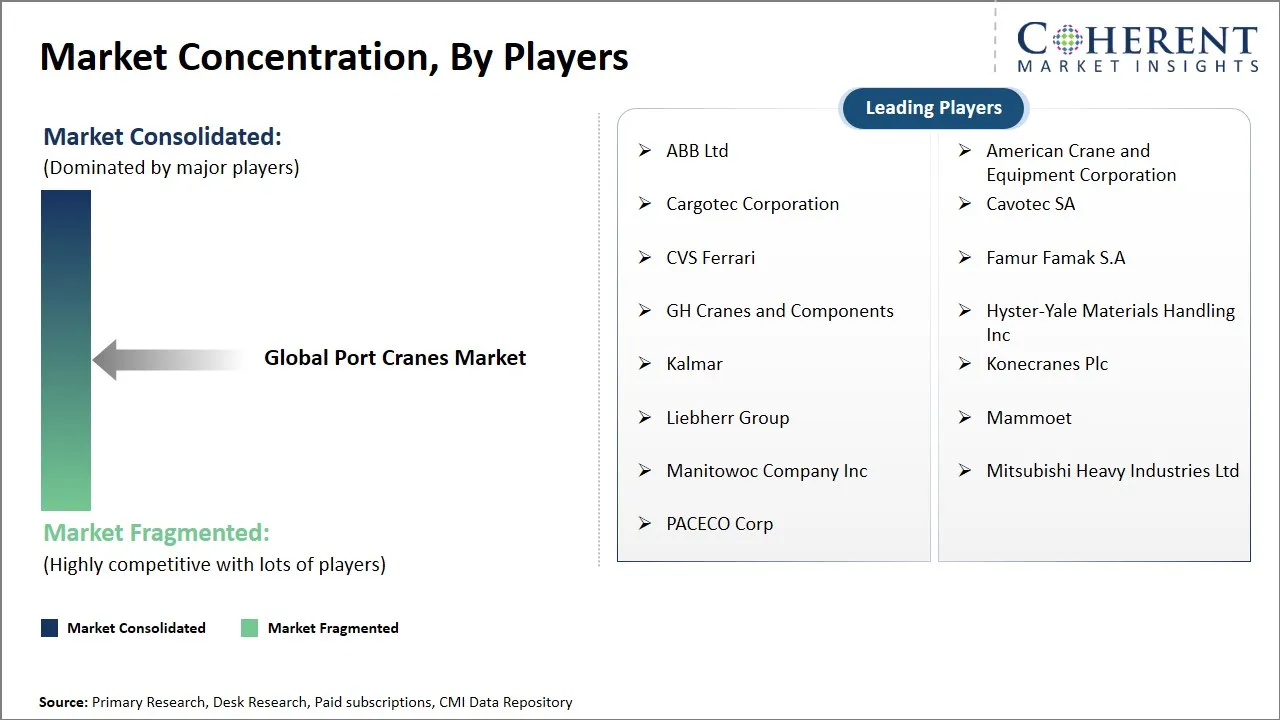
| Companies covered: | ABB Ltd, American Crane and Equipment Corporation, Cargotec Corporation, Cavotec SA, CVS Ferrari, Famur Famak S.A, GH Cranes and Components, Hyster-Yale Materials Handling Inc, Kalmar, Konecranes Plc, Liebherr Group, Mammoet, Manitowoc Company Inc, Mitsubishi Heavy Industries Ltd, and PACECO Corp | ||
| Growth Drivers: |
| ||
| Restraints & Challenges: |
| ||
Global Port Cranes Market Dynamics
Global Port Cranes Market Driver - Growth in Import and Export Activities
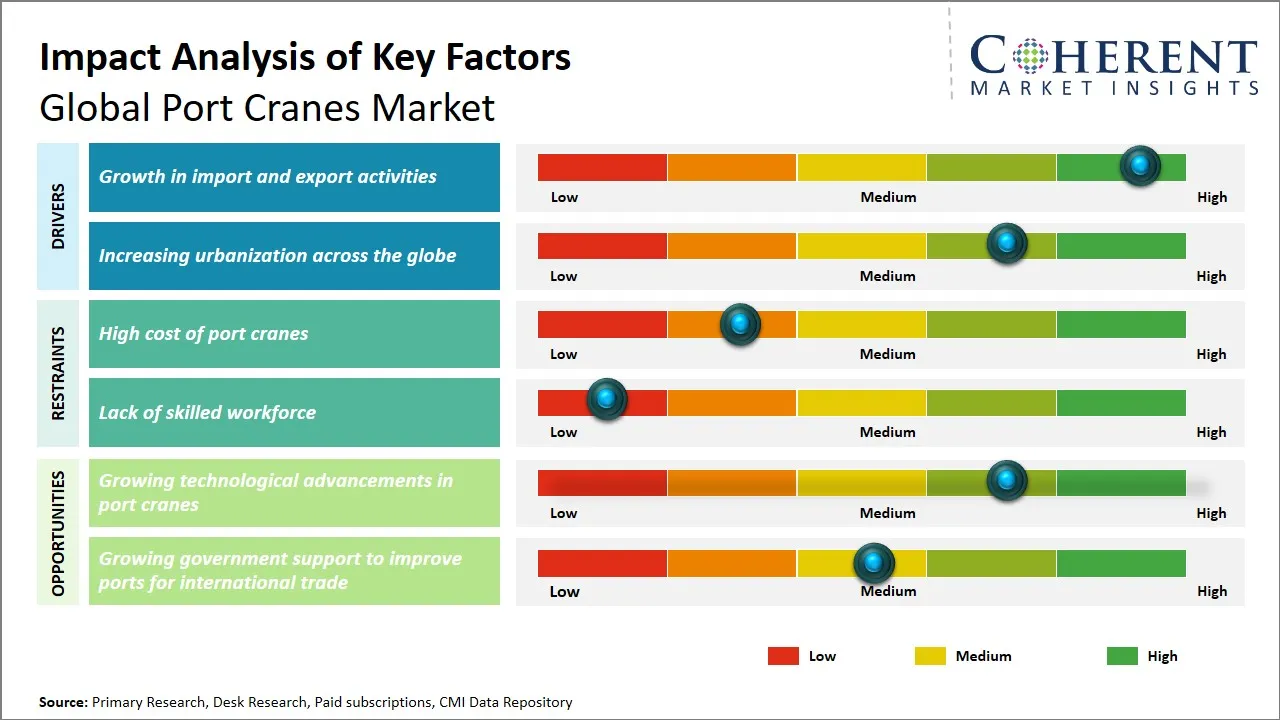
A rise in worldwide commerce, fueled by growing cross-border shipments and freight services, strongly influences the need for modern harbor lifting machines. With nations expanding their role in international distribution networks, the amount of freight moving through maritime terminals has grown markedly, calling for systems that handle loads reliably and swiftly. Equipment at docks plays a key part in transferring shipping containers, loose goods, and large machinery without delay or risk, thus reducing ship idle periods while supporting smoother terminal operations.
Global Port Cranes Market Opportunity - Growing Technological Advancements in Port Cranes
Despite rising global trade volumes, port crane systems evolve through incremental upgrades rather than sudden shifts. Automation enters slowly, guided by reliability needs instead of speed alone. Where sensors merge with mechanical arms, oversight becomes less dependent on manual checks. Efficiency gains appear not from isolated machines but from how they exchange information across networks. Remote operation emerges where environments pose risks to personnel. Downtime drops when alerts precede failures, thanks to constant monitoring streams. Within machines that modify grasp strength according to weight shifts, intelligence gradually forms. Faster unloading becomes expected as larger vessels dock, nudging systems toward flexible upgrades. When movement is refined during execution through responsive signals, accuracy rises. Long-lasting equipment draws funding, particularly where container hubs are extending their reach. With ongoing monitoring, machines last significantly longer. As shipments vary so much, adaptable systems now matter more than rigid ones did before.
Analyst Opinion (Expert Opinion)
- A different rhythm in global cargo routes underpins slow shifts in how ports seek cranes. Higher flows of commerce play a role, just as modernized berths across nations add pressure. Machines that run on electric power, linked via data pathways, appear more often, helping handle larger loads over time. What once moved slowly now adjusts with quieter momentum.
- Larger ships arriving at terminals require handling tools capable of higher output. Yet expenses tied to new machinery remain steep. Older control mechanisms complicate updates, slowing full deployment. Progress depends heavily on choices made during procurement phases. Innovation shapes outcomes just as much as financial commitment does.
Speak to the analyst
Want personalized insights?
Take the findings above to one of our principal consultants, or have the report rebuilt around the segments, geographies and competitors you actually track.
Market Segmentation
- Operation Insights (Revenue, USD Bn, 2021 - 2033)
- Manual
- Semi-Automated
- Fully Automated
- Type Insights (Revenue, USD Bn, 2021 - 2033)
- Ship to Shore (STS) Cranes
- Rubber Tyred Gantry (RTG) Cranes
- Rail Mounted Gantry (RMG) Cranes
- Others
- Port Type Insights (Revenue, USD Bn, 2021 - 2033)
- Sea Ports
- Inland Ports
- Dry Ports
- Lifting Capacity Insights (Revenue, USD Bn, 2021 - 2033)
- Below 40 Tons
- 40 to 80 Tons
- 80 to 100 Tons
- Above 100 Tons
- End User Insights (Revenue, USD Bn, 2021 - 2033)
- Commercial Ports
- Industrial Ports
- Naval Ports
- Regional Insights (Revenue, USD Bn, 2021 - 2033)
- North America
- U.S.
- Canada
- Latin America
- Brazil
- Argentina
- Mexico
- Rest of Latin America
- Europe
- Germany
- U.K.
- Spain
- France
- Italy
- Russia
- Rest of Europe
- Asia Pacific
- China
- India
- Japan
- Australia
- South Korea
- ASEAN
- Rest of Asia Pacific
- Middle East
- GCC Countries
- Israel
- Rest of Middle East
- Africa
- South Africa
- North Africa
- Central Africa
- North America
- Key Players Insights
- ABB Ltd
- American Crane and Equipment Corporation
- Cargotec Corporation
- Cavotec SA
- CVS Ferrari
- Famur Famak S.A
- GH Cranes and Components
- Hyster-Yale Materials Handling Inc
- Kalmar
- Konecranes Plc
- Liebherr Group
- Mammoet
- Manitowoc Company Inc
- Mitsubishi Heavy Industries Ltd
- PACECO Corp
Sources
Primary Research Interviews
- Port Terminal Operators
- Crane Manufacturers and Suppliers
- Port Authority Officials
- Maritime Logistics Managers
Databases
- Lloyd's List Intelligence Maritime Database
- Port Technology International Database
- World Port Source Database
- Maritime & Port Authority Database
Magazines
- Port Technology International Magazine
- World Cargo News
- Maritime Logistics Professional
- Container Management Magazine
- Port Strategy Magazine
Journals
- Journal of Marine Science and Engineering
- Maritime Policy & Management
- Transportation Research Part E: Logistics and Transportation Review
Newspapers
- Lloyd's List
- The Maritime Executive
- Ship & Bunker News
- Trade Winds
- Maritime Reporter and Engineering News
Associations
- International Association of Ports and Harbors (IAPH)
- World Shipping Council (WSC)
- International Cargo Handling Coordination Association (ICHCA)
- Container Equipment Manufacturers Association (CEMA)
- Port Equipment Manufacturers Association (PEMA)
Public Domain Sources
- International Maritime Organization (IMO) Publications
- UNCTAD Port Statistics
- World Bank Port Performance Database
- European Sea Ports Organization (ESPO) Reports
- United Nations Conference on Trade and Development Reports
Proprietary Elements
- CMI Data Analytics Tool
- Proprietary CMI Existing Repository of information for last 8 years
Get access to 250+ pages report
Every segment, forecast, competitor profile and data table behind the analysis above — available for instant download.
- ESOMAR Member
- ISO 9001:2015 Certified
- D-U-N-S Registered
- GDPR & CCPA Compliant
Missing comfort of reading report in your local language? Find your preferred language:
Transform your Strategy with Exclusive Trending Reports
Frequently Asked Questions
The global port cranes market stood at USD 1.85 Bn in 2026 and is expected to reach USD 2.70 Bn by 2033.
The CAGR of global port cranes market is projected to be 6.00% from 2026 to 2033.
Growth in import and export activities and increasing urbanization across the globe are the major factors driving the growth of the global port cranes market.
High cost of port cranes and lack of skilled workforce are the major factors hampering the growth of the global port cranes market.
In terms of operation, manual is estimated to dominate the market revenue share in 2026.
ABB Ltd, American Crane and Equipment Corporation, Cargotec Corporation, Cavotec SA, CVS Ferrari, Famur Famak S.A, GH Cranes and Components, Hyster-Yale Materials Handling Inc, Kalmar, Konecranes Plc, Liebherr Group, Mammoet, Manitowoc Company Inc, Mitsubishi Heavy Industries Ltd, and PACECO Corp are the major players.
Asia Pacific is expected to lead the global port cranes market in 2026.