

Global Positive Material Identification Market and Forecast – 2026-2033
Coherent Market Insights estimates that the global positive material identification market stood at USD 3 Bn in 2025 and will expand to USD 5.5 Bn by 2033, registering a CAGR of 7% between 2026 and 2033.
Key Takeaways of the Positive Material Identification Market
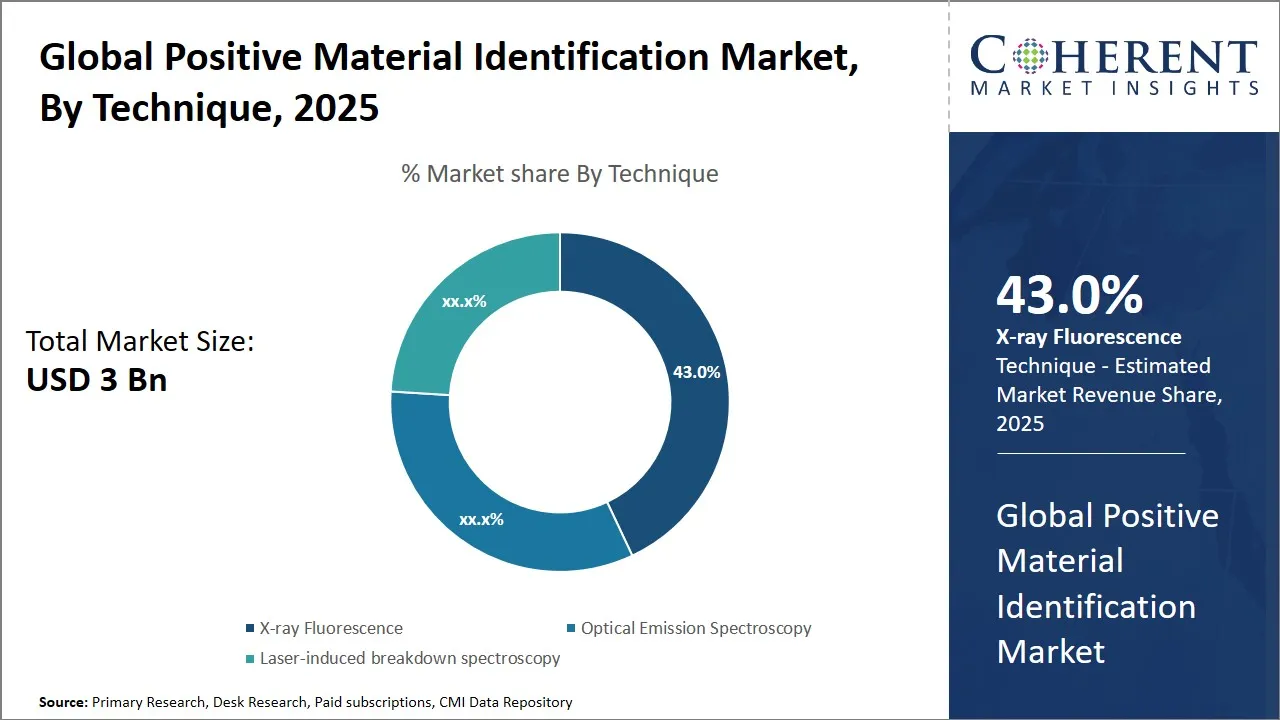
- The X-ray fluorescence segment accounted for 43% of the positive material identification market share in 2025.
- The equipment segment accounted for 47% of the market share in 2025.
- The oil and gas segment accounted for 32% of the global positive material identification market share in 2025.
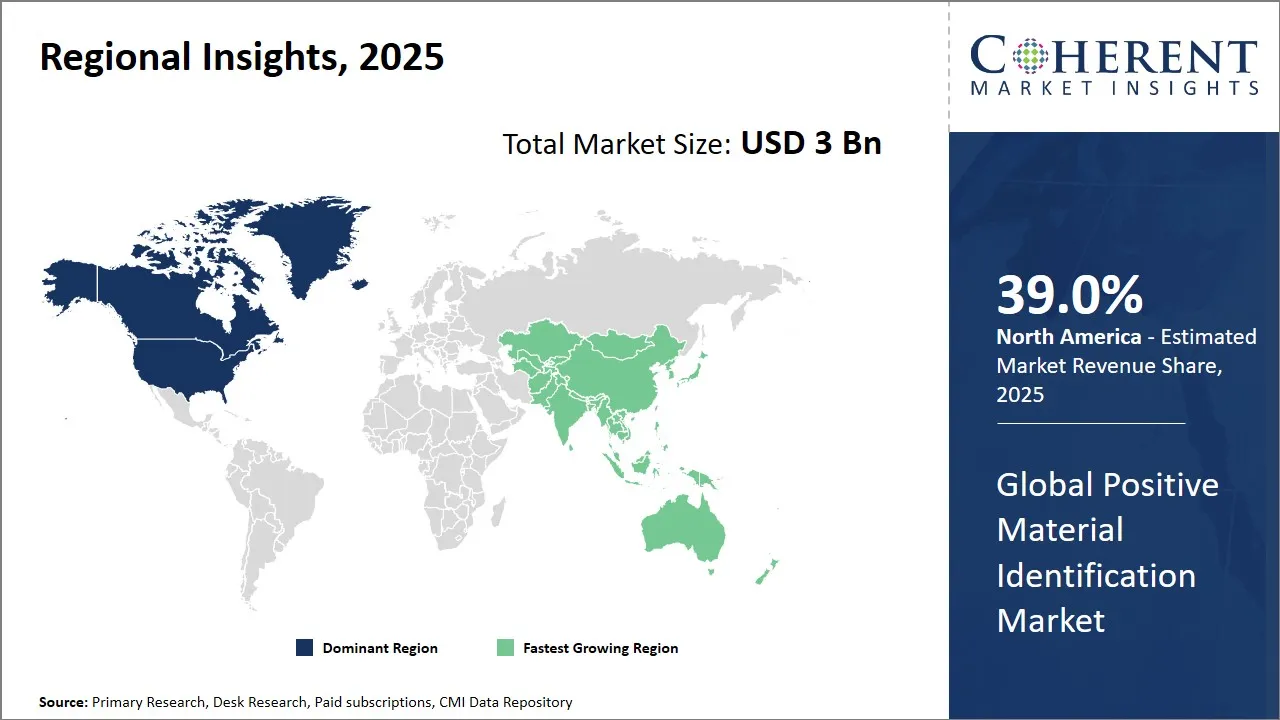
- North America dominated the positive material identification market in 2025 with a 39% share.
- Asia Pacific held 24% of the market share in 2025 and is expected to record the fastest growth over the forecast period.
Current Events and Its Impact
Current Events | Description and its Impact |
Wabtec Acquired Evident’s Inspection Technologies Division |
|
Segmental Insights
- Current Industry Events of 2026
- Market Size Estimation
- Regional Breakdown
- Competitive Landscape
- Customer Intelligence
- Segmental Analysis
- Pricing Analysis
- Key Market Drivers, Challenges & Future Trends
- Customized Insights Section
Why Does X-ray Fluorescence Segment Dominate the Global Positive Material Identification Market in 2025?
X-ray fluorescence segment accounted for 43.0% of the positive material identification market share in 2025. Primarily, expansion stems from adaptability paired with preservation during inspection processes. Speed combined with precision in detecting metal composition defines relevance within fields demanding strict adherence to quality benchmarks. Not limited by element type, performance spans heavy through select light materials. Because of broad applicability, usage persists across varied industrial landscapes.
For instance, on September 1, 2025, Helmut Fischer Group introduced an all-new generation of its high-end segment for coating thickness measurement and material analysis using X-ray fluorescence (XRF) with the two devices, FISCHERSCOPE XDAL and FISCHERSCOPE XDV.
(Source: helmut-fischer.com)
Equipment Segment Dominates the Global Positive Material Identification Market
The equipment segment accounted for 47.0% of the market share in 2025. Essential components enable performance in precision material identification, a requirement wherever accurate substance analysis is expected. Within such setups exist handheld devices, fixed installations, together with apparatuses designed for elemental detection tasks. Their role supports fundamental operations during evaluations focused on maintaining uniformity and dependable outcomes.
Why is Oil and Gas the Most Crucial End User in the Positive Material Identification Market?
The oil and gas segment accounted for 32.0% of the global positive material identification market share in 2025. As material checks support safe, steady function, growth followed. When pressures rise sharply - heat fluctuates, corrosive elements attack metal, systems must meet exact engineering rules. Compliance becomes essential under such conditions. Standards shape every phase of operation. Precision in selection becomes essential when surroundings challenge structural limits. Compliance is not optional where failure risks escalate rapidly.
Handheld XRF Analyzers Pricing Analysis
Premium Segment | Mid-Range |
Thermo Fisher Scientific (Niton Series)
Olympus Scientific Solutions (Vanta Series)
Bruker Corporation (EasyID Series)
| Rigaku Corporation (MiniFlex Series)
Applied Rigaku Technologies (RT500 Series)
SciAps (LIBS Technology)
|
Regional Insights
North America Positive Material Identification Market Analysis and Trends
North America accounted for a market share of 39% in 2025. Expansion emerges from established industrial settings, driven by solid regulatory frameworks together with extensive adoption of technology in areas like aviation, transportation, energy, and manufacturing. Owing to demanding standards for material evaluation, safety protocols, and uniformity, instruments capable of confirming makeup stay necessary.
Companies located in North America, among them Olympus, Bruker, and Hitachi High-Tech, allocate significant effort into advancing portable testing equipment. Well-built infrastructure allows wide integration of analytical techniques directly into working processes. Continued dominance in this area stems from long-standing expertise spread throughout key sectors.
Asia Pacific Positive Material Identification Market Analysis and Trends
Asia Pacific accounted for a market share of 24% in 2025 and is expected to register the fastest growth rate over the forecast period. Industrial expansion drives demand, while manufacturing output rises alongside broader aerospace and auto sector development. Support arrives via policy measures in nations including China, India, Japan, and South Korea, where authorities back automation progress and inspection standards. Emphasis on adherence to safety rules grows within energy extraction and building industries, adding momentum to market movement.
Firms like Innov-X Systems, acquired by Thermo Fisher Scientific, alongside SciAps and homegrown ventures introduce affordable, novel tools for material analysis. Foreign capital flows in, multinationals extend their factory networks, which together fuel wider use of testing technology across locations.
Global Positive Material Identification Market Outlook for Key Countries
Why is the U.S. Emerging as a Major Hub in the Positive Material Identification Market?
Despite global competition, strength comes from large-scale manufacturing combined with strict rules that require precise material checks. Leading firms such as Olympus and Bruker shape the field through compact tools capable of instant elemental detection using XRF methods. Driven by needs in aviation, national security, and chemical processing, verification systems find steady use across critical sectors. Progress continues as new mobile units allow immediate results, maintaining both reliability and forward momentum in testing technology.
Is China the Next Growth Engine for the Positive Material Identification Market?
Driven by swift industrial expansion, China experiences growing need for PMI systems, supported by targeted government measures. With standards tightening, scrutiny intensifies in automotive, aerospace, and electronics manufacturing. Not only global names such as Thermo Fisher Scientific and Hitachi play a role - local manufacturers also accelerate progress. As rules governing emissions and worker protection take effect, exact composition assessment becomes more common in state-run and private plants.
Germany Positive Material Identification Market Analysis and Trends
Still ahead in Europe’s positive material identification landscape, Germany draws strength from advanced auto and machine production industries. Within the sector, Spectro Analytical Instruments, linked to octopharma and Bruker emphasize long-term reliability paired with exactness, meeting tight local standards. Because government strategies support dependable readings together with steady performance and digital production links, PMI sees broader use during checks and verification steps inside industrial sites.
India Positive Material Identification Market Analysis and Trends
A shift upward in India’s positive material identification market follows expanding industrial activity across construction, energy, yet mechanical production. With initiatives like Make in India shaping policy, locally made equipment advances under favorable rules. Through partnerships, firms within the country work alongside international names such as SciAps or Thermo Fisher Scientific, tools emerge that meet specific needs at lower expense. Awareness is rising: confirming what materials are present supports reliability while lowering exposure to hazards, encouraging wider use of accurate detection techniques. Quietly, this shift shows how analysis becomes part of everyday workflows.
Japan Positive Material Identification Market Analysis and Trends
Advanced manufacturing sectors in Japan highlight strong capabilities in analyzing materials. Devices made by companies like Hitachi High-Tech and Olympus prioritize accuracy through compact spectrometers, along with tools that test without damage. Where safety standards are strict, instruments for identifying metal composition remain in consistent use. Progress emerges when public bodies work alongside firms, advancing how these technologies apply within production fields.
Market Players, Key Development, and Competitive Intelligence
Key Developments
- On January 22, 2025, Evident announced the launch of its next-generation Vanta Element handheld XRF analyzer series built for fast, accurate alloy identification in scrap sorting, metal manufacturing and precious metals testing. Available in two affordable models—the Vanta Element analyzer for basic alloy ID and the Vanta Element-S analyzer for alloy ID with light element analysis—the new series offers enhanced comfort, speed, and ease of use to increase confidence in every alloy analysis.
Top Strategies Followed by Global Positive Material Identification Market Players
- A mix of approaches shapes how companies position themselves within the worldwide Positive Material Identification field. Those at the forefront channel significant resources into research, focusing on refinement rather than reinvention. Progress emerges slowly when technology becomes the main arena for distinction among providers. Innovation, though steady, often follows practical needs instead of theoretical breakthroughs.
- Operating between high-end and budget tiers, some firms design equipment focused on functionality rather than excess. While maintaining baseline accuracy, their approach emphasizes affordability through lean production methods. Instead of competing on innovation, they prioritize consistency - meeting needs where precision demands are limited. For laboratories under financial constraints, such offerings present a feasible alternative when advanced capabilities are unnecessary. Performance remains stable, though customization options tend to be minimal by comparison.
- Where larger firms pass, smaller PMI suppliers step in, crafting tools with distinct functions, shaped by user needs. Their focus shifts toward portable units equipped with smart capabilities, sometimes linked through digital networks. Instead of broad markets, they target precise uses, fitting tightly into unique operational demands. Regions with specific standards find these adaptations particularly suitable. Innovation becomes less about size, more about fit.
Market Report Scope
Positive Material Identification Market Report Coverage
| Report Coverage | Details | ||
|---|---|---|---|
| Base Year: | 2025 | Market Size in 2025: | USD 3 Bn |
| Historical Data for: | 2020 To 2024 | Forecast Period: | 2026 To 2033 |
| Forecast Period 2026 to 2033 CAGR: | 7% | 2033 Value Projection: | USD 5.5 Bn |
| Geographies covered: |
| ||
| Segments covered: |
| ||
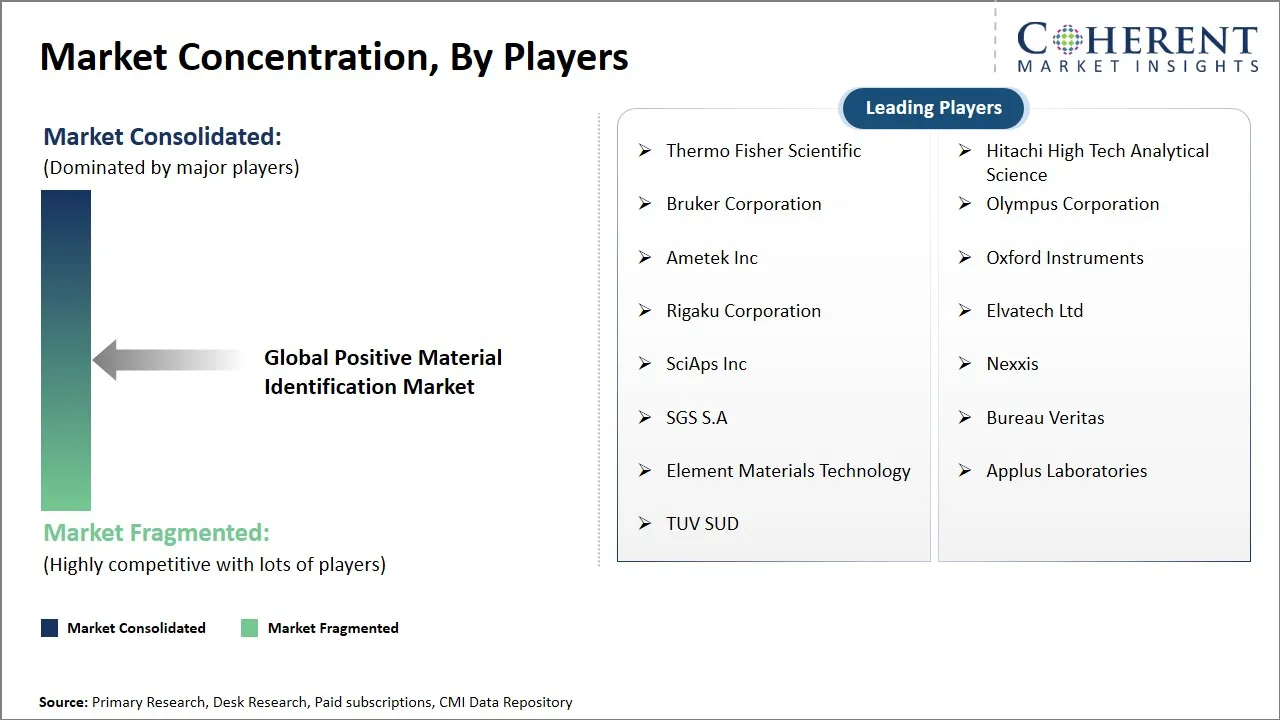
| Companies covered: | Thermo Fisher Scientific, Hitachi High Tech Analytical Science, Bruker Corporation, Olympus Corporation, Ametek Inc, Oxford Instruments, Rigaku Corporation, Elvatech Ltd, SciAps Inc, Nexxis, SGS S.A, Bureau Veritas, Element Materials Technology, Applus Laboratories, and TUV SUD | ||
| Growth Drivers: |
| ||
| Restraints & Challenges: |
| ||
Global Positive Material Identification Market Dynamics
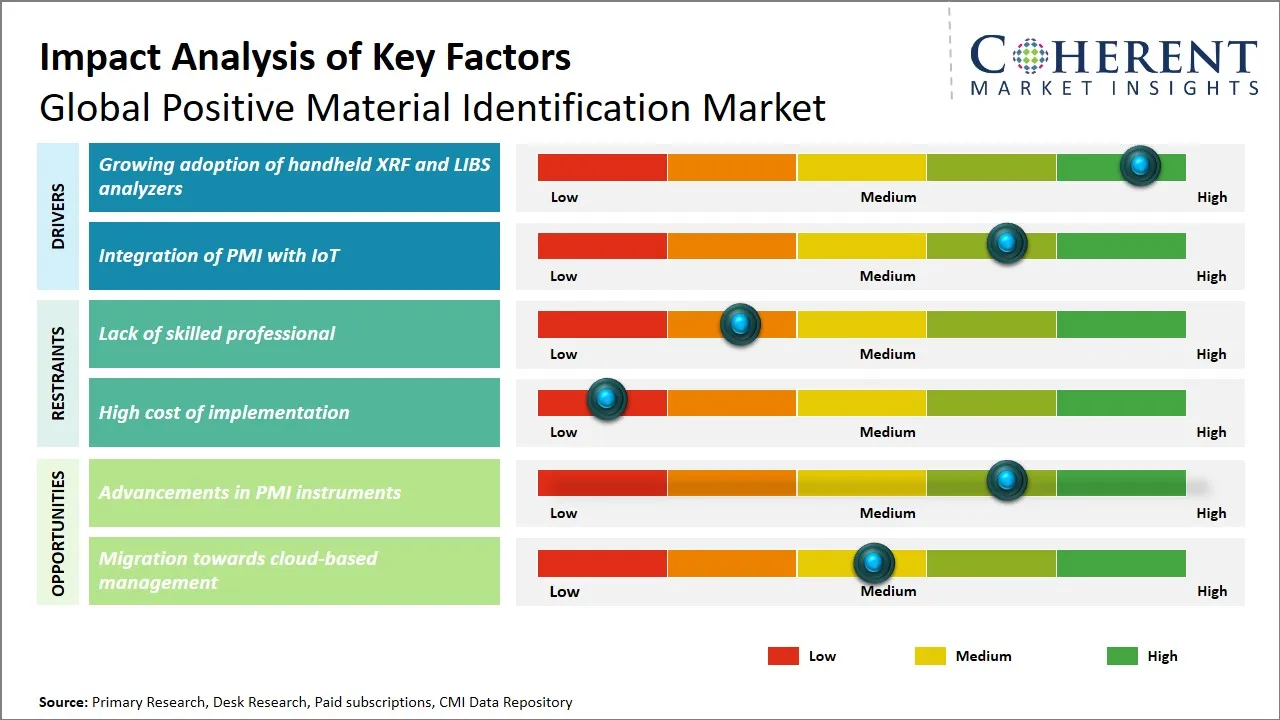
Global Positive Material Identification Market Driver - Growing Adoption of Handheld XRF and LIBS Analyzers
Increasing use of portable XRF together with LIBS tools shapes the positive material identification market in noticeable ways. Fast results, precision, no damage to samples define their role across fields like metal production, commercial aircraft manufacturing, vehicle assembly, oil processing. Operation directly at sites becomes simple; little prep work is required before testing begins. Immediate checks of what materials contain now happen where they are used, cutting delays while lowering chances for mistakes.
Global Positive Material Identification Market Opportunity - Advancements in PMI Instruments
Advancements in instrument design are shaping the future of global positive material identification markets. With greater precision emerging, speed improvements follow closely behind. Efficiency gains appear most notably where portability meets functionality, handheld units now deliver on-site results without sample damage. Real-time analytics enter the workflow, shifting how verification tasks unfold across sectors like aviation, vehicle production, energy extraction, and industrial fabrication. Detection methods evolve: X-ray fluorescence, laser-based process spectroscopy, and optical emission techniques each contribute distinct advantages. Among them, broader alloy recognition becomes possible under diverse field conditions.
Analyst Opinion (Expert Opinion)
- Steady expansion now marks the worldwide positive material identification market, guided less by volume and more by precision. Tighter rules take effect across industries like energy production, aviation, equipment building, alongside fossil fuel operations - shaping how materials are verified. What once seemed optional now draws attention as an essential measure against operational hazards, particularly where structures age or investments grow large.
- Looking ahead, shifts in technological focus suggest movement away from physical components toward systems built on software, network links, and data processing. Leading firms now include remote data handling, automatic material pairing, followed by machine-supported evaluation to enhance tracking accuracy while lowering reliance on manual inputs. In coming years, subscription-style metal testing setups combined with broader inspection tools appear likely to grow in use. At the same time, developing regions begin aligning growth in industry with wider deployment of rapid composition checks.
Speak to the analyst
Want personalized insights?
Take the findings above to one of our principal consultants, or have the report rebuilt around the segments, geographies and competitors you actually track.
Market Segmentation
- Technique Insights (Revenue, USD Billion, 2021 - 2033)
- X-ray Fluorescence
- Optical Emission Spectroscopy
- Laser-induced breakdown spectroscopy
- Component Insights (Revenue, USD Billion, 2021 - 2033)
- Equipment
- Software
- Services
- End User Insights (Revenue, USD Billion, 2021 - 2033)
- Oil and Gas
- Aerospace and Defense
- Metals and Mining
- Automotive
- Power Generation
- Others
- Regional Insights (Revenue, USD Billion, 2021 - 2033)
- North America
- U.S.
- Canada
- Latin America
- Brazil
- Argentina
- Mexico
- Rest of Latin America
- Europe
- Germany
- U.K.
- Spain
- France
- Italy
- Russia
- Rest of Europe
- Asia Pacific
- China
- India
- Japan
- Australia
- South Korea
- ASEAN
- Rest of Asia Pacific
- Middle East
- GCC Countries
- Israel
- Rest of Middle East
- Africa
- South Africa
- North Africa
- Central Africa
- North America
- Key Players Insights
- Thermo Fisher Scientific
- Hitachi High Tech Analytical Science
- Bruker Corporation
- Olympus Corporation
- Ametek Inc
- Oxford Instruments
- Rigaku Corporation
- Elvatech Ltd
- SciAps Inc
- Nexxis
- SGS S.A
- Bureau Veritas
- Element Materials Technology
- Applus Laboratories
- TUV SUD
Sources
Primary Research Interviews
- PMI Equipment Manufacturers
- Testing Laboratory Directors
- Quality Control Managers in Manufacturing Industries
- End-user Industry Representatives
Magazines
- Quality Magazine
- Industrial Equipment News
- Materials Testing & Analysis
- NDT & E International Magazine
Journals
- Journal of Materials Science
- NDT & E International
- Materials Characterization
Newspapers
- Financial Times
- Wall Street Journal
- Industrial News Today
- Manufacturing Business Technology
Associations
- American Society for Nondestructive Testing (ASNT)
- International Committee for Non-Destructive Testing (ICNDT)
- American Society for Testing and Materials (ASTM)
- Society for Materials Engineering and Sciences (SMES)
Public Domain Sources
- U.S. Patent and Trademark Office (USPTO)
- European Patent Office (EPO)
- Government Procurement Databases
- Industry Trade Publications
Proprietary Elements
- CMI Data Analytics Tool
- Proprietary CMI Existing Repository of information for last 8 years
Get access to 250+ pages report
Every segment, forecast, competitor profile and data table behind the analysis above — available for instant download.
- ESOMAR Member
- ISO 9001:2015 Certified
- D-U-N-S Registered
- GDPR & CCPA Compliant
Missing comfort of reading report in your local language? Find your preferred language:
Transform your Strategy with Exclusive Trending Reports
Frequently Asked Questions
The global positive material identification market stood at USD 3 Bn in 2025 and is expected to reach USD 5.5 Bn by 2033.
The CAGR of global positive material identification market is projected to be 7% from 2026 to 2033.
Growing adoption of handheld XRF and LIBS analyzers and integration of PMI with IoT are the major factors driving the growth of the global positive material identification market.
Lack of skilled professional and high cost of implementation are the major factors hampering the growth of the global positive material identification market.
In terms of technique, X-ray fluorescence is estimated to dominate the market revenue share in 2025.
PMI prevents material mix-ups that could lead to equipment failure, leaks, or catastrophic accidents in high-risk environments.
Cloud connectivity and automated reporting are transforming PMI into a traceable, data-driven quality assurance process.