

Global Rescue Robot Market Size and Forecast – 2026-2033
The Global Rescue Robot Market is estimated to be valued at USD 34.22 Bn in 2026 and is expected to reach USD 93.84 Bn by 2033, exhibiting a compound annual growth rate (CAGR) of 15.5% from 2026 to 2033.
Key Takeaways of the Rescue Robot Market
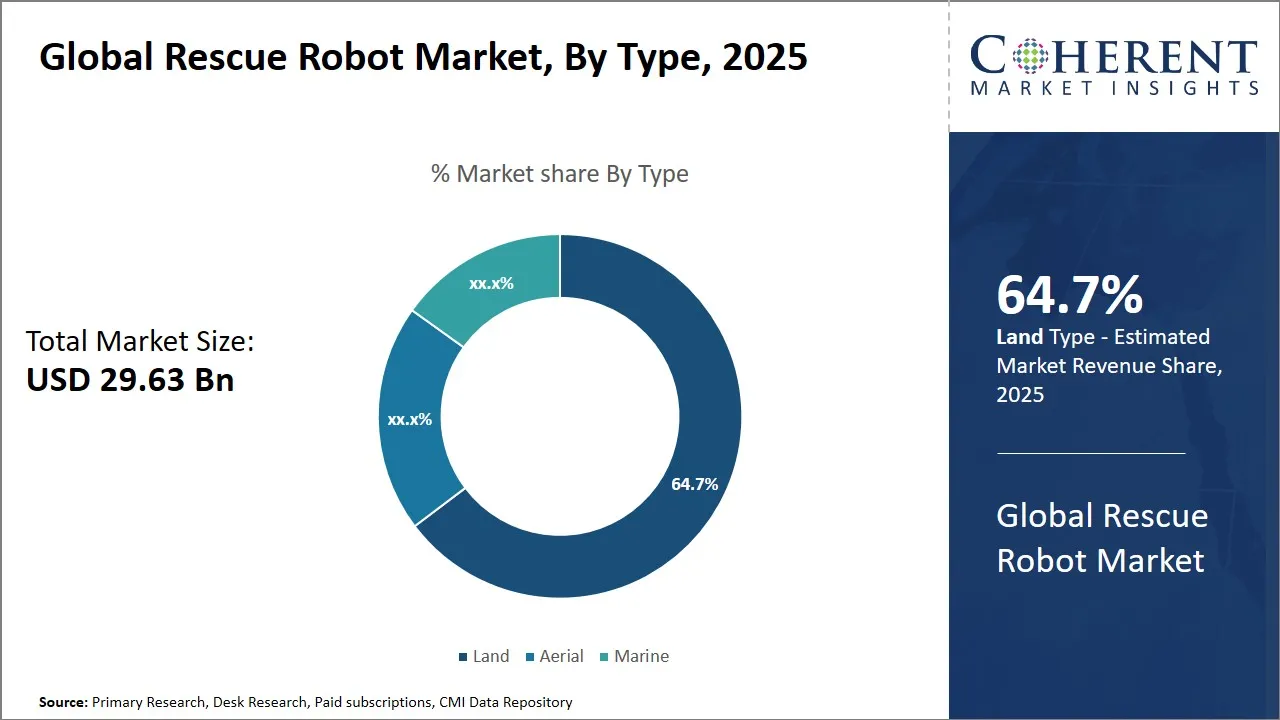
- The land segment leads the market holding an estimated share of 65.7% in 2026.
- The autonomous segment leads the market holding an estimated share of 61.7% in 2026.
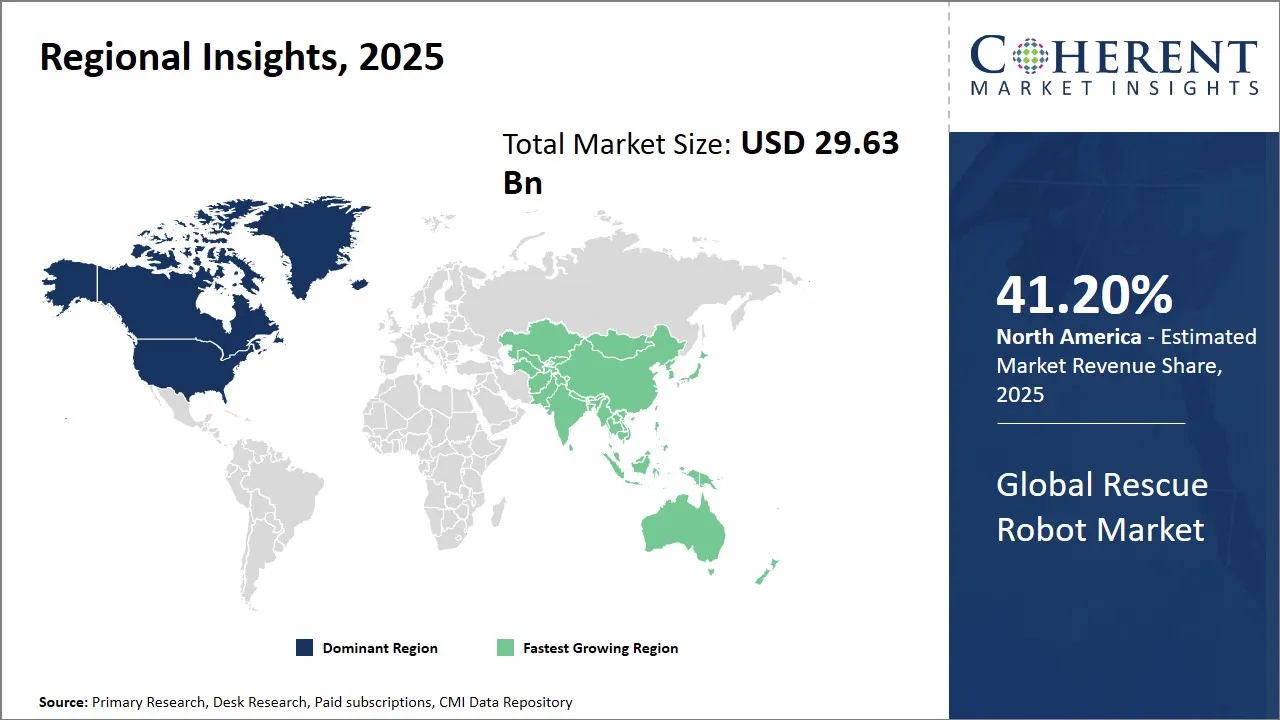
- North America is estimated to lead the market with a share of 41.2 % in 2026.
- Asia Pacific, holding a share of 26.6% in 2026, is projected to be the fastest growing region.
Market Overview
Current market trends indicate a surge in the integration of advanced AI and machine learning capabilities within rescue robots, enhancing their efficiency in complex and hazardous environments. Additionally, the adoption of unmanned ground vehicles (UGVs) and aerial drones for real-time data collection and remote operations is transforming traditional rescue missions. These innovations, coupled with regulatory support and growing private sector involvement, are propelling the market toward rapid expansion in the coming years.
Current Events and Its Impact
Current Events | Description and its impact |
EU‑funded CURSOR project’s SMURF robot prototype |
|
South Korea launches K‑Humanoid Alliance |
|
FAA/drones regulation & ISO standards in U.S./EU |
|
Segmental Insights
- Current Industry Events of 2026
- Market Size Estimation
- Regional Breakdown
- Competitive Landscape
- Customer Intelligence
- Segmental Analysis
- Pricing Analysis
- Key Market Drivers, Challenges & Future Trends
- Customized Insights Section
Global Rescue Robot Market Insights, by Type – Land Segment Leads Due to the Robots’ Versatility and Enhanced Operational Capabilities in Complex Environments
The land segment is expected to hold a share of 65.7% in 2026. Land rescue robots excel in navigating challenging terrains such as rubble-strewn areas post-earthquakes, collapsed buildings, and industrial accident sites where human access is either dangerous or impractical. With rising instances of natural disasters and industrial accidents globally, there is a lot of demand for equipment that can reduce human risk exposure.
Land robots fitted with high-resolution cameras, thermal imaging, and advanced sensors can enter hazardous zones without endangering rescue teams, providing critical real-time data to guide decision-making. Also, the continued advancement in robotics technology, such as improved mobility features and AI-based navigation, add to the effectiveness of land rescue robots.
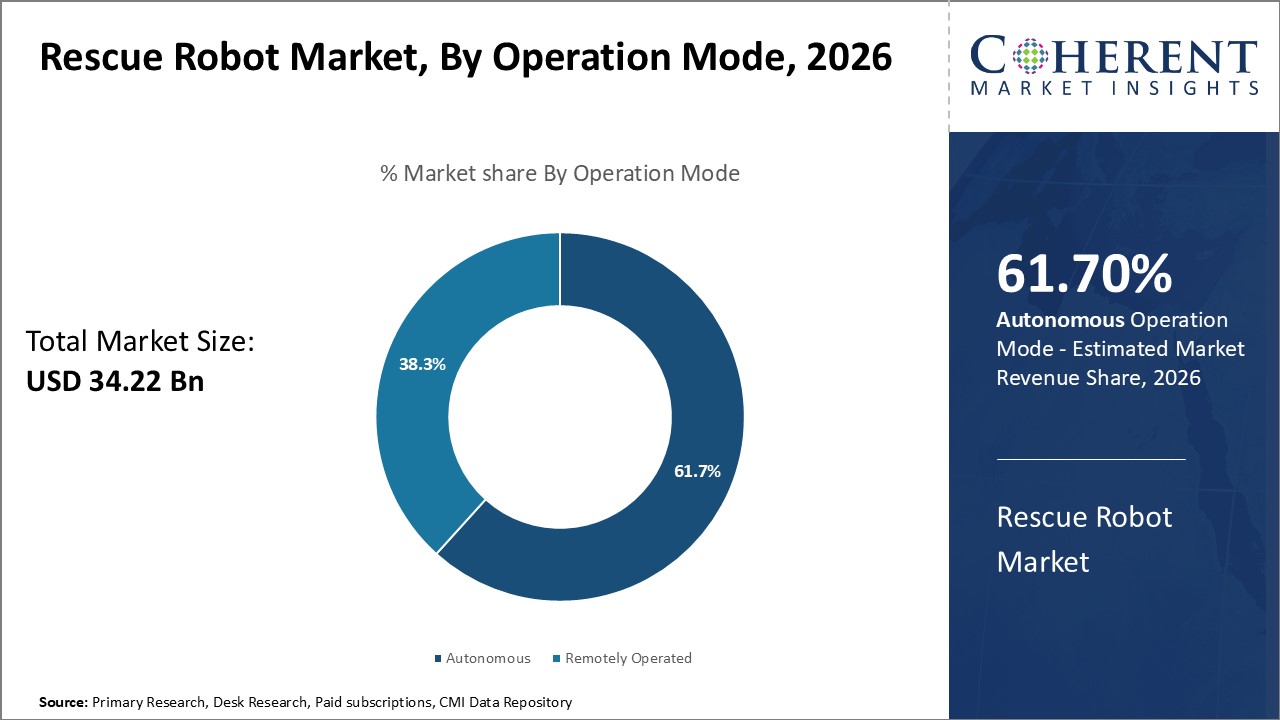
Global Rescue Robot Market Insights, by Operation Mode – Autonomous Segment Leads Due to Advancements in Automation and AI Technologies Enabling Enhanced Efficiency and Safety
Autonomous segment, holding an estimated share of 61.7% in 2026, have emerged as a critical segment in the global rescue robot market. The market is seeing a shift towards autonomous operation because of the ongoing advancements in artificial intelligence (AI), machine learning, sensor integration, and robotics, which help these systems make real-time decisions and perform complex tasks independently.
Another important factor is the improved safety offered by autonomous operation. By minimizing the need for direct human control, these robots lower the risk of operator error and contamination in hazardous settings such as chemical spills, radiation zones, or biological outbreaks. Autonomous systems can also maintain consistent operational performance without fatigue, making possible extended missions that might not be possible with human-controlled devices.
Technological innovations such as advanced path planning, obstacle recognition, and adaptive learning add to the reliability and resilience of autonomous rescue robots. These features help the robots handle dynamic environments, make on-the-fly adjustments, and overcome barriers without manual input.
Impact of AI on the Rescue Robot Market
Artificial Intelligence (AI) is significantly transforming the rescue robot market by enabling autonomous decision-making, real-time navigation, and advanced hazard recognition in complex environments. AI-powered rescue robots can analyze visual, thermal, and acoustic data to identify survivors, map disaster zones, and avoid obstacles without human intervention. These capabilities dramatically improve the speed and accuracy of search-and-rescue missions, especially in inaccessible or hazardous locations such as collapsed buildings, chemical spill zones, or earthquake-hit areas.
Moreover, AI integration reduces the cognitive load on human operators and enhances multi-robot coordination, which is crucial during large-scale emergencies. A compelling real-world example is the deployment of Deep Robotics’ Jueying X30, an AI-powered quadruped robot, used by Singapore Power for underground inspections and rescue operations.
Regional Insights
North America Rescue Robot Market Analysis and Trends
North America, holding an estimated share of 41.2% in 2026, dominates the global rescue robot market, driven by a well-established technological ecosystem, strong government support, and a robust industrial base focused on advanced robotics and defense applications. The U.S. Department of Defense and various federal agencies actively endorse the development and deployment of rescue robots for disaster response, search and rescue missions, and homeland security, bolstering innovation and funding.
Leading companies such as Boston Dynamics, FLIR Systems, and Endeavor Robotics significantly contribute by developing versatile and high-performance rescue robots capable of operating in diverse and challenging environments. For instance, Boston Dynamics, based in the U.S., continues to enhance its Spot quadruped robot for emergency response.
Asia Pacific Rescue Robot Market Analysis and Trends
The Asia Pacific region, holding an estimated share of 26.6% in 2026, exhibits the fastest growth, propelled by accelerating urbanization, increased frequency of natural disasters, and rising government investments in public safety infrastructure. Countries such as Japan, South Korea, China, and India are actively incorporating rescue robotics within their disaster management frameworks to improve emergency response efficiency. The presence of a growing manufacturing sector and rapid technological adoption fuels market expansion. In January 2026, Deep Robotics unveiled and field-deployed the Jueying X30, a quadruped robot designed for subterranean and disaster-prone environments.
Supportive government initiatives, including subsidies and research grants, have encouraged domestic production and innovation. Prominent players like Toshiba (Japan), Hyundai Robotics (South Korea), and DJI (China) are leveraging advanced AI and sensor integration technologies to create affordable, scalable rescue robots tailored for local needs.
Global Rescue Robot Market Outlook for Key Countries
U.S. Rescue Robot Market Analysis and Trends
The U.S. rescue robot market thrives on its high defense expenditure and a well-developed ecosystem for robotics research and commercialization. Key players such as Boston Dynamics, with their Spot robot, have demonstrated versatile applications ranging from disaster sites to military operations. FLIR Systems contributes specialized thermal imaging technology critical for locating victims during rescue missions. U.S. agencies frequently collaborate with private firms to pilot innovative solutions addressing both urban and wildland emergencies, cementing the country's leading position in product development and deployment.
Japan Rescue Robot Market Analysis and Trends
Japan benefits from a history of integrating robotics into disaster preparedness following frequent earthquakes and tsunamis. Companies like Toshiba and Mitsubishi Electric are pioneers in deploying rescue robots equipped with advanced mobility and sensory capabilities designed to navigate debris and hazardous environments. The government actively funds research under agencies like New Energy and Industrial Technology Development Organization (NEDO) to foster innovation. Japan’s emphasis on public safety and disaster resilience positions it as a key influencer in the global rescue robot landscape.
China Rescue Robot Market Analysis and Trends
China continues to lead Asia Pacific’s market growth through significant government backing and increased investments by state-owned enterprises and private manufacturers. Firms like DJI and Great Wall Robotics have introduced multi-functional rescue robots, focusing on affordability and mass production. China’s large and diverse landscape necessitates varied robot designs capable of rapid deployment in urban disasters, floods, and industrial accidents.
Germany Rescue Robot Market Analysis and Trends
Germany is characterized by its strong engineering tradition and integration of advanced automation technologies. Companies, such as KUKA and Schunk, provide sophisticated robotic platforms capable of precise maneuvering and real-time hazard detection, which are integral to rescue operations. The German government, through programs promoting Industry 4.0 and smart manufacturing, encourages local development of rescue robotics.
India Rescue Robot Market Analysis and Trends
India rescue robot market is rapidly evolving, fueled by increasing urban challenges and recent experiences with natural disasters. The government is pushing initiatives to enhance disaster response through technology adoption, including collaborations with startups and international partners. Companies like Systemantics and TATA Consultancy Services work on developing cost-effective, easy-to-operate robotic solutions tailored for India’s unique terrain and infrastructural constraints. Expanding public safety budgets and rising awareness contribute to the growing acceptance and integration of rescue robots across various states.
Market Players, Key Development, and Competitive Intelligence
Key Developments
- In February 2025, researchers at the MIT Lincoln Laboratory, in collaboration with the University of Notre Dame, created a vine-like robot that can squeeze between rubble. The robot could ease emergency responders’ burden following disastrous structural collapses.
- In November 2024, researchers from the University of Pennsylvania School of Engineering and Applied Science (Penn Engineering) developed PanoRadar, a new tool to give robots superhuman vision by transforming simple radio waves into detailed, 3D views of the environment.
- In September 2024, Austal Australia and Greenroom Robotics announced the establishment of a strategic commercial partnership, following the successful completion of the Patrol Boat Autonomy Trial (PBAT) for the Royal Australian Navy. The Strategic Partnership Agreement (SPA) will see Austal Australia and Greenroom Robotics collaborate further on developing watercraft-based products, services, and technologies that may reduce crewing, increase safety, and enable remote and autonomous operation of vessels designed and constructed by Austal Australia.
- In November 2023, Austal Australia announced that West Australian-based Greenroom Robotics has joined the Patrol Boat Autonomy Trial, underway for Trusted Autonomous Systems and the Royal Australian Navy. Greenroom Robotics integrated its Uncrewed Surface Vessel (USV) control software, known as GAMA, into Sentinel (a decommissioned Armidale-class Patrol Boat) that will allow autonomous navigation, remote pilotage and control, mission planning and operations.
Top Strategies Followed by Rescue Robot Market Players
- Established players dominate the market by investing heavily in research and development to innovate and introduce high-performance, technologically advanced rescue robots. These companies prioritize the integration of enhanced sensory systems, autonomous navigation capabilities, and robust materials, which significantly elevate the operational efficiency and reliability of their products.
- In 2025, Boston Dynamics partnered with NASA’s Jet Propulsion Laboratory to develop advanced terrain-adaptive rescue robots capable of navigating Martian-like and earthquake-affected terrains autonomously.
- Mid-level players in the global rescue robot market adopt a more cost-conscious approach, focusing on delivering solutions that strike a balance between quality and affordability. By targeting price-sensitive consumers such as smaller municipalities, non-governmental organizations, and mid-sized enterprises, these companies address a critical segment of the market that seeks functional yet economical robotic solutions for rescue operations.
- Tmsuk (Japan) launched a low-cost version of its T-53 Enryu disaster-response robot in late 2024, targeting municipal fire departments in Southeast Asia.
- Small-scale players in the global rescue robot market differentiate themselves by focusing on niche applications and innovative product attributes that cater to specialized rescue scenarios or emerging technological trends.
- Squishy Robotics (USA) specializes in deployable aerial-to-ground robots that cushion their landing from drones and then monitor hazardous environments such as gas leaks or fires.
Market Report Scope
Rescue Robot Market Report Coverage
| Report Coverage | Details | ||
|---|---|---|---|
| Base Year: | 2025 | Market Size in 2026: | USD 34.22 Bn |
| Historical Data for: | 2020 To 2024 | Forecast Period: | 2026 To 2033 |
| Forecast Period 2026 to 2033 CAGR: | 15.5% | 2033 Value Projection: | USD 93.84 Bn |
| Geographies covered: |
| ||
| Segments covered: |
| ||
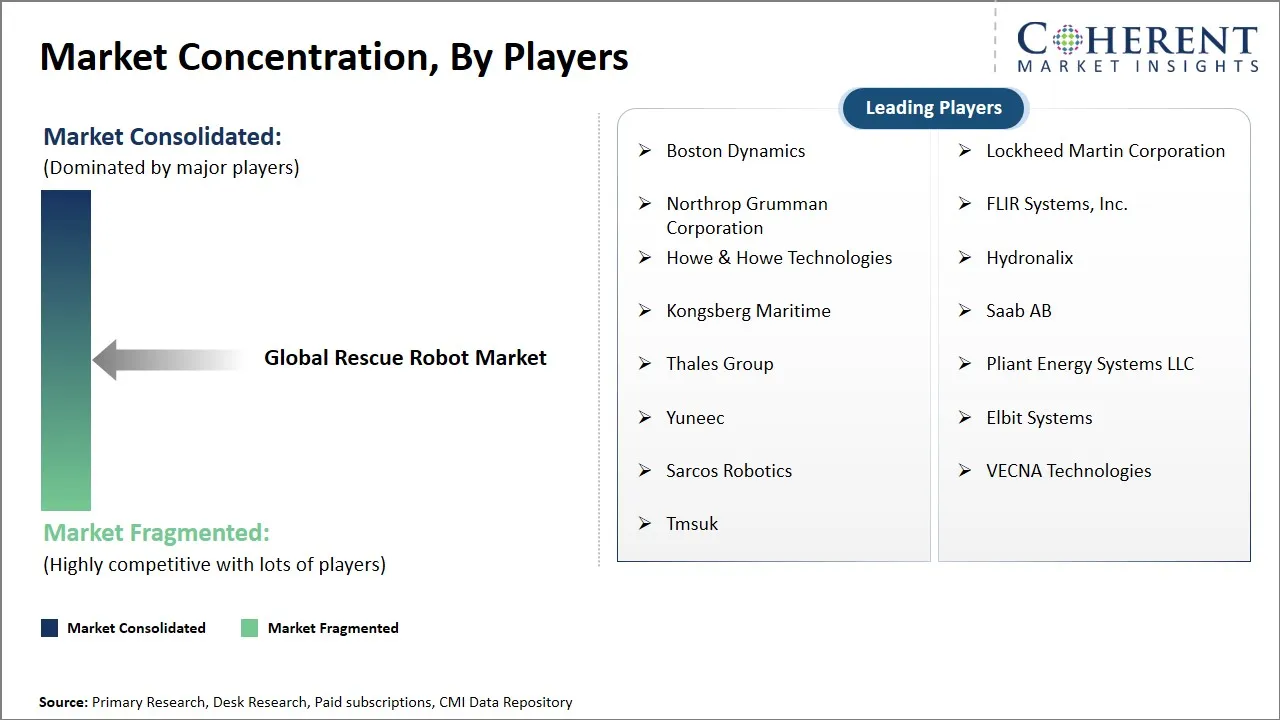
| Companies covered: | Boston Dynamics, Lockheed Martin Corporation, Northrop Grumman Corporation, FLIR Systems, Inc., Howe & Howe Technologies, Hydronalix, Kongsberg Maritime, Saab AB, Thales Group, Pliant Energy Systems LLC, Yuneec, Elbit Systems, Sarcos Robotics, VECNA Technologies, and Tmsuk | ||
| Growth Drivers: |
| ||
| Restraints & Challenges: |
| ||
Market Dynamics
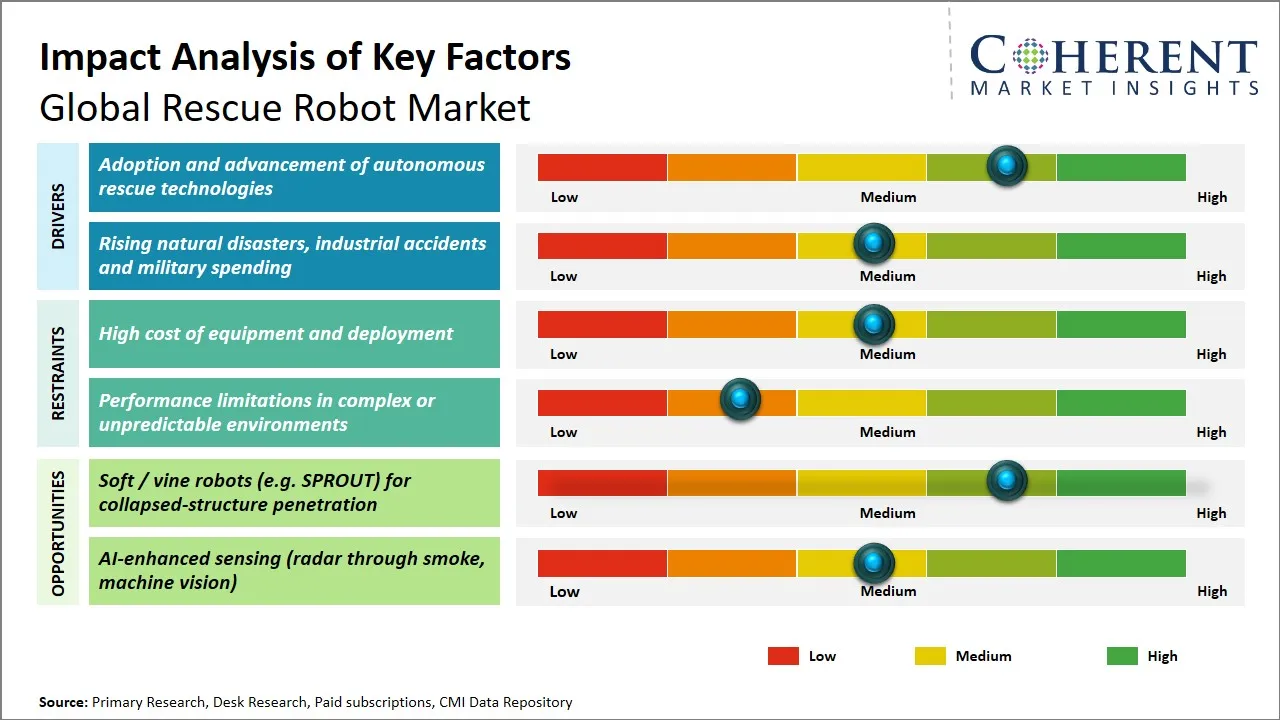
Global Rescue Robot Market Driver – Adoption and Advancement of Autonomous Rescue Technologies
Modern rescue operations demand rapid, precise, and safe interventions, which autonomous robots are uniquely positioned to provide by minimizing human risk in hazardous environments such as disaster zones, collapsed structures, and contaminated areas. Improvements in artificial intelligence, machine learning algorithms, sensor technologies, and real-time data processing have collectively enhanced the decision-making capabilities and operational efficiency of rescue robots. Deep Robotics, a leading Chinese robotics firm, has partnered with Singapore Power Group to deploy its Jueying X30 quadruped robot for underground inspection and emergency response readiness. This autonomous robot is equipped with advanced AI navigation, obstacle detection, and LiDAR-based spatial mapping capabilities.
These robots can now navigate complex terrains, identify victims, and relay critical information back to human operators without direct assistance, enabling faster response times and more effective search and rescue missions. Furthermore, integration with drones and other unmanned systems is expanding the scope and versatility of rescue applications.
Global Rescue Robot Market Opportunity – Soft/Vine Robots (e.g. SPROUT) for Collapsed-Structure Penetration
The global rescue robot market is witnessing a significant growth opportunity with the development and deployment of soft and vine robots, such as the SPROUT system, specifically designed for collapsed-structure penetration. Traditional rigid rescue robots often face challenges in navigating through narrow, unstable, and debris-filled environments typical of disaster sites. Soft and vine robots, constructed with flexible, compliant materials, offer enhanced adaptability and maneuverability, allowing them to squeeze through confined spaces and complex terrains that are otherwise inaccessible to conventional robots. This capability is critical for search and rescue operations following earthquakes, landslides, or structural failures, where timely access to survivors trapped under rubble can be life-saving.
Furthermore, these robots can minimize additional damage to fragile structures, as their softness reduces the risk of causing further collapse. The integration of advanced sensing technologies and AI-driven navigation enhances their ability to detect human presence, assess structural stability, and transmit real-time data back to rescue teams.
Analyst Opinion (Expert Opinion)
- The integration of artificial intelligence in rescue robots is evolving beyond navigation assistance into full-fledged decision-making systems. With advancements in reinforcement learning, sensor fusion, and edge computing, rescue robots can now autonomously adapt to chaotic, dynamic environments like collapsed buildings or wildfire zones. This shift reduces dependency on remote operators, speeds up mission response time, and expands the range of viable deployment scenarios. Real-world deployments—such as Deep Robotics’ Jueying X30 in Singapore—demonstrate that field-tested autonomy is no longer a future goal but a current differentiator.
- Traditional rigid-frame robots face serious limitations in navigating debris-filled or unstable environments. Enter soft robotics—vines, tentacle-like forms, and shape-morphing actuators that mimic biological systems. These innovations, such as the SPROUT vine robot from MIT, allow safe entry into collapsed structures without further disturbing them, enabling detection of life or hazards in areas previously inaccessible. As disaster zones grow more complex and high-risk, the value of adaptable, deformable robots will surge across military, urban, and industrial response missions.
- Modern rescue robots increasingly employ compact, multi-modal sensor suites that combine thermal imaging, LiDAR, hyperspectral vision, and radar capable of seeing through smoke or debris. These sensory advancements are transforming situational awareness during missions, enabling robots to build 3D maps in real time, detect trapped survivors, and monitor gas leaks or structural stress. Notably, the convergence of miniaturized sensors with edge AI is pushing robot size down while increasing capability—making them more agile, affordable, and mission-critical than ever before.
Speak to the analyst
Want personalized insights?
Take the findings above to one of our principal consultants, or have the report rebuilt around the segments, geographies and competitors you actually track.
Market Segmentation
- Type Insights (Revenue, USD Bn, 2021 - 2033)
- Land
- Aerial
- Marine
- Operation Mode Insights (Revenue, USD Bn, 2021 - 2033)
- Autonomous
- Remotely Operated
- Regional Insights (Revenue, USD Bn, 2021 - 2033)
- North America
- U.S.
- Canada
- Latin America
- Brazil
- Argentina
- Mexico
- Rest of Latin America
- Europe
- Germany
- U.K.
- Spain
- France
- Italy
- Russia
- Rest of Europe
- Asia Pacific
- China
- India
- Japan
- Australia
- South Korea
- ASEAN
- Rest of Asia Pacific
- Middle East
- GCC Countries
- Israel
- Rest of Middle East
- Africa
- South Africa
- North Africa
- Central Africa
- North America
- Key Players Insights
- Boston Dynamics
- Lockheed Martin Corporation
- Northrop Grumman Corporation
- FLIR Systems, Inc.
- Howe & Howe Technologies
- Hydronalix
- Kongsberg Maritime
- Saab AB
- Thales Group
- Pliant Energy Systems LLC
- Yuneec
- Elbit Systems
- Sarcos Robotics
- VECNA Technologies
- Tmsuk
Sources
Primary Research Interviews
Stakeholders
- Defense and Military Agencies (e.g., Emergency Response Coordinators, Disaster Command Officers)
- Firefighting and Emergency Rescue Units (e.g., Fire Chiefs, Search & Rescue Technicians)
- Robotics and AI Solution Providers (e.g., Lead Engineers, CTOs)
- Disaster Relief NGOs and Humanitarian Agencies (e.g., UN OCHA, Red Cross field officers)
- Drone and Ground Robotics Manufacturers (e.g., Boston Dynamics, Deep Robotics, Tmsuk)
- Academic and Research Institutions specializing in AI, autonomy, and disaster robotics
- Public Safety Authorities and Homeland Security Departments
Databases
- International Rescue Robotics Consortium (IRRC)
- Global Robotics and Disaster Data Exchange (GRDDE)
- Defense Innovation Analytics Hub (DIAH)
- U.S. Census
- Eurostat
- OECD
- Emergency Tech Deployment Tracker (ETDT)
Magazines
- Robotics Today
- Disaster Response Technology Magazine
- AI & Robotics Weekly
- RescueTech Insight
- Defense and Security Systems Review
- Public Safety Engineering Monthly
Journals
- Journal of Emergency Robotics and AI Systems
- Journal of Autonomous Systems in Public Safety
- International Journal of Rescue Robotics Innovation
- Journal of Disaster Risk Science and Engineering
- Journal of Building Engineering
- Automation in Construction Journal
Newspapers
- The Disaster Chronicle
- Global Robotics Bulletin
- The Guardian (UK)
- The Economic Times (India)
- Rescue News Network (RNN)
- Construction Week Online
Associations
- International Rescue Robotics Association (IRRA)
- Global Disaster Response Robotics Forum (GDRRF)
- American Society for Emergency Robotics (ASER)
- Asia-Pacific Robotics Response Council (APRRC)
- European Robotics for Safety Alliance (ERSA)
- National Search & Rescue Association (NSARA)
Public Domain Sources
- U.S. Census Bureau
- EUROSTAT
- World Bank
- United Nations Economic Commission for Europe (UNECE)
- ResearchGate
- International Civil Defence Organization (ICDO)
Proprietary Elements
- CMI Data Analytics Tool, Proprietary CMI Existing Repository of information for last 8 years
Get access to 250+ pages report
Every segment, forecast, competitor profile and data table behind the analysis above — available for instant download.
- ESOMAR Member
- ISO 9001:2015 Certified
- D-U-N-S Registered
- GDPR & CCPA Compliant
Missing comfort of reading report in your local language? Find your preferred language:
Transform your Strategy with Exclusive Trending Reports
Frequently Asked Questions
The global rescue robot market is estimated to be valued at USD 34.22 billion in 2026 and is expected to reach USD 93.84 billion by 2033.
The CAGR of global rescue robot market is projected to be 15.5% from 2026 to 2033.
Adoption and advancement of autonomous rescue technologies and rising natural disasters, industrial accidents and military spending are the major factors driving the growth of the global rescue robot market.
High cost of equipment and deployment and performance limitations in complex or unpredictable environments are the major factors hampering the growth of the global rescue robot market.
In terms of type, land is estimated to dominate the market revenue share in 2026.
Rescue robots are deployed in disaster zones—such as collapsed buildings, wildfires, and flood zones—for locating survivors, mapping environments, and delivering supplies or communication tools.
AI-powered autonomy, multi-sensor fusion, and soft robotics are key technologies enhancing robot effectiveness in complex rescue scenarios.