

Global Robotic Parking System Market Size and Forecast – 2026-2033
The Global Robotic Parking System Market is estimated to be valued at USD 420.3 Mn in 2026 and is expected to reach USD 1077.8 Mn by 2033, exhibiting a compound annual growth rate (CAGR) of 14.4% from 2026 to 2033.
Key Takeaways of the Robotic Parking System Market
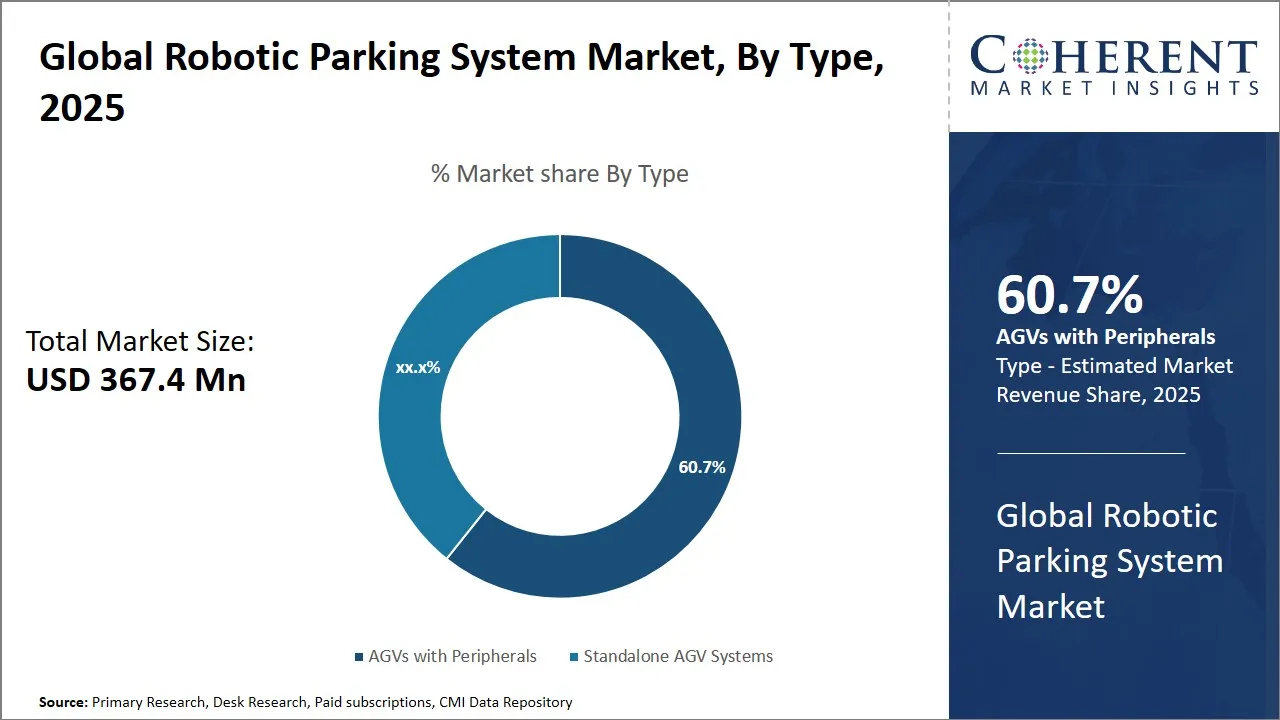
- The AGVs with peripherals segment leads the market, holding an estimated share of 61.7% in 2026.
- The fully automated segment leads the market, holding an estimated share of 72.3% in 2026.
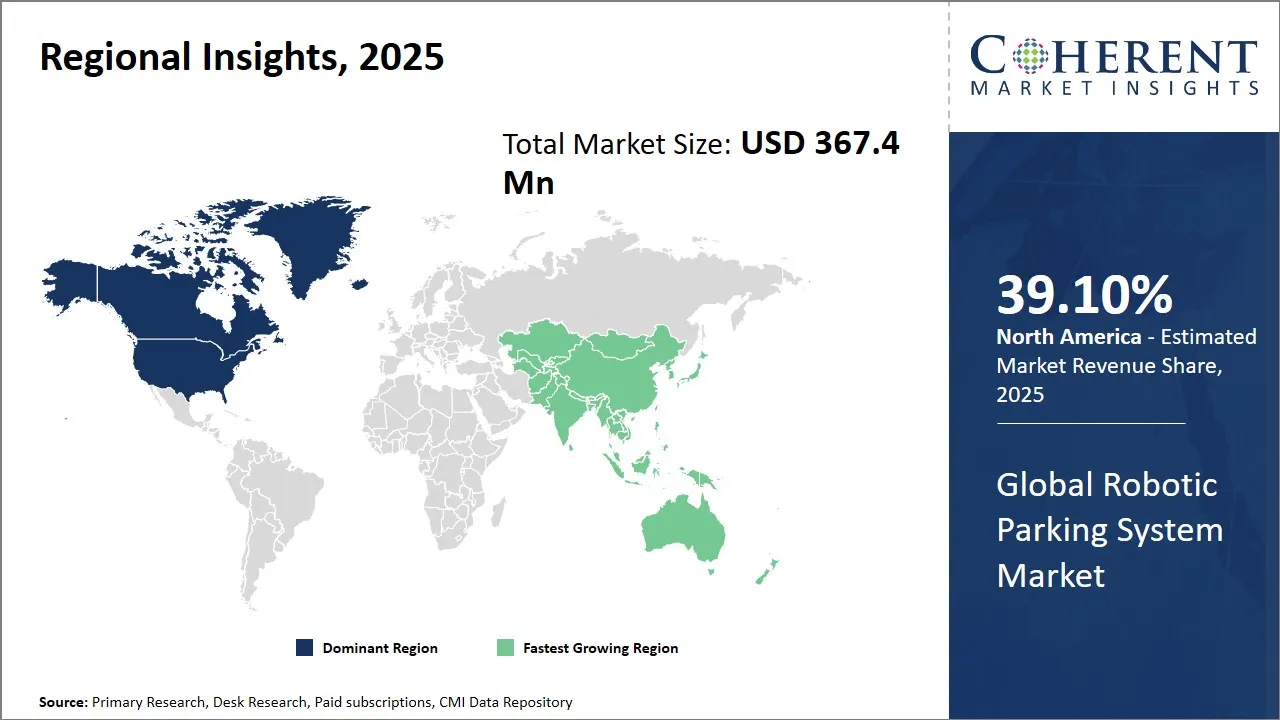
- North America is estimated to lead the market with a share of 39. 1% in 2026.
- Asia Pacific, holding a share of 25. 6% in 2026, is projected to be the fastest growing region.
Market Overview
A key trend shaping the Robotic Parking System Market is the integration of smart technologies such as IoT and AI to improve operational efficiency and user experience. Increasing investment in smart city projects is creating a lot of demand for automated parking systems that optimize space utilization and reduce carbon emissions. Additionally, rising vehicle ownership and urban congestion are accelerating the need for innovative parking solutions, further propelling market growth.
Current Events and Its Impact
Current Events | Description and its impact |
Geopolitical and Regulatory Developments |
|
Regional Infrastructure Projects and Urban Redevelopment |
|
Segmental Insights
- Current Industry Events of 2026
- Market Size Estimation
- Regional Breakdown
- Competitive Landscape
- Customer Intelligence
- Segmental Analysis
- Pricing Analysis
- Key Market Drivers, Challenges & Future Trends
- Customized Insights Section
Global Robotic Parking System Market Insights, by Type – AGVs with Peripherals Lead Due to Enhanced Operational Efficiency and System Integration
The AGVs with peripherals segment is expected to hold the highest share of 61.7% in 2026, are largely driven by their superior operational capabilities and seamless integration with ancillary systems. AGVs with peripherals include a network of sensors, cameras, communication modules, and control units that complement the core automated guided vehicles, enabling a more sophisticated parking management experience. This integration is critical in environments requiring high throughput and precision, such as multi-level urban parking facilities, airports, and commercial complexes.
One of the main growth drivers for this segment is the heightened need for maximizing parking space utilization while minimizing human intervention. AGVs with peripherals facilitate real-time monitoring and communication between vehicles, guiding systems, and parking structure controls, which boosts accuracy in vehicle placement and retrieval. This results in reduced vehicle turnaround time and optimized space usage, a necessity in crowded urban centers where parking scarcity is a major pain point.
Moreover, AGVs with peripherals offer advanced safety features that reduce the risk of accidents and vehicle damage, which is crucial for consumer trust and adoption. Features like obstacle detection, real-time alerts, and automated emergency stops enhance operational security. The ability to integrate with existing infrastructure components such as payment systems, access controls, and cloud-based management platforms provides a highly scalable and customizable solution tailored to diverse parking facility requirements.
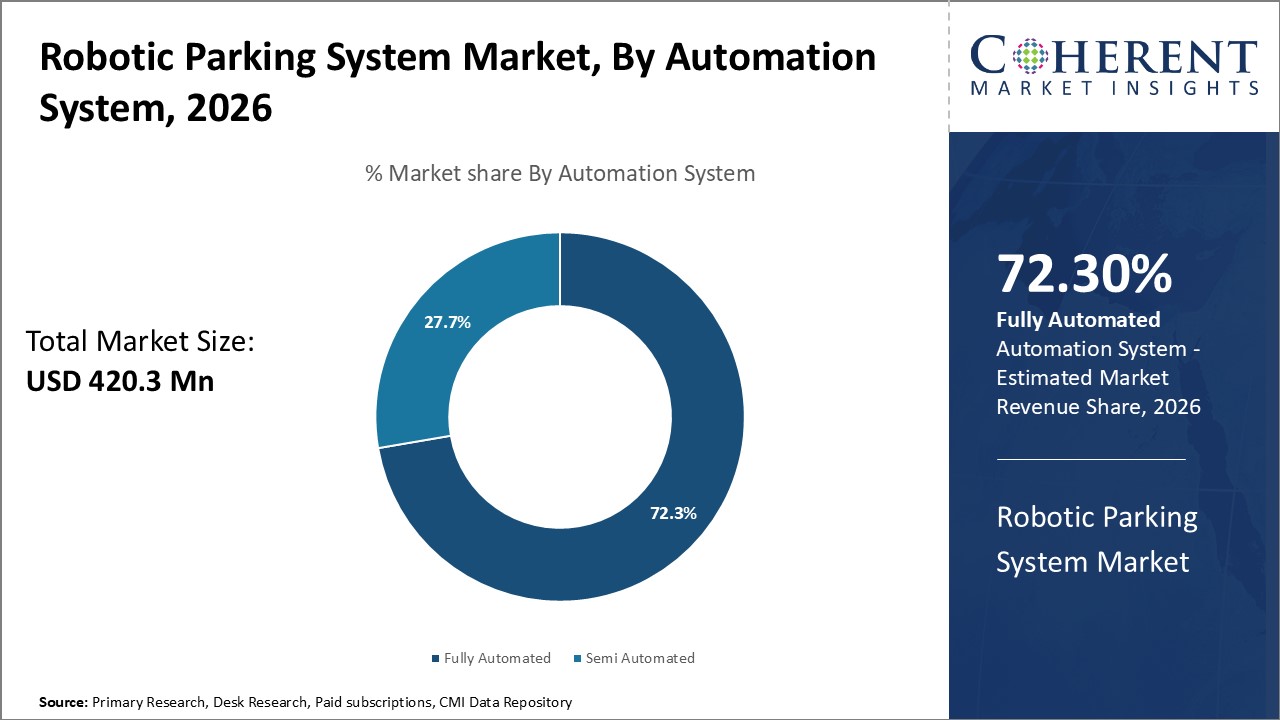
Global Robotic Parking System Market Insights, by Automation System – Fully Automated Systems lead owing to their unmatched operational autonomy and user convenience
The fully automated segment is expected to hold the highest market share of 72.3% in 2026. Fully automated parking systems eliminate the need for driver intervention by automating every aspect of parking—from vehicle identification and entry to storage and retrieval—providing a seamless, contactless experience.
A key factor fueling the growth of fully automated systems is the increasing demand for smart, hassle-free parking solutions in urban areas facing chronic parking shortages and traffic congestion. These systems help reduce the time drivers spend searching for parking spots, reducing urban traffic and decreasing carbon emissions from idling vehicles. The complete automation streamlines traffic flow within parking facilities, enabling faster vehicle turnover and maximizing space efficiency.
Fully automated robotic parking systems leverage cutting-edge technologies such as machine learning, computer vision, and IoT connectivity, allowing continuous improvement in parking precision and facility management. The elimination of human-driven errors reduces damage risks, maintenance costs, and liability issues, which encourages adoption by commercial property developers and municipalities looking for reliable, low-risk parking investments.
Impact of AI on the Robotic Parking System Market
Artificial Intelligence (AI) is significantly transforming the robotic parking system market by enhancing system intelligence, automation precision, and operational efficiency. AI algorithms enable real-time decision-making for optimal space allocation, vehicle tracking, and traffic flow within parking facilities. AI-powered cameras and sensors support license plate recognition, predictive maintenance, and dynamic parking guidance, reducing wait times and improving user experience. As smart cities continue to adopt integrated mobility solutions, the demand for AI-driven parking automation is rising, especially in high-density urban environments.
Stanley Robotics' automated valet parking system, deployed at Lyon-Saint Exupéry Airport in France, uses AI to detect vehicle size, select appropriate parking spaces, and operate autonomous mobile robots that park vehicles without human intervention. By combining AI with robotics, Stanley Robotics has improved space efficiency by up to 50% compared to traditional parking.
Regional Insights
North America Robotic Parking System Market
North America, holding a share of 39.1% in 2026, is expected to dominate the global robotic parking system market, fueled by rapid urbanization, high vehicle ownership rates, and the rising demand for smart infrastructure across metropolitan areas. Government-backed initiatives supporting smart city frameworks, along with local mandates for efficient land use and green building certifications (e.g., LEED), are driving adoption in both commercial and residential developments. Additionally, the strong presence of tech-forward players such as Westfalia Technologies (U.S.), CityLift Parking (U.S.), and Automated Parking Corp. (U.S.) contributes to market growth through innovations in AI integration, EV charging compatibility, and modular system design. For instance, in 2023, Westfalia Technologies introduced WEPLUG, an integrated automated EV fast-charging solution for robotic parking systems.
Asia Pacific Robotic Parking System Market
The Asia Pacific, holding a share of 25.6% in 2026, is expected to exhibit the fastest growth in the global robotic parking system market, fueled by rapid urbanization, escalating real estate prices, and increasing vehicle ownership in densely populated cities. Governments in countries like China, Japan, South Korea, and Singapore actively promote smart infrastructure projects to address space scarcity and traffic congestion, often backed by substantial financial incentives for technology adoption.
The burgeoning middle class and growing awareness about advanced parking convenience are intensifying the demand for robotic parking systems. Local industry players such as Beijing Tiandi Science & Technology (China), Park Plus System (India), and Mitsubishi Electric (Japan) are aggressively expanding product portfolios tailored for varied urban environments. For instance, in 2026, ARAPL launched India’s first AGV-based multi-level robotic parking system in Pune.
Global Robotic Parking System Market Outlook for Key Countries
Germany Robotic Parking System Market
Germany remains a leader due to the country’s strong automotive heritage and continuous investment in smart urban infrastructure. Major firms like KLAUS Multiparking and Wohr Parking Systems pioneer innovative robotic solutions with a strong emphasis on reliability and sustainability. Germany’s regulatory framework promoting energy efficiency and reduced urban sprawl further solidifies demand. The presence of multiple pilot projects in smart cities adds momentum, positioning Germany as both a technology developer and a key adopter in Europe.
China Robotic Parking System Market
China’s expansion is largely driven by high urban population density and government-backed initiatives such as the Smart City and New Infrastructure plans. Beijing Tiandi Science & Technology leads local innovation combined with global partnerships to produce scalable robotic parking solutions tailored for crowded urban landscapes. Rapid industrialization, coupled with rising vehicle ownership amplifies the demand surge.
Japan Robotic Parking System Market
Japan continues to lead innovation in robotic parking systems thanks to a longstanding commitment to automation and robotics as part of its industrial identity. Mitsubishi Electric and Hitachi provide cutting-edge automated parking solutions integrating advanced robotics and AI to efficiently use limited urban spaces. The country’s aging population also created demand for easy-to-use automated parking systems that require minimal physical effort.
U.S. Robotic Parking System Market
The U.S. sees extensive technological innovation and growing adoption of smart infrastructure in urban centers. Companies such as Park Plus and Robotic Parking Systems Inc. develop versatile automated parking models suited for different environments such as commercial hubs and airports. Trade dynamics allow the import of sophisticated components, enriching the local supply chain.
Singapore Robotic Parking System Market
The market in Singapore is driven by the city-state’s space constraints and ambitious Smart Nation initiatives. Housing a tech-savvy populace and strong government support, local companies and international players collaborate to offer highly efficient robotic parking systems. Singapore’s strategic position as a trade and technology hub in Southeast Asia adds to its continued innovation and deployment.
Market Players, Key Development, and Competitive Intelligence
Key Developments
- In February 2025, Manavata Health Campus, comprising HCG Manavta Cancer Centre (HCGMCC) and KIMS Manavata Multi-speciality Hospital, launched India’s largest robotic parking system in a healthcare facility. Spanning 16 floors with the capacity to accommodate 300 vehicles, the state-of-the-art system independently manages vehicle parking without human intervention
- In January 2024, Kopernikus Automotive joined forces with SKIDATA to harness the potential of AI and innovative technologies to transform the parking industry.
- In December 2023, ARAPL collaborated with its subsidiary ARAPL RaaS to develop India's first mobile robotic multi-level car parking system using automated guided vehicles (AGVs).
- In February 2023, BMW Group and Valeo announced their cooperation for the co-development of fully automated parking technologies up to Level 4.
Top Strategies Followed by Robotic Parking System Market Players
- Established market leaders invest heavily in research and development (R&D) to create high-performance, technologically advanced products that meet evolving customer needs.
- Stanley Robotics (France) partnered with airports in France and Germany to pilot AI-powered autonomous valet robots, capable of optimizing space by dynamically adjusting parking patterns. Its continued R&D efforts focus on combining robotics with computer vision and deep learning to enhance autonomous navigation and vehicle handling.
- Mid-level companies in the robotic parking system market primarily focus on delivering cost-effective products that strike a balance between quality and accessibility.
- Wohr Parking Systems (India/Germany) offers simplified puzzle and tower parking systems tailored to space-constrained urban environments in Asia Pacific. Their solutions are designed to minimize upfront investment while offering core automation benefits, making them attractive in price-sensitive markets like Southeast Asia and India.
- Small-scale companies operating in the robotic parking system space differentiate themselves by focusing on niche markets and innovative, specialized features.
- CityLift Parking (USA) focuses on compact urban installations, particularly high-end residential buildings and boutique commercial spaces in cities like San Francisco and Los Angeles.
Market Report Scope
Robotic Parking System Market Report Coverage
| Report Coverage | Details | ||
|---|---|---|---|
| Base Year: | 2025 | Market Size in 2026: | USD 420.3 Mn |
| Historical Data for: | 2020 To 2024 | Forecast Period: | 2026 To 2033 |
| Forecast Period 2026 to 2033 CAGR: | 14.4% | 2033 Value Projection: | USD 1077.8 Mn |
| Geographies covered: |
| ||
| Segments covered: |
| ||
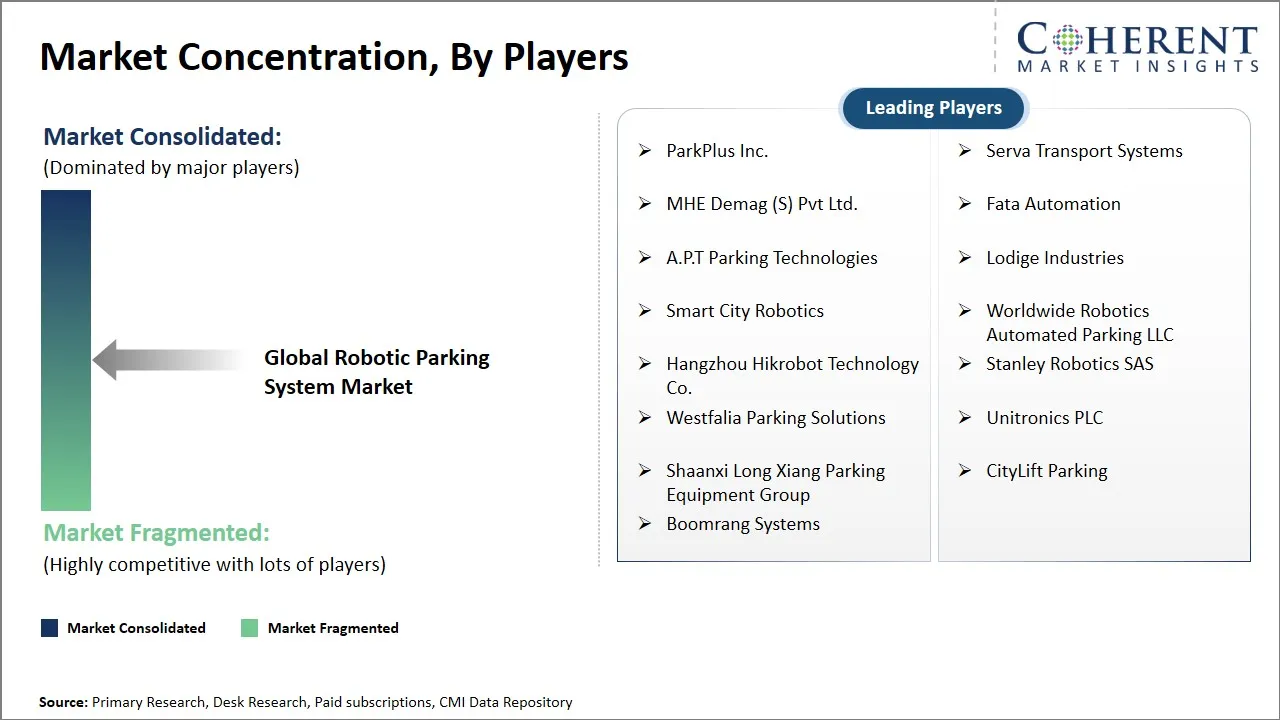
| Companies covered: | ParkPlus Inc., Serva Transport Systems, MHE Demag (S) Pvt Ltd., Fata Automation, A.P.T Parking Technologies, Lodige Industries, Smart City Robotics, Worldwide Robotics Automated Parking LLC, Hangzhou Hikrobot Technology Co., Stanley Robotics SAS, Westfalia Parking Solutions, Unitronics PLC, Shaanxi Long Xiang Parking Equipment Group, CityLift Parking, and Boomrang Systems | ||
| Growth Drivers: |
| ||
| Restraints & Challenges: |
| ||
Market Dynamics
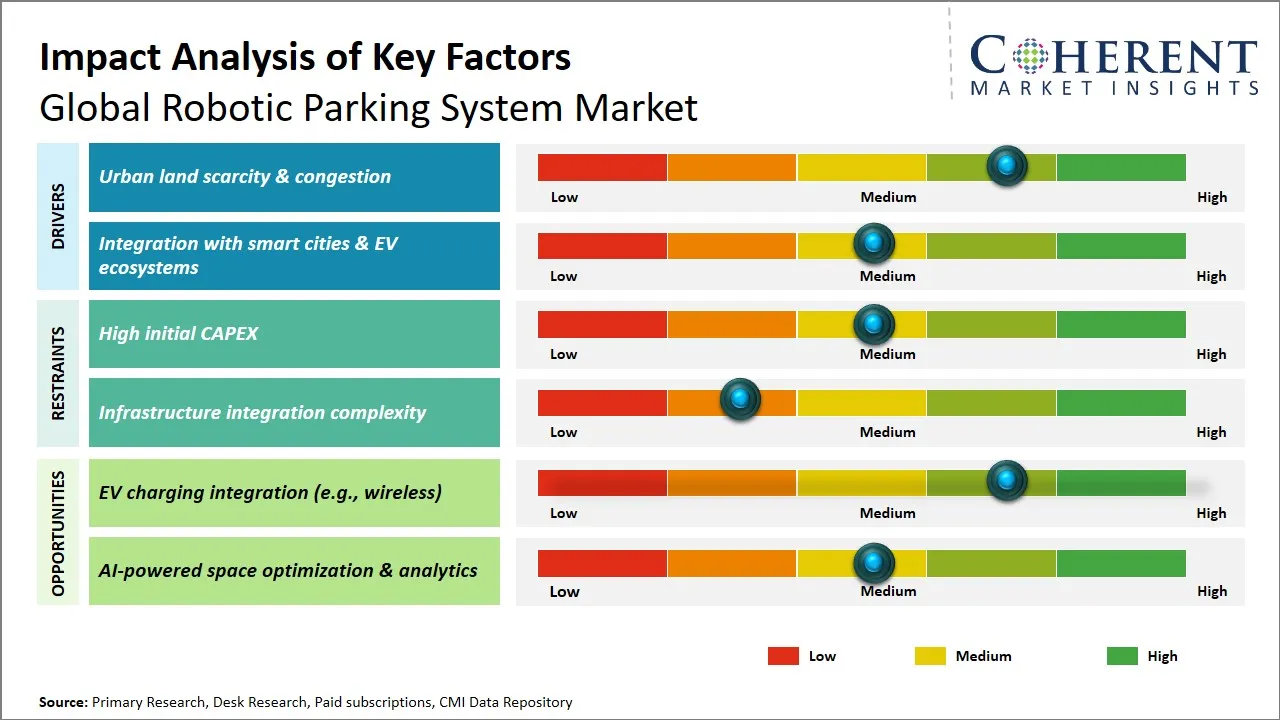
Global Robotic Parking System Market Driver – Urban Land Scarcity & Congestion
Traditional parking lots and garages require significant real estate, which is often both expensive and limited, making it challenging to accommodate the growing number of vehicles. Robotic parking systems help maximize the use of vertical and compact spaces, thereby reducing the footprint needed for vehicle storage. These automated systems make possible efficient stacking and retrieval of cars without the wide aisles required in conventional parking, tackling the issue of urban congestion.
For instance, Dubai International Financial Centre (DIFC) houses a fully automated robotic parking system, installed by Musanada and ParkPlus, to address severe space constraints and growing vehicle density in the central business district. Moreover, as traffic congestion worsens due to inadequate parking infrastructure, robotic parking reduces the time spent searching for parking spots, which also alleviates street-level traffic jams.
Global Robotic Parking System Market Opportunity – Integration of EV Charging Technologies in Robotic Parking Systems
As the adoption of electric vehicles accelerates worldwide due to increasing environmental regulations and consumer preference for sustainable transportation, the demand for convenient and efficient EV charging solutions is rising correspondingly. Robotic parking systems, which maximize space efficiency and minimize human intervention, can be seamlessly adapted to incorporate EV charging stations directly into their automated platforms. This integration facilitates simultaneous parking and charging of EVs, enhancing user convenience and optimizing the utilization of parking facilities.
Wireless charging, in particular, offers a futuristic and user-friendly approach by eliminating the need for physical cables, enabling effortless energy transfer as vehicles are parked. This not only improves the customer experience but also reduces wear and maintenance associated with traditional plug-in chargers.
Analyst Opinion (Expert Opinion)
- The integration of AI-powered computer vision systems is accelerating the shift from mechanical automation to intelligent, adaptive parking solutions. These technologies enable dynamic space optimization, real-time object detection, and seamless vehicle-handling, pushing the boundaries of what "fully automated" truly means.
- As electric vehicles surge, robotic parking systems that incorporate built-in EV charging capabilities—especially wireless and automated connectors, are setting a new benchmark. Market leaders are already piloting these systems, indicating that EV-compatibility will be central to future deployments.
- Scalable, modular robotic parking systems embedded with IoT connectivity are gaining traction for their ability to integrate into broader urban mobility and smart city ecosystems. This adaptability makes them ideal for retrofitting aging infrastructure while supporting future-ready transport networks.
Speak to the analyst
Want personalized insights?
Take the findings above to one of our principal consultants, or have the report rebuilt around the segments, geographies and competitors you actually track.
Market Segmentation
- Type Insights (Revenue, USD Mn, 2021 - 2033)
- AGVs with Peripherals
- Standalone AGV Systems
- Automation System Insights (Revenue, USD Mn, 2021 - 2033)
- Fully Automated
- Semi Automated
- Regional Insights (Revenue, USD Mn, 2021 - 2033)
- North America
- U.S.
- Canada
- Latin America
- Brazil
- Argentina
- Mexico
- Rest of Latin America
- Europe
- Germany
- U.K.
- Spain
- France
- Italy
- Russia
- Rest of Europe
- Asia Pacific
- China
- India
- Japan
- Australia
- South Korea
- ASEAN
- Rest of Asia Pacific
- Middle East
- GCC Countries
- Israel
- Rest of Middle East
- Africa
- South Africa
- North Africa
- Central Africa
- North America
- Key Players Insights
- ParkPlus Inc.
- Serva Transport Systems
- MHE Demag (S) Pvt Ltd.
- Fata Automation
- P.T Parking Technologies
- Lodige Industries
- Smart City Robotics
- Worldwide Robotics Automated Parking LLC
- Hangzhou Hikrobot Technology Co.
- Stanley Robotics SAS
- Westfalia Parking Solutions
- Unitronics PLC
- Shaanxi Long Xiang Parking Equipment Group
- CityLift Parking
- Boomrang Systems
Sources
Primary Research Interviews
Stakeholders
- Robotic Parking System Manufacturers (e.g., Westfalia, ParkPlus, CityLift Parking)
- Real Estate Developers and Urban Infrastructure Planners
- Smart City Project Consultants
- Automation and Robotics Engineers
- EV Charging Infrastructure Providers
- Airport and Commercial Facility Managers using automated parking systems
- Local Transportation Authorities and Municipal Parking Boards
Databases
- UrbanMobility Database (UMD)
- SmartInfraTech Data Repository
- APAC Smart Parking Intelligence Archive
- North American Infrastructure Index (NAII)
Magazines
- Automation & Mobility Review
- Smart Parking Innovations Magazine
- Urban Infrastructure Today
- Future Transport Design Quarterly
Journals:
- International Journal of Urban Mobility & Robotics
- Smart Infrastructure Systems Journal
- Journal of Intelligent Transportation and Parking
- Technologies in Urban Planning & Automation
Newspapers
- The Parking Gazette (Global)
- Mobility Times (Asia Edition)
- Infrastructure Today (North America)
- The Urban Developer Daily
Associations
- International Parking & Mobility Institute (IPMI)
- Urban Smart Parking Association (USPA)
- Asia Pacific Transport Automation Association (APTAA)
- North American Robotic Infrastructure Federation (NARIF)
- Global EV + Parking Integration Council (GEPIC)
Public Domain Sources
- U.S. Census Bureau
- EUROSTAT
- United Nations Economic Commission for Europe (UNECE)
- World Bank
- ResearchGate
Proprietary Elements
- CMI Data Analytics Tool, Proprietary CMI Existing Repository of Information for Last 8 Years
Get access to 250+ pages report
Every segment, forecast, competitor profile and data table behind the analysis above — available for instant download.
- ESOMAR Member
- ISO 9001:2015 Certified
- D-U-N-S Registered
- GDPR & CCPA Compliant
Missing comfort of reading report in your local language? Find your preferred language:
Transform your Strategy with Exclusive Trending Reports
Frequently Asked Questions
The global robotic parking system market is estimated to be valued at USD 420.3 million in 2026 and is expected to reach USD 1077.8 million by 2033.
The CAGR of global robotic parking system market is projected to be 14.4% from 2026 to 2033.
Urban land scarcity & congestion, and Integration with smart cities & EV ecosystems are the major factors driving the growth of global robotic parking system market.
High initial CAPEX and Infrastructure integration complexity are the major factors hampering the growth of global robotic parking system market.
In terms of type, the AGVs with peripherals segment is estimated to dominate the market revenue share in 2026.
ParkPlus Inc., Serva Transport Systems, MHE Demag (S) Pvt Ltd., Fata Automation, A.P.T Parking Technologies, Lodige Industries, Smart City Robotics, Worldwide Robotics Automated Parking LLC, Hangzhou Hikrobot Technology Co., Stanley Robotics SAS, Westfalia Parking Solutions, Unitronics PLC, Shaanxi Long Xiang Parking Equipment Group, CityLift Parking, and Boomrang Systems are the major players in the global robotic parking system market.
North America is expected to lead the global robotic parking system market in 2026.