

Global Scalp Micropigmentation Services Market Size and Forecast – 2026 to 2033
According to Coherent Market Insights, the global scalp micropigmentation services market is estimated to be valued at USD 3.10 Bn in 2026 and is expected to reach USD 4.91 Bn by 2033, exhibiting a compound annual growth rate (CAGR) of 6.8% from 2026 to 2033. This steady growth reflects rising consumer awareness about hair loss solutions and increasing acceptance of non-invasive cosmetic procedures worldwide. The expanding aging population and advancements in scalp micropigmentation techniques are further expected to drive market expansion during this period.
Key Takeaways of the Scalp Micropigmentation Services Market
- Full scalp coverage segment is expected to lead the global scalp micropigmentation services market capturing 38% share in 2026.
- Initial SMP procedure segment is estimated to represent 58% of the global scalp micropigmentation services market share in 2026.
- Entire scalp segment is projected to dominate with 34% of the market share in 2026.
- North America is expected to lead the market, holding a share of 36% in 2026. Asia Pacific is anticipated to be the fastest-growing region, with 27% share in 2026.
Market Overview
- Scalp micropigmentation services has shifted from a niche cosmetic add-on to a standalone hair restoration category with strong consumer pull. It is positioned as a non-surgical solution for baldness and thinning that delivers immediate visual density without downtime.
- The scalp micropigmentation services market operates on high-margin bundled service pricing, where most revenue is captured through full-treatment packages. Pricing is mainly based on coverage area, session count, practitioner expertise, and clinic brand positioning.
- A significant market trend in scalp micropigmentation services is the growing preference for minimally invasive, non-surgical hair restoration options. Innovations in pigment formulations and application technologies are enhancing treatment precision, safety, and durability, attracting a broader customer base.
- Rising social media influence and celebrity endorsements are boosting market visibility. Demand is also fueled by both men and women seeking cost-effective and time-efficient alternatives to traditional hair transplants, positioning scalp micropigmentation as a mainstream cosmetic solution.
Current Events and Its Impact
Current Events | Description and its Impact |
Expansion of SMP services inside hair transplant and dermatology clinics |
|
Increased scrutiny on tattoo ink and pigment safety practices |
|
Segmental Insights
- Current Industry Events of 2026
- Market Size Estimation
- Regional Breakdown
- Competitive Landscape
- Customer Intelligence
- Segmental Analysis
- Pricing Analysis
- Key Market Drivers, Challenges & Future Trends
- Customized Insights Section
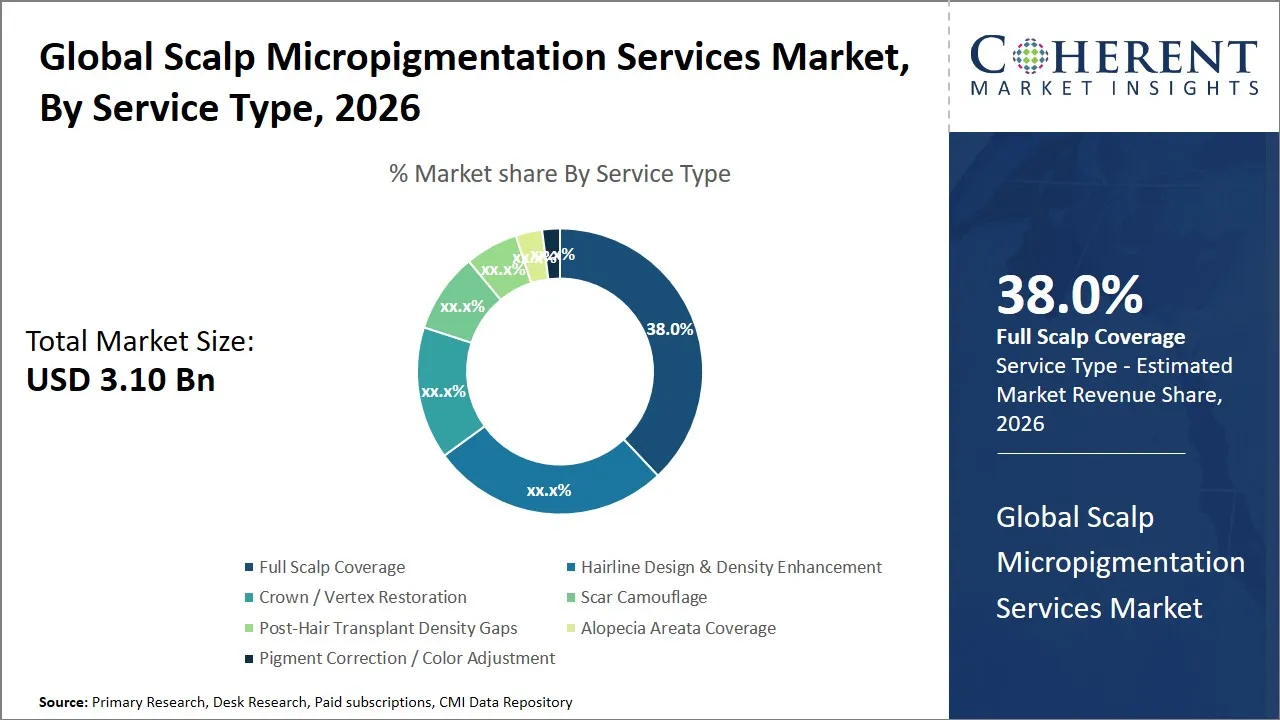
Why Does the Full Scalp Coverage Segment Dominate the Global Scalp Micropigmentation Services Market in 2026?
The full scalp coverage segment is expected to hold the largest share of 38% in 2026, owing to the comprehensive nature of treatment it offers to individuals suffering from severe hair loss. Full Scalp Coverage Customers with larger scalp losses are particularly attracted to full scalp coverage, seeing that other types of scalp restoration like hairline makeup or scar disguise can be unsatisfactory with regard to optical restoration. Full scalp micropigmentation (SMP) uses a holistic technique to mimic the look of natural hair follicles throughout the entire head resulting in an appearance of thickness which is seen to give a significant increase in confidence. This type of service serves a wider range of consumers who are not only men with male pattern baldness but also women and those who are alopecic or have their hair loss after chemotherapy and so its market base is wider.
Besides, the growing knowledge and acceptance of scalp micropigmentation as a non-invasive cosmetic treatment has driven the need to cover the entire scalp. Unlike hair transplant, SMP is able to provide instant aesthetic enhancement as well as having small downtime effects, which is compared to hair transplant, which may take longer to heal and is potentially risky. This convenience aspect motivates the customers to choose full scalp solutions particularly with improved quality pigmentation with improved application methods resulting in a natural appearance that can last long given the improvement in technology. The scalp customization features that regulate the pigment colors, density, and the shape of the hairline render full scalp coverage to be highly attractive, since it will be able to suit the expectations of every client.
For instance, due to advanced male-pattern baldness (Norwood 5-7) men wishing to be clean shaved-head without undergoing hair transplant surgery, a large demand spike on Full Scalp Coverage SMP is seen over the years in the North America and Western Europe where clinics offer 2-4 sessions with a 12-24 month refresh cycle to ensure consistency in density.
(Source- https://newmansmp.com/)
Why Does the Initial SMP Procedure Segment Dominate the Global Scalp Micropigmentation Services Market in 2026?
The initial SMP procedure segment is expected to hold the largest share of 58% in 2026, reflecting the critical importance of the first session in establishing the foundation of scalp micropigmentation. This preliminary process forms the basis of all the subsequent treatment processes where accuracy of pigmentation placement, color matching as well as the overall design are fixed. Consumers are likely to attach a lot of importance to this session since it establishes the long-term aesthetic pattern and touches upon the main hair loss issues of consumers. An effective initial procedure will lead to customer satisfaction that will bring loyalty and create an avenue to do a follow-up touch-up or maintenance.
The increasing rate of hair loss and the new tendency towards the non-surgical approach is what prompts an increasing number of first-time SMP customers who are interested in getting a quick and efficient change in their appearance. In the first process, the practitioners collaborate with clients to come up with unique designs, depending on the condition of the scalp, hair color, and the preferred density of the hair, which adds to the overall attractiveness of SMP as it focuses on doing individual service. This carefulness of the session implies that it has to be performed by competent experts and it has to use high quality pigments hence a high-quality stage that commands the biggest market share because it is a critical stage.
Entire Scalp Dominates the Scalp Micropigmentation Services Market
The entire scalp segment is expected to capture the highest share of 34% in 2026, as it addresses the fullest extent of hair loss and provides the most visibly impactful results. The entire scalp application is a preferred option as it treats several areas of the head at a time such as the frontal hairline, the crown, middle part of the head, and the temporal areas that give a balanced and natural look. This is particularly popular with people with diffuse thinning or general balding patterns as opposed to local scalp problems. The richness of the treated territory is what makes it especially attractive to the people who want to have a coherent restoration and a consistent design.
Moreover, the whole scalp application is needed because the pigment technology and application tools have enhanced scalp application capabilities enabling specialists to render a high-scale replication of natural hair patterns in high detail. It is now possible to replicate the density of the hair as well as the distribution of the follicles in a smooth manner all over the head giving it a young and full appearance that is hard to obtain by other cosmetic operations. To clients, the comprehensive nature of the coverage lowers the number of specialized treatments and time and cost required giving the service a greater appeal.
Gender and Age Segment Utilization Pattern for Scalp Micropigmentation Services Market
- Utilization of scalp micropigmentation remains male-dominated in terms of absolute volume, primarily because the biggest high-intent usage category is advanced baldness in men when they desire a complete reset of their hairlines and rapid cosmetic response The age bracket is 25-44 as this is where recession is seen as visually noticeable and the sensitivity to appearance is highest in career and social life Utilization remains steady in 55+ with fewer trials because they prefer age-appropriate hairline designs and faster cosmetic effect visualization.
- Women with diffuse thinning typically seek scalp micropigmentation (SMP) for density enhancement rather than full-shave coverage. Unlike men who embrace advanced baldness and prefer a clean shaved look, women usually aim for subtle scalp darkening between existing hair to avoid full coverage. Feminine identity plays a significant role in SMP decisions, as women tend to focus on enhancing hair volume without altering their overall appearance. The prevalence of feminine hair loss increases with age, particularly in midlife, leading more women to explore medical hair-loss treatments like SMP.
Regional Insights
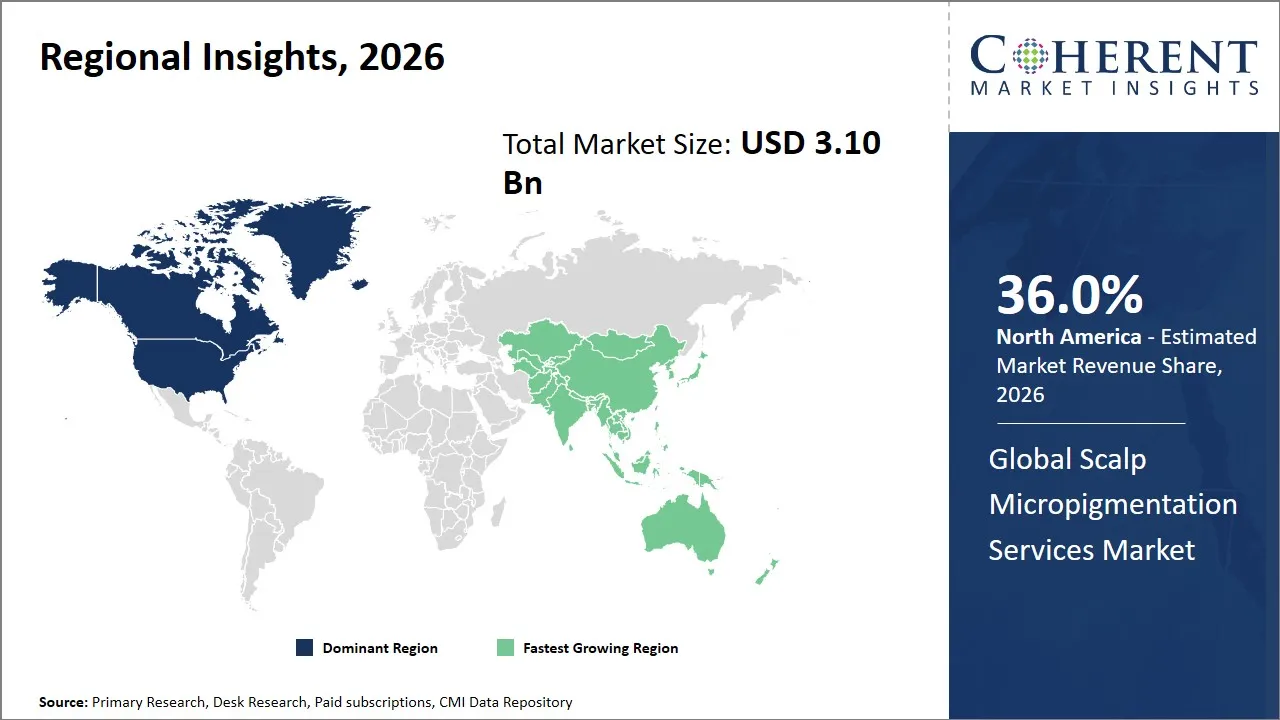
North America Scalp Micropigmentation Services Market Analysis and Trends
The North America region is projected to lead the market with a 36% share in 2026, attributed to several key factors. In the region, there is a well-developed healthcare system and complexes of cosmetic and aesthetic interventions. The awareness of the consumers on the solutions to hair loss is very high due to the high levels of marketing and promotional activities by the major players. Market stability and growth is also established through the government policies in favor of cosmetic dermatology and non-invasive aesthetics procedures.
The availability of many specialized clinics and a solid system of certified practitioners promotes the accessibility and quality of services, which drives demand. The innovative approaches to scalp micropigmentation (SMP) and increased services of a number of leading companies, including Bosley, HIS Hair Clinic, and Vinci Hair Restoration, have helped consolidate the leadership in the region. Besides, the dynamics of trade are in favor of imported advanced SMP equipment and pigments which are easy to acquire due to well-established supply chains that help in constant development of markets.
Asia Pacific Scalp Micropigmentation Services Market Analysis and Trends
The Asia Pacific region is expected to exhibit the fastest growth in the market contributing 27% share in 2026, due to rising disposable incomes, increasing awareness of aesthetic treatments, and growing acceptance of cosmetic procedures across urban areas. This rapid adoption is caused by the growing population of middle-class and an exploding beauty and personal care market. Regulations that are favorable to the survival of cosmetic clinics have been embraced by several governments in the region especially in countries such as South Korea, Japan and India. The increasing entrepreneurial environment promotes the establishment of special aesthetic clinics that provide SMP.
Moreover, the adoption of modern technologies and methods through cooperation with foreign actors speeds up the process of entering the market. Such companies as Derm Institute (India), Skin Revival (Australia), Yagami Aesthetic Clinic (Japan) have made their contribution with the introduction of new SMP services based on the regional preferences. Policy of trade liberalization and enhancing the logistic infrastructure has facilitated the supply of quality SMP products and inks which has perpetuated the market momentum.
Scalp Micropigmentation Services Market Outlook for Key Countries
What are the Current Trends Shaping the U.S. Scalp Micropigmentation Services Market?
The U.S. scalp micropigmentation services market is very developed and has a long-standing presence of the major SMP service providers who prioritize on innovation and client results. Regulatory systems provide product safety and certification of the practitioners which give the consumer confidence. The key competitors such as Bosley and HIS Hair Clinic are taking advantage of the situation as they constantly improve their SMP techniques and offer training programs. The robust consumer spending power and culture of the aesthetic improvements serve as an advantage to the market and ensures continuous demand. Also, the U.S. is a trendsetter, which has an impact on practices worldwide.
How is Japan Helping in the Growth of the Scalp Micropigmentation Services Market?
The scalp micropigmentation services market in Japan presents an increasing demand because of the aging population that worries about hair loss and the cultural appreciation of the state-of-the-art cosmetic services. The support of medical aesthetics in the name of wellness by the government is an added bonus to market growth. The main competitors like Yagami Aesthetic Clinic and Hair Tokyo have launched technologically superior SMP techniques using Japanese skin and hair structure, which are very appealing to the local consumers. International partnerships with SMP specialists promote the quality of services and customer confidence. The Japanese market can be characterized as precise and innovative that focuses on the natural and subtle outcomes.
Key Drivers for the Growth of the India Scalp Micropigmentation Services Market
The scalp micropigmentation services market in India is a fast-growing sector of consumerism where the affordability of aesthetic treatments is growing allowing more people in non-metropolitan regions to enjoy the benefits. The high population base and increase in the disposable income levels in the country offers a good platform on which the market can grow. Such top providers as Derm Institute and Soulshine Cosmetic Clinic have provided competition in terms of pricing and scalability. The government and the regulatory ameliorations provide incentives to start a clinic. In addition, the incorporation of online marketing platforms has succeeded in increasing the reach of consumers within the scalp micropigmentation.
Germany Scalp Micropigmentation Services Market Trends
The scalp micropigmentation services market in Germany can be described as having a high healthcare regulatory environment that provides high-quality scalp micropigmentation services. The market is supported by the developed medical aesthetics market and increased non-surgical cosmetic procedures demand in the country. Such notable firms as Scalpmed and Haircellent have been the first to develop superior SMP and use eco-friendly pigments that the European audience likes. Moreover, the efficient distribution networks and cooperation between dermatologists and SMP specialists contribute to the improvement of the credibility of the services delivered in Germany.
Aftercare Compliance and Healing Outcome Correlation: Impact of Post-Procedure Care on Pigment Retention, Fade Consistency, and Client Satisfaction
- Aftercare compliance is a key performance indicator in scalp micropigmentation since the initial 7-14 days are significant to the extent to which the pigment is settled and whether the healing outcome appears smooth throughout the scalp. Clients with very strict aftercare habits like keeping the scalp dry, not sweating, not scratching and limited exposure to the sun will generally experience better pigment retention and more accurate dot definition. Quite on the contrary, patchy lightening, premature fading, or blurred impressions are frequent results of poor compliance, compelling clinics to perform extra touch-ups and correction sessions. This has a direct effect on the clinic economics since rework will lower the margins, raise the amount of time spent on each client in the clinic and place an additional burden on operations throughout the high booking seasons.
- What happens to the healing is also dependent on the type of skin and lifestyle, but the compliance of the aftercare is the aspect that can be controlled and which accounts for most of the difference between great work and an average result. Scalp oils, intense workouts, and head washing as well as exposure to UV light increase the speed of fading, so even the most powerful procedure will not work properly without a strict regimen. Those clinics where organized aftercare systems are implemented such as written guidelines, photo based daily rounds, WhatsApp follow-ups, and planned post-session examinations tend to show increased levels of satisfaction, reduced complaints, and more consistent refresh cycles. This results in aftercare compliance being a quantifiable piece of data as clinics are able to monitor indicators of adherence, associate it with the results of healed density and streamline counseling scripts to minimize the most frequent causes of fading and non-adherence.
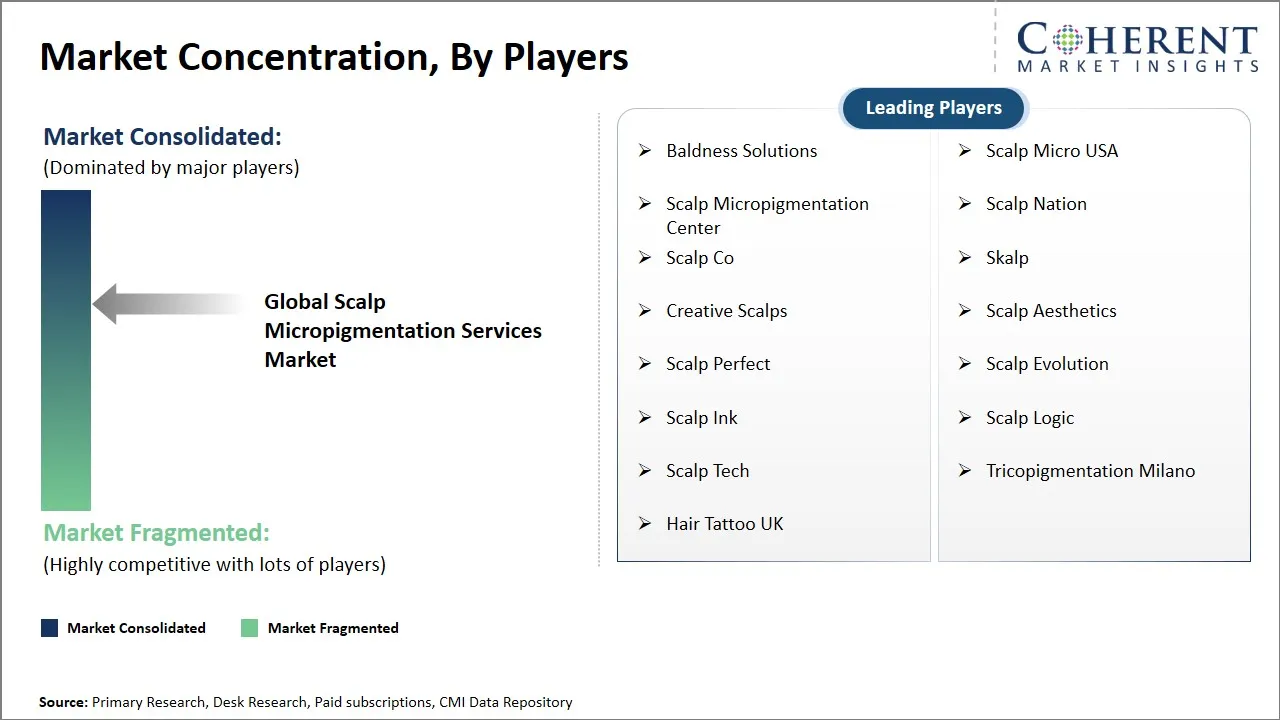
Concentration and Competitive Landscape
Key Developments
- In August 2025, Scalp Tech SMP is a top of the line manufacturer of hair loss and thinning remedies with headquarters based in Fresno, California that is changing lives by offering high quality scalp micropigmentation services. The company has ended up not only in restoring the confidence of clients, but also it is dedicated in providing the aspiring professionals with the knowledge needed to perform better, in this fast-growing sector. SMP is a permanent, naturalistic system compared to other hair restoration systems which looks as though it was shaved off, with unbelievable accuracy.
- In April 2025, Hair Transplant Medical Center was chosen as the leader of the hair restoration category in the peel region by the Consumer Choice Award. This award highlights the exceptional skills of this clinic in the field of hair restoration treatment and its commitment to providing transformational outcomes to people with problems of hair loss.
- In November 2024, Skins & Needles introduced Scalp Micropigmentation services through a partnership with Carbon Corrections Clinic, positioning SMP as a practical hair-loss solution for clients seeking pattern-baldness coverage, thinning camouflage, or scar blending.
Top Strategies Followed by Scalp Micropigmentation Services Market Players
Player Type | Strategic Focus | Examples |
Established Market Leaders | Established SMP players dominate by investing in better pigments, precision tools, and standardized techniques to deliver more natural hairlines, stronger dot retention, and fewer corrective cases. They treat outcomes like a product—optimizing density, shade matching, and fade control—so clients get predictable results across different scalp types and lifestyles. | Hair Restoration Institute of Minnesota (HRI) and Good Look Ink (GLI) merged on October 7, 2025, combining HRI’s medical hair restoration expertise with GLI’s scalp micropigmentation protocols and expanding access to a full-spectrum treatment platform across the Midwest and beyond. |
Mid-Level Players | Mid-level SMP players compete by offering affordable treatment packages that maintain decent quality, targeting price-sensitive clients such as millennials and middle-income groups. They grow through partnerships with device/pigment providers, training academies, and local clinics, allowing faster service expansion without heavy investment in owned infrastructure. | Scalp Culture is a clear example of a mid-level SMP brand scaling through a franchise/affiliate expansion model instead of building every location fully in-house. The company publicly promoted its franchising route, inviting trained practitioners to open a Scalp Culture Clinic under its brand umbrella. |
Small-Scale Players | Small SMP players survive by specializing in narrow, high-skill niches like scar camouflage, alopecia patch blending, or ethnicity-specific hairline design, where precision matters more than scale. They also differentiate through techniques like layered “3D SMP” style density builds and correction-focused services that larger chains often avoid. | 3D Scalp Micro Pigmentation is a good example of a small-scale SMP player because it competes through specialization and technique-led outcomes, not large clinic footprint. Their positioning is built around high-precision cosmetic correction work, such as scar camouflage, density enhancement for thinning zones, and full scalp coverage delivered with a “natural finish” approach rather than a standardized high-volume model. |
Market Report Scope
Scalp Micropigmentation Services Market Report Coverage
| Report Coverage | Details | ||
|---|---|---|---|
| Base Year: | 2025 | Market Size in 2026: | USD 3.10 Bn |
| Historical Data for: | 2020 To 2024 | Forecast Period: | 2026 To 2033 |
| Forecast Period 2026 to 2033 CAGR: | 6.8% | 2033 Value Projection: | USD 4.91 Bn |
| Geographies covered: |
| ||
| Segments covered: |
| ||
| Companies covered: | Baldness Solutions, Scalp Micro USA, Scalp Micropigmentation Center, Scalp Nation, Scalp Co, Skalp, Creative Scalps, Scalp Aesthetics, Scalp Perfect, Scalp Evolution, Scalp Ink, Scalp Logic, Scalp Tech, Tricopigmentation Milano, and Hair Tattoo UK | ||
| Growth Drivers: |
| ||
| Restraints & Challenges: |
| ||
Market Dynamics
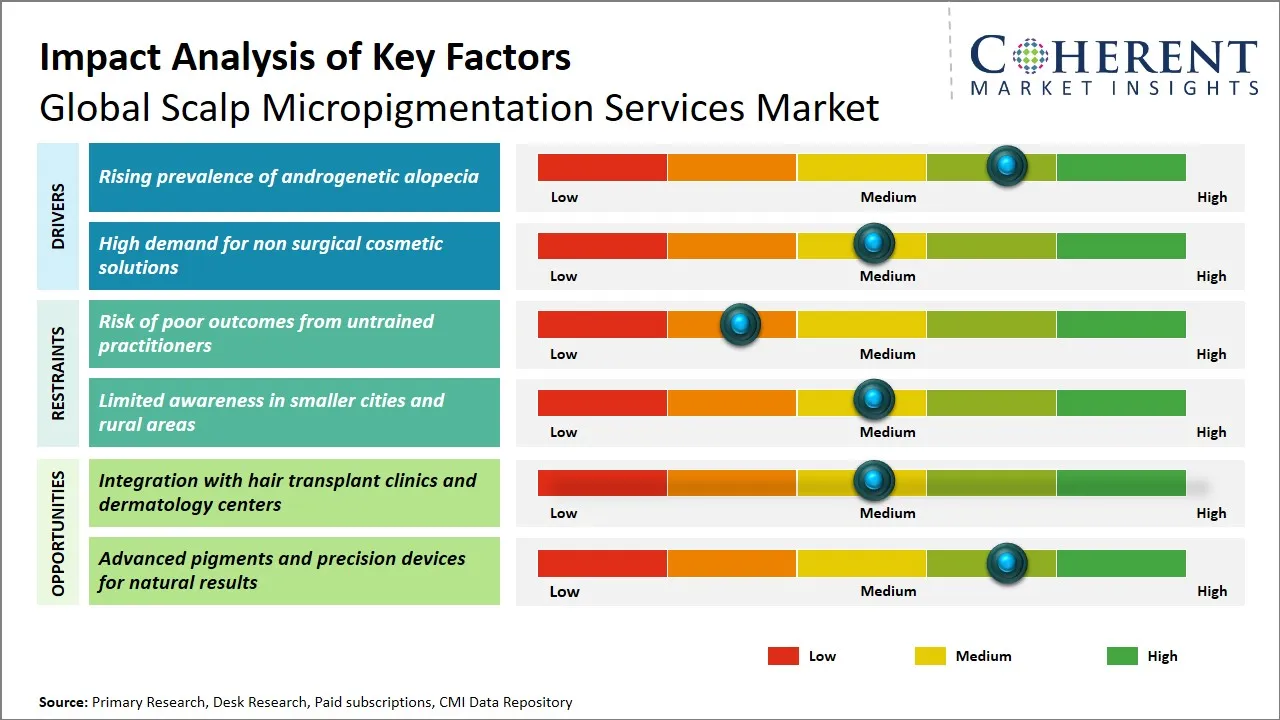
Scalp Micropigmentation Services Market Driver - Rising Prevalence of Androgenetic Alopecia
The rising incidence of androgenetic alopecia, otherwise referred to as male and female pattern baldness, is a major force behind the development of the global scalp micropigmentation services market. Since it is a hereditary condition and as much as half of the adult population of the world is affected by gradual hair thinning and receding hairlines, people affected by gradual hair loss and receding hairline are now actively seeking the effective and non-invasive means to regain a natural look to a scalp. Hair restoration methods like hair transplants are currently considered expensive, painful, and not necessarily producing immediate and promising results, so the scalp micropigmentation services is chosen by many victims as a more appealing procedure. The method is fast and a less invasive process involving perfect pigmentation to give the impression of fuller hair, especially to individuals who prefer avoiding surgeries to conceal their baldness.
Moreover, social awareness about cosmetic appearance and psychological effects of losing hair is also pushing more people to consider using cosmetic hair pigmenting, thereby necessitating more advanced and convenient services of scalp micropigmentation all around the world.
For instance, according to a 2025 epidemiology study, the prevalence of androgenetic alopecia is very high with up to ~80% of men and up to 50 percent of women aged 70 having balding caused by alopecia, which creates an even bigger consumer base of SMP services such as full scalp coverage and alopecia density enhancement.
(Source- https://journals.plos.org/plosone/article?id=10.1371%2Fjournal.pone.0319040&utm)
Scalp Micropigmentation Services Market Opportunity - Integration with Hair Transplant Clinics and Dermatology Centers
The scalp micropigmentation (SMP) services that are being integrated with the already existing hair transplant clinics and dermatological facilities serves as a major growth potential in the global market of scalp micropigmentation services. Through these medical and aesthetic service providers, SMP practitioners would be able to utilize the already existing bases of clients seeking hair restoration solutions thus promoting cross-referrals and treatment packages. Patients that do not have the best donor hair or other conditions that do not qualify them as an ideal hair restoration candidate often come to hair transplant clinics and dermatology centers; to such patients, they can offer a non-invasive, complementary aesthetic treatment with SMP, which improves the overall outcome of the treatment.
Also, by integrating the two methods, the surgical and non-surgical, it is possible to address a broader range of hair loss issues, including pattern baldness, or concealment of scarring. This synergy does not only expand the service offering, but also customer satisfaction and retention through the delivery of multi-faceted treatment plans which are tailored to clients. Moreover, these engagements enhance the credibility and trust in the market because SMP services in the market that are provided with medical treatments prioritize safety, quality of clinical and professionalism. Such conformity to medical-grade providers will be likely to boost the demand to adopt SMP services in disparate segments of the population, which will stimulate market penetration in both new and developed economies.
For instance, in January 2028, DHI International, a worldwide network of hair transplant centers and hair restoring clinics, proposed Scalp Micropigmentation (SMP) as part of its hair thinning alopecia and receding hairlines hair loss treatment model portraying direct integration of SMP as a part of a hair transplant center.
(Source-https://www.dhiinternational.com/scalp-micro-pigmentation-hair-loss-treatment-dhi-international/)
Analyst Opinion (Expert Opinion)
- Scalp micropigmentation is rapidly transitioning out of the niche cosmetic add on to a mainstream hair loss solution as it offers instant immediate visible density without surgery and without months of recovery. Male pattern baldness, increased grooming expenditure, and that the results can easily be sold by way of before after evidence on social media are pulling demand. It is also being enhanced on the supply side, with clinics increasing the results of pigment stability, better needle control, and more natural hairline creation, and there is an increase in the standards of safety requirements, with regulators driving cleaner sourcing and contamination control of inks employed in skin pigmentation procedures. Clinic integration and expansion in the region (particularly when hair transplant and dermatology centers package SMP to fill density and create scar camouflage) are the largest prospects, although the market still grapples with inconsistency in quality, untrained operators, and correction that creates reputational damage hindering trust building.
- On the industry ecosystem side, knowledge exchange is gaining more traction due to the fact that scalp micropigmentation services is being talked about at major medical and professional conferences with clinical hair restoration. Examples are the 32nd World Congress in Denver in October 2024 and Academy Masters Meeting 2024 in Greece in July 2024 both of which featured new methods in the holistic management of hair loss patients and facilitated the adoption of standardization and better techniques. The market is also being influenced by real-life changes, such as the Hair Restoration Institute of Minnesota combining with Good Look Ink in October 2025 in order to provide both a surgical restoration and scalp micropigmentation under a single roof, which is precisely how the category will climb the next level using integrated care models and greater medical trust.
Speak to the analyst
Want personalized insights?
Take the findings above to one of our principal consultants, or have the report rebuilt around the segments, geographies and competitors you actually track.
Market Segmentation
- Service Type Insights (Revenue, USD Bn, 2021 - 2033)
- Full Scalp Coverage
- Hairline Design & Density Enhancement
- Crown / Vertex Restoration
- Scar Camouflage
- Post-Hair Transplant Density Gaps
- Alopecia Areata Coverage
- Pigment Correction / Color Adjustment
- Session Type Insights (Revenue, USD Bn, 2021 - 2033)
- Initial SMP Procedure
- Touch-Up / Reinforcement Session
- Annual / Maintenance Refresh
- Application Area Insights (Revenue, USD Bn, 2021 - 2033)
- Entire Scalp
- Frontal Hairline
- Crown / Vertex
- Mid-Scalp
- Temporal Regions
- Donor Area
- Hair Loss Type Insights (Revenue, USD Bn, 2021 - 2033)
- Male Pattern Baldness (Androgenetic Alopecia)
- Diffuse Thinning
- Female Pattern Hair Loss
- Post-Hair Transplant Density Gaps
- Scarring Alopecia
- Alopecia Areata
- End User Insights (Revenue, USD Bn, 2021 - 2033)
- Men
- Women
- Transgender
- Provider Type Insights (Revenue, USD Bn, 2021 - 2033)
- Specialized SMP Clinics / Studios
- Aesthetic / Cosmetic Clinics & Med-Spas
- Hair Transplant Clinics
- Dermatology Clinics
- Multi-Service Salons (Premium)
- Mobile SMP Providers
- Regional Insights (Revenue, USD Bn, 2021 - 2033)
- North America
- U.S.
- Canada
- Latin America
- Brazil
- Argentina
- Mexico
- Rest of Latin America
- Europe
- Germany
- U.K.
- Spain
- France
- Italy
- Russia
- Rest of Europe
- Asia Pacific
- China
- India
- Japan
- Australia
- South Korea
- ASEAN
- Rest of Asia Pacific
- Middle East
- GCC Countries
- Israel
- Rest of Middle East
- Africa
- South Africa
- North Africa
- Central Africa
- North America
- Key Players Insights
- Baldness Solutions
- Scalp Micro USA
- Scalp Micropigmentation Center
- Scalp Nation
- Scalp Co
- Skalp
- Creative Scalps
- Scalp Aesthetics
- Scalp Perfect
- Scalp Evolution
- Scalp Ink
- Scalp Logic
- Scalp Tech
- Tricopigmentation Milano
- Hair Tattoo UK
Sources
Primary Research Interviews
Industry Stakeholders list
- Dermatology clinic owners
- Hair transplant surgeons
- Scalp micropigmentation master practitioners
- Aesthetic clinic managers
- Pigment formulation specialists
- SMP training academy directors
End-users list
- Male pattern baldness clients
- Female diffuse thinning clients
- Post hair transplant clients
- Alopecia areata clients
- Scar camouflage clients
- First-time cosmetic procedure buyers
Government and International Databases
- World Health Organization
- U.S. Food and Drug Administration
- U.S. National Institutes of Health
- Centers for Disease Control and Prevention
- European Medicines Agency
- OECD Data
Trade Publications
- Aesthetic Medicine Journal
- Dermatology Times
- Plastic Surgery Practice
- Cosmetics & Toiletries
- HAPPI Personal Care Products
- Tattoo Artist Magazine
Academic Journals
- JAMA Dermatology
- British Journal of Dermatology
- International Journal of Dermatology
- Dermatologic Surgery
- Journal of Cosmetic Dermatology
- Aesthetic Surgery Journal
Reputable Newspapers
- The New York Times
- The Wall Street Journal
- The Guardian
- BBC News
- Financial Times
- The Washington Post
Industry Associations
- International Society of Hair Restoration Surgery
- American Academy of Dermatology
- British Association of Dermatologists
- European Academy of Dermatology and Venereology
- American Society for Dermatologic Surgery
- Society of Cosmetic Chemists
Public Domain Resources
- Google Scholar
- ClinicalTrials.gov
- EU EUR-Lex
- U.S. Federal Register
- World Bank Open Data
Proprietary Elements
- CMI Data Analytics Tool: Proprietary analytics tool to analyze real-time market trends, consumer behavior, and technology adoption in market
- Proprietary CMI Existing Repository of Information for Last 8 Years
Get access to 250+ pages report
Every segment, forecast, competitor profile and data table behind the analysis above — available for instant download.
- ESOMAR Member
- ISO 9001:2015 Certified
- D-U-N-S Registered
- GDPR & CCPA Compliant
Missing comfort of reading report in your local language? Find your preferred language:
Transform your Strategy with Exclusive Trending Reports
Frequently Asked Questions
The global scalp micropigmentation services market is estimated to be valued at USD 3.10 billion in 2026 and is expected to reach USD 4.91 billion by 2033.
The CAGR of global scalp micropigmentation services market is projected to be 6.8% from 2026 to 2033.
Rising prevalence of androgenetic alopecia and high demand for non-surgical cosmetic solutions are the major factors driving the growth of the global scalp micropigmentation services market.
Results commonly last 12–36 months before a refresh is needed, depending on lifestyle, sun exposure, and aftercare adherence.
Faster visible results, lower cost vs surgery, minimal downtime, and predictable cosmetic improvement.
Risk of poor outcomes from untrained practitioners and limited awareness in smaller cities and rural areas are the major factors hampering the growth of the global scalp micropigmentation services market.
In terms of service type, full scalp coverage is estimated to dominate the market revenue share in 2026.