

Global Semiconductor Fabless Market Size and Forecast – 2026-2033
The global semiconductor fabless market is estimated to be valued at USD 5.05 Bn in 2026 and is expected to reach USD 9.41 Bn by 2033, exhibiting a compound annual growth rate (CAGR) of 9.3% from 2026 to 2033.
Key Takeaways of the Global Semiconductor Fabless Market
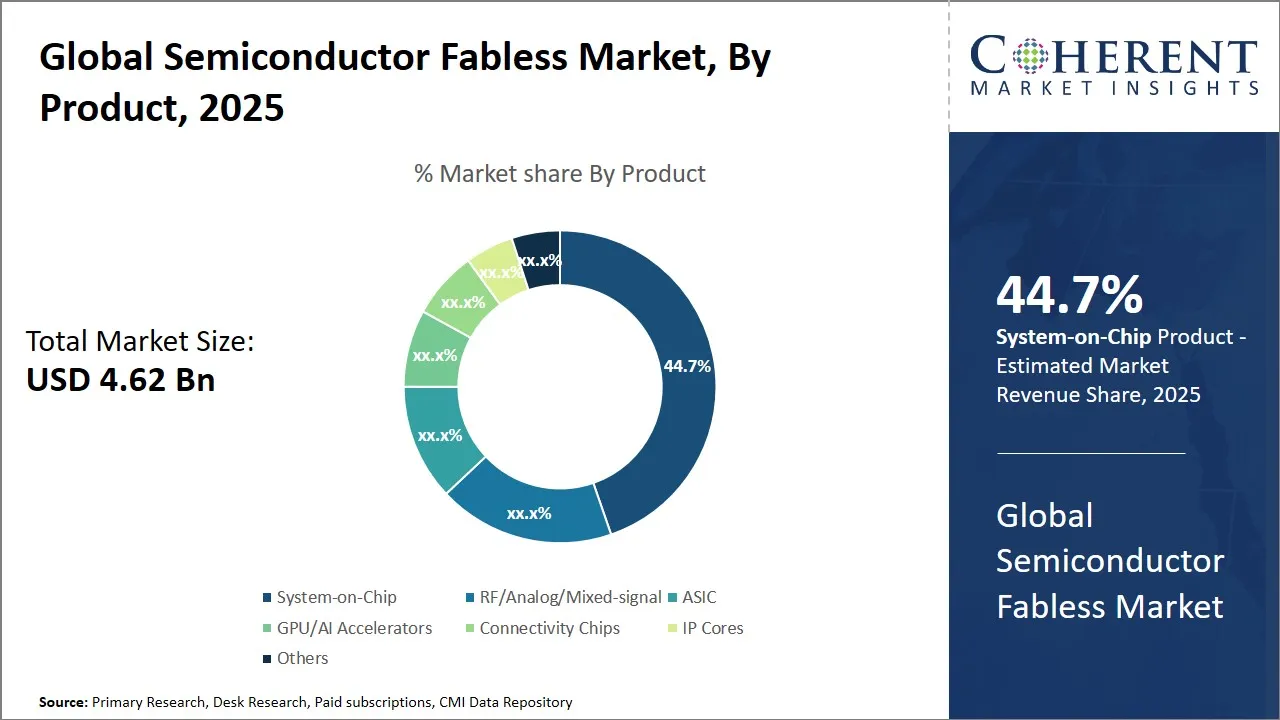
- The system-on-chip segment leads the market holding an estimated share of 45.7 % in 2026.
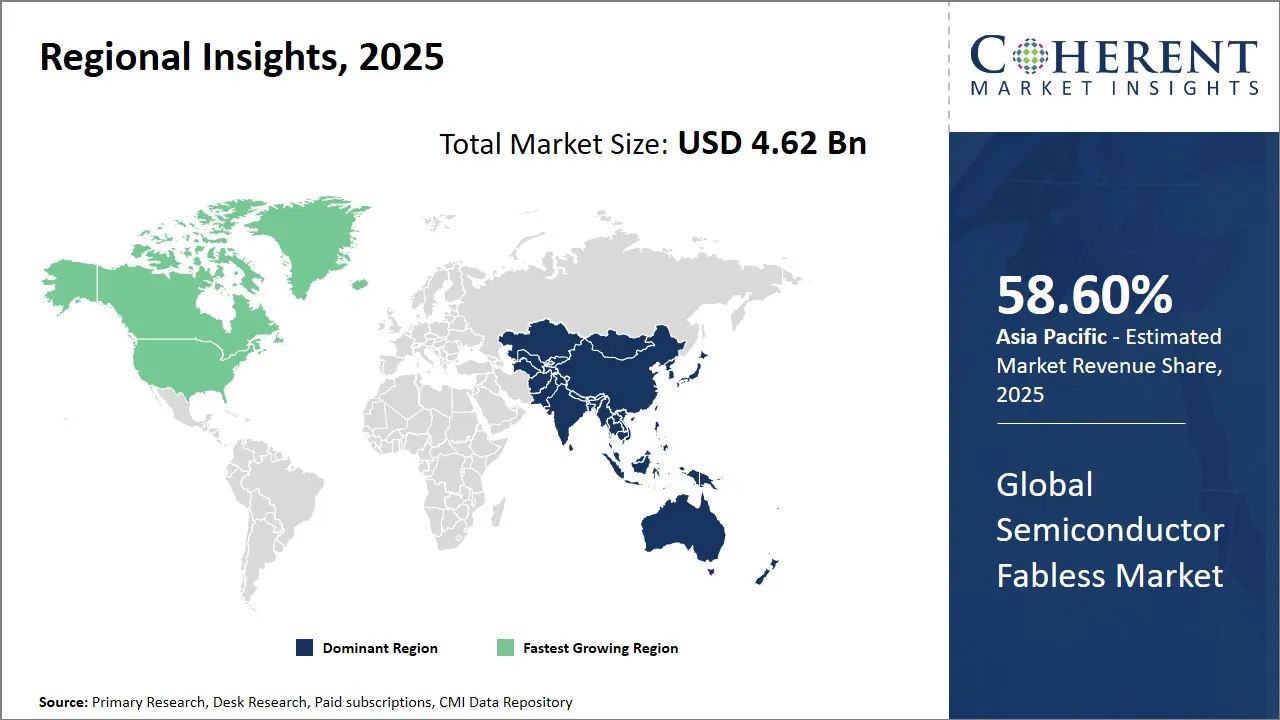
- Asia Pacific is estimated to lead the market with a share of 58.6 % in 2026.
- North America, holding an estimated share of 25.2 % in 2026, is projected to be the fastest growing region.
Market Overview
A market trends indicate a significant shift toward more specialized and application-specific integrated circuits, fueled by advancements in AI, IoT, and 5G technologies. Additionally, fabless companies are increasingly focusing on design efficiency and leveraging partnerships with foundries to accelerate product development cycles. The rising emphasis on low-power, high-performance chips is also reshaping the market landscape, supporting robust growth and continued technological evolution within the semiconductor fabless ecosystem.
Current Events and Its Impact
Current Events | Description and its Impact |
Fabless–Foundry Partnerships |
|
Funding Momentum in AI-Edge Chips |
|
Defense-Sector Engagement |
|
Segmental Insights
- Current Industry Events of 2026
- Market Size Estimation
- Regional Breakdown
- Competitive Landscape
- Customer Intelligence
- Segmental Analysis
- Pricing Analysis
- Key Market Drivers, Challenges & Future Trends
- Customized Insights Section
Global Semiconductor Fabless Market Insights, by Product – Rising Demand for Integrated Solutions Driving System-on-Chip Segment Growth
The system-on-chip segment is projected to hold 45.7% share in 2026, owing to its unparalleled ability to integrate multiple functionalities on a single semiconductor chip. This integration significantly enhances power efficiency, reduces the overall device footprint, and lowers manufacturing costs, making Systems-on-Chip (SoCs) highly attractive for a broad range of applications such as smartphones, automotive electronics, IoT devices, and consumer electronics. The proliferation of smartphones and connected devices is a key driver for the system-on-chip segment. SoCs enable compact and powerful designs that support advanced features like high-resolution cameras, multimedia processing, and seamless wireless connectivity. Moreover, the escalating adoption of 5G technology necessitates chips that can handle complex data processing and communication protocols efficiently, further propelling the SoC demand.
System-on-Chips, specifically those embedded with AI accelerators, empower devices to perform real-time data analytics, voice recognition, and image processing. This capability is essential for autonomous vehicles, smart home devices, and industrial automation, where latency and power constraints prevent reliance on cloud computing. For instance, Qualcomm’s Snapdragon 8 Gen 3 SoC integrates a dedicated AI engine that enables on-device generative AI, real-time language translation, and enhanced camera processing in flagship smartphones.
Additionally, advancements in semiconductor fabrication processes, such as smaller nanometer technologies, have enabled SoCs to pack more transistors while consuming less power. This technological progress has broadened the scope of their applications by addressing performance limitations that had traditionally restricted chip integration density. Finally, the shift toward customized semiconductor solutions in industries such as automotive and healthcare encourages fabless companies to focus on SoC development. These chips offer the flexibility to tailor functions precisely to end-user requirements, combining analog, digital, and mixed-signal blocks to meet stringent safety and reliability standards.
Impact of AI on the Semiconductor Fabless Market Players
Artificial Intelligence (AI) is profoundly reshaping the global semiconductor fabless market, particularly through the demand for high-performance GPUs, AI accelerators, and custom-designed ASICs. Fabless companies are leveraging AI workloads to create specialized chips that can handle massive computational requirements in data centers, autonomous vehicles, and edge devices. Unlike general-purpose processors, these AI-focused semiconductors are optimized for parallel processing, energy efficiency, and scalability, giving fabless firms an edge in innovation. As hyperscale cloud providers, automotive OEMs, and consumer electronics leaders increasingly require tailored AI solutions, fabless companies are driving the design pipeline while partnering with foundries for advanced-node manufacturing.
NVIDIA’s A100 and H100 GPUs have become central to training and deploying large AI models, from generative AI applications to scientific computing. NVIDIA, a fabless leader, designs these GPUs and relies on TSMC’s advanced 7nm and 5nm nodes for fabrication.
Regional Insights
Asia Pacific Semiconductor Fabless Market Analysis and Trends
The Asia Pacific region is projected to lead the market with a 58.6% share in 2026, driven by a robust ecosystem that includes well-established design hubs, a dense concentration of semiconductor companies, and synergistic relationships with foundries. Countries like Taiwan, South Korea, China, and Japan provide a solid foundation for fabless companies by offering advanced semiconductor manufacturing services through leading foundries such as TSMC, Samsung, and GlobalFoundries.
Government policies in these nations emphasize semiconductor innovation, investment incentives, and initiatives to enhance research and development, which encourages entrepreneurship and attracts global fabless firms. The presence of large electronics and ICT industries in this region further fuels the demand for custom and efficient semiconductor solutions, making Asia Pacific the epicenter of fabless innovation. Notable companies such as MediaTek (Taiwan), Qualcomm’s regional operations, and Himax Technologies contribute significantly to the advancement and commercial success of fabless designs in this region.
North America Semiconductor Fabless Market Analysis and Trends
North America, holding an estimated share of 25.2% in 2026, exhibits the fastest growth in the global semiconductor fabless market, due to its rich history of innovation, strong venture capital presence, and concentration of technology-driven enterprises. The U.S., in particular, boasts a developed ecosystem fortified by the presence of leading fabless companies including NVIDIA, AMD, and Broadcom. Government initiatives aimed at boosting domestic semiconductor design and production, such as funding for R&D and protectionist trade policies, enhance the region’s competitiveness. North America benefits from a highly skilled workforce, strong intellectual property protections, and interlinked supply chains that integrate design, software development, and marketing efficiently. In addition, the presence of key semiconductor design hubs like Silicon Valley accelerates innovation, fueling the rapid expansion of fabless companies.
Global Semiconductor Fabless Market Outlook for Key Countries
Taiwan Semiconductor Fabless Market Analysis and Trends
Taiwan stands as a cornerstone in the global fabless landscape, largely due to the synergy between fabless companies and world-leading foundries like TSMC. The Taiwanese government’s strategic support through favorable policies and funding has nurtured local fabless champions such as MediaTek, which drives substantial chip design innovations globally. The country’s highly specialized talent pool and infrastructure enable efficient collaboration and rapid development cycles, cementing Taiwan’s role as a global design powerhouse.
U.S. Semiconductor Fabless Market Analysis and Trends
The U.S. continues to lead in semiconductor fabless innovation with strong contributions from industry giants such as NVIDIA, Qualcomm, AMD, and Marvell Technology. The U.S. benefits from a robust startup ecosystem supported by substantial venture capital and government-backed programs aiming to reduce dependence on foreign manufacturing. Its intellectual property framework and fostering of advanced chip design and AI-integrated solutions allow American companies to remain at the forefront of technological advancement within the semiconductor fabless market.
China Semiconductor Fabless Market Analysis and Trends
China semiconductor fabless market is rapidly expanding, supported by government policies that prioritize self-reliance in the semiconductor sector under initiatives like “Made in China 2026.” Local fabless companies such as HiSilicon and UNISOC are gaining prominence by focusing on communications, mobile devices, and consumer electronics chips. Despite challenges related to trade restrictions and access to advanced manufacturing nodes, China’s vast domestic demand and investments in R&D propel the country’s semiconductor fabless market development.
South Korea Semiconductor Fabless Market Analysis and Trends
South Korea semiconductor fabless market thrives in close proximity to major fabrication giants such as Samsung Electronics and SK Hynix, allowing fabless companies to collaborate effectively with foundries. Companies like Silicon Works and MagnaChip Semiconductor focus on niche applications including display drivers and power management ICs. The government’s continuous support and investment in semiconductor innovation foster a conducive environment for fabless growth, while South Korea’s strong electronics manufacturing base ensures steady demand.
Japan Semiconductor Fabless Market Analysis and Trends
Japan remains a vital player in the fabless segment, leveraging its expertise in semiconductor materials and specialized chip design. Notable fabless companies like Renesas Electronics and Socionext contribute to the development of automotive, industrial, and consumer electronics semiconductors. Japanese government incentives and collaborations between academia and industry facilitate innovation, while Japan’s emphasis on quality and reliability sustains its market relevance amid evolving global competition.
Market Players, Key Development, and Competitive Intelligence
Key Developments
- In August 2025, Cyient Semiconductors Private Limited, a fast-growing custom silicon company, announced a strategic Channel Partner Agreement with GlobalFoundries (GF), one of the world's leading pure-play semiconductor foundries. Under the agreement, Cyient Semiconductors becomes an authorized reseller of GF's semiconductor manufacturing services and technologies.
- In June 2025, Continental AG took a strategic step to increase resilience and ensure future success with the establishment of an Advanced Electronics & Semiconductor Solutions (AESS) organization. This new organization has been established to design and verify automotive semiconductors with a view of fulfilling internal demand. As a strategic move, GlobalFoundries (GF) has been onboarded as the manufacturing partner for this organization.
- In June 2025, Bosch Global Software Technologies (BGSW) and Chennai-based Mindgrove Technologies, a fabless semiconductor startup, signed a memorandum of understanding (MoU) to jointly develop and deploy high-performance system-on-chip (SoC) solutions for applications across automotive, consumer electronics, industrial automation, and IoT infrastructure.
- In January 2025, L&T Semiconductor Technologies (LTSCT), a wholly-owned subsidiary of Larsen & Toubro, unveiled plans to invest over USD 10 billion in a silicon fabrication (fab) plant. The investment is contingent upon the company achieving USD 1 billion in annual revenue by 2026-27 through its proprietary chip designs and semiconductor products.
Top Strategies Followed by the Semiconductor Fabless Market Players
- Established fabless companies, characterized by their extensive resources and market influence, primarily invest heavily in research and development (R&D).
- Qualcomm invests billions annually in R&D (over USD 9.2 billion in FY 2023) to advance 5G SoCs, AI processors, and automotive platforms, ensuring its Snapdragon line remains a leader in mobile and connected device markets.
- Mid-level fabless companies adopt a different approach that emphasizes cost-effectiveness while maintaining acceptable quality standards.
- MediaTek consistently positions its Dimensity chipsets as affordable yet high-performance alternatives to Qualcomm, capturing significant market share in mid-range and budget smartphones, particularly in Asia Pacific.
- Small-scale fabless players commonly differentiate themselves by focusing on niche markets or specialized features that larger competitors may overlook. These companies often develop highly innovative or customized semiconductor products catering to specific applications such as IoT devices, wearable technology, or industrial automation.
- EdgeCortix, a Japanese fabless startup, develops AI accelerators optimized for edge computing with ultra-low power consumption, carving out a niche in defense, robotics, and IoT applications.
Market Report Scope
Semiconductor Fabless Market Report Coverage
| Report Coverage | Details | ||
|---|---|---|---|
| Base Year: | 2025 | Market Size in 2026: | USD 5.05 Bn |
| Historical Data for: | 2020 To 2024 | Forecast Period: | 2026 To 2033 |
| Forecast Period 2026 to 2033 CAGR: | 9.3% | 2033 Value Projection: | USD 9.41 Bn |
| Geographies covered: |
| ||
| Segments covered: |
| ||
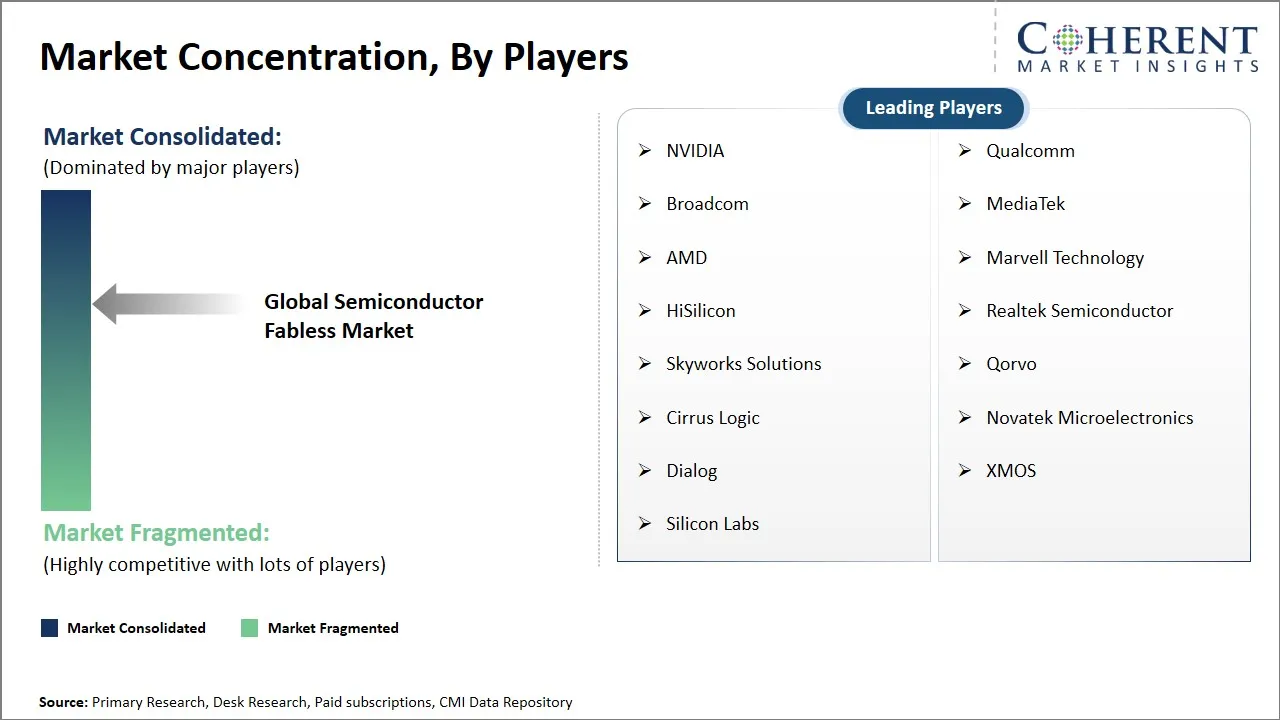
| Companies covered: | NVIDIA, Qualcomm, Broadcom, MediaTek, AMD, Marvell Technology, HiSilicon, Realtek Semiconductor, Skyworks Solutions, Qorvo, Cirrus Logic, Novatek Microelectronics, Dialog, XMOS, and Silicon Labs | ||
| Growth Drivers: |
| ||
| Restraints & Challenges: |
| ||
Market Dynamics
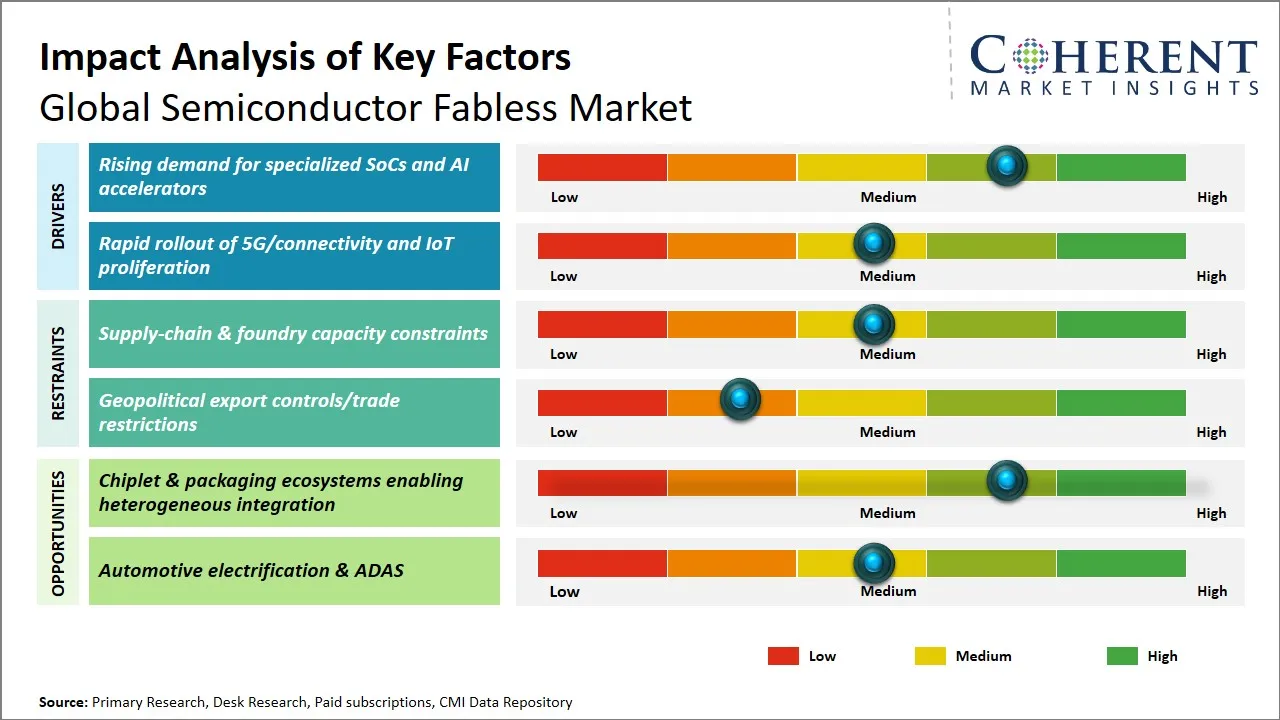
Global Semiconductor Fabless Market Driver - Rising Demand for Specialized SoCs and AI Accelerators
The growing complexity of modern electronic devices has led to an increased demand for highly specialized System-on-Chips (SoCs) tailored to specific applications, particularly in areas such as artificial intelligence, automotive systems, and edge computing. Traditional general-purpose chips are often unable to deliver the required performance and efficiency, driving Original Equipment Manufacturers (OEMs) and technology companies to turn to fabless semiconductor firms that can design custom SoCs optimized for particular workloads. Amazon Web Services (AWS) has developed its own Graviton processors (ARM-based SoCs) and Trainium AI accelerators through its Annapurna Labs (a fabless subsidiary).
In parallel, the surge in AI adoption across industries—from consumer electronics to cloud services—has accelerated the development and integration of AI accelerators, which are specialized processing units designed to handle AI algorithms more efficiently. These AI accelerators, often embedded within SoCs, enable faster data processing and lower power consumption, meeting the real-time demands of modern applications.
Global Semiconductor Fabless Market Opportunity – Chiplet and Packaging Ecosystems Enabling Heterogeneous Integration
Traditional monolithic chip designs face limitations in scaling performance and cost-efficiency due to increasing complexity and manufacturing constraints. Chiplet-based architectures, which involve integrating multiple smaller dies with varied functionalities into a single package, enable designers to optimize performance, power, and cost by mixing and matching best-in-class components fabricated on different process nodes. This modular approach supports heterogeneous integration, combining logic, memory, analog, and specialized accelerators within one system-in-package, addressing diverse application needs from high-performance computing to AI and 5G communications. For instance, AMD’s EPYC server processors use a chiplet architecture manufactured on different process nodes
Moreover, innovations in packaging technologies such as advanced interposers, fan-out wafer-level packaging, and 2.5D/3D integration facilitate higher bandwidth, lower latency, and improved thermal management, critical for next-generation semiconductor solutions. The growing ecosystem, including design tools, IP providers, and foundry partnerships, is accelerating time-to-market and mitigating the risks associated with complex chip development.
Analyst Opinion (Expert Opinion)
- Fabless companies are prioritizing AI-specific SoCs and accelerators, with GPUs, TPUs, and NPUs becoming central to datacenter, automotive, and edge deployments. This shift is pushing design innovation toward architectures optimized for parallelism, energy efficiency, and scalable AI workloads.
- The move toward chiplet and advanced packaging ecosystems enables fabless firms to integrate compute, memory, and I/O on heterogeneous process nodes. This reduces costs, improves yields, and allows rapid customization for diverse applications, from high-performance servers to power-efficient mobile devices.
- Beyond consumer electronics, fabless players are designing domain-focused SoCs for automotive (ADAS, EV powertrain control), healthcare (wearable diagnostics), and IoT/edge devices. These specialized chips present high-margin opportunities and allow smaller players to differentiate in niche but fast-growing markets.
Speak to the analyst
Want personalized insights?
Take the findings above to one of our principal consultants, or have the report rebuilt around the segments, geographies and competitors you actually track.
Market Segmentation
- Product Insights (Revenue, USD Bn, 2021 - 2033)
- System-on-Chip
- RF/Analog/Mixed-signal
- ASIC
- GPU/AI Accelerators
- Connectivity Chips
- IP Cores
- Others
- Regional Insights (Revenue, USD Bn, 2021 - 2033)
- North America
- U.S.
- Canada
- Latin America
- Brazil
- Argentina
- Mexico
- Rest of Latin America
- Europe
- Germany
- U.K.
- Spain
- France
- Italy
- Russia
- Rest of Europe
- Asia Pacific
- China
- India
- Japan
- Australia
- South Korea
- ASEAN
- Rest of Asia Pacific
- Middle East
- GCC Countries
- Israel
- Rest of Middle East
- Africa
- South Africa
- North Africa
- Central Africa
- North America
- Key Players Insights
- NVIDIA
- Qualcomm
- Broadcom
- MediaTek
- AMD
- Marvell Technology
- HiSilicon
- Realtek Semiconductor
- Skyworks Solutions
- Qorvo
- Cirrus Logic
- Novatek Microelectronics
- Dialog
- XMOS
- Silicon Labs
Sources
Primary Research Interviews
Stakeholders
- Fabless Semiconductor Executives
- Foundry Partners & Manufacturing Liaisons
- System OEMs & Device Manufacturers
- Semiconductor IP Core Developers
- Chip Design Software Providers (EDA Companies)
- Industry Consultants specializing in semiconductor supply chains
- Venture Capital Firms investing in semiconductor startups
Databases
- U.S. International Trade Commission (USITC)
- Taiwan Semiconductor Industry Statistics (TSIA)
- China Semiconductor Industry Association (CSIA) Data Portal
- OECD Digital Economy Databases
- Semiconductor Industry Association (SIA) Trade Data
Magazines
- Semiconductor Today
- EE Times
- Electronics Weekly
- Chip Design Magazine
- IoT & Semiconductor Review
Journals
- IEEE Journal of Solid-State Circuits
- Journal of Semiconductor Technology and Science
- Microelectronics Journal
- IEEE Transactions on Computer-Aided Design of Integrated Circuits and Systems
- Journal of Electronic Materials
Newspapers
- Nikkei Asia (Japan)
- The Economic Times (India)
- The Wall Street Journal (U.S.)
- South China Morning Post (Hong Kong)
- Financial Times (UK)
Associations
- Semiconductor Industry Association (SIA, U.S.)
- Taiwan Semiconductor Industry Association (TSIA)
- China Semiconductor Industry Association (CSIA)
- European Semiconductor Industry Association (ESIA)
- Global Semiconductor Alliance (GSA)
Public Domain Sources
- U.S. Census Bureau
- EUROSTAT
- World Semiconductor Trade Statistics (WSTS)
- World Bank
- United Nations Industrial Development Organization (UNIDO)
Proprietary Elements
- CMI Data Analytics Tool
- Proprietary CMI Existing Repository of information for last 8 years
Get access to 250+ pages report
Every segment, forecast, competitor profile and data table behind the analysis above — available for instant download.
- ESOMAR Member
- ISO 9001:2015 Certified
- D-U-N-S Registered
- GDPR & CCPA Compliant
Missing comfort of reading report in your local language? Find your preferred language:
Transform your Strategy with Exclusive Trending Reports
Frequently Asked Questions
The global semiconductor fabless market is estimated to be valued at USD 5.05 billion in 2026 and is expected to reach USD 9.41 billion by 2033.
The CAGR of the global semiconductor fabless market is projected to be 9.3% from 2026 to 2033.
Rising demand for specialized SoCs and AI accelerators and rapid rollout of 5G/connectivity and IoT proliferation are the major factors driving the growth of the global semiconductor fabless market.
Supply-chain & foundry capacity constraints and geopolitical export controls/trade restrictions are the major factors hampering the growth of the global semiconductor fabless market.
In terms of product, the system-on-chip segment is estimated to dominate the market revenue share in 2026.
It is a firm that designs chips but outsources manufacturing to foundries like TSMC or GlobalFoundries.
Chiplet-based architectures and automotive semiconductors are major growth opportunities.