

Global Shared Vehicles Market Size and Forecast: 2026-2033
The Global Shared Vehicles Market is estimated to be valued at USD 2.45 Bn in 2026 and is expected to reach USD 6.52 Bn by 2033, exhibiting a compound annual growth rate (CAGR) of 15.0% from 2026 to 2033.
Key Takeaways of the Shared Vehicles Market
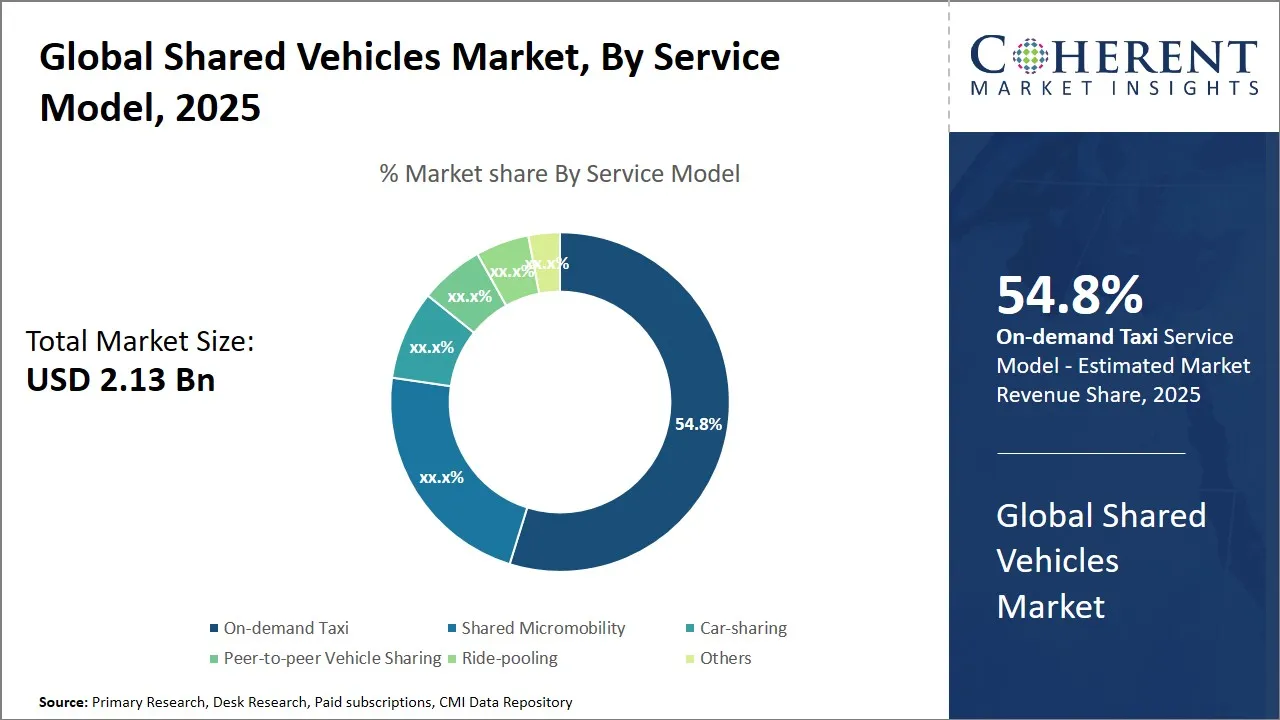
- The on-demand taxi segment leads the market holding an estimated share of 55.8% in 2026.
- The passenger cars segment leads the market holding an estimated share of 66.4% in 2026.
- Asia Pacific is estimated to lead the market with a share of 39.4% in 2026.
- Middle East, holding a share of 5.4% in 2026, is projected to be the fastest growing region.
Market Overview
Market trends indicate a strong shift towards electrification and integration of advanced technologies such as IoT and AI in shared vehicles, enhancing user experience and operational efficiency. Additionally, growing government initiatives promoting sustainable transport and the rise of app-based vehicle-sharing platforms are fueling market expansion, making shared vehicles a preferred choice for urban commuters seeking convenience, affordability, and eco-friendly travel options.
Current Events and their Impact
Current Events | Description and its impact |
Geopolitical and Trade Developments |
|
Economic and Infrastructure Trends |
|
Segmental Insights
- Current Industry Events of 2026
- Market Size Estimation
- Regional Breakdown
- Competitive Landscape
- Customer Intelligence
- Segmental Analysis
- Pricing Analysis
- Key Market Drivers, Challenges & Future Trends
- Customized Insights Section
Global Shared Vehicles Market Insights, By Service Model – On-demand Taxi Leads Owing to Rapid Urbanization and Increasing Consumer Preference for Convenience
The on-demand taxi segment leads the global shared vehicles market, holding an estimated share of 55.8% in 2026. Increasing urbanization has intensified traffic congestion and parking scarcity, making private vehicle ownership less attractive or practical, especially in dense metropolitan areas. On-demand taxi services provide a flexible and efficient alternative to private vehicles by offering users door-to-door transport without the hassle of ownership responsibilities such as maintenance, fuel costs, and parking fees.
Smartphone penetration and app-based service platforms have revolutionized how consumers book rides, making the process seamless and faster. These digital platforms use advanced GPS and ride-matching algorithms to reduce wait times and optimize routes, thereby enhancing the user experience. Additionally, cashless payment options and integrated fare management systems add to the convenience, attracting a broader demographic including tech-savvy millennials and urban professionals.
Additionally, environmental concerns and increasing regulatory support for shared mobility have encouraged shifts toward on-demand taxi services. Many cities aim to reduce carbon emissions and traffic density, prompting policies that favor ride-sharing over single-occupant private vehicles. On-demand taxis often utilize fuel-efficient or electric vehicles, further supporting sustainable urban transport initiatives. Moreover, the shared nature of this service helps reduce the number of vehicles on roads, contributing to alleviating congestion and decreasing overall pollution levels.
Consumer behavior also plays a significant role in the prominence of the on-demand taxi segment. The growing preference for flexible commuting options, aided by expanding ride-hailing company networks that operate in both established urban centers and emerging markets, has led to widespread adoption. The option to select different vehicle types based on trip purpose—ranging from economical rides to premium services—expands the market's reach. On-demand taxis also offer accessible mobility for demographics without access to private vehicles, including students, senior citizens, and transient populations.
Furthermore, integration with multimodal transport networks enhances the competitiveness of on-demand taxis. Real-time data and fleet management technologies support efficient vehicle allocation and dynamic pricing, improving operational efficiency and profitability for service providers, thereby encouraging continuous investment and innovation in this segment.
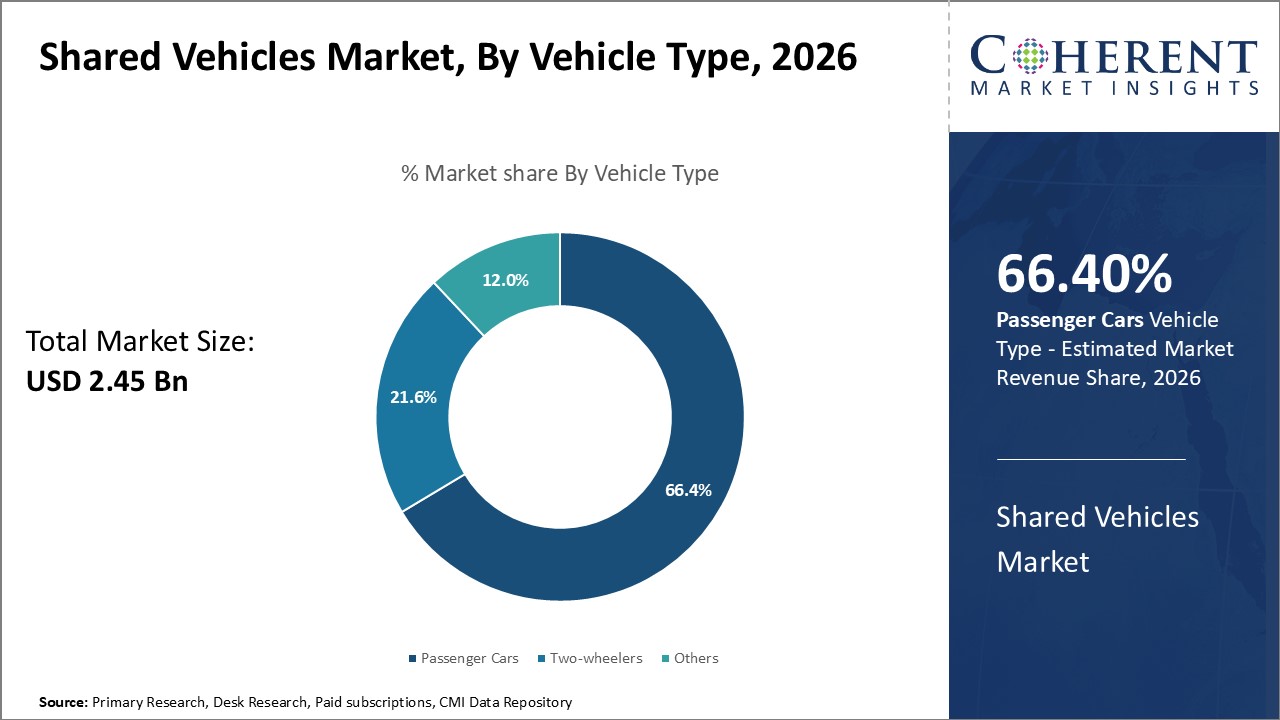
Global Shared Vehicles Market Insights, By Vehicle Type - Passenger Cars Dominate Due to Versatility and Broad Consumer Appeal
Passenger cars lead the vehicle type segment, holding an estimated share of 66.4% in 2026. Passenger cars cater to diverse transport demands, including commuting, business travel, social outings, and leisure trips. Their ability to comfortably accommodate multiple passengers and luggage makes them ideal for both individual and group users. The widespread availability of passenger cars also facilitates their prevalence in ride-sharing and car-sharing services. Many of these vehicles are fuel-efficient models designed to optimize cost-effectiveness for operators, which, in turn, translates into competitive pricing for consumers.
Another important driver supporting the dominance of passenger cars in the shared vehicles market is their compatibility with existing road and parking infrastructure. Cities worldwide have established networks of roads, parking spaces, and charging stations optimized for passenger cars, which eases operational challenges related to vehicle deployment, maintenance, and accessibility. Passenger cars also offer enhanced safety and comfort features compared to other vehicle types like two-wheelers or micromobility solutions, making them preferred choices for longer trips or inclement weather conditions. This contributes to higher user satisfaction and loyalty, encouraging repeat use within shared mobility frameworks.
From a technological standpoint, passenger cars provide ample opportunities for integration with vehicle telematics, real-time tracking, user preference analytics, and automated fleet management systems. In addition, corporate and institutional partnerships frequently utilize shared passenger cars for employee mobility or on-demand transport solutions, further boosting segment demand.
Pricing Analysis of the Shared Vehicles Market
Category/Service (U.S. unless noted) | Price Analysis |
Ride-hailing (Uber) — typical U.S. fare | USD 1–USD 2 per mile average (base guidance; excludes fees/surge). A 30-minute ride across big U.S. cities averaged ~USD 33.33 in 2025 (illustrative benchmark). |
Car-sharing — Zipcar (membership) | USD 9/month or USD 90/year standard membership. Some campuses offer USD 25–USD 35/year first-year promos. |
Car-sharing — Zipcar (usage rates) | Hourly rates commonly from USD 11/hour; daily caps often from ~USD 67–USD 83/day depending on vehicle/city; after daily included miles, USD 0.58/mile (example policy). |
Car-sharing — Zipcar (fees/policies snapshot) | Late return USD 50/hour (up to USD 150) plus extra time; low-fuel fee USD 30; some cars “daily-rate only.” (Policy examples; varies by plan & city.) |
Micromobility — Lime e-scooter (pay-as-you-go) | Common model: USD 1 unlock + USD 0.15–USD 0.30 per minute (city-dependent; official stance is “unlock + per-minute, varies”). |
Micromobility — Lyft Bay Wheels (SF Bay Area) classic bikes | USD 3.99 per 30-min single ride; Day Pass USD 15 (unlimited 30-min classic rides for 24h); Month USD 29; Annual USD 150. |
Micromobility — Lyft Bay Wheels e-bikes | Non-members: USD 0.30/min + USD 3.99 unlock. Members: USD 0.15/min, USD 0 unlock. (Prices round to the nearest minute.) |
Micromobility — Capital Bikeshare (Washington, DC) (from Aug 1, 2025) | Non-members: classic USD 0.15/min, e-bike USD 0.35/min. Members: classic first 45 min included; e-bike USD 0.15/min. (Annual USD 120, Monthly USD 25.) |
Micromobility — Bird/Lime reduced-fare programs (example: Denver) | Bird Access: USD 3/month + USD 0.05/min, no unlock fee. Lime Access: free 30-minute rides for qualified riders (local program terms apply). |
Regional Insights
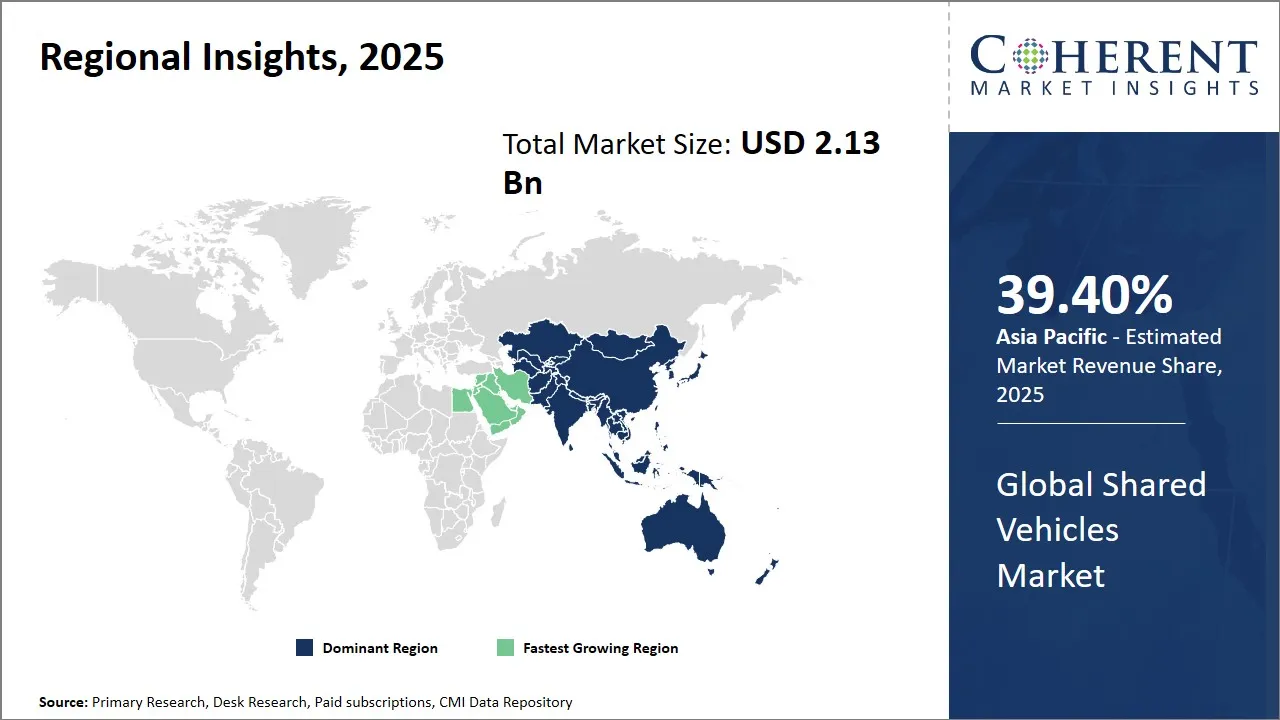
Asia Pacific Shared Vehicles Market Analysis and Trends
The Asia Pacific region, holding an estimated share of 39.40% in 2026, is expected to exhibit the fastest growth in the global shared vehicles market, spurred by rapid urbanization, increasing smartphone penetration, and rising disposable incomes in emerging economies like India and Southeast Asia. Government policies across the region emphasize smart city development and green mobility solutions, promoting electric shared vehicles and investments in urban transit infrastructure. The large population base and growing environmental consciousness create a fertile ground for shared mobility services.
Local players such as Ola in India and Grab in Southeast Asia lead innovation in micro-mobility and ride-hailing services, leveraging AI and data analytics to tailor offerings to diverse consumer needs. Cross-border collaborations and foreign direct investments also enhance market dynamism, enabling accelerated expansion and technology transfer within the region.
Middle East Shared Vehicles Market Analysis and Trends
The Middle East region, holding an estimated share of 5.4% in 205 is projected to be the fastest-growing market for shared vehicles, driven by ambitious government visions such as Saudi Arabia’s Vision 2030 and the UAE’s Smart Mobility Strategy. Rapid urban development, a young tech-savvy population, and increasing adoption of cashless payments are fueling demand for shared mobility services, particularly in metropolitan hubs like Dubai, Riyadh, and Doha.
Shared mobility players such as Careem and Udrive are expanding operations, while partnerships with global leaders like Cruise, WeRide, and Baidu Apollo are accelerating autonomous fleet testing in the region. The growing emphasis on sustainability and carbon reduction also promotes the uptake of electric taxis, e-scooters, and shared EV fleets. With favorable regulations, foreign direct investments, and strong public-private partnerships, the Middle East is rapidly transforming into a testbed for futuristic shared mobility ecosystems, setting the stage for long-term scalability and regional integration.
Shared Vehicles Market Outlook for Key Countries
U.S. Shared Vehicles Market Analysis and Trends
The U.S. leads due to early adoption of shared mobility models, supported by companies like Uber and Lyft that have revolutionized personal transportation. Strong venture capital investment and technology innovation foster new business models including car-sharing, scooter-sharing, and autonomous vehicle trials. Government emphasis on reducing urban congestion and emissions supports infrastructure for electric shared vehicles. Regulatory frameworks here balance innovation with safety, driving consumer confidence. The presence of strategic partnerships between automakers and tech firms, such as General Motors’ investment in shared vehicle platforms, continually advances market sophistication.
China Shared Vehicles Market Analysis and Trends
China is seeing mass adoption of shared vehicles because of its tech-savvy population and the government’s support for smart transportation solutions. Leading players like Didi Chuxing dominate the landscape, adding ride-hailing to multi-modal transport services including bike and e-scooter sharing. Government policies supporting electric vehicles and urban congestion reduction make an environment conducive to shared mobility growth. Also, China’s investments in AI and 5G technologies improve operational efficiency and user experience. Localization of solutions to meet different urban demands also adds to its market presence.
Germany Shared Vehicles Market Analysis and Trends
Germany continues to lead Europe shared vehicles market because of its focus on sustainability and high environmental standards. Established automakers like Volkswagen and BMW invest in car-sharing services and electric vehicle fleets integrated within broader mobility-as-a-service (MaaS) platforms. Strict government regulations on emissions and incentives for electric mobility push consumers toward shared vehicle options. Public-private partnerships also add to expansion and technological advancements in the sector.
India Shared Vehicles Market Analysis and Trends
India shows momentum because of growing urban populations and increasing digital connectivity. Local companies such as Ola and Zoomcar use local market insights to innovate in ride-sharing, vehicle subscription, and peer-to-peer car rental services. However, infrastructure challenges and regulatory complexities remain focal points for market development.
Market Players, Key Development, and Competitive Intelligence
Key Developments
- On August 21, 2025, Nuro, Inc., a leader in autonomous driving technology, announced the closing of a USD 203 million Series E funding round at a USD 6 billion valuation. The round includes Uber, returning investor Baillie Gifford, and new investors Icehouse Ventures, Kindred Ventures, NVIDIA, and Pledge Ventures.
- In June 2025, Lime, the shared scooter and bike company, and Uber signed a new multiyear agreement that allows Uber to continue to feature Lime’s shared bikes and scooters on its ridehail app. As part of the deal, Lime’s rented bikes and scooters will continue to appear in Uber’s app in the markets in which they overlap, including the US, Canada, Europe, Australia and New Zealand.
- In May 2025, Uber Technologies, Inc., the world’s largest mobility and delivery platform, and WeRide, a global leader in autonomous driving technology, announced a significant expansion of their previously announced strategic partnership, adding 15 additional cities globally over the next five years, including in Europe. This expanded partnership accelerates WeRide and Uber’s shared goal of making autonomous mobility a global reality, with both companies leading the way in delivering cutting-edge technology.
- In September 2024, TIER and Dott closed a financial transaction to merge the two companies. With revenues of USD 292.7 million (€250 million), supporting over 125 million trips a year in more than 20 countries, the newly combined business created the European leader of shared micro-mobility.
Top Strategies Followed by Shared Vehicles Market Players
- Established industry leaders aggressively invest in research and development (R&D) to pioneer high-performance and technologically advanced products that meet evolving consumer demands.
- Uber invested in autonomous ride-hailing R&D through its Advanced Technologies Group and continues to develop AI-driven routing & safety features to optimize fleet efficiency and enhance customer trust.
- Mid-level market participants employ distinct tactics to carve out their share by focusing on cost-effective solutions without significantly compromising on quality.
- Ola focuses on affordable ride-hailing and Ola Electric scooters, catering to India’s cost-sensitive market. Their Ola S1 Air EV scooter launched at a disruptive price point, boosting adoption in tier-2 and tier-3 cities.
- Small-scale players in the shared vehicles market differentiate themselves by focusing on niche segments or specialized feature sets that are often overlooked by larger competitors.
- Udrive operates a pay-per-minute car-sharing model, targeting short-term urban users (tourists, gig-economy workers). By offering hyperlocal flexible rentals, it differentiates itself from global ride-hailing giants.
Market Report Scope
Shared Vehicles Market Report Coverage
| Report Coverage | Details | ||
|---|---|---|---|
| Base Year: | 2025 | Market Size in 2026: | USD 2.45 Bn |
| Historical Data for: | 2020 To 2024 | Forecast Period: | 2026 To 2033 |
| Forecast Period 2026 to 2033 CAGR: | 15.0% | 2033 Value Projection: | USD 6.52 Bn |
| Geographies covered: |
| ||
| Segments covered: |
| ||
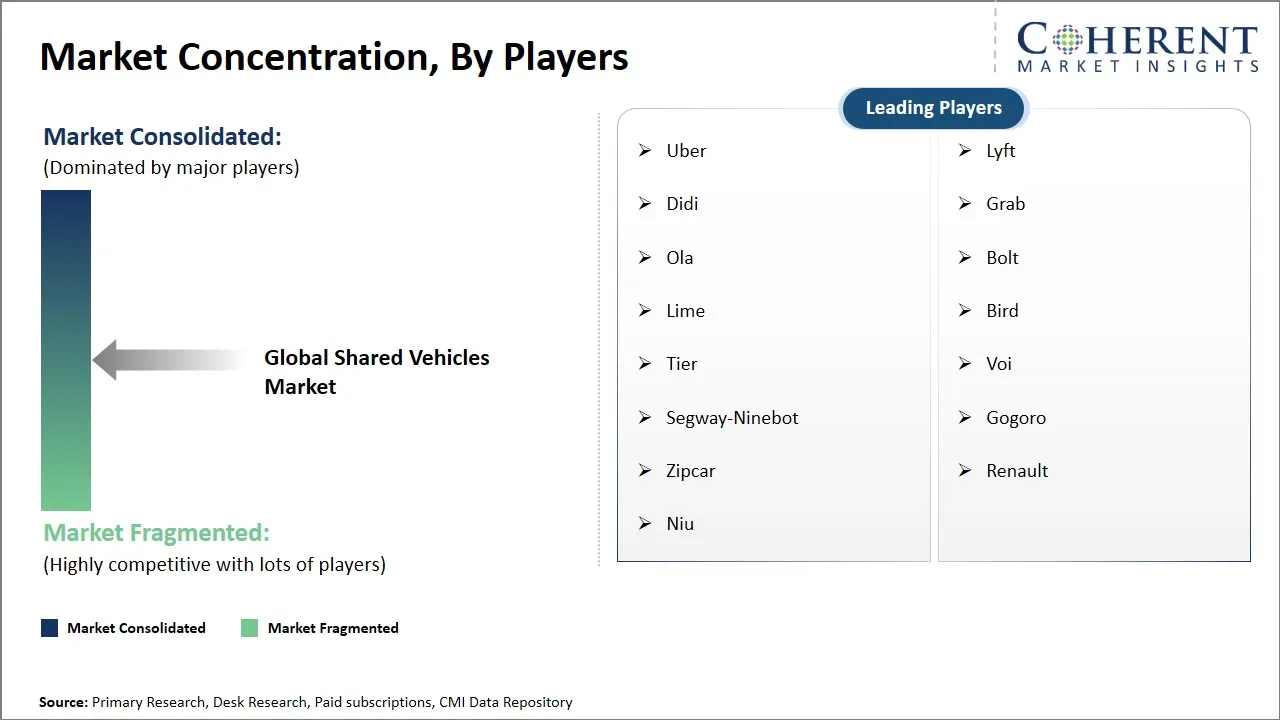
| Companies covered: | Uber, Lyft, Didi, Grab, Ola, Bolt, Lime, Bird, Tier, Voi, Segway-Ninebot, Gogoro, Zipcar, Renault, and Niu | ||
| Growth Drivers: |
| ||
| Restraints & Challenges: |
| ||
Market Dynamics
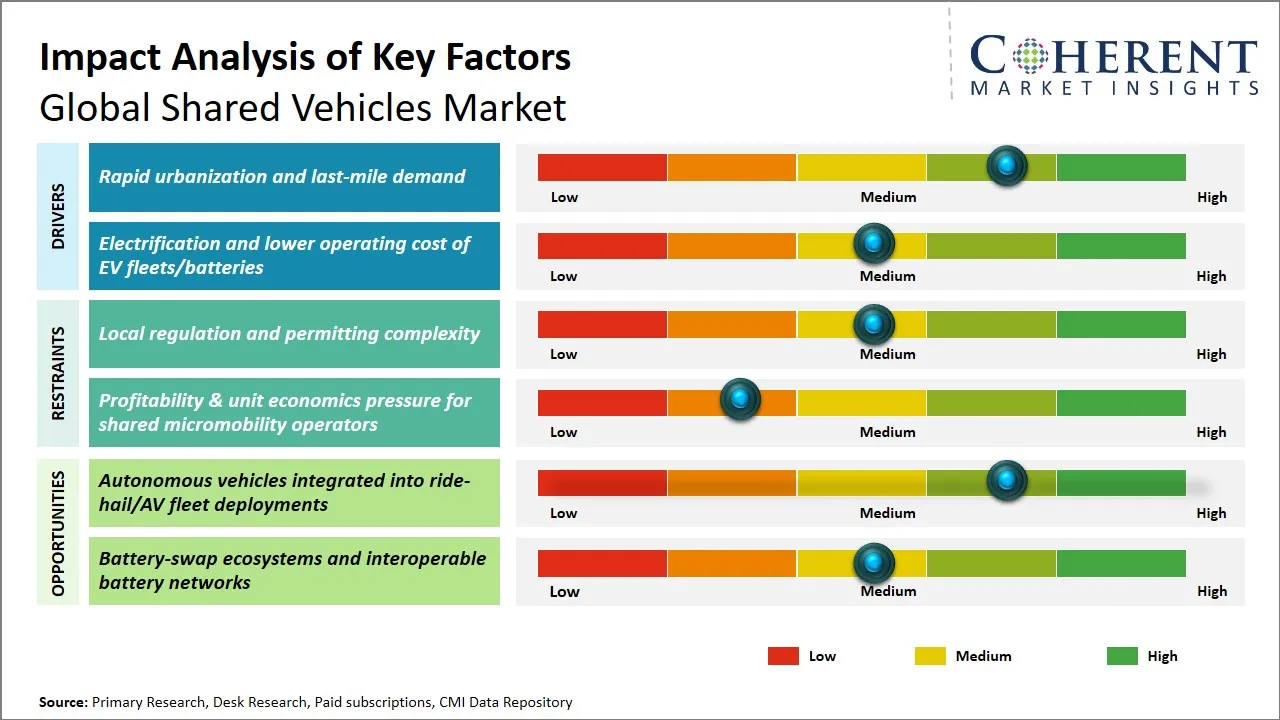
Global Shared Vehicles Market Driver - Rapid Urbanization and Last-mile Demand
The acceleration of urbanization across the globe has significantly intensified the demand for efficient and flexible transportation solutions, directly benefiting the shared vehicles market. As cities become more densely populated, conventional personal vehicle ownership faces increasing challenges such as limited parking, traffic congestion, and high maintenance costs. Shared vehicles address these issues by offering a convenient alternative that eliminates the need for individual car ownership while providing easy access to mobility on demand. MuvMi is a Thai ride-sharing platform operating an all-electric fleet of over 600 electric tuk-tuks across 12 Bangkok neighborhoods. These EV tuk-tuks are primarily deployed to bridge first- and last-mile connectivity with Bangkok’s public transit system.
Additionally, the surge in last-mile connectivity requirements, driven by the expansion of public transit networks and e-commerce logistics, further propels the need for short-distance, flexible travel options. Urban dwellers increasingly rely on shared mobility services to bridge gaps between public transport hubs and final destinations, helping to reduce travel time and improve overall commuting efficiency. This synergy between rapid urban growth and evolving last-mile transportation needs is a crucial factor driving widespread adoption and innovation within the shared vehicles ecosystem.
Global Shared Vehicles Market Opportunity – Integration of Autonomous Vehicles into Ride-Hail and AV Fleet Deployments
The integration of autonomous vehicles (AVs) into shared mobility and ride-hailing services presents a significant growth opportunity within the global shared vehicles market. As advancements in autonomous driving technology continue to mature, companies in the ride-hailing sector are increasingly investing in AV fleets to enhance operational efficiency, reduce labor costs, and improve customer experience. Autonomous shared vehicles have the potential to transform last-mile urban transportation by offering safer, more reliable, and cost-effective solutions compared to traditional human-driven vehicles. In May 2025, WeRide launched fully driverless Robotaxi trial operations on public roads in Abu Dhabi — the first of its kind in the Middle East. The service extended to major urban zones including Yas Island, Saadiyat Island, Al Maryah Island (financial district), and Al Reem Island (residential hub).
The deployment of AVs can lead to optimized fleet management through real-time data analytics, reducing wait times, and increasing vehicle utilization rates. Furthermore, the integration of AVs aligns with growing urban sustainability goals by enabling electric autonomous fleets that lower carbon emissions and traffic congestion. Several major ride-hailing companies and automotive OEMs are conducting pilot programs and strategic partnerships to accelerate AV adoption in key metropolitan areas, thereby fostering consumer trust and regulatory acceptance. The ongoing improvements in sensor technology, AI algorithms, and mapping infrastructure will facilitate the scalability of AV fleets, ultimately expanding shared mobility access to underserved regions and demographics.
Analyst Opinion (Expert Opinion)
- Robotaxis and autonomous shuttles are no longer confined to R&D trials; deployments in Abu Dhabi (WeRide), China (Baidu Apollo Go), and U.S. (Waymo, Cruise) highlight how AVs are entering real-world shared mobility networks. Over the next 5–7 years, scaling AV fleets will likely reduce operator costs (driver wages) and open new 24/7 shared mobility use-cases in urban and suburban corridors.
- Emerging models in Southeast Asia (Oyika, Gogoro) demonstrate how battery swapping eliminates downtime and addresses charging bottlenecks, especially for scooters and e-bikes used in shared fleets. This is particularly impactful for dense, high-traffic cities in Asia-Pacific, where quick turnaround and high utilization rates are critical for profitability.
- Players like Uber (with Lime), Grab, and Gojek are integrating multiple services (ride-hailing, micromobility, car-share, delivery) into unified apps. This ecosystem approach enhances user stickiness and opens cross-service monetization opportunities, while enabling future integration of new modes like air taxis, autonomous vans, and even shared drones.
Speak to the analyst
Want personalized insights?
Take the findings above to one of our principal consultants, or have the report rebuilt around the segments, geographies and competitors you actually track.
Market Segmentation
- Service Model Insights (Revenue, USD Bn, 2021 - 2033)
- On-demand Taxi
- Shared Micromobility
- Car-sharing
- Peer-to-peer Vehicle Sharing
- Ride-pooling
- Others
- Vehicle Type Insights (Revenue, USD Bn, 2021 - 2033)
- Passenger Cars
- Two-wheelers
- Other
- Regional Insights (Revenue, USD Bn, 2021 - 2033)
- North America
- U.S.
- Canada
- Latin America
- Brazil
- Argentina
- Mexico
- Rest of Latin America
- Europe
- Germany
- U.K.
- Spain
- France
- Italy
- Russia
- Rest of Europe
- Asia Pacific
- China
- India
- Japan
- Australia
- South Korea
- ASEAN
- Rest of Asia Pacific
- Middle East
- GCC Countries
- Israel
- Rest of Middle East
- Africa
- South Africa
- North Africa
- Central Africa
- North America
- Key Players Insights
- Uber
- Lyft
- Didi
- Grab
- Ola
- Bolt
- Lime
- Bird
- Tier
- Voi
- Segway-Ninebot
- Gogoro
- Zipcar
- Renault
- Niu
Sources
Primary Research Interviews
Stakeholders
- Shared Mobility Operators (e.g., Uber, Ola, Grab, Didi, Careem, Lyft)
- Micromobility Fleet Managers (e.g., Lime, Bird, Tier Mobility, Voi)
- Vehicle OEMs & EV Manufacturers (e.g., BYD, Hyundai, Gogoro, Segway-Ninebot)
- City Transport & Urban Planning Authorities (e.g., Singapore LTA, Dubai RTA, Transport for London)
- Battery-Swapping & Charging Infrastructure Providers (e.g., Gogoro Network, Oyika, Nio Power)
- Mobility Tech Startups (AI fleet optimization & AV developers)
- Sustainability & Smart City Consultants (with focus on EV transition in mobility services)
Databases
- World Urban Mobility Database
- International Transport Forum (ITF)
- OECD Transport Statistics
- U.S. Department of Transportation (USDOT)
- Asia Mobility Data Exchange (AMDE)
Magazines
- Smart Mobility Today
- Urban Transport Review
- Fleet Management Weekly
- EV & Mobility Tech
Journals
- Journal of Transport Geography
- Sustainable Cities and Society
- International Journal of Sustainable Transportation
- IEEE Transactions on Intelligent Transportation Systems
- Journal of Urban Mobility & Smart Infrastructure
Newspapers
- The Economic Times (India)
- The National (UAE)
- South China Morning Post
- Financial Times (UK)
- The New York Times (US)
Associations
- International Association of Public Transport (UITP)
- Shared Mobility Association (North America)
- Asia-Pacific Smart Mobility Alliance
- European Cyclists’ Federation (ECF)
- Global New Mobility Coalition (World Economic Forum initiative)
Public Domain Sources
- EUROSTAT
- World Bank Open Data
- United Nations Economic Commission for Europe (UNECE)
- International Energy Agency (IEA) Mobility Outlook
- ResearchGate (transportation studies)
Proprietary Elements
- CMI Data Analytics Tool
- Proprietary CMI Existing Repository of information for last 8 years
Get access to 250+ pages report
Every segment, forecast, competitor profile and data table behind the analysis above — available for instant download.
- ESOMAR Member
- ISO 9001:2015 Certified
- D-U-N-S Registered
- GDPR & CCPA Compliant
Missing comfort of reading report in your local language? Find your preferred language:
Transform your Strategy with Exclusive Trending Reports
Frequently Asked Questions
The global shared vehicles market is estimated to be valued at USD 2.45 Bn in 2026 and is expected to reach USD 6.52 Bn by 2033.
The CAGR of global shared vehicles market is projected to be 15.0% from 2026 to 2033.
Rapid urbanization and last-mile demand and electrification and lower operating cost of EV fleets/batteries are the major factors driving the growth of the global shared vehicles market.
Local regulation and permitting complexity and profitability & unit economics pressure for shared micromobility operators are the major factors hampering the growth of the global shared vehicles market.
In terms of Service Model, On-demand Taxi is estimated to dominate the market revenue share in 2026.
Uber, Lyft, Didi, Grab, Ola, Bolt, Lime, Bird, Tier, Voi, Segway-Ninebot, Gogoro, Zipcar, Renault, and Niu are the major players.
Asia Pacific is expected to lead the global shared vehicles market in 2026.