

Global Shilajit Market Size and Forecast – 2026-2033
The Global Shilajit Market is estimated to be valued at USD 221.4 Mn in 2026 and is expected to reach USD 504.9 Mn by 2033, exhibiting a compound annual growth rate (CAGR) of 12.5% from 2026 to 2033.
Key Takeaways of the Shilajit Market
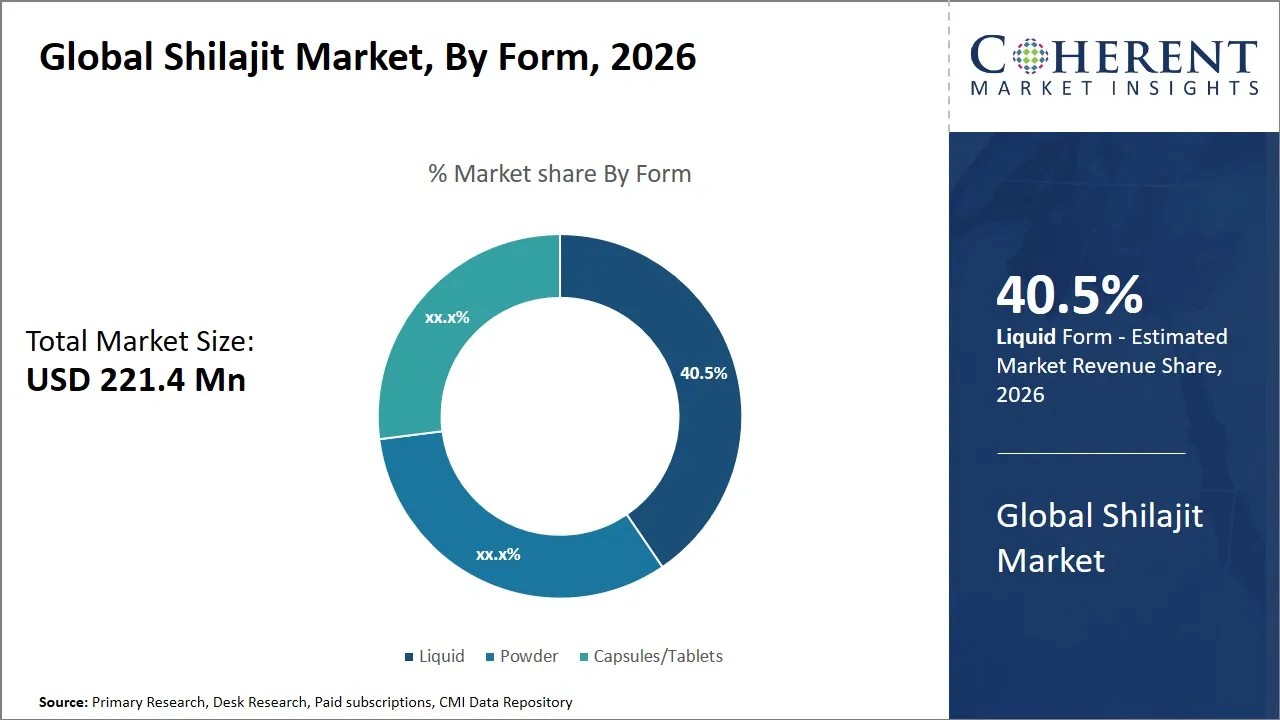
- Liquid segment is expected to account for 40.5 % of the market share in 2026.
- The bone & joint health segment is projected to hold 31.8 % of the market share in 2026.
- The offline segment is projected to account for 57.9 % of the Shilajit market in 2026.
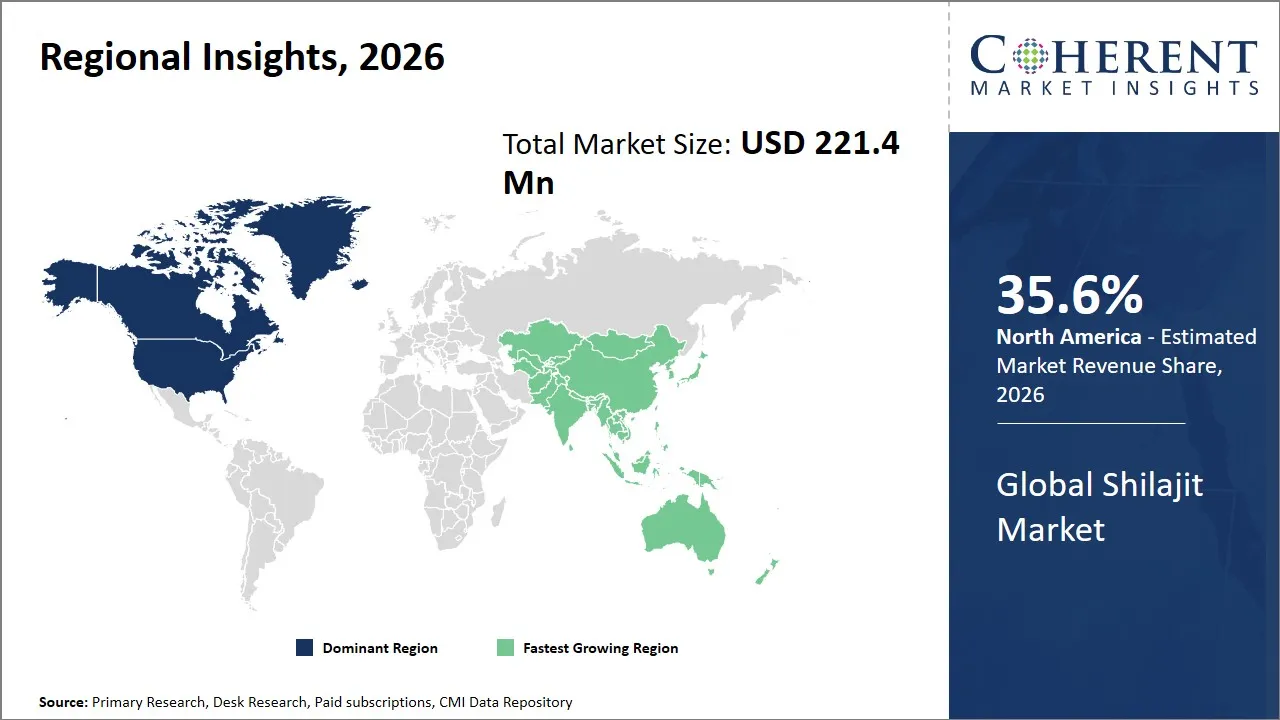
- North America is expected to dominate the market with a 35.6 % share in 2026.
- Asia Pacific is set to be the fastest-growing region, accounting for 15.3 % of the market share in 2026.
Market Overview
- The market trend for Shilajit is strongly influenced by a growing preference for herbal and traditional remedies in the wellness sector.
- Consumers are increasingly seeking alternative medicines with minimal side effects, which is propelling the use of Shilajit in dietary supplements, skin care products, and energy-boosting products.
- Additionally, advancements in extraction technologies and product formulations are enhancing the quality and availability of Shilajit, fueling market expansion.
- The growing emphasis on holistic health and natural therapies continues to shape the rising demand trajectory globally.
Current Events and Its Impact
Current Events | Description and its impact |
New wave of analytical evidence highlighting heavy-metal presence risk in Shilajit supplements (January 202) |
|
EU enforcement pressure on unauthorized botanical health claims strengthens (late 2025) |
|
Segmental Insights
- Current Industry Events of 2026
- Market Size Estimation
- Regional Breakdown
- Competitive Landscape
- Customer Intelligence
- Segmental Analysis
- Pricing Analysis
- Key Market Drivers, Challenges & Future Trends
- Customized Insights Section
Why Does Liquid Segment Dominate the Shilajit Market in 2026?
The liquid form is expected to command 40.5% share of the Shilajit market in 2026, primarily driven by its enhanced bioavailability and user convenience. Liquid Shilajit is easily absorbed by the body compared to powder or capsules, so the effects of the product take place quicker. This is important in a health supplement market where consumers expect to get efficient and palpable advantage, especially for conditions like fatigue, inflammation, and cognitive support that Shilajit aims to address.
Other reasons that are driving the liquid segment include ease of changing of dosage. The number of drops can be tailored by the user and this aspect is especially attractive to individual wellness plans. Moreover, liquid Shilajit can be easily dissolved in drinks like water, smoothies, or herbal teas, which increase compliance to the drug without the unpleasant bitter and gritty texture that is commonly experienced by those taking it in the powder form. This flexibility appeals to new and old consumers who need to have an easy way of consuming supplements.
Why Does Bone & Joint Health Dominate the Global Shilajit Market?
The bone & joint health segment is projected to lead the market, capturing 31.8% share in 2026, largely attributable to the increasing prevalence of musculoskeletal issues and heightened consumer focus on joint wellness. Shilajit has traditionally been known to have anti-inflammatory and regenerative effects, hence it is applicable in targeting joint stiffness, arthritis and symptoms related to osteoporosis. With aging populations in most parts of the world, bone density loss and joint pains are on the increase, and hence, there is an increased demand for natural supplements that have the potential to sustain long-term skeletal health.
Consumers are seeking alternatives to mainstream painkillers and steroid products because of their side effects and so are resorting to Ayurvedic products such as Shilajit. The ability of the compounds to increase collagen synthesis and enhance calcium uptake is known to the wellness community, and so it is a reliable source of bone strengthening. Moreover, the active lifestyles and growing cases of sport-related joint injuries also increase the consumer base of this segment to younger populations who are concerned about preventative strategies.
Offline Segment Dominates the Shilajit Market
The offline segment is expected to capture 57.9% share of the Shilajit market in 2026, underpinned by longstanding consumer trust and the value placed on in-person shopping experiences. Being a natural supplement specialized and having traditional medical roots, Shilajit tends to invite people to think about visiting the physical store, i.e., to use pharmacies, health food stores, and Ayurvedic clinics that can provide people with professional advice. Availability of well-informed employees who may offer personalized advice on buying or dose prescriptions is a very important element in determining the purchase decisions in the offline setting.
In addition, authenticity and purity are major concerns to many consumers in the purchase of herbal supplements. Physical retail environment enables them to check the packaging of the product and certifications as well as possibly checking the product prior to purchase, and thus, builds credibility. This is especially vital in the market where imitated or impure products have been claimed, and consumers will prefer visiting physical stores where they can be sure that the products are original.
Regional Insights
North America Shilajit Market Analysis and Trends
The North America region is projected to lead the market with a 35.6% share in 2026, driven primarily by growing consumer inclination toward natural health supplements and alternative medicine. There is also the presence of the supporting ecosystem of organic and health-aware retailers as well as e-commerce penetration.
Quality and safety are guaranteed by regulatory bodies, which helps build consumer confidence. For example, Pure Himalayan Shilajit, Sunfood Superfoods and Natural Shilajit Inc., who provide high quality lab-tested Shilajit products to meet the demands of fitness enthusiasts, and consumers in need of natural immunity enhancers. The engagement of wellness influencers and strategic marketing is another element that leads to fast market penetration.
Asia Pacific Shilajit Market Analysis and Trends
The Asia Pacific region is expected to exhibit the fastest growth in the market contributing 15.3% share in 2026. This growth can be attributed to the region’s deeply rooted rich traditional use of Shilajit as a natural supplement in Ayurvedic and traditional medicine systems. India, Nepal, and Bhutan are some of the leading life sources because of their geographic position in those natural deposits of Shilajit of high-quality embarkation are located in the Himalayan areas. The market ecosystem, which is developed and established, is backed with the significant number of local and international companies that invest in sustainable extraction and processing.
The market is further strengthened through government campaigns on the use of herbal medicine and natural health products. High presence in the industry and growing consumer awareness concerning health and wellness sustain Asia Pacific as a leading industry. With a presence in more than 200 countries, Dabur India Ltd., Patanjali Ayurved, and Forest Essentials are the top industry players that have broadened their market by adding Shilajit to their product lines of different formulations and wellness products, which has boosted the market growth.
Global Shilajit Market Outlook for Key Countries
Why is India Emerging as a Dominant Producer and Consumer in the Shilajit Market?
The India’s shilajit market is culturally inclined and has long been consuming Shilajit in Ayurveda, making it a leading manufacturer and consumer of the product. Its leadership position is maintained by the large number of Ayurvedic brands that emphasize purity and authenticity. Companies such as Dabur and Himalaya stress on research-supported formulations and ethical sourcing and have a well-developed domestic market. In addition, the government encourages native health activities with the help of programs such as the Ministry of AYUSH, which, consequently, generates demand. India is also a hub of exports where raw and processed Shilajit is exported all over the world.
Why is the U.S. Emerging as a High-Value, Innovation-Driven Market for Shilajit?
The U.S. shilajit market focuses heavily on quality assurance and product innovation. Increasing consumer preference for natural supplements correlates with wellness trends, and Shilajit is prominently marketed for energy enhancement and cognitive benefits. The trend of wellness is associated with a growing amount of consumption of natural supplements, and Shilajit is actively promoted as a natural source of extra energy and mental benefit.
Firms like Pure Himalayan Shilajit and Sunfood Superfoods offer their certifications to buyers with high health awareness. In addition, compliance is achieved through regulatory control by the FDA, which increases the confidence of the end users besides stimulating new suppliers to develop new product lines using Shilajit as one of the central ingredients.
Russia Shilajit Market Trends
Russia continues to lead the market in Eastern Europe due to traditional uses of Shilajit in folk medicine and increasing integration into modern dietary supplements. It is also close to large Shilajit resource areas in the Altai and Caucasus Mountains which facilitates sourcing of raw materials. To gain consumer confidence, Russian companies focus on authenticity of the product by conducting lab tests and certification. To grow the market steadily, market players such as Altai Products and Siberian Health have played their roles by creating formula that suits the local health trends such as immunity boosting and anti-fatigue supplements.
Germany Shilajit Market Trends
Germany’s Shilajit market benefits from stringent quality regulations and a strong demand for natural remedies within its established herbal supplementation sector. Consumers are focusing on certified organic and pharmaceutical grade supplements, which provides them with high barriers to entry, which is in favor of companies investing in terms of quality and transparency. Examples of firms that have presented Shilajit as a combination of other herbal extracts include Salus Haus and Dr. Wolz and are in the wellness and medical niche markets. Also, partnerships with research institutes increase product credibility and acceptance among German consumers who are oriented on scientifically validated natural health products.
Brazil Shilajit Market Trends
Brazil’s emerging market is buoyed by a growing trend towards natural and traditional health products, alongside increasing consumer education on the benefits of Shilajit. The wellness industry in the country is quickly embracing new types of supplements to satisfy the emerging demand to drink more energy and vitality giving supplements. International suppliers and local importers and distributors cooperate in order to secure availability. The major stakeholders are the local firms that manufacture herbal products as well as international brands that are increasing their presence by partnering.
Regulatory Compliance & Import Rejection Analysis
Parameter | What This Explicitly Captures | Why It Matters for Shilajit |
Exporting Country of Origin | Actual source country declared in customs filings (India, Nepal, Russia, Afghanistan, Kyrgyzstan) | High-altitude origin claims are often falsified; regulators track mismatch between declared origin and residue profile |
Importing Authority | Authority issuing rejection or clearance (U.S. FDA, EU RASFF, FSSAI India, SFDA Saudi, CFIA Canada) | Shilajit faces stricter scrutiny than generic herbal extracts due to heavy metal risk |
Border Lab Result vs Label Claim | Side-by-side numeric comparison | Core compliance failure driver |
Purity & Adulteration Risk Mapping
Risk Layer | What this Measures | Typical Shilajit-Specific Findings |
Raw Material Authenticity | Ratio of genuine high-altitude resin vs low-grade mineral pitch | High adulteration in bulk powder formats |
Heavy Metal Signature | Elemental pattern consistency with Himalayan geology | Lead and arsenic spikes indicate industrial contamination |
Market Players, Key Development, and Competitive Intelligence
Key Developments
- In July 2022, Dabur India Ltd. unveiled the expansion of its trusted healthcare and energizer brand, Dabur Shilajit, with the introduction of 'Dabur Himalayan Shilajit' during Amazon.in's Prime Day event. This innovative product is a natural health booster to improve well-being and promote healthy aging. Dabur Himalayan Shilajit is entirely pure and devoid of any fillers or additives. It functions as a natural revitalizer, containing over 80% Fulvic Acid, which provides exceptional antioxidant benefits by blocking free radical formation and lowering oxidative stress.
- In August 2021, Upakarma Ayurveda unveiled its latest offering: Shilajit Resin with Gold Dust. This unique formulation combines the natural potency of pure Shilajit with the luxurious touch of gold elements, specifically Swarna (Gold) Vang and Vark. The product results from thorough research and development, providing consumers with a lavish experience of gold-infused Shilajit in its rich resin form.
Top Strategies Followed by Global Shilajit Market Players
Player Type | Strategic Focus | Example |
Established Market Leaders | Heavy investment in R&D and innovation | For example, Patanjali Ayurved uses in-house R&D and massive procurement to introduce uniform Shilajit formulations supported by Ayurveda dominated positioning. Dabur aims at quality control, brand confidence and combination with its extended herbal range. |
Mid-Level Players | Cost-effective solutions with balanced quality | For example, brands such as Kapiva or Himalayan Organics maximize on sourcing and production by utilizing third-party GMP plant, which can scale-up quickly without expensive capex. The distributor tie-ups, e-commerce, and influencer-led education are some of the tools that these players lean on to propel penetration on price-sensitive yet health-conscious consumers. |
Small-Scale Players | Niche specialization & innovative variants | For example, D2C brands, such as Pure Himalayan Shilajit, focus on sourcing by altitude and minimum processing. Most of them embrace the use of high-tech methods such as low-temperature extraction, resin encapsulation or environment-friendly packaging as a form of indicating high-quality authenticity, although the quantities are small. |
Market Report Scope
Shilajit Market Report Coverage
| Report Coverage | Details | ||
|---|---|---|---|
| Base Year: | 2025 | Market Size in 2026: | USD 221.4 Mn |
| Historical Data for: | 2020 To 2024 | Forecast Period: | 2026 To 2033 |
| Forecast Period 2026 to 2033 CAGR: | 12.5% | 2033 Value Projection: | USD 504.9 Mn |
| Geographies covered: |
| ||
| Segments covered: |
| ||
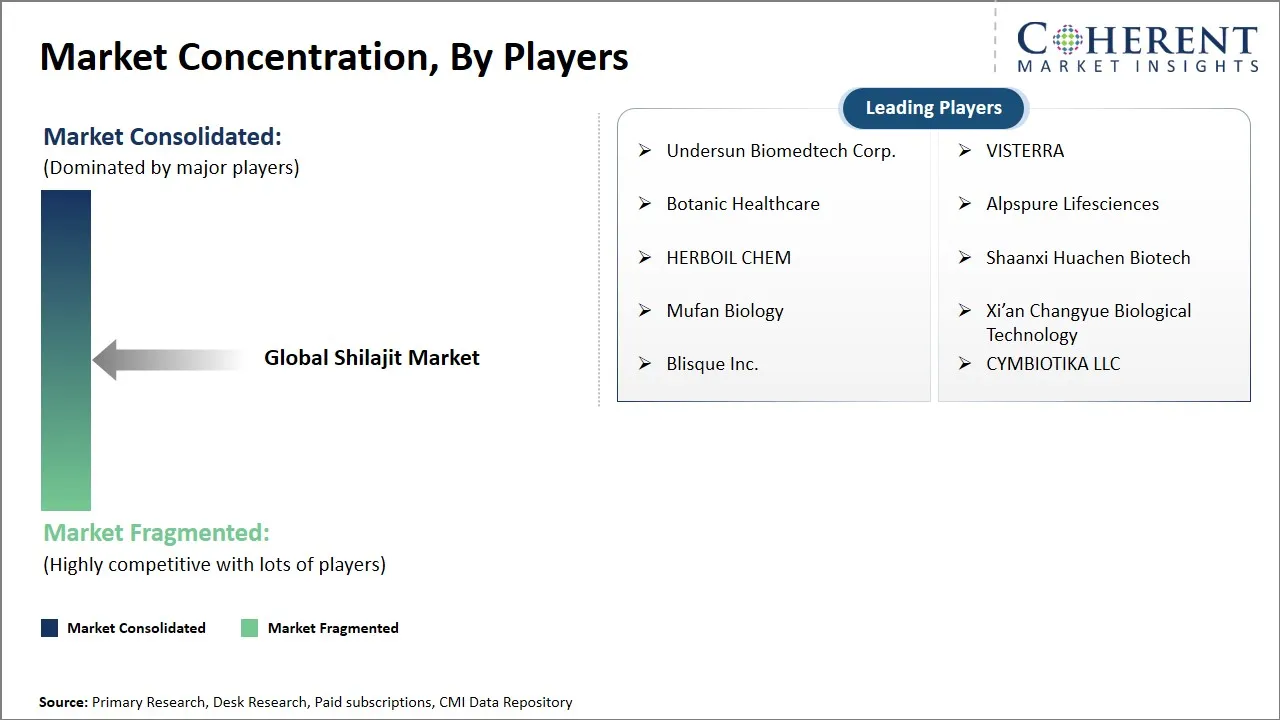
| Companies covered: | Undersun Biomedtech Corp., VISTERRA, Botanic Healthcare, Alpspure Lifesciences, HERBOIL CHEM, Shaanxi Huachen Biotech, Mufan Biology, Xi’an Changyue Biological Technology, Blisque Inc., and CYMBIOTIKA LLC | ||
| Growth Drivers: |
| ||
| Restraints & Challenges: |
| ||
Shilajit Market Dynamics
Shilajit Market Driver - Increasing Awareness of Herbal and Traditional Medicine
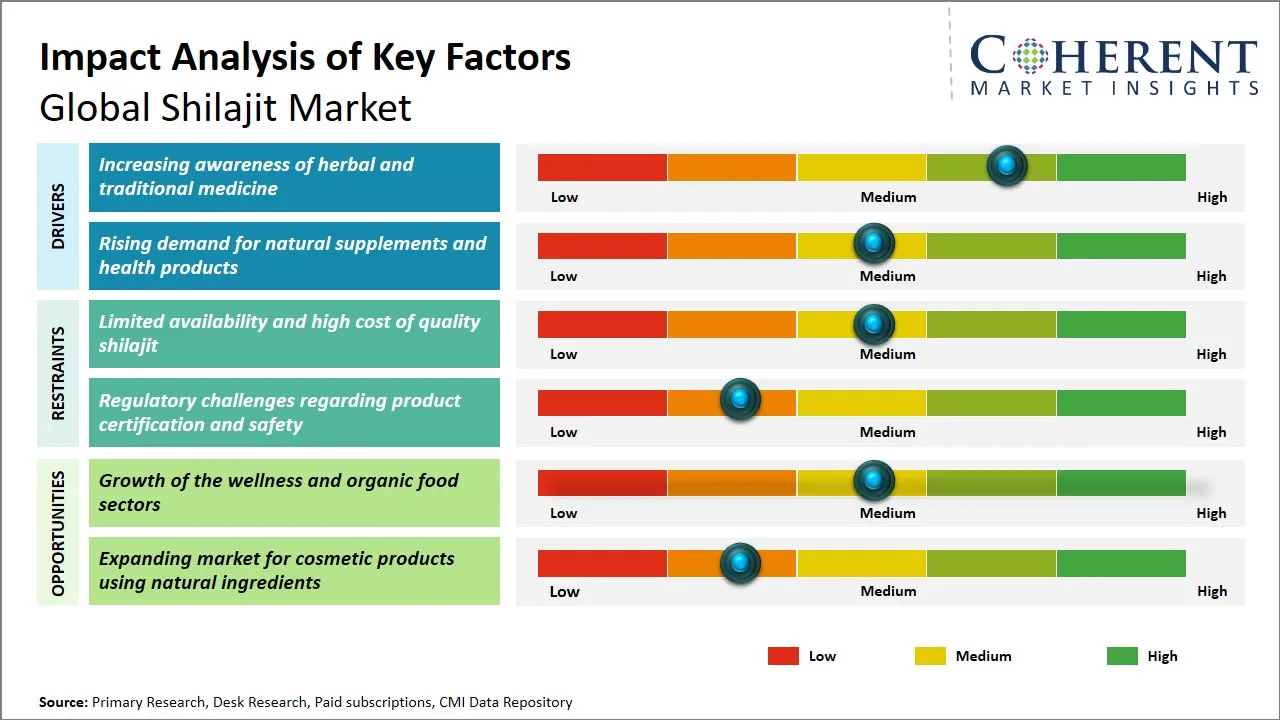
The growing global focus on holistic health and natural healing has fueled the rising demand for herbal medicinal products, with Shilajit emerging as a key supplement. The target market is also moving towards substitutes of synthetic drugs because of the issues of side effects and long-lasting health benefits based on natural compounds. Shilajit with its rejuvenating and adaptogenic effects fits in this change because it is highly rooted in the Ayurvedic traditional practice. This growing awareness is aided by the popular distribution of information via digital channels, wellness-focused groups, and increased support of the same by practitioners of alternative medicine.
For example, Himalaya Wellness has introduced purified, resin-based Shilajit as a daily vitality supplement in India, moving it beyond a niche traditional product.
Shilajit Market Opportunity - Expansion Driven by Growth in Wellness and Organic Food Sectors
The global Shilajit market will be in a position to enjoy the boom of business in wellness and organic food industries which is experiencing rise of consumer preference all over the world. With the increase in health-consciousness, consumers are increasingly finding natural and holistic substitutes to traditional supplements and this presents a potential fertile environment for Shilajit products. This growth in the demand for organic and plant-based health products correlates well with the fact that Shilajit is a natural resin with many health benefits, such as increased power, better thinking ability, and anti-aging. Trends which focus on preventative medical care and natural medicine have gained momentum especially in the developed (North America and Europe) markets, though they are also finding acceptance in the emerging markets (Asia Pacific and Latin America).
For example, the daily supplementation with natural ingredients has become the norm with the increase in the number of organic, plant-based, and clean-label products introduced into the market.
Analyst Opinion (Expert Opinion)
- The Shilajit market is also growing rapidly and this can be attributed to increasing consumer interest in natural remedies and health supplements. The overview of the World Ayurveda Conference (2023) and International Herbal Products Expo (2022) showcased important progress, with such companies as Dabur and Himalaya Wellness taking the vanguard in the new formulations that focus on the health advantages of Shilajit.
- Recent introduction of concentrated Shilajit resin product by Dabur will serve the growing need for energy-enhancing and cognitive-enhancing supplements, and focus on purity and potency.
- Companies that prioritize rigorous quality testing and educate consumers about the health benefits of Shilajit will likely gain a competitive edge. Ultimately, the growth of the Shilajit market will depend on its ability to harness consumer trends toward natural products while ensuring sustainability and maintaining high standards of quality and efficacy.
Speak to the analyst
Want personalized insights?
Take the findings above to one of our principal consultants, or have the report rebuilt around the segments, geographies and competitors you actually track.
Market Segmentation
- Form Insights (Revenue, USD Mn, 2021 - 2033)
- Liquid
- Powder
- Capsules/Tablets
- Application Insights (Revenue, USD Mn, 2021 - 2033)
- Bone & Joint Health
- Sexual Health
- Anti-aging
- General Health
- Others
- Distribution Channel Insights (Revenue, USD Mn, 2021 - 2033)
- Offline
- Online
- Regional Insights (Revenue, USD Mn, 2021 - 2033)
- North America
- U.S.
- Canada
- Latin America
- Brazil
- Argentina
- Mexico
- Rest of Latin America
- Europe
- Germany
- U.K.
- Spain
- France
- Italy
- Russia
- Rest of Europe
- Asia Pacific
- China
- India
- Japan
- Australia
- South Korea
- ASEAN
- Rest of Asia Pacific
- Middle East
- GCC Countries
- Israel
- Rest of Middle East
- Africa
- South Africa
- North Africa
- Central Africa
- North America
- Key Players Insights
- Undersun Biomedtech Corp.
- VISTERRA
- Botanic Healthcare
- Alpspure Lifesciences
- HERBOIL CHEM
- Shaanxi Huachen Biotech
- Mufan Biology
- Xi’an Changyue Biological Technology
- Blisque Inc.
- CYMBIOTIKA LLC
Sources
Primary Research Interviews
- CEO – Leading Shilajit Producer (e.g., Pürblack or Himalayan Shilajit equivalent)
- Supply Chain Director – Major Ayurvedic Supplements Distributor
- Production Lead – Specialty Shilajit Extract Manufacturer
- Sustainability Officer – Himalayan Herbal Certification Authority
Stakeholders
- Manufacturers
- End-use Sectors
- Nutraceuticals and Dietary Supplements
- Wellness and Fitness Brands
- Pharmaceuticals (Ayurvedic Medicines)
- Regulatory & Certification Bodies (e.g., FDA for dietary supplements, AYUSH in India)
- E-commerce Platforms and Retailers (Amazon, Alibaba, Flipkart, iHerb)
- Technology Integration Players: Standardized extract producers using fulvic acid technology
Databases
- UN Comtrade Database (for Shilajit trade statistics)
- India Import Export (EXIM) Database (Shilajit imports data)
- Eurostat Trade Statistics for Herbal Products
Magazines
- Nutraceuticals World – Trends in Ayurvedic supplements supply
- Ayurveda Journal – Shilajit in traditional medicine innovations
- Wellness Magazine – Applications in health supplements
Journals
- International Journal of Basic & Clinical Pharmacology – Shilajit health benefits
- Journal of Chemical Health Risks – Shilajit efficacy studies
- Journal of Ethnopharmacology – Review on Shilajit in traditional Indian medicine
- Phytotherapy Research – Biological evaluations of Shilajit
Newspapers
- The Economic Times (India) – Shilajit market growth and exports
- Business Standard (India) – Ayurvedic ingredients like Shilajit demand
- Reuters – Trends in global herbal supplements market
Associations
- Ayurvedic Pharmacopoeia Committee (India)
- Council for Scientific and Industrial Research (CSIR) – Herbal Division
- World Ayurveda Foundation
- American Herbal Products Association
- Indian Spice Board (for related herbal exports)
Public Domain Sources
- AYUSH Ministry Guidelines – Shilajit standardization and safety
- World Health Organization – Traditional medicine monographs on Shilajit
- USGS – Related mineral trade assessments (humic substances)
- FSSAI – Food safety standards for Shilajit products
Proprietary Elements
- CMI Data Analytics Tool, Proprietary CMI Existing Repository of information for last 8 years.
Get access to 250+ pages report
Every segment, forecast, competitor profile and data table behind the analysis above — available for instant download.
- ESOMAR Member
- ISO 9001:2015 Certified
- D-U-N-S Registered
- GDPR & CCPA Compliant
Missing comfort of reading report in your local language? Find your preferred language:
Transform your Strategy with Exclusive Trending Reports
Frequently Asked Questions
The global Shilajit market is estimated to be valued at USD 221.4 Mn in 2026 and is expected to reach USD 504.9 Mn by 2033.
The CAGR of global Shilajit market is projected to be 12.5% from 2026 to 2033.
Shilajit is exported to over 90 countries, with major imports from the U.S., UAE, and U.K.
Key consumers include health/wellness seekers, fitness enthusiasts, and users of traditional medicine.
Increasing awareness of herbal and traditional medicine and rising demand for natural supplements and health products are the major factors driving the growth of the global Shilajit market.
Limited availability and high cost of quality Shilajit and regulatory challenges regarding product certification and safety are the major factors hampering the growth of the global Shilajit market.
In terms of form, liquid is estimated to dominate the market revenue share in 2026.