

Global Shipping Software Market Size and Forecast – 2026 To 2033
The global shipping software market is expected to grow from USD 16.55 Bn in 2026 to USD 30 Bn by 2033, registering a compound annual growth rate (CAGR) of 10.2% from 2026 to 2033. The global shipping software market is driven by the increasing adoption of cloud-based shipping platforms. On May 4, 2026, Shadowfax launched Shadowfax 360, a unified cloud-based digital shipping platform designed for SMEs and direct-to-consumer (D2C) brands, enabling centralized shipment booking, tracking, and logistics management through a single interface. (Source: Shadowfax)
Key Takeaways of the Global Shipping Software Market
- The software segment is expected to account for 63.0 % of the global shipping software market share in 2026. Growing integration of AI, analytics, and route optimization software in shipping platforms is driving the growth of the segment. On April 24, 2026, FarEye debuted PILOT, an AI-powered dispatcher, that uses numerous AI agents to manage route planning, driver assignment, failed-delivery recovery and invoice reconciliation, cutting down logistics workflow time by up to 90%.
- The cloud-based segment is estimated to capture 52.0 % of the market share in 2026. Rising need for real-time shipment visibility and tracking is driving the growth of the segment. On June 24, 2026, Samsara Inc introduced the Samsara Tracking Label, a smart, single-use Bluetooth label that delivers near-real-time shipment visibility, powered by the Samsara Network. The Tracking Label can be managed within Samsara’s new Shipment Center and Shipment App, which seamlessly plug into an organization's existing infrastructure, regardless of shipping carrier. (Source: Samsara)
- The order management segment is estimated to capture 29.0 % of the market share in 2026. Expansion of omnichannel retail and fulfillment networks is a major factor driving the growth of the segment. On June 18, 2026, Amazon announced the roll out of more than 100 specialized Urban Fulfillment Centers, marking a significant expansion that will offer four times more selection over thousands of essentials already available on Amazon Now. (Source: Amazon)
- North America is expected to dominate the shipping software market in 2026 with a market share of 37.0 %. Expansion of digital freight and logistics marketplaces in North America is driving the growth of the regional market. On June 10, 2026, Amazon Freight opened its Less-Than-Truckload (LTL) freight service to all eligible shippers in the U.S., taking its digital freight marketplace beyond Amazon sellers with online booking, real-time tracking and technology-led freight management.
- Asia Pacific is expected to account for 29.0 % share in 2026 and is projected to record the fastest growth over the forecast period. Growing integration of shipping software with IoT-enabled smart supply chains in Asia Pacific is driving the growth of the regional market. On June 21, 2026, Delhivery launched Delhivery Maps, India’s first AI-native mapping suite built on commercial logistics telemetry.
- AI-Powered Shipping Optimization and Predictive Logistics: Artificial intelligence and machine learning are being used by shipping software companies to improve freight cost control, automate route planning, forecast delivery delays, and optimize carrier selection. Predictive analytics is being used by companies to enable proactive logistics decisions, reduce transit times and increase supply chain resilience.
- Growing Adoption of Cloud-Based Multi-Carrier Shipping Platforms: Organizations are swiftly moving from on-premises to cloud-based shipping software that allows them to deal with many carriers through a single platform. They are scalable, real-time updated, automatically maintain software and connect smoothly with ERP, warehouse management (WMS) and e-commerce logistics platforms, which is particularly attractive to organizations managing worldwide shipping.
Segmental Insights
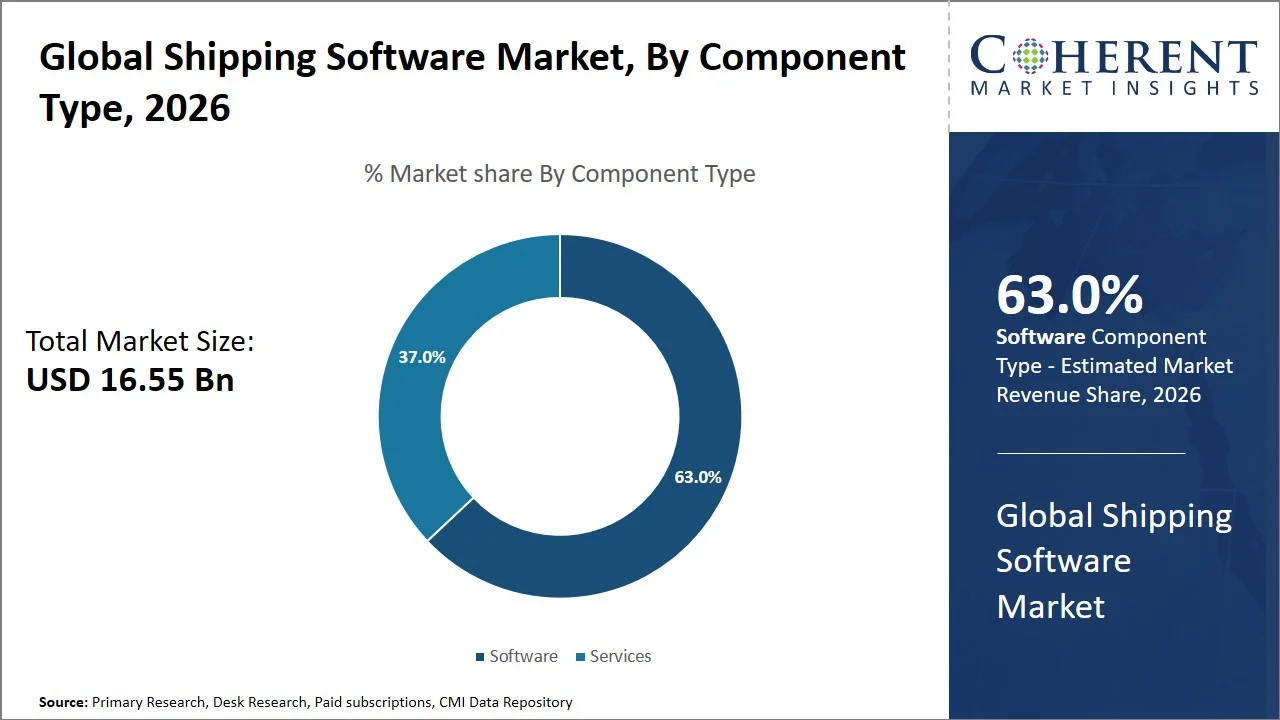
Why Does Software Dominate the Global Shipping Software Market?
The software segment is expected to account for 63.0% of the global shipping software market share in 2026. The fast growth of digital logistics and increasingly sophisticated global supply chains has led to an exponential increase in the demand for all-in-one shipping software that can manage shipment planning, carriers, documentation, tracking and analytics in one location. Software solutions enable firms to automate shipping procedures and easily integrate with enterprise resource planning (ERP), warehouse management systems (WMS) and e-commerce platforms, providing real-time visibility and operational data. Advances in cloud computing, artificial intelligence and API access have improved the capabilities of software, making it a crucial component in efficiency gains, cost reductions and scalable logistical operations across a wide spectrum of sectors. On November 27. 2025, Realm Realtime launched its next-generation Warehouse Management System (WMS) platform in 2025 for single-site and multi-site warehouses, providing enhanced cargo visibility, automation and integration across logistics operations.
- Current Industry Events of 2026
- Market Size Estimation
- Regional Breakdown
- Competitive Landscape
- Customer Intelligence
- Segmental Analysis
- Pricing Analysis
- Key Market Drivers, Challenges & Future Trends
- Customized Insights Section
Why is Cloud-Based the Most Preferred Deployment Type?
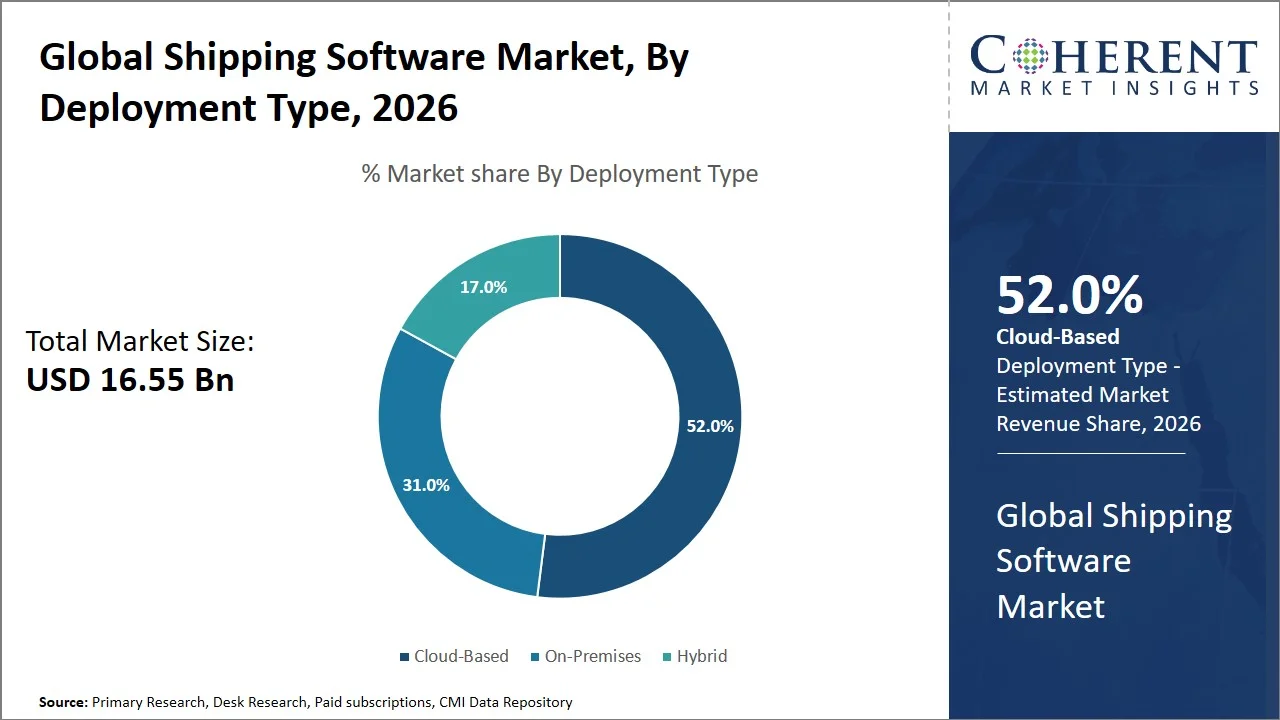
The cloud-based segment is expected to account for 52.0% of the global shipping software market share in 2026. Global logistics networks require scalability and easy communication. Cloud solutions enable enterprises to execute their shipping applications from anywhere, immediately scale up or down to match changing shipment quantities, and roll out upgrades without costly infrastructure adjustments. They also allow connectivity to e-commerce platforms, carrier networks, corporate resource planning (ERP) and warehouse management systems (WMS) for real-time data interchange and visibility into operations. What makes cloud-based shipping systems so attractive to organizations of all sizes is the cheaper upfront investment, subscription-based pricing and speedier installation. On May 4, 2026, Amazon announced the launch of Amazon Supply Chain Services (ASCS), a cloud-enabled logistics solution that allows companies to manage inventory, transportation, fulfillment and package delivery on a single digital platform, expanding its logistical capabilities beyond Amazon merchants.
Order Management Dominates the Global Shipping Software Market
The order management segment is expected to account for 29.0% of the global shipping software market share in 2026. The fast rise of e-commerce and omnichannel retail has led to a demand for companies that manage enormous numbers of shipments to efficiently process orders. Order management solutions automate order capture, inventory synchronization, carrier selection, shipping documentation and delivery updates from one platform, optimizing the entire fulfillment lifecycle. This means less human error, faster order processing, better inventory accuracy and happier customers with faster, more transparent delivery. The industries are investing in advanced order management skills as enterprises are increasingly valuing operational efficiency and perfect client experiences. On May 7, 2026, GoKwik launched Kwik Ship, an AI-powered logistics and order management platform that automates order allocation, carrier selection, shipping tracking, customer alerts and non-delivery management for direct-to-consumer enterprises.
Currents Events and their Impact
Current Events | Description and its Impact |
European Union - Import Control System 2 (ICS2) Release 3 (2025) |
|
United States - Federal Maritime Commission (FMC) Final Rule on Demurrage and Detention Billing (2024) |
|
Shipping Software Market Dynamics
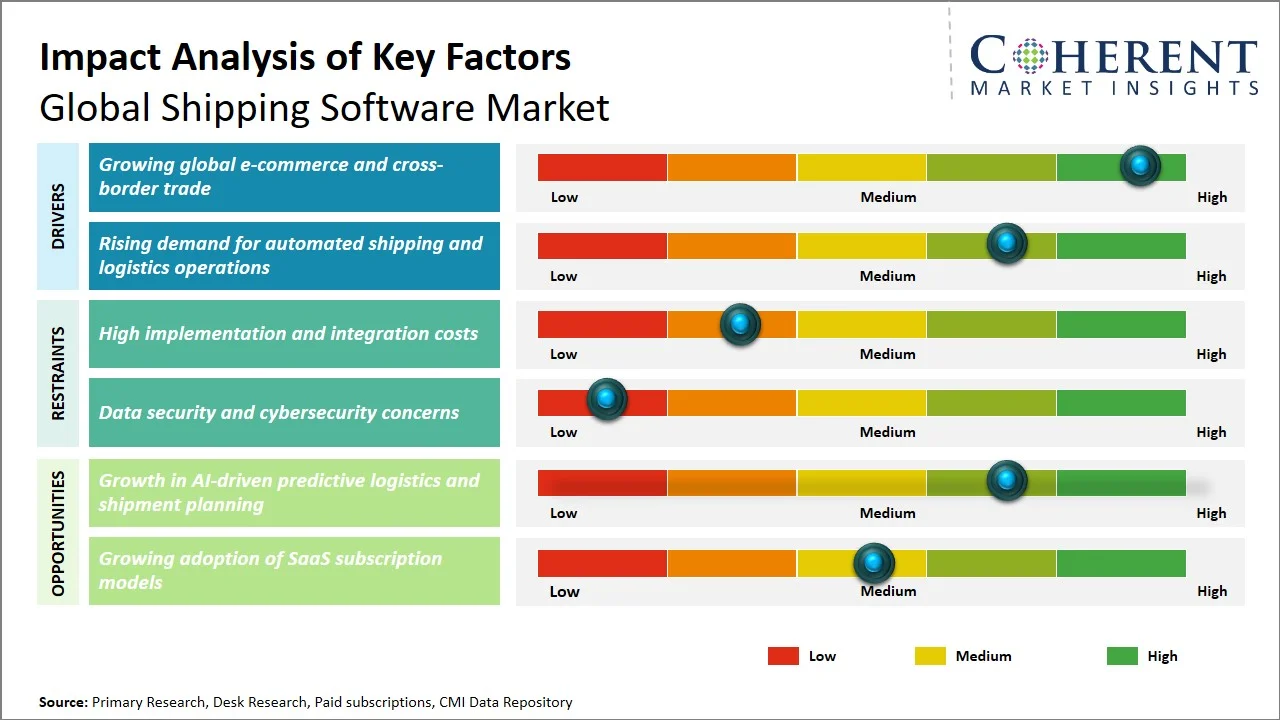
Market Drivers
- Growing global e-commerce and cross-border trade: The increasing global e-commerce and cross-border trade is a major factor fueling the shipping software sector. With higher cargo volumes and complex international logistics, businesses want strong digital solutions to tackle these challenges. Shipping software automates the handling of orders, carrier selection, preparation of customs papers, tracking of shipments and management of the delivery in several countries and transportation networks. When online retailers and manufacturers go into new markets, businesses are turning to sophisticated shipping technologies more and more to improve operational efficiency, reduce shipping costs, stay compliant with regulations and offer faster, more visible consumer experiences. On April 22, 2026, Amazon opened its first Global Warehousing and Distribution (GWD) Center in Shenzhen, China, to enable Chinese exporters to store items closer to global markets for lower transportation costs and faster cross-border delivery.
- Rising demand for automated shipping and logistics operations: One of the major factors that are boosting the use of shipping software across various sectors is the rising requirement for automated shipping and logistics operations. Companies are replacing manual processes with digital tools that automate scheduling shipments, designing labels, selecting carriers, documenting and invoicing freight and tracking deliveries. Automation optimizes operating efficiencies, minimizes human error, speeds up operations and increases supply chain visibility. This helps companies deal with increased freight volumes, save money and maintain excellent service. On May 14, 2025, Evri and DHL eCommerce announced a strategic agreement that will see DHL eCommerce UK combine with Evri. The combined Evri business will deliver over 1 billion parcels and a further 1 billion business letters each year and is expected to give major benefits to consumers and companies by providing greater choice and cost competitive alternatives. (Source: DHL)
Emerging Trends
- Expansion of End-to-End Shipment Visibility Through IoT and Real-Time Tracking: The application of IoT sensors, GPS tracking, RFID and telematics in shipping software is expanding rapidly to provide real-time visibility into shipments across the supply chain. Companies are using these capabilities to check the status of their cargo, track delivery performance, improve customer communications and reduce losses from delays or damaged shipments.
- Rising Focus on Sustainable and Carbon-Aware Shipping Management: Companies are beginning to use environmental sustainability as a competitive advantage in shipping software. Modern technologies can monitor carbon emissions, assess fuel consumption, design routes for lower emissions and generate ESG reports. Companies employ these technologies to comply with regulatory and corporate sustainability goals and to improve green logistics operations.
Regional Insights

Why is North America a Strong Market for Shipping Software?
North America is expected to account for a market share of 37.0% in 2026. North America is the leader in the use of shipping software, owing to the region’s highly digitized logistics landscape and the widespread usage of multi-carrier shipping platforms among retailers, manufacturers and third-party logistics providers. Companies such as UPS, FedEx, Amazon and Walmart rely on sophisticated shipping management systems that interact with warehouse automation and transportation management systems to improve parcel routing, delivery scheduling and real-time shipment visibility. The region is also home to leading shipping software vendors such as Descartes Systems Group, Manhattan Associates, ShipStation and EasyPost that are constantly improving AI-powered shipment optimization, API connection and cross-border compliance capabilities for commercial customers. On March 24, 2026, FedEx Corp. announced the rollout of FedEx SameDay Local, a delivery offering designed to enable its customers to meet rising consumer expectations for flexibility, control, and convenience while balancing their cost to serve. (Source: FedEx)
Why Does the Asia Pacific Shipping Software Market Exhibit High Growth?
Asia Pacific is projected to account for 29.0% of the global shipping software market and is expected to register the fastest growth. The Asia Pacific region is undergoing a rapid adoption of shipping software, fueled by the growing popularity of cross-border e-commerce, export-oriented industry, and investments in digital logistics in the region. China, Japan, South Korea, Singapore and India are rolling out cloud-native shipping platforms that interface with customs processes, regional carrier networks and automated fulfillment centers. Singapore’s shipping firms are increasingly turning to e-bill of lading platforms and digital port community systems, while logistics providers supporting marketplaces like Alibaba, JD.com, Rakuten and Flipkart are using shipping software to automate order processing, select carriers and track shipments in real time over large regional distribution networks. On May 23, 2024, Samsung SDS announced the expansion of its Cello Square digital logistics platform across Asia, providing regional manufacturers and exporters AI-enabled visibility of cargo, freight booking and supply chain analytics.
Global Shipping Software Market Outlook for Key Countries
Why is the U.S. Emerging as a Major Hub in the Shipping Software Market?
The U.S. has the world’s most developed software ecosystem for shipping, powered by big parcel delivery operations and complex omnichannel retail supply chains. Companies like Amazon, FedEx, UPS and Target depend heavily on shipping software coupled with robotics-enabled fulfillment centers, transportation management systems and predictive delivery analytics to manage millions of shipments everyday. Software companies including Pitney Bowes, ShipStation, EasyPost and ProShip are increasing their use of AI-powered shipping automation, multi-carrier rate optimization and automated customs documentation for local and international logistics operations.
Is China the Next Growth Engine for the Shipping Software Market?
The shipping software market of China is supported by the country’s leading manufacturing sector and broad cross-border e-commerce exports. Logistics operators working for platforms like Alibaba, JD.com, Temu and SHEIN deploy shipping software to streamline export paperwork, warehouse coordination, package consolidation and foreign carrier administration. Chinese ports, such as Shanghai Port and Ningbo-Zhoushan Port, are in fact pursuing smart port projects that feature digital logistics platforms, electronic customs clearance and AI-assisted cargo handling, creating considerable demand for innovative shipping software solutions.
Germany Shipping Software Market Analysis and Trends
Germany has one of Europe’s strongest markets for shipping software, owing to a sophisticated industrial base and highly automated logistics infrastructure. Sophisticated shipping software that links with enterprise resource planning systems, warehouse automation and multimodal freight management is essential for major global logistics companies such as DHL Group, DB Schenker and Hellmann Worldwide Logistics to cope with complicated European supply chains. German automotive and industrial businesses are also moving to digital shipping platforms to streamline export compliance, freight documentation and collaboration with carriers, while facilitating effective cross-border distribution across the European Union.
U.K. Shipping Software Market Analysis and Trends
The U.K. continues to be a significant driver of demand for shipping software as companies adapt to post-Brexit customs procedures and increasing e-commerce fulfillment needs. Retailers and logistics providers are turning to shipping management technologies more and more. They can automate customs declarations, calculate duties, integrate carriers and track packages for domestic and international shipments. Royal Mail, DPD UK and Evri have improved their digital shipping capabilities by linking cloud-based shipping software with automated sorting facilities and real-time delivery management tools to promote operational efficiency.
Japan Shipping Software Market Analysis and Trends
The shipping software market in Japan is characterized by a high focus on automation, precision logistics and technology based supply chain management. Major logistics firms such as Yamato Transport, Sagawa Express and Nippon Express are deploying modern shipping software connected with automated warehouses, IoT-enabled tracking systems and AI-assisted delivery planning to alleviate manpower shortages and increase operational productivity. Japanese firms also rely on integrated shipping platforms to organize domestic distribution and foreign exports, especially in the automobile, electronics, and industrial machinery sectors, where precise shipment timing and paperwork are crucial.
Global Shipping Software Market - Shipments Managed Through Shipping Software Annually (2026)
Region | Shipments Managed Through Shipping Software Annually (Billion Shipments) |
North America | 22.8 |
Asia Pacific | 20.4 |
Europe | 13.9 |
Latin America | 3.1 |
Middle East & Africa | 1.8 |
How is Growth in AI-Driven Predictive Logistics and Shipment Planning Creating New Growth Opportunities in the Shipping Software Market?
The growing adoption of AI-based predictive logistics and shipping planning is generating potential market growth opportunities. It assists businesses in spotting disruptions, streamlining delivery routes, and making data-driven choices for shipments before operational problems occur. Sophisticated AI algorithms analyze past shipping trends, weather conditions, port congestion, carrier performance, fuel pricing and real-time traffic data to predict delivery delays, choose the most cost-effective carriers, and adjust shipment plans on the fly. These abilities assist firms in reducing transportation costs, enhancing on-time delivery performance, optimizing fleet and warehouse utilization and improving customer satisfaction. As supply chains become more complex and time sensitive, the demand for intelligent shipping software is increasing worldwide. On May 6, 2025, Blue Yonder announced the release of five generative AI agents for logistics, warehouse, inventory, shelf and network operations, and a new Tariffs Agent that enables organizations to predict supply chain disruptions and optimize shipment strategy.
Market Players, Key Development, and Competitive Intelligence
Key Developments
- On April 30, 2026, Easyship launched its Model Context Protocol (MCP) Server, enabling AI assistants such as ChatGPT, Claude, Gemini, and enterprise automation platforms to access shipping rates, generate labels, schedule pickups, and retrieve shipment analytics through natural-language interactions.
- On June 20, 2024, Descartes completed the acquisition of BoxTop Technologies (U.K.), enhancing its freight forwarding and shipment management software portfolio across the European logistics market.
Competitive Landscape
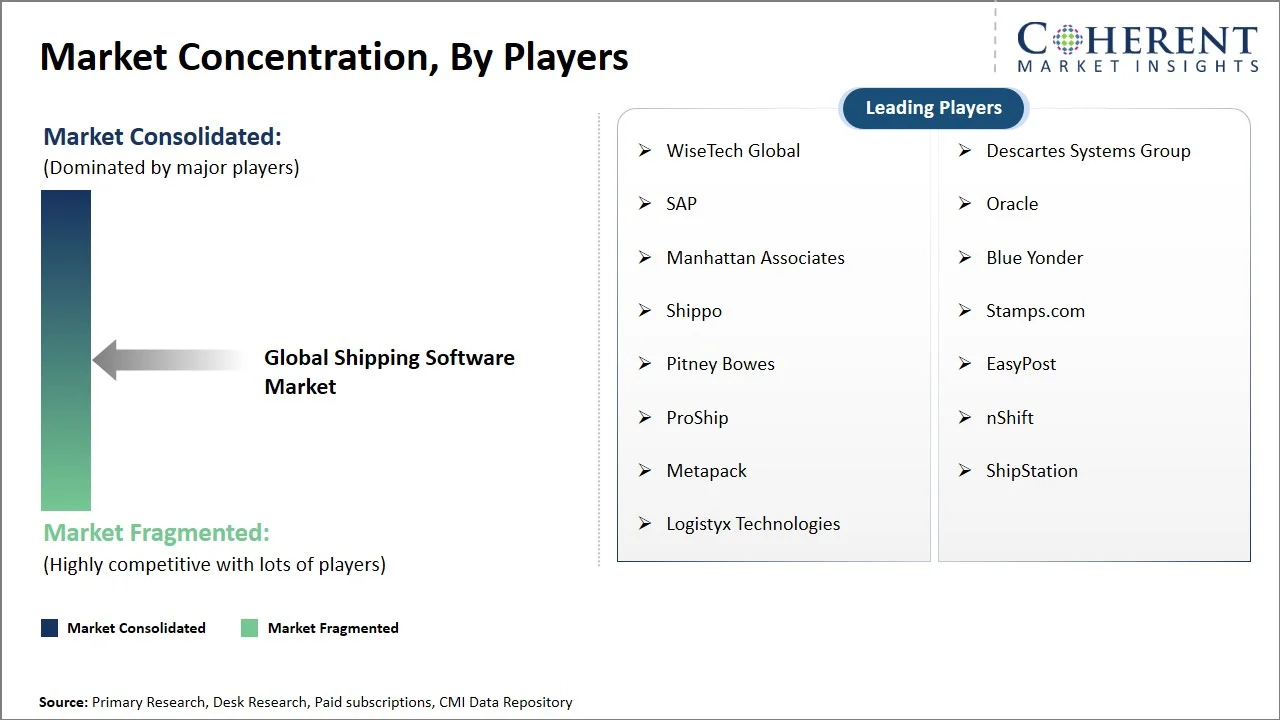
The global shipping software market is very competitive with the presence of large business software providers, niche logistics technology providers and new developers of cloud-native solutions. Adding artificial intelligence, cloud-based deployment, strategic acquisitions, and extended multi-carrier connection, key players like WiseTech Global, Descartes Systems Group, SAP, Oracle, Manhattan Associates, and Blue Yonder are strengthening their market positions. The competition is increasingly focused on end-to-end shipment visibility and seamless integration with enterprise resource planning (ERP), warehouse management systems (WMS), transportation management systems (TMS) and e-commerce platforms. Vendors are also investing in predictive analytics, automation, cybersecurity and compliance capabilities to differentiate their offerings.
Market Report Scope
Shipping Software Market Report Coverage
| Report Coverage | Details | ||
|---|---|---|---|
| Base Year: | 2025 | Market Size in 2026: | USD 16.55 Bn |
| Historical Data for: | 2020 To 2024 | Forecast Period: | 2026 To 2033 |
| Forecast Period 2026 to 2033 CAGR: | 10.2% | 2033 Value Projection: | USD 30 Bn |
| Geographies covered: |
| ||
| Segments covered: |
| ||
| Companies covered: | WiseTech Global, Descartes Systems Group, SAP, Oracle, Manhattan Associates, Blue Yonder, Shippo, Stamps.com, Pitney Bowes, EasyPost, ProShip, nShift, Metapack, ShipStation, and Logistyx Technologies | ||
| Growth Drivers: |
| ||
| Restraints & Challenges: |
| ||
Analyst Opinion (Expert Opinion)
- The ongoing digital transformation of global logistics operations and the growing focus on automation across supply chains are anticipated to influence the market for shipping software. With organizations looking to improve operational efficiency and maintain regulatory compliance, they are likely to increase their investment in cloud-native platforms, AI-driven shipment optimization and real-time visibility solutions. The increasing usage of integrated logistics ecosystems that connect carriers, warehouses, customs authorities and customers through unified digital platforms is also projected to drive the market’s rise.
- The future of the shipping software business is set to be driven by advancements in artificial intelligence, machine learning, Internet of Things (IoT), Blockchain and predictive analytics, allowing for more autonomous and intelligent logistical operations. The increasing roll out of digital freight platforms, smart ports, autonomous warehousing and cross-border e-commerce will generate new opportunities for software businesses to deliver fully integrated, scalable shipping solutions. With sustainability initiatives, carbon emissions monitoring and resilient supply chain management becoming strategic priorities, there is a need for shipping software to evolve into an all-in-one platform for operational performance optimization, regulatory compliance and environmental reporting across global logistics networks.
Speak to the analyst
Want personalized insights?
Take the findings above to one of our principal consultants, or have the report rebuilt around the segments, geographies and competitors you actually track.
Market Segmentation
- Component Type Insights (Revenue, USD Billion, 2021 - 2033)
- Software
- Services
- Deployment Type Insights (Revenue, USD Billion, 2021 - 2033)
- Cloud-Based
- On-Premises
- Hybrid
- Application Insights (Revenue, USD Billion, 2021 - 2033)
- Order Management
- Carrier Management
- Shipment Tracking
- Freight Management
- Warehouse Integration
- Label Generation
- Analytics and Reporting
- Regional Insights (Revenue, USD Billion, 2021 - 2033)
- North America
- U.S.
- Canada
- Latin America
- Brazil
- Argentina
- Mexico
- Rest of Latin America
- Europe
- Germany
- U.K.
- Spain
- France
- Italy
- Russia
- Rest of Europe
- Asia Pacific
- China
- India
- Japan
- Australia
- South Korea
- ASEAN
- Rest of Asia Pacific
- Middle East
- GCC Countries
- Israel
- Rest of Middle East
- Africa
- South Africa
- North Africa
- Central Africa
- North America
- Key Players Insights
- WiseTech Global
- Descartes Systems Group
- SAP
- Oracle
- Manhattan Associates
- Blue Yonder
- Shippo
- Stamps.com
- Pitney Bowes
- EasyPost
- ProShip
- nShift
- Metapack
- ShipStation
- Logistyx Technologies
Sources
Primary Research Interviews
- Shipping Software Vendors & Developers
- Logistics & Supply Chain Managers
- E-commerce & Retail Business Owners
- Freight Forwarders & Carriers
Magazines
- Logistics Management Magazine
- Supply Chain Brain Magazine
- Multichannel Merchant Magazine
- Inbound Logistics Magazine
Journals
- International Journal of Logistics Management
- Journal of Supply Chain Management
- Transportation Research Journal
Associations
- International Air Transport Association (IATA)
- World Shipping Council (WSC)
- Freight Management International (FMI)
- National Customs Brokers & Forwarders Association of America (NCBFAA)
Public Domain Sources
- U.S. Department of Transportation (DOT)
- World Trade Organization (WTO)
- United Nations Conference on Trade and Development (UNCTAD)
- Federal Maritime Commission (FMC)
Proprietary Elements
- CMI Data Analytics Tool
- Proprietary CMI Existing Repository of Information for Last 10 Years
Get access to 250+ pages report
Every segment, forecast, competitor profile and data table behind the analysis above — available for instant download.
- ESOMAR Member
- ISO 9001:2015 Certified
- D-U-N-S Registered
- GDPR & CCPA Compliant
Missing comfort of reading report in your local language? Find your preferred language:
Transform your Strategy with Exclusive Trending Reports
Frequently Asked Questions
The global shipping software market is expected to stand at USD 16.55 Bn in 2026 and is expected to reach USD 30 Bn by 2033.
The CAGR of the global shipping software market is projected to be 10.2% from 2026 to 2033.
Growing global e-commerce and cross-border trade and rising demand for automated shipping and logistics operations are the major factors driving the growth of the global shipping software market.
High implementation and integration costs and data security and cybersecurity concerns are the major factors hampering the growth of the global shipping software market.
In terms of component type, the software segment is estimated to dominate the market revenue share in 2026
AI enhances shipping software by optimizing routes, predicting delays, and automating operational decisions.
IoT enables real-time cargo tracking, asset monitoring, and improved supply chain visibility.