

Global Smart Shelves Market Size and Forecast – 2026 To 2033
The Global Smart Shelves Market is estimated to be valued at USD 5,428.6 Mn in 2026 and is expected to reach USD 13,751.5 Mn by 2033, exhibiting a compound annual growth rate (CAGR) of 14.20% from 2026 to 2033. The surging adoption of smart shelving solutions in retail, logistics and warehouse applications can be attributed to the growing demand for better inventory management, real-time shelf visibility, data analytics, automated pricing, and customer experience.
Smart shelves are increasingly playing a key role in connected-store initiatives due to their ability to prevent stockouts, help planograms and transform shelf data into quicker data-driven decisions. In June 2026, Hanshow developed xPilot in partnership with Microsoft, as a real-time store execution assistant powered by AI, which uses smart shelves, smart carts, robotics and other IoT touchpoints to boost shelf availability, price accuracy, and inventory management. (Source: Hanshow)
Key Takeaways of the Global Smart Shelves Market
- Hardware is expected to dominate the component segment with 6% of the market share in 2026, as retailers prioritize shelf-edge devices, sensors, displays, and tagging infrastructure before scaling analytics. In June 2024, Walmart announced plans to expand digital shelf labels to 2,300 stores by 2026, supporting faster price updates, improved replenishment, and reduced paper waste.
- RFID based smart shelves are expected to lead the technology segment with 7% of the market share in 2026, supported by item-level visibility, faster shelf audits, and improved stock traceability. In November 2025, the International Federation of Robotics highlighted PAL Robotics’ StockBot use at Decathlon stores, where RFID automation supports store-level inventory operations in dynamic retail environments.
- Inventory management is expected to be the leading application segment, accounting for 35.8% of the market in 2026 as smart shelves directly address stockouts, misplaced products, replenishment gaps, and shelf execution issues. In April 2026, Brain Corp reported that Albert used AI-powered shelf-scanning technology to identify out-of-stocks, pricing errors, and planogram issues, reducing dependence on manual checks.
- North America is expected to dominate the global smart shelves market with 34.6% share in 2026, supported by early adoption among grocery, mass retail, and convenience formats. In February 2024, SpartanNash announced the expansion of Simbe’s Tally autonomous inventory robot to 60 additional Midwest US stores, strengthening real-time shelf intelligence and associate productivity.
- Europe is expected to be the fastest-growing region, accounting for 29.4% of the market in 2026, as retailers accelerate investments in electronic shelf labels (ESLs) and connected-store technologies to improve price accuracy, labor productivity, and omnichannel execution. In October 2025, Morrisons, a U.K.-based supermarket chain, announced that France-based VusionGroup would install 10.8 million smart electronic shelf labels across all 497 Morrisons supermarkets, marking a major estate-wide digital shelf rollout.
- Integration of AI-Enabled Shelf Intelligence to Improve Store Performance: From periodic to continuous shelf checks, smart shelves are becoming a strategic store-performance layer and not simply hardware. AI-powered shelf intelligence enhances the replenishment process, pricing adherence, staffing optimization, and product placement, ensuring that retailers maintain profitable margins and deliver a better customer experience in their brick-and-mortar locations.
- Connected Retail Execution to Improve Store Efficiency: Smart shelves are becoming part of larger connected-store environments that include the shelf, the point of sale, mobile associate apps, e-commerce fulfilment and loyalty. This integration allows retailers to better manage pricing, stock availability, promotions and planograms' execution across all channels and creates better operational control, enhancing the commercial value of physical stores.
Segmental Insights
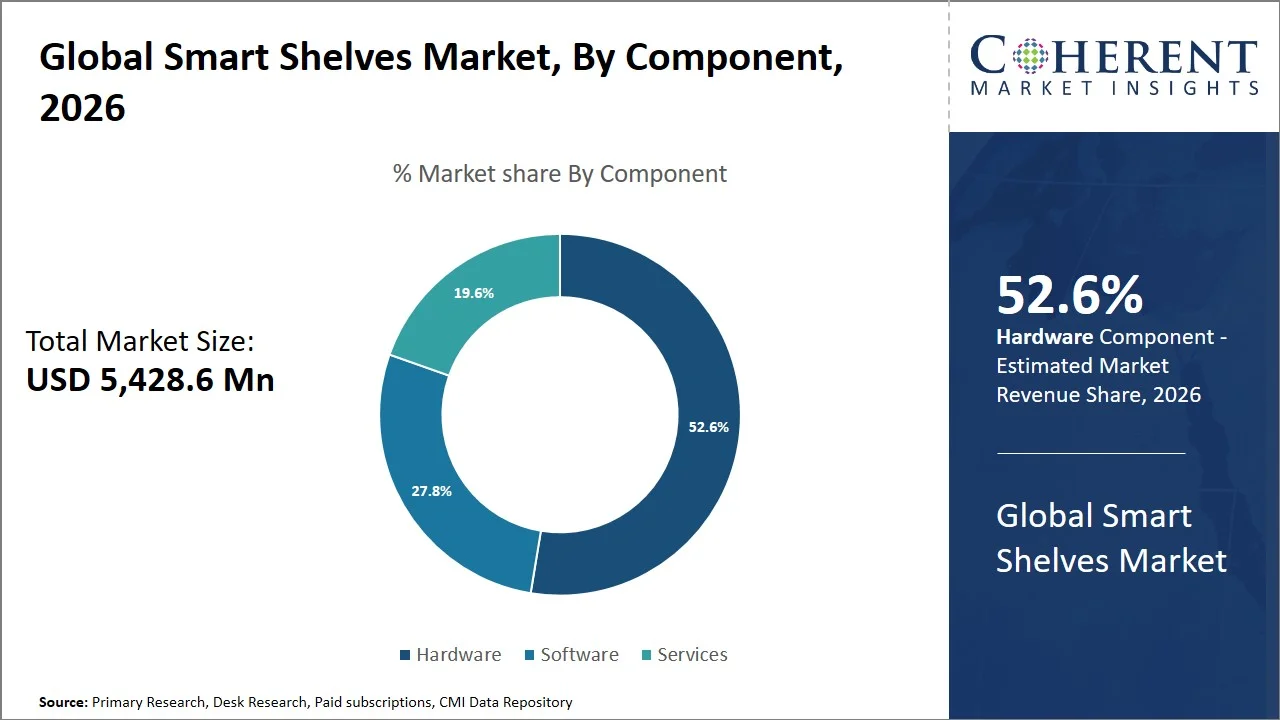
Why Does Hardware Dominate the Global Smart Shelves Market?
In terms of component, hardware is expected to account for 52.6% of the global smart shelves market in 2026. This is because software-driven value can be realized only after the physical deployment of electronic shelf labels, RFID readers, shelf sensors, cameras, gateways, and connectivity devices. The hardware approach is more appealing to retailers because it directly enhances the retail visibility, price visibility, replenishment triggers, and store-level execution. Retailers prefer hardware-led rollouts because these assets directly improve shelf visibility, price display accuracy, replenishment triggers, and store-level execution. Demand is the strongest in supermarkets, hypermarkets, pharmacies, and high-SKU retail formats where manual shelf checks are costly and error-prone. On the supply side, longer battery life, multi-color e-paper displays, LED indicators, and ruggedized shelf devices are making large-scale deployment more practical. In August 2025, SOLUM launched Newton A and Newton Core Plus ESL solutions across international markets, strengthening the hardware portfolio for scalable retail digitalization. (Source: SOLUM)
- Current Industry Events of 2026
- Market Size Estimation
- Regional Breakdown
- Competitive Landscape
- Customer Intelligence
- Segmental Analysis
- Pricing Analysis
- Key Market Drivers, Challenges & Future Trends
- Customized Insights Section
Why Do RFID Based Smart Shelves Represent the Largest Technology Segment in the Global Smart Shelves Market?
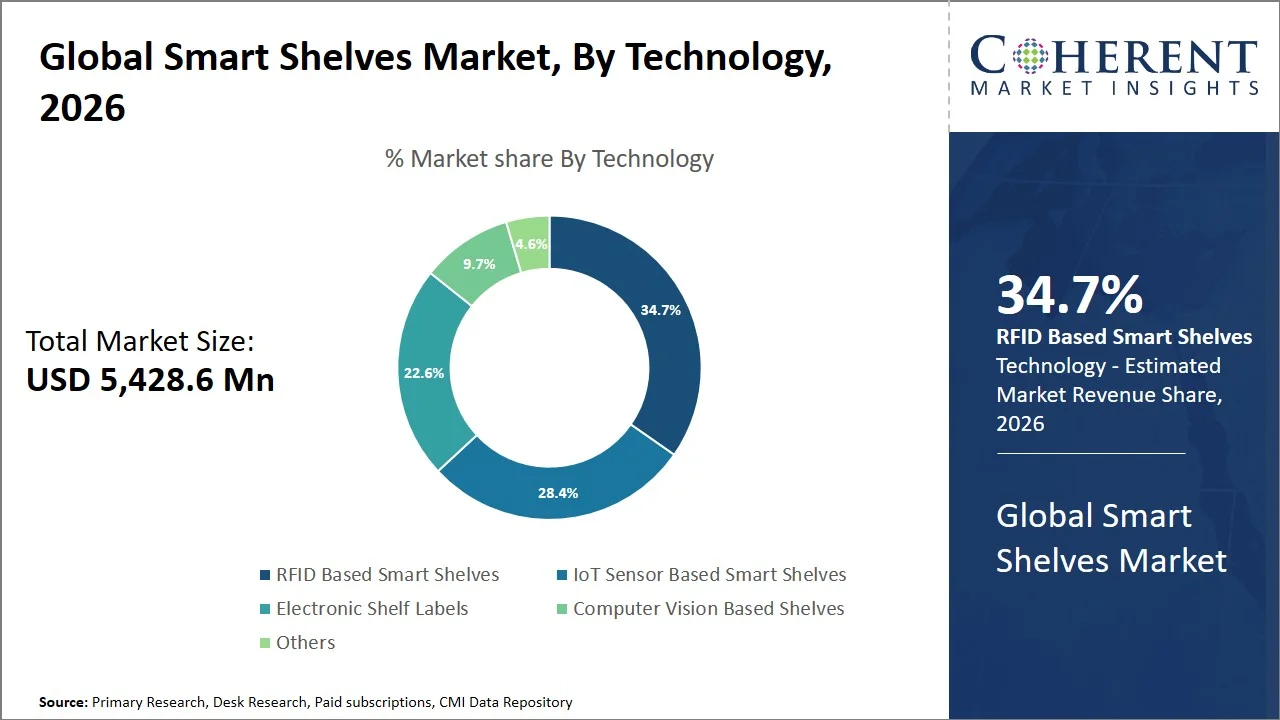
RFID based smart shelves are expected to represent the largest technology segment with 34.7% share in 2026, owing to their ability to identify products without line-of-sight scanning and support item-level visibility across sales floors, stockrooms, and fulfillment workflows. This technology is especially relevant for apparel, specialty retail, pharmacy, and high-value merchandise, where SKU-level tracking, shrink control, and faster associate search are business-critical. Demand is supported by retailers’ need to reduce phantom inventory and improve buy-online-pick-up-in-store accuracy. Supply-side maturity is also strong, as RFID tags, antennas, readers, and AI-assisted analytics can be integrated into existing store systems. In March 2025, Old Navy announced a partnership with RADAR for a phased rollout of AI-powered RFID technology across its nationwide store fleet, improving real-time inventory location and associate productivity. (Source: Gap Inc)
Why Does Inventory Management Dominate the Global Smart Shelves Market?
Inventory management is expected to dominate the application segment with 35.8% share in 2026, as smart shelves directly solve one of retail’s most costly operational gaps: mismatch between system inventory and actual shelf availability. The segment benefits from demand for faster replenishment, fewer missed sales, lower excess stock, and better omnichannel fulfillment accuracy. Adoption is the strongest in grocery, mass retail, convenience, and healthcare retail, where product availability affects basket size and customer loyalty. Technology suppliers are combining shelf cameras, AI models, RFID localization, and real-time tasking apps to convert shelf data into actionable replenishment workflows. In June 2026, IBM highlighted Focal Systems’ Shelf AI solution, which continuously detects stockouts and guides store teams to replenish products on time, reinforcing the commercial role of AI-led shelf inventory intelligence. (Source: IBM)
Global Smart Shelves Market Dynamics
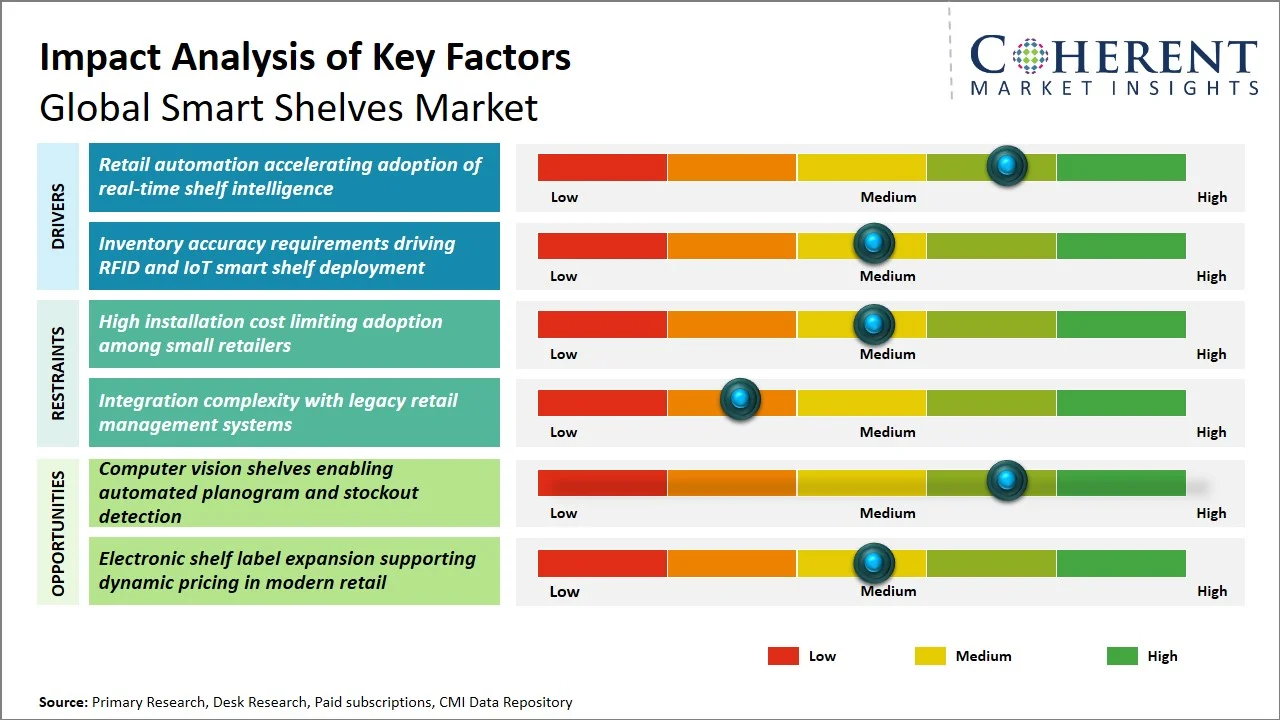
Key Market Drivers
Retail Automation Accelerating Adoption of Real-Time Shelf Intelligence
Retailers are moving beyond periodic manual audits toward continuous shelf visibility because labor-intensive shelf checks cannot support fast-moving pricing, replenishment, and omnichannel fulfillment needs. Smart shelves help stores detect empty facings, misplaced products, planogram gaps, and replenishment priorities in near real time, allowing store teams to focus on corrective action rather than inspection. This driver is especially strong in supermarkets, hypermarkets, convenience stores, and foodservice-linked retail formats where high SKU movement and limited backroom space increase the cost of stockouts. On the supply side, shelf cameras, edge AI, robotics, and mobile scanning are reducing deployment complexity. In November 2025, NomadGo announced a collaboration with Richtech Robotics to integrate Inventory AI into physical robots for autonomous counting, ordering, delivery validation, and restocking workflows, showing how shelf intelligence is shifting toward closed-loop automation. (Source: NamadGo)
Inventory Accuracy Requirements Driving RFID and IoT Smart Shelf Deployment
Inventory accuracy has become a board-level retail priority as stores are increasingly used for sales, returns, pickup, ship-from-store, and localized fulfillment. Smart shelves supported by RFID, IoT readers, and connected inventory engines give retailers a more reliable view of item location, stock depth, and product movement across store floors and distribution networks. This reduces phantom inventory, improves replenishment execution, and supports better availability for both in-store shoppers and digital orders. The technology is particularly relevant for apparel, specialty retail, healthcare retail, and high-value product categories where item-level visibility protects revenue and reduces shrink. In April 2026, Nedap announced a partnership with VF Corporation to deploy its Inventory Engine across more than 1,500 stores, starting in Q2 2026 with The North Face, to improve stock accuracy, product availability, and omnichannel performance.
Emerging Market Trends
Shift from Shelf Monitoring to Predictive Retail Execution
The smart shelves market is moving from passive monitoring toward predictive execution, where shelf data is used to forecast replenishment needs, identify recurring stockout patterns, and prioritize store tasks before availability issues become visible to customers. This trend is commercially important because retailers are under pressure to increase store productivity without proportionally increasing labor costs. Predictive shelf intelligence also improves merchandising discipline by linking inventory status, promotion activity, price changes, and planogram compliance into one operational workflow. As retailers connect shelf systems with POS, order management, and workforce tools, smart shelves are becoming a decision-support layer for store operations rather than a standalone sensing solution. This transition supports higher-value software and services revenue, while helping retailers improve inventory turns, customer satisfaction, and execution consistency across multi-store networks.
Rising Integration of Smart Shelves with Omnichannel Fulfillment Systems
Retailers are increasingly treating physical shelves as fulfillment nodes, not only as display space. This is pushing smart shelf platforms to integrate with click-and-collect, ship-from-store, last-mile delivery, and real-time stock reservation systems. The trend is important because inaccurate shelf availability directly affects online order substitutions, canceled pickup orders, and poor customer experience. Smart shelves help synchronize product visibility across physical and digital channels by confirming whether stock shown in enterprise systems is actually present, correctly placed, and ready to sell. This creates stronger adoption potential among supermarkets, pharmacies, specialty retailers, and convenience chains that rely on rapid order picking and high product availability. Vendors that can connect shelf-level data with order orchestration, replenishment, and associate tasking platforms are likely to command stronger enterprise contracts.
Current Events and their Impact
Current Events | Description and its Impact |
EU AI Act Implementation, August 2026 |
|
EU Cyber Resilience Act Reporting Obligations, September 2026 onward |
|
EU General Product Safety Regulation, January 2025 update after December 2024 applicability |
|
Regional Insights
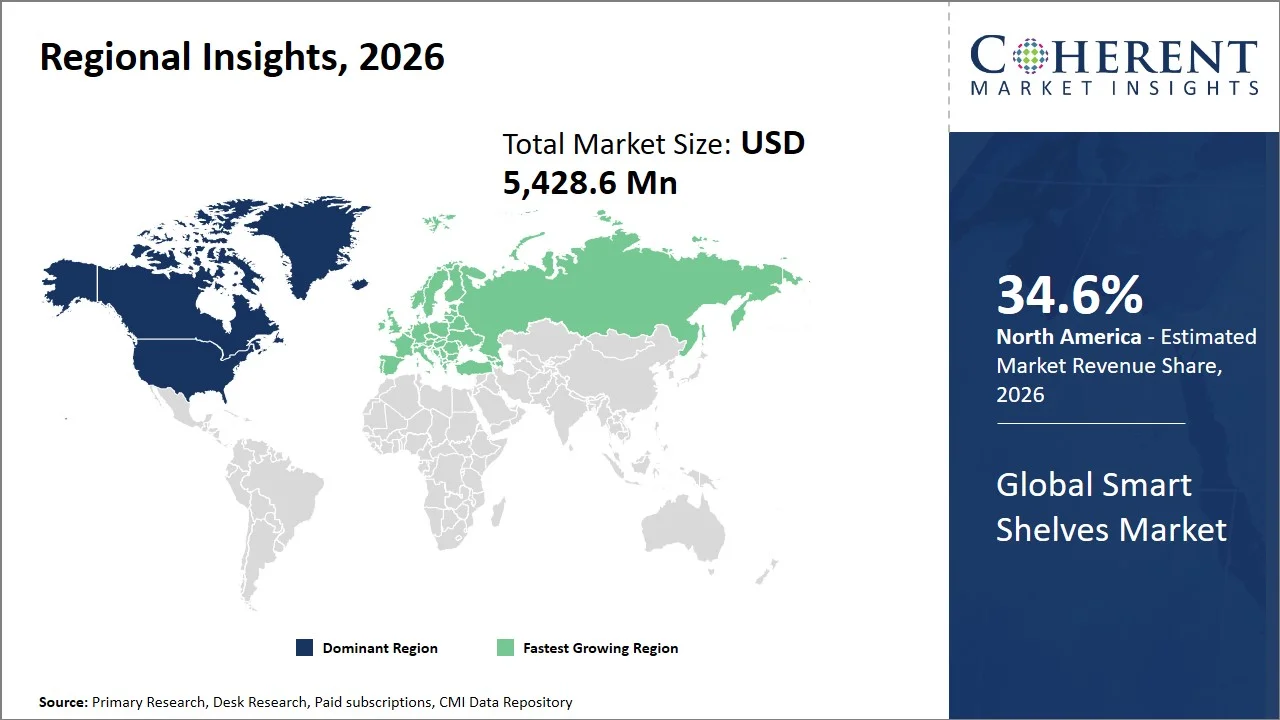
Why Does North America Dominate the Global Smart Shelves Market?
North America dominates the global smart shelves market with 34.6% share in 2026, supported by large-format grocery chains, mature retail IT infrastructure, and strong adoption of automated store operations. Retailers in the region are using smart shelf technologies to reduce pricing errors, improve product availability, and manage high SKU complexity across supermarkets, pharmacies, and specialty stores. The region also has a strong base of retail technology providers, RFID solution companies, cloud platforms, and enterprise software vendors, enabling faster integration of shelf-level data with POS, inventory, and fulfillment systems. In August 2024, U.S. Senators Elizabeth Warren and Bob Casey sent a formal letter to Kroger regarding its EDGE Shelf electronic shelf label technology, highlighting how digital shelf systems are becoming visible enough in U.S. grocery retail to attract policy scrutiny and consumer-pricing debate.
Why is Europe Emerging as the Fastest-Growing Region in the Smart Shelves Market?
Europe is emerging as the fastest-growing region in the smart shelves market with 29.4% share in 2026, supported by strong retail digitalization, strict price-transparency expectations, labor optimization pressure, and sustainability-focused store modernization. European retailers are adopting electronic shelf labels, RFID, and shelf-edge digital systems to reduce paper usage, improve promotion accuracy, and support faster in-store picking for online grocery orders. The market is also benefiting from Europe’s advanced grocery, convenience, and discount retail networks, where operational efficiency is central to margin protection. In August 2025, Co-op stated that electronic shelf labels were already visible in over 700 stores and were expected to roll out to more than 1,600 stores by year-end, with full deployment across more than 2,300 stores during 2026, supporting Europe’s rapid adoption trajectory.
Global Smart Shelves Market Outlook for Key Countries
Why is the U.S. a Key Market for the Smart Shelves Market?
The U.S. is a key market for smart shelves due to its concentration of large grocery chains, pharmacy networks, warehouse clubs, and omnichannel retailers that require accurate shelf execution at scale. Store-based fulfillment, curbside pickup, and same-day delivery have increased the need for reliable shelf-level inventory visibility. Smart shelves help U.S. retailers reduce out-of-stocks, improve price synchronization, and support associate tasking across large store footprints. The country also benefits from a strong ecosystem of barcode standards bodies, retail software vendors, cloud providers, and automation startups. In February 2024, GS1 US released guidance to accelerate the adoption of 2D barcodes for apparel and general merchandise ahead of Sunrise 2027, strengthening the data infrastructure that can connect shelf systems, POS, traceability, and product information platforms.
Why is India Important in the Global Smart Shelves Market?
India is important in the global smart shelves market because organized retail, quick commerce, supermarkets, and pharmacy chains are expanding rapidly across metro and tier-2 cities. Retailers face rising SKU density, frequent price changes, and stronger customer expectations for product availability, making shelf automation increasingly relevant. Smart shelves can help Indian retailers reduce manual label changes, improve replenishment discipline, and support integrated online-offline retail operations. The opportunity is especially strong in supermarkets, electronics retail, fashion, beauty, and healthcare retail, where assortment visibility and promotion execution affect revenue conversion. In November 2025, IBEF reported that India’s retail leasing surged to 3.2 million square feet in Q3 2025, a 65% year-on-year increase across the top seven cities, indicating rapid physical retail expansion that supports future smart shelf deployment.
Why Does China Support Growth in the Smart Shelves Market?
China supports growth in the smart shelves market through its advanced smart retail ecosystem, strong electronics manufacturing base, high digital payment penetration, and large-scale retail modernization. Chinese retailers are more willing to integrate shelf-edge displays, RFID, IoT devices, and data analytics into physical stores because consumers are already accustomed to digitally enabled shopping journeys. The country also has a supply-side advantage through domestic production of displays, sensors, wireless modules, and retail automation hardware, which can reduce deployment cost and improve scalability. Smart shelves are particularly relevant in supermarkets, convenience stores, fresh food retail, apparel, and cross-border retail formats. In January 2026, China’s National Bureau of Statistics reported that online retail sales reached USD 2350.10 billion in 2025, while physical goods sold online accounted for 26.1% of total retail sales, reinforcing the need for synchronized store and digital inventory systems.
Why is Germany a Strategic Country in the Smart Shelves Market?
Germany is a strategic country in the smart shelves market because it has a highly competitive retail structure led by discount chains, supermarkets, drugstores, DIY stores, and specialty retailers. German retailers emphasize operational precision, price accuracy, labor productivity, and compliance, making electronic shelf labels and connected shelf systems commercially attractive. The country’s strong industrial automation culture also supports adoption of reliable hardware, cloud-connected workflows, and integrated store systems. Smart shelves are especially relevant in German grocery, home improvement, and consumer electronics retail, where frequent price changes and broad assortments increase manual workload. In November 2025, EuroShop reported that OBI was deploying smart electronic shelf labels and VusionCloud technologies across more than 200 German stores, improving shelf-edge information control, price-change efficiency, and associate productivity in the DIY retail format.
Why is Japan an Important Growth Market for the Smart Shelves Market?
Japan is an important growth market for smart shelves because its retail sector faces persistent labor shortages, high convenience-store density, aging demographics, and strong demand for frictionless store operations. Smart shelves can help Japanese retailers automate stock checks, reduce manual price updates, manage expiry-sensitive products, and support compact store formats where shelf productivity is critical. The market is especially relevant for convenience stores, supermarkets, drugstores, and home improvement retailers that need efficient replenishment and accurate product-level visibility. Japan also has a strong technology supplier base in sensors, displays, RFID, and precision electronics. In June 2026, METI’s Current Survey of Commerce continued to track business activity across department stores, supermarkets, convenience stores, drugstores, and home improvement stores, reflecting the importance of these retail formats in Japan’s structured commerce landscape and their relevance for smart shelf adoption.
Technology Adoption Landscape in the Global Smart Shelves Market
Technology | Adoption Level | Key Application Area | Business Impact |
RFID Tags and Readers | High | Item-level product tracking and shelf availability | Improves inventory accuracy, replenishment speed, and shrink control across stores and warehouses |
IoT Weight and Proximity Sensors | High | Stock-level monitoring on shelves | Supports automated alerts for low stock, misplaced products, and replenishment gaps |
Electronic Shelf Labels | High | Price and promotion automation | Reduces manual price changes, improves pricing accuracy, and supports dynamic store execution |
Computer Vision Shelf Analytics | Medium | Planogram compliance and shelf condition monitoring | Enables visual detection of out-of-stocks, wrong facings, and merchandising gaps |
Edge AI Gateways | Medium | Local processing of shelf and sensor data | Reduces latency, limits cloud dependence, and improves real-time store response |
Cloud-Based Retail Analytics Platforms | High | Multi-store performance tracking and decision support | Converts shelf-level data into enterprise insights for replenishment, labor planning, and assortment decisions |
How are Connected Shelf Intelligence and Omnichannel Store Operations Creating New Growth Opportunities in the Global Smart Shelves Market?
Connected shelf intelligence is creating a major growth opportunity by turning store shelves into real-time operating assets. Retailers can use shelf-level visibility to improve product availability, reduce waste, automate price updates, strengthen planogram execution, and support faster online order fulfillment from physical stores. This opportunity is commercially important because the value of smart shelves extends beyond hardware installation; retailers can generate recurring benefits through analytics, alerts, software dashboards, and workflow automation. Vendors can differentiate by offering modular systems that combine RFID, IoT sensors, ESLs, cameras, and cloud analytics instead of selling isolated devices. Supermarkets and hypermarkets represent the largest near-term opportunity due to high SKU density and frequent price changes, while pharmacies and specialty retail offer premium use cases around accuracy, compliance, and loss prevention. As retailers modernize store infrastructure, smart shelf suppliers that offer scalable integration with POS, ERP, and order management systems can capture stronger long-term contracts.
Market Players, Key Development, and Competitive Intelligence
Key Developments
- In June 2026, Vusion expanded its long-standing partnership with JYSK across Europe. The agreement includes upgrading ESLs across 450 Nordic stores, rolling out Vusion solutions in 750 additional stores, and migrating JYSK’s legacy on-premise platform to VusionCloud. By 2027, deployment is expected to scale to around 2,500 stores across the Nordic, DACH, and Benelux regions, supporting cloud-based retail operations.
- In April 2026, Pricer and JRTech Solutions signed a USD 51 million digital store transformation deal with Sobeys in Canada. The agreement includes deployment of Pricer’s latest electronic shelf label technology and Pricer Plaza cloud platform across an estimated 300–350 Sobeys stores. This development strengthens ESL adoption in North American grocery retail and supports faster pricing updates, improved shelf execution, and centralized store operations
Competitive Landscape
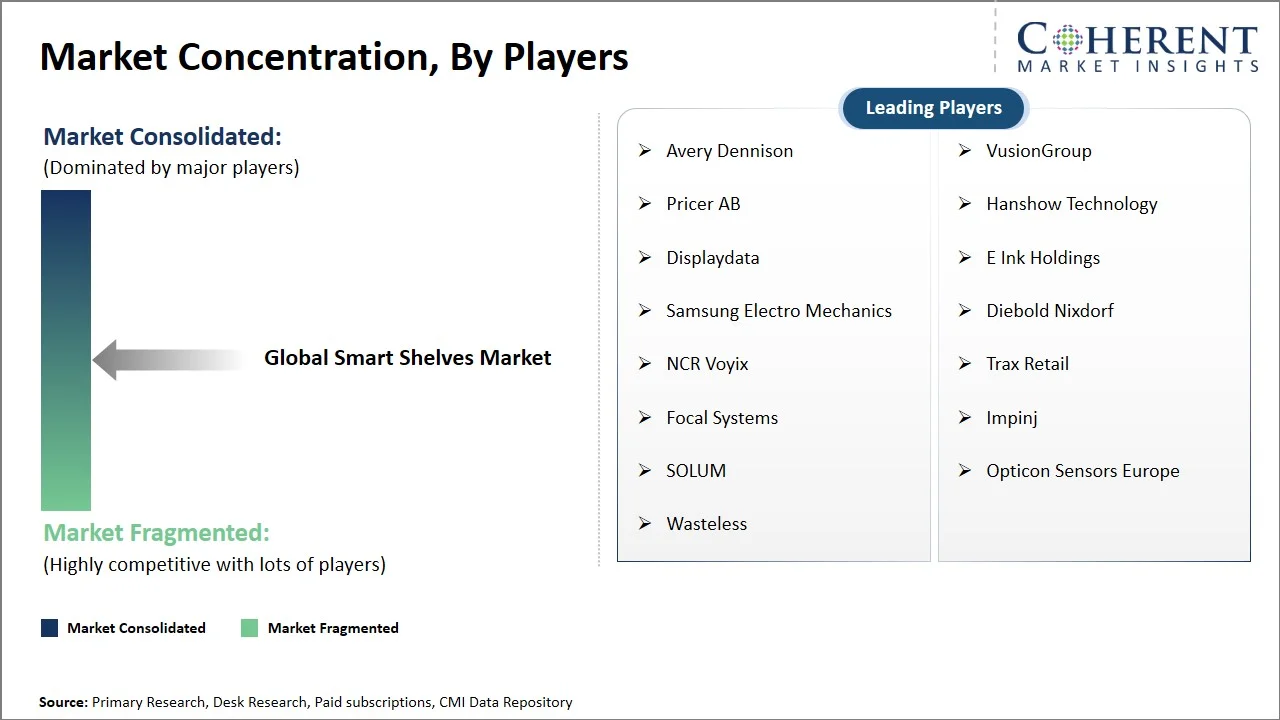
The global smart shelves market is moderately fragmented, with competition between retail technology providers, RFID specialists, ESL manufacturers, IoT sensor companies, computer vision vendors, software analytics firms, and systems integrators. Competition is shifting from standalone shelf hardware toward integrated platforms that combine data capture, analytics, automation, and store workflow execution.
Key focus areas include:
- Product quality and differentiation: Vendors compete on sensor accuracy, battery life, tag readability, display clarity, and durability under high-traffic retail conditions.
- Technology adoption and process efficiency: Players are investing in AI, edge computing, cloud dashboards, and API-based integration to reduce deployment friction.
- Pricing and cost competitiveness: Retailers compare upfront hardware cost, installation effort, software subscriptions, maintenance, and total return on investment.
- Supply reliability and scalability: Large retailers prefer suppliers that can support multi-store rollouts, standardized installation, and consistent device availability.
- Compliance and quality control: Cybersecurity, product safety, data privacy, and wireless certification are becoming important procurement filters.
- Distribution network and customer reach: Companies with retail channel partners, regional integrators, and after-sales support teams have stronger adoption potential.
- Solution specification differentiation: Competitive advantage is built around RFID range, ESL display formats, sensor precision, analytics depth, and integration flexibility.
- Partnerships and supplier agreements: Vendors increasingly rely on alliances with retailers, software platforms, automation firms, and cloud providers to deliver end-to-end shelf intelligence.
Market Report Scope
Smart Shelves Market Report Coverage
| Report Coverage | Details | ||
|---|---|---|---|
| Base Year: | 2025 | Market Size in 2026: | USD 5,428.6 Mn |
| Historical Data for: | 2020 To 2024 | Forecast Period: | 2026 To 2033 |
| Forecast Period 2026 to 2033 CAGR: | 14.20% | 2033 Value Projection: | USD 13,751.5 Mn |
| Geographies covered: |
| ||
| Segments covered: |
| ||
| Companies covered: | Avery Dennison, VusionGroup, Pricer AB, Hanshow Technology, Displaydata, E Ink Holdings, Samsung Electro Mechanics, Diebold Nixdorf, NCR Voyix, Trax Retail, Focal Systems, Impinj, SOLUM, Opticon Sensors Europe, and Wasteless | ||
| Growth Drivers: |
| ||
| Restraints & Challenges: |
| ||
Analyst Opinion (Expert Opinion)
- The global smart shelves market is expected to maintain strong momentum over the forecast period as retailers modernize stores to improve inventory visibility, pricing accuracy, and omnichannel fulfillment. Hardware will remain the foundation of deployment, but software and services will become more strategically important as retailers seek actionable shelf intelligence rather than device-only upgrades.
- The strongest growth pockets are likely to emerge in RFID-based shelves, IoT sensor systems, electronic shelf labels, and AI-enabled shelf analytics. Supermarkets, hypermarkets, pharmacies, and specialty retail stores offer strong adoption potential because they face high SKU complexity, frequent replenishment needs, and strict execution requirements.
- Key barriers include high initial installation cost, integration complexity with legacy retail systems, cybersecurity risk, staff training needs, and inconsistent performance in complex shelf environments. Market players should focus on modular deployments, measurable ROI, cybersecurity-ready architecture, and seamless integration with retail ERP, POS, and order management systems to gain competitive advantage.
Speak to the analyst
Want personalized insights?
Take the findings above to one of our principal consultants, or have the report rebuilt around the segments, geographies and competitors you actually track.
Market Segmentation
- Component Insights (Revenue, USD Mn, 2021 - 2033)
- Hardware
- Software
- Services
- Technology Insights (Revenue, USD Mn, 2021 - 2033)
- RFID Based Smart Shelves
- IoT Sensor Based Smart Shelves
- Electronic Shelf Labels
- Computer Vision Based Shelves
- Others
- Application Insights (Revenue, USD Mn, 2021 - 2033)
- Inventory Management
- Pricing and Label Automation
- Planogram Compliance
- Customer Behavior Analytics
- Theft Prevention and Loss Reduction
- End User Insights (Revenue, USD Mn, 2021 - 2033)
- Supermarkets and Hypermarkets
- Convenience Stores
- Specialty Retail Stores
- Pharmacies and Healthcare Retail
- Warehouses and Distribution Centers
- Regional Insights (Revenue, USD Mn, 2021 - 2033)
- North America
- U.S.
- Canada
- Latin America
- Brazil
- Argentina
- Mexico
- Rest of Latin America
- Europe
- Germany
- U.K.
- Spain
- France
- Italy
- Russia
- Rest of Europe
- Asia Pacific
- China
- India
- Japan
- Australia
- South Korea
- ASEAN
- Rest of Asia Pacific
- Middle East
- GCC Countries
- Israel
- Rest of Middle East
- Africa
- South Africa
- North Africa
- Central Africa
- North America
Source
Primary Research Interviews
- Smart shelf providers offering ESLs, RFID shelves, IoT sensor shelves, computer vision analytics, shelf cameras, and connected store platforms
- ESL manufacturers supplying e-paper labels, digital displays, wireless tags, LED labels, pricing automation, and cloud platforms
- RFID providers offering tags, RAIN RFID readers, antennas, scanners, middleware, and inventory visibility solutions
- IoT hardware suppliers providing sensors, gateways, BLE/Wi-Fi modules, edge devices, cameras, and connectivity components
- Retail software firms offering inventory management, planogram compliance, pricing automation, shelf analytics, and omnichannel platforms
- Supermarkets, hypermarkets, and convenience stores using smart shelves for availability, pricing, and replenishment
- Specialty retailers (apparel, beauty, electronics) using RFID for SKU-level visibility
- Pharmacies using smart shelves for inventory accuracy, expiry tracking, and compliance
- Warehouses, dark stores, and fulfillment centers using shelf automation for picking and stock visibility
- System integrators, POS/ERP partners, cloud providers, and retail IT consultants
- Retail executives, store managers, supply chain and merchandising teams
- QA, cybersecurity, compliance, and certification experts supporting deployments
Stakeholders
- Key players: Avery Dennison, VusionGroup, Pricer AB, Hanshow, Displaydata, E Ink, Samsung Electro-Mechanics, NCR Voyix, Trax Retail, Impinj, Zebra, SES-imagotag, StrongPoint
- ESL ecosystem: hardware suppliers, display producers, smart rail and shelf-edge vendors, cloud platform providers
- RFID ecosystem: tag and reader manufacturers, antenna suppliers, middleware firms, integrators
- IoT ecosystem: sensor makers, gateway providers, connectivity and embedded system vendors
- Computer vision ecosystem: camera providers, AI analytics firms, edge AI vendors
- Retail users: supermarkets, convenience stores, pharmacies, apparel, electronics, and specialty retailers
- Fulfillment ecosystem: dark stores, micro-fulfillment centers, logistics providers
- Software ecosystem: POS, ERP, inventory, pricing, and analytics platforms
- Compliance ecosystem: testing labs, cybersecurity auditors, certification bodies
- Distribution ecosystem: distributors, implementation partners, installers, and service providers
Databases
- Company reports, presentations, press releases, case studies, and technical documents
- UN Comtrade, ITC Trade Map, USITC, Eurostat – trade data for RFID, ESLs, sensors, and retail hardware
- U.S. Census, Eurostat, China NBS, Japan METI, India DPIIT, UK ONS – retail and market indicators
- Patent databases: WIPO, USPTO, EPO, Google Patents – ESL, RFID, IoT shelf innovations
- GS1 standards – barcode, EPC/RFID, Digital Link
- FCC, CE/RED, ETSI, Bluetooth SIG – compliance tracking
- Product certification and cybersecurity documentation
Magazines / Industry Publications
- RFID Journal, Retail Dive, Grocery Dive, Retail TouchPoints, RetailWire
- The Grocer, Progressive Grocer, Supermarket News, Convenience Store News
- Modern Retail, Retail Week, Retail Systems, Retail Customer Experience
- Supply Chain Dive, Logistics Management, DC Velocity
- Packaging Europe, Food Logistics, Pharmaceutical Commerce
- IoT World Today, Computer Vision News, Edge AI publications
- Digital Commerce 360, Retail Asia, Inside Retail Asia
Journals
- Journal of Retailing and Consumer Services, International Journal of Retail & Distribution Management
- International Journal of Production Economics, Supply Chain Management
- Computers in Industry, Expert Systems with Applications
- IEEE IoT Journal, IEEE Sensors Journal, Sensors
- Wireless Networks, Computer Networks
- Machine Vision and Applications, Pattern Recognition Letters
- Decision Support Systems, Information Systems Frontiers
- Journal of Business Logistics, Technological Forecasting and Social Change
Credible News Sources
- CNBC, Financial Times, Wall Street Journal
- Retail Dive, Grocery Dive, Chain Store Age, Retail TouchPoints
- RFID Journal, RAIN Alliance, AIM Global
- Supermarket News, Progressive Grocer, The Grocer
- Supply Chain Dive, Logistics Management
- IoT World Today, Computer Vision News
- Digital Commerce 360, InternetRetailing
Associations
- National Retail Federation, EuroCommerce, British Retail Consortium, Retailers Association of India
- GS1, RAIN Alliance, AIM Global
- NFC Forum, Bluetooth SIG, Wi-Fi Alliance, LoRa Alliance
- FMI, Consumer Brands Association, NACS
- IWLA, WERC, MHI
- ETSI, IEEE, ISO, IEC
- BRCGS, GS1 Healthcare
Public Domain Sources
- FCC – RF compliance for ESLs, RFID, and IoT devices
- European Commission – AI Act, Cyber Resilience, product regulations
- FTC – pricing transparency and consumer protection
- NIST – IoT cybersecurity guidance
- U.S. Census, Eurostat, UK ONS, China NBS, Japan METI, India DPIIT – retail data
- BIS, CE bodies, FCC labs – product compliance
- ISO/IEC standards for RFID, barcode, and IoT
Proprietary Elements
- CMI Data Analytics Tool
- Proprietary CMI Existing Repository of information for last 10 years.
Get access to 250+ pages report
Every segment, forecast, competitor profile and data table behind the analysis above — available for instant download.
- ESOMAR Member
- ISO 9001:2015 Certified
- D-U-N-S Registered
- GDPR & CCPA Compliant
Missing comfort of reading report in your local language? Find your preferred language:
Transform your Strategy with Exclusive Trending Reports
Frequently Asked Questions
The CAGR of the global smart shelves market is projected to be 14.20% from 2026 to 2033.
The global smart shelves market is estimated to be valued at USD 5,428.6 Mn in 2026 and is expected to reach USD 13,751.5 Mn by 2033.
Europe is expected to be the fastest-growing region in the global smart shelves market, supported by rapid adoption of electronic shelf labels, retail automation, and connected store technologies.
RFID based smart shelves are expected to dominate the technology segment, owing to their strong role in improving inventory accuracy, stock visibility, and item-level tracking.
Inventory management is expected to hold the largest application share, as retailers increasingly use smart shelves to reduce stockouts, improve replenishment, and enhance shelf-level visibility.
Retail automation accelerating adoption of real time shelf intelligence and inventory accuracy requirements driving RFID and IoT smart shelf deployment are the major factors driving the growth of the global smart shelves market.
High installation cost limiting adoption among small retailers and integration complexity with legacy retail management systems are the major factors hampering the growth of the global smart shelves market.