

Smokeless Tobacco Market Size and Trends – 2026 to 2033
Global Smokeless Tobacco Market is estimated to be valued at USD 24.70 Bn in 2026 and is expected to reach USD 32.25 Bn by 2033, growing at a compound annual growth rate (CAGR) of 3.9% from 2026 to 2033.
Key Takeaways from Smokeless Tobacco Market Report
- Based on Product, the Chewing tobacco segment is expected to contribute 72.8% market share in 2026 owing to its convenience of use and deep-rooted traditional preferences.
- Based on Form, the Dry segment is expected to contribute the highest market share of 62.9% in 2026 owing to the diverse consumption options and versatility it offers compared to other forms.
- Based on Distribution, the Online segment is expected to contribute the highest market share of 54.9% in 2026 driven by its ability to expand access.
- Asia Pacific market share is expected to account for 49.6% in 2026. While, North America is anticipated to be the fastest growing region.
Market Overview
The market for smokeless tobacco has been steadily growing due to greater numbers of individuals are learning about the health risks of smoking. Anti-tobacco laws and campaigns have helped lower smoking rates in many countries. But more people are using smokeless tobacco products like snus and chewing tobacco to satisfy their nicotine cravings. People think these other forms are less harmful than smoking cigarettes, even though they do not constitute completely safe. New flavors and packaging for products have also continued to bring in new customers.
Current Events and Its Impact
Current Event | Description and its Impact |
Regulatory and Policy Changes |
|
Public Health Initiatives and Awareness Campaigns |
|
Regulatory Standards for the Smokeless Tobacco Market
Regulations for smokeless tobacco products vary widely across countries, reflecting differing public health priorities and legal frameworks. Here's a concise overview of key standards:
Core Regulatory Elements
- Nicotine Content Limits: Many countries cap nicotine levels to reduce addiction risk.
- Ingredient Disclosure: Manufacturers must list all ingredients, including flavorings and preservatives.
- Packaging Requirements: Plain packaging laws, graphic health warnings, and child-resistant containers are common in strict markets.
- Taxation and Licensing: Excise taxes and mandatory licenses are used to control distribution and consumption.
- Marketing Restrictions: Advertising is often banned or heavily regulated, especially to prevent youth exposure.
Global Variability
- United States: Products require FDA authorization under the PMTA (Premarket Tobacco Product Application) process.
- European Union: Snus is banned in most EU countries except Sweden; other smokeless products face strict labeling and marketing rules.
- India: Gutka and flavored smokeless tobacco are banned in several states; packaging must include graphic warnings.
- Middle East & Asia: Regulations range from minimal oversight to complete bans, depending on the country.
- Current Industry Events of 2026
- Market Size Estimation
- Regional Breakdown
- Competitive Landscape
- Customer Intelligence
- Segmental Analysis
- Pricing Analysis
- Key Market Drivers, Challenges & Future Trends
- Customized Insights Section
Segmental Insights
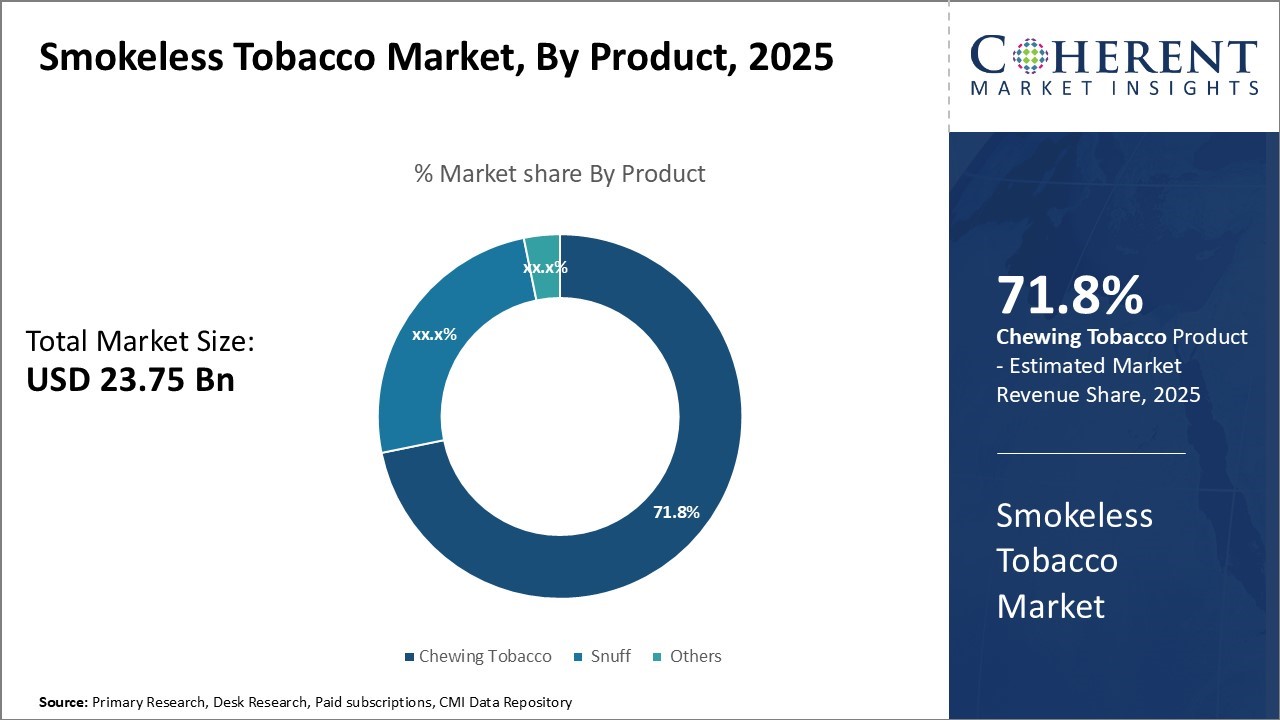
Smokeless Tobacco Market Insights, By Product - Convenience and Traditional Preference Drive Chewing Tobacco's Market Dominance
By Product, chewing tobacco is expected to contribute 72.8% smokeless tobacco market share in 2026 owing to its convenience of use and deep-rooted traditional preferences. Chewing tobacco is very convenient to carry around and are able to be used anywhere without drawing attention to yourself, which is why it is so popular with busy professionals and manual laborers. Chewing also feels good in the mouth while producing saliva. Chewing tobacco is a part of the culture of rural areas and is seen as an entertaining activity to do with family and friends. People still chew tobacco even though there are health risks as they remember their cultural and ancestral backgrounds.
For instance, in January 2025, the FDA approved marketing for 20 ZYN nicotine pouch products after a rigorous scientific review. These smokeless pouches showed lower health risks than cigarettes and moist snuff. Strict marketing restrictions aim to prevent youth exposure, with ongoing monitoring to ensure compliance.
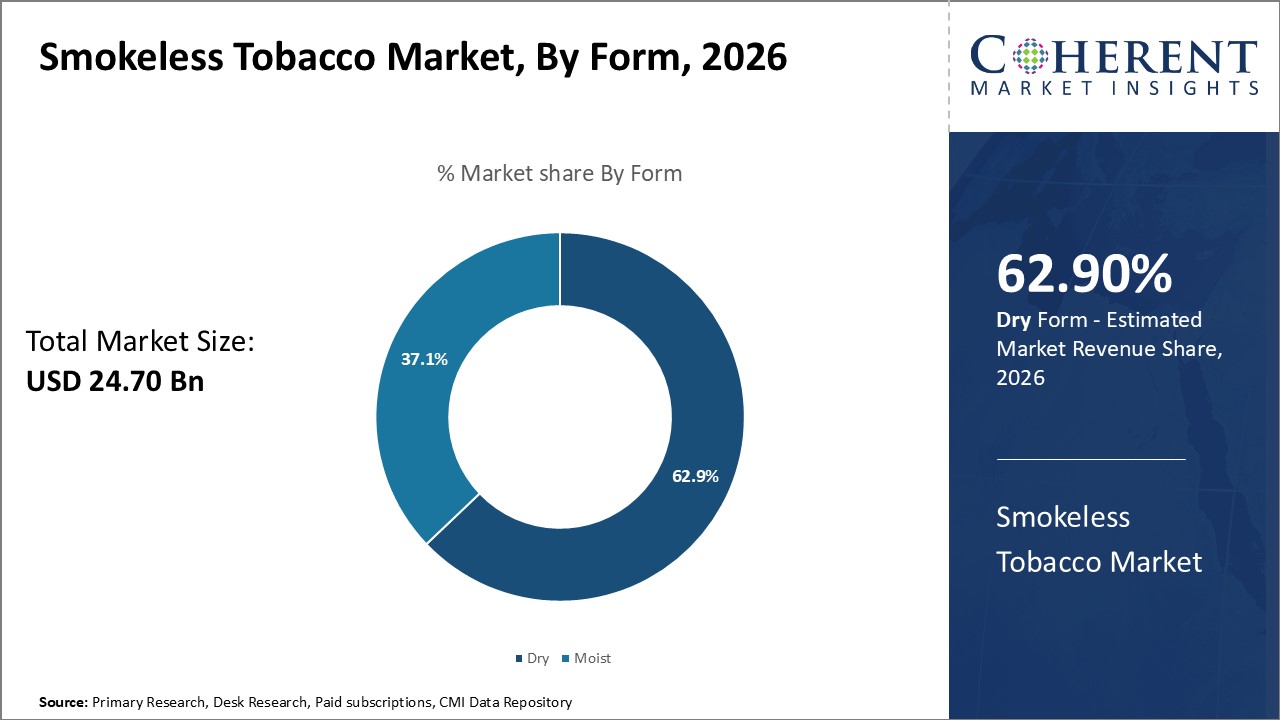
Smokeless Tobacco Market Insights, By Form - Dry Smokeless Tobacco is Popular and Versatile
By Form, the dry segment is expected to contribute the highest market share of 62.9% in 2026 owing to the diverse consumption options and versatility it offers compared to other forms. Dry smokeless tobacco can be easily transported and discreetly consumed. It also lets users pick their favorite ways to use it, like chewing, sniffing, or putting it between their gum and lip. This flexibility lets someone try out different levels of nicotine release over long periods of time. A person may easily stock up on and use dry smokeless tobacco products on the go without having to spit like those who smoke with moist forms. Given that dry smokeless tobacco is easy to carry around and can be used in a variety of ways, it remains popular.
For instance, in April 2025, KLAR launched a groundbreaking nicotine pouch technology featuring a patented multi-layer design that enhances flavor release and mouthfeel. The new pouches offer improved nicotine delivery and reduced irritation, aiming to elevate user experience. This innovation marks a significant step forward in smokeless tobacco alternatives.
Smokeless Tobacco Market Insights, By Distribution Channel - Online platforms Drive Higher Market Capture Through Expanded Access
By Distribution Channel, the online segment is expected to contribute the highest market share of 54.9% in 2026 driven by its ability to expand access. Brands are able reach and connect with a much larger group of consumers across the world through online platforms. This includes women and young people in cities who are harder to reach. Digital marketing techniques help make buying things normal, and complex targeting helps brands find the right customers. The ease of shopping online from home also draws in first-time users. Online segments also make more money by selling directly to customers without middlemen. These things are making it easier for online platforms to reach more people compared to traditional retail outlets that only have a few locations.
Regional Insights
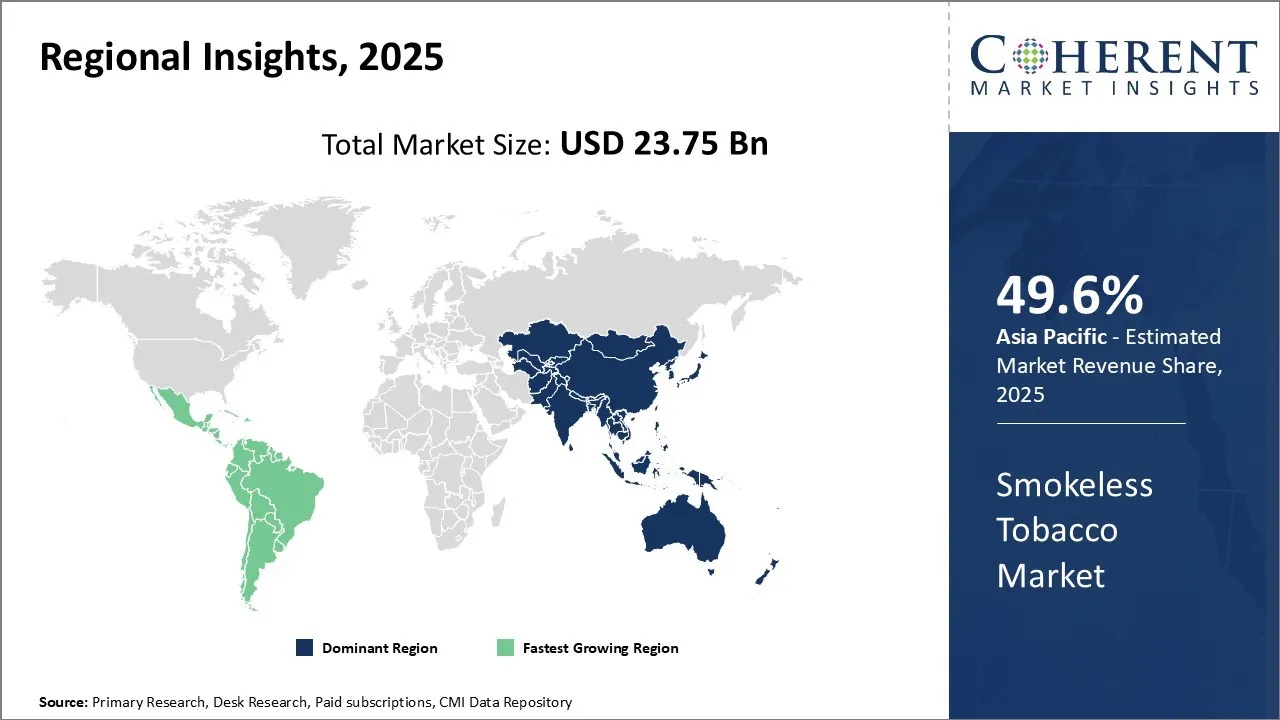
Asia Pacific Smokeless Tobacco Market Analysis & Trends
Asia Pacific is the largest market for smokeless tobacco as individuals are satisfied using it and utilize it frequently. The market share is expected to account for 49.6% in 2026. India and Bangladesh are two countries where large numbers of people have traditionally used smokeless tobacco products. Also, the region's economies are based on agriculture, which makes it a good place for businesses to grow tobacco. To meet the huge demand in the region, major companies like ITC and Godfrey Phillips India have a large production and distribution network across South Asia.
For instance, in August 2026, Sweden’s model for reducing smoking through nicotine pouches and harm-reduction strategies is gaining traction in Asia. Experts and policymakers across the region are exploring Swedish practices to combat tobacco-related health issues. The approach emphasizes innovation, regulation, and public awareness to promote a smoke-free future beyond traditional cessation methods.
North America Smokeless Tobacco Market Analysis & Trends
North America is a fast-growing market for smokeless tobacco. This is as consumers are increasingly open to the product, are loyal to brands, and new products are always coming out. Chewing tobacco and moist snuff are very popular, especially in the southern and rural parts of the U.S. People still prefer well-known brands like Copenhagen and Skoal, but younger people are more interested in newer flavored and pouch-based products. Online shopping has made smokeless tobacco easier to get, and these products have fewer rules than cigarettes, which makes it easier to market and sell them. All of these things together make North America even stronger in the global market.
For instance, in September 2026, Altria entered a Memorandum of Understanding with South Korea’s KT&G to explore long-term growth opportunities beyond traditional tobacco. The agreement aims to expand innovation, product development, and global reach in reduced-risk categories. Both companies view the collaboration as a strategic step toward a more diversified and sustainable future.
Smokeless Tobacco Market Outlook for Key Countries
United States Smokeless Tobacco Market Trends
The US smokeless tobacco market is changing a lot considering more and more people are buying newer kinds and flavors of smokeless tobacco. In the past, the market was mostly made up of chewing tobacco and moist snuff. Nevertheless, these days, people want more choices and types of smokeless tobacco. Businesses are coming up with new ideas and commencing new lines of products, such as snus pouches, oral nicotine pouches, and nicotine pouches without tobacco.
For instance, in March 2026, Reynolds American announced to expand the production of its smokeless nicotine pouches to meet rising consumer demand. The move supports the company’s commitment to reduced-risk products and aligns with shifting market trends. Enhanced manufacturing capacity aims to improve supply chain efficiency and accelerate innovation in the growing nicotine alternatives sector.
Russia Smokeless Tobacco Market Trends
Recent trends have created an enormous impact on the smokeless tobacco market in Russia, changing how businesses plan and how people behave. There are a number of important trends that are affecting the market. One of these is that Russian consumers are becoming more health-conscious. More people know that smokeless tobacco products like oral snuff, chewing tobacco, and low-tiered khubus are bad for their health. Over the past few years, government public health organizations in the country have run a number of educational campaigns that have mostly led to this increased health awareness.
Japan Smokeless Tobacco Market Trends
A greater number of individuals are switching from traditional smoked tobacco products to smokeless ones like snus and chewing tobacco because they are worried about the health risks. People are choosing smokeless products more often, so tobacco companies have to spend more time and money making and selling them. For example, large businesses like Japan Tobacco and Imperial Tobacco have added new flavors and packaging aimed at younger customers to their smokeless product lines, making them much bigger. They are spending a lot of money on ads to get people to think of smokeless as a "safer" choice than smoking.
For instance, in June 2026, British American Tobacco (BAT) launched Glo Hyper Hilo, a new premium tobacco heating device in Japan. Featuring advanced induction heating and sleek design, the product aims to enhance user experience and support BAT’s smoke-free vision. Japan remains a key market for BAT’s reduced-risk product innovation and expansion.
Market Players, Key Development, and Competitive Intelligence
Key Developments
- In October 2024, BAT announced plans to introduce a synthetic nicotine version of its Velo nicotine pouches in the United States by 2025. This initiative represents one of the first major uses of synthetic nicotine by a leading tobacco company, aiming to diversify product offerings in the smokeless segment.
- In October 2024, JTI completed the acquisition of Logic Technology Development, a U.S.-based e-cigarette company. This acquisition is expected to enhance JTI's presence in the U.S. market and expand its portfolio in the smokeless tobacco category.
- In July 2024, PMI announced USD 600 million investment to establish a manufacturing facility in Colorado dedicated to producing Zyn nicotine pouches. This plant is expected to commence operations by 2025 and create 500 jobs, underscoring PMI's commitment to meeting the growing demand for smokeless tobacco alternatives in the U.S.
Market Report Scope
Smokeless Tobacco Market Report Coverage
| Report Coverage | Details | ||
|---|---|---|---|
| Base Year: | 2025 | Market Size in 2026: | USD 24.70 Bn |
| Historical Data for: | 2020 To 2024 | Forecast Period: | 2026 To 2033 |
| Forecast Period 2026 to 2033 CAGR: | 3.9% | 2033 Value Projection: | USD 32.25 Bn |
| Geographies covered: |
| ||
| Segments covered: |
| ||
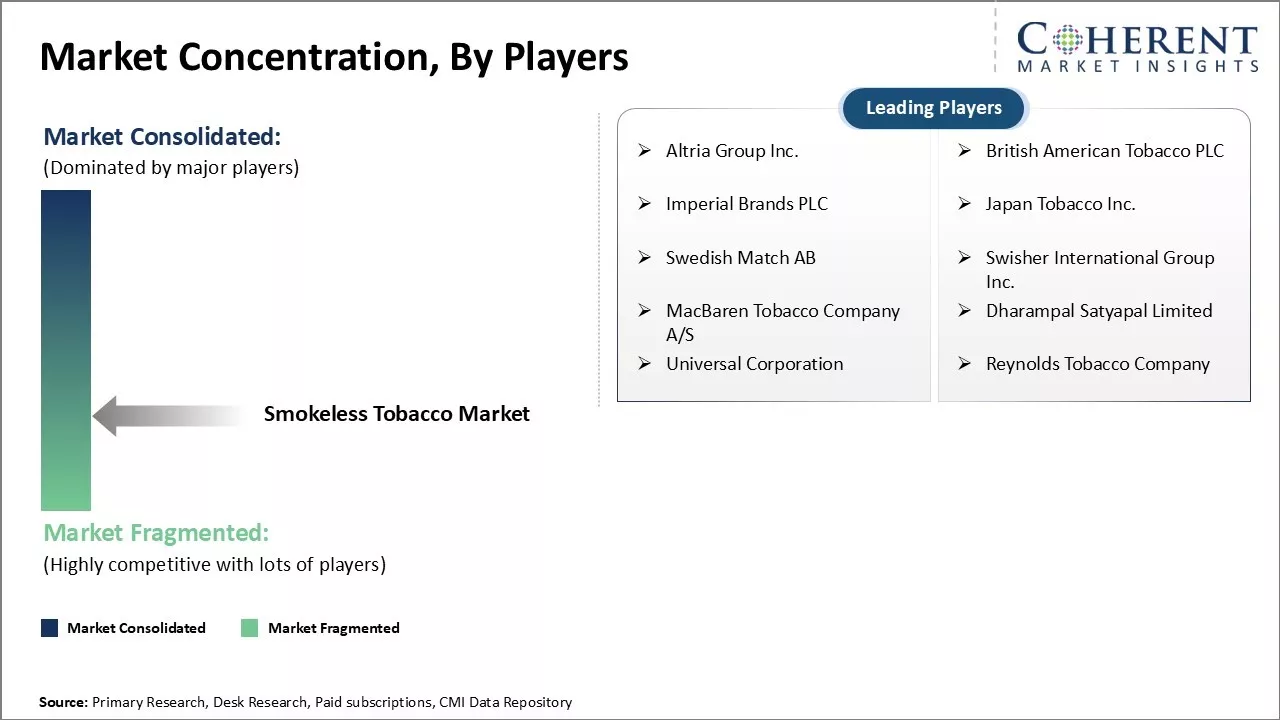
| Companies covered: | Altria Group Inc., British American Tobacco PLC, Imperial Brands PLC, Japan Tobacco Inc., Swedish Match AB, Swisher International Group Inc., MacBaren Tobacco Company A/S, Dharampal Satyapal Limited, Universal Corporation, Reynolds Tobacco Company | ||
| Growth Drivers: |
| ||
| Restraints & Challenges: |
| ||
Market Dynamics
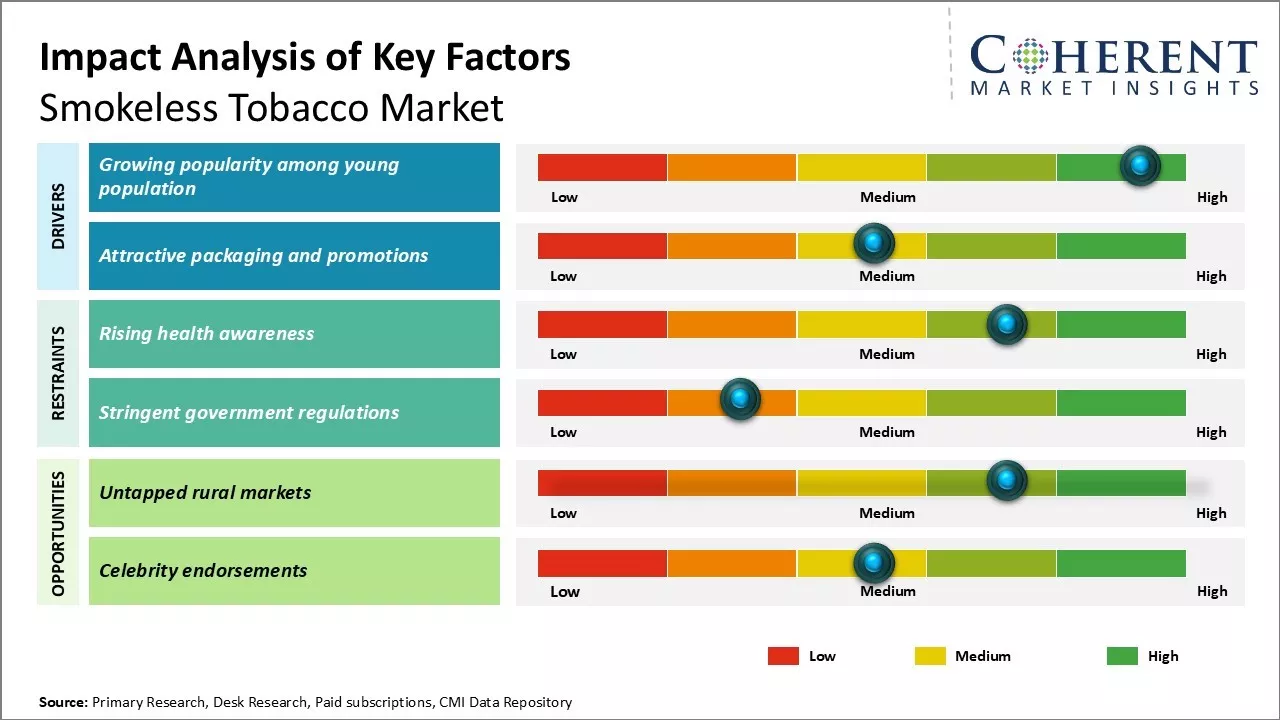
Smokeless Tobacco Market Driver
Growing Popularity Among Young Population
The smokeless tobacco market has been experiencing increased demand from young consumers in recent years. While smoking rates have declined among teens and young adults, smokeless tobacco products are perceived as a safer alternative to smoking. These products are easily available, come in various flavors such as fruits, candy, and mint that are quite appealing to the young consumers. Also, the strong marketing campaigns by manufacturers portray the use of these products in a very casual way. Advertisements often feature young, energetic models using chewing tobacco and nicotine pouches, which helps build perception among youth that it is a common, socially acceptable thing to follow.
Smokeless Tobacco Market Opportunity
Untapped Rural Markets Offer Potential Opportunities
One of the key opportunities for the smokeless tobacco market lies in tapping into the untapped rural markets. While the urban markets are now crowded with established brands and saturated with health messages, rural regions still offer significant growth potential. Rural areas account for a large segment of smokeless tobacco consumers in the country. However, the penetration and availability of brands are comparatively lower than cities. Most rural consumers have lower health awareness. The niche local and unorganized players currently dominate the rural landscape. The leading companies can look at penetrating deeper into villages by tailoring their product portfolio, packaging, promotion and distribution as per rural needs. An aggressive distribution expansion combined with mass communication campaigns catered to rural audiences can help capture a bigger share of the sizable untapped rural market for smokeless tobacco over the next few years.
Analyst Opinion (Expert Opinion)
- The smokeless tobacco market remains a relatively steady segment. While the growth rates may not be exponential, the market has consistent long-term demand drivers. The predominant driver continues to be popularity and social acceptance in certain regions. Areas like South Asia, where smokeless tobacco products have deep cultural roots, still account for a major share. However, regulatory measures and increased health awareness act as restraints in other developed markets.
- North America and Europe have been the fastest growing regions for newer oral nicotine pouches. Products marketed as a less harmful alternative to smoking are gaining traction. These low-risk products present a good opportunity for industry players. At the same time, public campaigns highlighting the health impacts of traditional nicotine-based snacks have started impacting consumption in high-volume areas. Stringent packaging warnings and advertising bans proposed by governments could also dampen growth prospects if passed.
- The competitive landscape remains concentrated with a few large multinational companies dominating production and marketing. However, the market offers prospects for both incumbents and new entrants with innovative harm-reduced offerings. While overall volumes may not skyrocket, companies tapping into niche segments and changing consumer preferences stand to benefit. The future trajectory will depend on navigating regulatory headwinds and adapting to shifting social attitudes in different local contexts worldwide.
Speak to the analyst
Want personalized insights?
Take the findings above to one of our principal consultants, or have the report rebuilt around the segments, geographies and competitors you actually track.
Market Segmentation
- By Product Insights (Revenue, USD Bn, 2026 - 2033)
- Chewing Tobacco
- Snuff
- Others
- By Form Insights (Revenue, USD Bn, 2026 - 2033)
- Dry
- Moist
- By Distribution Channel Insights (Revenue, USD Bn, 2026 - 2033)
- Online
- Offline
- Regional Insights (Revenue, USD Bn, 2026 - 2033)
- North America
- U.S.
- Canada
- Latin America
- Brazil
- Argentina
- Mexico
- Rest of Latin America
- Europe
- Germany
- U.K.
- Spain
- France
- Italy
- Russia
- Rest of Europe
- Asia Pacific
- China
- India
- Japan
- Australia
- South Korea
- ASEAN
- Rest of Asia Pacific
- Middle East
- GCC Countries
- Israel
- Rest of Middle East
- Africa
- South Africa
- North Africa
- Central Africa
- Key Players Insights (Revenue, USD Bn, 2021 - 2033)
- Altria Group Inc.
- British American Tobacco PLC
- Imperial Brands PLC
- Japan Tobacco Inc.
- Swedish Match AB
- Swisher International Group Inc.
- MacBaren Tobacco Company A/S
- Dharampal Satyapal Limited
- Universal Corporation
- Reynolds Tobacco Company
Sources
Primary Research Interviews from the following stakeholders
Stakeholders
- Interviews with smokeless tobacco manufacturers, distributors, retailers, regulatory authorities, public health experts, and procurement heads across leading global markets.
Specific stakeholders
- Procurement and category managers at retail chains & convenience stores (e.g., 7-Eleven, Walgreens, Tesco)
- Supply chain managers at tobacco distribution hubs (e.g., ITC distribution network, Altria logistics partners)
- Regulatory compliance officers in health ministries (e.g., FDA – U.S., Ministry of Health & Family Welfare – India, Public Health England)
- Product managers and R&D leads at smokeless tobacco product OEMs (e.g., chewing tobacco, snus, dissolvable tobacco, snuff)
- Marketing and brand managers at leading tobacco companies (e.g., oral nicotine pouch brands, heritage smokeless brands)
- Retail kiosk operators and small store owners in smokeless tobacco–dominant regions (South Asia, Africa, Scandinavia, U.S.)
- Agricultural cooperatives and farmers producing tobacco leaf (India, Bangladesh, Brazil, Zimbabwe, U.S.)
Databases
- World Health Organization (WHO) Global Tobacco Surveillance System
- World Trade Organization (WTO) Trade Statistics
- UN Comtrade Database
- U.S. Food and Drug Administration (FDA) Tobacco Products Center – Market & Regulatory Data
- Eurostat – Tobacco & Consumer Goods Trade Data
- U.S. Department of Agriculture (USDA) Tobacco Reports
- Indian Ministry of Commerce & Industry – Tobacco Board Statistics
- China Customs Statistics – Tobacco Trade Data
- Directorate General of Commercial Intelligence and Statistics (DGCIS), India
- Centers for Disease Control and Prevention (CDC) – Tobacco-Related Data Portal
Magazines
- Tobacco Reporter
- Tobacco Journal International
- Smokeshop Magazine
- Convenience Store News (Tobacco Section)
- The Grocer (Tobacco & FMCG Section)
- Retail News Asia – Tobacco & FMCG Trends
- Inside Tobacco
Journals
- Tobacco Control (BMJ)
- Nicotine & Tobacco Research (Oxford University Press)
- Journal of Public Health Policy
- International Journal of Environmental Research and Public Health (Tobacco & Health Section)
- Addictive Behaviors (Elsevier)
- Journal of Agricultural and Food Chemistry (for smokeless tobacco composition)
- Public Health Reports
Newspapers
- The Wall Street Journal – Consumer & Tobacco Industry Reports
- The Economic Times – FMCG & Tobacco Sector
- Financial Times – Tobacco, Regulation & Trade Coverage
- The Hindu Business Line – Agriculture & Tobacco Trade News
- Nikkei Asia – Consumer Goods & Tobacco Supply Chain
- The Guardian – Public Health & Tobacco Coverage
- South China Morning Post – FMCG & Tobacco Industry
Associations
- World Health Organization (WHO) – Framework Convention on Tobacco Control (FCTC)
- Campaign for Tobacco-Free Kids (Global Tobacco Data)
- Tobacco Board of India
- U.S. National Tobacco Growers Association
- European Smokeless Tobacco Council (ESTOC)
- Public Health Foundation of India (PHFI) – Tobacco Research Initiatives
- International Tobacco Growers Association (ITGA)
Public Domain Sources
- U.S. Centers for Disease Control and Prevention (CDC)
- U.S. Food and Drug Administration (FDA) – Tobacco Products Reports
- Ministry of Health & Family Welfare (Government of India)
- National Cancer Institute (NCI) – Tobacco & Cancer Research
- Public Health England (PHE) – Smokeless Tobacco Studies
- World Health Organization (WHO) – Global Adult Tobacco Survey (GATS)
- Reserve Bank of India (RBI) – Reports on FMCG & Agriculture
- Agricultural Statistics Data (India, Brazil, U.S.)
Get access to 250+ pages report
Every segment, forecast, competitor profile and data table behind the analysis above — available for instant download.
- ESOMAR Member
- ISO 9001:2015 Certified
- D-U-N-S Registered
- GDPR & CCPA Compliant
Missing comfort of reading report in your local language? Find your preferred language:
Transform your Strategy with Exclusive Trending Reports
Frequently Asked Questions
The Smokeless Tobacco Market is estimated to be valued at USD 24.70 Bn in 2026, and is expected to reach USD 32.25 Bn by 2033.
The CAGR of the Smokeless Tobacco Market is projected to be 3.9% from 2026 to 2033.
Growing popularity among young population and Attractive packaging and promotions are the major factors driving the growth of Smokeless Tobacco Market.
Rising health awareness and stringent government regulations are the major factors hampering the growth of Smokeless Tobacco Market.
In terms of Product, Chewing Tobacco, estimated to dominate the market revenue share in 2026.
Altria Group Inc., British American Tobacco PLC, Imperial Brands PLC, Japan Tobacco Inc., Swedish Match AB, Swisher International Group Inc., MacBaren Tobacco Company A/S, Dharampal Satyapal Limited, Universal Corporation, Reynolds Tobacco Company are the major players.
Asia Pacific is expected to lead the Smokeless Tobacco Market in 2026.