

Global Space Based Network Market Size and Forecast – (2026-2033)
Coherent Market Insights estimates that the global space based network market is expected to reach USD 10 Bn in 2026 and will expand to USD 62 Bn by 2033, registering a CAGR of 21% between 2026 and 2033.
Key Takeaways of the Space Based Network Market
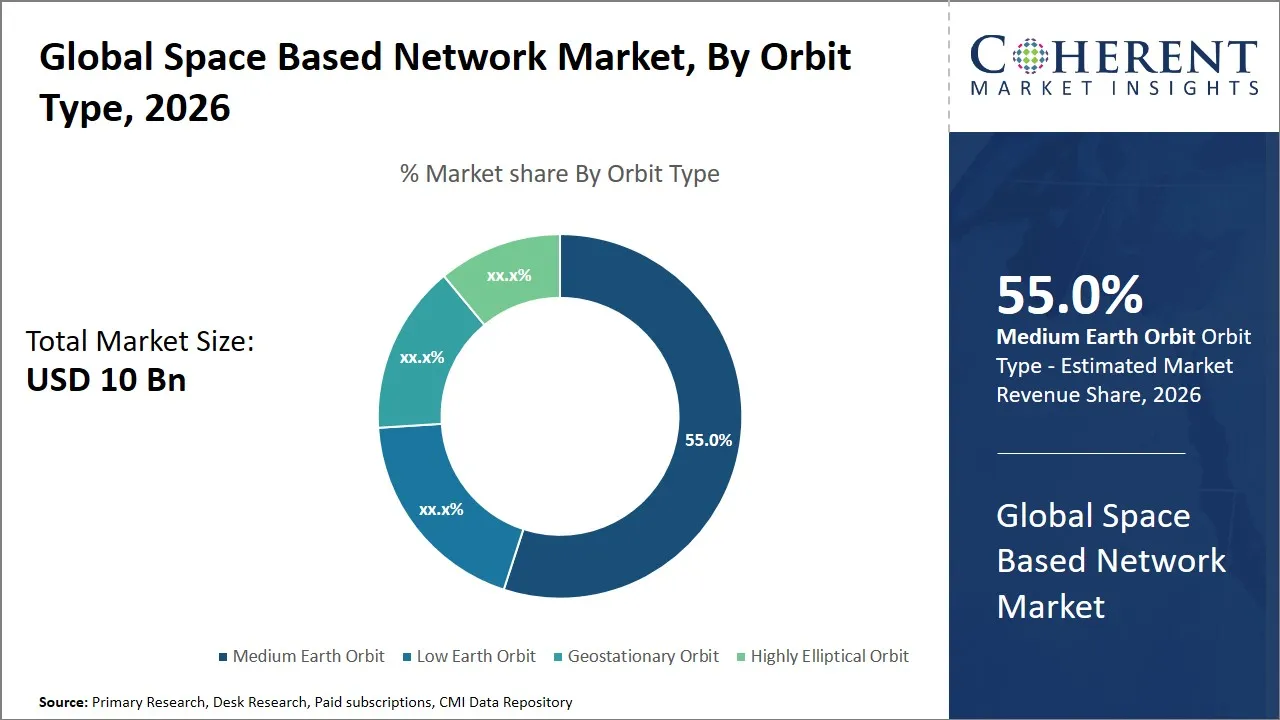
- The medium earth orbit segment is expected to account for 55% of the space based network market share in 2026.
- The satellites segment is estimated to capture 36% of the global space based network market share in 2026.
- The broadband connectivity segment is projected to hold 33.5 % of the market share in 2026.
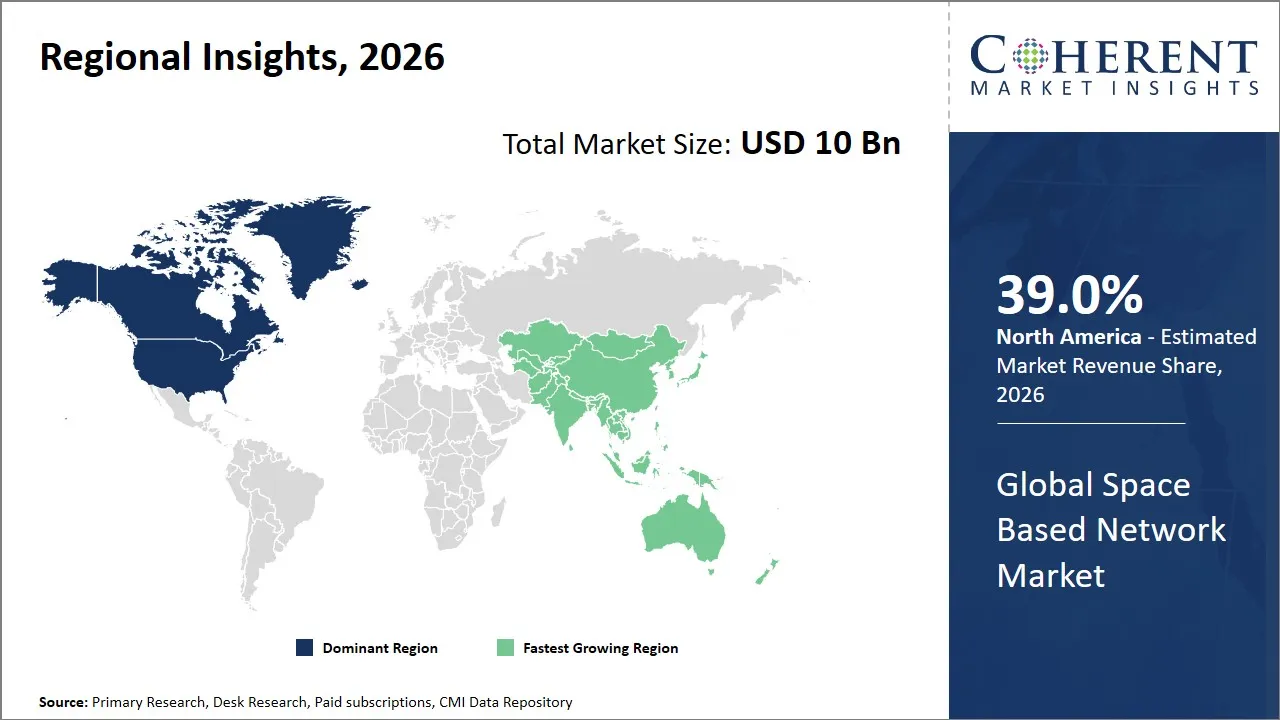
- North America will dominate the space based network market in 2026 with an estimated 39%
- Asia Pacific will hold 26% share in 2026 and is expected to record the fastest growth over the forecast period.
Currents Events and Its Impact
Current Events | Description and its Impact |
Amazon Project Kuiper |
|
Segmental Insights
- Current Industry Events of 2026
- Market Size Estimation
- Regional Breakdown
- Competitive Landscape
- Customer Intelligence
- Segmental Analysis
- Pricing Analysis
- Key Market Drivers, Challenges & Future Trends
- Customized Insights Section
Why Does the Medium Earth Orbit Segment Dominate the Global Space Based Network Market in 2026?
The medium earth orbit segment is expected to account for 55.0% of the market share in 2026. Although situated between LEO and GEO altitudes, ranging from about 2,000 to 35,786 kilometers above Earth, MEO hosts satellites designed to balance broader reach against reduced delay. Because they orbit at this intermediate height, these systems access wider regions than low-flying counterparts without enduring the lag common in higher-altitude networks. For applications like global positioning and data relay, such performance traits become valuable under certain operational demands. Thus, location plays a central role in shaping their functional benefits.
Satellites Segment Dominate the Global Space Based Network Market
The satellites segment is expected to hold 36.0% of the space based network market share in 2026. As satellites allow data to move across great distances through air and space, expansion continues. Essential as high-altitude connection points, these systems support nearly every orbital setup. This role fuels steady funding for building satellites, sending them into orbit, and caring for them once deployed.
For instance, on October 20, 2025, SpaceX launched 20 spare OneWeb satellites to strengthen the resiliency of French operator Eutelsat’s rival low Earth orbit (LEO) broadband network. The launch was carried atop a Falcon 9 rocket.
(Source: space.com)
Why is Broadband Connectivity the Most Preferred Application in the Space Based Network Market?
The broadband connectivity segment is projected to capture 33.5% of the global space based network market share in 2026. Expansion stems from rising worldwide demand for fast, stable internet, even in isolated areas. As digital tools, online platforms, and rich media become widespread, cities and distant regions face similar pressures to improve connectivity. From satellites emerges a key solution, quietly reshaping how networks reach across terrain.
Latency & Throughput Tier Economics
Provider / Orbit Tier | Typical Latency (RTT, ms) | Typical Throughput (Down/Up, Mbps) | Approx. Cost |
Starlink (LEO) | 20–50 ms | 50–250 Mbps down / 10–40 Mbps up | ~USD 110–USD 120/mo retail |
Starlink Business | 20–50 ms | 150–500 Mbps+ | ~USD 500/mo business |
Eutelsat OneWeb (LEO) | ~70 ms | ~150–195 Mbps down / 20–30 Mbps up | High enterprise pricing (~USD 9,600–USD 18,000/mo for 50–100 Mbps) |
GEO (Legacy like Viasat / HughesNet) | ~600 ms | ~25–150 Mbps | ~USD 50–USD 150/mo |
DS2D (Direct-to-Cell future service) | ~125–140 ms | ~4–24 Mbps (projected mobile) | ~USD 10/mo (supplemental) |
Regional Insights
North America Space Based Network Market Analysis and Trends
The North America region is projected to lead the market with a 39% share in 2026. Driven by an established aerospace environment, federal support plays a key role alongside active industrial participation. In the U.S., funding from agencies like NASA and the Department of Defense combines with efforts from major firms like SpaceX, Lockheed Martin and Boeing to advance technological boundaries and extend satellite systems. Because supply networks are developed and research capacities highly evolved, new satellite arrays emerge quickly, along with associated ground solutions. Where rules align with business needs, cooperation grows naturally between public and private sides. This alignment helps maintain North America’s position at the forefront of space-related activity.
For instance, on November 14, 2025, Viasat, Inc., a global leader in satellite communications, announced the successful launch and initial signal acquisition of the ViaSat-3 Flight 2 (F2) satellite. ViaSat-3 F2 will provide services over the Americas region and represents the latest addition to Viasat’s global satellite network.
(Source: investors.viasat.com)
Asia Pacific Space Based Network Market Analysis and Trends
The Asia Pacific region is expected to exhibit the fastest growth in the market contributing 26% share in 2026. Greater investment in space technology contributes to progress, while broader industrial capacity supports expansion alongside government initiatives focused on connecting distant regions. In places such as China and India, satellite systems grow rapidly due to priorities involving defense, digital access, yet also long-term exploration goals. Agencies including ISRO and CNSA push boundaries; at the same time, new private companies drive change through fresh approaches to development. Cooperation among nations strengthens, opening pathways across borders and this shared momentum expands reach within the Asia Pacific region more deeply over time.
Global Space Based Network Market Outlook for Key Countries
Why is the U.S. Emerging as a Major Hub in the Space Based Network Market?
Driven by combined efforts between government bodies and corporate entities, activity in the American market gains momentum. Firms like SpaceX, OneWeb - operating extensively within the country - Boeing, and Lockheed Martin run extensive networks of orbiting systems used for connectivity, national security, and research tasks. Through federal programs comes support, providing funds together with strategic outlooks that influence commercial ventures as well as defense demands. Advancement in space-based systems progresses steadily, guided by lasting proficiency in aviation science and a global reputation for originality, while structural frameworks, both physical and virtual, undergo continual refinement within the field.
Is China the Next Growth Engine for the Space Based Network Market?
Under direction from national goals, satellite communications in China expand through coordination between CNSA and major government-supported entities such as CASC. Rapid launches push these systems forward, enabling functions from data transmission to defense operations, also missions venturing past low Earth orbit. Industrial strength fuels progress; at the same time, rising capital flows into emerging space ventures. With careful placement amid global conditions, growth extends not only outward but across different areas of the nation’s space-related industries.
India Space Based Network Market Analysis and Trends
A shift becomes clear across India’s satellite communication sector, driven by consistent advances at ISRO, known for affordable launches and an expanding network focused on information transfer. Recently, policy shifts began enabling private involvement, visible in firms like Antrip Corporation and newer ventures crafting compact orbital systems for worldwide connectivity. Importantly, underserved rural populations demand improved digital access, which now influences technological direction. Meanwhile, joint initiatives across borders and shared expertise slowly widen both skill levels and global presence.
Germany Space Based Network Market Analysis and Trends
Despite its central location in Europe, Germany shapes global access to orbital infrastructure through joint programs run by the European Union and the European Space Agency. Key players such as Airbus Defence and Space, alongside Thales Alenia Space, take part in building satellites, linking complex systems, along with developing control stations on Earth. Focus often shifts toward combining satellite platforms that ensure protected data transfer, track ecological changes, plus guide movement across regions. Because of consistent policy frameworks and cooperative ventures across borders, progress remains steady - helping maintain influence within orbiting clusters and their supporting services.
Japan Space Based Network Market Analysis and Trends
Advanced capabilities in technology from companies like Mitsubishi Electric Corporation and NEC Corporation help shape Japan's market expansion. Supported by initiatives led by JAXA, progress gains momentum through focused investment. Development priorities include next-generation satellite communications - such as high-capacity models - and precise tracking frameworks. Partnerships across the Asia Pacific enable shared innovation and cooperative projects. These alliances strengthen Japan’s influence in deploying regional space networks. Attention also turns toward monitoring natural disasters and intelligent urban systems. Such efforts reflect broader uses for space-derived data both at home and overseas.
Market Players, Key Development, and Competitive Intelligence
Key Developments
- On June 30, 2025, Vodafone Group and AST SpaceMobile Inc announced their new joint venture satellite company, SatCo, will be headquartered in Luxembourg, creating a European sovereign integrated satellite service.
- On February 8, 2025, Kinéis completed its fourth satellite launch and signed strategic partnerships with Europorte‑Kerlink and CLS. The success of the 4th launch once again demonstrates the reliability of Kinéis’ technical capabilities.
Top Strategies Followed by Global Space Based Network Market Players
Player Type | Strategic Focus | Example |
Established Market Leaders | Echostar Acquisition | On January 2, 2024, EchoStar Corporation announced the completion of its acquisition of DISH Network Corporation To complete the acquisition, a wholly owned subsidiary of EchoStar merged with and into DISH Network, with DISH Network surviving the merger as a wholly owned subsidiary of EchoStar. |
Mid-Level Players | Bell and AST Space Mobile Test Completion | On October 3, 2025, Bell Canada and AST Space Mobile complete Canada's first successful space-based direct-to-cell 4G voice over LTE (VoLTE) call, broadband data and video streaming test. |
Small-Scale Players | Business Agreement | On August 4, 2025, Innovative Rocket Technologies Inc announced that they have entered into a five-year launch integration, mission planning, and propulsion systems agreement with SpaceBelt KSA for a total contract value of up to USD 640 million. This partnership places Innovative Rocket Technologies at the forefront of one of the most strategic and forward-looking space innovation initiatives in the Middle East. |
Market Report Scope
Global Space Based Network Market Report Coverage
| Report Coverage | Details | ||
|---|---|---|---|
| Base Year: | 2025 | Market Size in 2026: | USD 10 Bn |
| Historical Data for: | 2020 To 2024 | Forecast Period: | 2026 To 2033 |
| Forecast Period 2026 to 2033 CAGR: | 21 % | 2033 Value Projection: | USD 62 Bn |
| Geographies covered: |
| ||
| Segments covered: |
| ||
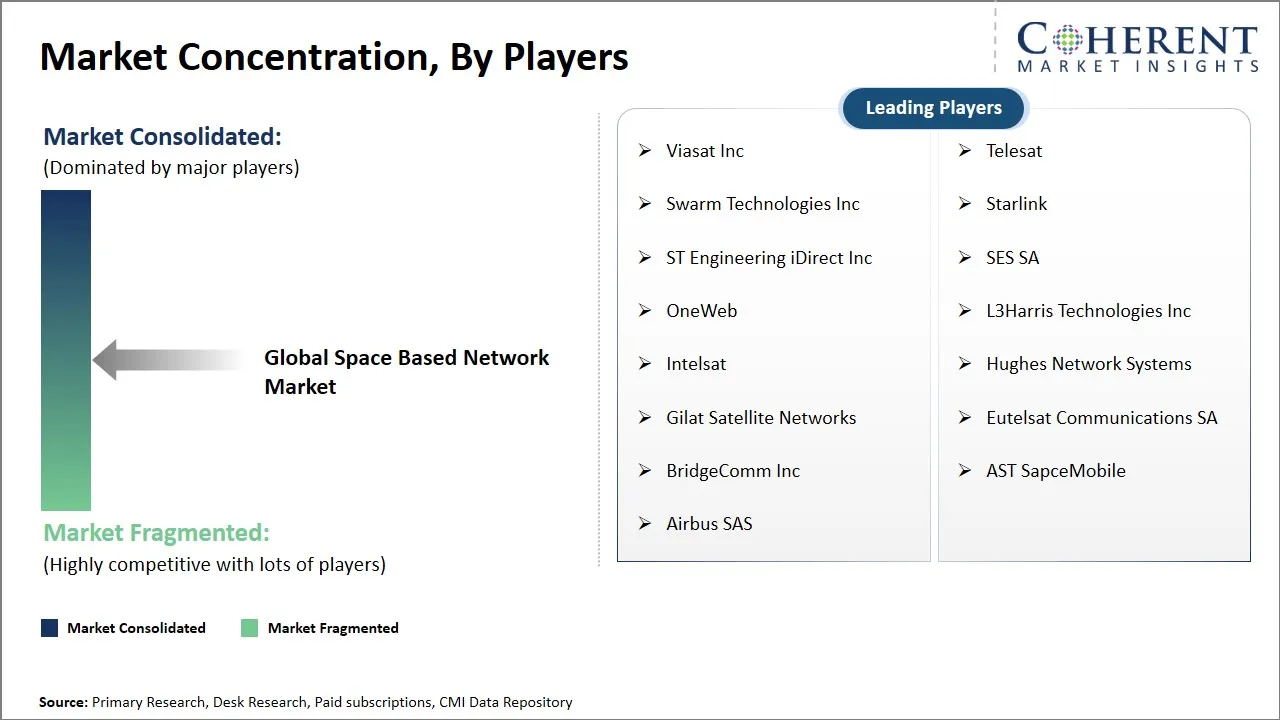
| Companies covered: | Viasat Inc, Telesat, Swarm Technologies Inc, Starlink, ST Engineering iDirect Inc, SES SA, OneWeb, L3Harris Technologies Inc, Intelsat, Hughes Network Systems, Gilat Satellite Networks, Eutelsat Communications SA, BridgeComm Inc, AST SapceMobile, and Airbus SAS | ||
| Growth Drivers: |
| ||
| Restraints & Challenges: |
| ||
Global Space Based Network Market Dynamics
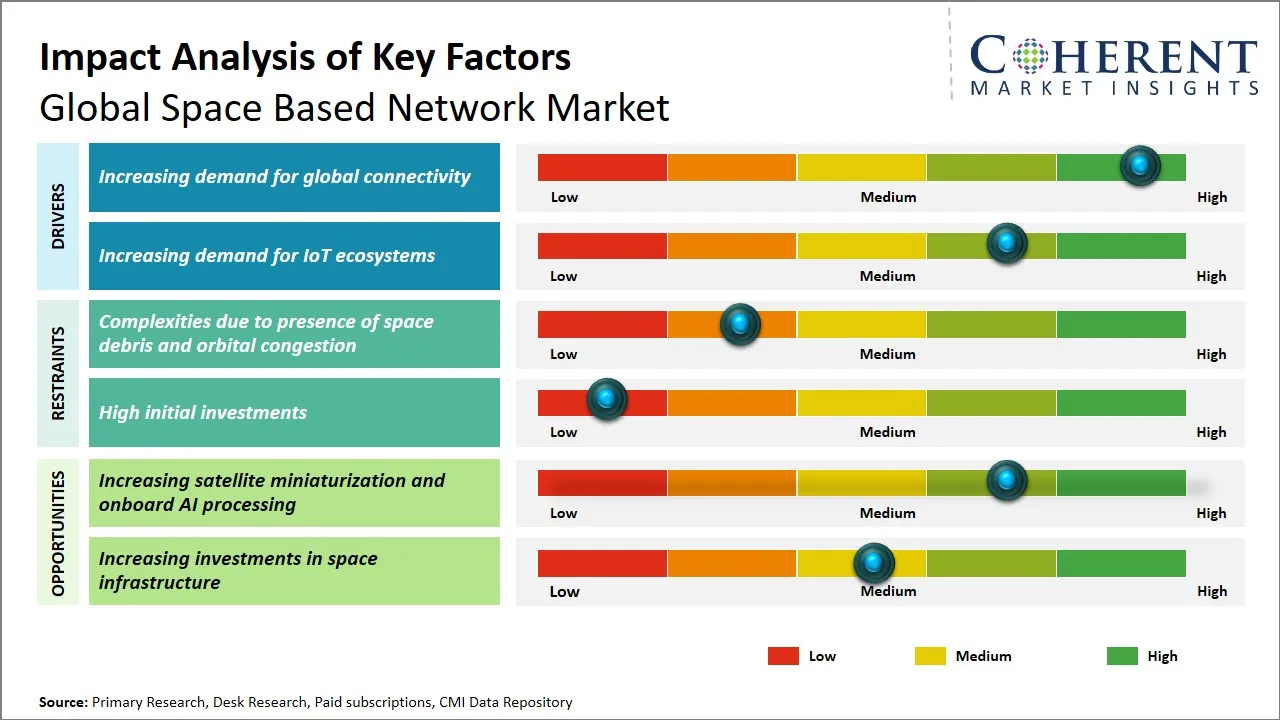
Global Space Based Network Market Driver - Increasing Demand for Global Connectivity
Spreading digital environments, together with growing demands for smooth interaction between distant locations, raise pressure on worldwide links - prompting wider use of networks in space. When organizations, administrations, or people count on fast web connections and instant data transfer, land-based setups frequently fail, particularly far from urban centers. Orbiting systems, using groups of satellites paired with modern transmission methods, deliver reach where earthbound alternatives struggle to perform.
On September 4, 2025, JetBlue announced it will be the first airline in the world to sign on with Amazon’s Project Kuiper, an advanced low Earth orbit satellite broadband network, to bring even faster and more reliable connectivity to its popular onboard Wi-Fi known as Fly-Fi.
(Source: news.jetblue.com)
Global Space Based Network Market Opportunity - Increasing Satellite Miniaturization and Onboard AI Processing
Growth in the global space-based network sector emerges alongside progress in shrinking satellite size and integrating embedded computing into spacecraft systems. With technology shifting, lightweight models known as SmallSats or CubeSats gain practicality for routine launches. One effect: lower expenses during lift-off, along with quicker setup of orbital groups that broaden signal reach while strengthening system reliability. At the same time, intelligent software built directly into these units enables immediate analysis of information while still in orbit. Instead of sending unprocessed streams down to ground stations, decisions happen mid-space, cutting delays and easing pressure on transmission channels. Efficiency across connections improves when less raw output travels through the network.
For instance, on October 28, 2024, TelePIX announced the successful completion of the in-space demonstration of TetraPLEX, an artificial intelligence (AI) processor for satellites. This marks the world's first successful demonstration of real-time, high-speed parallel processing of satellite big data AI model in the extreme conditions of space.
Analyst Opinion (Expert Opinion)
- A shift unfolds across the worldwide satellite network sector, shaped by expanding constellations, growing need for constant access, while space systems link more deeply with communication platforms. Notable providers like SpaceX, Amazon, and Eutelsat OneWeb launch vast groups of satellites, transforming how data moves through air and orbit alike. Once limited to specialized roles, these networks now underpin broad internet coverage, transport needs, security operations, alongside business services.
- Small satellites, equipped with smarter computing systems, shift how competition unfolds across the sector. Cost of launching drops while response times improve, owing to decisions made in space rather than on the ground. Firms of moderate size find room to act, especially where focused solutions matter most. New entries explore niches like remote sensing, machine-to-machine links, independent network operations, and information gathered beyond the atmosphere. Progress here does not wait for giants alone.
Speak to the analyst
Want personalized insights?
Take the findings above to one of our principal consultants, or have the report rebuilt around the segments, geographies and competitors you actually track.
Market Segmentation
- Orbit Type Insights (Revenue, USD Bn, 2021 - 2033)
- Medium Earth Orbit
- Low Earth Orbit
- Geostationary Orbit
- Highly Elliptical Orbit
- Component Insights (Revenue, USD Bn, 2021 - 2033)
- Satellites
- Ground Stations
- Transponders
- Antennas
- Routers and Switches
- Others
- Application Insights (Revenue, USD Bn, 2021 - 2033)
- Broadband Connectivity
- Data Communication
- Earth Observation
- Remote Sensing
- Others
- End User Insights (Revenue, USD Bn, 2021 - 2033)
- Telecommunication
- Government and Military
- Aviation
- Maritime
- Oil and Gas
- Others
- Regional Insights (Revenue, USD Bn, 2021 - 2033)
- North America
- U.S.
- Canada
- Latin America
- Brazil
- Argentina
- Mexico
- Rest of Latin America
- Europe
- Germany
- U.K.
- Spain
- France
- Italy
- Russia
- Rest of Europe
- Asia Pacific
- China
- India
- Japan
- Australia
- South Korea
- ASEAN
- Rest of Asia Pacific
- Middle East
- GCC Countries
- Israel
- Rest of Middle East
- Africa
- South Africa
- North Africa
- Central Africa
- North America
- Key Players Insights
- Viasat Inc
- Telesat
- Swarm Technologies Inc
- Starlink
- ST Engineering iDirect Inc
- SES SA
- OneWeb
- L3Harris Technologies Inc
- Intelsat
- Hughes Network Systems
- Gilat Satellite Networks
- Eutelsat Communications SA
- BridgeComm Inc
- AST SapceMobile
- Airbus SAS
Sources
Primary Research Interviews
- Satellite Network Operators and Service Providers
- Space Technology Equipment Manufacturers
- Telecommunications Infrastructure Companies
- Government Space Agencies and Defense Contractors
Databases
- Space Foundation Database
- Satellite Industry Association (SIA) Database
- International Telecommunication Union (ITU) Database
- Federal Aviation Administration (FAA) Commercial Space Database
Magazines
- Satellite Today Magazine
- Space News Magazine
- Via Satellite Magazine
- Aerospace America Magazine
Journals
- International Journal of Satellite Communications and Networking
- IEEE Transactions on Aerospace and Electronic Systems
- Journal of Spacecraft and Rockets
Newspapers
- Space Daily
- SpaceflightNow
- SpaceX Updates & News
- Aviation Week Network
Associations
- Satellite Industry Association (SIA)
- Space Foundation
- International Astronautical Federation (IAF)
- Commercial Spaceflight Federation (CSF)
Public Domain Sources
- NASA Public Reports and Publications
- European Space Agency (ESA) Public Documents
- Federal Communications Commission (FCC) Filings
- Space Data Association Public Resources
Proprietary Elements
- CMI Data Analytics Tool
- Proprietary CMI Existing Repository of information for last 8 years
Get access to 250+ pages report
Every segment, forecast, competitor profile and data table behind the analysis above — available for instant download.
- ESOMAR Member
- ISO 9001:2015 Certified
- D-U-N-S Registered
- GDPR & CCPA Compliant
Missing comfort of reading report in your local language? Find your preferred language:
Transform your Strategy with Exclusive Trending Reports
Frequently Asked Questions
The global space based network market stood at USD 10 Bn in 2026 and is expected to reach USD 62 Bn by 2033.
The CAGR of global space based network market is projected to be 21% from 2026 to 2033
Increasing demand for global connectivity and increasing demand for IoT ecosystems are the major factors driving the growth of the global space based network market.
Complexities due to presence of space debris and orbital congestion and high initial investments are the major factors hampering the growth of the global space based network market.
In terms of orbit type, medium earth orbit is estimated to dominate the market revenue share in 2026.
Viasat Inc, Telesat, Swarm Technologies Inc, Starlink, ST Engineering iDirect Inc, SES SA, OneWeb, L3Harris Technologies Inc, Intelsat, Hughes Network Systems, Gilat Satellite Networks, Eutelsat Communications SA, BridgeComm Inc, AST SapceMobile, and Airbus SAS are the major players.
North America is expected to lead the global space based network market in 2026.