

Military Robots Market Size and Forecast – 2026 to 2033
The global military robots market is estimated to be valued at USD 27,037.6 Mn in 2026 and is expected to reach USD 42,099.0 Mn in 2033, exhibiting a compound annual growth rate (CAGR) of 6.5% from 2026 to 2033.
Key Takeaways
- Based on platform, the land segment is expected to lead with 45% share in 2026, driven by its versatile deployment across reconnaissance, EOD, and logistics missions.
- Based on mode of operation, the autonomous segment is forecast to hold 68.1% market share in 2026, owing to increasing investment in AI‑driven decision making and reduced need for real‑time human control.
- Based on Region, North America is set to lead the global military robots market with a 48.5% share in 2026. While, Asia Pacific is anticipated to be the fastest growing region.
Market Overview
The global military robots market will witness substantial growth in the near future and major growth drivers of the market include government investment, increased expenditure on military, and increasing adoption of advanced technologies. Increasing demand for automated systems is a key factor driving the development of the military robotics market. Another major driver is the demand for sophisticated unmanned systems to combat foreign attacks.
Current Events and Its Impact
Current Events | and its impact |
US-China Strategic Competition |
|
Artificial Intelligence Governance and Ethics |
|
Military Robots in Defense Sector
Military robots are transforming the 2025 defense sector by integrating autonomy, artificial intelligence, and multi-domain operability to meet evolving operational and strategic demands. Military robotics involves land, marine, and airborne platforms that have been designed with sophisticated sensors, AI-enabled decision-making techniques, and communication networks in order to reinforce battlefield efficacy and soldier safety. Military robots are finding increasing application in a range of tasks related to reconnaissance, surveillance, logistics, EOD, and combat support missions. This has reduced human risk, improving the effectiveness and efficiency of operations.
The need for military robots is thus fueled by the increasing budgets for defense, improvements in AI and robotics, and the immediate requirement felt for force multiplication in modern-day war. Moreover, cybersecurity and AI safety issues remain very critical as autonomous systems become more capable, requiring secure communications and resilient algorithms. Ethical and regulatory concerns around fully autonomous weapons are also shaping the development and deployment strategies of these systems.
For instance, in October 2025, KAL-M Robotics (Chennai) and Rudram Dynamics (Gandhinagar) announced a collaboration to build an all-terrain UGV, optimized for desert environments.
- Current Industry Events of 2026
- Market Size Estimation
- Regional Breakdown
- Competitive Landscape
- Customer Intelligence
- Segmental Analysis
- Pricing Analysis
- Key Market Drivers, Challenges & Future Trends
- Customized Insights Section
Segmental Insights
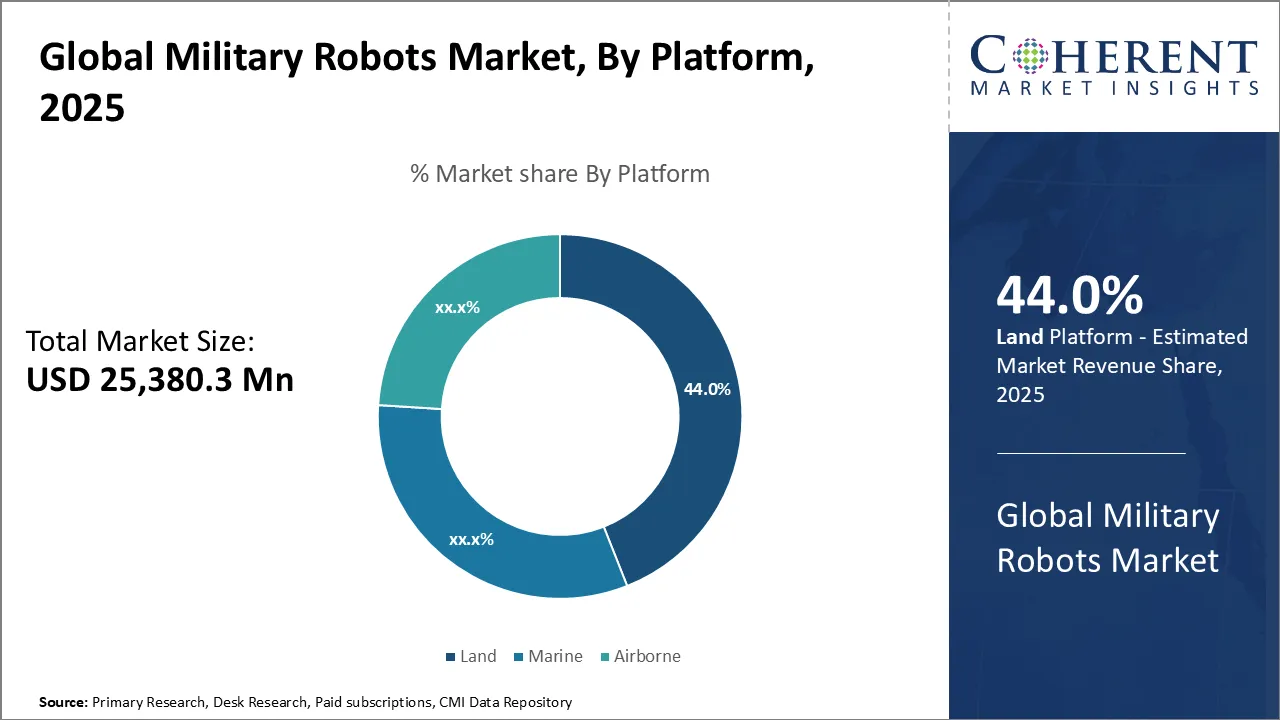
Military Robots Market Insights, By Platform - Land Segment Leads Due to Broad Deployment and Strategic Applications
By platform, the land segment is forecasted to have the largest contribution to the share of the market in 2026. Most armed forces worldwide are increasingly testing and deploying land-based military robots because of their versatility over a wide range of terrains and operational roles. Robots like the Indian Army's Snake Robot, Wheeled Robot with Passive Suspension, Wall-Climbing Robot, Legged Robot, and Robot Sentry show the wide applicability of land systems in reconnaissance, surveillance, and combat support.
These land platforms enable armed forces to execute high-risk missions with minimal human exposure, thereby providing tactical advantages in both urban and battlefield environments. Their ability to adapt to difficult terrain and interface well with human-operated systems or semi-autonomous systems makes them extremely valuable. Advances in AI and robotics continue to improve navigation, obstacle avoidance, and operational autonomy for ground-based systems, driving up adoption rates.
For instance, in February 2025, Adani Defence & Aerospace, in partnership with DRDO, launched a 4×4 vehicle-mounted system designed to detect and neutralize drones (counter-UAS). The system includes radar, jammers, a 7.62 mm gun, and other sensors.
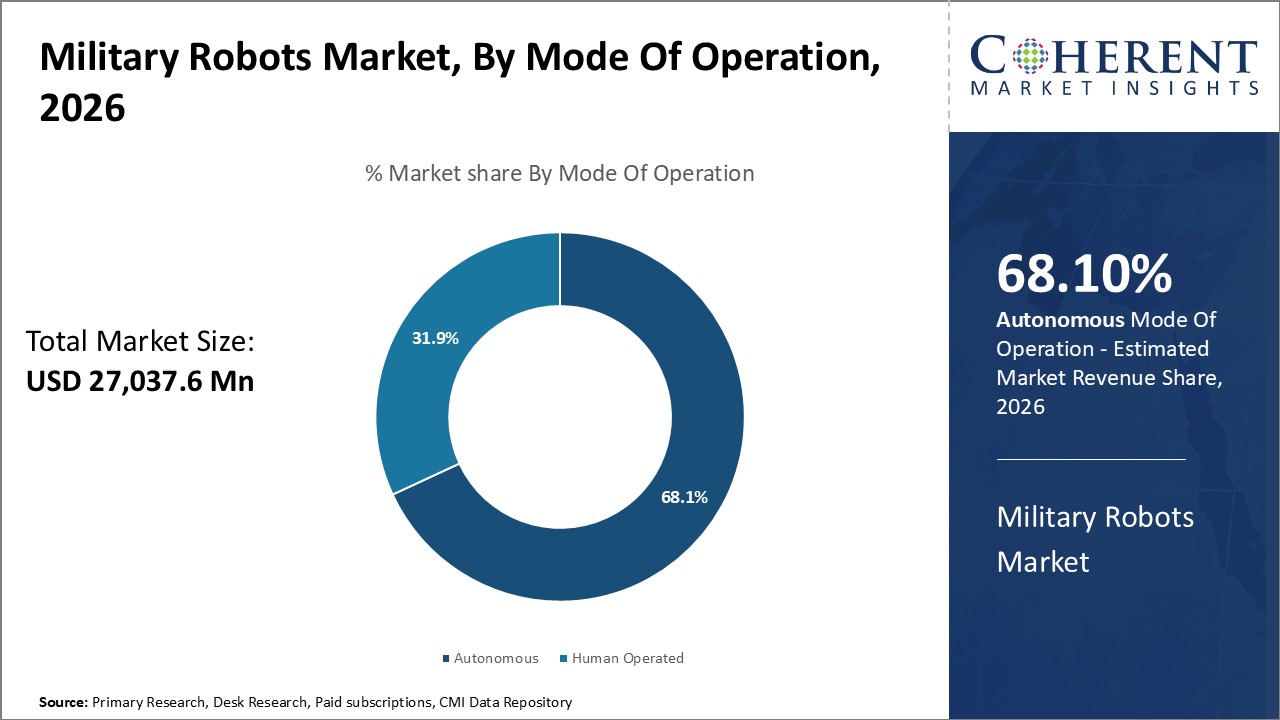
Military Robots Market Insights, By Mode of Operation - Autonomous Segment Poised for Rapid Growth
The autonomous segment is expected to grow significantly because of increased testing and adoption of automated systems from different domains. Autonomous UGVs, UAVs, and USVs are being evaluated for numerous military roles ranging from reconnaissance/surveillance to logistics and combat roles.
Autonomous systems minimize the need for continuous human interference, optimize operational efficacy, and enable high-risk missions to be conducted safely. Countries including the U.S., India, and France are increasingly incorporating autonomous robots driven by AI into their armed forces.
For instance, in July 2025, the U.S. Army demonstrated autonomous quadruped robots capable of following preset paths, carrying equipment, and transmitting real-time battlefield data, highlighting the growing reliance on AI-enabled unmanned systems to supplement human forces.
Regional Insights
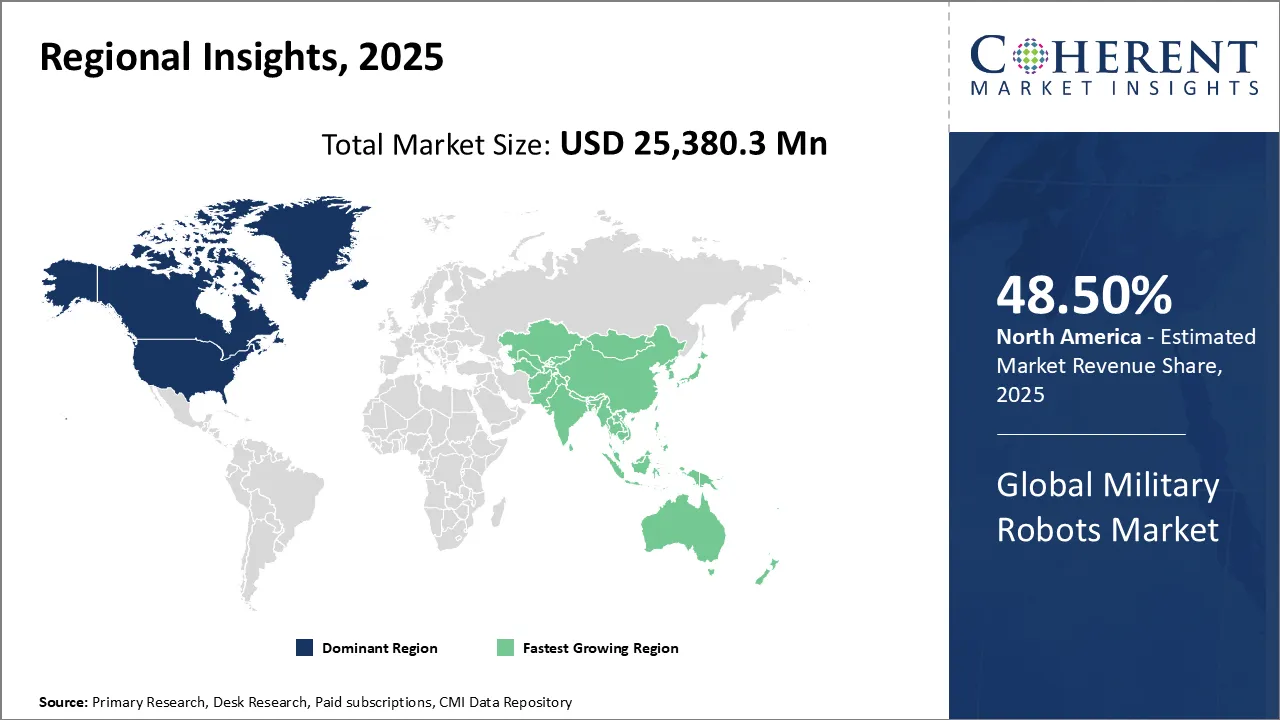
North America Military Robots Market Analysis & Trends
North America, with the largest regional share of 48.50% in the forecast period, is likely to dominate the global military robots market because of growing defense expenditure and technological advancements in unmanned systems. The U.S. is a major contributor because of the growing investments in military modernization and innovation. Strong R&D efforts, capable manufacturing, and supportive government policies have accelerated the development and deployment processes of military robots across land, marine, and airborne platforms.
Furthermore, programs such as the Strategic Aerospace and Defense Initiative and the Technology Demonstration Program are being promoted by the Government of Canada in order to support research and development in robotics and other advanced defense technologies. These initiatives enable North America to continue to hold a leading position in autonomous systems, human-operated robots, and multi-domain platforms, making it one of the main drivers of the global military robots market.
For instance, in March 2026, ARA announced a partnership with Clemson University to develop an advanced diesel-electric drivetrain for an autonomous robot platform for the U.S. Army.
Asia Pacific Military Robots Market Analysis & Trends
During the forecast period, the Asia Pacific is expected to register major growth in the military robots market, as rising defense budgets and modernization programs in China and India continue to drive demand. The region is increasingly focusing on military modernization and the integration of advanced technologies, including robotics.
India has accelerated the procurement of unmanned systems to enhance border security and improve its operational effectiveness. This, in turn, is increasing demand for newer forms of military robotics solutions in autonomous vehicles, UAVs, UGVs, and combat support robots. Economies in this region are constantly building their defense capabilities through indigenous R&D programs or with licensed production in cooperation with technology providers from around the world. These provide very attractive growth opportunities for military robots manufacturers.
For instance, in April 2024,
Military Robots Market Outlook Country-Wise
U.S. Military Robots Market Trends
The United States is making significant strides in the deployment of autonomous ground vehicles to support front-line logistics and sustainment operations. A fully autonomous tactical vehicle being developed by Overland AI and demonstrated during recent U.S. Army exercises drives itself across contested terrain using a multisensor navigation system without continuous human input. This reflects a strategic move by the Army toward using robotics to reduce risk to personnel while keeping supply lines open. Overland's autonomy stack, called OverDrive, is already being adapted for various ground platforms-a point that underlines the flexibility and scalability of these robotic systems.
For instance, in April 2024, Anduril Industries was selected by the U.S. Army and the Defense Innovation Unit to supply the software framework for Robotic Combat Vehicles (RCVs). The framework is designed to support autonomy, payload management, and modularity across RCV variants.
China Military Robots Market Trends
China is advancing its ground robotics capabilities with its so-called “robot wolves”, quadrupedal unmanned systems developed by China South Industries Group (CSGC). Publicly showcased in PLA exercises, often performing tasks that place them directly in support of infantry and sometimes mounted with reconnaissance payloads or light weapons, according to Chinese media, they are intended for everything from transport to strike duties and can form “pack” elements, a feature that would dramatically increase their tactical utility. Mobility includes complex terrain, stair climbing, and the ability to adapt to mission profiles, which suggests that they are indeed being fielded for real operational support.
Market Report Scope
Military Robots Market Report Coverage
| Report Coverage | Details | ||
|---|---|---|---|
| Base Year: | 2025 | Market Size in 2026: | USD 27,037.6 Mn |
| Historical Data for: | 2020 To 2024 | Forecast Period: | 2026 To 2033 |
| Forecast Period 2026 to 2033 CAGR: | 6.5% | 2033 Value Projection: | USD 42,099.0 Mn |
| Geographies covered: |
| ||
| Segments covered: |
| ||
| Companies covered: | Saab AB, Northrop Grumman Corporation, BAE Systems plc., Lockheed Martin Corporation, Thales Group, General Dynamics Corporation, IAI Group, AeroVironment Inc., Elbit Systems Ltd., FLIR Systems Inc., Cobham Ltd., and QinetiQ Group PLC | ||
| Growth Drivers: |
| ||
| Restraints & Challenges: |
| ||
Military Robots Market Drivers
Growing investments in unmanned technologies to augment the market pace
In recent years, the investments in research and development of next-generation robots that can be utilized in various combat and non-combat applications has increased significantly. Several governments are showing deep interest in leveraging the advantages that are offered by robots in the military sector, and they have started investing in autonomous military systems. Even with the strong focus on unmanned aerial vehicles, the investments in developing ground and sea-based robots have also increased in recent times. Thus, these factors are likely to fuel the growth of the global military robots market over the forecast period.
Growing adoption of advanced technology to fuel the market growth
Machine-assisted and unmanned systems are being used for replacing people in various dangerous, mentally taxing, and physically grueling duties. Replacing humans with robots in military missions offers various advantages. Autonomous systems boost the force when used in tandem with the soldiers on the battlefield. These robots also help in reducing casualties as they remove human warfighters from dangerous missions. Due to such advantages, the use of technologies such as Machine Learning and Artificial Intelligence in robotic systems is increasing in military segment, and this factor is likely to drive growth of the global military robots market over the forecast period.
Military Robots Market Opportunities
Increasing Global Conflicts Driving Military Robots Market Growth
Rising geopolitical tensions and conflicts among nations are creating substantial growth opportunities for the global military robots market. Shifts in the international strategic landscape, including unilateral actions, power politics, and hegemonism, are challenging traditional security frameworks and prompting countries to bolster their defense capabilities. As a result, governments across regions are increasing military expenditure to improve national security and operational readiness. This growing demand for advanced defense systems, particularly unmanned and robotic platforms, is expected to significantly propel market growth.
Investments in Unmanned Platforms Fuel Market Expansion
Significant investments in unmanned platforms, including autonomous ground vehicles, aerial drones, and marine robots, are fostering a lucrative environment for military robotics growth. Governments and defense organizations are allocating resources to research and development (R&D) for enhancing operational capabilities, improving autonomy, and integrating advanced AI systems. Continuous innovations in sensor technologies, communication networks, and AI-driven decision-making are driving new product development and adoption.
Analyst Opinion (Expert Opinion)
The military robots market is entering a transformative phase driven by advancements in autonomy, AI integration, and multi-domain operational capability. Increasing geopolitical tensions and the modernization of armed forces are compelling defense organizations to prioritize robotic systems over traditional manned platforms. For instance, the U.S. Army’s adoption of Robotic Combat Vehicles (RCVs) such as the TRX and S‑MET demonstrates a strategic shift toward force multiplication and risk reduction for ground troops, while China’s deployment of quadrupedal “robot wolves” in PLA exercises highlights an emerging trend of leveraging AI-driven unmanned systems for reconnaissance and amphibious operations.
Recent technological innovations, such as AI-enabled navigation and swarm coordination, are no longer experimental but are being operationalized in real-world scenarios. DARPA’s investment in autonomous underwater vehicles and the integration of machine learning into unmanned aerial vehicles illustrate the growing emphasis on adaptive, decision-capable robotic platforms. Moreover, the rapid adoption of these systems in logistics, reconnaissance, and combat support roles is reshaping military doctrines globally.
Ultimately, the competitive edge in the military robotics sector is now tied to speed of innovation, integration of AI autonomy, and the ability to deploy multi-domain systems effectively. Firms and militaries that prioritize iterative development, real-world testing, and interoperability with existing forces are positioned to dominate the evolving battlefield landscape. The future of defense is increasingly robotic, and early movers are likely to define operational superiority for the next decade.
Speak to the analyst
Want personalized insights?
Take the findings above to one of our principal consultants, or have the report rebuilt around the segments, geographies and competitors you actually track.
Military Robots Industry News
- In July 2025, Saab and General Atomics announced a collaboration to build an Unmanned Airborne Early Warning (UAEW) system using the MQ-9B platform, integrating Saab’s AEW sensors for persistent surveillance.
- In September 2025, Lockheed Martin’s Skunk Works and BAE Systems’ FalconWorks announced a strategic collaboration to develop modular, uncrewed autonomous air systems.
- In October 2025, Thales launched OpenDRobotics, a robotics platform that integrates unmanned air and ground vehicles with AI for collaborative combat missions.
Market Segmentation
- Platform Insights (Revenue, USD Mn & KT, 2026 - 2033)
- Land
- Marine
- Airborne
- Mode of Operation Insights (Revenue, USD Mn & KT, 2026 - 2033)
- Human Operated
- Autonomous
- Regional Insights (Revenue, USD Mn & KT, 2026 - 2033)
- North America
- U.S.
- Canada
- Latin America
- Brazil
- Argentina
- Mexico
- Rest of Latin America
- Europe
- Germany
- U.K.
- Spain
- France
- Italy
- Russia
- Rest of Europe
- Asia Pacific
- China
- India
- Japan
- Australia
- South Korea
- ASEAN
- Rest of Asia Pacific
- Middle East & Africa
- GCC Countries
- Israel
- Rest of Middle East & Africa
- North America
- Key Players Insights (Revenue, USD Mn, 2021 - 2033)
- Saab AB
- Northrop Grumman Corporation
- BAE Systems plc.
- Lockheed Martin Corporation
- Thales Group
- General Dynamics Corporation
- AI Group
- AeroVironment Inc.
- Elbit Systems Ltd.
- FLIR Systems Inc.
- Cobham Ltd.
- QinetiQ Group PLC
Sources
Primary Research Interviews from the following stakeholders
Stakeholders
- Interviews with defense procurement officials, R&D heads of military robotics divisions, unmanned systems engineers, defense strategy analysts, and technology integration specialists across major regional markets.
Specific stakeholders
- Defense R&D heads and innovation managers at leading military organizations (e.g., U.S. Army Futures Command, PLA Equipment Development Department, Indian DRDO)
- Program managers and system integration engineers at defense contractors (e.g., Lockheed Martin, Northrop Grumman, Saab AB, BAE Systems, Thales Group)
- Autonomous system architects and robotics engineers at unmanned systems manufacturers (e.g., AeroVironment, Milrem Robotics, Elbit Systems, QinetiQ)
- Defense technology and procurement officers at NATO and allied military commands
- Cybersecurity and AI safety leads for autonomous platforms in government defense organizations
- Operations and testing managers overseeing trials of UGVs, UAVs, USVs, and autonomous combat support systems
- Strategic planners and logistics managers in armed forces integrating unmanned systems into operational doctrines
Databases
- United Nations Comtrade Database
- World Trade Organization (WTO) Trade Statistics
- Stockholm International Peace Research Institute (SIPRI)
- U.S. Department of Defense
- Jane’s Defence Database
- China Defense White Papers
- Indian Ministry of Defence
- European Defence Agency (EDA)
Magazines
- Defense News
- Jane’s Defence Weekly
- Armada International
- Military Technology Magazine
- Unmanned Systems Technology
- Naval Forces
- Aviation Week & Space Technology
- Robotics & Automation News
Journals
- Journal of Field Robotics
- Autonomous Robots (Springer)
- Defence Technology Journal
- IEEE Transactions on Robotics
- International Journal of Advanced Robotic Systems
- Robotics and Autonomous Systems (Elsevier)
- Journal of Defense Modeling and Simulation
Newspapers
- The Wall Street Journal – Defense & Aerospace
- The New York Times – Military & Technology Section
- Defense News
- The Hindu – National Defense & Security
- South China Morning Post – Defense Technology Coverage
- The Times of India – Military Procurement & Defense Updates
- Financial Times – Aerospace & Defense
Associations
- Association for Unmanned Vehicle Systems International (AUVSI)
- International Society of Automation (ISA) – Defense & Robotics Division
- European Defence Agency (EDA) – Robotics & Autonomous Systems Programs
- U.S. Army Robotic Systems Program Office (RSPO)
- NATO Science and Technology Organization – Research & Robotics Panel
- Society of Allied Weight Engineers – Military Systems Division
Public Domain Sources
- U.S. Department of Defense – Annual Reports & Technology Updates
- Ministry of Defence (India) – DRDO Projects and Unmanned Systems Reports
- European Commission – Defence Research & Capability Reports
- United Nations Office for Disarmament Affairs – Global Military Robotics Policy Reports
- Stockholm International Peace Research Institute (SIPRI) – Global Military Spending & Procurement
- Ministry of National Defence (China) – Defense White Papers and Autonomous Systems Announcements
- National Institute of Standards and Technology (NIST) – Robotics & AI Standards for Defense Applications
- U.S. Government Accountability Office (GAO) – Reports on Autonomous Military Systems
Proprietary Elements
- CMI Data Analytics Tool, and Proprietary CMI Existing Repository of information for last 8 years
*Definition: A military robot is a type of robotic machine that is used by the military to perform specific missions. These machines are usually designed to carry out tasks that would be difficult for humans. The robot can do many different things, such as delivering ammunition, carrying injured soldiers, and even firing missiles.
Get access to 250+ pages report
Every segment, forecast, competitor profile and data table behind the analysis above — available for instant download.
- ESOMAR Member
- ISO 9001:2015 Certified
- D-U-N-S Registered
- GDPR & CCPA Compliant
Missing comfort of reading report in your local language? Find your preferred language:
Transform your Strategy with Exclusive Trending Reports
Frequently Asked Questions
The Military Robots Market is estimated to be valued at USD 27,037.6 Mn in 2026, and is expected to reach USD 42,099.0 Mn by 2033.
The CAGR of the Military Robots Market is projected to be 6.5% from 2026 to 2033.
Growing investments in unmanned technologies and growing adoption of advanced technology are fuelling the growth of market.
The Land segment is the leading platform segment in the market.
Saab AB, Northrop Grumman Corporation, BAE Systems plc., Lockheed Martin Corporation, Thales Group, General Dynamics Corporation, IAI Group, AeroVironment Inc., Elbit Systems Ltd., FLIR Systems Inc., Cobham Ltd., and QinetiQ Group PLC
North America is expected to lead the global military robots market.