

Global Spinning Machinery Market and Forecast – 2026-2033
The global spinning machinery market is estimated to be valued at USD 6.71 Bn in 2026 and is expected to reach USD 9.89 Bn by 2033, reflecting a compound annual growth rate (CAGR) of 5.7% from 2026 to 2033.
Key Takeaways of the Spinning Machinery Market
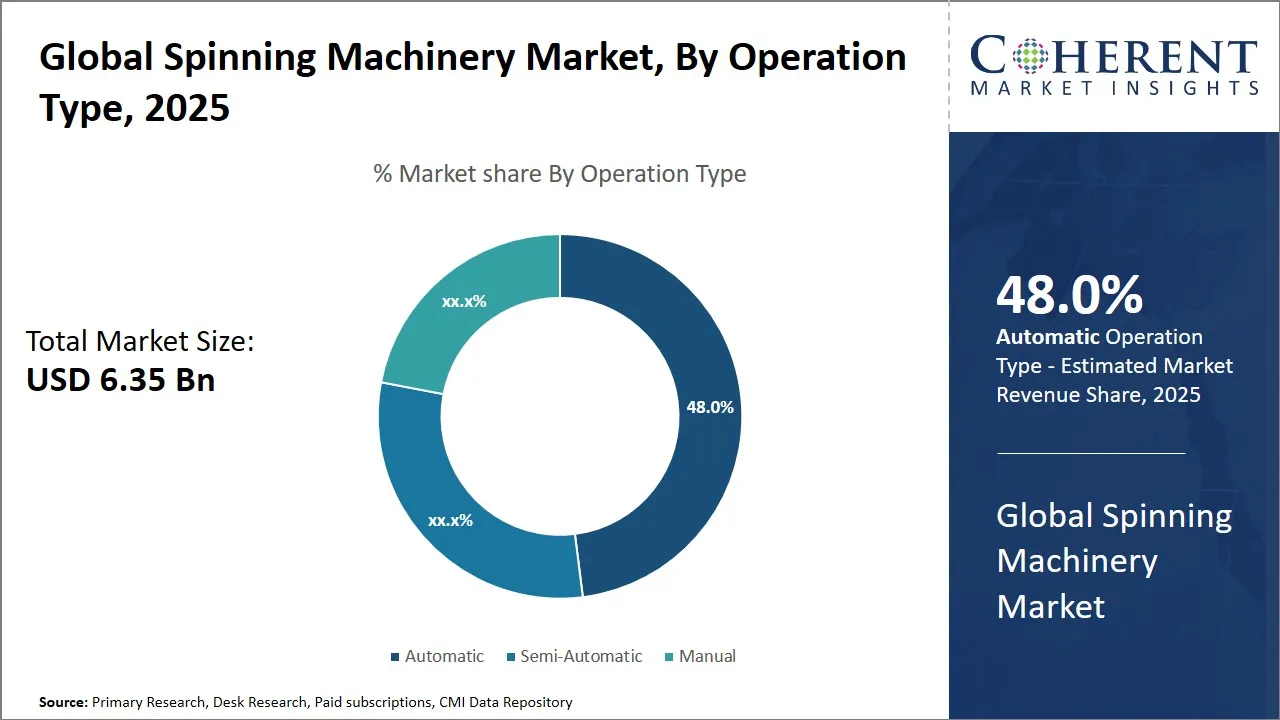
- The automatic segment is expected to account for 49% of the spinning machinery market share in 2026.
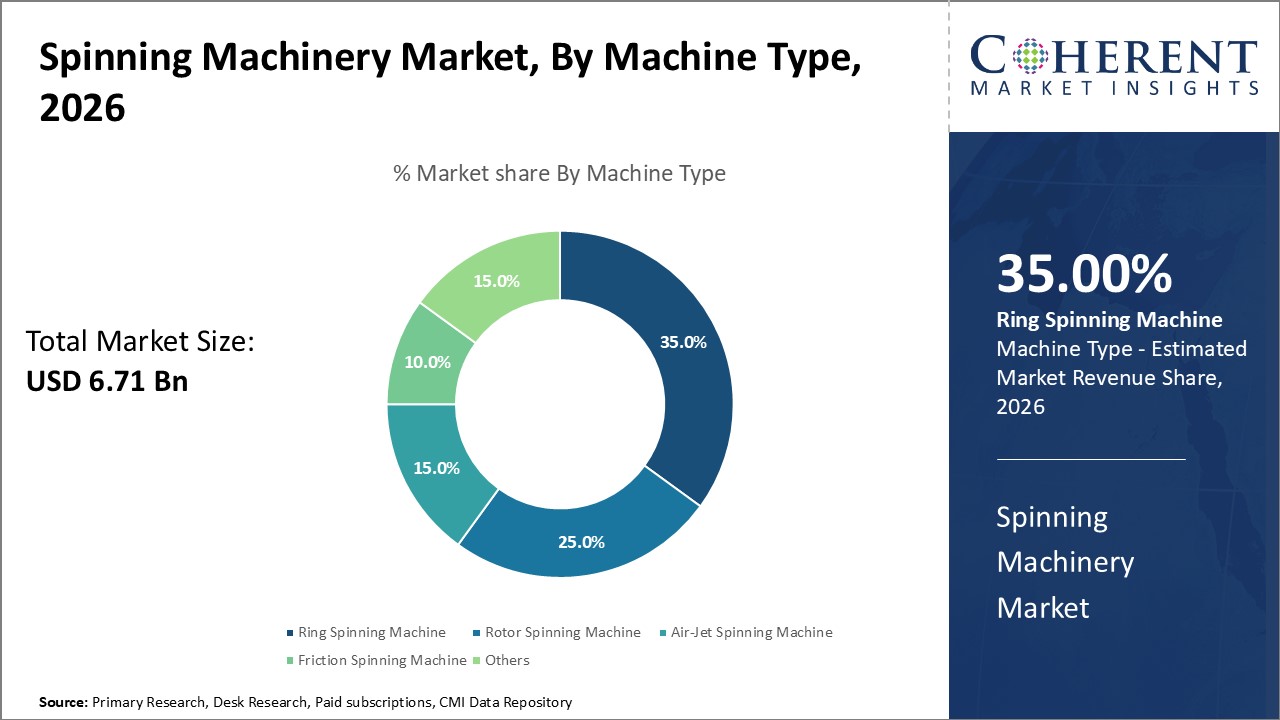
- The ring spinning machine segment is projected to capture 35% of the market share in 2026.
- The natural fibers segment is expected to command 43% share in 2026.
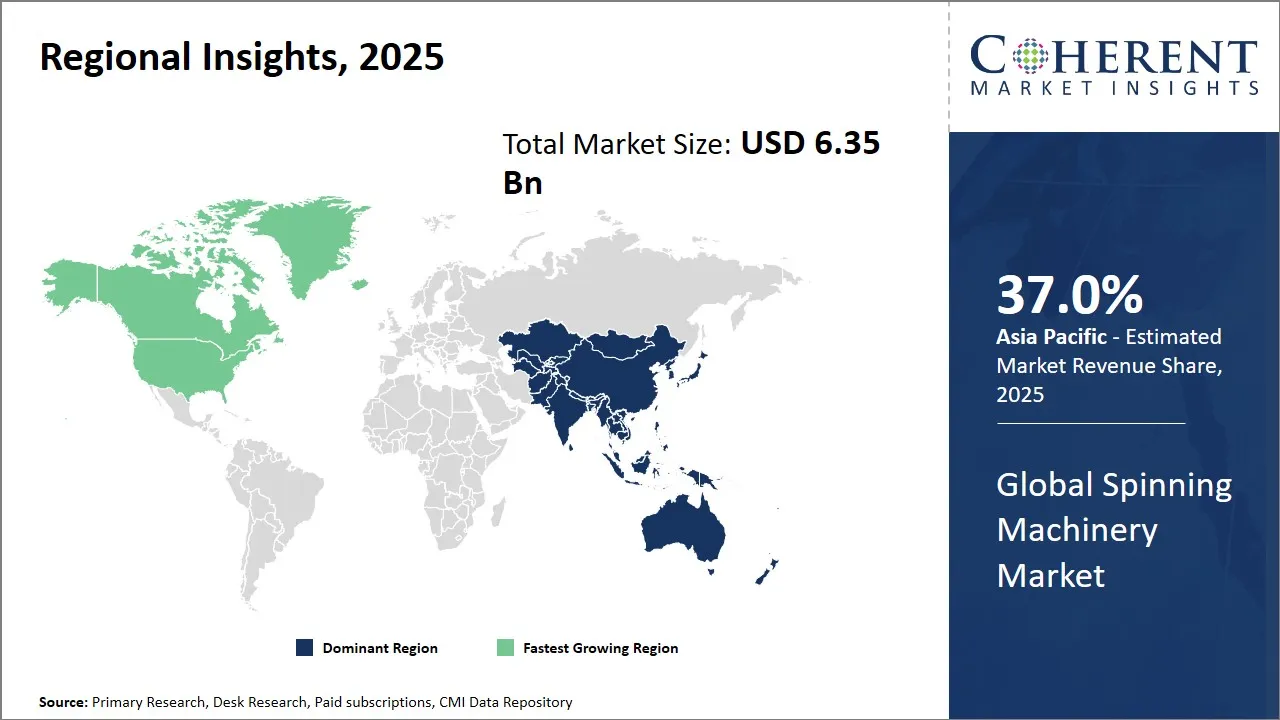
- Asia Pacific will dominate the spinning machinery market in 2026 with an estimated 37% share.
- North America will hold 29% share in 2026 and record the fastest growth.
Current Events and Its Impact
Current Events | Description and its Impact |
Saurer Product Launch |
|
Segmental Insights
- Current Industry Events of 2026
- Market Size Estimation
- Regional Breakdown
- Competitive Landscape
- Customer Intelligence
- Segmental Analysis
- Pricing Analysis
- Key Market Drivers, Challenges & Future Trends
- Customized Insights Section
Why Does the Automatic Segment Dominate the Global Spinning Machinery Market in 2026?
The automatic segment is expected to hold 49.0% of the global spinning machinery market share in 2026. The growth mainly comes from how well it improves daily operations while cutting down on workforce needs. Since automatic machines use advanced tech like digital controls along with live tracking tools, they keep spinning running nonstop without much need for workers. As these systems limit mistakes made by people, they also deliver more uniform yarn which is important for fabric producers who must follow strict quality rules.
Moreover, growing wages in key fabric-making areas are pushing producers toward automated solutions. Because they support flexible output levels, robotic spinners help firms boost efficiency despite limited staff availability. Since these systems operate longer without frequent pauses or close monitoring, overall expenses per item drop noticeably.
Ring Spinning Machine Segment Dominates the Global Spinning Machinery Market
The ring spinning machine segment is expected to hold 35.0% of the global spinning machinery market share in 2026. The rise comes mainly from their ability to make strong, consistent yarns fitting tough needs across many fabric types. Thanks to a method involving constant twist and wrap, the thread gains durability and evenness - ideal not just for clothing but also for industrial fabrics.
One key reason ring spinning machines are widely used lies in how well they adapt to various fibers and yarn thicknesses. Owing to this, producers value their broad compatibility with materials. These systems generate threads fitting many requirements, important for standing out in the modern tailored fabric industry.
Why are Natural Fibers the Most Widespread Material Type in the Spinning Machinery Market?
The natural fibers segment is expected to hold 43.0% of the global spinning machinery market share in 2026. The main use of natural fibers in spinning machines shows a shift toward sustainable choices by buyers and producers. Cotton, wool, or flax stand out because they break down easily, come from renewable sources, yet leave less impact than man-made options.
This trend gains strength from growing interest among eco-aware buyers looking for fabrics derived from nature, seen as better and cozier because they let air pass through while pulling sweat away. Because of this shift in buyer mindset, producers now focus on equipment that handles organic threads well, aiming to keep up with market needs.
Energy Efficiency & Cost per Kg Yarn Produced
Spinning Technology | Energy Consumption (kWh/kg yarn) | Approx. Energy Cost per kg Yarn (based on USD 0.10/kWh) |
Rotor (Open-End) Spinning | 2.44–2.58 | USD 0.24–USD 0.26 |
Ring Spinning (Standard) | 2.5–3.6 | USD 0.25–USD 0.36 |
Ring Spinning (Optimized/Modern) | 1.32–1.36 | USD 0.13–USD 0.14 |
Compact Spinning | 1.21 | USD 0.12 |
Older/Conventional Machines | 3.5+ | USD 0.35+ |
Regional Insights
Asia Pacific Spinning Machinery Market Analysis and Trends
Asia Pacific is projected to lead the market with a 37% share in 2026. The rise comes from a solid base of fabric factories, active support by governments, while big machine builders have set up shop across the area. Nations including China, India, or Pakistan run countless mills and spin plants - pushing need for smarter spinning gear. Rules that back cloth exports, along with cash going into upgrading factory setups, keep this zone ahead.
On top of that, tech-focused firms like Murata Machinery (Japan), Trützschler (in China), plus Lakshmi Machine Works (India) help push new tools forward, handling massive output needs here. Trade patterns tilt toward Asia Pacific since several nations ship stitched clothes worldwide, so they hold tight control over earlier steps like yarn making.
North America Spinning Machinery Market Analysis and Trends
North America is expected to exhibit the fastest growth in the market, contributing 29% share in 2026. The North America spinning machinery scene sees consistent interest owing to a strong textile sector and a growing push toward automated, efficient processes. This market covers equipment that turns both natural and man-made fibers into yarn like ring, rotor, and air-jet systems, with use across clothing, household fabrics, specialty materials and industrial goods.
Firms in the U.S., Canada, and Mexico are putting more money into smarter spinning tech to boost output, rely less on workers, get better yarn results, while hitting eco targets using tools that save power and cut waste. With high-tech textile makers already here, along with companies bringing production back home and needing tougher supply networks, businesses prefer updating old machines instead of building entirely new plants.
Global Spinning Machinery Market Outlook for Key Countries
Why is China Emerging as a Major Hub in the Spinning Machinery Market?
China stays ahead because of its huge textile sector and strong push from leaders to modernize factories. Firms such as Jiangsu Sunshine Group team up with international partners, building smart spinning systems using robotics along with internet-connected tools. As a top production center, China keeps needing advanced machines that cut down on worker numbers while boosting product standards. A well-built network of suppliers plus key export deals help drive machine innovation forward.
India Spinning Machinery Market Analysis and Trends
India has lots of spinning mills, plus it needs newer machines to swap out old ones. The government backs this shift - programs like TUFS give mills reasons to buy smarter tech and boost output. Big local players such as LMW work next to global names like Rieter or Trützschler, bringing fresh options from compact systems to open-end setups. With plenty of trained workers and rising fabric sales abroad, the need stays strong and tight.
Germany Spinning Machinery Market Analysis and Trends
Germany still tops Europe’s market share thanks to its deep roots in industry and top-tier machine-making skills. With big names such as Groz-Beckert and Saurer based there, it's a go-to spot for advanced spinning tech that values durability, smart automation, while running green. Its solid research networks combined with state backing for digital upgrades in fabric production help local builders stay ahead in new machine design. Because Germany ships out so much equipment, its reach stretches far beyond borders.
Is Brazil the Next Growth Engine for the Spinning Machinery Market?
The market in Brazil shows steady change, fueled by fresh spending on equipment tied to stronger clothing and fabric sectors. Local needs spark curiosity in compact spinners - machines that work well with mixed fibers, either organic or man-made. Firms such as Sant Fabricacoes, along with regional arms of global players, focus on gear built around how Brazilians actually make textiles. Pushes from officials to improve transport networks plus closer business links across borders help boost output for nearby markets - and keep homes supplied too.
Turkey Spinning Machinery Market Analysis and Trends
Turkey sits right between Europe and Asia Pacific, giving it an edge in textiles which helps boost both making clothes and selling them abroad. To keep things up to date, local authorities offer support like tax breaks and better roads, which pushes new spinning tech into factories. Big names like Rieter or Murata do not just sell gear but they team up locally and run solid service setups to meet rising needs. Being tightly linked with worldwide clothing supply routes fuels steady growth in Turkey's machine market.
Market Players, Key Development, and Competitive Intelligence
Key Developments
- In May 2025, Rieter announced that it acquired Barmag from OC Oerlikon for substantial equity purchase value of USD 890 Million, aiming to become leading player in natural and manmade fibers.
- In June 2025, Mr. Akio Toyoda offered a USD 33 billion bid which will convert Toyota Industries into private sector, aiming to restructure Toyota's business aiming corporate reshaping movement.
Top Strategies Followed by Global Spinning Machinery Market Players
Player Type | Strategic Focus | Example |
Established Market Leaders | Product Showcase | In September 2025, Rieter announced it has put together a powerful portfolio for ITMA ASIA and CITME 2025 that gives spinning mills the chance to actively shape the future through intelligent automation. |
Mid-Level Players | Business Collaboration | In August 2025, Jiangsu Xinmanrun New Materials Technology Co., Ltd. and Saurer Group announced an official partnership for a comprehensive 150,000-spindle spinning project. |
Small-Scale Players | Business Collaboration | In May 2025, Alok Industries Limited, a leading name in India’s textile sector and backed by Reliance Industries Ltd., entered into a strategic agreement with Rieter India Private Limited for the supply and installation of a complete compact spinning system. |
Market Report Scope
Spinning Machinery Market Report Coverage
| Report Coverage | Details | ||
|---|---|---|---|
| Base Year: | 2025 | Market Size in 2026: | USD 6.71 Bn |
| Historical Data for: | 2020 To 2024 | Forecast Period: | 2026 To 2033 |
| Forecast Period 2026 to 2033 CAGR: | 5.7% | 2033 Value Projection: | USD 9.89 Bn |
| Geographies covered: |
| ||
| Segments covered: |
| ||
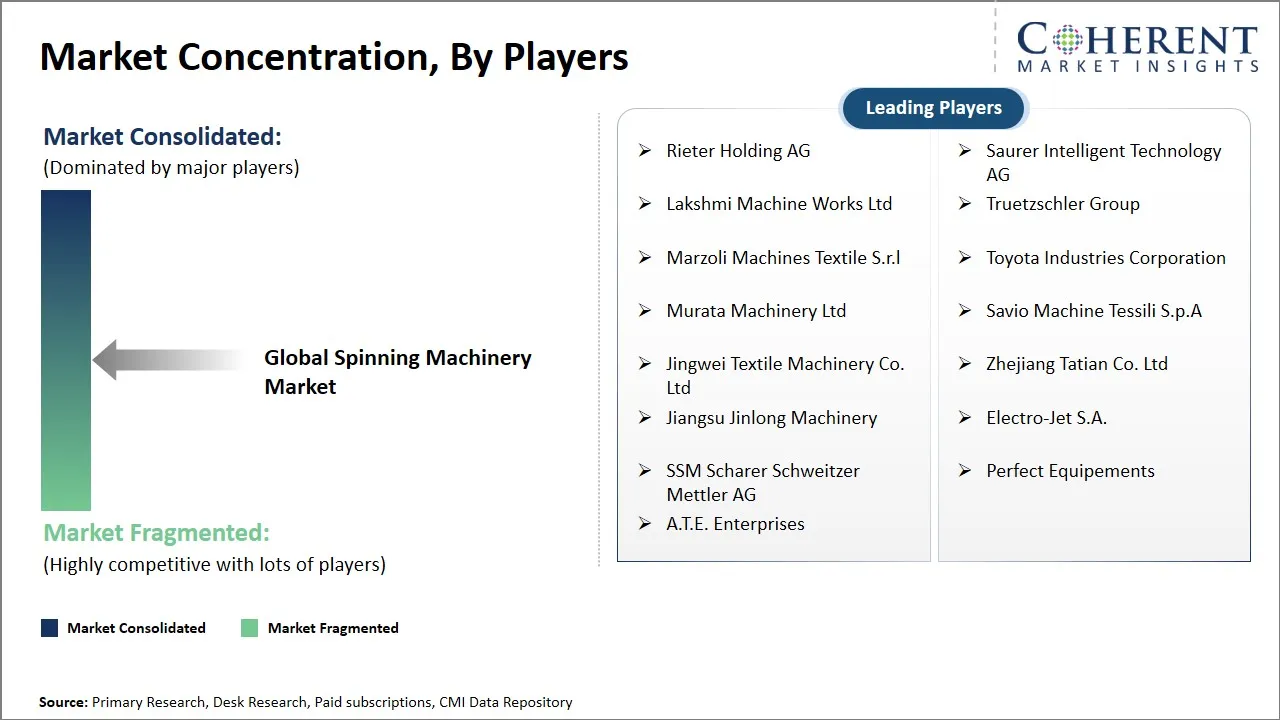
| Companies covered: | Rieter Holding AG, Saurer Intelligent Technology AG, Lakshmi Machine Works Ltd, Truetzschler Group, Marzoli Machines Textile S.r.l, Toyota Industries Corporation, Murata Machinery Ltd, Savio Machine Tessili S.p.A, Jingwei Textile Machinery Co. Ltd, Zhejiang Tatian Co. Ltd, Jiangsu Jinlong Machinery, Electro-Jet S.A., SSM Scharer Schweitzer Mettler AG, Perfect Equipements, and A.T.E. Enterprises | ||
| Growth Drivers: |
| ||
| Restraints & Challenges: |
| ||
Global Spinning Machinery Market Dynamics
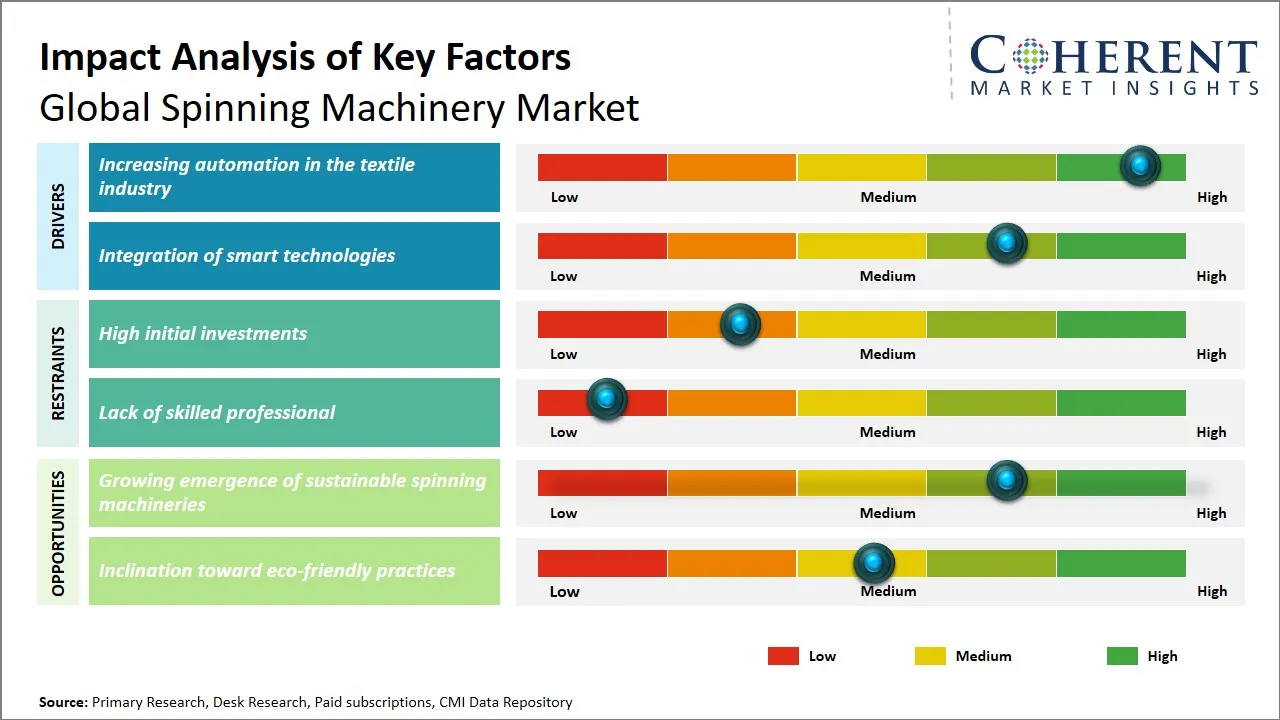
Global Spinning Machinery Market Driver - Increasing Automation in the Textile Industry
The rise in using automation across textile and apparel manufacturing is pushing up need for high-tech spinning gear. Because machines handle more tasks, companies save on worker expenses while keeping output steady and smooth. Instead of relying on people, automated setups fine-tune how yarn gets spun, cutting mistakes along the way. These systems run faster than traditional ones, use materials smarter, helping meet stronger worldwide fabric needs.
In addition, factories going digital tend to buy equipment loaded with sensors, live tracking, and tools that make sense of performance data. This blend simplifies tasks while supporting smart upkeep, cutting delays plus expenses. Since fabric makers aim to boost logistics and eco practices, auto systems in yarn production become vital in pushing worldwide machine demand ahead.
Global Spinning Machinery Market Opportunity - Inclination Toward Eco-Friendly Practices
The global spinning machinery market is seeing a real shift owing to more interest in green technology and sustainability. As shoppers, regulators, and green groups want less pollution, factories now push harder to upgrade gear with cleaner options. Machines built for sustainability aim to save power, cut scraps, or run on natural inputs which slashes expenses while supporting reuse-focused production cycles.
Moreover, smarter controls, efficient motors, or plant-based oils are changing old-school spin units, boosting output without hurting nature. Firms focusing R&D cash here stand to gain as environmentally aware mills look to buy new tools, especially where local rules back greener factory habits. This shift is getting faster as more buyers care about eco-friendly fabrics and this trend is showing up everywhere, from established regions to emerging ones. So, when makers build green features into their machines, they are not just helping the planet, they are staying ahead by matching what shoppers want while fitting into worldwide green goals, opening big opportunities in the market.
Analyst Opinion (Expert Opinion)
- The global spinning machinery market shows steady gains owing to expanding textile industries and constant tech upgrades. Growth is expected to keep moving up at a rate between moderate and strong each year. Growth is fueled not just by demand for better yarn but also through automated setups where IoT blends with AI, pushing factories into the Industry 4.0 era. Even though Asia Pacific leads as the main center powered by massive production networks, signs point to smarter, greener machines spreading fast across Europe and North America, showing how more regions are leaning on clean-energy workflows and connected plant designs.
- High startup expenses, unpredictable material prices, or a constant shortage of trained workers still hold back growth, especially for smaller firms. Even though modern machines improve output and consistency, high costs yet tricky upkeep make them tough to adopt in emerging textile regions. Still, the future looks good because new tech keeps opening doors for automated systems, early problem detection, or eco-friendly yarn production fitting both performance goals and green targets.
Speak to the analyst
Want personalized insights?
Take the findings above to one of our principal consultants, or have the report rebuilt around the segments, geographies and competitors you actually track.
Market Segmentation
- Operation Type Insights (Revenue, USD Billion, 2021 - 2033)
- Automatic
- Semi-Automatic
- Manual
- Machine Type Insights (Revenue, USD Billion, 2021 - 2033)
- Ring Spinning Machine
- Rotor Spinning Machine
- Air-Jet Spinning Machine
- Friction Spinning Machine
- Others
- Material Type Insights (Revenue, USD Billion, 2021 - 2033)
- Natural Fibers
- Synthetic Fibers
- Blended Fibers
- Spinning Process Insights (Revenue, USD Billion, 2021 - 2033)
- Short Staple Spinning
- Long Staple Spinning
- End User Insights (Revenue, USD Billion, 2021 - 2033)
- Apparel and Fashion
- Home Textiles
- Industrial Textiles
- Medical Textiles
- Automotive Textiles
- Others
- Regional Insights (Revenue, USD Billion, 2021 - 2033)
- North America
- U.S.
- Canada
- Latin America
- Brazil
- Argentina
- Mexico
- Rest of Latin America
- Europe
- Germany
- U.K.
- Spain
- France
- Italy
- Russia
- Rest of Europe
- Asia Pacific
- China
- India
- Japan
- Australia
- South Korea
- ASEAN
- Rest of Asia Pacific
- Middle East
- GCC Countries
- Israel
- Rest of Middle East
- Africa
- South Africa
- North Africa
- Central Africa
- North America
- Key Players Insights
- Rieter Holding AG
- Saurer Intelligent Technology AG
- Lakshmi Machine Works Ltd
- Truetzschler Group
- Marzoli Machines Textile S.r.l
- Toyota Industries Corporation
- Murata Machinery Ltd
- Savio Machine Tessili S.p.A
- Jingwei Textile Machinery Co. Ltd
- Zhejiang Tatian Co. Ltd
- Jiangsu Jinlong Machinery
- Electro-Jet S.A.
- SSM Scharer Schweitzer Mettler AG
- Perfect Equipements
- T.E. Enterprises
Sources
Primary Research Interviews
- Spinning machinery manufacturers and suppliers
- Textile industry executives and production managers
- Equipment distributors and dealers
- Technology providers and automation specialists
Databases
- BIS World Textile Manufacturing Database
- Global Trade Atlas
- UN Comtrade Database
Magazines
- Textile World Magazine
- International Textile Magazine
- Textile Industries Magazine
- Knitting Industry Magazine
- Textile Technology Magazine
Journals
- Journal of Textile Engineering
- Textile Research Journal
- International Journal of Textile Science
Newspapers
- Fibre2Fashion News
- Textile Today
- Just Style Industry News
- Textile World News
- Asian Textile Journal
Associations
- International Textile Manufacturers Federation (ITMF)
- Textile Machinery Association of India (TMAI)
- European Committee of Textile Machinery Manufacturers (CEMATEX)
- China Textile Machinery Association (CTMA)
- American Textile Machinery Association (ATMA)
Public Domain Sources
- World Trade Organization (WTO) trade statistics
- Ministry of Textiles government reports
- European Union textile industry publications
- OECD industrial production data
- National textile industry statistical yearbooks
Proprietary Elements
- CMI Data Analytics Tool
- Proprietary CMI Existing Repository of information for last 8 years
Get access to 250+ pages report
Every segment, forecast, competitor profile and data table behind the analysis above — available for instant download.
- ESOMAR Member
- ISO 9001:2015 Certified
- D-U-N-S Registered
- GDPR & CCPA Compliant
Missing comfort of reading report in your local language? Find your preferred language:
Transform your Strategy with Exclusive Trending Reports
Frequently Asked Questions
The global spinning machinery market is estimated to be valued at USD 6.71 Bn in 2026 and is expected to reach USD 9.89 Bn by 2033.
The CAGR of global spinning machinery market is projected to be 5.7% from 2026 to 2033.
Increasing automation in the textile industry and integration of smart technologies are the major factors driving the growth of the global spinning machinery market.
High initial investments and lack of skilled professional are the major factors hampering the growth of the global spinning machinery market.
In terms of operation type, the automatic segment is estimated to dominate the market revenue share in 2026.
Manufacturers are increasingly adopting energy-efficient and low-waste spinning machines to meet environmental regulations and sustainability goals.
Digitalization enables real-time monitoring, predictive maintenance, and improved productivity through Industry 4.0-enabled systems.