

Global Surimi Market Size and Forecast – 2026-2033
According to Coherent Market Insights, the Global Surimi Market is estimated to be valued at USD 5.45 Bn in 2026 and is expected to reach USD 8.64 Bn by 2033, exhibiting a compound annual growth rate (CAGR) of 6.8% from 2026 to 2033.
Key Takeaways of the Surimi Market
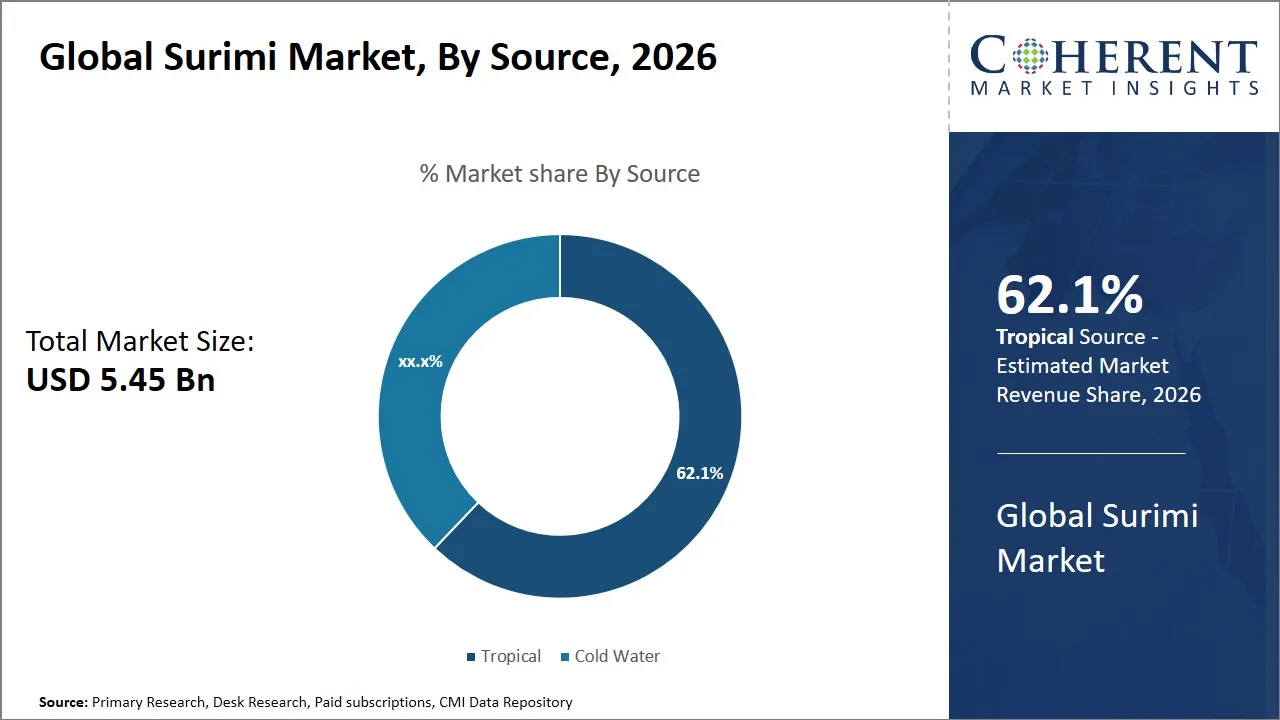
- The tropical segment is projected to hold 62.1 % of the global surimi market in 2026, driven by favorable climate and abundant raw fish availability.
- The frozen segment is expected to account for 56.8 % of the surimi market in 2026.
- The B2B segment is projected to capture 65.8 % of the surimi market in 2026, driven by high institutional demand and bulk procurement practices.
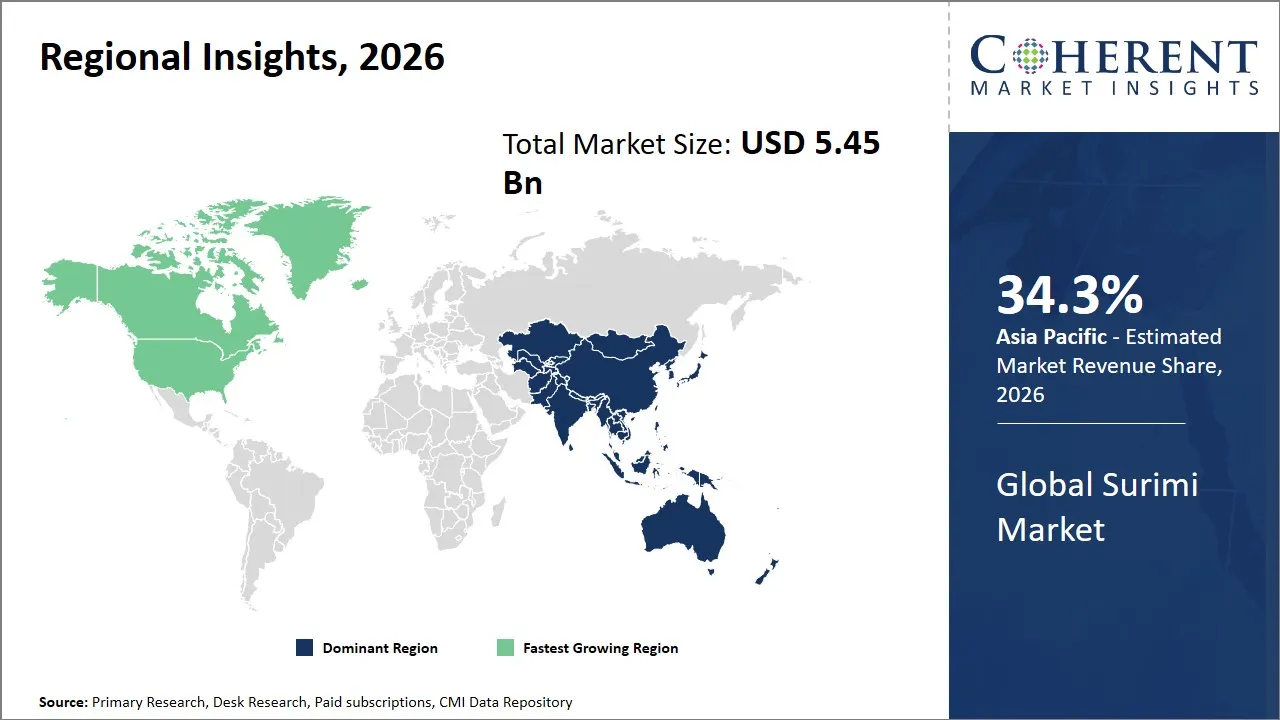
- The Asia Pacific region is expected to lead the market with a 34.3 % share in 2026, fueled by its strong seafood consumption, established aquaculture industries, and robust manufacturing capabilities.
- The North America region is projected to grow the fastest, capturing 19.3 % share of the market in 2026, driven by rising consumer demand for healthy, protein-rich, and convenient seafood options.
Market Overview
- The current seafood market trends show increasing demand for sustainable and eco-friendly sustainable seafood sourcing which drives growth in the surimi market.
- The rising demand for convenient food products together with new flavor developments drives greater acceptance among customers. The growing recognition of surimi as a healthy food option because of its high protein content and low-fat content has led to more people trying it.
- The market experiences substantial growth because emerging economies show both increased disposable income and urbanization trends which drive market growth.
Current Events and Its Impact
Current Events | Description and its impact |
Rising Retail & Product Expansion (e.g., Surimi launches in major retail chains) |
|
Growth in Aquatic Exports from Key Asian Suppliers |
|
Segmental Insights
- Current Industry Events of 2026
- Market Size Estimation
- Regional Breakdown
- Competitive Landscape
- Customer Intelligence
- Segmental Analysis
- Pricing Analysis
- Key Market Drivers, Challenges & Future Trends
- Customized Insights Section
Why Does the Tropical Segment Dominate the Surimi Market in 2026?
The tropical segment is expected to hold 62.1% share of the global surimi market in 2026, mainly because of the favorable climatic condition, and huge production of raw fish materials in the tropical regions. The tropical waters have been found to be the breeding grounds of a number of fish species that are highly fit to produce surimi. These include a range of mackerel and threadfin among others that provide favorable texture and taste that are quite fitting to consumer demand for quality seafood products.
The sustainable fishing activities that have been practiced universally within the tropical areas with the help of the advantageous rules and the fishery management programs managed by people have allowed provision of consistent and dependable supply of fish raw materials to the manufacturers of surimi. This consistency promotes investment in processing facilities and technological advancements that subsequently increase the efficiency of surimi production in such regions.
Why is Frozen Surimi the Preferred Choice for Extended Shelf Life and Supply Chain Efficiency?
The frozen segment is projected to hold 56.8% share of the surimi market in 2026. Frozen surimi guarantees that the texture, taste, and nutrients in products are preserved during the long duration of storage, which allows manufacturers and distributors to maintain a consistent quality of products during the production phases to the consumption phases.
The long shelf life of frozen surimi is especially helpful in fulfilling the needs of the global supply chains, under which surimi products sometimes pass through lengthy transportation times before they reach the remote market. Freezing serves as an important food preservation method, which would reduce food waste, minimize spoilage and enable greater flexibility in inventory management on the part of retailers and foodservice providers.
For example, Gadré Surimi Crab Sticks produced by Gadre Marine (Meena Brand Surimi), one of the leading global surimi manufacturers. Gadre Marine’s portfolio includes frozen surimi blocks and value‑added processed seafood products that leverage frozen surimi as the base ingredient.
B2B Segment Dominates the Surimi Market
The B2B segment is projected to capture 65.8% share of the surimi market in 2026, which will be motivated by the good institutional demand and bulk purchasing habits that are evident in the segment. B2B implies selling to food processors, wholesalers, large-scale caterers, and commercial kitchens which demand large quantities of surimi as a raw or semi-finished ingredient.
One of the biggest drivers of the B2B channel’s success is the continued growth of the world foodservice industry, fast-food chains, ready-to-eat meal producers and hotels that are looking for new menu impetus and economical sources of protein that contain surimi. These organizations appreciate stable quality, dependable supply, and price benefits which are usually negotiated in bulk contracts and hence the B2B channel is the most effective channel of delivering such requirements.
Regional Insights
Asia Pacific Surimi Market Analysis and Trends
The Asia Pacific region is projected to lead the market with a 34.3% share in 2026, due to the fact that the regions have a strong culture of consuming seafood, well-established aquaculture industry with massive manufacturing capabilities. Japan, China, South Korea and Thailand are some of the countries with well-developed supply chains of large-scale processing and export of surimi products.
The market has been strengthened by government programs encouraging export and investment in cold chain facilities in seafood. Rivals such as Nippon Suisan Kaisha Ltd. (Japan), Pacific Seafood Group (China) and CJ CheilJedang (South Korea) are the dominant manufacturers of surimi in the market and as such, their dominance in innovation, improvement of quality and product diversification in the market is clearly evident.
North America Surimi Market Analysis and Trends
The North America region is expected to exhibit the fastest growth in the market contributing 19.3% share in 2026, due to increasing consumer demand for healthy, protein-rich, and convenient seafood options. The increasing awareness of the nutritional value and diversity of surimi-based products has triggered the growth of the market in the U.S. and Canada.
Favorable regulatory regimes on the imports of seafood together with trade agreements on the free flow of seafood across the borders have facilitated this expansion. The major competitors like Trident Seafoods, Aqua Star (part of Maruha Nichiro Corporation) and Bumble Bee Seafoods have taken very active strides into the surimi market, enhancing the availability of the products both by retail and foodservice outlets.
Global Surimi Market Outlook for Key Countries
Why is Japan a Leading Player in the Surimi Market?
The Japan Surimi market is still a pillar in the surimi industry with its pre-historic culinary custom of using surimi-based foods such as kamaboko and chikuwa. Nippon Suisan Kaisha Ltd. and Maruha Nichiro Corporation are some of the Japanese companies which have helped in product innovation and sustainability programs, to find the best varieties of fish and fine tuning the technological processing. The policies that promote the fishing industry and the export of seafoods still offer a strong platform on which the industry can operate.
U.S. Surimi Market Trends
The surimi market in the U.S. indicates the increasing consumer trends as to healthy foods and convenience, which provoke the surimi product demand in ready-to-eat foods, in snacks, and in seafood blends. Large players like the Trident Seafoods and Ocean Beauty Seafoods have used the technology of advanced processing and the extended distribution channels to reach a wide range of consumer segments. Besides, high retail ties and distribution in foodservice stores have increased surimi’s penetration in the market nationwide.
Why is China a Dominant Force in the Surimi Market?
The geographical location as a major producer and consumer of surimi products is advantageous to China’s position since it enjoys large supply of raw materials and increasing consumption of seafood in the country. Local industries such as Fujian Xinya Foodstuff Group and Aquatic products enterprises have increased the scale of production and adopted the international standards to enhance the quality expectations. The surimi market’s growth both within the country and internationally has also been further boosted by government activities aimed at encouraging modernization of the aquaculture sector and export-oriented policies.
South Korea Surimi Market Trends
South Korea is at the forefront in the production of innovative surimi products that meet the local flavor, which is facilitated by an effective food processing industry and well-established fisheries industry. Companies like CJ CheilJedang and Daesang contribute greatly to the increase of productivity and range of products. The fact that the governments are concerned with support to the fisheries and food technology sector creates a favorable ecosystem that will sustain the growth of the surimi market.
Canada Surimi Market Trends
The growth of the Canada surimi market is also connected with the growing popularity of seafood alternatives among consumers and sustainable sourcing activities. The major players in the industry such as Ocean Choice International and J and J Seafood have focused on traceability and environment-friendly packaging to appeal to health-conscious consumers. The Canadian surimi industry is given further impetus by trade policies that help in exporting seafood to the international markets and investments in cold chain facilities.
Raw Material Dependency & Species Economics
Raw Material | Species | Economics (Cost Trends) | Sustainability Concerns | Supply Stability |
Alaska Pollock | Gadus chalcogrammus | Stable, fluctuates based on quotas | Overfishing concerns; Sustainable fishing initiatives in place | Moderate; affected by quotas |
Atlantic Herring | Clupea harengus | Cost varies by demand and fishing regulations | Overfishing, low sustainability | Low stability; High seasonal variability |
Red Snapper | Lutjanus campechanus | Higher cost due to fishing zones, sustainable quotas being enforced | Sustainability improvements underway | Low; Highly regulated catch limits |
Market Players, Key Development, and Competitive Intelligence
Key Developments
- In September 2024, Viciunai Group launched a new surimi product, "Big Stick," into the U.K. retail market, now available in Asda and ALDI stores. The 60g surimi sticks, initially sold at ALDI's "Food To Go" stands, cater to the growing demand for convenient snacks in English-speaking countries. This innovative product is designed for quick lunches, joining other grab-and-go items like sandwiches and salads. Viciunai's market expertise enabled the creation of this tailored product to meet evolving consumer needs.
- In June 2024, Japan’s Suzuhiro Kamaboko launched a premium surimi powder targeting upscale Asian restaurants. The product achieves a gel strength of 600-800 by simply adding water and stirring for one to two minutes. This innovation offers a high-quality, convenient alternative to traditional surimi. Suzuhiro aims to enhance texture and efficiency in premium seafood dishes.
- In March 2024, Aquamar Inc. unveiled new heat-and-eat shellfish innovations at Seafood Expo North America 2024, including offerings inspired by traditional Italian and Spanish dishes. These easy-to-prepare, refrigerated products, like Steamed Mussels with Tomato and Garlic, expand Aquamar’s portfolio of surimi and seafood solutions. Attendees can preview these innovations at Aquamar's booth and sample them at the Wave Makers' Zone on March 2024.
- In March 2024, Japan's Maruha Nichiro, the prominent global seafood company, announced acquisition of a 10% stake in Kibun Foods, a surimi producer, with investment USD 20.72 Mn. This acquisition aims to foster joint development of new surimi-based products. The strategic move reflects Maruha Nichiro's focus on expanding its seafood portfolio. Kibun Foods is known for its expertise in surimi production, enhancing the partnership.
Top Strategies Followed by Global Surimi Market Players
Player Type | Strategic Focus | Example |
Established Market Leaders | Heavy investment in R&D and innovation | For example, Thai Union Group has invented innovations in ready-to-eat and sustainable surimi products, as to respond to the need of customers to buy and eat conveniently and responsibly. |
Mid-Level Players | Balance cost and sustainability | For example, Stavis Seafood focuses on North American customers by selling high-quality surimi at a reasonable price with many cases of using strategic supply chain partnerships to simplify production. |
Small-Scale Players | Niche specialization & innovative variants | For instance, Uni-President has entered into the niche market of organic surimi, allergens-free and organic-certified products to meet the rising consumer demand for healthy and clean-label foods. |
Market Report Scope
Surimi Market Report Coverage
| Report Coverage | Details | ||
|---|---|---|---|
| Base Year: | 2025 | Market Size in 2026: | USD 5.45 Bn |
| Historical Data for: | 2020 To 2024 | Forecast Period: | 2026 To 2033 |
| Forecast Period 2026 to 2033 CAGR: | 6.8% | 2033 Value Projection: | USD 8.64 Bn |
| Geographies covered: |
| ||
| Segments covered: |
| ||
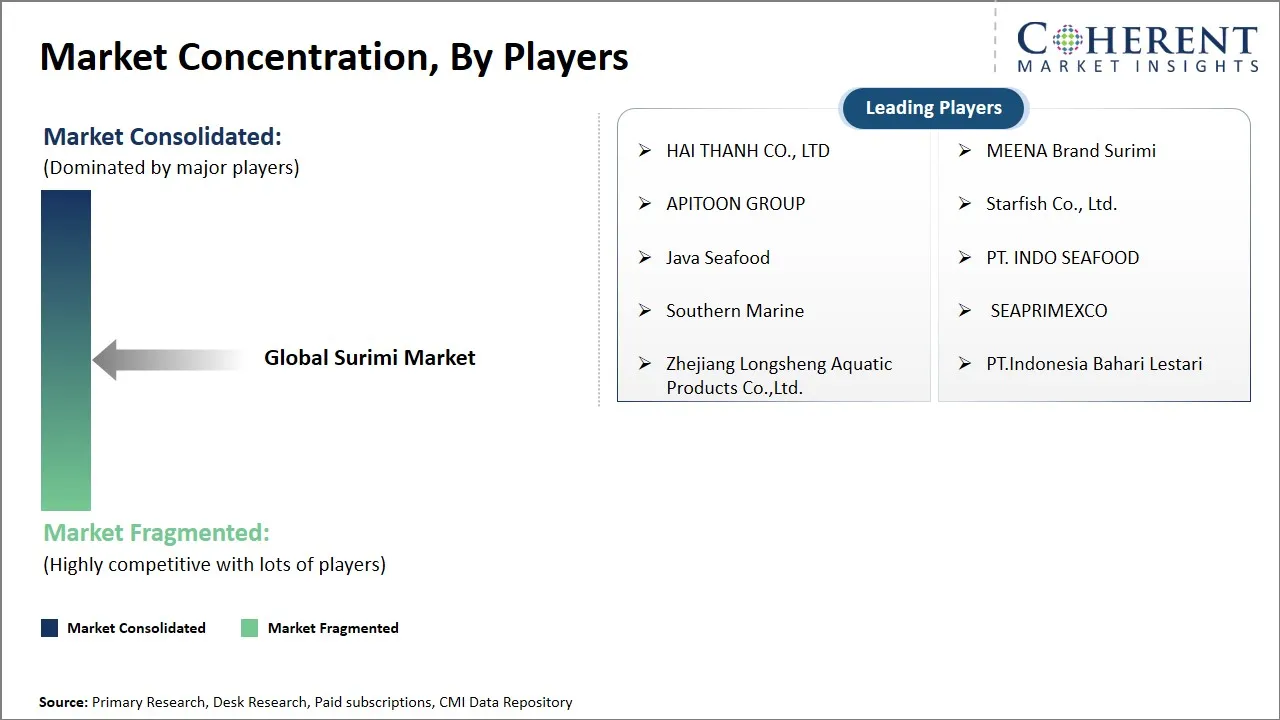
| Companies covered: | HAI THANH CO., LTD, MEENA Brand Surimi, APITOON GROUP, Starfish Co., Ltd., Java Seafood, PT. INDO SEAFOOD, Southern Marine, SEAPRIMEXCO, Zhejiang Longsheng Aquatic Products Co.,Ltd., and PT.Indonesia Bahari Lestari | ||
| Growth Drivers: |
| ||
| Restraints & Challenges: |
| ||
Surimi Market Dynamics
Surimi Market Driver - Increasing Consumer Demand for Seafood Products and Healthy Protein Sources
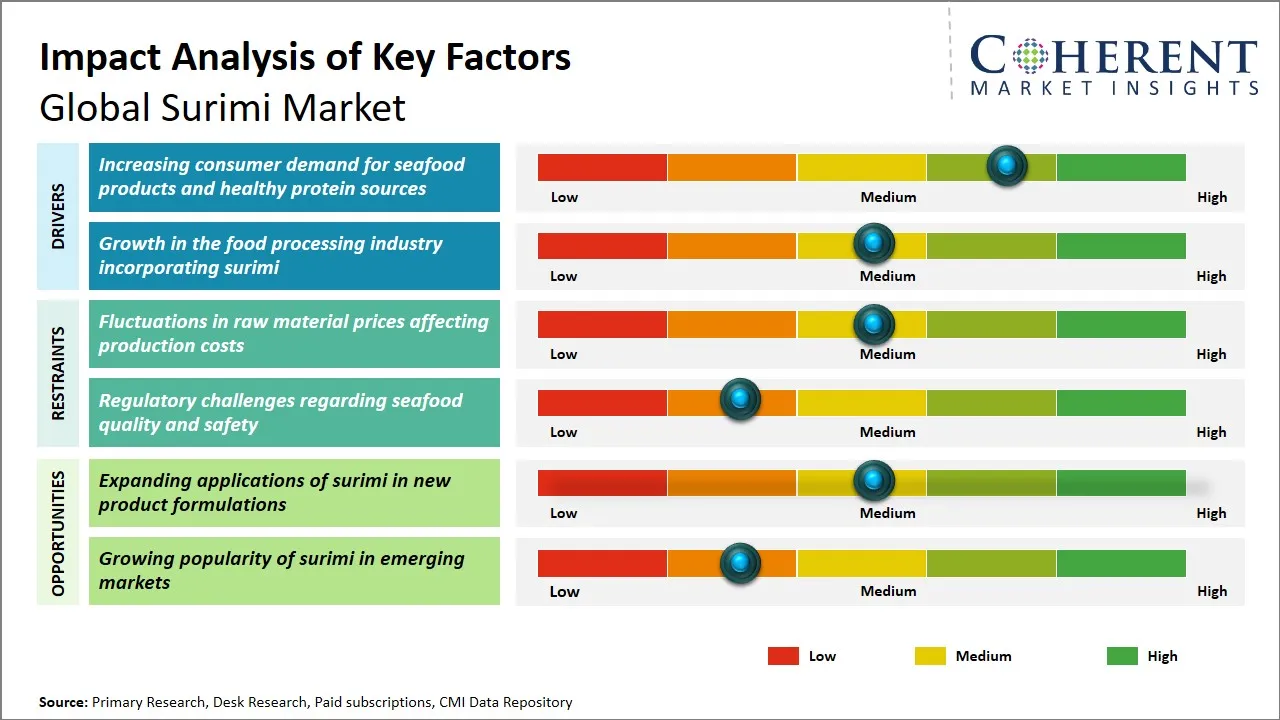
The emerging consciousness of health and wellness of the consumers in the world has played a great role in the rising demand for seafood products including surimi. Surimi can be a competitive alternative to the conventional sources of meat since it contains lean protein and has diverse culinary uses to attract more people who are interested in healthy, low-fat, and high-protein food variants. Besides, the understanding of seafood as a heart-healthy option that is abundant in omega-3 products, fatty acids has only contributed to consumer interest. The changing eating habits are also contributing to this change in the sense that more consumers are shifting to pescatarian and flexitarian diets that focus on plant and seafood-based proteins.
For example, Japan, South Korea, and the U.S. (2023 to 2025) Retail and foodservice sales of surimi-based products (crab sticks, kani salads, seafood rolls) achieved increase sale due to the switching of consumers towards lean protein. Large retailers increased chilled and frozen SKUs of surimi that were packaged as low-fat high-protein seafood.
Surimi Market Opportunity - Expanding Applications of Surimi in New Product Formulations
The global surimi market is witnessing considerable growth potential driven by the expanding applications of surimi in innovative product formulations across various food segments. Historically, surimi has been mostly utilized in the making of seafood imitations like crab sticks and fish balls. Food manufacturers are, however, considering its addition to various types of products such as ready to eat meals, snacks, and health-conscious protein substitutes in increasing numbers. The peculiarities of surimis as a functional ingredient contribute to this trend, including its gel-forming properties, the ability to improve the texture and nutritional value, permitting it to be transformed into various gastronomic variations.
For example, between 2023 and 2024 in Europe and Asia, food manufacturers like Orkla Group (Europe), Thai Union Group (Asia), Maruha Nichiro Corporation (Asia), and Sysco Corporation (Europe & Asia) introduced surimi-based protein bowls, seafood dumplings, and microwavable meals that leveraged surimi's gel strength and neutral flavor to enhance texture.
Analyst Opinion (Expert Opinion)
- The surimi industry is in the growth curve with the rising demand for consumers towards alternative seafood, and healthy sources of protein. Experience of the Global Seafood Expo (2023) and the International Surimi Congress (2022) indicated the key trends, where companies such as Aqua Star and Trans-Ocean Products dominated with product differentiation, including flavored and value-added surimi products.
- The recent introduction of sustainably sourced snack sticks of surimi by Aqua Stars demonstrates the development of the industry that is oriented to the appeal to the health-conscious people as they seek easy to prepare meals. The conferences were noted to have discussed the increasing need of transparency in sourcing and processing as the consumers are increasingly becoming more aware of the environmental and health effects of their food preferences. Yet, the problem of varying prices of raw materials and the competition with the plant-based protein alternatives was often mentioned as a possible obstacle.
- The firms investing in advertising campaigns to demonstrate the versatility and sustainability of surimi will most probably have a huge market share. Finally, the success of the surimi market will be based on its capacity to innovate continuously and to react to the shifting consumer preference in regards to health, convenience, and sustainability in sources of proteins.
Speak to the analyst
Want personalized insights?
Take the findings above to one of our principal consultants, or have the report rebuilt around the segments, geographies and competitors you actually track.
Market Segmentation
- Source Insights (Revenue, USD Bn, 2021 - 2033)
- Tropical
- Cold Water
- Alaska Pollock
- Pacific Whiting
- Others
- Form Insights (Revenue, USD Bn, 2021 - 2033)
- Frozen
- Fresh
- Distribution Channel Insights (Revenue, USD Bn, 2021 - 2033)
- B2B
- B2C
- Hypermarkets & Supermarkets
- Convenience Stores
- Online
- Others
- Regional Insights (Revenue, USD Bn, 2021 - 2033)
- North America
- U.S.
- Canada
- Latin America
- Brazil
- Argentina
- Mexico
- Rest of Latin America
- Europe
- Germany
- U.K.
- Spain
- France
- Italy
- Russia
- Rest of Europe
- Asia Pacific
- China
- India
- Japan
- Australia
- South Korea
- ASEAN
- Rest of Asia Pacific
- Middle East
- GCC Countries
- Israel
- Rest of Middle East
- Africa
- South Africa
- North Africa
- Central Africa
- North America
- Key Players Insights
- HAI THANH CO., LTD
- MEENA Brand Surimi
- APITOON GROUP
- Starfish Co., Ltd.
- Java Seafood
- INDO SEAFOOD
- Southern Marine
- SEAPRIMEXCO
- Zhejiang Longsheng Aquatic Products Co.,Ltd.
- Indonesia Bahari Lestari
Sources
Primary Research Interviews
- CEO – Leading Surimi Producer (e.g., Viciunai Group or Seaprimexco Vietnam equivalent)
- Supply Chain Director – Major Surimi Distributor (e.g., Trans-Ocean Products)
- Production Lead – Surimi Processing Plant (e.g., Dalu Surimi or Kicoimex)
- Sustainability Officer – Seafood Certification Authority (e.g., Marine Stewardship Council for surimi fisheries)
Stakeholders
- Manufacturers (Viciunai Group, Thong Siek Global, Gadre Marine)
- End-use Sectors
- Processed Seafood (Imitation Crab, Kamaboko, Fish Sticks)
- Ready-to-Eat Foods and Food Service Industry
- Sushi and Convenience Products Producers
- Regulatory & Certification Bodies (e.g., Marine Stewardship Council (MSC), Friend of the Sea for surimi suppliers, FDA/EU seafood regulations)
- E-commerce Platforms and Retailers (Alibaba, Supermarkets/Hypermarkets, Online Seafood Retailers)
- Technology Integration Players: Surimi by-products processors (proteins, collagen, fish oil)
Databases
- UN Comtrade Database (HS Code for fish paste/surimi trade)
- India Import Export (EXIM) Database (surimi imports growth)
- FAO Fisheries and Aquaculture Statistics (Surimi production)
- Eurostat Trade Statistics for Fish Products
- VASEP Seafood Database (Vietnam surimi exports)
Magazines
- SeafoodNews.com – Surimi price challenges and production
- National Fisherman – Alaska pollock surimi trends
- Vietfish Magazine – Fish cakes and surimi exports
- IntraFish – Global surimi market dynamics
Journals
- Journal of Food Science and Technology – Surimi processing techniques
- Food Hydrocolloids – Surimi gel properties and quality
- Comprehensive Reviews in Food Science and Food Safety – Surimi by-products
- Aquaculture – Tilapia surimi innovations
Newspapers
- Reuters – Surimi trade and market expansions (e.g., Russia to India)
- Business Standard (India) – Surimi imports and Asia demand
- The Wall Street Journal – Global seafood demand impacts
Associations
- Japan Kamaboko Association (Surimi-based products)
- Vietnam Association of Seafood Exporters and Producers (VASEP) Surimi Club
- Association of Genuine Alaska Pollock Producers (GAPP)
- International Pacific Halibut Commission (related fisheries)
Public Domain Sources
- FAO – Guidelines for surimi production and trade
- Marine Stewardship Council – Sustainability standards for surimi fisheries
- Friend of the Sea – Certification for surimi suppliers
- US FDA – Seafood safety standards for surimi
- EU Commission – Import regulations on fish paste products
Proprietary Elements
- CMI Data Analytics Tool, Proprietary CMI Existing Repository of information for last 8 years.
Get access to 250+ pages report
Every segment, forecast, competitor profile and data table behind the analysis above — available for instant download.
- ESOMAR Member
- ISO 9001:2015 Certified
- D-U-N-S Registered
- GDPR & CCPA Compliant
Missing comfort of reading report in your local language? Find your preferred language:
Transform your Strategy with Exclusive Trending Reports
Frequently Asked Questions
The global surimi market is estimated to be valued at USD 5.45 Bn in 2026 and is expected to reach USD 8.64 Bn by 2033.
Surimi is a processed seafood paste made primarily from deboned, washed, and refined white‑fish flesh. Used as a functional ingredient to create analog products like imitation crab, fish balls, and seafood analogs.
Raw fish supply, cold chain costs, fuel prices, and trade policies.
The CAGR of global surimi market is projected to be 6.8% from 2026 to 2033.
Increasing consumer demand for seafood products and healthy protein sources and growth in the food processing industry incorporating surimi are the major factors driving the growth of the global surimi market.
Fluctuations in raw material prices affecting production costs and regulatory challenges regarding seafood quality and safety are the major factors hampering the growth of the global surimi market.
In terms of source, tropical is estimated to dominate the market revenue share in 2026.