

Global Sustainability Certification Market Size and Forecast
The Global Sustainability Certification Market is estimated to be valued at USD 3.58 Bn in 2026 and is expected to reach USD 5.98 Bn by 2033, exhibiting a compound annual growth rate (CAGR) of 7.6% from 2026 to 2033.
Key Takeaways of the Sustainability Certification Market
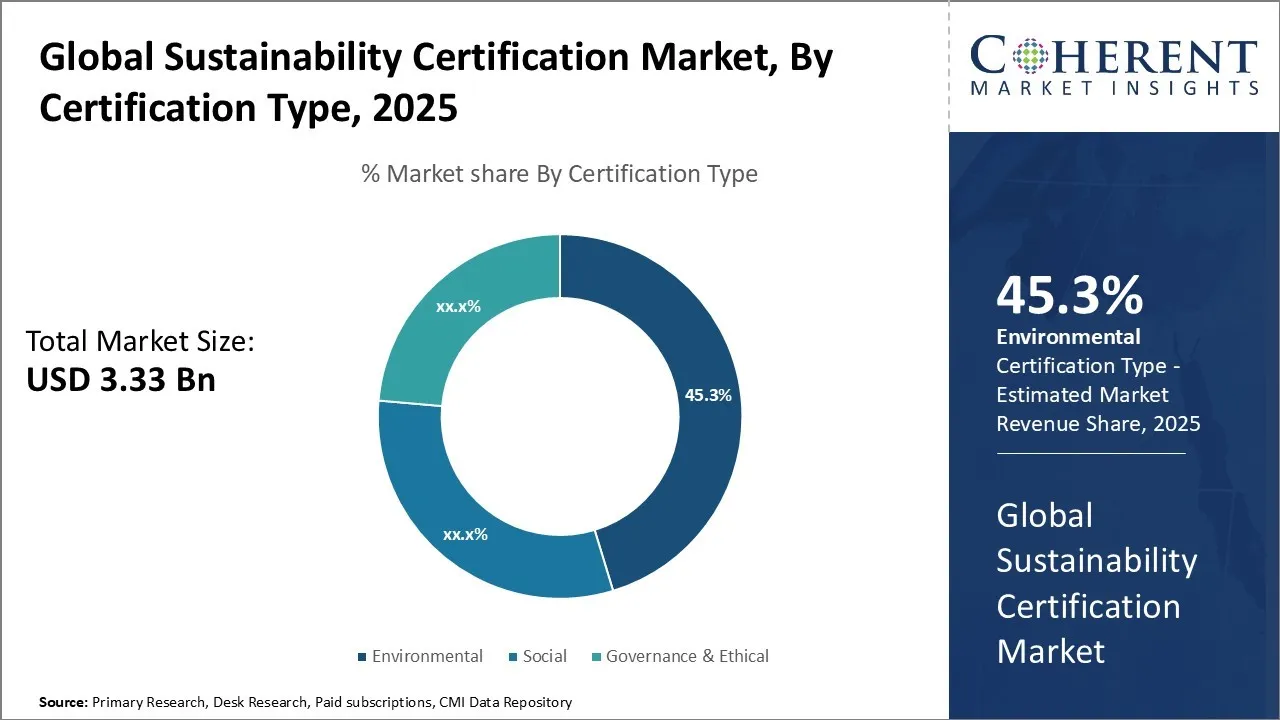
- The environmental segment leads the market holding an estimated share of 46.3 % in 2026.
- The Energy & Emissions segment leads the market holding an estimated share of 36.3 % in 2026.
- North America is estimated to lead the market with a share of 34.7 % in 2026.
- Asia Pacific, holding a share of 31.2 % in 2026, is projected to be the fastest growing region.
Market Overview
Market trends indicate a rising emphasis on green building certifications, renewable energy endorsements, and supply chain transparency as companies seek to enhance their sustainability credentials. Technological advancements, such as Blockchain for traceability and AI for compliance monitoring, are also adding to market growth. Similarly, the integration of sustainability metrics into investment decisions is creating demand, which may add to market growth in the coming years.
Current Events and their Impact
Current Events | Description and its impact |
Regulatory and Policy Shifts in Key Regions |
|
Technological Advancements and Digital Verification Tools |
|
Segmental Insights
- Current Industry Events of 2026
- Market Size Estimation
- Regional Breakdown
- Competitive Landscape
- Customer Intelligence
- Segmental Analysis
- Pricing Analysis
- Key Market Drivers, Challenges & Future Trends
- Customized Insights Section
Global Sustainability Certification Market Insights, By Certification Type – Environmental Segment Leads Owing to Increasing Regulatory Pressure
The Environmental segment dominates the global sustainability certification market, holding an estimated share of 46.3% in 2026. Governments worldwide are putting in place strict standards to reduce carbon footprints and minimize pollution. These regulatory frameworks push companies to get recognized environmental certifications that validate their efforts in managing environmental impacts to add to their credibility with stakeholders and customers.
Moreover, the rising awareness among consumers about ecological issues intensifies demand for products and services certified for environmental responsibility. These certifications often focus on aspects such as carbon neutrality, waste reduction, sustainable sourcing, and water conservation. Businesses adopting these certifications benefit from improved public perception and often gain preferential access to markets that prioritize sustainability.
Additionally, the environmental segment’s growth is propelled by the rise in renewable energy adoption, circular economy initiatives, and green supply chain management. Organizations actively seek certification to benchmark their performance and demonstrate tangible progress towards sustainability goals. The availability of third-party verifications assures stakeholders of compliance and boosts investor confidence.
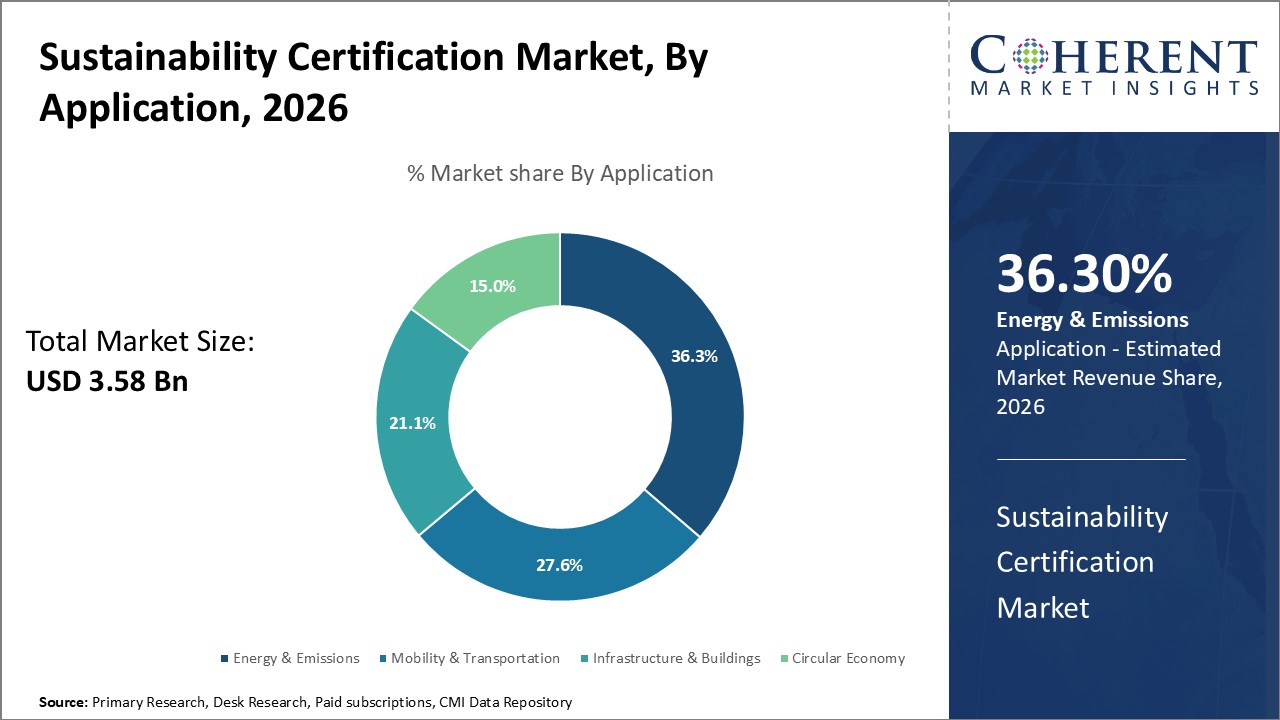
Global Sustainability Certification Market Insights, By Application – Energy & Emissions leads the market driven by global decarbonization efforts and increasing energy efficiency mandates
The Energy & Emissions application segment is expected to command the largest share of 36.3% in 2026. Governments, international bodies, and corporations are intensively pursuing decarbonization strategies to meet ambitious climate targets such as those set by the Paris Agreement. These initiatives require rigorous measurement, monitoring, and reduction of energy consumption and emissions, for which certifications offer an effective framework and validation method.
Energy & Emissions certifications focus on confirming that organizations comply with energy efficiency standards, renewable energy integration, and emissions reduction targets. As energy use constitutes one of the largest contributors to global emissions, companies across sectors are compelled to adopt certified energy management systems to optimize consumption and decrease environmental impact.
Corporate sustainability agendas increasingly prioritize energy management as a cost-saving and risk mitigation strategy. Certifications in this segment help companies demonstrate leadership in energy performance, thereby attracting environmentally conscious investors and consumers. Furthermore, organizations leveraging certified energy practices often benefit from incentives such as tax breaks, subsidies, and preferential procurement, reinforcing the appeal of obtaining these certifications.
Technological advancements, such as smart metering, automation, and advanced analytics, enhance the ability to track and improve energy use, making certification processes more precise and actionable. The growing adoption of renewable energy sources also necessitates verification to ensure authenticity and sustainability claims, providing additional impetus for certification uptake.
Impact of Artificial Intelligence (AI) on the Sustainability Certification Market
Artificial Intelligence (AI) is significantly transforming the sustainability certification landscape by streamlining auditing processes, enhancing data accuracy, and enabling real-time compliance tracking. Traditional certification methods often relied on manual data collection and documentation, which were time-consuming and prone to human error. AI-powered platforms now allow certification bodies and businesses to automate environmental and social impact assessments by analyzing large volumes of operational data, satellite imagery, and sensor inputs. This not only accelerates the certification process but also increases its reliability. Additionally, AI facilitates predictive analytics, helping organizations identify sustainability risks and areas for improvement well before formal audits.
In 2021, IBM partnered with the Responsible Sourcing Blockchain Network (RSBN), using AI and blockchain technologies to certify ethical sourcing of minerals like cobalt across global supply chains. By combining AI with digital ledgers, the system verifies environmental and social compliance at each step, offering tamper-proof certification data to stakeholders.
Regional Insights
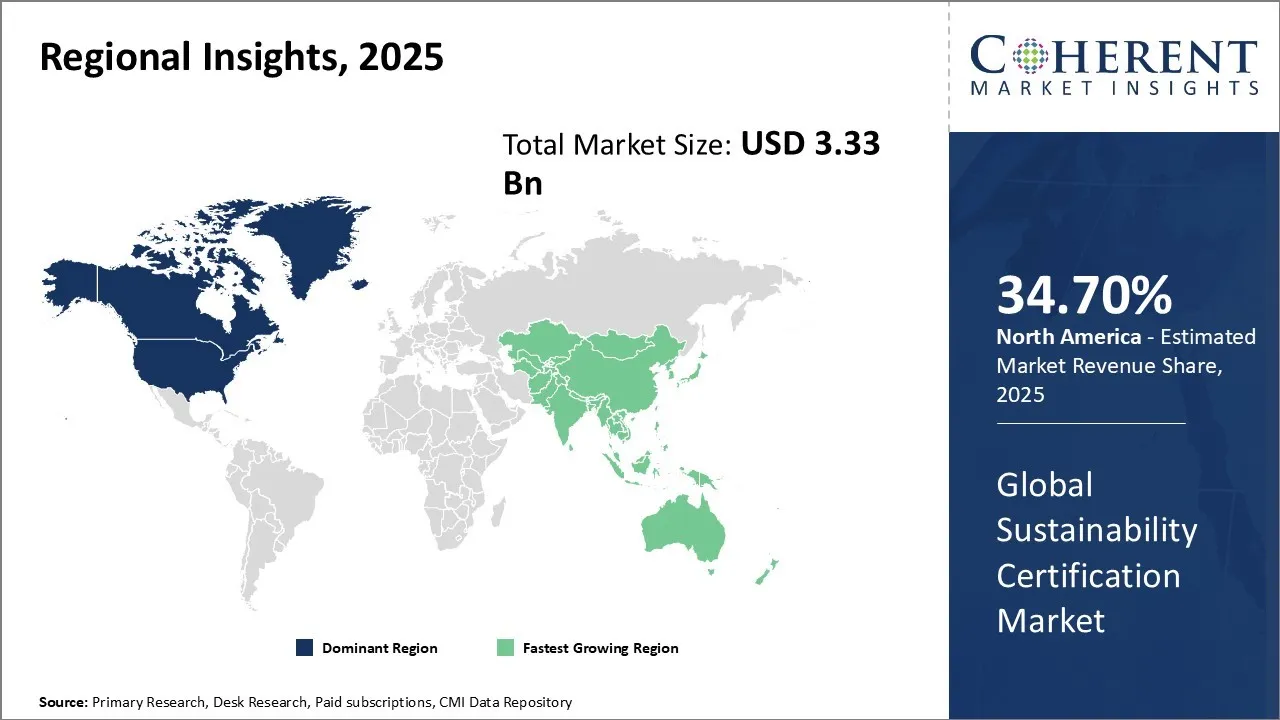
North America Sustainability Certification Market Analysis and Trends
North America, holding an estimated share of 34.70% in 2026, dominates the global sustainability certification market, driven by a mature market ecosystem with well-established sustainability frameworks, strong governmental policies, and extensive industry participation. The region benefits from rigorous environmental regulations and incentives, such as the U.S. Green Building Council’s Leadership in Energy and Environmental Design (LEED) certification widely adopted across industries. The presence of pioneering companies—such as SGS North America, Intertek Group, and UL LLC—facilitates comprehensive sustainability auditing and certification services.
Moreover, North America's robust trade infrastructure supports numerous industries, including manufacturing, construction, and consumer goods, propelling demand for sustainability credentials to comply with stringent environmental standards and meet consumer expectations. Increasing corporate emphasis on Environmental, Social, Governance (ESG) criteria also underpins the strong uptake of certification services.
Asia Pacific Sustainability Certification Market Analysis and Trends
The Asia Pacific, holding an estimated share 31.2% in 2026, exhibits the fastest growth in the sustainability certification market, fueled by rapid industrialization, increasing environmental awareness, and expanding manufacturing and services sectors. Countries such as China, India, Japan, and South Korea have intensified government mandates and incentives for sustainable practices in response to environmental challenges.
The expansion of green building initiatives, renewable energy projects, and sustainable supply chain movements have elevated demand for certifications like ISO 14001, BREEAM, and various energy efficiency standards. Notable companies like TUV SUD, Bureau Veritas, and DNV operate actively across the region, helping local firms comply with both domestic regulations and international sustainability standards. Trade dynamics involving export-driven economies also encourage adherence to global sustainability certifications to maintain competitive positioning abroad.
Global Sustainability Certification Market Outlook for Key Countries
U.S. Sustainability Certification Market Analysis and Trends
The U.S. is characterized by a sophisticated regulatory landscape and a strong private sector commitment to sustainability, with government policies encouraging adoption of green certifications across building, manufacturing, and technology sectors. Entities such as UL LLC and NSF International lead the market by offering diverse certification services tailored to stringent environmental laws and voluntary green initiatives. The U.S. sustainability certification market’s influence is enhanced by its role as a trendsetter in global sustainability standards and frameworks, driving innovations in certification protocols and corporate social responsibility reporting.
China Sustainability Certification Market Analysis and Trends
China sustainability certification market reflects governmental priorities targeting environmental pollution mitigation and sustainable economic development. State-driven policies promoting green construction, energy conservation, and resource management create significant demand for certifications. Companies like TUV Rheinland and SGS have expanded their operations to facilitate compliance with domestic standards such as China’s Green Building Evaluation Standard, alongside international certifications. The export-oriented nature of many Chinese industries further motivates adherence to global sustainability certification, enhancing market penetration and corporate commitments.
Germany Sustainability Certification Market Analysis and Trends
Germany continues to lead Europe sustainability certification market with its strong industrial base, particularly in automotive, engineering, and renewable energy sectors. The country's stringent regulatory environment, featuring frameworks such as the German Sustainable Building Council (DGNB), drives businesses toward robust certification uptake. Key players like TÜV SÜD and DNV GL provide specialized services demanding high technical expertise, supporting Germany’s reputation as a global leader in sustainability. The synergy between government regulations, industry innovation, and consumer demand solidifies the nation’s position in the market.
India Sustainability Certification Market Analysis and Trends
India sustainability certification market is marked by significant growth potential, supported by increasing government focus on sustainable development goals and energy-efficient infrastructure. The government’s initiatives such as the Energy Conservation Building Code (ECBC) promote widespread demand for certifications. Local and international companies, including Bureau Veritas and SGS India, play important roles in guiding firms through evolving compliance requirements. The rise of environmentally conscious enterprises and growing exports have made sustainability certification a strategic priority, stimulating market expansion.
Brazil Sustainability Certification Market Analysis and Trends
Brazil sustainability certification market benefits from the country’s commitment to preserving its vast biodiversity and implementing responsible agricultural and industrial practices. The region’s adoption of certifications related to forestry, agriculture, and energy management is shaped by governmental regulations and international trade requirements. Companies like SGS and Intertek contribute significantly by offering certifications that help businesses align with sustainability standards demanded in global markets. Brazil’s participation in international sustainability initiatives enhances the market's traction and importance within Latin America.
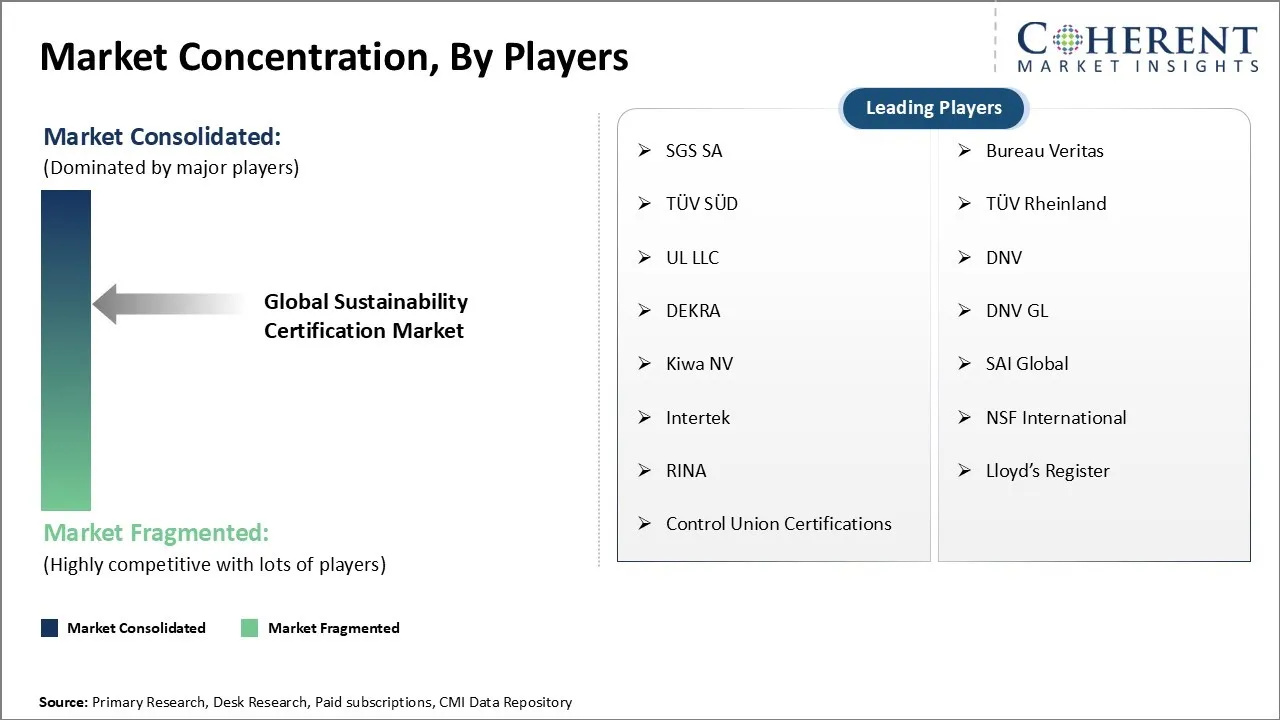
Market Players, Key Development, and Competitive Intelligence
Key Developments
- In June 2025, Textile Exchange launched the Materials Matter Standard Pilot Version V1.0, which will be used for pilot testing the feasibility of the criteria in the field and is not effective, therefore it is not possible for companies to get certification under this version.
- In April 2025, SGS announced its participation in the development of the TIC Council’s newly released Certification System for Sustainability Processes (CSSP), a framework that provides independent, recognized certification for sustainability and green claims.
- In March 2025, the Rainforest Alliance launched an update to its Sustainable Agriculture Standard as well as developed new specialized certification solutions for critical impact areas.
- In February 2025, Dr. Bronner’s, a natural brand of soap in North America, and the highest scoring B Corp, announced that it will drop its B Corp Certification and not renew with B Lab, the organization that manages the well-known certification for companies with a stated social purpose. The announcement followed a multi-year campaign by Dr. Bronner’s calling on B Lab to meaningfully improve the B Corp standard.
Top Strategies Followed by Sustainability Certification Market Players
- Established players dominate the market with their robust investments in research and development (R&D), driving the innovation of high-performance certification products that meet or exceed evolving regulatory standards and customer expectations.
- SGS SA launched its AI-enhanced sustainability performance evaluation tool in 2024, integrating IoT and predictive analytics to provide continuous monitoring for clients seeking ISO 14001 and carbon neutrality certifications.
- Mid-level players in the sustainability certification market carve out their position by concentrating on cost-effective solutions that strike a balance between quality and affordability.
- Kiwa Group (Netherlands/Asia presence) introduced a modular certification model tailored for small manufacturers in Southeast Asia. This pay-as-you-scale model lowers entry barriers for small factories seeking basic sustainability compliance under standards like ISO 50001 (Energy Management), enabling stepwise upgrades as their sustainability goals mature.
- Small-scale players contend with limited resources by carving out specialized niches within the sustainability certification ecosystem.
- Control Union Certifications specializes in organic and regenerative agriculture certifications, and has expanded its reach into Southeast Asia and Latin America by offering GlobalG.A.P., USDA Organic, and Regenerative Organic Certification (ROC).
Market Report Scope
Sustainability Certification Market Report Coverage
| Report Coverage | Details | ||
|---|---|---|---|
| Base Year: | 2025 | Market Size in 2026: | USD 3.58 Bn |
| Historical Data for: | 2020 To 2024 | Forecast Period: | 2026 To 2033 |
| Forecast Period 2026 to 2033 CAGR: | 7.6% | 2033 Value Projection: | USD 5.98 Bn |
| Geographies covered: |
| ||
| Segments covered: |
| ||
| Companies covered: | SGS SA, Bureau Veritas, TÜV SÜD, TÜV Rheinland, UL LLC, DNV, DEKRA, DNV GL, Kiwa NV, SAI Global, Intertek, NSF International, RINA, Lloyd’s Register, and Control Union Certifications | ||
| Growth Drivers: |
| ||
| Restraints & Challenges: |
| ||
Market Dynamics
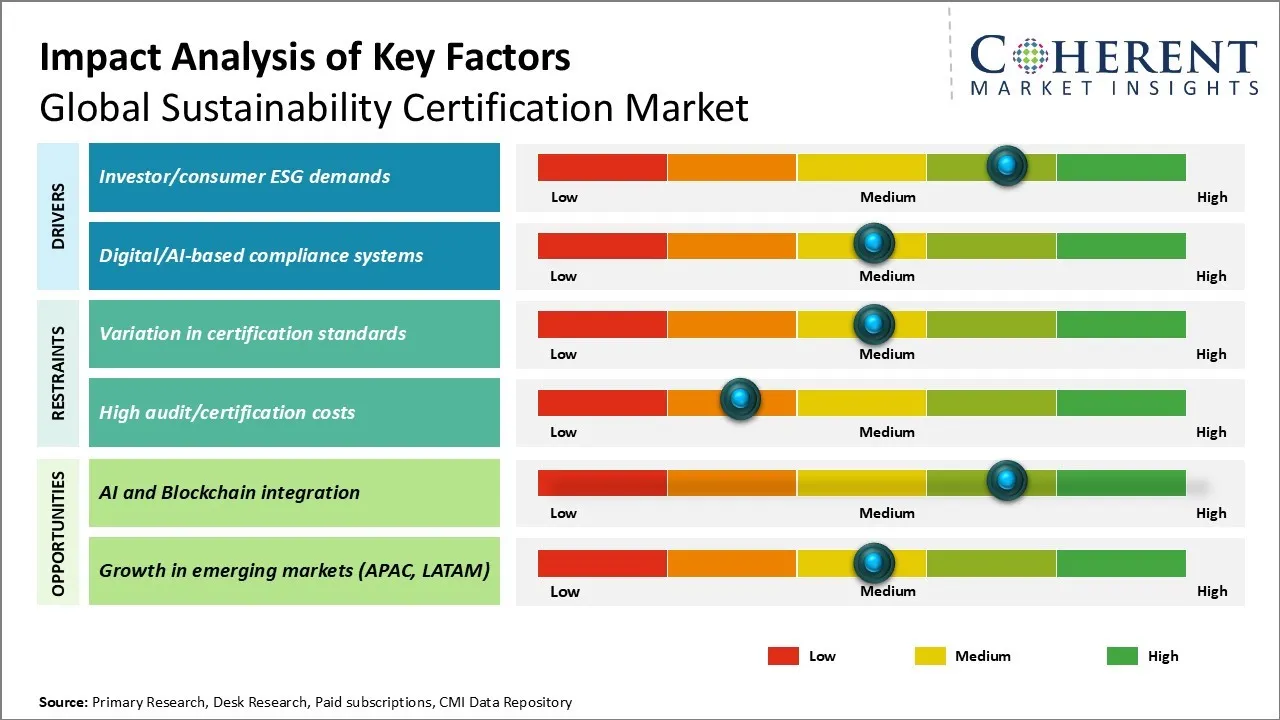
Global Sustainability Certification Market Driver – Investor/consumer ESG Demands
Investors are increasingly scrutinizing corporate ESG performance as a key factor in their decision-making processes, seeking to minimize risks associated with environmental degradation, social controversies, and governance failures. In 2023, BlackRock, one of the world’s largest asset managers, announced that over 75% of its actively managed portfolios now incorporate sustainability criteria as a key decision-making factor.
This heightened focus encourages companies to obtain recognized sustainability certifications to demonstrate transparency and commitment toward responsible business practices. Simultaneously, consumers are becoming more aware and selective, favoring brands that authenticate their sustainability claims through credible certifications. This dual pressure from market contributors fosters a competitive environment where companies prioritize certification to enhance brand reputation, satisfy stakeholder expectations, and improve access to capital.
Global Sustainability Certification Market Opportunity – Integration of AI and Blockchain
AI-powered analytics can streamline data collection and verification by automating the assessment of vast amounts of environmental and social compliance data, reducing human error and accelerating certification timelines. This automation allows certification bodies to handle increased volumes of applications without compromising accuracy, thereby meeting the growing demand for sustainability credentials. Meanwhile, blockchain technology offers a decentralized and immutable ledger that ensures the integrity and traceability of sustainability claims. By recording every transaction and certification step on a Blockchain, stakeholders—ranging from producers to consumers—can independently verify authenticity, minimizing fraudulent activities and greenwashing risks. For instance, The Responsible Sourcing Blockchain Network (RSBN), led by IBM and RCS Global, integrates AI and blockchain to certify ethical sourcing of raw materials like cobalt in the electric vehicle (EV) supply chain. It tracks environmental and social compliance from mines in the DRC to battery manufacturers globally.
Additionally, Blockchain-enabled smart contracts can automate compliance checks and renewals, further lowering operational costs and increasing market confidence. The combined capabilities of AI and Blockchain also facilitate real-time monitoring and reporting of sustainability performance, enabling continuous improvement and proactive management. This technological synergy not only drives operational efficiencies but also fosters greater stakeholder engagement by providing transparent and credible certification results.
Analyst Opinion (Expert Opinion)
- Certification bodies are moving beyond process compliance to emphasize measurable environmental and social outcomes—such as carbon intensity per product unit, biodiversity impact, and fair wage ratios. This shift aligns certification with global climate and SDG targets, enhancing credibility and investor trust.
- Tailored frameworks like GreenPro (construction), ROC (agriculture), and ZEV-certification (automotive) are gaining traction. As one-size-fits-all models lose relevance, sector-specific criteria are ensuring that sustainability is not only adopted but effectively applied at the operational level.
- Emerging certifications now prioritize Scope 3 emissions tracking and product life-cycle circularity. Standards such as the Ellen MacArthur Foundation's Circulytics and Cradle to Cradle Certified® are pushing companies to report on downstream and end-of-life impacts—previously overlooked in traditional audits.
Speak to the analyst
Want personalized insights?
Take the findings above to one of our principal consultants, or have the report rebuilt around the segments, geographies and competitors you actually track.
Market Segmentation
- Certification Type Insights (Revenue, USD Bn, 2021 - 2033)
- Environmental
- Social
- Governance & Ethical
- Application Insights (Revenue, USD Bn, 2021 - 2033)
- Energy & Emissions
- Mobility & Transportation
- Infrastructure & Buildings
- Circular Economy
- Regional Insights (Revenue, USD Bn, 2021 - 2033)
- North America
- U.S.
- Canada
- Latin America
- Brazil
- Argentina
- Mexico
- Rest of Latin America
- Europe
- Germany
- U.K.
- Spain
- France
- Italy
- Russia
- Rest of Europe
- Asia Pacific
- China
- India
- Japan
- Australia
- South Korea
- ASEAN
- Rest of Asia Pacific
- Middle East
- GCC Countries
- Israel
- Rest of Middle East
- Africa
- South Africa
- North Africa
- Central Africa
- North America
- Key Players Insights
- SGS SA
- Bureau Veritas
- TÜV SÜD
- TÜV Rheinland
- UL LLC
- DNV
- DEKRA
- DNV GL
- Kiwa NV
- SAI Global
- Intertek
- NSF International
- RINA
- Lloyd’s Register
- Control Union Certifications
Sources
Primary Research Interviews
Stakeholders
- Sustainability Certification Bodies
- Corporate ESG Heads from Manufacturing, Energy, and FMCG sectors
- Supply Chain Compliance Managers from Multinational Firms
- Green Building Certification Experts (e.g., LEED, BREEAM auditors)
- Circular Economy Consultants
- Technology Providers for Blockchain & AI in Certification
- Third-Party Auditors and ISO Accreditation Advisors
Databases
- Environmental Performance Index (EPI)
- UNCTAD Sustainability Database
- International Trade Centre’s Standards Map
- Global Reporting Initiative (GRI) Database
- SustainCert Data Warehouse
Magazines
- ESG Business Review
- Green Future Insights
- Certification Monthly
- Sustainability Today
- Eco-Compliance Digest
Journals
- Journal of Sustainable Development and Policy
- Global Environmental Governance Review
- Journal of Corporate Sustainability & Responsibility
- Supply Chain Sustainability Journal
- Technology and ESG Integration Quarterly
Newspapers
- The ESG Times
- Business Green Daily
- Environmental Business News
- Asia-Pacific Sustainability Chronicle
- North America Impact Tribune
Associations
- International Sustainability Standards Board (ISSB)
- Global Certification Forum (GCF)
- Environmental Auditors Association (EAA)
- Asia-Pacific ESG Council
- North American Green Certification Alliance (NAGCA)
Public Domain Sources
- United Nations Global Compact
- EUROSTAT
- U.S. Securities and Exchange Commission (SEC) ESG Filings
- World Bank Sustainability Indicators
- ResearchGate
- United Nations Economic and Social Council (ECOSOC)
Proprietary Elements
- CMI Data Analytics Tool, Proprietary CMI Existing Repository of information for the last 8 years
Get access to 250+ pages report
Every segment, forecast, competitor profile and data table behind the analysis above — available for instant download.
- ESOMAR Member
- ISO 9001:2015 Certified
- D-U-N-S Registered
- GDPR & CCPA Compliant
Missing comfort of reading report in your local language? Find your preferred language:
Transform your Strategy with Exclusive Trending Reports
Frequently Asked Questions
The global sustainability certification market is estimated to be valued at USD 3.58 Bn in 2026 and is expected to reach USD 5.98 Bn by 2033.
The CAGR of global sustainability certification market is projected to be 7.6% from 2026 to 2033.
Investor/consumer ESG demands and Digital/AI-based compliance systems are the major factors driving the growth of the global sustainability certification market.
Variation in certification standards and high audit/certification costs are the major factors hampering the growth of the global sustainability certification market.
In terms of Certification Type, Environmental subsegment is estimated to dominate the market revenue share in 2026.
SGS SA, Bureau Veritas, TÜV SÜD, TÜV Rheinland, UL LLC, DNV, DEKRA, DNV GL, Kiwa NV, SAI Global, Intertek, NSF International, RINA, Lloyd’s Register, and Control Union Certifications are the major players in the global sustainability certification market
North America is expected to lead the global sustainability certification market in 2026.