

Secondary Battery Market Size and Forecast – 2026-2033
Secondary Battery Market size is estimated to be valued at USD 1,28,567.4 Mn in 2026 and is expected to reach USD 2,65,918.2 Mn in 2033, exhibiting a compound annual growth rate (CAGR) of 10.9% from 2026 to 2033.
Key Takeaways
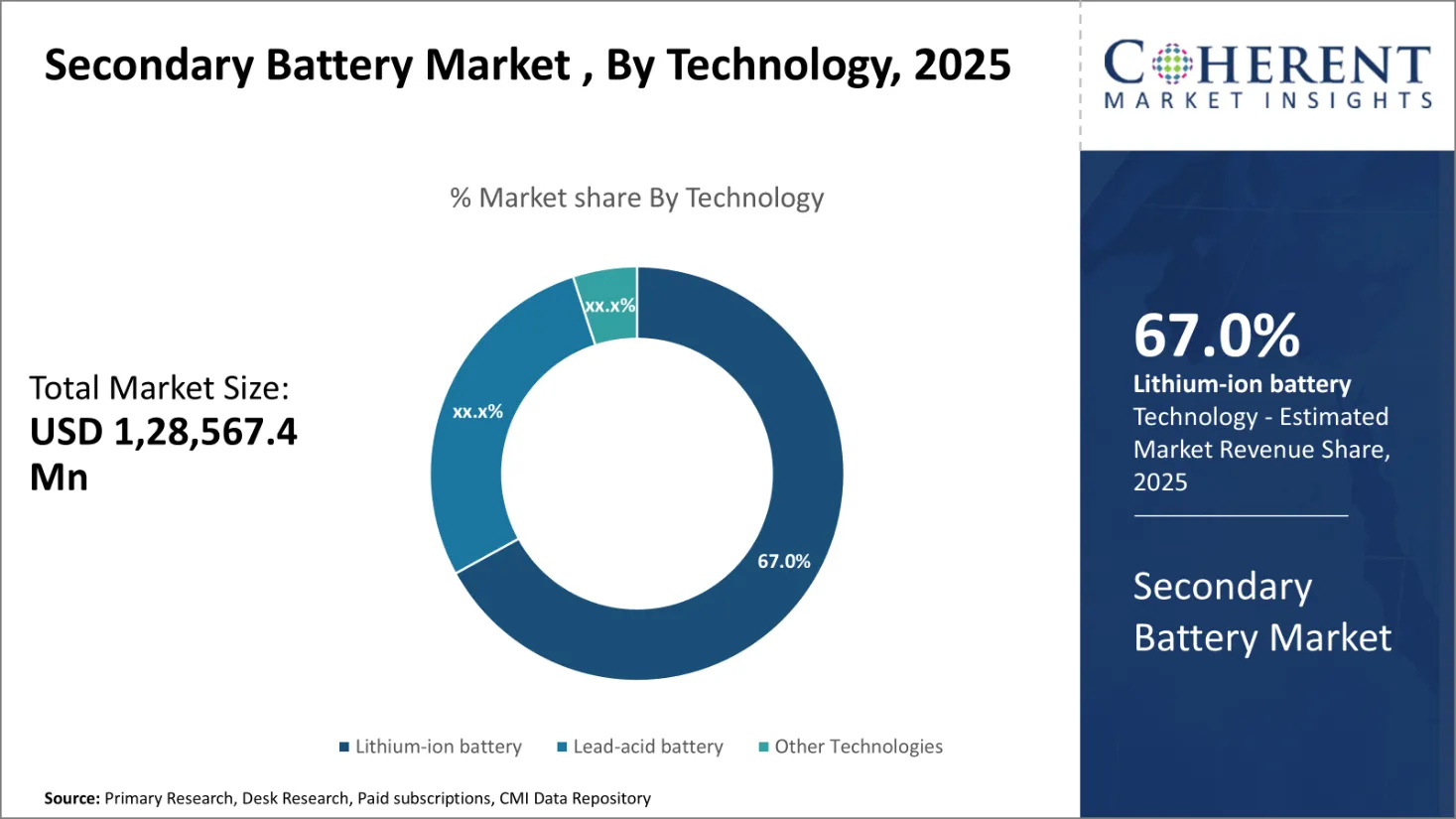
- Based on Technology, Lithium-Ion Segment is dominating the market by holding 68% during the forecast period due to its use in electric cars, grid storage, and smartphones.
- Based on Application, Consumer Electronics Segment is expected to grow the most due to the increased need for smartgates, wearables, and other portable devices which use secondary batteries.
- Based on Region, Asia Pacific is expected to hold 46.64% of the Secondary Battery Market share in 2026 owing to the enormous battery manufacturing plants in China, Japan, and South Korea.
Market Overview
Secondary Battery market is projected to grow massively in the coming years. Secondary Battery Market Growth is driven by a number of reasons which include advanced technology, increased demand in the consumer sector, government-level policies fostering energy storage system development, and heightened requirements for Electric Vehicles (EVs). For example, BloombergNEF's Energy Storage Market Outlook states that the global energy storage market for installations will reach 411 GW/1,194 GWh by 2030, with secondary batteries at the center of it all. All these factors, coupled with China's NEV (New Energy Vehicle) policy and heated Battery Regulation from EU, underline the importance scope of opportunity within the market and augments the market growth prospects secondary batteries for use in energy transition technologies.
Current Events and Its Impact
Event | Description and Impact |
Electric Vehicle (EV) Adoption |
|
Renewable Energy Storage |
|
Segmental Insights
- Current Industry Events of 2026
- Market Size Estimation
- Regional Breakdown
- Competitive Landscape
- Customer Intelligence
- Segmental Analysis
- Pricing Analysis
- Key Market Drivers, Challenges & Future Trends
- Customized Insights Section
Global Secondary Battery Market Insights, by Technology: Lithium-ion Batteries Lead Due to Versatility Across Energy Storage and EV Applications
By Technology, The Global Secondary Battery Market Analysis shows that it is subdivided into Lead-acid Batteries, Lithium-ion Batteries, and Other Technologies (which comprises NiMH and NiCd). Out of these, the lithium-ion battery segment is anticipated to lead for the duration of the forecast period because of its varied applications in electric vehicles and energy storage systems, both in commercial and residential settings. This segment's market position is further strengthened by the increasing use of lithium-ion batteries in integrating renewable energy systems. These batteries are widely adopted because of their high energy density, low weight, and longer life cycle making them the preferred choice across industries that are in need of reliable and efficient power solutions.
The lead-acid battery segment is also projected to witness significant growth due to the adoption of these batteries in mobility aids, marine applications, access platforms, cleaning machines, recreational transport like golf carts and others. Their affordability and proven performance continue to fuel the batteries’ relevance across legacy and niche use cases, thereby bolstering segment growth despite fierce competition from newer technologies.
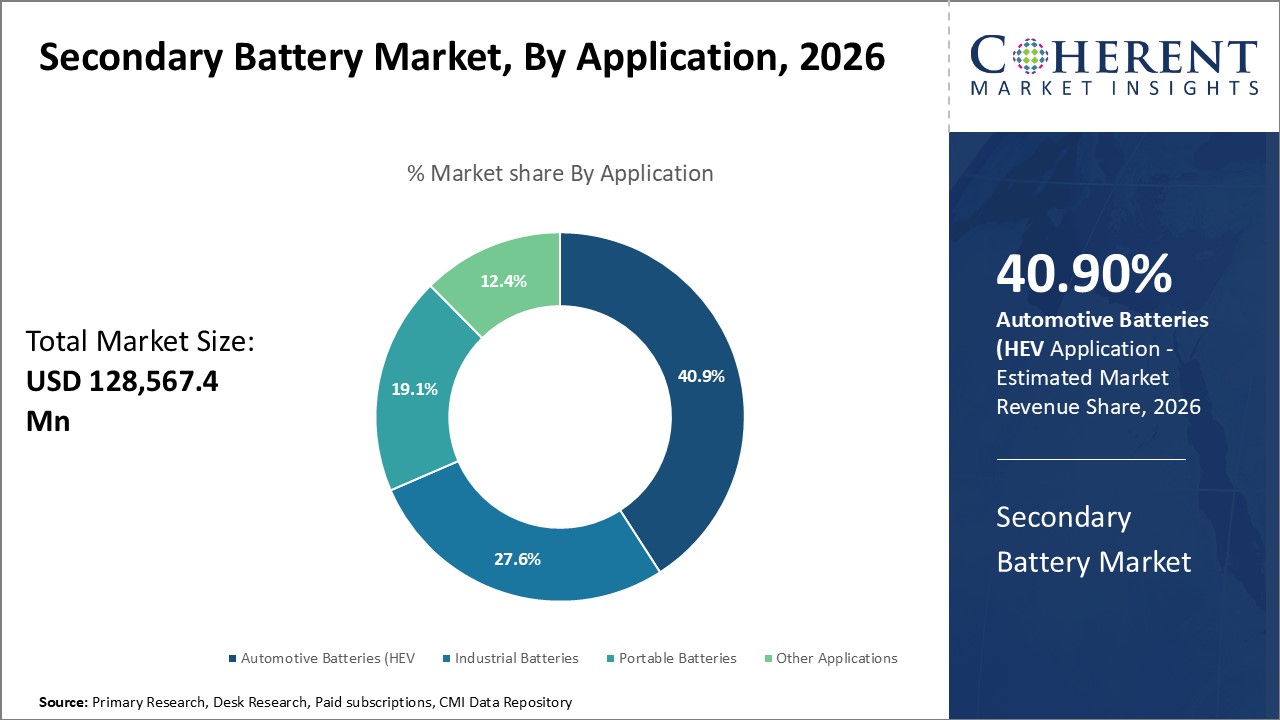
Global Secondary Battery Market Insights, by Application: Automotive Batteries Dominate Amid Rising EV Adoption Worldwide
By application the market is segmented into Automotive Batteries which include HEV, PHEV, and EV, Industrial Batteries which include Motive and Stationary such as Telecom, UPS, and Energy Storage Systems, Portable which covers consumer Portable Batteries, and Other Applications which encompasses SLI and Power Tool Batteries. Of these, the automotive segment dominates the Secondary Battery Market Demand due to an increase in electric vehicles across both developing and developed regions. Government incentives and subsidies have been and remain important for EV penetration and consequently secondary battery demand throughout the mobility sector.
Due to the expansion of the logistics and warehousing sectors, Industrial batteries are also gaining traction. Robust battery systems are increasingly being used to power material handling equipment and energy storage systems with the growth of intralogistics, automation, and advanced energy systems. The industrial segment is poised for strong growth in the near term as they provide construction services and advance infrastructure reliant services in heavily import and distribution service dependent countries.
Pricing Analysis
- In 2024 the average price of battery packs is estimated to cost around $120 per kWh. This decline from $137 per kWh in 2023 is thanks to technology improvements and increased demand.
- With raw material volatility, lithium and cobalt's changing prices still impact battery costs despite showing some signs of stabilization.
- Solid state batteries cater to the Secondary Battery Market Value, but currently, they cost 2.5-3 times more to make than traditional lithium-ion packs. They are expected to commercially useful between 2028 and 2030.
- Regional Price Variations shows Asia in the lead for cost effectiveness because of their economy and North America and Europe facing higher charges for labor and security standards.
Regional Insights
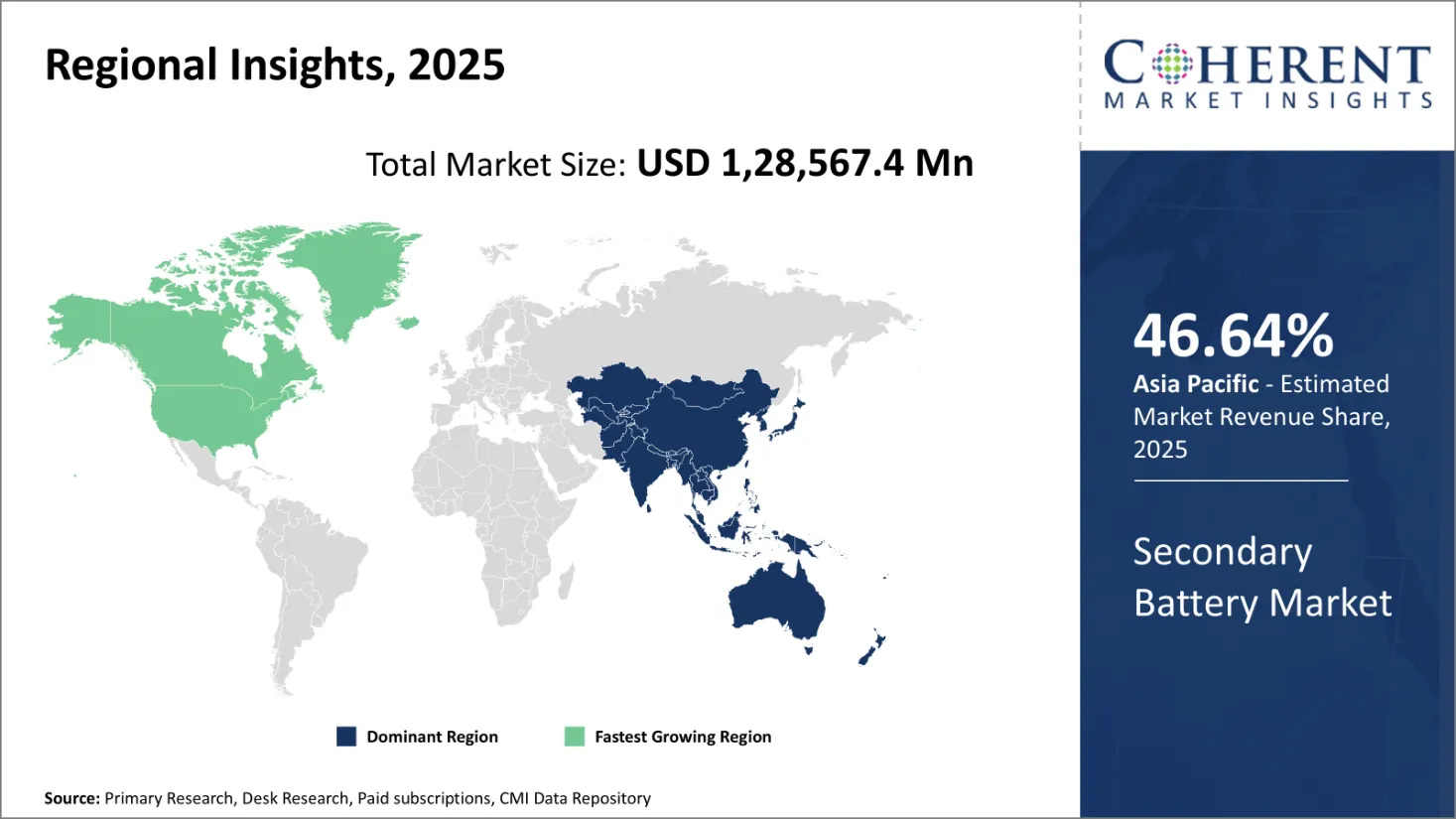
Global Secondary Battery Market in Asia Pacific Leads with EV Policy Push and Production Powerhouse
Asia Pacific is dominating Secondary Battery Market Trends with a market share of 46.64% in 2026 due to robust manufacturing ecosystems and aggressive policy frameworks promoting clean mobility. As of 2026, China, South Korea, and Japan continue to be the epicenters of battery cell production and export.
Governments in the region are heavily investing in EV adoption. India, for example, announced in January 2026 its commitment to reach a 30% EV penetration rate by 2032, supported by incentives under its FAME-II scheme and the PLI (Production-Linked Incentive) program for battery manufacturing. In parallel, China’s NEV (New Energy Vehicle) market surged with over 9 million NEVs sold in 2024, driving demand for lithium-ion batteries used in both EVs and grid-scale energy storage. This combination of policy incentives and manufacturing scale continues to anchor Asia Pacific’s dominance in the secondary battery market. For instance, in March 2026, BYD opened a new 30 GWh battery plant in Xi’an, China, boosting its annual battery output to meet the exploding demand for EVs domestically and across global Secondary Battery Market Demand.
North America Secondary Battery Market
Owing to policies supporting clean technology, onshoring, and EV sales, North America has become a secondary hub for battery innovation. The inflation reduction act has also catalyzed investments in batteries by providing tax credits for onshore production of cells and packs. The IRA also incentivizes American companies to shift their dependencies on Asian imports to domestic sources. This forced GM, LG, Ford and even Tesla to set up new gigafactories across the country. A prime example is the recently announced GM and LG Energy jointly owned gigafactory in Michigan, slated to begin operations in April 2026. It has a production capacity of 40 GWh which is expected to meet the requirements of 500,000 electric vehicles per year.
Europe Secondary Battery Market
Europe persists in striving for climate neutrality within the foreseeable future while also achieving energy independence, which is likely to be accomplished within the next three decades. Battery gigafactories are emerging across the ecosystem, subsidized via the European Green Deal along with corresponding Bank Regulations that entail sustainability and recyclability prerequisites.
Germany, Sweden, and France are taking the lead in this charging innovation. Germany, for one, is heavily investing in domestic battery cell production to bottom-feed Germany’s automotive industry. In February 2026, Volkswagen’s PowerCo commenced construction on its 2nd gigafattery in Valencia, Spain. This is part of their larger plan of funding surpassing 10 billion euros aimed at localizing EV supply chains. Gatorys claim that Europe’s concentration on circular economy of batteries and second life applications of batteries (particularly for home energy storage) distinguish it within the gloal ecosystem and make Europe an advancing and differentiating market.
Global Secondary Battery Market in China
SINOPEC and CATL already operated their top-of-the-line plants even before 2021, which enabled China to quickly increase production after they became leaders in the secondary battery market. China was expanded in ByD and Gotion after China was advanced in the EV industry. With the world at gunpoint with vaccine stocks, China massively expanded the domestic stocks of electric vehicle charging stations for public use. It worked productively to achieve its October 2023 targets, focused on using clean mobility to help the world become neutral in 2030. It's also reforming state subsidies for overall developed growth deviced in transformation programs for the energy, power electronics, and their construction industries to halt regional gaps in transportation.
U.S. Secondary Battery Market
Encouraged by federal initiatives like the Inflation Reduction Act (IRA) and state EV mandates, the U.S. secondary battery market is expanding rapidly. The adoption of EVs, increasing domestic energy resilience goals, and reducing reliance on foreign battery supplies are all working in tandem to support the Secondary Battery Market Growth. System-wide investments from automakers and tech companies like Tesla, GM, Ford, and Microsoft are further raising consumer sentiment supporting American-made clean energy technologies across commercial and residential sectors. This drastic shift is also leading to the construction of new battery megafactories across the country. Additionally, new startups and recycling companies like Redwood Materials are literally changing the U.S. approach to innovation by creating a circular economy focused on battery materials.
India Secondary Battery Market
India is rapidly establishing its prospects in the global secondary battery market. Its purpose of achieving a mission on EVs, enhancement of renewable energy, and access to power are strong indicators for India’s secondary battery market growth. With the PLI for Advanced chemistry cells and the subsidizing programs under FAME II, domestic and foreign players are stepping up to establish battery production facilities owing to the government supported schemes. Indian electric two-wheeler vehicles and LFP (Lithium Iron Phosphate) batteries stand as a frontier of innovation due to the need for cost-effective, safe, and thermally stable battery technologies along with shared mobility and decentralized energy storage systems. Furthermore, the Secondary Battery Market Report suggests that India’s mid class citizens along with an increasing concern towards environment are bolstering the change from conventional fuels to battery alternatives in urban areas and even rural regions.
Export-Import Analysis of the Secondary Battery Market (2024–2025)
Major Exporting Countries
- China: Remains the world leader in lithium-ion battery exports with shipments reaching nearly $43.7 billion between January and September 2024. While there was a decline in export value of 10.1% year-on-year, exports did increase by 4.6%, suggesting that there is a shift towards more competitively priced products. Major exporting regions are Fujian, Guangdong, and Jiangsu.
- South Korea and Japan: Support their strong export positions with high-performance batteries for electric vehicles (EVs) and consumer electronics, capitalizing on advanced manufacturing infrastructure.
Top Importing Countries
- United States: Imported approximately 191,200 metric tons of lithium-ion batteries in Q2 2024, with China accounting for 82% of these imports. Other significant sources include South Korea, Poland, Hungary, and Japan.
- India: In the fiscal year 2023–24, India imported lithium-ion batteries worth around $3 billion, with China being the leading supplier, contributing over $2.5 billion.
- Germany: As Europe's automotive hub, Germany continues to import substantial volumes of lithium-ion batteries to support its EV industry and energy storage needs.
Key Trends
- Localization of Battery Production: To reduce dependency on Asian imports, the U.S. and EU are investing heavily in domestic battery manufacturing. The European Union has announced plans for 40 new gigafactories, representing investments of approximately €30 billion.
- Trade Policies and Tariffs:
- The U.S. has increased tariffs on Chinese lithium-ion batteries, with rates set to rise from 7.5% to 25% starting in January 2026.
- President Trump has initiated a national security probe into critical mineral imports, potentially leading to broader tariffs to encourage domestic sourcing.
- Cross-Border Investments: Strategic partnerships are forming to bolster regional production. For instance, Stellantis and China's CATL have committed to a €4.1 billion investment in a battery factory in Spain, aiming to produce lithium iron phosphate batteries for small and medium-sized EVs.
Emerging Technologies and Their Impact on the Secondary Battery Market
1. Recyclable and Second-Life Batteries
- Latest Technology: Hydrometallurgical recycling and re-manufacturing techniques for lithium, nickel, and cobalt extraction with minimal environmental impact.
- Example: In March 2025, Redwood Materials began supplying recycled battery-grade materials to Panasonic. Additionally, Nissan expanded its second-life program by repurposing used Leaf EV batteries for backup power in remote Japanese regions.
- Impact: These advancements are fostering a circular economy within the battery industry, reducing raw material dependency, lowering carbon emissions, and enabling more sustainable battery manufacturing practices across automotive and energy sectors.
2. AI-Powered Battery Management Systems (BMS)
- Latest Technology: AI-driven BMS platforms that use predictive algorithms and cloud integration for real-time diagnostics, thermal regulation, and performance optimization.
- Example: In January 2025, Bosch and Microsoft launched an intelligent BMS solution for EVs and grid systems, enabling lifecycle optimization and real-time fault detection to improve system efficiency and reduce operational risks.
- Impact: AI-enhanced BMS is transforming how batteries are monitored, offering better lifecycle management, minimizing downtime, and increasing battery longevity. These systems will help optimize performance across EV fleets, grid storage, and other large-scale applications.
3. Solid-State Batteries
- Latest Technology: Solid-state batteries using lithium-metal anodes and sulfide-based electrolytes, providing higher energy densities and faster charge cycles.
- Example: In April 2024, Toyota unveiled solid-state battery prototypes capable of achieving a 1,000+ km range and ultra-fast 10-minute charging times. Toyota aims for mass production by 2027, especially for high-performance EVs and aerospace applications.
- Impact: Solid-state batteries are expected to radically enhance EV driving ranges, reduce charging times, and eliminate safety concerns associated with liquid electrolytes, revolutionizing the EV market and pushing the limits of mobility and energy storage technology.
End-user Survey, Feedback, and Unmet Needs
- Automotive OEMs expressed a strong need for batteries with longer range, faster charging, and safer operation for EVs.
- Consumer electronics manufacturers prioritize lightweight, compact batteries with high energy output and thermal stability.
- Feedback from energy companies highlights a gap in cost-effective large-scale storage solutions for intermittent renewable sources.
Unmet Needs
- Affordable alternatives to lithium-based batteries.
- Scalable recycling infrastructure to handle growing battery waste.
- Improved thermal management for high-capacity batteries.
- Enhanced data transparency in battery lifecycle and performance.
Global Secondary Battery Market: Key Developments
- In April 2025, Samsung SDI reiterated plans to commercialize solid-state batteries by 2027. The company stressed its efforts on increasing the parameters of energy density and safety features to become the leader of next generation battery technology for electric vehicles and high-performance electronics.
- In March 2025, Panasonic Energy entered a long-term deal with Lucid Motors for the supply of advanced cylindrical lithium-ion battery cells. This partnership will assist Lucid to prep production while providing extended range and performance on their luxury EVs.
- In February 2025, Contemporary Amperex Technology Co., Limited (CATL) rolled out next generation lithium iron phosphate (LFP) batteries with ultra-fast charging capabilities. The innovation aimed at electric vehicles and commercial transport is intended to increase energy throughput and ease of charging.
- In January 2025, Northvolt announced beginning full-scale operations at the gigafactory in Skellefteå, Sweden. The facility represents a huge step in battery manufaturing self-sufficiency for Europe, as it has a targeted annual capacity to supply batteries for over one million EVs.
Market Report Scope
Secondary Battery Market Report Coverage
| Report Coverage | Details | ||
|---|---|---|---|
| Base Year: | 2025 | Market Size in 2026: | USD 1,28,567.4 Mn |
| Historical Data for: | 2020 To 2024 | Forecast Period: | 2026 To 2033 |
| Forecast Period 2026 to 2033 CAGR: | 10.9% | 2033 Value Projection: | USD 2,65,918.2 Mn |
| Geographies covered: |
| ||
| Segments covered: |
| ||
| Companies covered: | TianJin Lishen Battery Joint-Stock Co. Ltd., BYD Co. Ltd., Tesla Incorporation, Contemporary Amperex Technology Co. Limited, Showa Denko K.K., Duracell Inc., Samsung SDI, EnerSys, Saft Groupe SA, GS Yuasa Corporation, Panasonic Corporation, Clarios, and LG Chem Ltd. | ||
| Growth Drivers: |
| ||
| Restraints & Challenges: |
| ||
Global Secondary Battery Market Trends
Renewable power is gaining traction in the market
Renewable power generation is increasingly being adopted across several regions around the world. Countries such as Germany and France used to at the forefront of deployment of renewable energy, these countries are however also depend on the net electricity exporters. Several emerging countries are also deploying renewable energy and also are net importers of electricity, as the need for electricity is increasing in these countries. Moreover, the lower grid infrastructure of these countries will create more critical demand for energy storage systems for maintaining the constant supply of electricity. Thus, this trend is likely to drive growth of the global secondary battery market over the forecast period.
Rise in demand for data processing is a growing trend
The use of internet has increased globally, along with rise in data collection and use of technologies such as IoT, and artificial intelligence. This in turn is creating strong demand for data processing. Due to this, several companies in the data center market are heavily investing in data centers, which in turn is boosting the capacity of data centers. The newer data centers offer greater processing capacities. Thus, this trend is likely to drive the demand for secondary batteries, which is expected to propel the market growth in the coming future.
Global Secondary Battery Market Restraints
Mismatch demand and supply of raw materials to impede the market growth
The cost of lithium-ion batteries is declined, which further is creating strong demand for these batteries and minerals needed for manufacturing them. As a result cost of these minerals is growing and also creating shortage of the mineral supply. The manufacturing of electric vehicles has increased due to rise in investment. Due to this the consumer electronics segment is in competition with the EV industry for Li-on batteries. Thus, this mismatched supply and demand along with rising cost of these raw materials is expected to restrain growth of the global secondary battery market over the forecast period.
Stringent government regulations to hamper growth of the market
Stringent government regulations for manufacturing of secondary battery is limiting growth of the market, as the process of manufacturing batteries generates wastewater and emits pollutants such as cobalt, cadmium, cyanide, copper, lead, iron, nickel, manganese, zinc, and mercury. The battery manufacturers are advised usually to reduce the number of hazardous substance put out into the environment. These regulations thus complicate the process of manufacturing batteries, which further hinders the market growth. However, with growing awareness regarding the environmental impact of battery manufacturing, market players are seeking solutions and are abiding by the regulations, which is likely to support the market growth.
Global Secondary Battery Market Drivers
Rise in adoption of Electric Vehicles to augment the market growth
Consumer electronics sector has been a major consumer of lithium-ion batteries. However, in recent years, manufacturers of electric vehicles have become the biggest lithium-ion battery consumers due to rise in sales of these vehicles. The use of Electric vehicles helps reduce CO2, NOX, emission or any other type of greenhouse gases. Thus, the environmental impact of these vehicles compared to traditional vehicles is lower. Due to such advantages of electric vehicles, various governments across of the world are promoting adoption of EVs. This in turn is anticipated to fuel growth of the global secondary battery market over the forecast period.
Global Secondary Battery Market Opportunities
Growing use of AI in research and development of batteries is expected to create multiple growth opportunities in the global secondary battery market over the forecast period. Increased battery life is one of the important advancements in batteries. These newer batteries can now last through greater number of cycles. Companies are heavily spending on research and development of batteries with longer life. The use of AI in testing of new batteries is increasing to predict the service life accurately, and reduce the required time and cost. Thus, this in turn is likely to create lucrative environment for growth opportunities in the global secondary battery market.
Rise in growth of telecommunication sector is anticipated to provide market players with several business opportunities in the global secondary battery market over the forecast period. The demand for secondary batteries will benefit from the increasing growth of telecommunication industry in developed region. For instance, Germany is the largest economy in the European Union with strong internet ecosystem. According to Coherent Market Insights, in 2019, the total telecommunications industry revenue in Germany was nearly EUR 57 billion. Thus, growth of telecommunication sector will offer lucrative opportunities in the market.
Players, Manufacturing Facilities, and Production Capacities
The global secondary battery market is underpinned by several major manufacturers, each with significant production capacities and strategic manufacturing locations. As of 2025, CATL leads the industry with an estimated annual production capacity exceeding 670 GWh, supported by facilities in China, Germany, and Indonesia. LG Energy Solution follows, aiming to expand its global production capacity to 540 GWh by 2025, with manufacturing sites in South Korea, Poland, the U.S., and China. Tesla, in collaboration with Panasonic, operates Gigafactories in Nevada, U.S., and Germany, contributing to a combined capacity that is part of Panasonic's broader goal to reach 200 GWh annually by 2030. BYD, with production hubs in China and Brazil, had surpassed a total battery production capacity of 135 GWh by late 2022. Meanwhile, Northvolt, operating in Sweden and Germany, had plans to achieve an annual production capacity of 60 GWh; however, the company has faced financial challenges, including filing for bankruptcy in the U.S. in late 2024.
Analyst Opinion
- The accelerating global pivot to electric vehicles (EVs), grid-scale energy storage, and consumer electronics is fueling unprecedented growth in the secondary battery market, positioning it as a cornerstone of the energy transition.
- Advances in lithium-ion, solid-state, and sodium-ion chemistries are not only extending battery lifespans and boosting energy densities but also driving down costs—spurring adoption in sectors ranging from automotive to aerospace.
- Pro-battery manufacturing policies—such as the U.S. Inflation Reduction Act, the EU Battery Regulation, and China’s “Made in China 2025” initiative—are catalyzing domestic production and reducing dependency on foreign supply chains.
- However, volatility in the supply of critical raw materials like lithium, cobalt, and nickel continues to strain global battery production, highlighting the need for localized sourcing strategies and materials innovation.
- Analysts underscore the growing strategic importance of battery recycling and second-life energy storage systems—both as solutions to resource constraints and as pivotal levers for long-term economic and environmental sustainability.
Speak to the analyst
Want personalized insights?
Take the findings above to one of our principal consultants, or have the report rebuilt around the segments, geographies and competitors you actually track.
Market Segmentation
- Global Secondary Battery Market, By Technology (Revenue, USD Mn, 2021 - 2033)
- Lead-acid Battery
- Lithium-ion Battery
- Other Technologies
- NiMh
- NiCD
- Global Secondary Battery Market, By Application (Revenue, USD Mn, 2021 - 2033)
- Automotive Batteries
- HEV
- PHEV
- EV
- Industrial Batteries
- Motive
- Stationary
- Telecom
- UPS
- Energy Storage Systems (ESS)
- Portable Batteries
- Consumer Electronics
- Other Applications
- Power Tools Batteries
- SLI Batteries
- Automotive Batteries
- Global Secondary Battery Market, By Geography (Revenue, USD Mn, 2021 - 2033)
- North America
- U.S.
- Canada
- Latin America
- Brazil
- Argentina
- Mexico
- Rest of Latin America
- Europe
- Germany
- U.K.
- Spain
- France
- Italy
- Russia
- Rest of Europe
- Asia Pacific
- China
- India
- Japan
- Australia
- South Korea
- ASEAN
- Rest of Asia Pacific
- Middle East
- GCC Countries
- Israel
- Rest of Middle East
- Africa
- South Africa
- North Africa
- Central Africa
- North America
- Company Profiles
- BYD Co. Ltd
- Contemporary Amperex Technology Co. Limited
- Duracell Inc.
- EnerSys
- GS Yuasa Corporation
- Clarios
- LG Chem Ltd
- Panasonic Corporation
- Saft Groupe SA
- Samsung SDI
- Showa Denko K.K.
- Tesla Incorporation
- TianJin Lishen Battery Joint-Stock Co. Ltd.
Sources
- Primary Research interviews: Industry experts, battery manufacturers, raw material suppliers, battery recycling firms, OEM representatives, energy storage system providers, and electric vehicle OEMs.
- Databases: International Energy Agency (IEA), World Bank, United Nations COMTRADE, Global EV Outlook, BloombergNEF (BNEF), U.S. Energy Information Administration (EIA), International Renewable Energy Agency (IRENA).
- Magazines: Battery Technology International, CleanTechnica, Power Electronics News, Electric & Hybrid Vehicle Technology International, Energy Storage News.
- Journals: Journal of Power Sources, Energy Storage Materials, Renewable and Sustainable Energy Reviews, Batteries, Nature Energy.
- Newspapers: The Economic Times (Energy & Auto), Nikkei Asia (Tech & Energy), South China Morning Post (EV & Battery Trends), The Guardian (Sustainable Tech), The Wall Street Journal (Energy Transition Coverage).
- Associations: Battery Council International (BCI), Advanced Rechargeable & Lithium Batteries Association (ARLBA), European Battery Alliance (EBA), International Battery Materials Association (IBMA), Society of Automotive Engineers (SAE).
- Public Domain sources: Annual reports and investor presentations from key battery manufacturers, government portals (e.g., U.S. DOE, Ministry of Industry and Information Technology of China), patent databases, environmental compliance agencies, and public technical papers from leading universities.
- Proprietary Elements: CMI Data Analytics Tool, Proprietary CMI Existing Repository of information for last 8 years
Get access to 250+ pages report
Every segment, forecast, competitor profile and data table behind the analysis above — available for instant download.
- ESOMAR Member
- ISO 9001:2015 Certified
- D-U-N-S Registered
- GDPR & CCPA Compliant
Missing comfort of reading report in your local language? Find your preferred language:
Transform your Strategy with Exclusive Trending Reports
Frequently Asked Questions
The Secondary Battery Market size is estimated to be valued at USD 1,28,567.4 Mn in 2026, and is expected to reach USD 2,65,918.2 Mn by 2033.
The CAGR of the Secondary Battery Market is projected to be 10.9% from 2026 to 2033.
Declining cost of lithium-ion battery and rise in adoption of Electric Vehicles are fuelling the growth of market.
The Lithium-Ion Battery segment is the leading component segment in the market.
Mismatch demand and supply of raw materials and stringent government regulations are the major factors restraining growth of the market.
TianJin Lishen Battery Joint-Stock Co. Ltd., BYD Co. Ltd., Tesla Incorporation, Contemporary Amperex Technology Co. Limited, Showa Denko K.K., Duracell Inc., Samsung SDI, EnerSys, Saft Groupe SA, GS Yuasa Corporation, Panasonic Corporation, Clarios, and LG Chem Ltd.