Schedule a meeting with report Author
TEMPERATURE CONTROLLED PHARMACEUTICAL CONTAINERS MARKET SIZE AND SHARE ANALYSIS - GROWTH TRENDS AND FORECASTS (2025-2032)
Temperature Controlled Pharmaceutical Containers Market, By Product Type (Insulated Shippers, Insulated Containers, Others), By Control Type (Active and Passive), By Application (Frozen, Chilled, Ambient), By End User (Biopharmaceutical Companies, Research Institutes, Others), By Geography (North America, Latin America, Europe, Asia Pacific, Middle East & Africa)
- Published In : 25 Jun, 2025
- Code : CMI6948
- Page number : 165
- Formats :
Excel and PDF
- Industry : Pharmaceutical
- Historical Range : 2020 - 2024
- Base Year : 2025
- Estimated Year : 2026
- Forecast Period : 2025-2032
Global Temperature Controlled Pharmaceutical Containers Market size is estimated to be valued at USD 5.64 Bn in 2025 and is expected to reach USD 11.49 Bn by 2032, exhibiting a compound annual growth rate (CAGR) of 10.7% from 2025 to 2032.
To learn more about this report, Download Free Sample
Key Takeaways
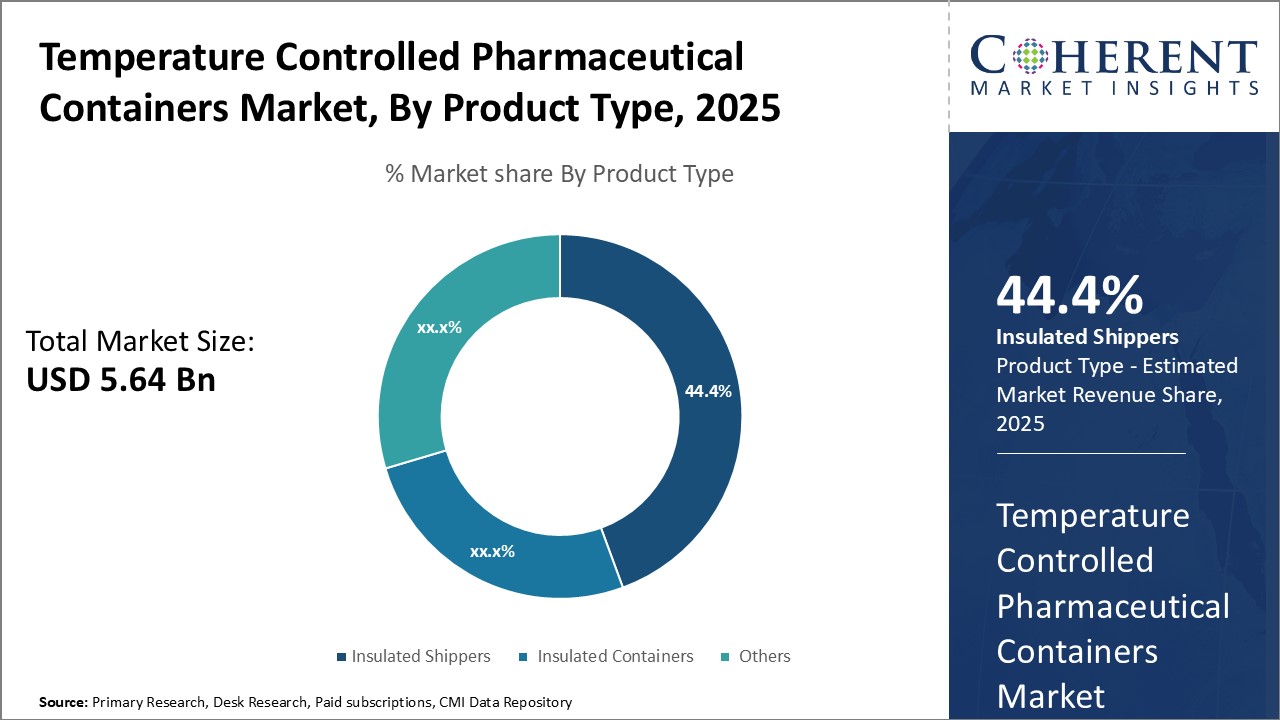
- By Product Type, the Insulated Shippers segment is projected to dominate the global temperature controlled pharmaceutical containers market outlook with a 44.4% share in 2025, driven by their widespread use in shipping sensitive pharmaceutical products safely over long distances.
- By Application, the Frozen segment is expected to lead the market with a 41.9% share in 2025, reflecting the rising demand for ultra-low temperature storage solutions for vaccines and biologics.
- By End User, the Biopharmaceutical Companies segment is anticipated to hold the largest market share of 55.1% in 2025, fueled by increasing biologics production and strict cold chain requirements.
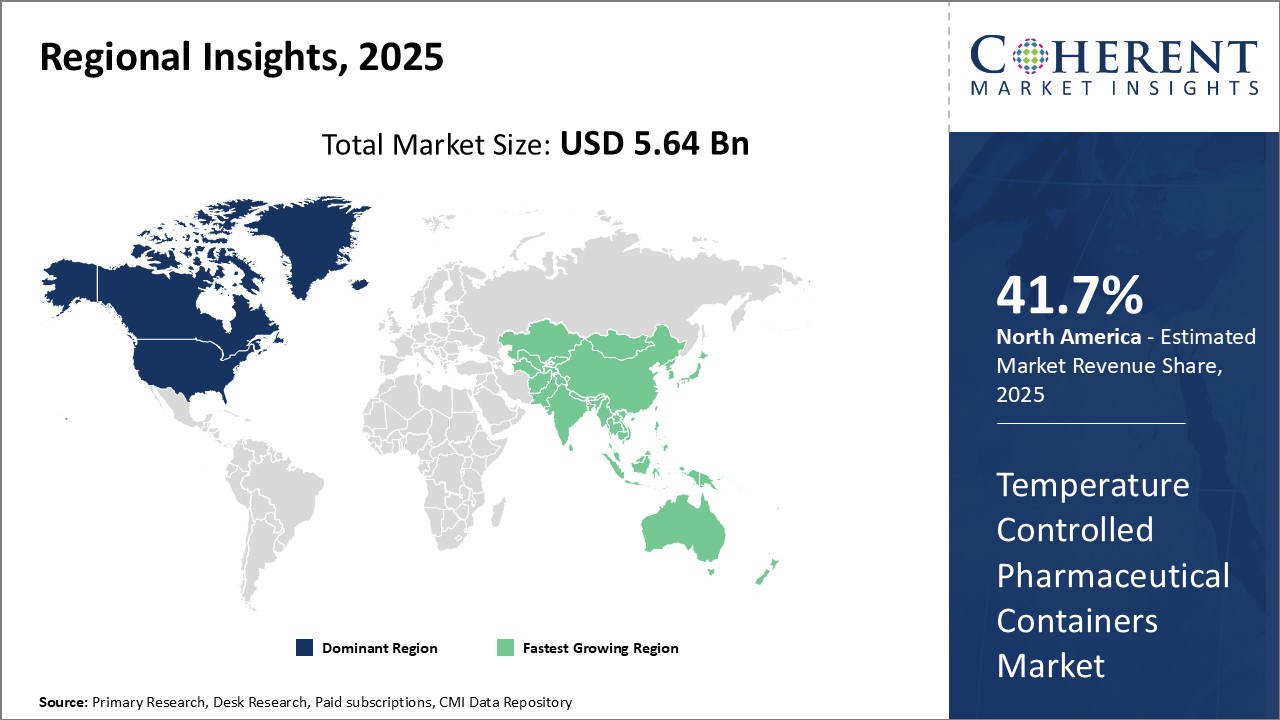
- By Region, North America is forecasted to maintain market leadership with an estimated 41.7% share of the global temperature controlled pharmaceutical containers market in 2025, supported by advanced cold chain infrastructure, stringent regulatory standards, and a strong pharmaceutical manufacturing base.
Market Overview
Global Temperature Controlled Pharmaceutical Containers Market growth is driven by rising demand for temperature-sensitive drugs and biologics due to the increasing prevalence of chronic diseases. Stringent regulations regarding the transportation of pharmaceutical products compels pharmaceutical manufacturers and logistics companies to utilize innovative temperature controlled packaging solutions. Growing focus on cold chain management of vaccines and development of next-generation temperature-controlled packaging such as intelligent & smart containers are expected to create lucrative opportunities for market players. However, high costs associated with advanced temperature controlled solutions can hamper the market growth.
Current Events and Its Impact on the Global Temperature Controlled Pharmaceutical Containers Market
|
Event |
Description and Impact |
|
Geopolitical Disruptions in Critical Shipping Lanes |
|
|
Regulatory Shifts Driving Traceability Requirements |
|
|
Technological Innovations Reshaping Capabilities |
|
Uncover macros and micros vetted on 75+ parameters: Get instant access to report
Pipeline Analysis
- Pelican BioThermal is working specifically on reusable shipping systems tailored for mRNA vaccine shipments which can sustain ultra-low temperatures for 240 hours. These are next-generation shipping systems that will be used in long-distance transport.
- Sonoco ThermoSafe is expected to commercially rollout its smart packaging solutions with GPS, temperature and humidity tracking by late 2025. The packaging comes with IoT-enabled sensors for real-time updates making it ideal for monitoring shipments
- Cold Chain Technologies is integrating modular container systems that allow configurational customization to mixed temperature multi-pharma lettered shipments .
- Softbox Systems targets last-mile delivery sustainable packaging by developing ultra-lightweight insulated containers made from recyclable materials and PMCs (phase change materials).
- Envirotainer actively designs research biologic air cargo containers focusing on AI-based critical temperature excursion prediction reasoning for biologic shipments.
Patent Landscape
The patents pertaining to temperature-sensitive pharmaceutical containers are unprecedented as the innovation in the cold chain logistics and packaging is on the rise. Major stakeholders like Pelican BioThermal, Cold Chain Technologies, and Envirotainer have patented smart IoT containers monitoring temperatures with GPS tracking and data logging. Some of the patents are also related to the innovations in phase change materials (PCMs) and vacuum insulated panels which help keep precise thermal ranges for long periods of time.
One of the emerging concepts within this field is sustainable container technologies as patents on these reusable andeco-friendly sheltering components are on the rise. Moreover, proprietary contracts for sealing systems along guarding product shipment through regulatory compliance with tamper-proof stamps during transport is also becoming popular.
From a geographical perpective, North America and Europe remain at forefront for most patents while Asia-Pacific is trailing them boosted by advances in pharmaceutical manufacture and logistics infrastructure. With tightening regulations globally, companies are pursuing patent protection in order to stand out from competitors to establish dominance because other technologies can add patent claims which makes borders irrelevant.
Reimbursement Scenario
As of October 2023, pharmaceutical containers that are temperature controlled still do not have a unified approach for reimbursement as the entire industry remains fragmented and highly variable across global healthcare systems. Most regions consider these containers to be part of ‘cold chain logistics’ and therefore cannot be treated as standalone reimbursable items.
In the US, reimbursement coverage via Medicare Part B covers limited container types under its Durable Medical Equipment provision which constitutes only about 2.3% of total DME expenditure. These reimbursements often require prior authorization and cost-effectiveness evaluation, typically falling between $245-$890 per container. Specialty pharmacy benefit managers (PBMs) covering private insurers assess temperature-controlled packaging for specialty medications deemed medically necessary and some biologics.
Also in Europe, national agencies such as NHS UK or G-BA Germany review cases within broader contexts of medical device coverage or logistical criteria frequently referring to Good Distribution Practice (GDP) and ISO benchmarks. Increasing cold chain regulatory scrutiny drives encroachment on clinical importance despite no standardized pathways resulting in payers reevaluating cold chain pricing provisions within value-based care frameworks.
A surge in precision medicine along with direct-to-patient models is anticipated to create greater need for sophisticated advanced packaging solution tailored reimbursements.
Prescribers’ Preference
Pharmacists across different therapeutic areas have expressed concern for the integrity, cost, safety, and compliance of temperature-sensitive pharmaceuticals including their preferred container type. In oncology, prescribers favor ultra-cold storage with real-time monitoring and backup systems alongside validated temperature mapping to prevent loss of efficacy during storage. In autoimmune and inflammatory diseases, early-stage biologics such as adalimumab and infliximab require reliable refrigerated containers. Biologic medicines that need stringent patient-centric characteristics such as portability with proactive alerts against untoward changes are more advanced than previous generations.
Vaccinators dealing with COVID-19 vaccines as well as pediatric vaccinators focus on maintaining cold chain compliance while having large volume storage which fulfills WHO and national immunization standards. Endocrinologists prescribing insulin therapies emphasize ease of handling while requiring compact home-friendly temperature-stable containers highlighting fully closed systems against tampering. Prescribers from all areas value comprehensive (clear) regulatory documentation along with data traceability making them compatible with home delivery models—the primary reason why advanced temperature-controlled containers facilitate safe and effective delivery enable safe treatment delivery .
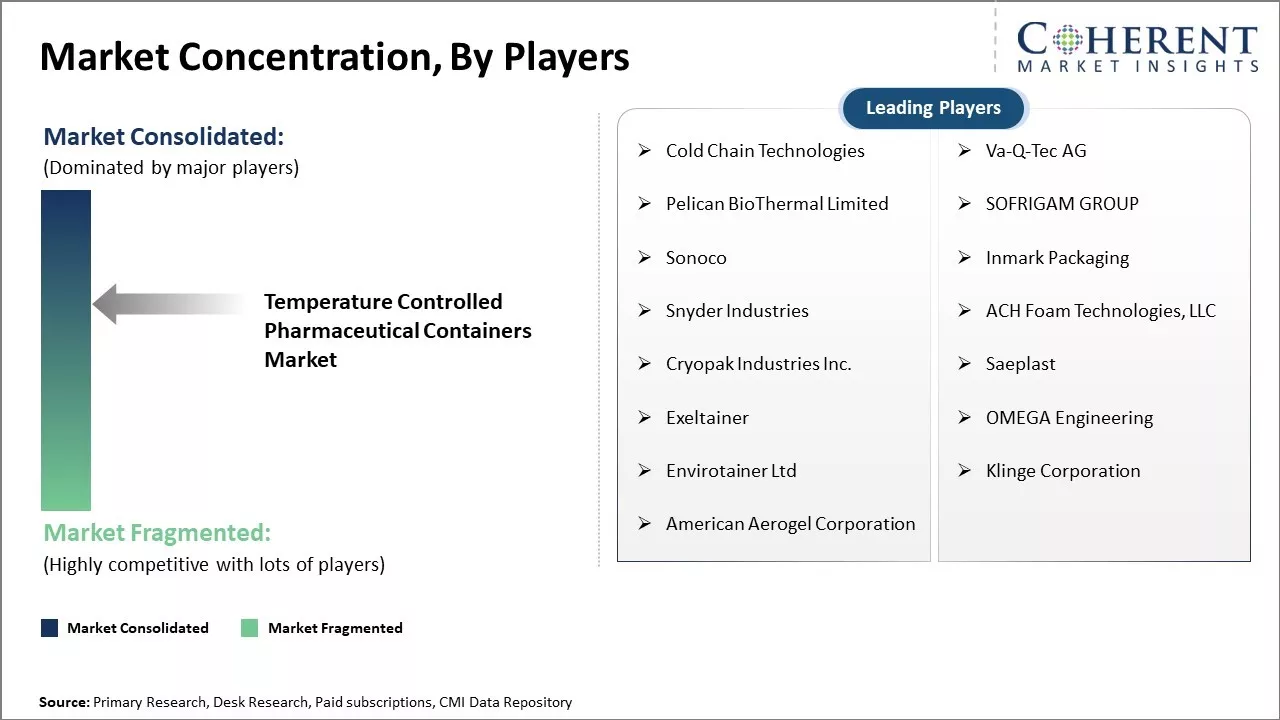
Market Concentration and Competitive Landscape
To learn more about this report, Download Free Sample
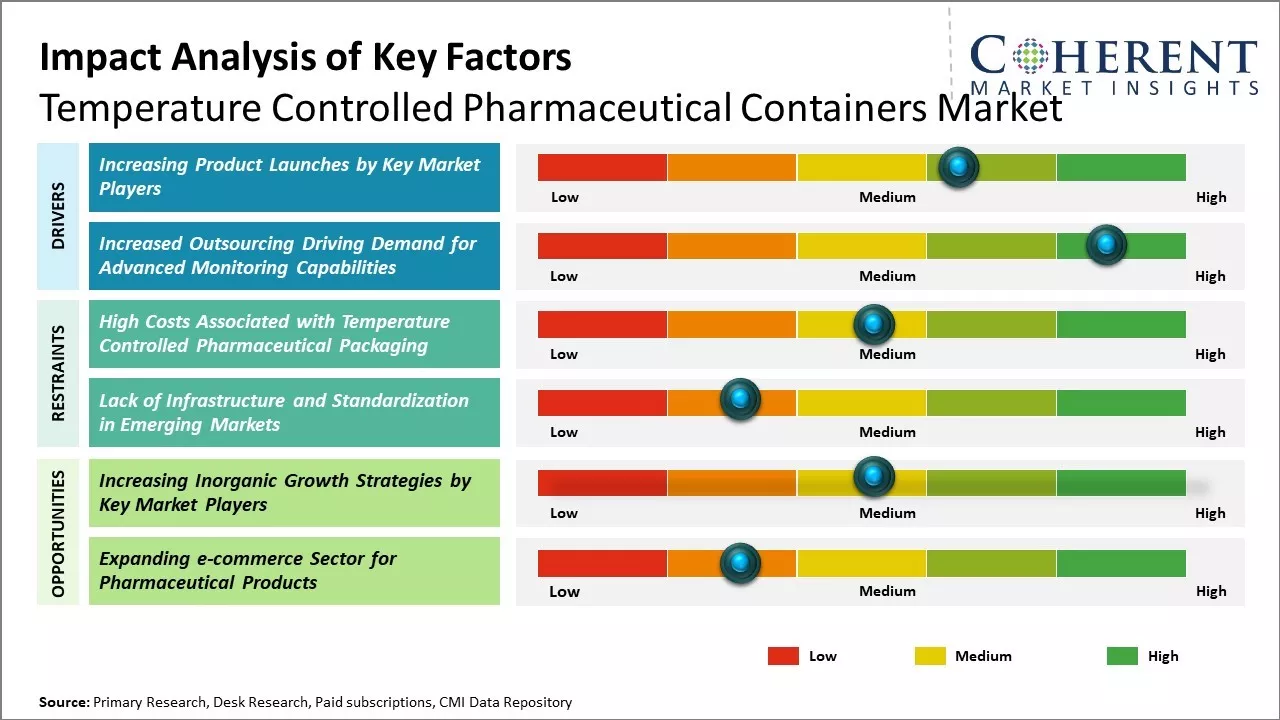
Increasing Product Launches by Key Market Players
Increasing adoption of organic growth strategies such as product launches by key market players is expected to drive the market growth over the forecast period. For instance, in September 2023, Pluss Advanced Technologies (PLUSS), the phase change material technology company, announced the launch of Celsure XL Pallet Shipper series and Celsure VIP Multi-use parcel shipper series, two new temperature-controlled packaging solutions for the pharmaceutical industry, that offers an alternative to conventional gel pack solutions and expensive leased containers.
Growing demand for temperature-controlled packaging solutions
The demand for temperature controlled packaging solutions for pharmaceutical products has been increasing significantly over the past few years. With more medicines and vaccines requiring strict temperature control during storage and transportation, the need for specialized temperature controlled containers and packaging has risen tremendously. This stringent requirement is driven by the fact that exposing drugs and biological products to temperatures outside their recommended range, even briefly, can potentially reduce their efficacy and potency or even render them ineffective.
Market Opportunity – Increasing Inorganic Growth Strategies by Key Market Players
Increasing adoption of inorganic growth strategies, such as agreement, is expected to offer lucrative growth opportunities for the market growth over the forecast period. For instance, in November 2022, Sonoco ThermoSafe, a unit of Sonoco and one of the largest global providers of temperature assurance packaging, and LATAM Cargo, an international cargo airline, announced a global lease agreement for the new Pegasus ULD temperature-controlled bulk shipping container.
Temperature Controlled Pharmaceutical Containers Market - Segmentation Analysis
To learn more about this report, Download Free Sample
Temperature Controlled Pharmaceutical Containers Market Insights, By Product Type
Product Type segment is sub-segmented into insulated shippers, insulated containers, and others. Insulated shippers sub-segment is estimated to hold 44.4% of the market share in 2025 due to continuous innovations. Insulated shippers offer reliable temperature control during transit, thus, making them indispensable for transporting temperature sensitive medications and biological samples.
Leading manufacturers are focusing on developing advanced insulation technologies that can withstand challenging climate conditions and extend product lifetime. For example, new vacuum insulated panels significantly reduce heat transfer, keeping contents within recommended temperature ranges for longer durations as compared to traditional materials. Some companies have also engineered shippers with improved assembly/disassembly mechanisms for reuse that eases costs and environmental impact.
Temperature Controlled Pharmaceutical Containers Market Insights, By Application
Application segment is sub-segmented into frozen, chilled, ambient. Frozen sub-segment is estimated to hold 41.9% of the market share in 2025 as stringent regulations mandate specialized logistics for medications requiring sub-zero storage and transportation. However, developing robust cold chain infrastructure presented challenges initially especially in emerging pharma hubs.
To address this issue, several logistics companies invested in centralized refrigerated warehouses, controlled atmosphere carriers and advanced facility monitoring systems. Courier fleets were upgraded with temperature mapping, GPS tracking and multi-compartment refrigeration, thus, enabling separation of doses with varying freezing requirements.
Temperature Controlled Pharmaceutical Containers Market Insights, By End User
End User segment is sub-segmented into biopharmaceutical companies, research institutes, others. Biopharmaceutical companies sub-segment is estimated to hold 55.1% of the market share in 2025, due to rising share of biologics in drug pipelines. While working on novel targets, these companies rely heavily on contract manufacturers and logistics providers for finished drug supply. Given their resource constraints and focus on R&D, outsourcing non-core operations like packaging, storage and transportation helps speed products to market.
Experienced temperature-controlled packaging vendors provide compliant, cost-effective solutions tailored to each stage of clinical trials and commercialization. As biologics commercialization grows exponentially, large pharma firms also leverage specialized third-party logistics to ensure seamless supply chain execution worldwide, and this reduces investment risks. Technology alliances further help optimize packaging, refrigeration and monitoring approaches.
Temperature Controlled Pharmaceutical Containers Market - Regional Insights
To learn more about this report, Download Free Sample
North America Temperature Controlled Pharmaceutical Containers Market Analysis and Trends
North America is projected to lead the global temperature controlled pharmaceutical containers market, commanding an estimated 41.7% share in 2025. The U.S., with its well-established pharmaceutical sector and advanced healthcare infrastructure, forms the core of this dominance. Key pharmaceutical hubs such as New Jersey, Boston, and San Francisco host major companies whose extensive distribution networks demand reliable cold chain packaging solutions.
Rising healthcare spending combined with growing demand for biologics and specialty drugs is driving manufacturers to prioritize uninterrupted temperature control, fueling adoption of specialized pharmaceutical containers across the region.
Asia Pacific Temperature Controlled Pharmaceutical Containers Market Analysis and Trends
Asia Pacific stands out as the fastest-growing region for temperature controlled pharmaceutical containers during the forecast period. Rapid improvements in healthcare access and a burgeoning middle class have accelerated pharmaceutical industry expansion in countries including China, India, and South Korea. These nations have evolved into vital manufacturing centers for pharmaceuticals and biologics, with increasing medicine exports necessitating robust cold chain logistics.
The active presence of multinational pharmaceutical firms engaged in regional manufacturing and distribution further stimulates demand for temperature-controlled containers, positioning Asia Pacific as a critical growth market.
Dominating Countries in the Temperature Controlled Pharmaceutical Containers Market
United States Temperature Controlled Pharmaceutical Containers Market Analysis and Trends
The U.S. dominates North America’s temperature controlled pharmaceutical containers market, supported by a mature pharmaceutical ecosystem and cutting-edge healthcare facilities. Leading pharmaceutical clusters such as Boston and New Jersey feature companies pioneering cold chain innovations to safeguard biologics and specialty drugs. Strong regulatory frameworks combined with high healthcare expenditure encourage continuous investment in temperature-controlled packaging solutions, solidifying the U.S. as a global leader in this market segment.
China Temperature Controlled Pharmaceutical Containers Market Analysis and Trends
China is a key driver of the Asia Pacific market growth, propelled by government initiatives promoting pharmaceutical manufacturing and export expansion. The country’s focus on enhancing cold chain infrastructure supports large-scale production and shipment of temperature-sensitive medicines.
Collaborative efforts between industry and academia are advancing cold chain technologies to meet increasing domestic and international demand. Despite regulatory complexities, China remains an essential hub for temperature controlled pharmaceutical container innovation and commercialization.
Market Report Scope
Temperature Controlled Pharmaceutical Containers Market Report Coverage
| Report Coverage | Details | ||
|---|---|---|---|
| Base Year: | 2024 | Market Size in 2025: | USD 5.64 Bn |
| Historical Data for: | 2020 To 2024 | Forecast Period: | 2025 To 2032 |
| Forecast Period 2025 to 2032 CAGR: | 10.7% | 2032 Value Projection: | USD 11.49 Bn |
| Geographies covered: |
|
||
| Segments covered: |
|
||
| Companies covered: |
Cold Chain Technologies, Va-Q-Tec AG, Pelican BioThermal Limited, SOFRIGAM GROUP, Sonoco, Inmark Packaging, Snyder Industries, ACH Foam Technologies, LLC, Cryopak Industries Inc., Saeplast, Exeltainer, OMEGA Engineering, Envirotainer Ltd, Klinge Corporation, American Aerogel Corporation |
||
| Growth Drivers: |
|
||
| Restraints & Challenges: |
|
||
Uncover macros and micros vetted on 75+ parameters: Get instant access to report
Analyst Viewpoint
- The market is witnessing strong growth driven by increasing demand for temperature-sensitive biologics, vaccines, and personalized therapies that require strict cold chain integrity.
- Rising adoption of specialty pharmaceuticals and advanced drug delivery systems is reshaping packaging needs across the pharmaceutical industry.
- Stringent global regulations governing pharmaceutical storage and transport are accelerating investments in high-performance temperature-controlled containers.
- High initial capital costs and the complexity of cold chain logistics continue to be major restraints, especially for small and mid-sized pharmaceutical firms.
- Inconsistent regulatory standards across regions create operational inefficiencies and compliance hurdles for multinational manufacturers.
- Maintenance and operational costs of temperature-controlled packaging systems pose long-term cost challenges for end-users.
- Growth opportunities are emerging from the expansion of the biosimilars market and increasing demand for personalized medicines requiring precise storage conditions.
- Direct-to-patient drug delivery models are gaining popularity, creating demand for compact, secure, and traceable temperature-controlled solutions.
- North America continues to lead the market due to its advanced pharmaceutical ecosystem, robust cold chain infrastructure, and strict regulatory oversight.
- Asia-Pacific is expected to be the fastest-growing region, supported by rising pharmaceutical manufacturing output, healthcare investment, and biotechnology development.
Temperature Controlled Pharmaceutical Containers Market Key Developments
- In March 2025, ColdPack Technologies launched a new line of reusable insulated shippers featuring integrated IoT sensors for real-time temperature and location tracking, enhancing cold chain visibility for pharmaceutical shipments.
- In January 2025, ThermoSafe Inc. partnered with a leading biopharmaceutical company to co-develop ultra-lightweight frozen vaccine containers designed to maintain stability at -80°C for extended periods, targeting global vaccine distribution needs.
- In November 2024, Pelican BioThermal introduced biodegradable insulated containers, aiming to reduce environmental impact while maintaining thermal performance for temperature-sensitive drug shipments.
- In September 2024, the US FDA updated cold chain packaging guidelines, requiring stricter temperature excursion reporting for pharmaceutical containers, prompting manufacturers to innovate in monitoring and data logging technologies.
Market Segmentation
- Product Type Insights (Revenue, USD Bn, 2020 - 2032)
- Insulated Shippers
- Insulated Containers
- Others
- Control Type Insights (Revenue, USD Bn, 2020 - 2032)
- Active
- Passive
- Application Insights (Revenue, USD Bn, 2020 - 2032)
- Frozen
- Chilled
- Ambient
- End User Insights (Revenue, USD Bn, 2020 - 2032)
- Biopharmaceutical Companies
- Research Institutes
- Others
- Regional Insights (Revenue, USD Bn, 2020 - 2032)
- North America
- U.S.
- Canada
- Latin America
- Brazil
- Argentina
- Mexico
- Rest of Latin America
- Europe
- Germany
- U.K.
- Spain
- France
- Italy
- Russia
- Rest of Europe
- Asia Pacific
- China
- India
- Japan
- Australia
- South Korea
- ASEAN
- Rest of Asia Pacific
- Middle East
- GCC
- Israel
- Rest of Middle East
- Africa
- South Africa
- North Africa
- Central Africa
- Key Players Insights
- Cold Chain Technologies
- Va-Q-Tec AG
- Pelican BioThermal Limited
- SOFRIGAM GROUP
- Sonoco
- Inmark Packaging
- Snyder Industries
- ACH Foam Technologies, LLC
- Cryopak Industries Inc.
- Saeplast
- Exeltainer
- OMEGA Engineering
- Envirotainer Ltd
- Klinge Corporation
- American Aerogel Corporation
Sources:
Primary Research Interviews
:- Pharmaceutical Cold Chain Logistics Managers
- Temperature Controlled Container Manufacturers
- Pharmaceutical Distribution Directors
- Regulatory Affairs Specialists
- Others
Databases:
- FDA Orange Book Database
- WHO Global Health Observatory
- Pharmaceutical Research and Manufacturers of America (PhRMA) Database
- European Medicines Agency (EMA) Database
- Others
Magazines:
- Cold Chain IQ Magazine
- Pharmaceutical Commerce
- BioPharm International
- Logistics Management
- Others
Journals:
- International Journal of Pharmaceutics
- Pharmaceutical Technology
- Journal of Pharmaceutical Sciences
- Others
Newspapers:
- Financial Times
- The Wall Street Journal
- Reuters Health News
- Bloomberg Healthcare
- Others
Associations:
- International Association for Cold Chain Logistics (IACCL)
- Pharmaceutical Research and Manufacturers of America (PhRMA)
- European Federation of Pharmaceutical Industries and Associations (EFPIA)
- Global Cold Chain Alliance (GCCA)
- Others
Public Domain Sources:
- U.S. Food and Drug Administration (FDA) Publications
- World Health Organization (WHO) Reports
- European Medicines Agency (EMA) Guidelines
- Centers for Disease Control and Prevention (CDC) Data
- Others
Proprietary Elements:
- CMI Data Analytics Tool
- Proprietary CMI Existing Repository of information for last 8 years
*Definition: Temperature controlled pharmaceutical containers consists of pharmaceutical shipping containers and packaging that are designed to maintain temperature-controlled environments for medicines such as vaccines, insulin, biologics, and other drugs requiring strict temperature control during transport. These specialized containers uses various techniques like insulation, gel packs, dry ice, or powered cooling to keep medications within required temperature ranges to ensure their efficacy and safety during distribution through global supply chains.
Share
Share
About Author
Ghanshyam Shrivastava - With over 20 years of experience in the management consulting and research, Ghanshyam Shrivastava serves as a Principal Consultant, bringing extensive expertise in biologics and biosimilars. His primary expertise lies in areas such as market entry and expansion strategy, competitive intelligence, and strategic transformation across diversified portfolio of various drugs used for different therapeutic category and APIs. He excels at identifying key challenges faced by clients and providing robust solutions to enhance their strategic decision-making capabilities. His comprehensive understanding of the market ensures valuable contributions to research reports and business decisions.
Ghanshyam is a sought-after speaker at industry conferences and contributes to various publications on pharma industry.
Missing comfort of reading report in your local language? Find your preferred language :
Transform your Strategy with Exclusive Trending Reports :
Frequently Asked Questions
EXISTING CLIENTELE
Joining thousands of companies around the world committed to making the Excellent Business Solutions.
View All Our Clients