

Global Tugboat Market Size and Forecast: 2026-2033
The Global Tugboat Market is estimated to be valued at USD 1.37 Bn in 2026 and is expected to reach USD 2.47 Bn by 2033, exhibiting a compound annual growth rate (CAGR) of 8.8% from 2026 to 2033.
Key Takeaways of the Tugboat Market
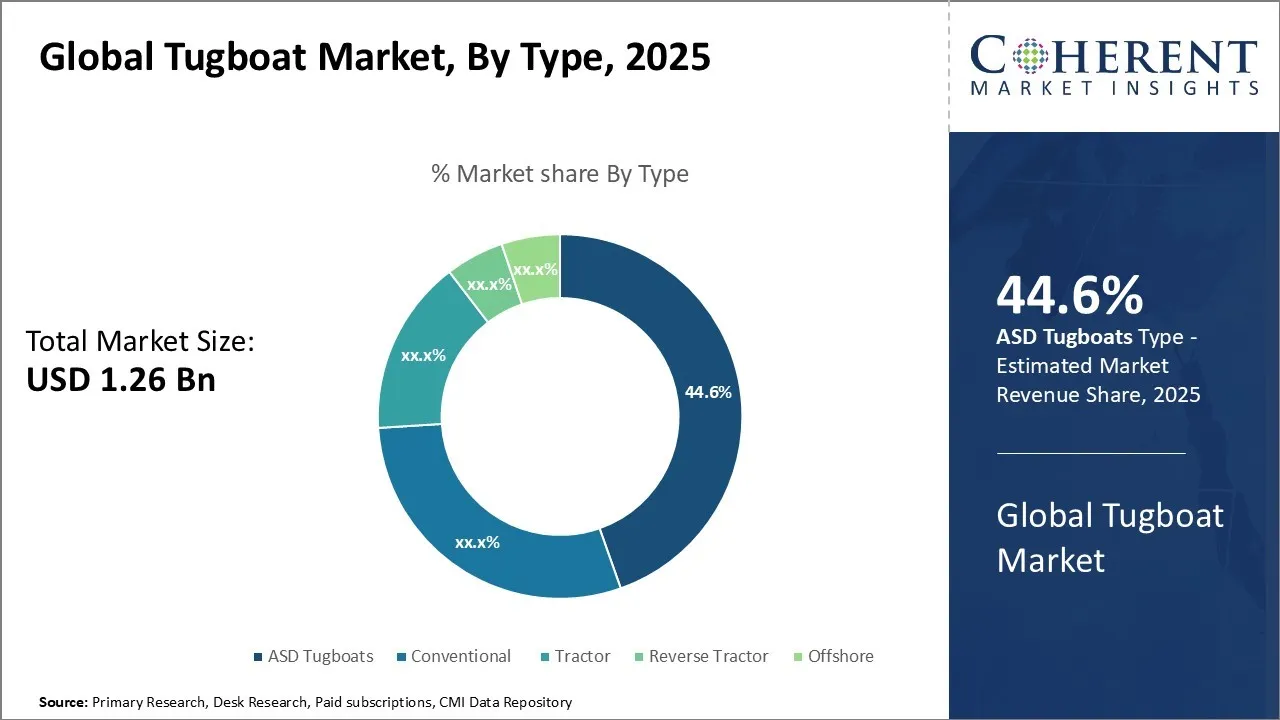
- The ASD tugboats segment leads the market holding an estimated share of 45.6% in 2026.
- The harbor/ship‑assist segment leads the market holding an estimated share of 52.5% in 2026.
- Asia Pacific is estimated to lead the market with a share of 34. 8% in 2026.
- Europe, holding a share of 20. 9% in 2026, is projected to be the fastest growing region.
Market Overview
The market is seeing a shift towards environment-friendly and technologically advanced vessels. Operators are increasingly adopting electric and hybrid-powered tugboats to comply with stringent emission regulations and reduce carbon footprints. Also, the use of automation and digital navigation systems is improving operational efficiency, safety, and cost-effectiveness, pushing the market toward sustainable growth in the coming years.
Current Events and their Impact
Current Events | Description and its impact |
Geopolitical and Trade Developments |
|
Economic and Infrastructure Trends |
|
Segmental Insights
- Current Industry Events of 2026
- Market Size Estimation
- Regional Breakdown
- Competitive Landscape
- Customer Intelligence
- Segmental Analysis
- Pricing Analysis
- Key Market Drivers, Challenges & Future Trends
- Customized Insights Section
Global Tugboat Market Insights, By Type – ASD Tugboats Lead Owing to Superior Maneuverability and Operational Efficiency
ASD tugboats segment is expected to hold 45.6% share in the global tugboat market in 2026. Azimuth Stern Drive (ASD) tugboats come with azimuth thrusters that can rotate 360 degrees, making possible precise directional control and improved propulsion efficiency. This allows these vessels to perform complex maneuvers in confined waterways, crowded harbors, and challenging offshore environments, which are increasingly common as maritime traffic intensifies worldwide.
Ports today need to handle larger vessels and contend with tighter schedules, which creates demand for tugs that can provide quick, accurate, and reliable assistance during docking, undocking, and ship escorting. ASD tugboats’ ability to deliver high bollard pull while maintaining exceptional responsiveness ensures they can support these operations with reduced risk and improved turnaround time.
Also, the versatility of ASD tugboats extends to offshore applications, including support for oil and gas platforms and wind farm logistics. Their robust hull design and enhanced stability make them suitable for challenging open-sea conditions, ensuring operational continuity and safety. Another growth driver is the emphasis on environmental sustainability and regulatory compliance within the maritime industry. ASD tugboats often feature modern propulsion technologies that contribute to lower fuel consumption and reduced emissions compared to older conventional models. Ports and shipping companies are prioritizing eco-friendly solutions to meet stringent environmental regulations and minimize their carbon footprint, making ASD tugboats a preferred choice.
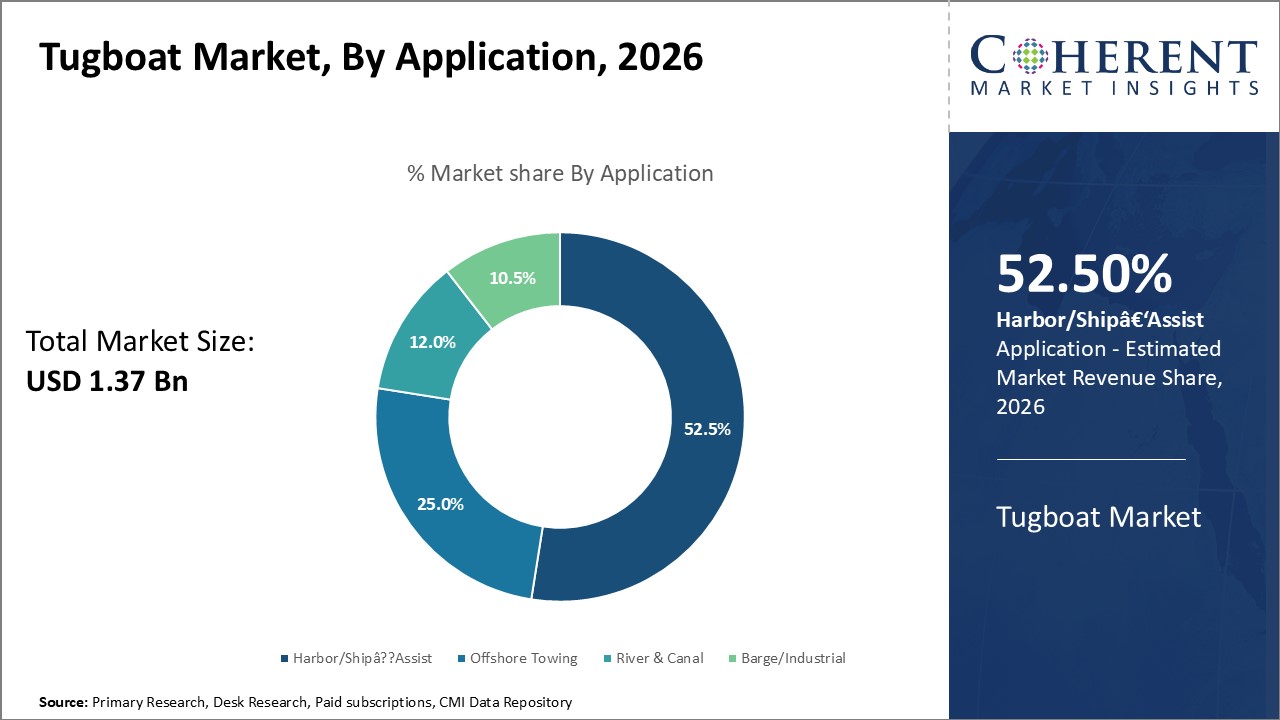
Global Tugboat Market Insights, By Application – Harbor/Ship-Assist Application Leads Driven by Increasing Maritime Traffic and Port Modernization Initiatives
Harbor and ship-assist functions continue to dominate, holding an estimated share of 52.5% in the global tugboat market in 2026. As ports grow larger and vessel sizes increase—particularly with the proliferation of ultra-large container ships—there is a critical need for specialized tugboats that can safely and swiftly assist in berthing, unberthing, and escorting operations. Many governments and private operators have invested heavily in upgrading port facilities, including deepening channels and automating cargo handling processes, which in turn demands the use of highly capable tugboats.
Safety regulations and operational protocols in congested harbor environments also contribute to the high share of this segment. The growing emphasis on protecting vessels and port infrastructure from collision and grounding incidents encourages port authorities to rely on tugboat assistance for precise vessel movements. Harbor tugs are essential in mitigating risks arising from variables like adverse weather, strong currents, and high traffic volumes, making them indispensable in routine and emergency scenarios.
Furthermore, environmental considerations continue to influence harbor/ship-assist operations. Ports globally are adopting “green port” initiatives, encouraging the use of tugboats that combine power with low emissions to reduce pollution in port vicinities. This drives demand for newer, more efficient tugboat models specifically designed for harbor applications, including those utilizing cleaner fuels or hybrid propulsion systems.
The strategic location of major ports along crucial shipping routes reinforces the importance of ship-assist tugboats. With maritime traffic expected to remain robust, the operational demand for harbor tugs to facilitate quick vessel turnaround times becomes paramount. Their role in enabling smooth transitions within port terminals directly supports global trade flow and economic growth.
Price Analysis of the Tugboat Market
Segment/Type | Typical New-Build Price (USD Billion) | Used/Second‑Hand Price (USD Billion) |
ASD Harbor/Ship‑Assist Tugs (25–45 t BP) | 2.5 – 5.0 | 1.0 – 2.5 |
Tractor/Voith‑Schneider Tugs (similar BP) | 1.8 – 4.0 | 0.8 – 2.0 |
Conventional Twin‑Screw Harbor Tugs | 1.2 – 3.0 | 0.5 – 1.5 |
Offshore/Ocean‑Going Escort Tugs (>50 t BP) | 3.0 – 6.0 | 1.5 – 3.0 |
Small River/Canal Tugs (<500 HP) | 0.5 – 1.0 | 0.2 – 0.5 |
Regional Insights
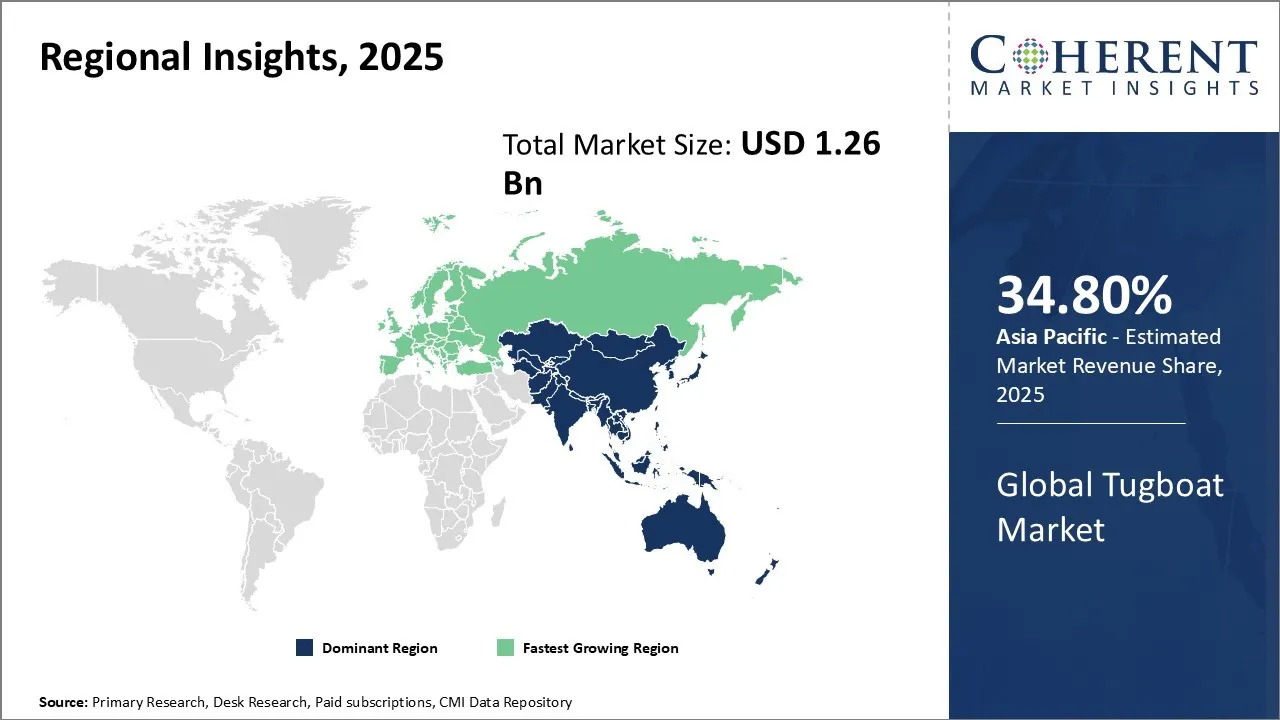
Asia Pacific Tugboat Market Analysis and Trends
Asia Pacific, holding a share of 34.80% in 2026, is expected to dominate the global tugboat market, primarily driven by the region’s expansive maritime trade ecosystem and rapidly growing port infrastructure. Countries like China, Japan, South Korea, and India have some of the busiest ports globally, enhancing the demand for tugboats to assist with maneuvering large vessels. The presence of leading shipbuilding industries and government initiatives to modernize shipping infrastructure further bolster market growth here.
Additionally, ongoing investments in dredging and harbor development projects create significant demand for advanced and powerful tugboats. Key players such as Smit Lamnalco (a part of Boskalis), Japan’s Mitsubishi Shipbuilding, and India's ABG Shipyard contribute robustly to the region’s tugboat production and modernization efforts. Moreover, favorable maritime policies and strengthened supply chain logistics accentuate Asia Pacific’s commanding position in this market.
Europe Tugboat Market Analysis and Trends
Europe, holding an estimated share of 20.9% in 2026, is witnessing rapid growth in the tugboat market, driven by strong environmental regulations, modernization of aging port infrastructure, and the expansion of offshore wind energy projects. The region is at the forefront of maritime decarbonization, with countries like Norway, the Netherlands, Germany, and the U.K. actively investing in hybrid and electric tugboats to meet stringent IMO Tier III and EU Fit for 55 emission standards. Ports such as Rotterdam, Hamburg, and Antwerp are undergoing fleet renewals, with port authorities mandating low-emission or zero-emission vessel operations.
The European Union’s Green Deal and associated funding mechanisms have further accelerated the demand for technologically advanced, eco-efficient tugboats. Leading regional players like Boluda Towage, Kotug International, and Bukser og Berging are at the forefront of this transformation, with partnerships to build or acquire hybrid-electric tugs from builders such as Sanmar Shipyards and Damen Shipyards.
Global Tugboat Market Outlook for Key Countries
China Tugboat Market Analysis and Trends
China is anchored by its status as the world’s largest shipbuilding country with numerous shipyards producing technologically advanced tugboats tailored for mega-ports like Shanghai and Shenzhen. The government’s China Maritime Silk Road initiative fuels port expansions and modernization projects that demand a high number of auxiliary vessels including tugboats. Major local players like China Shipbuilding Industry Corporation (CSIC) push innovation in hybrid and eco-friendly tug models that align with China’s environmental regulations and port operational efficiency goals. The integration of smart port systems in China also enhances the operational deployment of tugboats, supporting heavy shipping traffic safely and efficiently.
U.S. Tugboat Market Analysis and Trends
The U.S. maintains a mature tugboat market dominated by sophisticated ship maneuvering demands along its vast coastline and major ports such as Houston, Los Angeles, and New York. Port modernization programs driven by the America’s Maritime Strategy emphasize eco-friendly and high-power tugboats to meet stringent emissions regulations. Leading companies like Foss Maritime and Kirby Corporation contribute significantly through fleets that serve both coastal and inland waterways. The strategic maritime defense presence and offshore drilling activities in the Gulf of Mexico also create specialized demand segments. Government incentives for vessel retrofitting and new builds underpin technological advancements in this market.
India Tugboat Market Analysis and Trends
India continues to lead its regional tugboat market with rapid port infrastructure expansion along its western and eastern seaboards, including dedicated freight corridors and deep-water port development. The Indian government’s Sagarmala Initiative, focusing on port-led industrialization and coastal shipping, substantially enhances tugboat demand for cargo handling and ship positioning operations. Domestic shipbuilders such as L&T Shipbuilding and ABG Shipyard have introduced modern tugs that emphasize efficiency and compliance with international marine standards. Increasing offshore wind and energy projects further stimulate specialized tugboat usage. India’s growing merchant fleet and intraregional trade augment overall market momentum.
U.A.E. Tugboat Market Analysis and Trends
The U.A.E. is shaped by its positioning as a global maritime hub, with Jebel Ali port being a critical node in Middle Eastern and African trade flows. Ambitious government policies aimed at expanding port capacity and increasing specialized maritime services boost the demand for powerful, versatile tugboats capable of handling megaships and offshore support vessels. Local enterprises like Gulf Navigation and international firms operating in free zones contribute to fleet modernization and adoption of advanced navigation technologies. The U.A.E’s strategic focus on reducing turnaround times and enhancing port operational efficiency drives the tugboat market’s rapid evolution.
Brazil Tugboat Market Analysis and Trends
Brazil benefits from its extensive coastline and significant offshore oil & gas activities in the Campos and Santos basins, which require robust tugboat fleets to support supply chain logistics and offshore drilling platforms. The Brazilian government supports port infrastructure upgrades under its National Logistics and Ports Plan, emphasizing improved cargo handling efficiency. Companies like Wilson Sons actively operate integrated maritime support services, including modern tug fleets that meet environmental and safety standards. Expansion of container terminals and efforts to improve inland waterway navigation also contribute to tugboat utilization incrementation.
Market Players, Key Development, and Competitive Intelligence
Key Developments
- In May 2025, Mediterranean Shipping Company (MSC) increased its stake in Boluda Towage Holding to 49%, finalizing the merger of its tugboat subsidiary MedTug into the Spanish group. Vicente Boluda will retain operational control and management of the enlarged group.
- In April 2025, Moran Towing and Transportation Co and McAllister Towing both welcomed newbuild tugs with emissions compliant with US Environmental Protection Agency (EPA) Tier 4 emissions rules.
- In July 2024, Eastern Shipbuilding Group (ESG), Panama City, Fla., said it has been awarded a contract to build four new 84'x42'x14' ship assist/escort tugs for Saltchuk Marine, Seattle, U.S.
- In July 2024, Tug Construction, LLC teamed up with BP in a new joint venture to provide Jones Act operators with state-of-the-art, emission-compliant tugboats for bareboat charter. The newly formed entity, Ursa Major Marine Holdings, LLC, acquired a tugboat from Tug Construction and placed an order for two additional tugs from Portland, U.S. shipbuilder Diversified Marine, Inc.
Top Strategies Followed by Tugboat Market Players
- Established players dominate the landscape by heavily investing in research and development (R&D) to innovate high-performance tugboats that meet stringent safety and environmental standards.
- Damen Shipyards Group launched the RSD-E Tug 2513, a fully electric zero-emission tug, in 2023. The tug was developed through extensive R&D and is currently in service at the Port of Amsterdam.
- Mid-level players in the tugboat market typically pursue strategies centered around offering cost-effective solutions that strike a balance between quality and affordability.
- Sanmar Shipyards has increased exports of affordable hybrid-ready tugs to countries like Nigeria, Azerbaijan, and Georgia, providing competitive alternatives to Western-built tugs.
- Small-scale tugboat manufacturers distinguish themselves by focusing on specialized features or innovative designs tailored to niche customer requirements.
- Cheoy Lee Shipyards (Hong Kong) specializes in custom-built harbor and river tugboats for Southeast Asia, focusing on smaller bollard pull classes for tight waterway maneuverability.
Market Report Scope
Tugboat Market Report Coverage
| Report Coverage | Details | ||
|---|---|---|---|
| Base Year: | 2025 | Market Size in 2026: | USD 1.37 Bn |
| Historical Data for: | 2020 To 2024 | Forecast Period: | 2026 To 2033 |
| Forecast Period 2026 to 2033 CAGR: | 8.8% | 2033 Value Projection: | USD 2.47 Bn |
| Geographies covered: |
| ||
| Segments covered: |
| ||
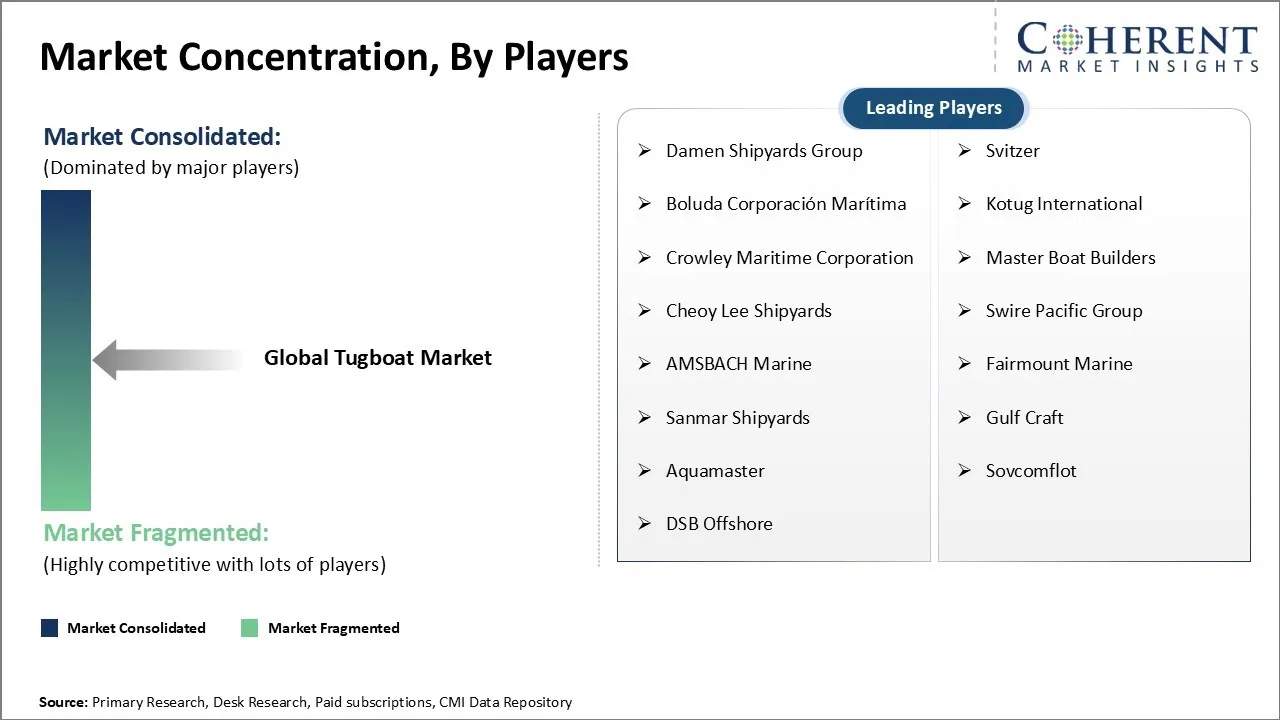
| Companies covered: | Damen Shipyards Group, Svitzer, Boluda Corporación Marítima, Kotug International, Crowley Maritime Corporation, Master Boat Builders, Cheoy Lee Shipyards, Swire Pacific Group, AMSBACH Marine, Fairmount Marine, Sanmar Shipyards, Gulf Craft, Aquamaster, Sovcomflot, and DSB Offshore | ||
| Growth Drivers: |
| ||
| Restraints & Challenges: |
| ||
Market Dynamics
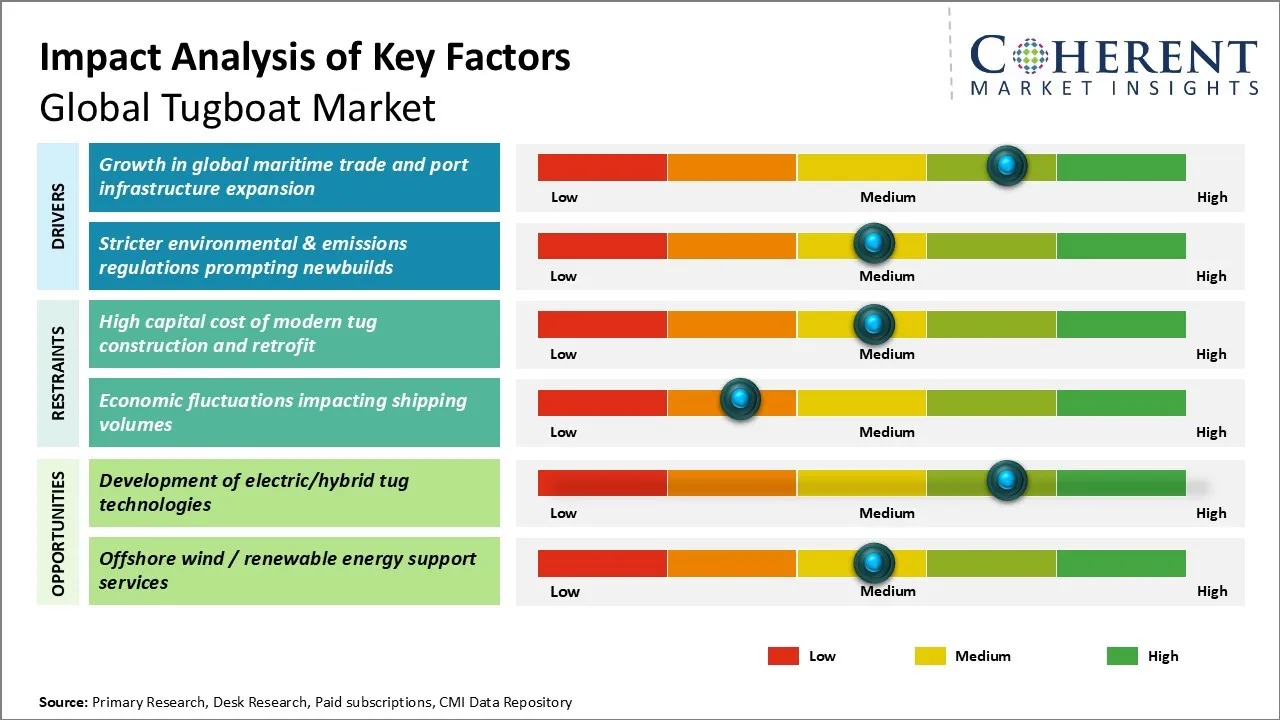
Global Tugboat Market Driver – Growth in Global Maritime Trade and Port Infrastructure Expansion
The continuous growth in global maritime trade acts as a fundamental driver for the tugboat market, as the increasing volume of cargo transported via sea necessitates enhanced port operations and vessel maneuvering support. With the surge in international trade activities, ports are expanding their infrastructure by deepening harbors, enlarging docking areas, and upgrading terminal facilities to accommodate larger and more sophisticated vessels. This rapid development creates higher demand for efficient tugboat services to ensure safe berthing, unberthing, and navigation within congested or constrained port environments.
For instance, the Colombo Port is undergoing a USD 1.4 billion expansion under the South Asia Gateway Terminals (SAGT) and Port City Colombo projects, supported by investments from India, China, and global operators. Moreover, the rise in mega container ships and bulk carriers further emphasizes the need for powerful, technologically advanced tugboats capable of managing these larger vessels with precision and reliability.
Global Tugboat Market Opportunity – Development of Electric and Hybrid Tug Technologies
Increasing environmental regulations and the growing emphasis on reducing carbon emissions in the maritime industry are driving demand for cleaner, more energy-efficient tugboats. Electric and hybrid tugs offer substantial advantages such as lower fuel consumption, reduced greenhouse gas emissions, and decreased operational noise, making them highly attractive to port authorities and shipping companies aiming to align with sustainability goals. Advancements in battery technology, energy storage systems, and electric propulsion methods are improving the operational efficiency and range of these vessels, addressing previous limitations related to power and operational duration.
Moreover, government incentives and subsidies in various regions, particularly in Europe and North America, are accelerating investments in green maritime technologies, further promoting the deployment of electric and hybrid tugboats. In addition to environmental benefits, these tugs also provide long-term cost savings through reduced fuel expenses and lower maintenance requirements compared to conventional diesel-powered tugboats. The integration of smart technologies and automation in electric/hybrid tugs further enhances operational safety and efficiency, presenting opportunities for innovation and competitive differentiation among manufacturers and service providers in the tugboat market.
Analyst Opinion (Expert Opinion)
- Major economies like China, India, Indonesia, and Vietnam are aggressively investing in port infrastructure under national programs (e.g., China's Belt & Road, India’s Sagarmala). This is translating into strong demand for new harbor and escort tugs, particularly ASD and hybrid-ready variants, to handle rising cargo volumes and mega-vessels.
- European ports are not only expanding but also decarbonizing rapidly. Countries like Norway, the Netherlands, and Germany are leading demand for electric and hybrid tugboats, driven by IMO Tier III regulations and EU Fit for 55 policies. Fleet replacement and retrofitting activities are accelerating across North Sea and Baltic ports.
- The U.S. and Canada are witnessing consistent but mature demand, primarily driven by fleet renewal in response to EPA Tier IV and California’s zero-emission harbor craft mandates. Ports like Los Angeles, Seattle, and Houston are increasingly turning to low-emission tugs, fostering demand for domestic shipbuilders offering compliant solutions.
Speak to the analyst
Want personalized insights?
Take the findings above to one of our principal consultants, or have the report rebuilt around the segments, geographies and competitors you actually track.
Market Segmentation
- Type Insights (Revenue, USD Bn, 2021 - 2033)
- ASD Tugboats
- Conventional
- Tractor
- Reverse Tractor
- Offshore
- Application Insights (Revenue, USD Bn, 2021 - 2033)
- Harbor/Ship‑Assist
- Offshore Towing
- River & Canal
- Barge/Industrial
- Regional Insights (Revenue, USD Bn, 2021 - 2033)
- North America
- U.S.
- Canada
- Latin America
- Brazil
- Argentina
- Mexico
- Rest of Latin America
- Europe
- Germany
- U.K.
- Spain
- France
- Italy
- Russia
- Rest of Europe
- Asia Pacific
- China
- India
- Japan
- Australia
- South Korea
- ASEAN
- Rest of Asia Pacific
- Middle East
- GCC Countries
- Israel
- Rest of Middle East
- Africa
- South Africa
- North Africa
- Central Africa
- North America
- Key Players Insights
- Damen Shipyards Group
- Svitzer
- Boluda Corporación Marítima
- Kotug International
- Crowley Maritime Corporation
- Master Boat Builders
- Cheoy Lee Shipyards
- Swire Pacific Group
- AMSBACH Marine
- Fairmount Marine
- Sanmar Shipyards
- Gulf Craft
- Aquamaster
- Sovcomflot
- DSB Offshore
Sources
Primary Research Interviews
Stakeholders
- Port Authorities and Harbor Masters (e.g., Port of Rotterdam, Port of Singapore)
- Tugboat Operators and Fleet Managers (e.g., Boluda Towage, Svitzer, Crowley Maritime)
- Tugboat Shipbuilders and Engineers (e.g., Damen Shipyards, Sanmar, Master Boat Builders)
- Naval Architects and Maritime Consultants
- Marine Fuel & Engine System Suppliers (e.g., Wärtsilä, Caterpillar Marine)
- Maritime Regulatory Experts (IMO, EU Maritime Commission)
Databases
- International Maritime Organization (IMO) Statistics
- UNCTAD Maritime Transport Database
- MarineTraffic Port Operations Index
- World Association for Waterborne Transport Infrastructure (PIANC)
- Global Port Infrastructure Index (GPII)
Magazines
- Tug & Salvage International
- Maritime Executive
- WorkBoat Magazine
- Marine Log
- Ship Technology Global
- Port Strategy Magazine
Journals
- Journal of Marine Science and Engineering
- Ocean Engineering Journal
- Journal of Ship Production and Design
- Journal of Coastal and Port Engineering
- Marine Policy Journal
Newspapers
- Lloyd’s List
- TradeWinds Maritime News
- The Maritime Standard
- The Hindu BusinessLine (India)
- The Straits Times (Singapore)
Associations
- International Tug & Salvage Association (ITSA)
- International Chamber of Shipping (ICS)
- European Tugowners Association (ETA)
- American Waterways Operators (AWO)
- Indian National Shipowners’ Association (INSA)
Public Domain Sources
- United Nations Conference on Trade and Development (UNCTAD)
- World Bank – Global Maritime Logistics Indicators
- European Commission Transport and Mobility Data
- MarineInsight Knowledge Base
- ResearchGate
Proprietary Elements
- CMI Data Analytics Tool, Proprietary CMI Existing Repository of information for last 8 years
Get access to 250+ pages report
Every segment, forecast, competitor profile and data table behind the analysis above — available for instant download.
- ESOMAR Member
- ISO 9001:2015 Certified
- D-U-N-S Registered
- GDPR & CCPA Compliant
Missing comfort of reading report in your local language? Find your preferred language:
Transform your Strategy with Exclusive Trending Reports
Frequently Asked Questions
The global tugboat market is estimated to be valued at USD 1.37 Bn in 2026 and is expected to reach USD 2.47 Bn by 2033.
The CAGR of global tugboat market is projected to be 8.8% from 2026 to 2033.
Growth in global maritime trade and port infrastructure expansion and stricter environmental & emissions regulations prompting newbuilds are the major factors driving the growth of the global tugboat market.
High capital cost of modern tug construction and retrofit and economic fluctuations impacting shipping volumes are the major factors hampering the growth of the global tugboat market.
In terms of type, the ASD tugboats segment is estimated to dominate the market revenue share in 2026.
Damen Shipyards Group, Svitzer, Boluda Corporación Marítima, Kotug International, Crowley Maritime Corporation, Master Boat Builders, Cheoy Lee Shipyards, Swire Pacific Group, AMSBACH Marine, Fairmount Marine, Sanmar Shipyards, Gulf Craft, Aquamaster, Sovcomflot, and DSB Offshore are the major players.
Asia Pacific is expected to lead the global tugboat market in 2026.