

U.S., Europe and Rest of the World Life Sciences Commercialization Vendor Platform Market Size and Forecast – 2026 To 2033
The U.S., Europe and Rest of the World life sciences commercialization vendor platform market is expected to grow from USD 14,625.3 Mn in 2026 to USD 26,121.7 Mn by 2033, registering a compound annual growth rate (CAGR) of 8.6% from 2026 to 2033. The U.S., Europe and Rest of the World life sciences commercialization vendor platform market is poised for significant expansion, fueled by the increasing number of novel drug approvals and the rising complexity of commercial launches, particularly for specialty medicines and biologics.
According to U.S. Food Drug and Administration, in 2024 Center for Drug Evaluation and Research (CDER) approved 50 novel drugs, including 26 orphan drug therapies, while 66% of these approvals benefited from expedited regulatory programs, reinforcing the increasing commercialization workload and the need for advanced vendor platforms to support patient engagement, market access, and omnichannel commercialization strategies.
Key Takeaways of the U.S., Europe and Rest of the World Life Sciences Commercialization Vendor Platform Market
- Launch strategy and management is projected to hold a market share of 23.1 % of the U.S., Europe and rest of the world life sciences commercialization vendor platform market share in 2026, making it the dominant functionality segment, driven by the growing complexity of specialty drug launches and increasing emphasis on coordinated market access and stakeholder engagement. For instance, in 2025, the European Medicines Agency (EMA) expanded its pre-authorization engagement framework to facilitate earlier interactions with patient and healthcare professional organizations during medicine evaluation, supporting more effective commercialization planning and launch preparedness.
- Master Data Management (MDM) is projected to hold 29.0 % of the U.S., Europe and Rest of the World life sciences commercialization vendor platform market share in 2026, making it the dominant type segment, supported by the increasing need for standardized healthcare professional (HCP), healthcare organization (HCO), and product data across commercial operations. For instance, in 2024, the International Council for Harmonization (ICH), supported by the U.S. FDA and the European Medicines Agency, advanced harmonization initiatives for the use of real-world data (RWD) and real-world evidence (RWE), reinforcing the importance of standardized and interoperable data management across the pharmaceutical product lifecycle.
- Biotechnology segment is projected to hold 54.8 % of the U.S., Europe and Rest of the World life sciences commercialization vendor platform market share in 2026, making it the dominant industry segment, owing to the increasing commercialization of biologics and advanced therapy medicinal products (ATMPs). For instance, in January 2025, the European Medicines Agency (EMA) recommended 114 medicines for marketing authorization in 2024, including several advanced therapies and orphan medicines, reflecting the expanding biotechnology pipeline requiring specialized commercialization and market access capabilities.
- Rising Commercialization of Cell & Gene Therapies: The increasing commercialization of cell and gene therapies presents a significant growth opportunity for commercialization vendor platforms. These therapies require highly specialized launch planning, patient identification, treatment center coordination, reimbursement management, and long-term patient monitoring, driving the demand for integrated digital platforms capable of orchestrating complex commercialization workflows across multiple stakeholders.
- Expansion of Omnichannel Engagement in Rare Disease Commercialization: The growing focus on rare diseases is accelerating the adoption of omnichannel commercialization platforms that enable personalized engagement with healthcare professionals, patients, caregivers, and advocacy groups. Vendor platforms offering AI-driven customer engagement, medical affairs coordination, and real-time analytics are increasingly being adopted to improve outreach efficiency, optimize market access strategies, and support highly targeted commercial launches in niche therapeutic areas.
Segmental Insights
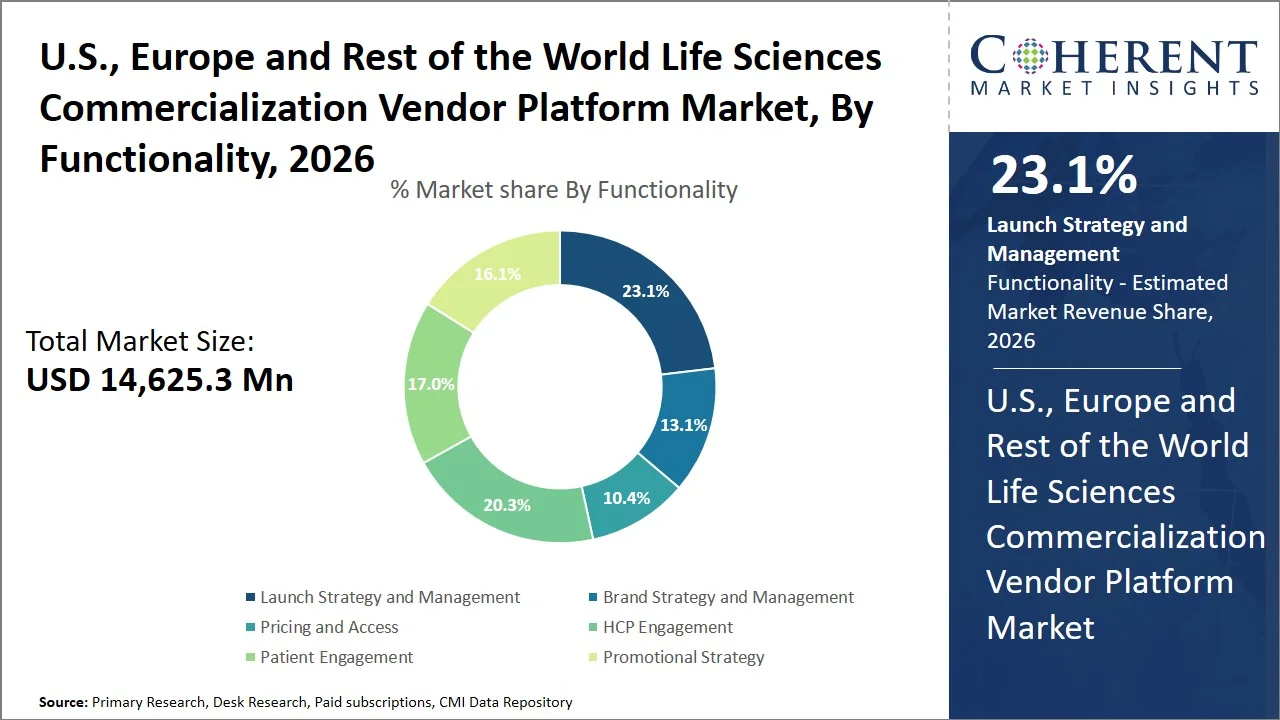
Why Does Launch Strategy and Management Dominate the U.S., Europe and Rest of the World Life Sciences Commercialization Vendor Platform Market?
Launch strategy and management is projected to hold a market share of 23.1% in 2026, as life science companies demand cohesive solutions for integrating all stages of the product launch cycle: launch planning, regulatory approval, market access readiness, and the cross-functional commercial launch across multiple geographies. The expanding product launch landscape characterized by specialty drugs, biologics and multi-country deployments is boosting the demand for these systems to drive preparedness, engagement and informed decision-making. For instance, in October 2025, the European Commission published updated and new EudraLex Volume 10 clinical trials guidelines to reflect a raft of new recommendations covering areas such as decentralized clinical trials, reporting Member State selection, and common Part I/Part II issues. Continuing the process of harmonizing clinical development and ensuring the pharmaceutical industry can more effectively align regulatory planning with downstream commercial activities.
- Current Industry Events of 2026
- Market Size Estimation
- Regional Breakdown
- Competitive Landscape
- Customer Intelligence
- Segmental Analysis
- Pricing Analysis
- Key Market Drivers, Challenges & Future Trends
- Customized Insights Section
Why is Master Data Management (MDM) the Most Preferred Type in the U.S., Europe and Rest of the World Life Sciences Commercialization Vendor Platform Market?
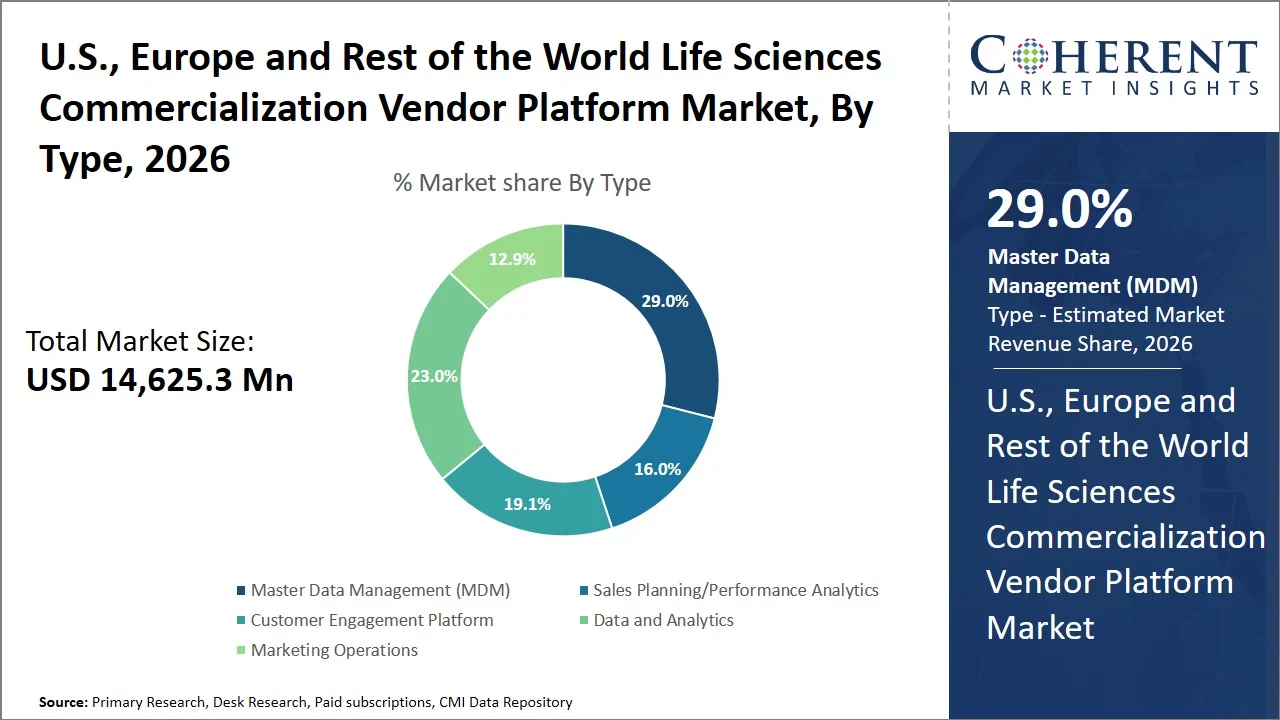
Master Data Management (MDM) is projected to hold 29.0% of the market share in 2026, as life sciences organizations increasingly require a consistent, accurate, and standardized healthcare professional (HCP), healthcare organization (HCO), products, and commercial data. The master data management (MDM) solutions also assist organizations with data governance, the reduction of data silos, the utilization of AI capabilities for advanced analytics, enabling consistent engagement and supporting effective global commercial operations. For instance, in May 2025, the European Medicines Agency (EMA) convened the Product Management Service (PMS) Information Day, drawing attention to the importance of harmonized product master data and digital interoperability to enable regulatory workflows and accelerate transformation towards a digital European medicines network, underlining the growing relevance of master data management throughout the drug life cycle.
Biotechnology Segment Dominates the U.S., Europe and Rest of the World Life Sciences Commercialization Vendor Platform Market
The biotechnology segment is expected to hold 54.8% of the U.S., Europe and rest of the world life sciences commercialization vendor platform market share in 2026, driven by the robust growth of biologic-based medicines and therapies like cell and gene therapies and precision medicines that need targeted approaches for commercialization, market access, and stakeholder engagement. Biotechnology firms increasingly leverage advanced commercialization solutions to support global launch of complex products, navigate the regulatory pathway and enable better commercial choices leveraging data. For instance, in October 2025, the European Medicines Agency (EMA) has approved Brinsupri, the first in a new class of therapy indicated for patients with non-cystic fibrosis bronchiectasis which had received support under the PRIority MEdicines (PRIME) scheme.
Currents Events and their Impact
Current Events | Description and its Impact |
Implementation of the EU Health Technology Assessment (HTA) Regulation (January 2025) |
|
EU Pharmaceutical Legislation Reform Agreement (December 2025) |
|
U.S., Europe and Rest of the World Life Sciences Commercialization Vendor Platform Market Dynamics
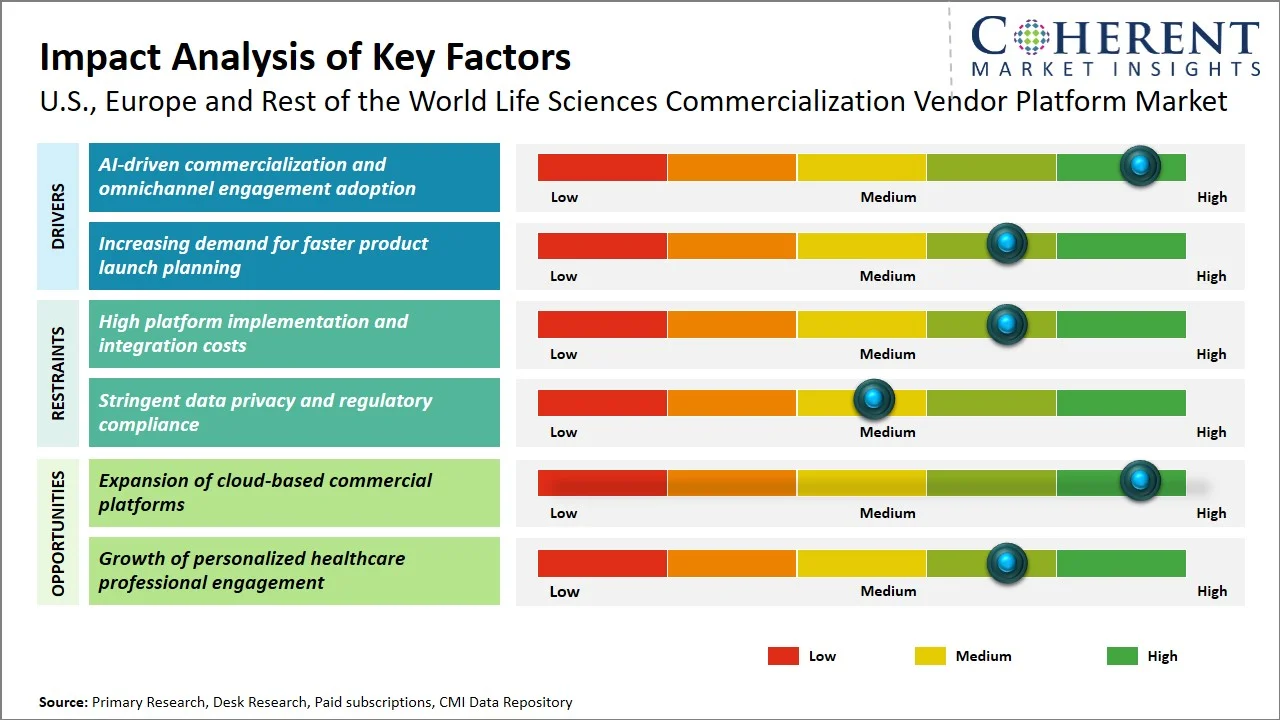
Market Drivers
- AI-driven commercialization and omnichannel engagement adoption: Companies leverage AI embedded into omnichannel commercialization platforms to enable more tailored engagement, predict behavior and offer immediate commercial insights to HCPs, patients and payers. Integrated AI-enabled platforms are improving campaign optimization, creating personalized content and informing commercial decision-making while facilitating communication that works on the digital and in-person level. For instance, in June 2025, the U.S. Food and Drug Administration (FDA) unveiled Elsa, a generative Artificial Intelligence (AI) tool designed to help employees work more efficiently, highlighting the rising adoption of AI across the life sciences ecosystem.
- Increasing demand for faster product launch planning: Life sciences businesses are investing in digital commercialization platforms that are enabling their launch planning process with growing specialty drugs and biologic launches. The new platform helps life sciences companies plan and launch new drugs for multiple countries. Such a solution facilitates efficient planning and execution of cross-functional tasks from regulatory approval and market access, to in-market commercial execution. For instance, in January 2025, the European Union initiated its Health Technology Assessment (HTA) Regulation and began rolling out the use of Joint Clinical Assessments (JCAs) for selected medicines, which has accelerated the use of integrated commercialization platforms in the industry to support and align their efforts on generating evidence, sequence launch and access in EU Member States.
Emerging Trends
- AI-Powered Commercial Intelligence and Next-Best-Action Platforms: The life sciences industry is beginning to embed AI into commercialization platforms to glean real-time insights into physician engagement, prescribing behavior, and overall market trends. AI-driven next-best-action suggestions are empowering better salesforce effectiveness, customized campaigns and enhanced commercial decision-making throughout a product's life cycle.
- Convergence of Commercial, Medical Affairs, and Market Access Platforms: Organizations are moving away from siloed commercial systems toward unified platforms that connect commercial operations, medical affairs, regulatory information, and market access functions. This integrated approach allows for smooth data exchange, consistent stakeholder engagement, and quicker adaptation to changing reimbursement and compliance requirements in global markets.
Core Commercialization Platform Modules and Their Strategic Value in the U.S. Europe and Rest of the World Life Sciences Commercialization Vendor Platform Market
Platform Module | Primary Business Function | Strategic Value to Life Sciences Companies |
Launch Strategy & Management | Product launch planning | Accelerates time-to-market and launch readiness |
Master Data Management (MDM) | Healthcare Professional/ Healthcare Organization and product data governance | Improves data quality and compliance |
Omnichannel Engagement | Customer engagement orchestration | Enhances personalized stakeholder interactions |
Commercial Analytics | Sales and market insights | Enables data-driven commercial decisions |
Incentive Compensation | Sales performance management | Optimizes sales force productivity |
Territory & Alignment Management | Sales territory optimization | Improves field force effectiveness |
How is the expansion of cloud-based commercial platforms creating new growth opportunities in the U.S., Europe and Rest of the World life sciences commercialization vendor platform market?
In a new trend toward commercialization in the cloud, life sciences organizations can achieve a single, harmonized source of data for commercial, regulatory, and customers. Commercial organizations using the cloud have the ability to gain improved scalability, collaborative power, and faster launch processes. Life science companies such as pharmaceutical companies and biotechnology organizations have favored this new technology for rapid adoption, increased compliance, and global functionality through cloud-native technologies. For instance, under the FY2025 Prescription Drug User Fee Act (PDUFA) commitments, U.S. FDA began the modernization of Electronic Submission Gateway (ESG NextGen) toward a cloud-based secure platform to accommodate higher data volumes, increase interconnectivity, and allow more responsive industry-agency communication and interactions.
Market Players, Key Development, and Competitive Landscape
Key Developments
- In March 2026, Model N announced a strategic partnership with CCX to expand its global market access capabilities for life sciences companies. The collaboration integrates Model N's commercialization and revenue management expertise with CCX's market access solutions, enabling pharmaceutical and biotechnology companies to better align product launch strategies, pricing, reimbursement planning, and commercial decision-making across global markets
- In August 2025, EVERSANA announced the development of an end-to-end AI-powered life sciences marketing agency built on Google Cloud technology. The platform integrates generative AI, advanced analytics, and cloud capabilities to streamline commercial content creation, campaign execution, and personalized customer engagement for pharmaceutical and biotechnology companies.
- In November 2023, AstraZeneca launched Evinova, a dedicated health-tech business designed to accelerate innovation across the life sciences sector through digital solutions for clinical trials and healthcare delivery. The launch strengthens digital commercialization capabilities by improving trial efficiency, patient engagement, and data-driven decision-making, supporting the growing adoption of life sciences commercialization platforms.
Competitive Landscape
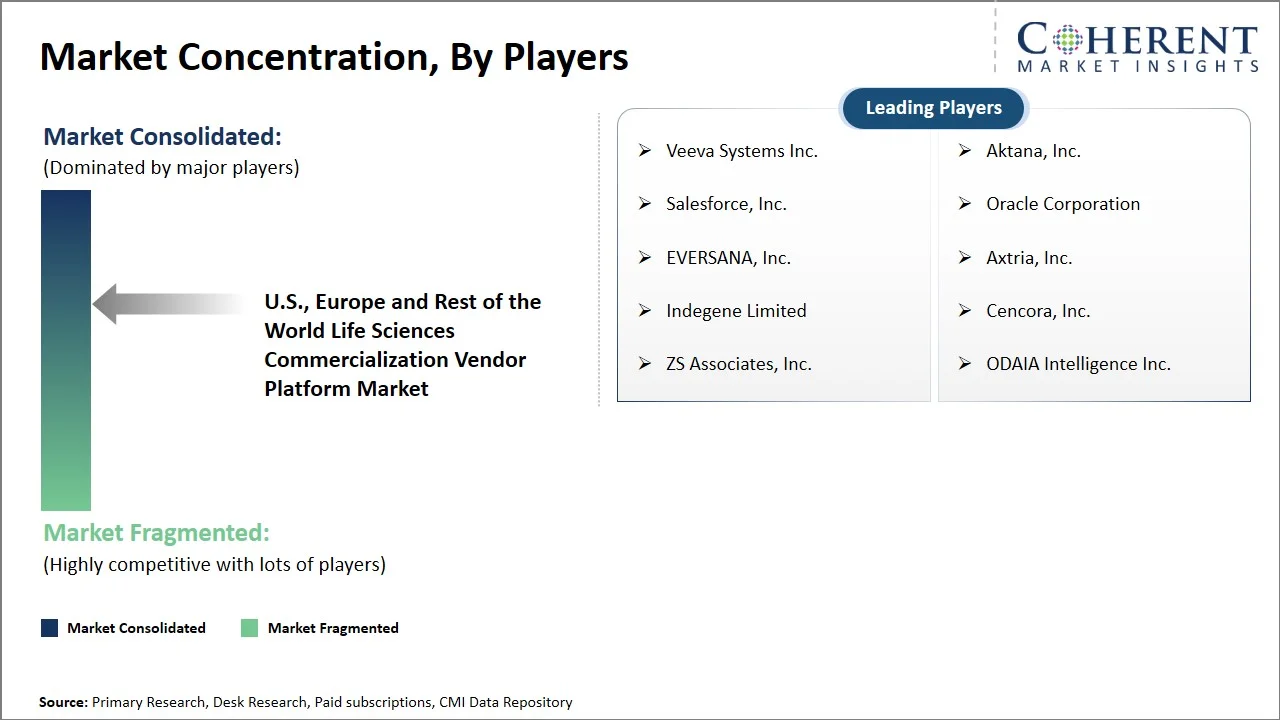
The U.S., Europe and rest of the world life sciences commercialization vendor platform market is moderately consolidated, with leading technology providers competing through AI-enabled commercialization capabilities, cloud-native platform development, and integrated end-to-end commercial solutions. Companies are strengthening their market positions through strategic partnerships with pharmaceutical and biotechnology firms, acquisitions to expand digital capabilities, and continuous investments in data interoperability, analytics, and regulatory-compliant commercial workflows. Key focus areas include:
- AI-Driven Commercial Analytics, Predictive Insights & Omnichannel Customer Engagement
- Cloud-Based Commercialization Platforms, Master Data Management (MDM) & Data Interoperability
- Integrated Product Launch Planning, Market Access, Pricing & Reimbursement Strategy
- Sales Force Effectiveness, Territory Alignment & Incentive Compensation Management
- Regulatory-Compliant Commercial Workflows, Real-World Data (RWD) Integration & Commercial Intelligence
- Strategic Partnerships, Platform Integrations & AI-Enabled Digital Commercial Transformation
Market Report Scope
U.S., Europe and Rest of the World Life Sciences Commercialization Vendor Platform Market Report Coverage
| Report Coverage | Details | ||
|---|---|---|---|
| Base Year: | 2025 | Market Size in 2026: | USD 14,625.3 Mn |
| Historical Data for: | 2020 To 2024 | Forecast Period: | 2026 To 2033 |
| Forecast Period 2026 to 2033 CAGR: | 8.6% | 2033 Value Projection: | USD 26,121.7 Mn |
| Segments covered: |
| ||
| Companies covered: | Veeva Systems Inc., Aktana, Inc., Salesforce, Inc., Oracle Corporation, EVERSANA, Inc., Axtria, Inc., Indegene Limited, Cencora, Inc., ZS Associates, Inc., and ODAIA Intelligence Inc. | ||
| Growth Drivers: |
| ||
| Restraints & Challenges: |
| ||
Analyst Opinion (Expert Opinion)
- In the coming years, the U.S., Europe and rest of the world life sciences commercialization vendor platform market is expected to evolve toward AI-powered, cloud-native, and highly integrated commercialization ecosystems that unify launch planning, commercial operations, market access, and omnichannel engagement. As specialty drugs, biologics, and advanced therapies continue to grow, demand will increasingly shift from standalone commercial applications to end-to-end platforms that enable real-time decision-making and seamless cross-functional collaboration.
- Most opportunities can be foreseen within launch strategy and management platforms for biotechnology and specialty pharmaceutical companies, particularly in the United States, where the high volume of innovative drug approvals, complex payer landscape, and rapid adoption of digital commercial technologies continue to drive investment in commercialization infrastructure. Europe also presents substantial opportunities as pharmaceutical companies adopt integrated platforms to support multi-country launches and evolving market access requirements.
- To strengthen their competitive position, market players should invest in AI-enabled commercial intelligence, predictive analytics, and cloud-native platform architectures while expanding interoperability with CRM, regulatory, clinical, and market access systems. Strengthening strategic partnerships with pharmaceutical and biotechnology companies, embedding advanced analytics and automation into commercialization workflows, and delivering configurable, compliant, and scalable SaaS solutions will be critical differentiators in an increasingly competitive market.
Speak to the analyst
Want personalized insights?
Take the findings above to one of our principal consultants, or have the report rebuilt around the segments, geographies and competitors you actually track.
Market Segmentation
- Functionality Insights (Revenue, USD Mn, 2021 - 2033)
- Launch Strategy and Management
- Brand Strategy and Management
- Pricing and Access
- HCP Engagement
- Patient Engagement
- Promotional Strategy
- Type Insights (Revenue, USD Mn, 2021 - 2033)
- Master Data Management (MDM)
- Sales Planning/Performance Analytics
- Customer Engagement Platform
- Data and Analytics
- Marketing Operations
- Industry Insights (Revenue, USD Mn, 2021 - 2033)
- Biotechnology
- Pharmaceuticals
- Key Players Insights
- Veeva Systems Inc.
- Aktana, Inc.
- Salesforce, Inc.
- Oracle Corporation
- EVERSANA, Inc.
- Axtria, Inc.
- Indegene Limited
- Cencora, Inc.
- ZS Associates, Inc.
- ODAIA Intelligence Inc.
Sources
Primary Research Interviews
- Commercial excellence and launch strategy leaders from global pharmaceutical and biotechnology companies
- Commercial operations and sales effectiveness managers across specialty pharma organizations
- Market access and pricing & reimbursement experts (U.S., Europe & Rest of the World)
- Medical affairs and omnichannel engagement leaders
- Master Data Management (MDM) and commercial IT specialists
- Commercial analytics and digital transformation executives
- Regulatory affairs professionals involved in product commercialization and launch planning
Stakeholders
- Pharmaceutical and biotechnology companies
- Life sciences commercialization platform providers
- Contract sales organizations (CSOs) and commercialization service providers
- Healthcare professional (HCP) engagement and customer relationship management (CRM) solution providers
- Commercial analytics and market access consulting firms
- Cloud infrastructure and enterprise software providers
- End-use Sectors
- Global pharmaceutical companies
- Biotechnology companies
- Specialty pharmaceutical companies
- Contract research organizations (CROs) and Contract development and manufacturing organizations (CDMOs)
- Medical device and diagnostics companies
- Cell & gene therapy developers
- Vaccine manufacturers
- Life sciences commercial consulting organizations
- Regulatory & Health Bodies
- U.S. Food and Drug Administration (FDA)
- European Medicines Agency (EMA)
- U.S. Centers for Medicare & Medicaid Services (CMS)
- National Institute for Health and Care Excellence (NICE), UK
- Pharmaceuticals and Medical Devices Agency (PMDA), Japan
- International Council for Harmonization of Technical Requirements for Pharmaceuticals for Human Use (ICH)
Databases
- U.S. FDA – Drugs@FDA Database (approved prescription drugs and biologics)
- European Medicines Agency (EMA) – Medicines Database
- ClinicalTrials.gov – Clinical trial pipeline and commercialization insights
- European Commission – EU Health Technology Assessment (HTA) Portal
- OECD Health Statistics
- World Health Organization (WHO) – Global Health Observatory
Magazines
- Pharmaceutical Executive
- Pharmaceutical Commerce
- Life Sciences Review
- PharmaVOICE
- MedTech Dive
- Fierce Pharma
- BioPharma Dive
Journals
- Nature Reviews Drug Discovery
- Drug Discovery Today
- Journal of Commercial Biotechnology
- Therapeutic Innovation & Regulatory Science
- Journal of Medical Marketing
- Value in Health
Newspapers
- Financial Times – Healthcare & Pharmaceuticals
- The Wall Street Journal – Health
Associations
- Drug Information Association (DIA)
- Biotechnology Innovation Organization (BIO)
- Pharmaceutical Research and Manufacturers of America (PhRMA)
- European Federation of Pharmaceutical Industries and Associations (EFPIA)
- International Society for Pharmaceutical Engineering (ISPE)
- Healthcare Businesswomen's Association (HBA)
Public Domain Sources
- U.S. Food and Drug Administration (FDA)
- European Medicines Agency (EMA)
- European Commission – Health and Food Safety (DG SANTE)
- U.S. Centers for Medicare & Medicaid Services (CMS)
- National Institute for Health and Care Excellence (NICE)
- World Health Organization (WHO)
- Organisation for Economic Co-operation and Development (OECD)
- International Council for Harmonization of Technical Requirements for Pharmaceuticals for Human Use (ICH)
Proprietary Elements
- CMI Data Analytics Tool, Proprietary CMI Existing Repository of information for last 10 years.
Get access to 250+ pages report
Every segment, forecast, competitor profile and data table behind the analysis above — available for instant download.
- ESOMAR Member
- ISO 9001:2015 Certified
- D-U-N-S Registered
- GDPR & CCPA Compliant
Missing comfort of reading report in your local language? Find your preferred language:
Transform your Strategy with Exclusive Trending Reports
Frequently Asked Questions
The U.S., Europe and Rest of the World life sciences commercialization vendor platform market is estimated to be valued at USD 14,625.3 Mn in 2026 and is expected to reach USD 26,121.7 Mn by 2033.
Launch strategy and management dominate due to the increasing complexity of specialty drug and biologics launches, growing demand for coordinated market access planning, and the need to accelerate product commercialization across multiple geographies.
A life sciences commercialization vendor platform is a digital solution that integrates launch planning, commercial operations, market access, customer engagement, and analytics to optimize the commercialization of pharmaceutical and biotechnology products.
The CAGR of the U.S., Europe and Rest of the World life sciences commercialization vendor platform market is projected to be 8.6% from 2026 to 2033.
AI-driven commercialization and omnichannel engagement adoption, and increasing demand for faster product launch planning are the major factors driving the growth of the U.S., Europe and Rest of the World life sciences commercialization vendor platform market.
High platform implementation and integration costs, and stringent data privacy and regulatory compliance are the major factors hampering the growth of the U.S., Europe and Rest of the World life sciences commercialization vendor platform market.
AI-enabled platforms leverage predictive analytics, next-best-action recommendations, and real-time commercial insights to optimize launch planning, personalize stakeholder engagement, and improve sales and market access effectiveness.