

U.S. Hair Brush Market Size and Forecast – 2026 To 2033
The U.S. Hair Brush Market is estimated to be valued at USD 650.4 Mn in 2026 and is expected to reach USD 1,166.2 Mn by 2033, exhibiting a compound annual growth rate (CAGR) of 8.7% from 2026 to 2033. The increasing spending is driven by evolving consumer preferences and fashion trends, heightened awareness about hair care, and rising disposable income across the U.S. According to the U.S. Bureau of Labor Statistics Consumer Expenditure Surveys, the average annual U.S. household spending on personal care products and services increased from USD 866 in 2022 to USD 978 in 2024, reflecting around 12.9% growth. This indicates rising consumer spending on personal care, supporting the demand for haircare and grooming tools in the market in the U.S. (Source: U.S. Bureau of Labor Statistics)
Key Takeaways of the U.S. Hair Brush Market
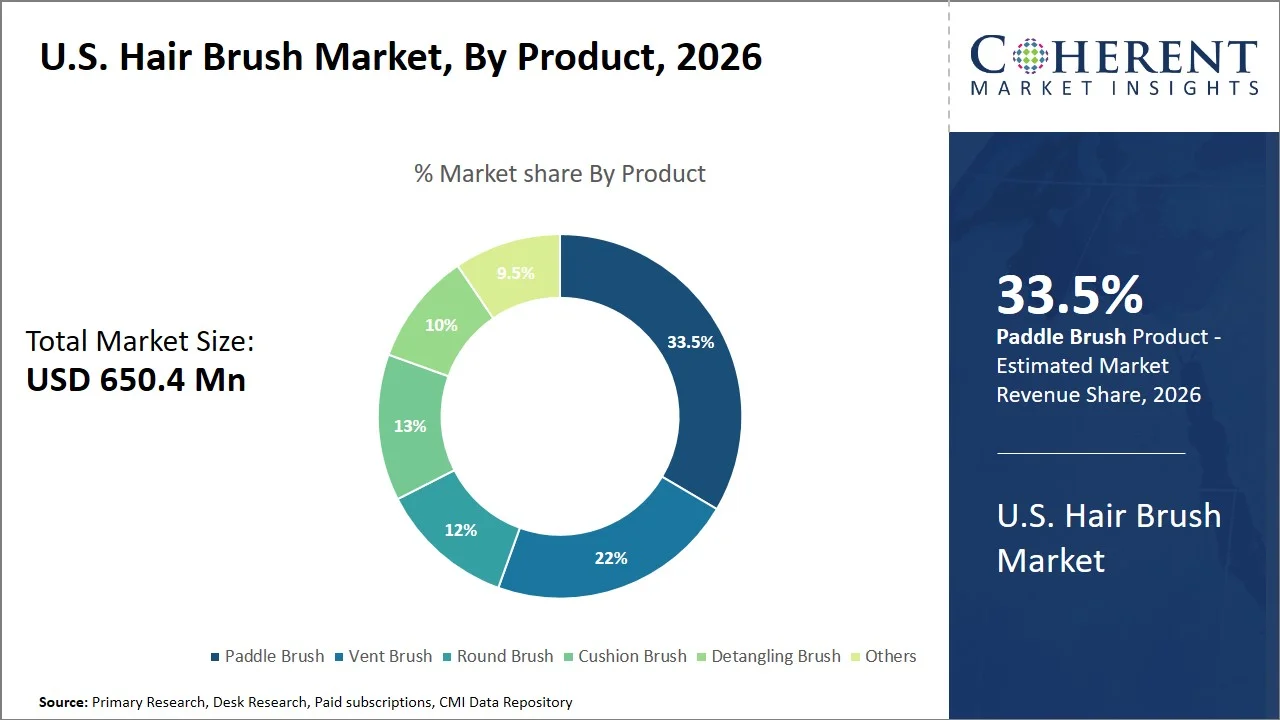
- The paddle brush segment is expected to be the top product category in the U.S. hair brush market in 2026, representing 33.5 % of the market share. Paddle brushes are highly favored for their flexibility and efficiency in detangling and styling various hair types, enabling both salon and at-home users to maintain smooth, tangle-free hair through regular grooming routines. Their broad bristle surface ensures quick coverage and gentle handling, making them ideal for everyday use. For example, Wet Brush original detangler paddle brush – works on all hair types, featuring intelliflex bristles for painless detangling. (Source: Wet Brush)
- The synthetic hair brush segment is projected to capture 65.6 % of the market share in 2026, driven by strong consumer preference for durable, lightweight, and cost‑effective brushes. Products featuring heat‑resistant nylon bristles, suitable for repeated use and blow‑dry styling, are particularly popular, reflecting the demand for functional and long‑lasting hair care tools. For example, Alan Truman heat resistant nylon bristle paddle brush offers durable and heat‑tolerant nylon bristles for everyday styling and detangling. (Source: Alan Truman)
- The personal segment is projected to account for 71.5 % of the market share in 2026. This is because of the growing consciousness of consumers about the care of their hair and the growing self-grooming practices (such as acquiring of expensive personal grooming kits for regular use).(Source: Beretta Gallery USA)
- Eco-Friendly and Premium Hair Care Trends: Hair brushes are now being more accepted by consumers due to their demands to be made from eco-friendly and sustainable materials.
- Market Expansion Catalysts: The U.S. hair brush market is experiencing growth driven by innovative hair care products that feature ergonomic, heat‑resistant, and functional designs, along with rising consumer awareness about grooming and maintaining healthy hair. These product innovations not only improve styling efficiency but also align with broader hair care routines, making brushes an essential component of daily hair care regimens.
Segmental Insights
Why Does the Paddle Brush Segment Dominate the U.S. Hair Brush Market?
The paddle brush segment is expected to hold 33.5% share of the U.S. hair brush market in 2026, owing to its versatility and efficacy in addressing different hair types and various hair care demands. Paddle brushes feature a wide, flat design that helps to detangle and smooth the hair effectively while minimizing breakage and discomfort. This design lends them a favorite choice for those who want to enjoy healthy hair and take care of their hair every day. There are brands out there that make a specific type of paddle brush for detangling wet hair and minimizing hair breakage such as Wet Brush and Conair. For example, Wet Brush's “Original Detangler Paddle Brush” works on all types of hair and features a focus on painless detangling – a key factor in your U.S. paddle brush purchase.
(Source: Wet Brush)
- Current Industry Events of 2026
- Market Size Estimation
- Regional Breakdown
- Competitive Landscape
- Customer Intelligence
- Segmental Analysis
- Pricing Analysis
- Key Market Drivers, Challenges & Future Trends
- Customized Insights Section
Why is the Synthetic Segment the Most Preferred Material in the U.S. Hair Brush Market?
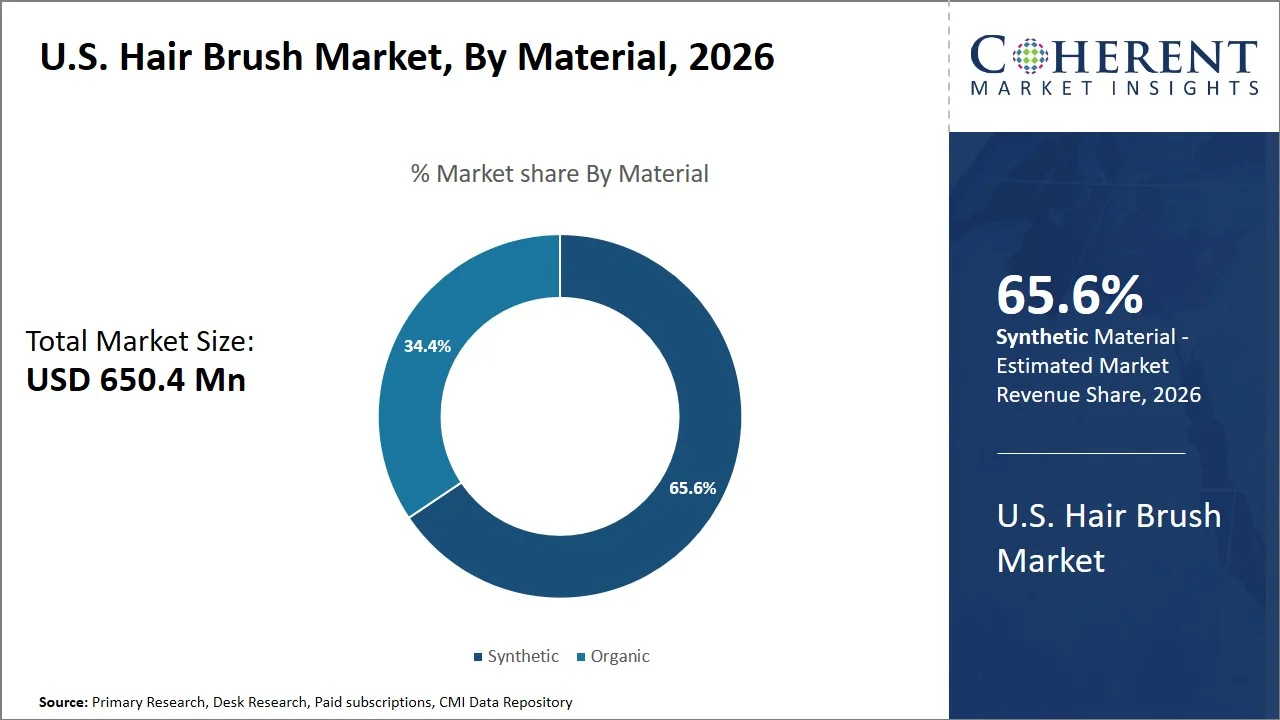
The synthetic segment is expected to hold 65.6% share of the market in 2026, driven largely by their affordability, durability, and adaptability to various brush designs. Synthetic brushes, often made from nylon, plastic, or other polymers, offer manufacturing flexibility that supports diverse bristle types and configurations, enabling brands to cater to a broad consumer base with different hair textures and needs.
One of the primary growth drivers for synthetic hair brushes lies in their cost-effectiveness. Compared to organic options such as boar bristles or wooden handles, synthetic brushes are more budget-friendly, making them accessible to a wide range of consumers.
For example, Conair and Goody offer nylon-bristle brushes for everyday use, marketed as durable, easy to clean, and suitable for wet and dry hair, demonstrating the market’s preference for synthetic materials. The Goody Ouchless Detangling Brush is a widely used example emphasizing synthetic bristles for gentle hair care.
Personal Segment Dominates the U.S. Hair Brush Market
The personal segment is expected to hold 71.5% share of the U.S. hair brush market in 2026, driven by increasing consumer interest in grooming and self-care. The trend towards daily hair care has been growing significantly, owing to increasing awareness about the importance of hair health in maintaining a good appearance. These trends favor increased demand for personal-use hair brushes.
For example, Target and Walmart are some of the retailers that strongly promote personal-use hair brushes. Products such as the Revlon Paddle Hair Brush or Wet Brush Personal Detangler are designed for personal grooming at home, reflecting the segment’s dominance.
Currents Events and their Impact
Current Events | Description and its Impact |
New U.S. Market Entrants & Expansion of Premium Hair Brush Brands |
|
Shift Toward Sustainability & Consumer Preferences for Eco‑Friendly Tools |
|
U.S. Hair Brush Market Dynamics
Market Drivers
Rising Personal Grooming and Self-Care Spending is Boosting the Demand for Hair Brushes
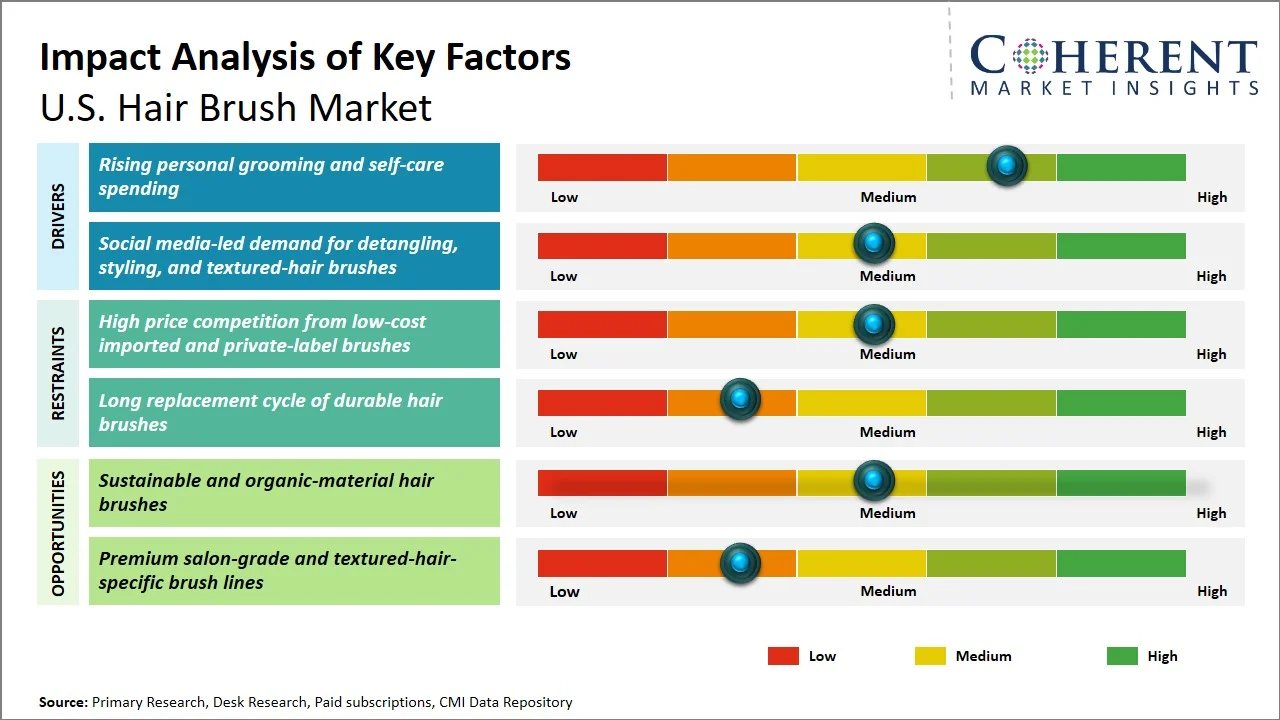
The increasing emphasis on personal grooming and self-care among U.S. consumers is significantly driving the demand for hair brushes in the market. People are increasingly aware of their physical appearance as well as their well-being, and there is appreciable improvement in spending on grooming accessories, such as hair care accessories. As people become more conscious of the significance of keeping their hair healthy, they are more inclined to purchase high-quality brushes that are applicable to various hair types and styles.
For example, consumers in the U.S. are willing to spend on premium hair care and grooming products, indicating a desire for products that will keep hair healthy and maintain its appearance. This trend is shown by a host of popular brands, such as Parachute Advansed, Hair & Care, Nihar Naturals, Livon, Set Wet, Mediker, Revive and Beardo, which offer products for individual hair types and hair preferences, including their preference for superior hair care products, U.S. consumers are drawn to these brands.
Social Media-led Demand for Detangling, Styling, and Textured-Hair Brushes
Social media has become a powerful catalyst for demand in the U.S. hair brush market, especially for specialized products such as detangling, styling, and textured‑hair brushes, as influencers and creators showcase tools tailored to specific hair needs. Platforms like TikTok and Instagram are now among the leading online channels influencing beauty purchases, with almost one‑third of U.S. beauty product buyers discovering products through social sites and these platforms accounting for roughly 33 % of beauty‑related purchases in the U.S. in 2023.
Emerging Trends
- Premiumization and Experience ‑Driven Products: Hair brushes are increasingly marketed as premium lifestyle tools, featuring ergonomic designs, high‑quality materials (e.g., boar‑blend bristles, sustainable wood, advanced polymers), and improved performance for specific hair types. Limited editions, designer collaborations and luxury finishes are helping brands to justify premium pricing and engage more consumers, especially those attracted to beauty and trends.
- Personalization and Customization: Customers want hair brushes that fit their individual hair requirements like bristle type according to hair texture (thick, fine, curly), sensitive scalp, or detangling. Brands are introducing modular or customizable products, allowing consumers to personalize by selecting handle types, bristle hardness and accessories, thus increasing the perceived value and loyalty to the brand.
How is the growing demand for sustainable and organic-material hair brushes creating new growth opportunities in the U.S. hair brush market?
As the U.S. hair brush market evolves, it is a great opportunity for brands which focus on eco-friendly and organic-material hair brushes. With an increased awareness of environmental issues and the harmful effects of plastic, people are asking for products that are made from renewable, environment-friendly and biodegradable resources such as bamboo, wood, and plant-based fibers. The trend is a growing consumer preference for sustainable beauty products aligned with their values of taking care of the environment and their health.
For example, sustainability is influencing purchase behavior at a deeper level: over 90 % of consumers say they are more likely to buy from brands with eco‑friendly packaging, while 54 % have deliberately chosen products with sustainable packaging in the past six months, signaling that materials and lifecycle impact are now key criteria for many buyers. (Source: Shorr Packaging Corporation)
Electric vs Manual Brush Penetration in the U.S. Hair Brush Market
Type | Estimated Market Position | Key Drivers |
Manual Hair Brushes | Majority share of total U.S. hair brush market | Simplicity, lower cost, wide variety (paddle, detangling, round) |
Electric Hair Brushes | Growing but smaller penetration within the overall hair brush market | Multifunctionality (styling + brushing), convenience, salon‑like results at home |
Market Players, Key Development, and Competitive Intelligence
Key Developments
- In February 2026, Goody and Wet Brush, leaders in hair accessories and tools, are excited to announce the launch of a first-of-its-kind limited-edition collection in partnership with Mackenzie-Childs, the artisan-driven American-heritage home décor brand. The exclusive 2026 collection will be available at Target, and features a curated assortment of hair brushes and accessories that marry trusted performance with Mackenzie-Childs' unmistakable aesthetic.
- In November 2023, Wet Brush announced the launch of a new hairbrush customization tool on its official website. This innovative feature, Wet Brush Your Way, helps consumers personalize their hairbrushes by selecting one of the five color options and enhancing their designs with text, icons, and images. The initiative aims to elevate the hair care experience by enabling users to express their individuality through custom designs, making it ideal for use during special occasions such as family reunions or milestone celebrations.
Competitive Landscape
Growing consumer focus on personal grooming and self-care is driving the U.S. hair brush market. Contrary to this, established brands benefit from a larger size, distribution channels, and high brand awareness, whereas emerging brands fight their way by innovation and niche targeting and sustainable products. Key focus areas include:
- Comfortable, long-lasting and hair-friendly constructions
- Product line expansion for all hair types, styles, and materials (including eco-friendly products)
- Strategic alliances, brand alliances and omnichannel retailing (ENS)
Market Report Scope
U.S. Hair Brush Market Report Coverage
| Report Coverage | Details | ||
|---|---|---|---|
| Base Year: | 2025 | Market Size in 2026: | USD 650.4 Mn |
| Historical Data for: | 2020 To 2024 | Forecast Period: | 2026 To 2033 |
| Forecast Period 2026 to 2033 CAGR: | 8.7% | 2033 Value Projection: | USD 1,166.2 Mn |
| Segments covered: |
| ||
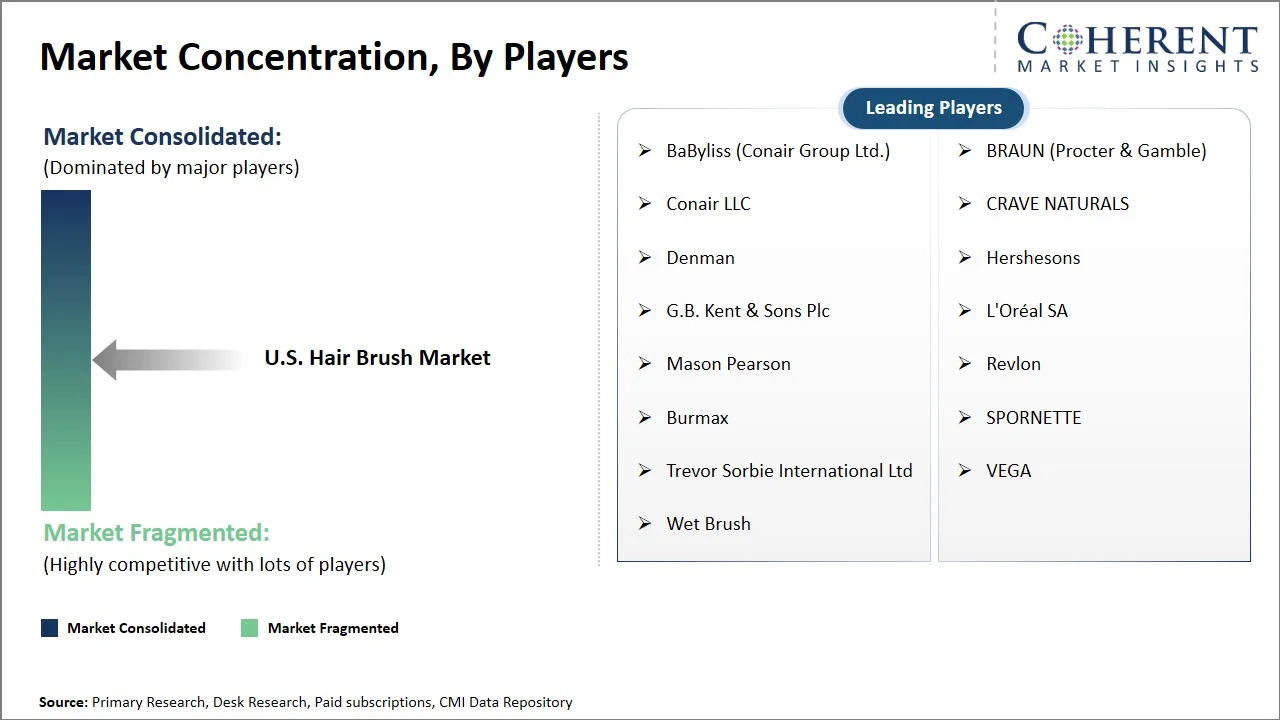
| Companies covered: | BaByliss (Conair Group Ltd.), BRAUN (Procter & Gamble), Conair LLC, CRAVE NATURALS, Denman, Hershesons, G.B. Kent & Sons Plc, L'Oréal SA, Mason Pearson, Revlon, Burmax, SPORNETTE, Trevor Sorbie International Ltd, VEGA, and Wet Brush | ||
| Growth Drivers: |
| ||
| Restraints & Challenges: |
| ||
Analyst Opinion (Expert Opinion)
- The U.S. hair brush market is projected to experience steady growth driven by growing consumer focus on personal grooming, hair health, and premium styling experiences. The market is undergoing significant changes in the next 5-7 years driven by trends like sustainable materials, multifunctional brushes, and smart grooming tools. At-home professional styles hair care will be driven by a surge in e-commerce and niche and premium market will expand at a faster pace.
- Paddle and detangling brushes for personal use offer the best opportunity for growth, especially premium products from natural or composite materials. In the U.S., affluent suburban communities and urban centers are likely to be targeted by the hair care products market, where consumers are more inclined to support high-quality and sustainably sourced hair care products. Moreover, segments with an interest in special hair types, curly hair, textured hair, and chemically processed hair are underserved.
Speak to the analyst
Want personalized insights?
Take the findings above to one of our principal consultants, or have the report rebuilt around the segments, geographies and competitors you actually track.
Market Segmentation
- Product Insights (Revenue, USD Mn, 2021 - 2033)
- Paddle Brush
- Vent Brush
- Round Brush
- Cushion Brush
- Detangling Brush
- Others
- Material Insights (Revenue, USD Mn, 2021 - 2033)
- Synthetic
- Organic
- Application Insights (Revenue, USD Mn, 2021 - 2033)
- Personal
- Professional
- End User Insights (Revenue, USD Mn, 2021 - 2033)
- Women
- Men
- Children
- Key Players Insights
- BaByliss (Conair Group Ltd.)
- BRAUN (Procter & Gamble)
- Conair LLC
- CRAVE NATURALS
- Denman
- Hershesons
- B. Kent & Sons Plc
- L'Oréal SA
- Mason Pearson
- Revlon
- Burmax
- SPORNETTE
- Trevor Sorbie International Ltd
- VEGA
- Wet Brush
Sources
Primary Research Interviews
- Hair brush manufacturers (small, medium, and large-scale producers)
- Supply Chain Managers of consumer personal care product companies
- Product Development Managers of professional hair care brands
- Retail category managers from beauty and personal care retail chains
Stakeholders
- Manufacturers and brands (e.g., Conair, Goody, Wet Brush, Revlon Professional)
- End-use sectors
- Consumers – retail and e-commerce buyers
- Professional salons and stylists
- Retailers and e-commerce platforms: Ulta Beauty, Sally Beauty, Target, Amazon
- Regulatory & Certification Bodies: U.S. FDA (cosmetic regulations), CPSC (product safety standards), ASTM International (performance testing standards)
Databases
- S. Census & Economic Census – Personal care and beauty products manufacturing
- UN Comtrade Database (HS codes for hair brushes: 9615.11)
- Nielsen Retail Tracking Data – Hair care tools category
Magazines
- Beauty Packaging – Product design and packaging trends
- Professional Beauty – Innovations in styling tools
- Salon Today – Professional hair brush usage and adoption
- Modern Salon – Hair care tools and professional styling equipment
Journals
- International Journal of Cosmetic Science – Product performance and hair interaction
- Journal of Cosmetic Dermatology – Hair care and scalp health
- Consumer Studies in Beauty & Personal Care – Usage behavior and preferences
Newspapers
- The Wall Street Journal – Beauty and personal care retail trends
Associations
- Professional Beauty Association (PBA)
- North American Hairstyling Association (NAHA)
- Cosmetic, Toiletry, and Fragrance Association (CTFA)
Public Domain Sources
- U.S. Consumer Product Safety Commission – Hair brush safety guidelines
- FDA – Cosmetic ingredient regulations
- OECD – Trade and import/export of personal care goods
Proprietary Elements
- CMI Data Analytics Tool, Proprietary CMI Existing Repository of information for last 10 years.
Get access to 250+ pages report
Every segment, forecast, competitor profile and data table behind the analysis above — available for instant download.
- ESOMAR Member
- ISO 9001:2015 Certified
- D-U-N-S Registered
- GDPR & CCPA Compliant
Missing comfort of reading report in your local language? Find your preferred language:
Transform your Strategy with Exclusive Trending Reports
Frequently Asked Questions
The U.S. hair brush market is estimated to be valued at USD 650.4 Mn in 2026 and is expected to reach USD 1,166.2 Mn by 2033.
The CAGR of U.S. hair brush market is projected to be 8.7% from 2026 to 2033.
Rising personal grooming and self-care spending and social media-led demand for detangling, styling, and textured-hair brushes are the major factors driving the growth of the U.S. hair brush market.
Hair brushes are sold through offline retail channels, including supermarkets, beauty supply stores, and specialty salons, as well as online platforms such as Amazon, Walmart.com, and brand websites. Some premium brands also sell directly to consumers.
Trends influencing the market include growing demand for sustainable brushes, multifunctional electric brushes, and professional salon-grade brushes expanding into consumer segments.
High price competition from low-cost imported and private-label brushes and long replacement cycle of durable hair brushes are the major factors hampering the growth of the U.S. hair brush market.
In terms of product, paddle brush is estimated to dominate the market revenue share in 2026.