

U.S. Light Commercial Vehicle Market Size and Forecast – 2026-2033
The U.S. light commercial vehicle market is estimated to be valued at USD 240.34 Bn in 2026 and is expected to reach USD 371.03 Bn by 2033, exhibiting a compound annual growth rate (CAGR) of 6.4% from 2026 to 2033.
Key Takeaways of the U.S. Light Commercial Vehicle Market
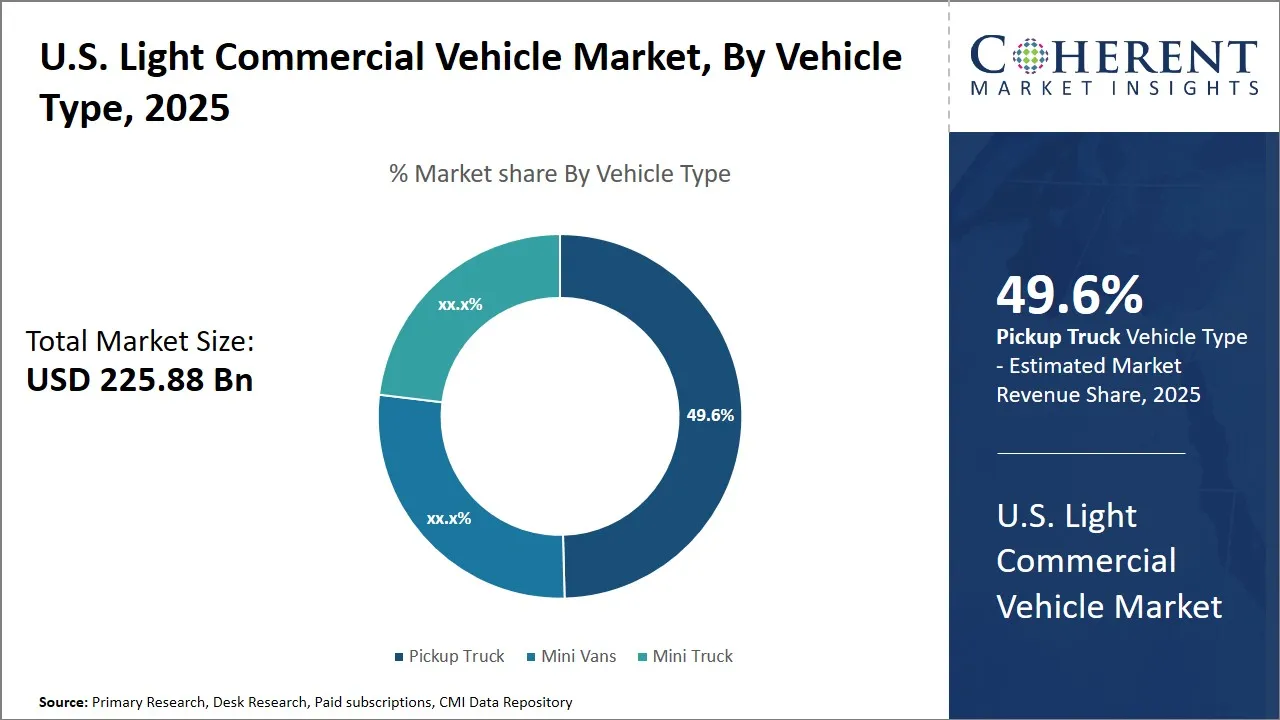
- The pickup truck segment lead the market holding an estimated share of 50.6 % in 2026.
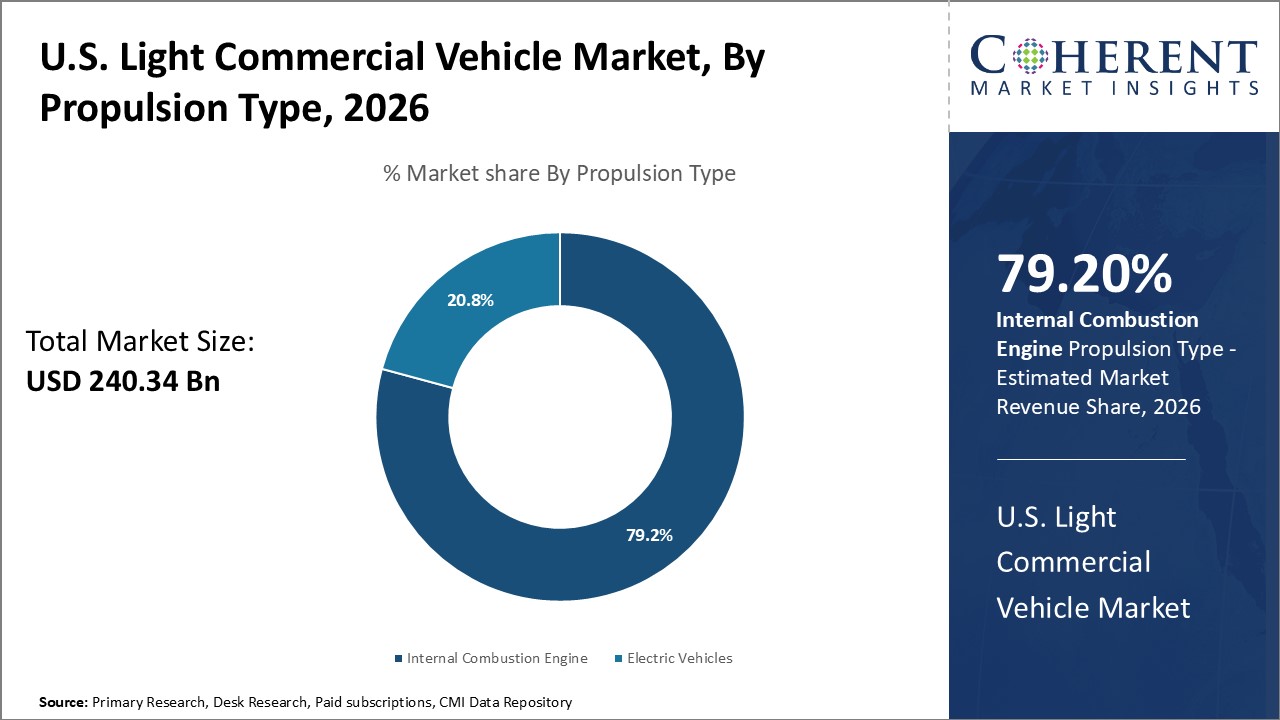
- The internal combustion engine segment is expected to capture 79.2 % of the market share in 2026.
- The mining & construction segment lead the market holding an expected share of 34.1 % in 2026.
Market Overview
The market is seeing a big shift towards electrification and smart connectivity in the light commercial vehicle sector. Manufacturers are investing a lot in electric and hybrid models to meet regulatory requirements and consumer demand for sustainable options. Also, advancements in vehicle-to-everything (V2X) communication and autonomous driving technologies are improving operational efficiency and safety. These innovations are reshaping the market landscape, making light commercial vehicles important players for urban mobility and freight transport.
Current Events and Its Impact
Current Events | Description and its Impact |
Stellantis (Ram) opens orders for 2025 Ram ProMaster EV |
|
Ford Pro/E-Transit 2025 order banks and commercial incentives |
|
California Advanced Clean Fleets (ACF) and state ZEV fleet rules |
|
Segmental Insights
- Current Industry Events of 2026
- Market Size Estimation
- Regional Breakdown
- Competitive Landscape
- Customer Intelligence
- Segmental Analysis
- Pricing Analysis
- Key Market Drivers, Challenges & Future Trends
- Customized Insights Section
U.S. Light Commercial Vehicle Market Insights, by Vehicle Type – Pickup Trucks Segment Dominate Because of Versatility and Consumer Preference
The U.S. light commercial vehicle market is led by the pickup truck segment, which holds the highest market share of 50.6% in 2026. The versatility of pickup trucks plays a big role in their high adoption in both commercial and personal applications. These vehicles offer a mix of cargo capacity, towing capability, and off-road performance. Businesses involved in construction, agriculture, and small-scale logistics prefer pickup trucks because they can easily transport tools, materials, and personnel across different terrains without compromising mobility or efficiency.
Also, the cultural affinity for pickups in the U.S. adds to their demand. Pickup trucks have a deeply ingrained image as practical yet rugged vehicles, appealing to both commercial fleets and individual owners who may use them for work and recreation. Advances in comfort and technology, like improved cabin ergonomics, infotainment systems, and safety features, have improved the user base beyond traditional commercial buyers to include families and outdoor enthusiasts. Ford’s F-150 remains the best-selling vehicle in the U.S. for more than four decades, adopted by small businesses, families, and recreational users.
To add, manufacturers have consistently innovated tailor pickups to meet changing needs by offering different configurations like single cabs, extended cabs, and crew cabs, with payload capacities and engine options to suit different business requirements. This adaptability ensures that pickups remain instrumental for industries needing reliable, all-purpose vehicles that can handle demanding tasks on and off the road. The availability of aftermarket customization also improves their utility, allowing businesses to install specialized equipment, thereby increasing operational efficiency.
U.S. Light Commercial Vehicle Market Insights, by Propulsion Type – Internal Combustion Engine Segment Prevail Because of Infrastructure and Cost Advantages
The internal combustion engines segment maintain the highest market share of 79.2% in the U.S. light commercial vehicle market in 2026. Despite the growing interest in electric vehicles, Internal Combustion Engines (ICE) continue to dominate because of established fueling infrastructure and cost-effectiveness. The refill network for gasoline and diesel is strong robust and widespread, providing uninterrupted operational capabilities for commercial users who depend on these vehicles for long working hours and long travel distances without concerns related to range anxiety or fuel availability.
Cost considerations also support internal combustion vehicles in the commercial sector. Initial purchase prices, maintenance costs, and repair services for ICE vehicles benefit from decades of supply chain development and service network expansion. Commercial buyers want minimized downtime and controlled operational expenses, and ICE vehicles offer predictable maintenance routines with readily available spare parts and skilled technicians. Also, the lifecycle of internal combustion vehicles, supported by a mature resale market, allows businesses to manage asset replacement cycles easily.
Technical advancements in ICE vehicles like improvements in fuel efficiency, emission controls, and engine durability have helped mitigate environmental and regulatory pressures. In sectors where performance reliability and immediate serviceability are non-negotiable, ICE powertrains remain the more practical option. The ongoing debate and transition toward electrification have not yet fully addressed the infrastructural and cost barriers faced by commercial operators, ensuring that internal combustion engines continue to be the backbone of the light commercial vehicle market.
U.S. Light Commercial Vehicle Market Insights, by End Use – Mining & Construction Segment Leads Due to Specialized Utility and Demand
The mining & construction segment is projected to hold the largest share of 35.1% in the U.S. light commercial vehicle market in 2026, because of their specialized operational needs and the high demand for reliable, durable transport solutions. These sectors need vehicles that can handle rough terrain, heavy payloads, and demanding work schedules, making light commercial vehicles very useful for daily operations. These vehicles are strong and can maneuver in confined or off-road environments, which suits the harsh conditions typical in mining sites and construction zones.
The mining and construction sectors are also big contributors to infrastructure development and resource extraction, which makes sustained and growing demand for light commercial vehicles. As projects become more complex and geographically dispersed, there is an increased need for flexible and efficient transportation options to move equipment, materials, and workforce between sites. Vehicles with high payload capacities and towing abilities help streamline onsite logistics, reduce dependency on multiple trips, and improve productivity. Also, regulatory requirements for safe transportation and operator ergonomics in mining and construction add to the demand for specialized light commercial vehicles suited to meet these standards.
Pricing Analysis of the U.S. Light Commercial Vehicle Market
Vehicle/Segment | Typical base MSRP (USD) | Typical commercial/fleet price (incl. destination & common fleet incentives) | Typical upfit/body-cost range (USD) | Typical fleet-ready price range (USD) |
Ford Transit — Full-size cargo van (ICE) | USD 46,710 – USD 47,400 | USD 48,000 – USD 55,000 | USD 3,000 – USD 20,000 (shelving/partitions → vocational packages) | USD 51,000 – USD 75,000 |
Ford E-Transit — Full-size electric cargo van (BEV) | ~USD 49,350 | USD 48,000 – USD 56,000 after federal/state incentives | USD 3,000 – USD 20,000 | USD 52,000 – USD 76,000 |
Ford F-150 (commercial/fleet trim) — Light pickup | USD 38,810 (XL base) → USD 45,695 (XLT shown) | USD 39,000 – USD 55,000 | USD 1,000 – USD 12,000 (toolboxes, racks, service bodies) | USD 40,000 – USD 67,000 |
Chevrolet Express/GMC Savana (cargo van, ICE) | USD 41,800 (starting) | USD 42,000 – USD 50,000 | USD 3,000 – USD 20,000 | USD 46,000 – USD 70,000 |
Mercedes-Benz eSprinter — Electric cargo van | USD 61,250 | USD 62,000 – USD 75,000 | USD 3,500 – USD 25,000 | USD 66,000 – USD 100,000 |
Rivian Commercial/RCV (electric delivery van) | USD 79,900 | USD 79,900 – USD 95,000 | USD 5,000 – USD 25,000 (fleet telematics/interior configs/refrigeration rare) | USD 85,000 – USD 120,000 |
BrightDrop/Chevrolet BrightDrop (Zevo/EV van) | ~USD 45,425 – USD 46,425 | USD 45,000 – USD 55,000 (post offers/incentives) | USD 3,000 – USD 25,000 | USD 49,000 – USD 80,000 |
Ram ProMaster EV — Electric cargo/step van | USD 56,495 | USD 56,500 – USD 70,000 | USD 3,000 – USD 30,000 (step-van bodies or vocational upfits) | USD 60,000 – USD 100,000 |
Medium/light box truck on cutaway/chassis-cab (Class 3–4) | Chassis MSRP: USD 50,000 – USD 90,000 (varies by cab/chassis) | USD 55,000 – USD 100,000 | Box/body costs: USD 15,000 – USD 35,000 (dry freight); refrigerated add USD 12k–USD 40k | USD 70,000 – USD 170,000 (depends on chassis & body length) |
Step vans/walk-in delivery vans (new EV step vans or ICE) | USD 80,000 – USD 150,000 (step-van OEMs/EV variants vary widely) | USD 80,000 – USD 160,000 | Specialty vocational work often integrated at factory/upfitter; additional telematics USD 2k–USD 10k | USD 85,000 – USD 170,000 |
Typical small-fleet upfit (shelving + ladder rack + partition) | n/a | n/a | USD 1,500 – USD 8,000 | n/a |
Typical refrigerated upfit for cargo van (small reefer unit + insulation) | n/a | n/a | USD 11,000 – USD 40,000 |
Market Players, Key Development, and Competitive Intelligence
Key Developments
- In April 2025, GM temporarily halted production of its electric commercial van at its assembly plant in Ontario due to slow sales.
- In February 2025, Rivian Automotive opened sales for the Rivian Commercial van to fleets of all sizes in the US. Safety features include automatic emergency braking, collision warnings, and 360-degree visibility.
- In August 2024, General Motors moved its BrightDrop electric commercial vans under the Chevrolet brand. The shift brought BrightDrop EVs to Chevrolet's broad commercial vehicle sales and service dealer network.
- In February 2024, Mercedes-Benz introduced the First fully electric van, the all-new eSprinter.
Top Strategies Followed by U.S. Light Commercial Vehicle Market Players
- Established industry leaders invest a lot in research and development (R&D) to add to product innovation and improve vehicle performance, efficiency, and sustainability.
- Ford invested billions in EV and connected-fleet technology including its dedicated E-Transit electric cargo van platform, over-the-air software updates, and the Ford Pro telematics/charging ecosystem.
- Mid-level competitors in the U.S. light commercial vehicle sector focus on offering cost-effective products that balance quality, reliability, and affordability.
- Stellantis positions the Ram ProMaster EV and its ICE counterpart with aggressive pricing and simplified upfit packages to attract budget-conscious delivery and trades fleets.
- Small-scale market players differentiate themselves in the U.S. LCV market by focusing on niche segments and specialized vehicle features that are often missed by larger competitors.
- Workhorse concentrates on electric step vans and pilot drone-delivery solutions for parcel carriers, a narrow but growing niche.
Market Report Scope
U.S. Light Commercial Vehicle Market Report Coverage
| Report Coverage | Details | ||
|---|---|---|---|
| Base Year: | 2025 | Market Size in 2026: | USD 240.34 Bn |
| Historical Data for: | 2020 To 2024 | Forecast Period: | 2026 To 2033 |
| Forecast Period 2026 to 2033 CAGR: | 6.4% | 2033 Value Projection: | USD 371.03 Bn |
| Segments covered: |
| ||
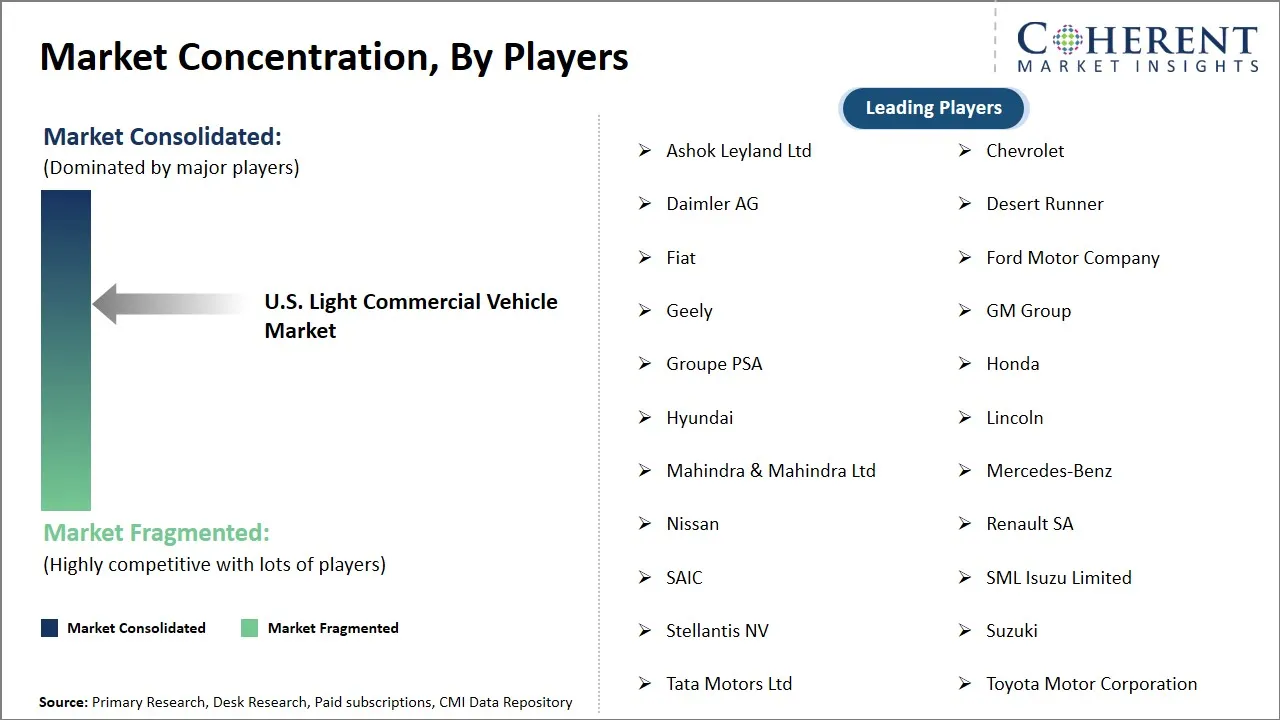
| Companies covered: | Ashok Leyland Ltd, Chevrolet, Daimler AG, Desert Runner, Fiat, Ford Motor Company, Geely, GM Group, Groupe PSA, Honda, Hyundai, Lincoln, Mahindra & Mahindra Ltd, Mercedes-Benz, Nissan, Renault SA, SAIC, SML Isuzu Limited, Stellantis NV, Suzuki, Tata Motors Ltd, and Toyota Motor Corporation | ||
| Growth Drivers: |
| ||
| Restraints & Challenges: |
| ||
Market Dynamics
U.S. Light Commercial Vehicle Market Driver – Rapid Growth of E-Commerce and Last-Mile Delivery Demand
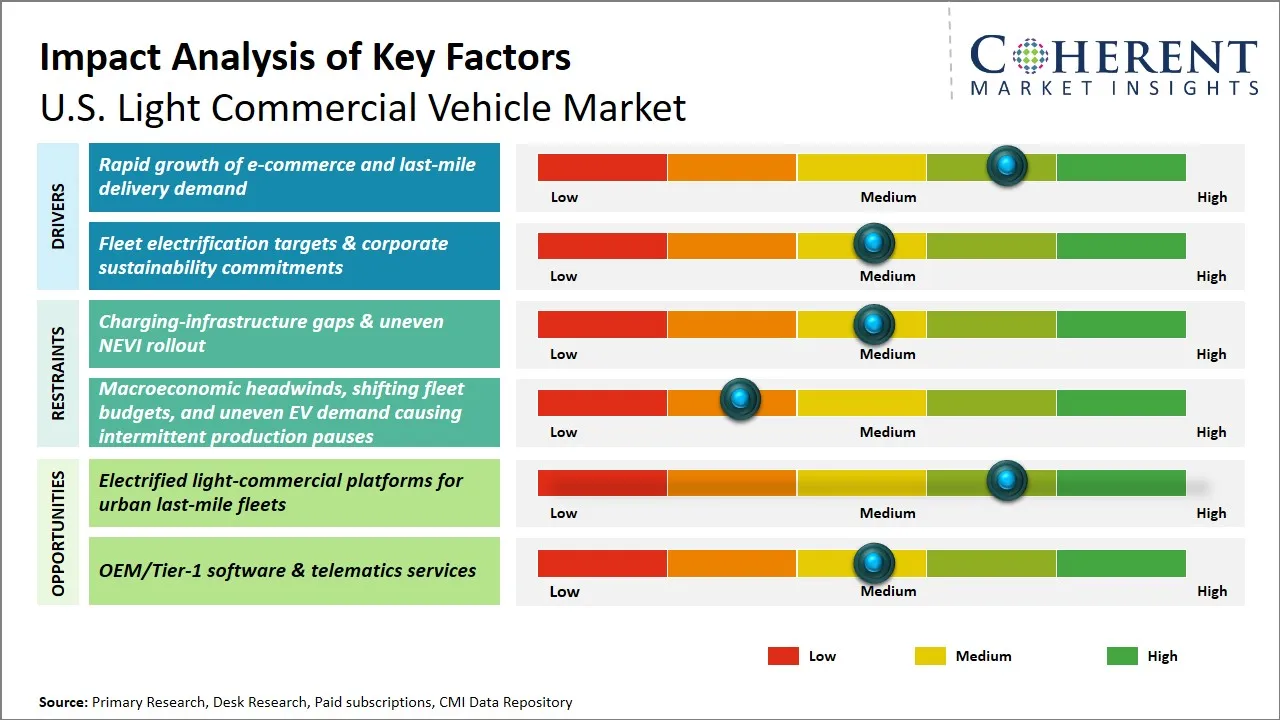
The fast growth of e-commerce has created a lot of need for efficient last-mile delivery solutions, making demand for Light Commercial Vehicles (LCVs) in the U.S. As more consumers choose online shopping, retailers and logistics companies need to optimize their distribution networks to meet tight delivery windows and handle different order volumes. Light commercial vehicles offer agility, fuel efficiency, and urban maneuverability, making them useful for navigating congested city streets while accommodating different cargo sizes. This shift towards fast and flexible delivery models pushes businesses to continuously grow and upgrade their LCV fleets to ensure timely, cost-effective, and reliable service. Also, the rise in contactless deliveries post-pandemic has also shown the importance of LCVs, as companies aim to improve operational efficiency and customer satisfaction. Consequently, the rise in e-commerce-related logistics demands remains a big factor propelling growth within the U.S. light commercial vehicle sector.
U.S. Light Commercial Vehicle Market Opportunity – Electrified Light-Commercial Platforms for Urban Last-Mile Fleets
The growing demand for sustainable and efficient urban logistics presents a significant opportunity in the U.S. light commercial vehicle market through the adoption of electrified light-commercial platforms tailored for last-mile delivery fleets. As e-commerce continues its rapid expansion, driven by increased consumer preference for online shopping, the need for agile, emission-free, and cost-effective urban delivery solutions has never been more critical. Electrified LCVs, including electric vans and small electric trucks, offer fleet operators the advantage of reduced carbon emissions, lower operating costs due to decreased fuel and maintenance expenses, and compliance with increasingly stringent environmental regulations set by federal and local governments. Additionally, urban areas are often imposing restrictions on internal combustion engine vehicles to reduce pollution and improve air quality, further driving fleet operators to transition towards electric platforms. Technological advancements, such as improved battery efficiency, extended driving ranges, and faster charging infrastructure, enhance the feasibility and attractiveness of electrified LCVs for urban logistics. Moreover, government incentives and subsidies targeting electric vehicle adoption provide additional financial motivation for fleet upgrades. These factors collectively create a compelling growth trajectory for electrified light-commercial platforms, positioning them as a key driver for innovation and investment within the U.S. urban last-mile delivery segment.
Analyst Opinion (Expert Opinion)
- Telematics platforms and cloud-based analytics are becoming standard, enabling real-time vehicle health monitoring, route optimization, and predictive maintenance. This reduces downtime and total cost of ownership—key selling points for large delivery and service fleets.
- Solid-state and high-nickel battery chemistries, along with megawatt-class depot chargers and vehicle-to-grid (V2G) capabilities, are set to cut charging times and improve fleet energy economics. These advancements will make electric vans and pickups viable for heavier-duty, multi-shift operations.
- OEMs are developing skateboard-style chassis and over-the-air updatable control systems, allowing a single electric platform to support multiple body styles—cargo van, box truck, shuttle—while adding new features via software. This lowers development costs and shortens time-to-market for specialized commercial variants.
Speak to the analyst
Want personalized insights?
Take the findings above to one of our principal consultants, or have the report rebuilt around the segments, geographies and competitors you actually track.
Market Segmentation
- Vehicle Type Insights (Revenue, USD Bn, 2021 - 2033)
- Pickup Truck
- Mini Vans
- Mini Truck
- Propulsion Type Insights (Revenue, USD Bn, 2021 - 2033)
- Internal Combustion Engine
- Electric Vehicles
- End Use Insights (Revenue, USD Bn, 2021 - 2033)
- Mining & Construction
- Industrial
- Passenger Transportation
- Logistics
- Others
- Key Players Insights
- Ashok Leyland Ltd
- Chevrolet
- Daimler AG
- Desert Runner
- Fiat
- Ford Motor Company
- Geely
- GM Group
- Groupe PSA
- Honda
- Hyundai
- Lincoln
- Mahindra & Mahindra Ltd
- Mercedes-Benz
- Nissan
- Renault SA
- SAIC
- SML Isuzu Limited
- Stellantis NV
- Suzuki
- Tata Motors Ltd
- Toyota Motor Corporation
Sources
Primary Research Interviews
Stakeholders
- Fleet Operations Managers and Procurement Heads
- Light Commercial Vehicle OEM Executives and Product Managers
- Dealership & Upfit Specialists (cargo‐van and chassis-cab converters, refrigeration installers)
- EV Charging Network Operators and Infrastructure Planners
- Municipal & State Transportation Fleet Directors (California, Texas, New York)
- Battery Technology Engineers and Telematics Solution Providers (for connected LCV platforms)
Databases
- U.S. Department of Transportation Vehicle Registration Database
- Bureau of Transportation Statistics (BTS) – Freight and Fleet Data
- U.S. Energy Information Administration (EIA) – Alternative Fuels Data Center
- National Highway Traffic Safety Administration (NHTSA) Recall & Compliance Database
- Federal Highway Administration (FHWA) Commercial Vehicle Inventory
Magazines
- Fleet Owner
- Work Truck Magazine
- Automotive Fleet
- Green Car Reports (Fleet & Commercial EV section)
- Transport Topics
Journals
- SAE International Journal of Commercial Vehicles
- Journal of Transportation Engineering, Part A: Systems
- IEEE Transactions on Intelligent Transportation Systems
- Energy Reports (special issues on EV adoption)
- Journal of Cleaner Production (commercial vehicle electrification studies)
Newspapers
- The Wall Street Journal – Logistics & Transportation Section
- The Detroit News – Automotive Industry Coverage
- Financial Times – US Auto & Mobility Desk
- The New York Times – Climate & Energy Desk (Fleet Electrification articles)
- Reuters – Automotive and Fleet Newswire
Associations
- National Truck Equipment Association (NTEA)
- American Trucking Associations (ATA)
- Electric Drive Transportation Association (EDTA)
- North American Fleet Association (NAFA)
- U.S. Commercial Vehicle Upfitters Association (CVUA)
Public Domain Sources
- U.S. Census Bureau
- U.S. Environmental Protection Agency (EPA) – Green Vehicle Guide & Compliance Data
- Federal Motor Carrier Safety Administration (FMCSA)
- International Energy Agency (IEA) Transport Statistics
- World Bank Transport Data Repository
- ResearchGate (open-access fleet and EV adoption papers)
Proprietary Elements
- CMI Data Analytics Tool, Proprietary CMI Existing Repository of information for last 8 years
Get access to 250+ pages report
Every segment, forecast, competitor profile and data table behind the analysis above — available for instant download.
- ESOMAR Member
- ISO 9001:2015 Certified
- D-U-N-S Registered
- GDPR & CCPA Compliant
Missing comfort of reading report in your local language? Find your preferred language:
Transform your Strategy with Exclusive Trending Reports
Frequently Asked Questions
The U.S. light commercial vehicle market is estimated to be valued at USD 240.34 billion in 2026 and is expected to reach USD 371.03 billion by 2033.
The CAGR of the U.S. light commercial vehicle market is projected to be 6.4% from 2026 to 2033.
Rapid growth of e-commerce and last-mile delivery demand and fleet electrification targets & corporate sustainability commitments are the major factors driving the growth of the U.S. light commercial vehicle market.
Charging-infrastructure gaps & uneven NEVI rollout and macroeconomic headwinds, shifting fleet budgets, and uneven EV demand causing intermittent production pauses are the major factors hampering the growth of the U.S. light commercial vehicle market.
In terms of vehicle type, the pickup truck segment is estimated to dominate the market revenue share in 2026.
Internal combustion engines dominate with an 78.2% share in 2026.
Light commercial vehicles are vehicles under about 14,000 lbs. GVWR used for goods or passenger transport, primarily pickups, cargo vans, chassis-cabs, and small box/step vans.