

U.S. TBR Tire Market Size and Forecast – 2026-2033
The U.S. TBR tire market is estimated to be valued at USD 5,159.1 Mn in 2026 and is expected to reach USD 6,519.6 Mn by 2033, exhibiting a compound annual growth rate (CAGR) of 3.4% from 2026 to 2033.
Key Takeaways of the U.S. TBR Tire Market
- The drive tires segment is projected to hold a 34.0 % of the market share in 2026.
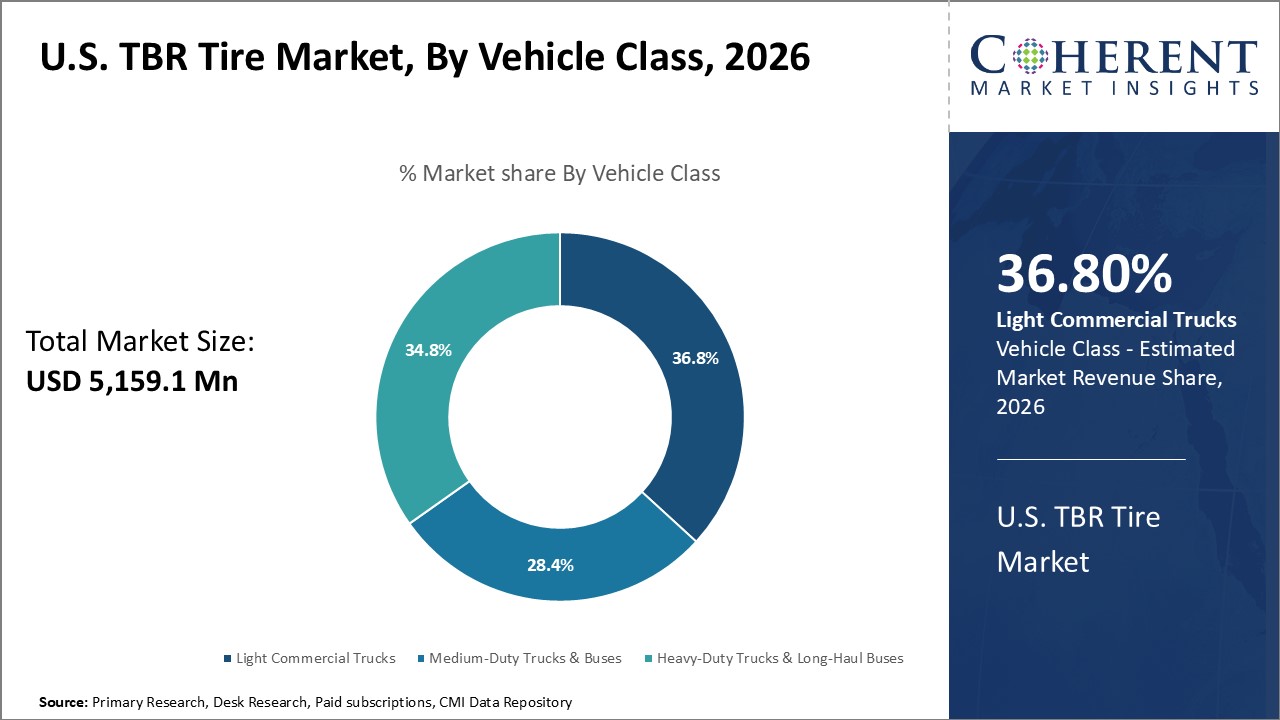
- The light commercial trucks segment is projected to account for 36.8 % of the U.S. TBR tire market share in 2026.
- The OEM segment is expected to captures 54.7 % of the U.S. TBR tire market in 2026.
Market Overview
The latest trends in the market indicate the increased focus on sustainability and technological innovation in the TBR tire segment. To have better fuel efficiency and less carbon footprint, manufacturers are investing in more eco-friendly materials and more advanced tire designs. Also, the implementation of the smart tire technologies, including real-time monitoring sensors, is increasingly becoming common, enhancing the safety and efficiency in the operation of commercial vehicles. These tendencies will influence the market environment within the next few years and further application to different business spheres of transportation.
Current Events and Its Impact
Current Events | Description and its Impact |
Tariff Increases & Trade Policy Changes (2025 reciprocal and Section 232 tariffs etc.) |
|
Shift in Buyer Behavior: Flight to Value & Operational Cost Pressures |
|
Segmental Insights
- Current Industry Events of 2026
- Market Size Estimation
- Regional Breakdown
- Competitive Landscape
- Customer Intelligence
- Segmental Analysis
- Pricing Analysis
- Key Market Drivers, Challenges & Future Trends
- Customized Insights Section
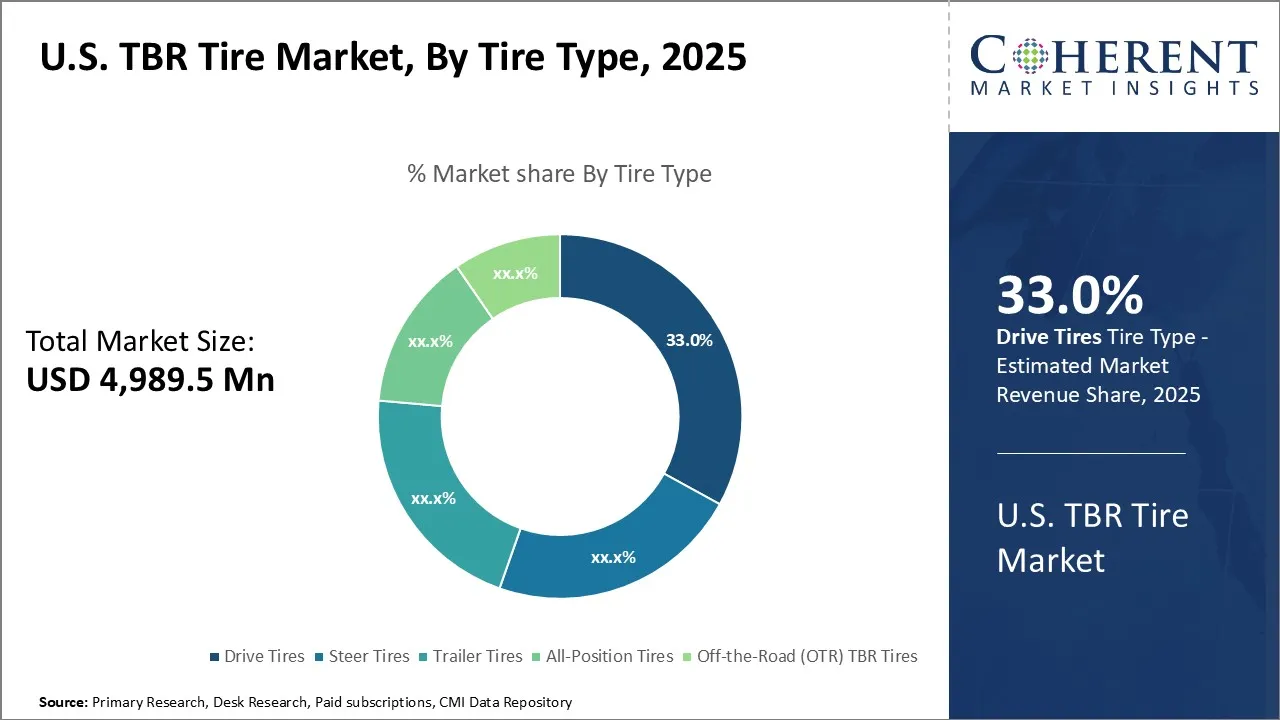
U.S. TBR Tire Market Insights, by Tire Type - Drive Tires Segment Dominates Due to their Critical Role in Enhancing Vehicle Performance and Durability
The Drive tires segment is projected to account for 34.0% share in 2026 and is distinctively designed to give traction and cope with the huge torque produced by the engine and therefore become necessary in trucks that work in a harsh environment. Their TBR tire market is the most dominated in the U.S. and this is due to the use of the growing use of the medium- and heavy-duty trucks to facilitate the movement of goods and logistics infrastructure, especially in the e-commerce and retail supply chains.
For example, in 2024, leading U.S. logistics operators like FedEx and UPS significantly expanded their fleets of Class 8 trucks to handle the rising volume of last-mile and interstate deliveries. These vehicles predominantly rely on advanced drive tire configurations to ensure fuel efficiency, road grip during varied weather conditions, and durability under continuous high-load operations.
U.S. TBR Tire Market Insights, By Vehicle Class - Light Commercial Trucks Segment Dominates Due to Expanding Urban Logistics and Last-Mile Delivery Needs
The light commercial trucks segment is expected to capture 36.8% of the market share in 2026. Local and regional deliveries of these vehicles demand tires that prove to be highly maneuverable, loaded and highly durable to the frequent stop and go nature of these deliveries. Light commercial trucks must be used in complex urban settings that demand tires with the ability to balance comfort, multiple road surfaces traction and puncture resistance against debris or curbs. These performance attributes are the motivators behind the fact that TBR tires are specifically designed to satisfy the operational characteristics of the said type of vehicles.
Also, the heightened concern on environmental sustainability has made it necessary to design lighter and fuel efficient tire options to be installed in light commercial trucks that directly will lead to a reduction in general emissions in the congested urban centers. Manufacturers of tires are retaliating by creating tread patterns and rubber formulations that are less rolling resistant but do not limit load carrying. Furthermore, electric light commercial vehicles are also affecting the tire specifications because such vehicles need tires that will support instant torque and serve heavy battery weight with minimum noise production in an urban setting.
U.S. TBR Tire Market Insights, By Sales Channel – OEM Segment Dominates Driven by Integrated Supply Chain Efficiencies and Emphasis on Vehicle Performance Optimization
The OEM segment is projected to hold 55.7% share in 2026, because of their importance in the assembly of the vehicle and the strategic advantages of having the tires supplied at the manufacturing level. OEM tires are usually designed with a high level of specificity to meet the needs of a certain model of trucks so that its performance, safety, and adherence to the manufacturer warranties are the best. The OEM process enables the close collaboration between tire designers and vehicle engineers to achieve very high standards of load capacity, handling and durability at the very beginning.
Macro Economic Factors Impacting on U.S. TBR Tire Market Growth
Macroeconomic Factors
- Freight Transportation Growth: The expansion of freight transportation in the U.S., driven by e-commerce growth and increasing demand for goods movement, fuels the need for commercial vehicles and thus TBR tires. The U.S. freight transport sector is projected to grow around 3.4% annually, supporting tire demand.
- Infrastructure Investment: Government spending on transportation infrastructure, such as highways and public transit, encourages higher usage of trucks and buses, boosting the demand for TBR tires. For example, $54 billion was allocated for highway improvements in 2021.
- Raw Material Price Fluctuations: Variability in prices of rubber and steel affects production costs and profitability, posing a challenge for tire manufacturers.
- Environmental Regulations: Increasing government regulations focused on fuel efficiency and emissions push innovation in tire technology, including fuel-efficient and eco-friendly TBR tires, adding both pressure and opportunity for manufacturers.
- Economic Cycles: Broader economic conditions and downturns can dampen demand for commercial vehicles and tires due to reduced freight and passenger transport activities.
Market Players, Key Development, and Competitive Intelligence
Key Development
- In in July 2025, The Hankook tire and technology, which is the main tire producer in South Koreas, declared, that they would increase their manufacturing capacity at the U.S plant. The development will include additional production lines that will specialize in truck and bus radial (TBR) tires with the production set to commence later in the year.
Top Strategies Followed by U.S. TBR Tire Market Players
- The major incumbents are focused on innovation and global expansion and therefore they spend a lot of money in research and development (R&D) in designing high performance tires that deliver updated regulatory requirements as well as customer requirements in terms of durability and fuel efficiency. This international growth diversifies their revenue bases in addition to making them the forces to reckon in the competitive market in the U.S. because of economies of scale and extensive networks of services.
- An example is the Michelins Energy guard technology, a combination of low rolling resistance compounds and aerodynamic sidewall designs to enhance fleet savings on fuel, and the Enliten technology platform developed by Bridgestone to make it more sustainable without compromising on the performance.
- The mid-level players in the U.S. TBR tire market are taking a different route as they are focusing on finding the right balance in terms of both quality and cost to capture price-sensitive customer like small fleet operators, and independent truck owners. These firms are concentrated on the designing of cheaper tires that do not affect the other major performance characteristics like tire tread life and load carrying capacity.
- Indicatively, the Yokohama Tire Corporation (Yokohamas 715R) open shoulder regional drive tire has long tread life at a reasonable price, and is particularly created to target cost-effective solutions by regional haulers.
- The competitors in the U.S. TBR tire market are able to segment their niches by small players, focusing on the innovative features of their products and implementing the latest technologies that could be adopted to separate their products. Such companies usually target niche niches, like tires that are suited to a particular area climate or applications that would need greater durability or more environmentally friendly material. Also, to have an opportunity to enter the market and increase their presence, small-scale actors establish partnerships with local startups and manufacturers in the region and can capitalize on localized knowledge and distribution channels.
- An example is Double Coins RT600 that is customized to meets the requirements of the regional climate with high tread life and retreadability of the casing, which appeal to Midwest and Southeast regional fleets.
Market Report Scope
U.S. TBR Tire Market Report Coverage
| Report Coverage | Details | ||
|---|---|---|---|
| Base Year: | 2025 | Market Size in 2026: | USD 5,159.1 Mn |
| Historical Data for: | 2020 To 2024 | Forecast Period: | 2026 To 2033 |
| Forecast Period 2026 to 2033 CAGR: | 3.4% | 2033 Value Projection: | USD 6,519.6 Mn |
| Segments covered: |
| ||
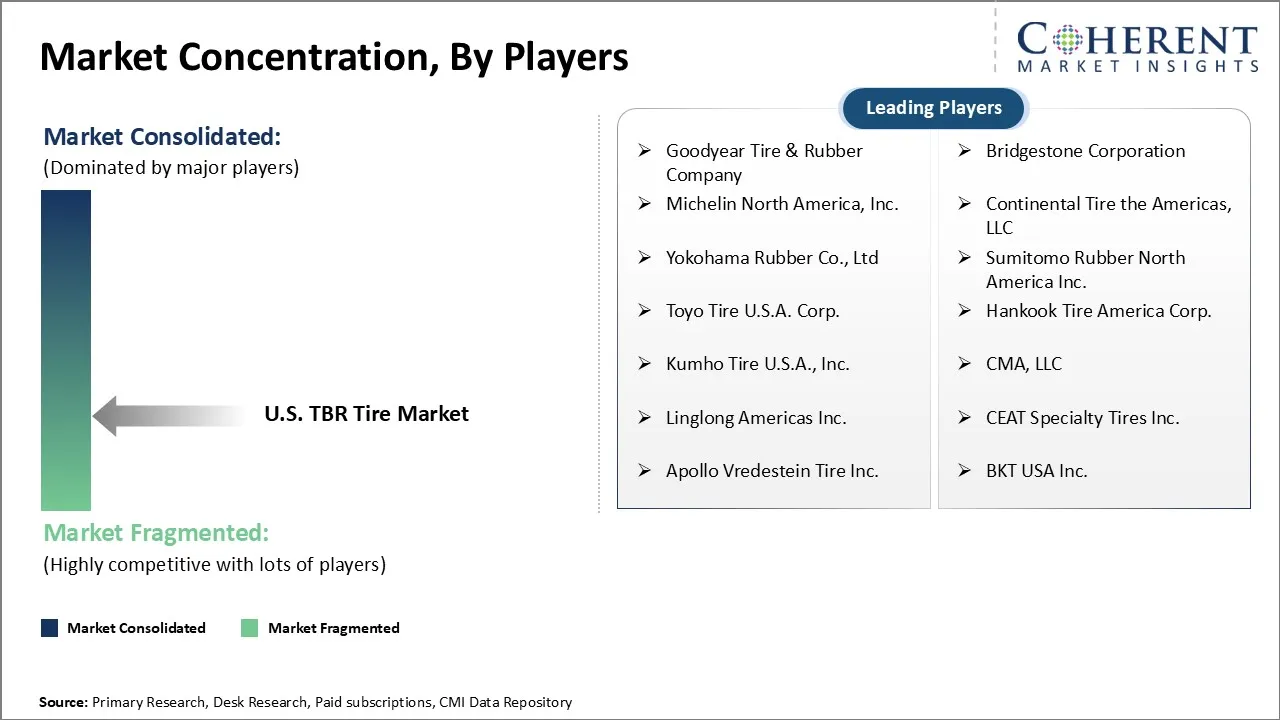
| Companies covered: | Goodyear Tire & Rubber Company, Bridgestone Corporation, Michelin North America, Inc., Continental Tire the Americas, LLC, Yokohama Rubber Co., Ltd, Sumitomo Rubber North America Inc., Toyo Tire U.S.A. Corp., Hankook Tire America Corp., Kumho Tire U.S.A., Inc., CMA, LLC, Linglong Americas Inc., CEAT Specialty Tires Inc., Apollo Vredestein Tire Inc., and BKT USA Inc. | ||
| Growth Drivers: |
| ||
| Restraints & Challenges: |
| ||
U.S. TBR Tire Market Dynamics
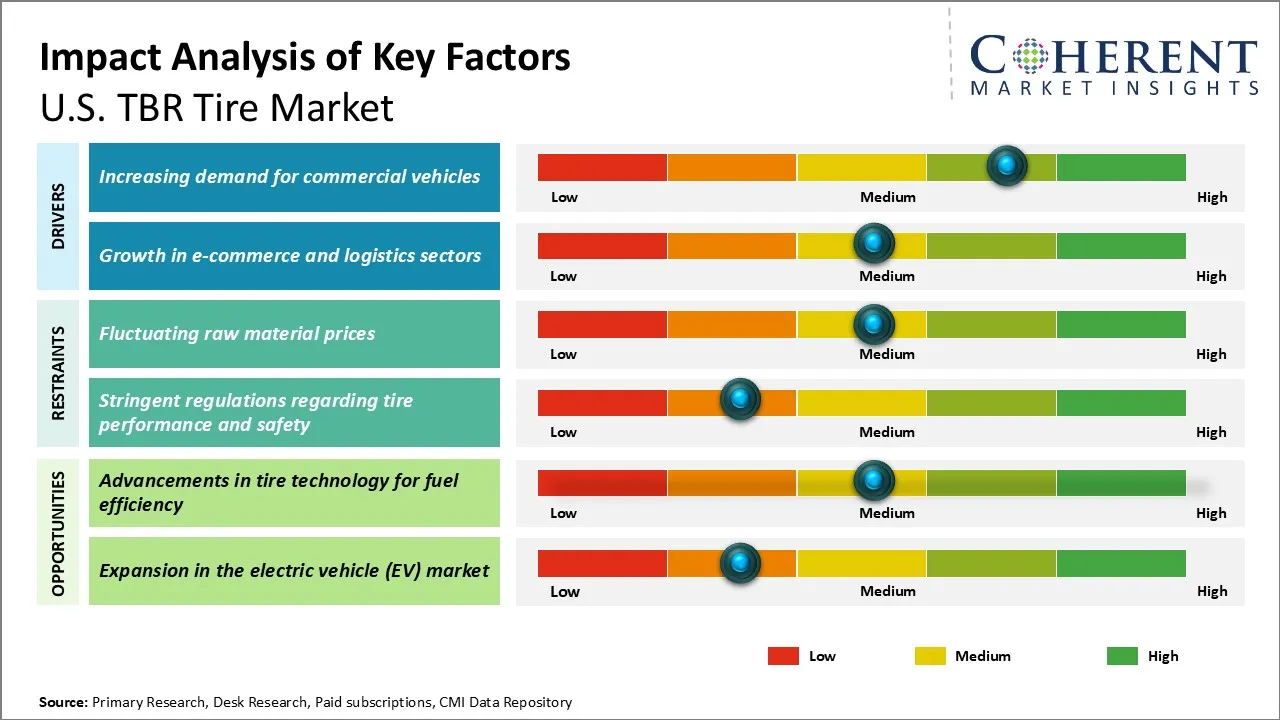
U.S. TBR Tire Market Driver - Increasing Demand for Commercial Vehicles
The increasing demand of business vehicles in the United States is serving as a major driver to the tire market of Truck and Bus Radial (TBR). This influx has been mainly due to an impressive growth of the economy in areas like logistics, transport and the construction industry, which significantly depends on heavy duty vehicles, to operate effectively. Due to the current popularity of e-commerce and the growing pace of infrastructure development projects, fleet operators are moving to upgrade and broaden their commercial vehicle fleets to satisfy the increasing transportation demands. This directly means that there is an increasing demand of durable and high performance TBR tires that can carry heavy loads and at the same time secure and offer fuel efficiency.
As an example, the booming e-commerce sector in the U.S. that is spearheaded by Amazon, FedEx, and UPS has contributed greatly to the high demand of the delivery trucks and long-haul trailers. In 2024, Amazon replaced their existing Class 8 trucks with thousands more to deploy them in their model of same-day and next-day delivery. These types of fleet expansions directly increase the demand of TBR tires with ability to support with heavy load and long distance travel.
U.S. TBR Tire Market Opportunity - Advancements in Tire Technology for Fuel Efficiency
The U.S. TBR tire market is going to have a lot to enjoy due to the ongoing tire technology development to improve the fuel efficiency. As the pressure to minimize carbon emissions increases between regulators and growing cost of fuel, the need to fuel efficient solutions to minimize operational costs is taking priority with the fleet operator and logistics companies. Low rolling resistance tires, new tread compounds and efficient tire constructions are among the innovations that are playing a central role in lowering fuel consumption without interfering with the tire performance and tires life cycle. These advances in technology allow trucking organizations to increase the distance of their vehicles per tank of fuel, which reduces the total fuel cost, a key consideration because of the high mileage of commercial trucks.
One such example is the use of fuel saving tires by the major fleet operators such as Schneider National and J.B. Hunt to reach their internal cost goals as well as the external sustainability expectations. The tangible value of such innovations has been evidenced by many of such fleets who have reported a saving of their fuel expenditure in a year.
Analyst Opinion (Expert Opinion)
- The U.S. TBR tire market is undergoing dynamic expansion, as a result of the revival of freight movement and the growing demand of durable and high-performance tires. The Tire Technology Expo and the Commercial Vehicle Show provided some insights on the developments that have been made and companies such as Michelin and Goodyear seem to be leading the pack of innovators.
- The recent introduction of its new energy saving TBR tire line by Michelins can be viewed as a strategic reaction to the energy saving needs of the trucking industry in terms of low cost of operation and low fuel consumption. In these conferences, much has been said about the imperativeness of sustainability and manufacturers are paying much attention to the use of ecofriendly materials and manufacturing process. Nevertheless, such factors like a supply chain disruption and the unstable price of raw materials were often mentioned as the possible factors limiting growth.
- Those that are able to harmonize their supply chains and provide solutions that allow tires to extend their lifespan and improve their performance will most likely be able to take a bigger share of the market. Moreover, effective marketing policies that will help in sensitizing the fleet operators on the advantages of the advanced TBR technologies will be needed. Finally, the future development of the U.S. TBR tire market will be related to its innovativeness in the context of regulatory and economic issues.
Speak to the analyst
Want personalized insights?
Take the findings above to one of our principal consultants, or have the report rebuilt around the segments, geographies and competitors you actually track.
Market Segmentation
- Tire Type Insights (Revenue, USD Mn, 2021 - 2033)
- Drive Tires
- Steer Tires
- Trailer Tires
- All-Position Tires
- Off-the-Road (OTR) TBR Tires
- Vehicle Class Insights (Revenue, USD Mn, 2021 - 2033)
- Light Commercial Trucks
- Medium-Duty Trucks & Buses
- Heavy-Duty Trucks & Long-Haul Buses
- Sales Channel Insights (Revenue, USD Mn, 2021 - 2033)
- OEM
- Aftermarket
- Rim Size Insights (Revenue, USD Mn, 2021 - 2033)
- Below 20 Inches
- 20–22.5 Inches
- Above 22.5 Inches
- Application Insights (Revenue, USD Mn, 2021 - 2033)
- Highway / Long-Haul
- Regional / Urban Delivery
- Off-Highway / Mixed-Service
- Winter / Severe Weather
- Tire Construction Features Insights (Revenue, USD Mn, 2021 - 2033)
- Standard Radial Tires
- Low Rolling Resistance (LRR) Tires
- Re-treadable Tires
- Puncture Resistant / Severe Duty Tires
- End Use Industry Insights (Revenue, USD Mn, 2021 - 2033)
- Freight & Logistics
- Public Transport
- Construction & Mining
- Waste Management
- Retail & E-Commerce Delivery
- Agriculture & Rural Transport
- Key Players Insights
- Goodyear Tire & Rubber Company
- Bridgestone Corporation
- Michelin North America, Inc.
- Continental Tire the Americas, LLC
- Yokohama Rubber Co., Ltd
- Sumitomo Rubber North America Inc.
- Toyo Tire U.S.A. Corp.
- Hankook Tire America Corp.
- Kumho Tire U.S.A., Inc.
- CMA, LLC
- Linglong Americas Inc.
- CEAT Specialty Tires Inc.
- Apollo Vredestein Tire Inc.
- BKT USA Inc.
Sources
Primary Research Interviews
- Product Line VP – Leading U.S. TBR Tire Manufacturer
- Head of Fleet Procurement – Major Commercial Transportation Company
- Sales Director – North American Tire Distributor
- Sustainability Officer – National Tire Recycling Association
Stakeholders
- Manufacturers (Domestic and International – OEM and Replacement)
- End Use Sectors:
- Commercial Truck Fleet Operators
- Public Transportation Agencies
- Logistics & Delivery Service Providers
- Regulatory & Certification Bodies
- E-commerce Platforms and Tire Retailers
- Technology Providers: Connected Tire Solutions, Retreading Innovation Vendors
Databases
- U.S. International Trade Commission (USITC) Import/Export Data
- U.S. Department of Transportation (DOT) Truck, Bus & Tire Safety Data
- UN Comtrade Database (Global Trade Flows for TBR Tires)
- U.S. Tire Manufacturers Association (USTMA) Industry Reports
Magazines
- Tire Business – U.S. Market News and Trends
- Modern Tire Dealer – Insights and Market Data on TBR Tires
- Fleet Owner Magazine – Commercial Fleet Product Reviews and Trends
- Rubber & Plastics News – Updates on TBR Tire Industry Developments
Journals
- Journal of Rubber Research – TBR Tire Performance & Materials
- Journal of Traffic and Transportation Engineering – Impact of Tires on Fleet Operations
- International Journal of Automotive Technology – Truck and Bus Tire Innovations
- Tire Science and Technology Journal – Quality, Design & Testing in TBR Tires
Newspapers
- The Wall Street Journal – Market Share, M&A, and Industry Growth
- Reuters – Regulatory News Affecting U.S. Tire Market
- Bloomberg – Pricing, Demand, Import/Export Shifts
- Transport Topics – Logistics Industry News and Tire Sector Updates
Associations
- U.S. Tire Manufacturers Association (USTMA)
- Tire Retread & Repair Information Bureau (TRIB)
- Rubber Manufacturers Association
- American Trucking Associations
- National Highway Traffic Safety Administration (NHTSA)
Public Domain Sources
- U.S. Department of Transportation (DOT) – Regulations and Market Data
- Environmental Protection Agency (EPA) – Standards for Recycling & Disposal
- Federal Motor Carrier Safety Administration (FMCSA) – Fleet and Safety Regulations
- U.S. International Trade Commission (USITC) – Trade and Tariff Data
Proprietary Elements
CMI Data Analytics Tool, Proprietary CMI Existing Repository of information for last 8 years.
Get access to 250+ pages report
Every segment, forecast, competitor profile and data table behind the analysis above — available for instant download.
- ESOMAR Member
- ISO 9001:2015 Certified
- D-U-N-S Registered
- GDPR & CCPA Compliant
Missing comfort of reading report in your local language? Find your preferred language:
Transform your Strategy with Exclusive Trending Reports
Frequently Asked Questions
The U.S. TBR tire market is estimated to be valued at USD 5,159.1 Mn in 2026 and is expected to reach USD 6,519.6 Bn by 2033.
The CAGR of the U.S. TBR tire market is projected to be 3.4% from 2026 to 2033.
Increasing demand for commercial vehicles and growth in e-commerce and logistics sectors are the major factors driving the growth of the U.S. TBR tire market.
Fluctuating raw material prices and stringent regulations regarding tire performance and safety are the major factors hampering the growth of the U.S. TBR tire market.
In terms of tire type, the drive tires segment is estimated to dominate the market revenue share 2026.
Goodyear Tire & Rubber Company, Bridgestone Corporation, Michelin North America, Inc., Continental Tire the Americas, LLC, Yokohama Rubber Co., Ltd, Sumitomo Rubber North America Inc., Toyo Tire U.S.A. Corp., Hankook Tire America Corp., Kumho Tire U.S.A., Inc., CMA, LLC, Linglong Americas Inc., CEAT Specialty Tires Inc., Apollo Vredestein Tire Inc., and BKT USA Inc. are the major players.