

Global USB Docking Station Market Size and Forecast – 2026 To 2033
The global USB docking station market is expected to grow from USD 1.90 Bn in 2026 to USD 2.75 Bn by 2033, registering a compound annual growth rate (CAGR) of 2.6% from 2026 to 2033. The global USB docking station market is driven by the growing demand for multi display workstation connectivity. On April 2, 2026, Hyper announced the launch of the HyperDrive Next Thunderbolt 5 Dock. This powerful dock delivers up to 120 Gbps Thunderbolt 5 video bandwidth, support for triple high-resolution displays, built-in M.2 PCIe expansion, and Thunderbolt Share for connecting two PCs.
Key Takeaways of the Global USB Docking Station Market
- The USB C docking stations segment is expected to account for 42.0 % of the global USB docking station market share in 2026. Expansion of BYOD policies in corporate organizations is driving the growth of the segment. On November 3, 2025, Ivanti released its 2025 Secure by Design research, reporting that 44% of employees use personal smartphones for work, 37% use personal hotspots, and 32% use personal computers, prompting enterprises to strengthen BYOD policies through unified endpoint management and zero-trust security solutions.
- The 5 to 8 ports segment is estimated to capture 48.0 % of the market share in 2026. Rising use of high speed data transfer and power delivery solutions is majorly driving the growth of the segment. On March 6, 2026, UGREEN launched the Maxidok Thunderbolt 5 Docking Station Series featuring the Maxidok 17-in-1 and Maxidok 10-in-1 models.
- The commercial enterprises segment is estimated to capture 33.0 % of the market share in 2026. Expansion of enterprise workstation modernization projects is driving the growth of the segment. On January 6, 2025, Dell Technologies unveiled its Dell Pro Max workstation line at CES 2025, replacing its traditional workstation nomenclature for AI-centric enterprise workstations powered by Intel Core Ultra processors and NVIDIA RTX Pro graphics.
- North America is expected to dominate the USB docking station market in 2026 with a market share of 36.0 %. Increasing integration with AI ready and creator workstations in North America is driving the growth of the regional market. On January 6, 2025, HP introduced next-generation AI-enabled ZBook and Z workstation platforms, expanding its creator and engineering portfolio with Intel Core Ultra and AMD Ryzen AI processors together with NVIDIA RTX professional graphics.
- Asia Pacific is expected to account for 32.0 % of the market share in 2026 and is projected to record the fastest growth over the forecast period. Rising demand from education and digital learning institutions across Asia Pacific is driving the growth of the regional market. On June 29, 2026, Samsung Electronics launched its Interactive Display WAF Series with Google EDLA certification, USB-C connectivity and power supply across education use cases across Asia Pacific.
- Rapid Shift Toward Thunderbolt 4 Thunderbolt 5 and USB4 Docking Stations: Enterprises and professional users are increasingly moving to next generation docking stations supporting Thunderbolt 4, Thunderbolt 5 and USB4 standards to benefit from higher data transfer speeds multi 4K or 8K display support faster charging and better compatibility with high performance AI laptops and creator workstations.
- Growing Integration of Smart Dock Management and Enterprise Security Features: Companies are releasing docking stations with remote firmware updates, device fleet management, MAC address pass-through, PXE boot, Wake on LAN and advanced security features, which give centralized IT management for large-scale hybrid workplace deployments.
Segmental Insights
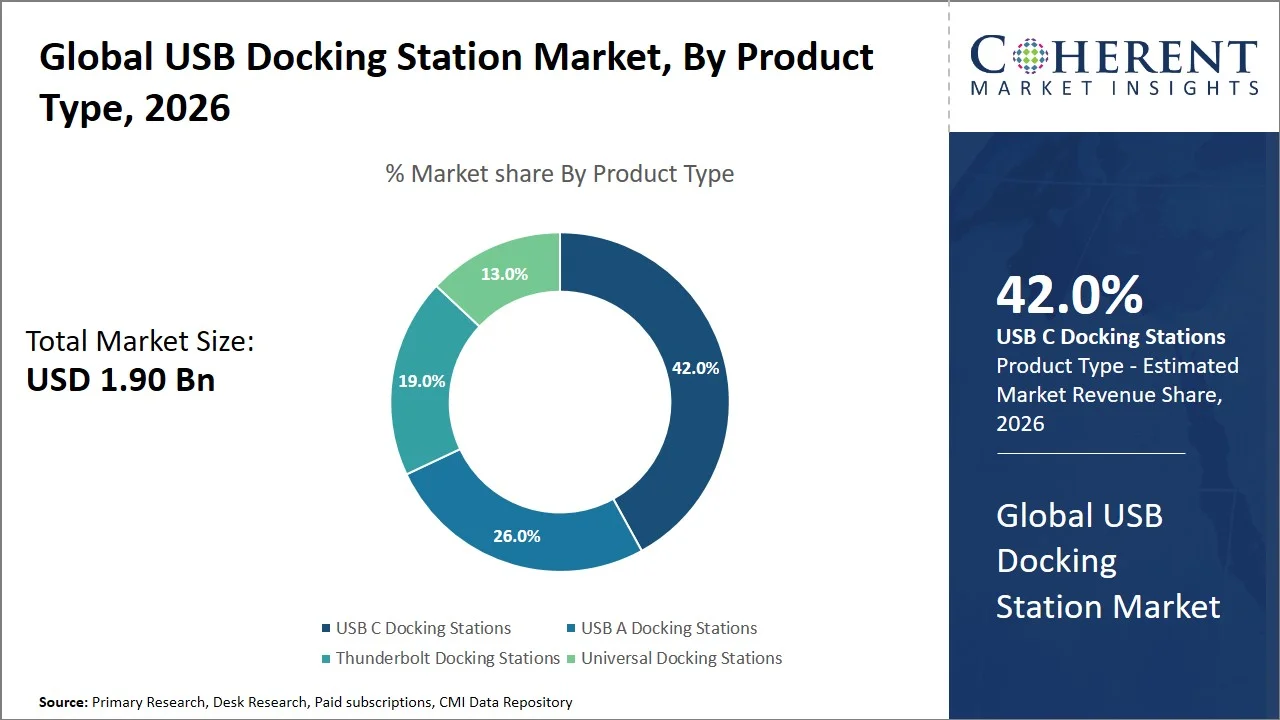
Why Do USB C Docking Stations Dominate the Global USB Docking Station Market?
The USB C docking stations segment is expected to account for 42.0% of the global USB docking station market share in 2026. The main driver of demand for USB C docking stations is the widespread standardization of USB C connectivity on modern laptops. Most commercial and premium consumer products from leading notebook manufacturers such as Dell, HP, Lenovo, Apple, Acer and ASUS use USB C connectors that handle data transfer, video output and power delivery all through a single cable. This universal compatibility allows users to connect multiple screens, external storage, networking and peripherals while simultaneously charging their devices, simplifying workspace setup and increasing productivity. As companies progressively adopt USB C based notebook fleets and hybrid work environments flourish, organizations are turning to USB C docking stations to provide better interoperability across varied hardware ecosystems. For example, the European Union’s USB-C laptop charging mandate took effect in April 2025, mandating all newly marketed computers to use USB-C charging. The rule has driven product transitions among manufacturers including Dell, HP, Lenovo, Acer, ASUS and Apple, further driving demand for universal USB-C docking stations in both the enterprise and consumer sectors.
- Current Industry Events of 2026
- Market Size Estimation
- Regional Breakdown
- Competitive Landscape
- Customer Intelligence
- Segmental Analysis
- Pricing Analysis
- Key Market Drivers, Challenges & Future Trends
- Customized Insights Section
Why are 5 to 8 Ports the Most Preferred Port Configuration?
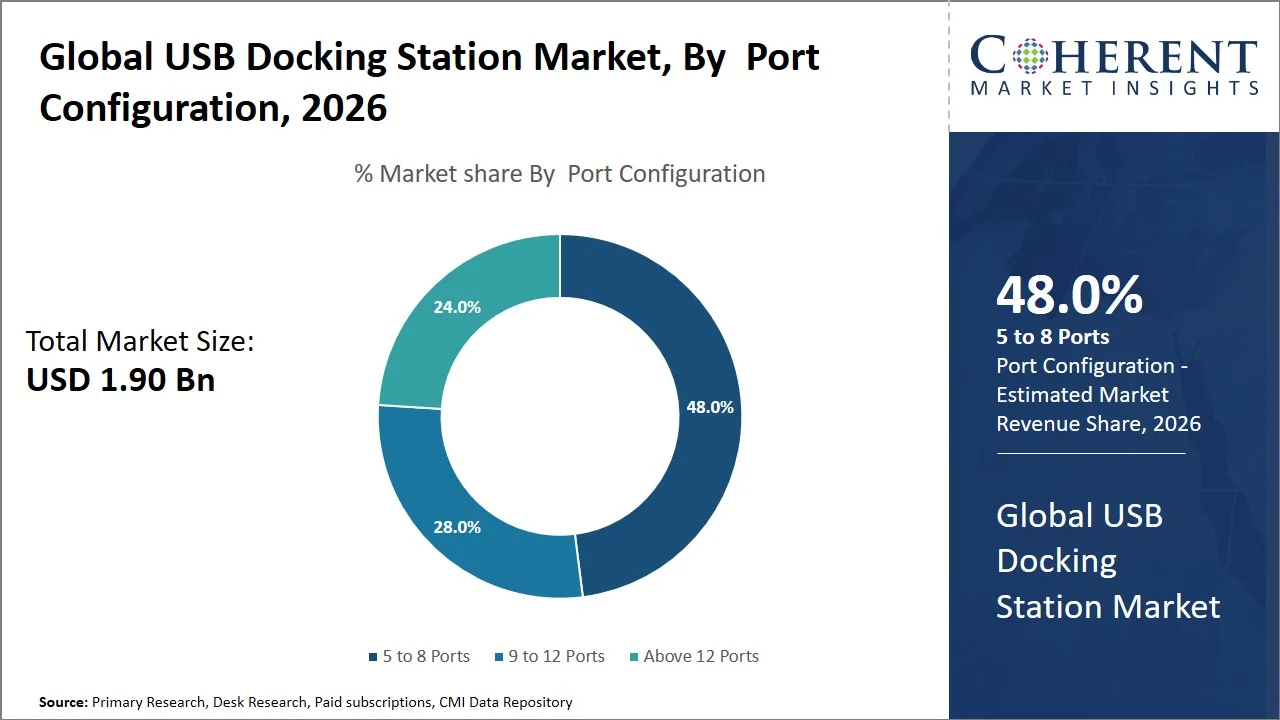
The 5 to 8 ports segment is expected to account for 48.0% of the global USB docking station market share in 2026. The main reason why there is a preference to dock with 5 to 8 ports is that they are the best compromise between connection and price. This configuration typically includes essential ports such as HDMI or DisplayPort, USB-A, USB-C, Ethernet, audio, and SD card readers, meeting the connectivity requirements of most professional and personal computing environments. It covers the daily needs of business users, students and home office workers without overcomplicating or overcharging. They are preferred by enterprises deploying large numbers of workstations and by consumers looking for practical and cost effective connectivity options because of their compact size, lower power consumption and compatibility with common laptops. On January 6, 2026, Anker unveiled the Nano Docking Station at CES 2026, a compact docking solution featuring eight USB-C ports, including HDMI, USB-A, USB-C, Ethernet, SD card reader, and 100W Power Delivery, targeted at mobile professionals and home office users who require practical connectivity for their daily tasks.
Commercial Enterprises Dominate the Global USB Docking Station Market
The commercial enterprises segment is expected to account for 33.0% of the global USB docking station market share in 2026. The main driver of demand from commercial firms is the growing adoption of hybrid work rules and the standardization of laptop deployments in businesses. Organizations are investing in docking stations that allow employees to connect laptops to multiple monitors, wired networks, external storage, and workplace peripherals via a single connection, boosting productivity and simplifying IT management. Large corporations also emphasize universal docking solutions, requiring flexible desk sharing, reduced setup time, and compatibility across varied device fleets. This makes commercial organizations the largest end-user category for USB docking stations. On September 5, 2025, Lenovo announced the ThinkPad Thunderbolt 5 Smart Dock 7500 at IFA 2025, which includes Accessories Fleet Manager cloud monitoring and remote firmware management, 180 W Power Delivery, triple 8K display support and enterprise IT administration tools to help organizations deploying standardized ThinkPad workstations to hybrid offices.
Current Events and their Impact
Current Events | Description and its Impact |
European Union Radio Equipment Directive Delegated Regulation on Cybersecurity (Effective August 2025) |
|
European Union Ecodesign for Sustainable Products Regulation (ESPR) (Regulation (EU) 2024/1781) |
|
Global USB Docking Station Market Dynamics
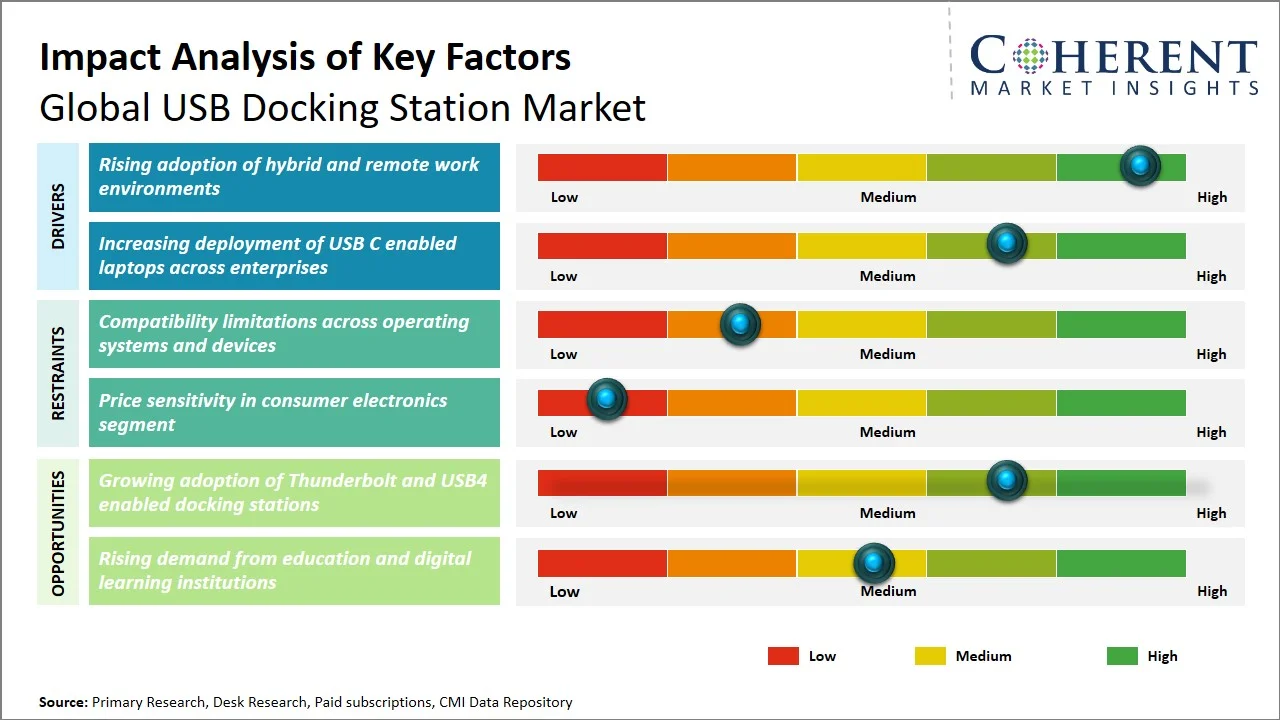
Market Drivers
- Rising adoption of hybrid and remote work environments: With the rise of hybrid and remote workspaces, the demand for USB docking stations has seen substantial growth as enterprises look to give employees with seamless connectivity to workstations from home and office spaces. Docking stations allow users to connect several monitors, keyboards, mouse, wired networks, storage devices and charging using a single USB C connection, saving time on desk setup and increasing productivity. As companies spend more and more in flexible office architecture and hot desking tactics, USB docking stations have become an essential adjunct for consistent user experience and effective device management. On December 30, 2025, Targus announced the availability of its Thunderbolt 5 Triple Video 8K EcoSmart Docking Station with 140W EPR (DOCK230). Purposely built for modern hybrid professionals, creators, and power users, DOCK230 delivers an advanced combination of display performance, bandwidth, charging power, and multiPC flexibility.
- Increasing deployment of USB C enabled laptops across enterprises: The cost of USB C enabled laptops is decreasing, driving the need for USB docking stations. More and more organizations are moving away from legacy laptops to current USB C devices. They are progressively adopting universal docking stations that support a wide range of laptop manufacturers, while simplifying IT procurement and minimizing compatibility difficulties. The change let employees connect all office peripherals with a single cable, simplifying operational efficiency and allowing for uniform enterprise workspace deployments. On July 23, 2026, Acer updated its TravelMate business notebook collection with new AI-enabled enterprise notebooks with USB4 Type-C connectivity, dual-display compatibility and high-speed charging capabilities. They were built for enterprise IT teams moving away from legacy connectors and into standardized USB-C workplace ecosystems.
Emerging Trends
- Expansion of Multi Display and High Power Delivery Solutions: There is a growing need for docking stations that can support three or four external displays along with power delivery greater than 100W making it ideal for engineering design software, financial trading workstations, video production, and AI development environments that demand high productivity.
- Rising Adoption of Sustainable and Modular Docking Station Designs: Leading vendors are emphasizing energy-efficient chipsets, recycled materials, plastic-free packaging, and modular docking designs that enable users to upgrade connectivity modules instead of replacing entire devices, thereby supporting corporate sustainability goals and reducing electronic waste.
Regional Insights
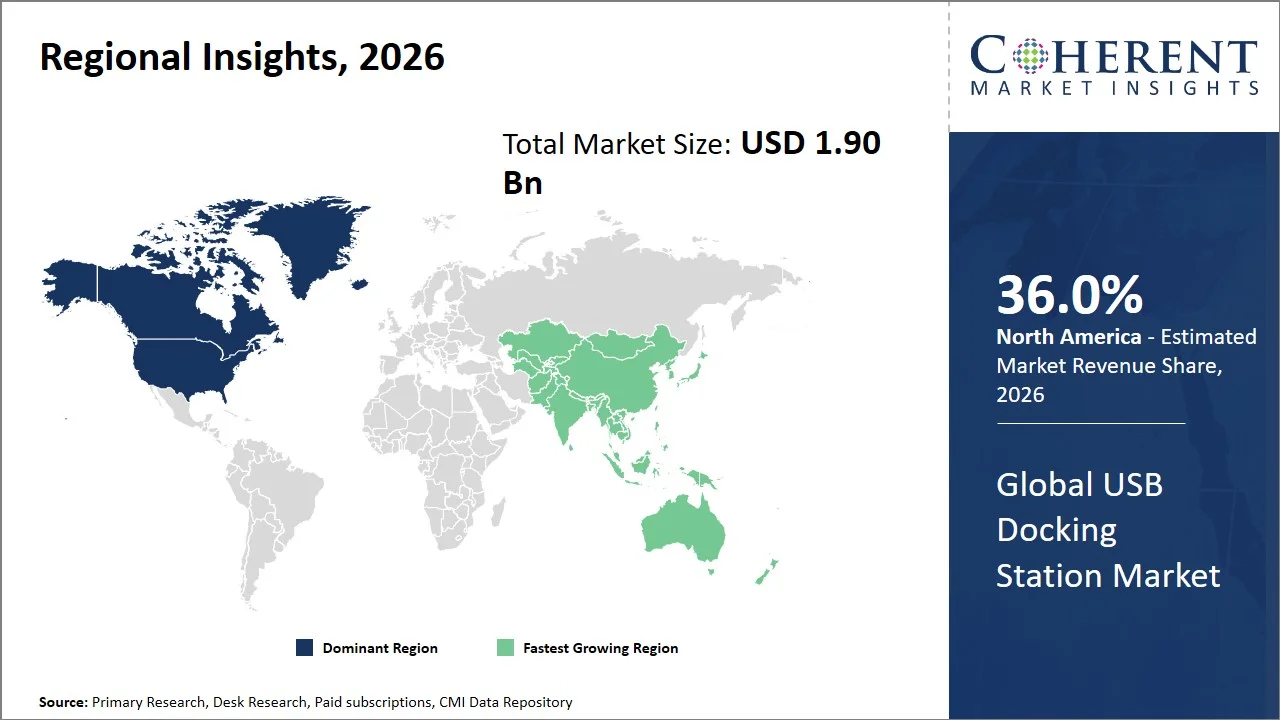
Why is North America a Strong Market for USB Docking Stations?
North America is expected to account for a market share of 36.0% in 2026. The U.S. and Canada are among the most mature regional markets for USB docking stations since hybrid work infrastructure is widely deployed and premium workplace laptops are the norm. Key vendors such as Dell, HP, Lenovo, Kensington, Plugable Technologies, Belkin and StarTech have wide distribution channels and good enterprise relationships across the region.
Companies such as Microsoft, Amazon, Google, JPMorgan Chase, Deloitte and Accenture are still investing in flexible office settings, including USB C docking solutions to allow dual and triple monitor setups. Educational institutions and healthcare organizations also hastened the adoption of universal docking stations to facilitate the connectivity of workstations. Thunderbolt 4 and USB4 docks have been rapidly adopted in the region, and enterprise clients are increasingly looking for more advanced functionality such as MAC address pass through, Wake on LAN, PXE boot and centralized firmware maintenance for large scale IT operations.
Why Does the Asia Pacific USB Docking Station Market Exhibit High Growth?
Asia Pacific is projected to account for 32.0% of the global USB docking station market in 2026 and is expected to register the fastest growth. Asia Pacific is the fastest growing regional market with large-scale notebook manufacturing, digital workplace transformation and the rise of enterprise IT spending in China, Japan, South Korea, India and Southeast Asia felling growth. China continues to be the largest manufacturer of USB docking stations in the world, with companies such as Baseus, UGREEN, ORICO, Anker and a wide range of ODM suppliers supporting global brands. Demand for premium Thunderbolt docking stations used in engineering, semiconductor and electronics sectors is driven by Japan and South Korea. The global capability centers in India (by firms like IBM, Capgemini, TCS, Infosys, and Accenture) have grown rapidly, hence increasing the installation of docking stations for hybrid staff. Regional manufacturers are also introducing compact GaN powered docking stations with higher power delivery and support for multiple 4K displays to address growing demand from mobile professionals.
Global USB Docking Station Market Outlook for Key Countries
Why is the U.S. Emerging as a Major Hub in the USB Docking Station Market?
The U.S. leads the world in business adoption of USB docking stations, due to its mature corporate IT ecosystem and early shift to USB C laptops. Dell’s WD22TB4, HP’s Thunderbolt Dock G4, Lenovo ThinkPad Universal USB C Dock, Kensington SD5780T and Plugable UD series are widely employed in enterprise environments. Federal agencies, financial organizations, consulting firms, universities and healthcare systems are moving toward standardizing docking stations to facilitate secure hot desking and hybrid work environments. Organizations are prioritizing corporate capabilities such as remote firmware updates, device authentication, support for network boot, and integrated security management. This has hastened the replacement of older USB A docking solutions with newer higher bandwidth USB4 and Thunderbolt platforms from Dell, HP, Lenovo, and Microsoft that have been introduced at a quick pace.
Is China the Next Growth Engine for the USB Docking Station Market?
As the largest manufacturing base and one of the fastest growing consumption markets for USB docking stations, China… Chinese businesses like Baseus, UGREEN, ORICO, Wavlink and Vention have increased their global footprint with USB C and Thunderbolt docking solutions with multi display support and high wattage charging. Shenzhen, Dongguan and Suzhou remain important manufacturing hubs that serve as docking points for worldwide brands through OEM/ODM collaborations. "The growth of cloud computing, semiconductor design and consumer electronics industries in China has resulted in a strong demand for multiple monitor workstations as more experts seek multiple monitor workstations. In addition, the government's attempts to boost local electronics manufacturing and high-end computer infrastructure have also enhanced the domestic production capabilities of docking station components and final devices.
Germany USB Docking Station Market Analysis and Trends
Germany is Europe's top market for USB docking stations, driven by its robust industrial, automotive and engineering sectors. Companies like Siemens, Bosch, SAP, BMW Group, Mercedes-Benz Group, Volkswagen Group and Continental use docking stations extensively to help engineers, software developers and design professionals working in hybrid office environments. German firms have rapidly adopted USB C notebooks and are already deploying Thunderbolt enabled docking stations capable of supporting several high definition screens for CAD, simulation and industrial software applications. Demand is also driven by the country’s concentration on Industry 4.0 and digital engineering workflows, in addition to its adherence to European cybersecurity and environmental rules which influence connected electronic peripherals.
Japan USB Docking Station Market Analysis and Trends
The market for USB docking stations in Japan is characterized by a high demand of premium, small and high reliability docking stations targeted at business professionals and technology heavy sectors. Companies including Sony, Panasonic, Fujitsu, NEC, Toshiba, Hitachi, and Canon are launching USB C laptops with universal docking stations to speed up workplace modernization. Semiconductor manufacturers, robotics companies, automotive suppliers and electronics design organizations are clamoring for high bandwidth Thunderbolt docks to support engineering software, AI development and multi monitor productivity. Japanese consumers also show significant preference for compact desktop accessories with outstanding build quality, prompting manufacturers to produce space efficient docking stations with integrated charging and advanced thermal management.
U.K. USB Docking Station Market Analysis and Trends
Following extensive acceptance of hybrid working policies throughout both public and private sector, the U.K. has enjoyed considerable uptake of USB docking stations. London-based banks including HSBC, Barclays, Lloyds Banking Group and Standard Chartered have invested in standardized USB C docking systems to help create flexible workplace environments. Professional services businesses such as PwC, EY, Deloitte and KPMG continue to roll out docking stations that allow for a smooth transition between home and workplace. Universities, National health service organisations and government departments have also upgraded workplace infrastructure with universal docking stations to help manage devices, boost employee productivity and ensure secure enterprise connectivity across distributed workforces.
Global USB Docking Station Market - Thunderbolt 4 vs Thunderbolt 5 vs USB4 Adoption Trends (2025)
Interface Technology | Estimated Adoption Share | Primary Adoption Area |
Thunderbolt 4 | 54% | Enterprise workstations and premium business laptops |
Thunderbolt 5 | 11% | AI workstations, creator PCs, engineering and media production |
USB4 | 35% | Mainstream commercial laptops, education, SMBs, and consumer notebooks |
How is the Growing Adoption of Thunderbolt and USB4 Enabled Docking Stations Creating New Growth Opportunities in the Global USB Docking Station Market?
The growing adoption of Thunderbolt and USB4 enabled docking stations is opening up new growth opportunities and broadening deployment beyond conventional office workstations to bandwidth intensive applications such as AI development, engineering simulation, professional content creation, financial trading and medical imaging. Thunderbolt 5 docking stations from vendors such as CalDigit, Kensington, Anker, and Plugable are now shipping and offer bandwidths of up to 80 Gbps, with bandwidth boost capabilities of up to 120 Gbps for display intensive workloads, allowing multiple 4K or 8K displays, high-speed NVMe storage, and external GPUs to all work over a single connection.
Dell, HP and Lenovo have introduced Thunderbolt 4 and USB4 support into their latest commercial AI PC portfolios, prompting corporations to replace legacy USB docks with higher performing universal docking options. With the introduction of Intel Core Ultra and AMD Ryzen AI powered notebooks, the demand has risen for advanced docking stations capable of delivering over 100 W of power, supporting PCIe based peripherals, and providing enterprise features such as remote firmware management, Wake on LAN, and MAC address pass through. The shift in technology is enabling manufacturers to focus on higher-value products at premium enterprise, engineering, media production and research businesses, while also creating recurring possibilities through workstation upgrades and enterprise IT renewal cycles.
On March 5, 2025, Apple announced the new Mac Studio, the most powerful Mac ever made, featuring M4 Max and the new M3 Ultra chip. The ultimate pro desktop delivers groundbreaking pro performance, extensive connectivity with Thunderbolt 5, and new capabilities in its compact design.
Market Players, Key Development, and Competitive Landscape
Key Developments
- On April 23, 2025, Anker launched its first Thunderbolt 5 docking station featuring an integrated GaN power supply, 14 ports, support for up to dual 8K displays, remote firmware management through Dock Manager software, and up to 232 W total power output, targeting professional creators and enterprise users requiring high-bandwidth workstation connectivity.
- On April 7, 2025, CalDigit introduced the TS5 Thunderbolt 5 Dock in 2025, expanding its premium workstation portfolio with 15 ports, 140 W host charging, PCIe 64 Gbps external SSD support, dual 8K or triple 4K display capability, and enhanced compatibility with Thunderbolt 5 and USB4 devices for creative professionals and engineering workloads.
Competitive Landscape
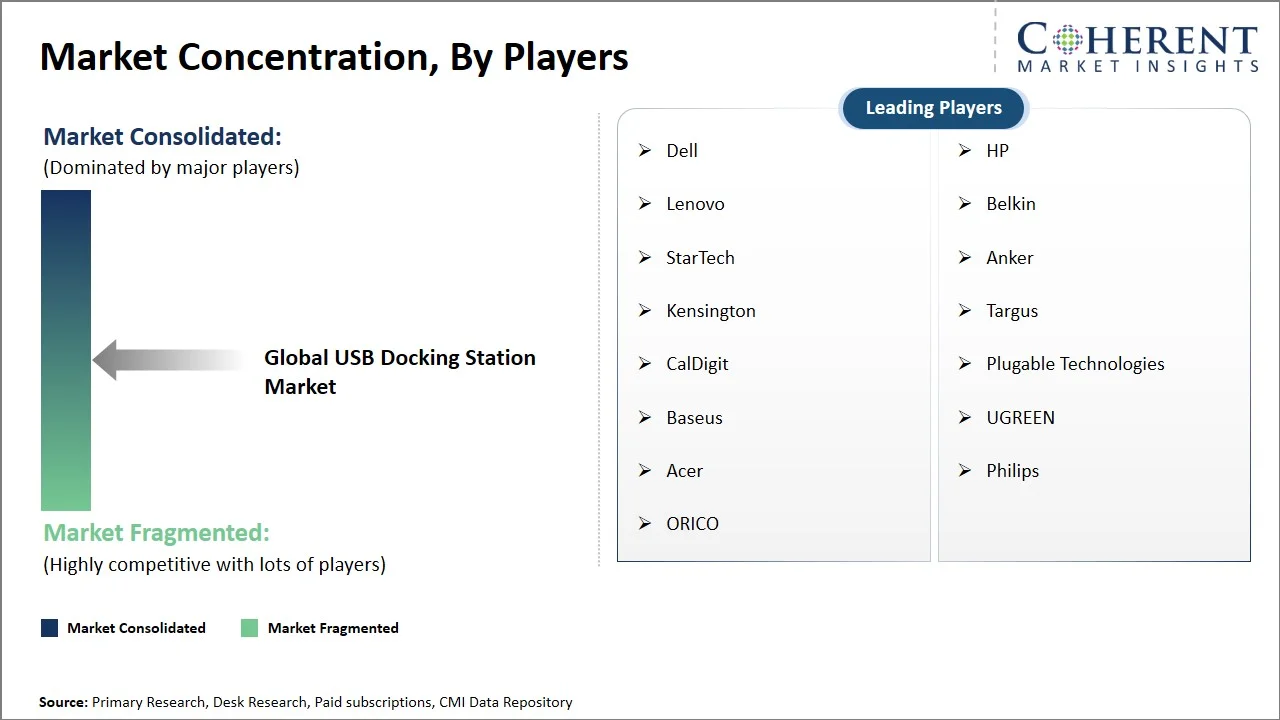
The global USB docking station market is highly competitive, with Dell, HP, Lenovo, Kensington, Belkin, CalDigit, Plugable Technologies, Anker, StarTech, Baseus, UGREEN and ORICO among the leaders. Competition is increasingly focused on high bandwidth connectivity, enterprise manageability and premium workstation performance rather than basic port expansion. Dell is continuing to build its commercial environment with the WD22TB4 Thunderbolt Dock, which is built for enterprise fleets that need modular upgrades and remote firmware maintenance. The Thunderbolt Dock G4 is aimed at the enterprise with superior security, remote management and interoperability with HP Wolf Security equipped devices.
The ThinkPad ecosystem: Lenovo benefits from universal USB C and Thunderbolt docks that are certified for large business deployments. CalDigit has made the leap to the professional creator space with Thunderbolt 5 docking stations designed with ultra-high bandwidth workflows in mind. Anker and Baseus are targeting premium consumer and small business customers with compact GaN powered docking stations with high wattage charging and multiple display outputs. Kensington and Plugable continue differentiating themselves through enterprise certifications, extensive operating system compatibility, and advanced networking features including PXE boot, Wake on LAN, and MAC address pass through.
Market Report Scope
USB Docking Station Market Report Coverage
| Report Coverage | Details | ||
|---|---|---|---|
| Base Year: | 2025 | Market Size in 2026: | USD 1.90 Bn |
| Historical Data for: | 2020 To 2024 | Forecast Period: | 2026 To 2033 |
| Forecast Period 2026 to 2033 CAGR: | 2.6% | 2033 Value Projection: | USD 2.75 Bn |
| Geographies covered: |
| ||
| Segments covered: |
| ||
| Companies covered: | Dell, HP, Lenovo, Belkin, StarTech, Anker, Kensington, Targus, CalDigit, Plugable Technologies, Baseus, UGREEN, Acer, Philips, and ORICO | ||
| Growth Drivers: |
| ||
| Restraints & Challenges: |
| ||
Analyst Opinion (Expert Opinion)
- The strongest future growth is expected to come from the transition toward Thunderbolt 5 and USB4 based enterprise workstations as AI PCs, high-performance notebooks, and multi display office environments become standard across knowledge intensive industries. Legacy USB A docking stations are expected to decline steadily as organizations standardize on universal USB C connectivity during laptop refresh cycles.
- The U.S. commercial enterprise applications are expected to have the highest opportunity for Thunderbolt and USB4 docking stations, followed by China and Japan, where the demand for premium docking solutions supporting multiple 4K and 8K displays, high speed PCIe storage and power delivery above 100 W is driven by AI workstation deployments, semiconductor design, software engineering and digital content production.
- Market participants should look to invest in remote fleet management, predictive firmware updates, improved cybersecurity and compatibility with Microsoft Copilot Plus PCs, Intel Core Ultra platforms and AMD Ryzen AI systems, alongside hardware innovation, to focus on enterprise grade software capabilities. Companies that expand Thunderbolt 5 portfolios while strengthening OEM partnerships with leading notebook manufacturers and offering modular, upgradeable docking architectures will be better positioned to capture long term enterprise procurement contracts and premium market segments.
Speak to the analyst
Want personalized insights?
Take the findings above to one of our principal consultants, or have the report rebuilt around the segments, geographies and competitors you actually track.
Market Segmentation
- Product Type Insights (Revenue, USD Billion, 2021 - 2033)
- USB C Docking Stations
- USB A Docking Stations
- Thunderbolt Docking Stations
- Universal Docking Stations
- Port Configuration Insights (Revenue, USD Billion, 2021 - 2033)
- 5 to 8 Ports
- 9 to 12 Ports
- Above 12 Ports
- End User Insights (Revenue, USD Billion, 2021 - 2033)
- Commercial Enterprises
- Government
- Education
- Healthcare
- Individual Consumers
- Distribution Channel Insights (Revenue, USD Billion, 2021 - 2033)
- Online
- Offline
- Regional Insights (Revenue, USD Billion, 2021 - 2033)
- North America
- U.S.
- Canada
- Latin America
- Brazil
- Argentina
- Mexico
- Rest of Latin America
- Europe
- Germany
- U.K.
- Spain
- France
- Italy
- Russia
- Rest of Europe
- Asia Pacific
- China
- India
- Japan
- Australia
- South Korea
- ASEAN
- Rest of Asia Pacific
- Middle East
- GCC Countries
- Israel
- Rest of Middle East
- Africa
- South Africa
- North Africa
- Central Africa
- North America
- Key Players Insights
- Dell
- HP
- Lenovo
- Belkin
- StarTech
- Anker
- Kensington
- Targus
- CalDigit
- Plugable Technologies
- Baseus
- UGREEN
- Acer
- Philips
- ORICO
Sources
Primary Research Interviews
- Enterprise IT Infrastructure Directors
- Corporate IT Procurement Managers
- Global Workplace Technology Managers
- OEM Laptop Product Managers
Magazines
- Computerworld
- CIO Magazine
- PCWorld
- TechRadar Pro
Journals:
- IEEE Transactions on Consumer Electronics
- IEEE Computer
- IEEE Transactions on Industrial Informatics
- Journal of Systems Architecture
- ACM Transactions on Computer Systems
Associations
- USB Implementers Forum (USB-IF)
- Video Electronics Standards Association (VESA)
- PCI Special Interest Group (PCI-SIG)
- HDMI Forum
Public Domain Sources
- U.S. Census Bureau
- U.S. Bureau of Economic Analysis (BEA)
- U.S. Bureau of Labor Statistics (BLS)
- Eurostat
Proprietary Elements
- CMI Data Analytics Tool
- Proprietary CMI Existing Repository of Information for the Last 10 Years
Get access to 250+ pages report
Every segment, forecast, competitor profile and data table behind the analysis above — available for instant download.
- ESOMAR Member
- ISO 9001:2015 Certified
- D-U-N-S Registered
- GDPR & CCPA Compliant
Missing comfort of reading report in your local language? Find your preferred language:
Transform your Strategy with Exclusive Trending Reports
Frequently Asked Questions
The global USB docking station market is expected to stand at USD 1.90 Bn in 2026 and is expected to reach USD 2.75 Bn by 2033.
The CAGR of the global USB docking station market is projected to be 2.6% from 2026 to 2033.
Rising adoption of hybrid and remote work environments and increasing deployment of USB C enabled laptops across enterprises are the major factors driving the growth of the global USB docking station market.
Compatibility limitations across operating systems and devices and price sensitivity in consumer electronics segment are the major factors hampering the growth of the global USB docking station market.
In terms of product type, the USB C docking stations segment is estimated to dominate the market revenue share in 2026.
They enable instant access to multiple peripherals, displays, networking, and charging through a single connection.
Many universal docking stations support both operating systems, although some advanced features may vary.