

Global Vacuum Flask Market Size and Forecast – 2026-2033
According to Coherent Market Insights, the global vacuum flask market is estimated to be valued at USD 5.89 Bn in 2026 and is expected to reach USD 8.46 Bn by 2033, expanding at a compound annual growth rate (CAGR) of 5.3% from 2026 to 2033.
Key Takeaways of the Vacuum Flask Market
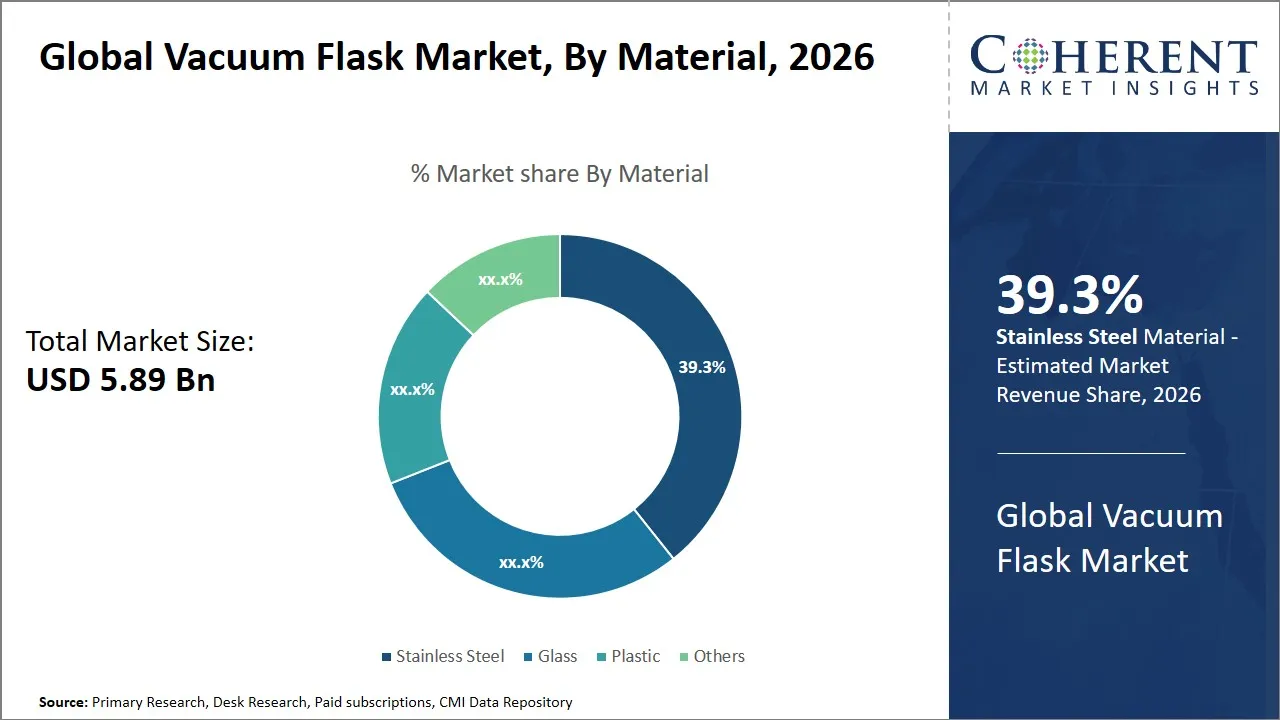
- Stainless steel segment is expected to hold 39.3% of the vacuum flask market share in 2026.
- The less than 16oz segment is estimated to capture 48.9% of the global vacuum flask market share in 2026.
- The single-wall segment is projected to represent 41.7% of the market share in 2026.
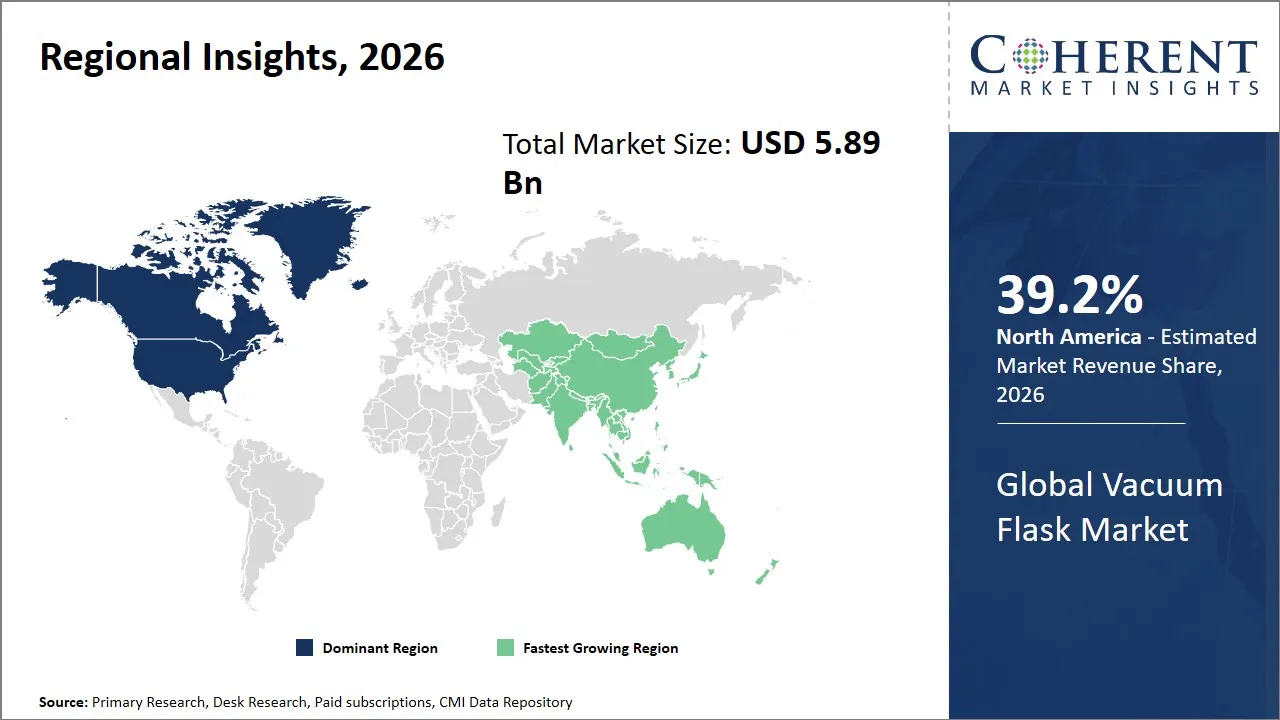
- North America is projected to lead the vacuum flask market with a 39.2% share in 2026.
- Asia Pacific is expected to record the fastest market growth, contributing a 19.3% share in 2026.
Market Overview
- Current market trends highlight a strong shift towards eco-friendly and reusable vacuum flasks, propelled by rising environmental awareness and government regulations aimed at reducing single-use packaging
- Additionally, the integration of smart technologies, such as temperature monitoring and connectivity features, is enhancing user experience and product appeal.
- The growing preference for premium and customizable products is further fueling market expansion, especially among younger, urban consumers seeking convenience and sustainability.
Current Events and Its Impact
Current Events | Description and its Impact |
EU Packaging & Packaging Waste Regulation (PPWR) — Regulation (EU) 2025/40 enters into force (February 2025) |
|
EU ban on BPA in food-contact materials (effective January 20, 2025) |
|
Segmental Insights
- Current Industry Events of 2026
- Market Size Estimation
- Regional Breakdown
- Competitive Landscape
- Customer Intelligence
- Segmental Analysis
- Pricing Analysis
- Key Market Drivers, Challenges & Future Trends
- Customized Insights Section
Why Does the Stainless Steel Segment Dominate the Global Vacuum Flask Market in 2026?
Stainless steel segment is expected to hold 39.3% of the global vacuum flask market share in 2026, this has outstanding durability, safety, and functionality, which will appeal greatly to the choices and lifestyle requirements of the consumers. The very nature of stainless steel is rather tough, so it is a perfect matter to use as a material of vacuum flasks, which have to endure everyday customer, accidents, and mishandling during traveling or outdoor activities. Compared to glass, which is very delicate, and tends to break easily, or plastic, which may fade or be smelly after a period of use, stainless steel does not lose its structural integrity and this guarantees customers of a product that will last long.
A prominent example is Thermos Brand, which is one of the leading players in the global vacuum flask market. They have consistently utilized stainless steel for their flasks due to its durability and insulation properties. Their stainless steel vacuum flasks are widely used by outdoor enthusiasts and travelers, providing a reliable solution for keeping beverages hot or cold during extended trips.
Why is the Less Than 16oz Segment Driving Demand in the Vacuum Flask Market?
The less than 16oz segment is projected to hold 48.9% of the vacuum flask market share in 2026, which is rising because of the growing preference of the consumers towards convenience and portability. The current hectic lifestyles require one to have products that can be fitted in bags, backpacks or cup holders and therefore smaller sized flasks are very appealing to use on the move. This small size enables consumers to take the exact volume of drink, which reduces the weight carrying capacity as well as meeting their needs on the consumption individually.
Portability is crucial especially to the urban commuter, students and office workers who desire a lightweight, spill-proof container which they can use daily. The smaller size is superior in such situations due to its simplicity of usage and storage, which is in line with the shifting trends towards minimalism and minimalist accessories. In addition, other industries such as microtravel and outdoor industries can use such small flasks because of space and weight limitations when hiking, cycling or camping.
Single-Wall Segment Dominates the Global Vacuum Flask Market
The single-wall segment is anticipated to hold 41.7% of the global vacuum flask market share in 2026, with the main reason being that it is simple, lightweight with the advantage of affordability which makes it a convenient product to a large number of consumers. In contrast to the double-wall or triple-wall insulated flasks that offer a longer range of temperatures protection due to advanced vacuum or foam protection, single-wall flasks emphasize comfort and portability, which is valued by those users who think convenience is more important than the ability to maintain the temperature over a long period.
Among the primary reasons why this type of segmentation has been predominant is the cost of the item because the single-wall vacuum flask typically involves fewer complicated manufacturing procedures and materials in their production than the multi-wall versions. This reduced price will enable manufacturers to charge the consumers competitively and a resultant effect is that they will attract consumers with low incomes or those buying to use as daily goods. To most users, particularly those that require a flask to be used on short-term basis say in a quick hydration run or a short commute, single-wall insulation is enough to retain the temperature without the need to have a high quality insulation.
Regional Insights
North America Vacuum Flask Market Analysis and Trends
The North America region is projected to lead the market with a 39.2% share in 2026, with the increasing health awareness, environment friendly activities and the tendency towards reusable products. The high retail network and focus on innovation provide by the region has seen manufacturers provide non-homogenized and high-quality product lines. Government policies that promote the elimination of plastic waste influence consumers to replace unsustainable products with more sustainable ones, namely vacuum flasks.
Some of the key players in the U.S. and Canada have provided a significant contribution such as Thermos LLC and Contigo who have come up with ergonomic and smart vacuum flask solutions which are aimed at the active lifestyles. Besides, the dynamic trade environment in North Americas allows importing high-quality goods and developing competencies in domestic manufacturing.
Asia Pacific Vacuum Flask Market Analysis and Trends
The Asia Pacific region is expected to exhibit the fastest growth in the market contributing 19.3% share in 2026. Other countries including China, Japan and India are also playing an important part as they have a large consumer base and are becoming more urbanized. The government programs on sustainable products and material technology innovations have also fueled the development of the market. The region enjoys an established supply chain system, which has many leading manufacturers and exporters.
The support of the entry of such notable companies like Zojirushi (Japan), Thermos LLC (China subsidiary), and Milton Industries (India) which introduced technologically advanced and durable vacuum flasks according to the regional preferences of customers has played a central role.
Global Vacuum Flask Market Outlook for Key Countries
Why is China Emerging as a Dominant Player in the Vacuum Flask Market?
The market of China vacuum flask is diverse in the sense that the region is dominated by immense manufacturing base supporting both local consumption and export. The presence of large-scale production facilities is essential to Chinese companies like Supor and Zojirushis manufacturing hubs. The market has been facilitated by government panoplies of encouraging the use of green products and enhancing competitiveness in exports. Additionally, the growing demand is being boosted by the growing urbanization and disposable incomes, and the markets are being reached out by e-commerce solutions, which have dramatically increased their reach to a wide range of consumer groups.
Japan Vacuum Flask Market Trends
Japan still leads in technologically advanced products of vacuum flasks that have high durability and new features like temperature regulation. Established companies such as Zojirushi and Tiger Corporation, hold the market dominance by launching next generation insulated bottles every so often. The product design is affected by cultural tastes of quality and multifunctionality. The Japanese market is advantageous due to its good investment in R&D and the policies by the government promoting environmental sustainability, which motivates producers to come up with environmentally friendly materials and smooth designs.
Why is the U.S. Vacuum Flask Market Thriving with Consumer Demand for Sustainability?
The U.S. vacuum flask market is marked by growing consumer preference for environmentally sustainable products, which increases demand for reusable vacuum flasks. The presence of major players, such as Thermos LLC and Contigo, is also well-established, and the two companies aim at product innovation, which includes spill-proof lids, increased insulation and beauty. Active government campaigns targeting plastic waste reduction reinforce market momentum. Additionally, the U.S. benefits from strong retail chains and a robust online marketplace, facilitating widespread product availability and brand visibility.
India Vacuum Flask Market Trends
The vacuum flask market in India has been experiencing the rate of fast growth due to the growth of middle-class income and the growth in urban population. Milton and Borosil Industries are among the important local manufacturers, and their products are a combination of cheap and quality. There has been a positive effect on market adoption on government efforts to promote clean energy and sustainability. Moreover, the hospitality and educational industries of Indias development are promoting the use of vacuum flasks to drink. The emergence of online shops has been incredibly instrumental in improving customer access to a range of vacuum flask products.
Germany Vacuum Flask Market Trends
The market of the Germany vacuum flask is characterized by the desire of consumers to purchase the products of high quality and environmental friendliness. Such European manufacturers as Emsa and Alfi are oriented at high craftsmanship and effective insulation technology. The government policies are very keen on environmental protection and the consumers are being influenced to use reusable beverages containers. Germans age retail markets, growing health consciousness, helps in creating stable demand in the market. The strategic position of the country in Europe also promotes active trading of the product and the premium vacuum flask products can be distributed across the neighboring markets.
Substitution Risk (LiTaO₃, Silicon Photonics)
Substitution Risk Factor | Explanation for LiTaO₃ & Silicon Photonics | Impact on Vacuum Flask Market |
Material Substitution | Lithium Tantalate (LiTaO₃) and Silicon Photonics are used in advanced optical and electronic applications. Their materials could face competition from alternatives like Gallium Nitride (GaN) or Indium Phosphide (InP). | In the vacuum flask market, material substitutions focus on sustainable materials like bioplastics or recycled metals. New materials offering better insulation or eco-friendly benefits could disrupt current market leaders. |
Technological Substitution | Silicon Photonics offers high-bandwidth data transmission, potentially replacing traditional electronic systems in telecom and computing, impacting photonic devices. | In vacuum flasks, technological innovations like improved insulation technology (e.g., phase-change materials) could substitute traditional designs, offering more effective thermal retention. |
Market Players, Key Development, and Competitive Intelligence
Key Development
- In February 2025, Stanley Tumbler’s parent firm responded to Stanley Black & Decker’s trademark lawsuit. The Seattle-based parent company of the Stanley drinkware brand said it plans to “vigorously defend” against a federal trademark lawsuit filed against it by Stanley Black & Decker, a 182-year-old Connecticut-based manufacturer of the Stanley line of tools.
Top Strategies Followed by Global Vacuum Flask Market Players
Player Type | Strategic Focus | Example |
Established Market Leaders | Heavy investment in R&D and innovation | For example, Thermos, Zojirushi, Tiger Corporation, Stanley (PMI Worldwide), and Hydro Flask keep releasing products with enhanced vacuum insulation, lightweight stainless steel structure, spilled lids and lifestyle-themed designs. The example of Stanley rugged outdoor flasks and Hydro Flasks insulated lifestyle bottles depicts an example of successful positioning through innovation. |
Mid-Level Players | Balance cost and sustainability | Companies like Milton, Cello World, Borosil and Signoraware, are selling competitively priced vacuum flasks and insulated bottles in Asia Pacific, the Middle East and emerging markets. These companies are casual partners of local distributors and contract manufactures to increase the scale of production and expand products. |
Small-Scale Players | Niche specialization & innovative variants | For instance, numerous regional brands and startup lifestyle labels across Europe and Asia Pacific introduce customizable flasks, bamboo-coated bottles, or compact travel solutions sold primarily through e-commerce platforms. These firms often capitalize on sustainability trends or personalization features to gain traction against larger competitors. |
Market Report Scope
Vacuum Flask Market Report Coverage
| Report Coverage | Details | ||
|---|---|---|---|
| Base Year: | 2025 | Market Size in 2026: | USD 5.89 Bn |
| Historical Data for: | 2020 To 2024 | Forecast Period: | 2026 To 2033 |
| Forecast Period 2026 to 2033 CAGR: | 5.3% | 2033 Value Projection: | USD 8.46 Bn |
| Geographies covered: |
| ||
| Segments covered: |
| ||
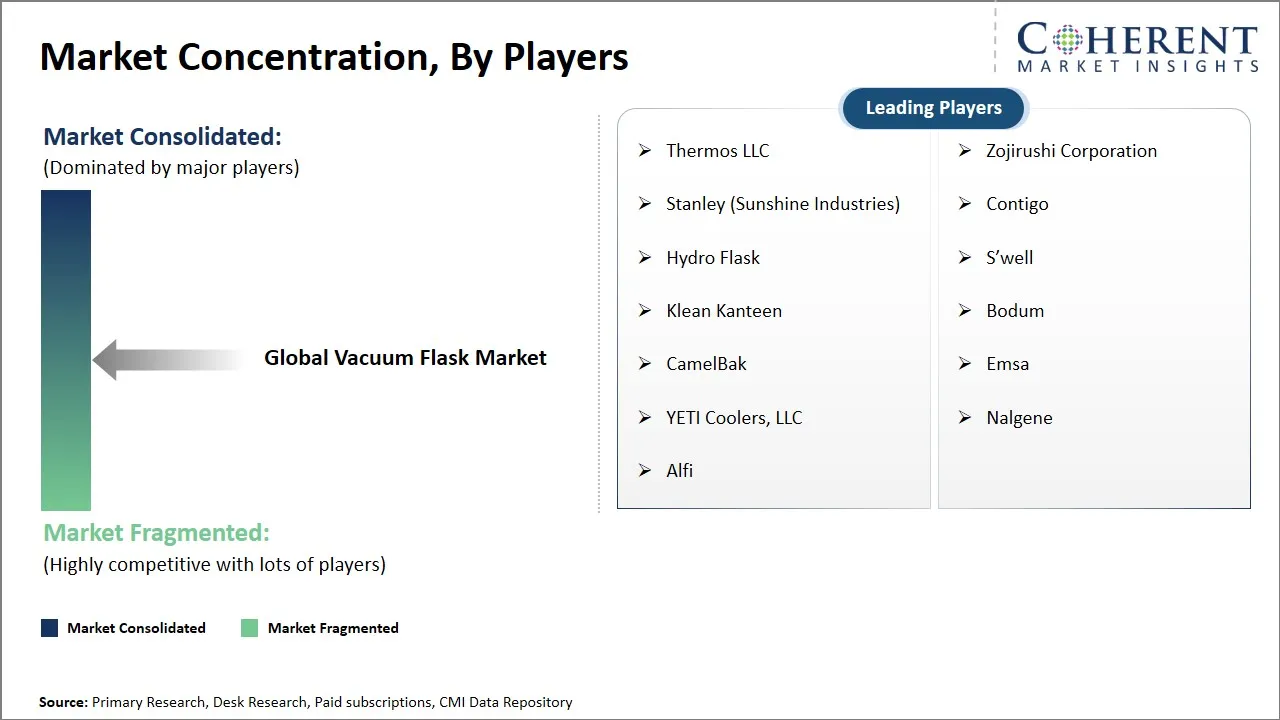
| Companies covered: | Thermos LLC, Zojirushi Corporation, Stanley (Sunshine Industries), Contigo, Hydro Flask, S’well, Klean Kanteen, Bodum, CamelBak, Emsa, YETI Coolers, LLC, Nalgene, and Alfi | ||
| Growth Drivers: |
| ||
| Restraints & Challenges: |
| ||
Vacuum Flask Market Dynamics
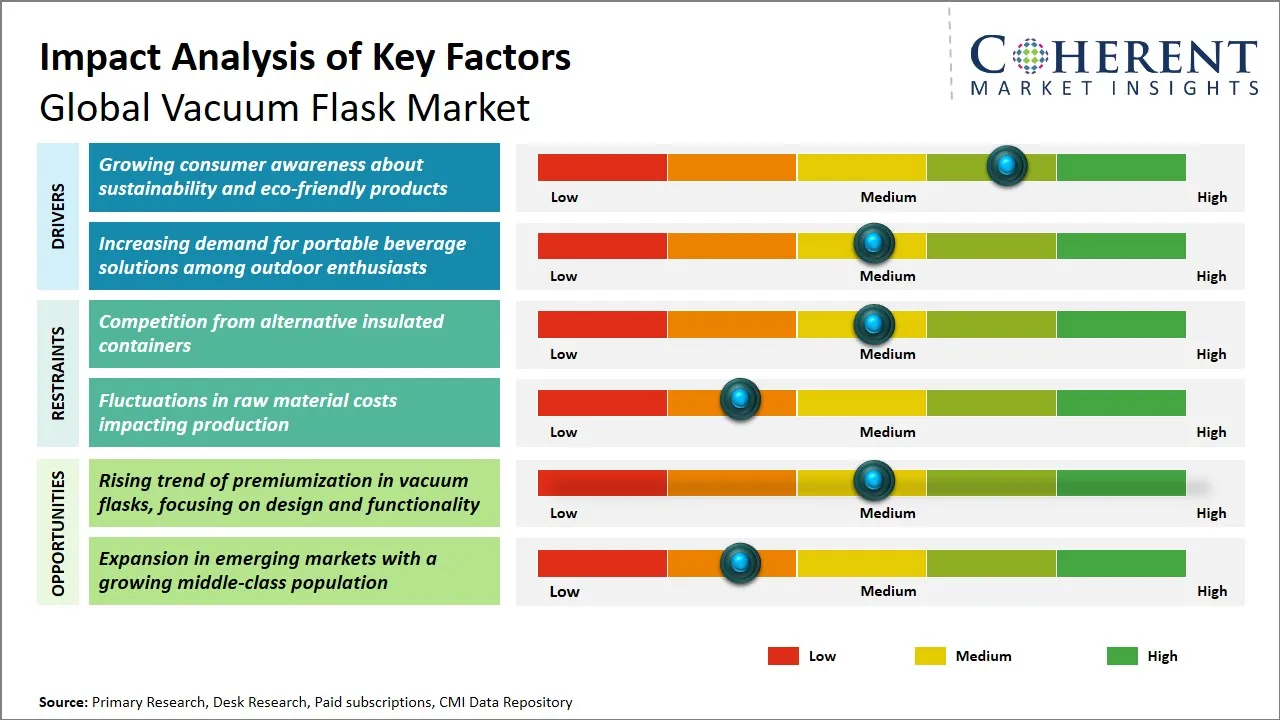
Vacuum Flask Market Driver - Growing Consumer Awareness About Sustainability and Eco-Friendly Products
The consumers in the world are increasingly aware of the environmental consequences of their buying behavior, and this is shifting towards sustainable and eco-friendly products. This increased consciousness is having a major effect on demand in the vacuum flask section since consumers are now actively seeking options that will decrease the number of single-use plastics and encourage more waste management disposal. The reusability and durability provided by vacuum flasks also make them suitable to this kind of environmentally conscious thinking, therefore being a very appealing product to the environmentally conscious consumer.
For example, corporate and institutional sustainability programs: MNCs are currently offering employees branded reusable flasks as ESG efforts and to reduce plastics, disposable bottles and cups are now being substituted with reusable options in offices.
Vacuum Flask Market Opportunity - Rising Trend of Premiumization in Vacuum Flasks Focusing on Design and Functionality
There is an upsurge in the growth of the global vacuum flask market supported by increasing trend in premiumization providing a huge opportunity to the manufacturers and retailers. The consumers are also demanding high-quality, innovative and stylish products that offer a combination of high-quality design and increased functionality in form of the vacuum flasks. The trend is driven by increasing health awareness, leisure activities in the outdoor activities, and a need to have personalized lifestyle products.
For example, outdoor and sports premium equipment: The extreme temperature and adventure sports high-performance flasks are being offered increasingly as part of outdoor equipment to form a category of higher value products.
Analyst Opinion (Expert Opinion)
- The market of vacuum flasks is experiencing stable growth due to the rise in consumer understanding of sustainability and the necessity to have drinks that can be taken anywhere in the pocket. The analysis of the Global Coffee and Beverage Conference (2023) and Sustainable Kitchenware Expo (2022) sparked some insightful insights revealing that such companies as Thermos and Contigo are at the forefront of innovations in terms of design and sustainability characteristics.
- Recent entry of a new set of greener vacuum flasks of recycled materials by Thermoss indicates the way the industry enjoys the need to handle the environmental issues whilst increasing consumer experience. Discussions during these conferences noted a growing popularity of flasks that are personalized and multi-purpose, so as to satisfy health-conscious customers that care about hydration and convenience. Nevertheless, issues like market saturation and substitution by other beverage containers were often mentioned as the possible obstacles to growth.
- Market share will be likely to be owned by companies that emphasize on unique selling propositions like company collapsible designs and better insulation technology. Finally, the further development of the vacuum flask market will be based on its capacity to be constantly innovative and aligned to changing customer preferences regarding sustainability, functionality, and stylishness in beverage storage solutions.
Speak to the analyst
Want personalized insights?
Take the findings above to one of our principal consultants, or have the report rebuilt around the segments, geographies and competitors you actually track.
Market Segmentation
- Material Insights (Revenue, USD Bn, 2021 - 2033)
- Stainless Steel
- Glass
- Plastic
- Others
- Capacity Insights (Revenue, USD Bn, 2021 - 2033)
- Less than 16oz
- 16 oz-32 oz
- More Than 32oz
- Insulation Insights (Revenue, USD Bn, 2021 - 2033)
- Single-wall
- Double-wall
- Triple-wall
- Distribution Channel Insights (Revenue, USD Bn, 2021 - 2033)
- Online Retail
- Offline Retail
- Regional Insights (Revenue, USD Bn, 2021 - 2033)
- North America
- U.S.
- Canada
- Latin America
- Brazil
- Argentina
- Mexico
- Rest of Latin America
- Europe
- Germany
- U.K.
- Spain
- France
- Italy
- Russia
- Rest of Europe
- Asia Pacific
- China
- India
- Japan
- Australia
- South Korea
- ASEAN
- Rest of Asia Pacific
- Middle East
- GCC Countries
- Israel
- Rest of Middle East
- Africa
- South Africa
- North Africa
- Central Africa
- North America
- Key Players Insights
- Thermos LLC
- Zojirushi Corporation
- Stanley (Sunshine Industries)
- Contigo
- Hydro Flask
- S’well
- Klean Kanteen
- Bodum
- CamelBak
- Emsa
- YETI Coolers, LLC
- Nalgene
- Alfi
Sources
Primary Research Interviews
- CEO – Leading Vacuum Flask Manufacturer (e.g., Thermos or Zojirushi equivalent)
- Supply Chain Director – Major Stainless Steel Insulated Bottle Distributor
- Production Lead – Vacuum Insulated Container Producer
- Sustainability Officer – Reusable Drinkware Certification Authority
Stakeholders
- Manufacturers
- End-use Sectors
- Outdoor and Sports Equipment Retailers
- Office and Home Use Consumers
- Travel and Tourism Industry (Thermos for Beverages)
- Regulatory & Certification Bodies (e.g., BIS for stainless steel vacuum flasks in India IS 17526:2021, FDA for food-grade materials, EU food contact regulations)
- E-commerce Platforms and Retailers (Amazon, Flipkart, Alibaba, IKEA)
- Technology Integration Players: Smart insulated bottle makers with app connectivity (e.g., Hydro Flask, Yeti innovations)
Databases
- UN Comtrade Database (HS Code 961700 for Vacuum flasks and vessels)
- India Import Export (EXIM) Database
- USITC Trade Data for consumer goods
- Eurostat Trade Statistics for household articles
Magazines
- Housewares News – Trends in reusable drinkware
- Outdoor Retailer Magazine – Vacuum flasks in sports and camping
- Giftware News – Stainless steel bottle market dynamics
- Progressive Grocer – Sustainable packaging in beverages
- Travel Goods Showcase – Insulated bottles for travel
Journals
- Journal of Food Engineering – Thermal insulation in vacuum flasks
- Packaging Technology and Science – Sustainability in reusable containers
- Materials Science and Engineering – Stainless steel for consumer products
- International Journal of Consumer Studies – Consumer behavior in drinkware
- Journal of Sustainable Tourism – Eco-friendly travel accessories
Newspapers
- The Wall Street Journal – Consumer goods demand for insulated bottles
- Business Standard (India) – Vacuum flask imports growth in Asia
- South China Morning Post – China manufacturing of stainless steel flasks
- Nikkei Asia – Japanese brands like Zojirushi market expansion
- Reuters – Supply chain issues in housewares sector
Associations
- International Housewares Association (IHA)
- Indian Stainless Steel Development Association (ISSDA)
- Giftware Association
- Outdoor Industry Association
- Bureau of Indian Standards (BIS) for vacuum flasks
- Sustainable Packaging Coalition
Public Domain Sources
- FDA – Guidelines for food contact materials in bottles
- European Commission – REACH compliance for stainless steel
- World Health Organization – Safety standards for consumer drinkware
- USGS – Related mineral stats for steel production (indirect)
- OECD – Consumer goods trade and sustainability reports
Proprietary Elements
- CMI Data Analytics Tool, Proprietary CMI Existing Repository of information for last 8 years.
Get access to 250+ pages report
Every segment, forecast, competitor profile and data table behind the analysis above — available for instant download.
- ESOMAR Member
- ISO 9001:2015 Certified
- D-U-N-S Registered
- GDPR & CCPA Compliant
Missing comfort of reading report in your local language? Find your preferred language:
Transform your Strategy with Exclusive Trending Reports
Frequently Asked Questions
The global vacuum flask market is estimated to be valued at USD 5.89 Bn in 2026 and is expected to reach USD 8.46 Bn by 2033.
A vacuum flask is an insulated container designed to maintain the temperature of its contents (hot or cold) by minimizing heat transfer through conduction, convection, and radiation.
The CAGR of global vacuum flask market is projected to be 5.3% from 2026 to 2033.
Growing consumer awareness about sustainability and eco-friendly products and increasing demand for portable beverage solutions among outdoor enthusiasts are the major factors driving the growth of the global vacuum flask market.
Competition from alternative insulated containers and fluctuations in raw material costs impacting production are the major factors hampering the growth of the global vacuum flask market.
In terms of material, stainless steel is estimated to dominate the market revenue share in 2026.
Thermos LLC, Zojirushi Corporation, Stanley (Sunshine Industries), Contigo, Hydro Flask, S’well, Klean Kanteen, Bodum, CamelBak, Emsa, YETI Coolers, LLC, Nalgene, and Alfi are the major players.