

Coated Fabrics Market Size and Share Analysis
Coated Fabrics Market size is estimated to be valued at USD 25.42 Bn in 2026 and is expected to reach USD 34.13 Bn in 2033, exhibiting a compound annual growth rate (CAGR) of 4.3% from 2026 to 2033.
Key Takeaways
- Based on Material Type, the Polymer Coated segment is projected to hold the highest global coated fabrics market share in 2026, driven by Robust application in automotive interiors.
- Based on Application, the Transportation segment is expected to account for 30.7% of the market share in 2026, owing to the rising automobile sales and advancements.
- Based on Region, North America is expected to lead the global coated fabrics market in 2026 with a 38% share, driven by rising demand for protective garments in the pharmaceutical and chemical industries. while, Asia Pacific is considered as the fastest growing region during he forecast period.
Market Overview
The increased emphasis on safety measures and stringent regulations concerning worker safety in industries such as automotive, chemical, and oil & gas is a key factor contributing to the Global Coated Fabrics Market's optimistic growth projection. Furthermore, the growing demand for environmentally friendly materials propels the Global Coated Fabrics Market forward. Coated fabrics are a sustainable option because they can be made from a variety of materials, including natural fibers such as cotton and hemp, as well as recycled materials such as plastic bottles. These eco-friendly qualities are boosting coated fabrics market demand, while specialist producers gain a larger coated fabrics market share as industries prioritize safer and greener materials. Because of these factors, the Global Coated Fabrics Market is poised for steady and sustainable growth.
Current Events and their Impact on the Coated Fabrics Market
Current Events | Description and its Impact |
Geopolitical Tensions & Trade Policy Shifts |
|
Technological Advancements |
|
Export Import Overview of Coated Fabrics Market
The coated fabrics market has shown dynamic trade activity over the past year, with significant volumes in both exports and imports across key global regions.
India remains an active participant in this space, with 18,400 coated textile export shipments recorded, contributed by 1,377 exporters catering to 2,398 international buyers. This underscores India’s expanding footprint in the global coated fabrics trade.
On the import front, China dominated the global supply of polymer coated fabrics, accounting for a commanding 80.06% of total imports. The United States followed as the second-largest exporter, contributing 9.22% to global imports of polymer coated fabrics.
Globally, between November 2023 and October 2024, the world imported 26,329 shipments of PVC coated fabric, supplied by 2,825 exporters to 2,807 buyers. This period witnessed a 12% year-on-year growth, reflecting increasing global demand. Notably, October 2024 alone saw 2,412 shipments, marking an 18% increase from October 2023 and no change from the previous month (September 2024).
- Current Industry Events of 2026
- Market Size Estimation
- Regional Breakdown
- Competitive Landscape
- Customer Intelligence
- Segmental Analysis
- Pricing Analysis
- Key Market Drivers, Challenges & Future Trends
- Customized Insights Section
Segmental Insights
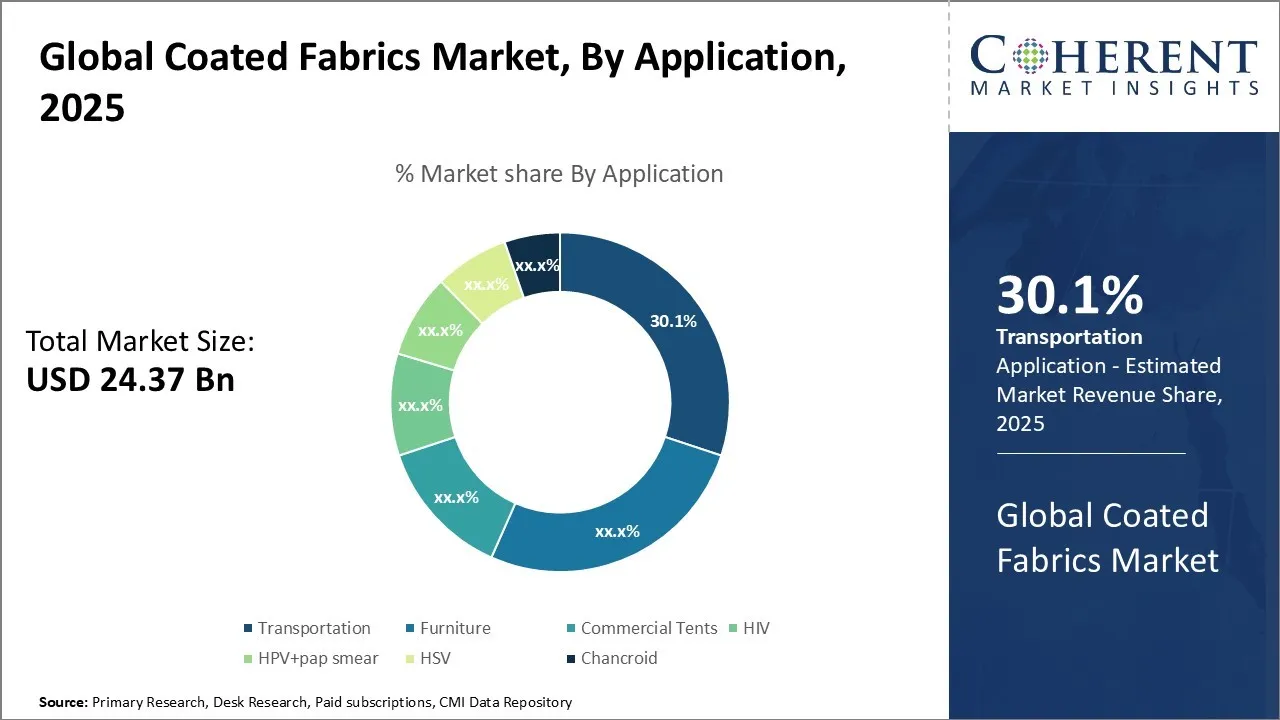
Coated Fabrics Market Insights, By Application
Transportation Holds the Most Prominent Share on Account of the Rising Automobile Sales
In terms of application, transportation segment dominated the coated fabrics market in 2026 with around 30.7% of market share in terms of revenue, due to rising automobile sales and advancements in road and rail transportation. They are mostly used in the automotive industry to make seat belts, roofing, vehicle seats, air bags, and interiors. Along with that, the strict government policies regarding vehicle security and safety measures may positively compel automobile manufacturers to install airbags in vehicles further boosts the automotive industry due to increased demand for commercial and passenger vehicles resulting in coated fabrics market growth.
In December 2024, Italian advanced materials firm Vulcaflex introduced a new range of 100% vegan certified coated fabrics for automotive interiors, now certified by The Vegan Society. This die-free portfolio includes seat covers, door panels, and dashboard materials offering high durability and aesthetic appeal without animal-derived components.
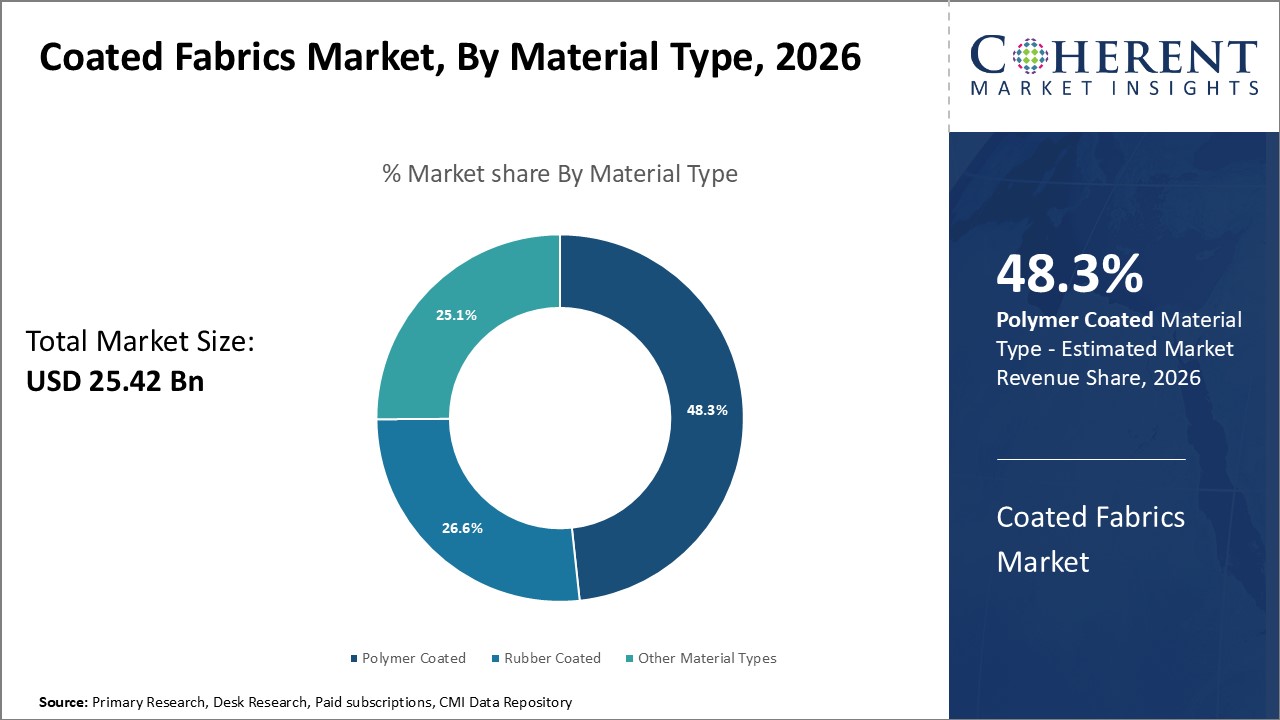
Coated Fabrics Market Insights, By Material Type
Polymer Coated Dominates the Overall Market
In terms of material type, the polymer coated segment is expected to contribute the highest share of the market in 2026, fueled by robust application in automotive interiors, airbags, and protective clothing across industries like transportation, construction, and industrial safety. Asia-Pacific automotive production, especially in China and India is a significant driver, as polymer coatings enhance durability, weather resistance, and aesthetic appeal. The Polymer coating is gaining momentum due to its versatility and strong demand across key sectors. Polymer coated fabric is a composite material made by applying a polymer layer to a textile fabric, enhancing its properties and creating a durable, often waterproof or water-resistant material.
In June 2024, the Mitchell Group introduced NetZERO, the first water-based polyurethane synthetic leather made entirely without organic solvents, marking a sustainability milestone in commercial upholstery. Engineered for healthcare, hospitality, and contract sectors, NetZERO’s inaugural pattern Evergreen, offers a triple-brushed texture in 23 water-dyed colorways. Its manufacturing process cuts energy use by 50%, enables water recycling, and avoids toxic chemicals including flame retardants, PFAS, and phthalates.
Regional Insights
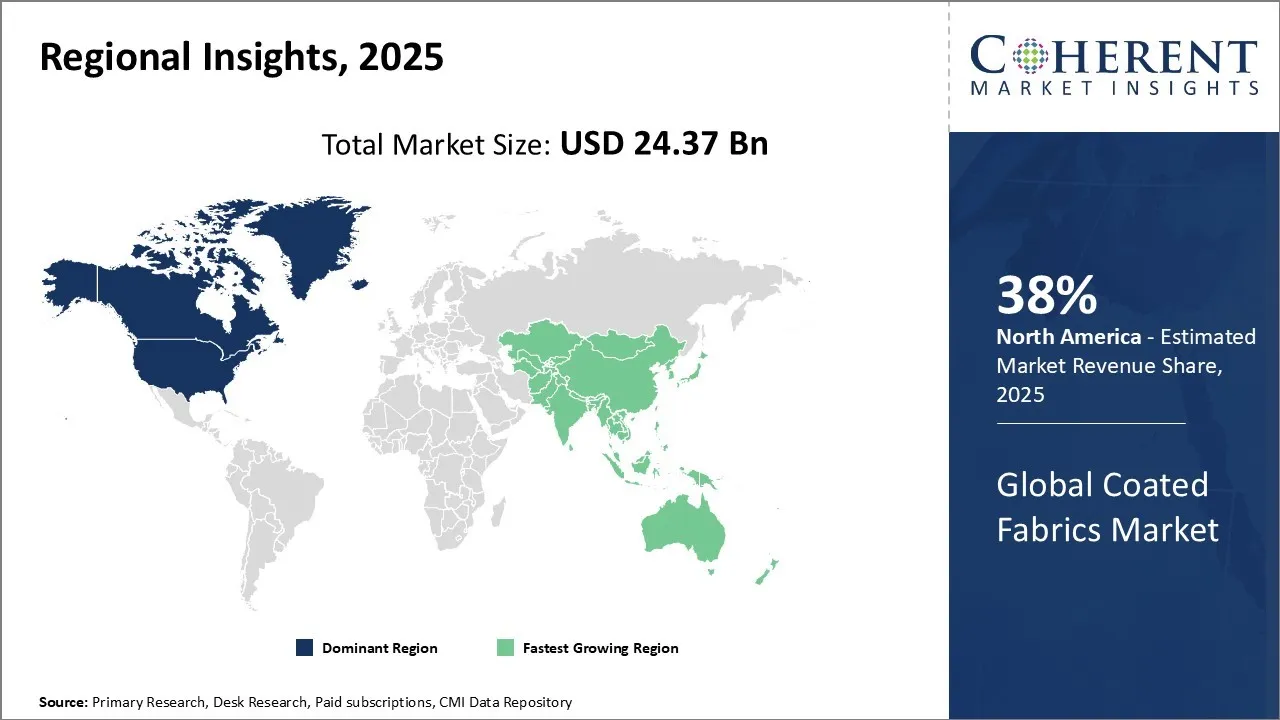
North America Coated Fabrics Market Analysis & Trends
The global coated fabrics market is dominated by North America, which is anticipated to cover around 38% share in 2026. North America has the largest global share of this market driven by rising demand for protective garments in the pharmaceutical and chemical industries, as well as severe FDA regulations. The coated fabrics in pharmaceuticals is driven by increasing awareness of hygiene and safety standards in the pharmaceutical and healthcare industries. This demand is further fueled by stringent regulations from organizations like the FDA and the need for infection control. Canada leads US PVC-coated fabric imports with USD 112.62 million in 2024, benefiting from zero tariffs.
Asia Pacific Coated Fabrics Market Analysis & Trends
Asia Pacific led the market due to an increase in the construction industry. Growing industrialization in India and China suggests the presence of manufacturing enterprises in Asia Pacific that will boost demand for polymer coated products in the fabric market. Due to the existence of a significant automotive manufacturing hub and investments in R&D activities. Additionally, the construction industry in Asia Pacific region booming with 2% year-on-year rise in demand for silicone-coated tarpaulins, widely used for scaffolding covers, site enclosures, and weatherproofing in large-scale developments. These coated fabrics offer superior tensile strength, UV resistance, and durability, ideal for demanding construction environments. This shift is not only streamlining procurement but also fostering regional industrialization, reinforcing Asia-Pacific's position as a key coated fabric manufacturing base.
Coated Fabrics Market Outlook Country-Wise
The U.S. Coated Fabrics Market Trends
The U.S. coated fabrics market is experiencing a steady growth due to the rising need for safety measures in transportation, automotive, and protective clothing, along with advancements in coated fabric technology. For instance, in August 2024, scientists at the University of Massachusetts Amherst developed a chalk-based coating for fabrics that reduces surface temperature by up to 8 °F, and up to 15 °F cooler than untreated material. The coated textile maintained cooler microclimate conditions during 90 °F summer testing, offering a promising solution for outdoor apparel, shelter, and military applications. Researchers are now exploring large-scale production and commercial viability.
China Coated Fabrics Market Trends
China coated fabrics market is witnessing significant growth in recent years, fueled by China’s industrialization, infrastructure development, and the growth of key industries like automotive and construction. China is a major producer and consumer of coated fabrics, particularly PVC coated fabrics, and is expected to maintain a strong market position in the Asia-Pacific region. China is the world's largest producer of clothes and accessories, as well as upholstered furniture and automobiles, which are driving the demand for coated fabrics in this sector region. For instance, Kunshan Xiefu New Material, unveiled under the Covestro Insqin partner program marking the first Chinese manufacturer in the sustainability initiative. The expanded event also includes eco-focused Econogy Tours and forums emphasizing green textiles, reinforcing China’s commitment to responsible coated fabric production.
Market Report Scope
Coated Fabrics Market Report Coverage
| Report Coverage | Details | ||
|---|---|---|---|
| Base Year: | 2025 | Market Size in 2026: | USD 25.42 Bn |
| Historical Data for: | 2020 To 2024 | Forecast Period: | 2026 To 2033 |
| Forecast Period 2026 to 2033 CAGR: | 4.3% | 2033 Value Projection: | USD 34.13 Bn |
| Geographies covered: |
| ||
| Segments covered: |
| ||
| Companies covered: | Saint Gobain S.A, Bayer AG, PPG Industries, Akzonobel N.V., 3M Company, Valspar Corporation, E.I. du Pont de Nemours and Company, BASF SE Paints, Nippon Paints and Sherwin Williams | ||
| Growth Drivers: |
| ||
| Restraints & Challenges: |
| ||
Global Coated Fabrics Market Growth Drivers
Growth in the Automotive Industry to Drive Market
The automotive coated fabric is used in cars to improve the interior's look and feel. Resins, PVC, rubber, lacquer, plastics, and oil or varnish finishes are some of the materials used to coat or process the fabric. The automotive-coated fabric used in automobiles is corrosive-, water-, UV-, rot-, and oil-repellent-resistant. High-performance coated fabric is provided by OMNOVA to auto OEMs all over the world. Due to their striking design, eco-friendly attributes, low emissions, appealing appearance, long-lasting performance, and superb touch, OMNOVA coated fabric upholsteries are used by the majority of automotive manufacturers.
The demand for polymer coated fabric, which is mainly used in automotive soft tops, seat covers, upholstery, interiors of light vehicles, and airbags, may increase as global automotive production and per-capita disposable income rise. For airbags, companies are creating recyclable coated fabric, which will support the automotive sector. For instance, Toyobo created a coated fabric that is recyclable for airbags. In place of the silicone polymer used in side curtain airbags, the product is applied to a nylon polymer. Without separating the coating material from the base fabric, this can be recycled. This innovation reflects a broader trend within the coated fabrics market research, focusing on sustainable and high-performance automotive applications.
Increasing the Supply of Protective Clothing Will Increase Demand
Protection against hazardous biological and chemical materials is required in everyday work and can be obtained through the selection of appropriate protective clothing. Rapid industrialization as a result of heavy investments in the manufacturing industry, combined with stringent government regulations imposed by OSHA and NIOSH regarding the use of protective gears, will drive the overall protective clothing market demand. Polyurethane coated fabric can be used to make high altitude protective clothing, fire retardant clothing, and chemical protective clothing (CPC) due to properties such as flexibility at low temperatures, resistance to high impact, and resistance to high weather. As a result, the overall Coated Fabrics Market growth in the protective clothing industry is expected to accelerate.
Chemical protective clothing (CPC) is used to protect workers from physical and chemical hazards. It is also used to protect the entire body from poisonous chemicals that manifest their effects through skin absorption. The long-lasting CPC is made of rubber or PVC-coated fabrics, which usually prevent chemical permeation and penetration through fabrics in clothing. Fire retardant fabrics are classified into two types: those made of naturally flame-retardant fibers and those made of 100% cotton with a flame-retardant coating.
Global Coated Fabrics Market Opportunities
The coated fabrics market forecast holds strong potential, driven by demand for advanced materials across transportation, healthcare, defense, and sustainability-focused industries. Smart textiles integrated with sensors are expected to revolutionize automotive and military applications by enabling real-time environmental monitoring.
In 2024, BMW began prototyping interior fabrics with solar-absorbing coatings to power auxiliary systems. The rise of electric vehicles is also spurring demand for lightweight, flame-retardant coated fabrics for battery insulation. In healthcare, antimicrobial and fluid-repellent coated textiles are being developed for hospital environments to reduce infection risk. Furthermore, eco-conscious packaging and bio-based PU coatings are gaining traction as regulators push for reduced plastic use. Construction firms are also adopting coated geotextiles for water management and erosion control. As material science advances, the next wave of coated fabrics is likely to be multifunctional combining durability, aesthetics, and performance making them integral to industries focused on resilience, hygiene, and sustainability.
Recent Developments
- In May 2025, Rivertex Technical Fabrics introduced Rivercyclon 450 FR, a revolutionary flame-retardant fabric crafted entirely from polypropylene, making it the industry's first fully recyclable, PVC-free alternative meeting global fire safety standards. Rivercyclon 450 FR delivers lightweight durability, weldability, and flex resistance up to 100,000 cycles.
- In April 2025, Elkem showcased its latest BLUESIL™ textile coating silicones at Techtextil North America 2025. Elkem emphasized lightweight performance solutions designed to enhance durability, insulation, and wearer comfort.
- In August 2024, Carnegie, a leader in sustainable textiles, launched two new vinyl-free, PVC- and PFAS-free coated upholsteries, embellish Print and Botanic Print as part of its Conscious Collection. These silicone-hybrid fabrics mimic woven and hand-embroidered textures, while delivering high performance: over 100,000 double rubs, bleach-cleanability, antimicrobial protection, and hospital-grade disinfectant resistance. Produced via a clean CPU (Clean Performance Urethane) method without solvents like DMF, the new designs combine vibrant aesthetics with environmental responsibility.
- In July 2024, Trelleborg Group boosted its engineered coated fabrics business by constructing a new LEED-certified, carbon-neutral facility in Rutherfordton, North Carolina. Scheduled to begin operations in early 2026, the €26 million plant will enhance production for critical sectors including aircraft escape slides, water infrastructure, healthcare, and outdoor equipment.
Analyst Opinion (Expert Opinion)
The coated fabrics market value is undergoing a strategic transformation, driven by a convergence of regulatory pressure, material science innovation, and the redefinition of durability as a core value in end-use sectors. In my view, the single most undervalued catalyst in this space is the shift from commodity-driven consumption to performance-driven procurement, especially in sectors like mobility, defense, and technical apparel.
While many associate coated fabrics with upholstery and interior trims, the auto sector’s aggressive pivot to lightweight, high-durability materials is driving coated fabric adoption into chassis and underbody applications. Notably, OEMs like BMW and Toyota are experimenting with thermoplastic polyurethane (TPU)-coated textiles to replace traditional rubber-based protective materials, citing superior abrasion resistance (up to 40% improvement) and easier recyclability. Moreover, flame-retardant coated fabrics are now being mandated for EV battery encapsulation in select markets—not as an option, but as a compliance necessity.
Military procurement in the U.S. and EU has turned toward ballistic-grade coated fabrics that deliver both weather resistance and infrared stealth. In 2023, the U.S. Army Material Command authorized pilot-scale deployment of silicone-coated aramid for tenting systems and mobile shelters—offering a 25% lower heat signature and double the tear strength of legacy PVC-coated canvas. This signals a broader movement: militaries want modular, mission-ready textiles that extend beyond NATO compliance.
Speak to the analyst
Want personalized insights?
Take the findings above to one of our principal consultants, or have the report rebuilt around the segments, geographies and competitors you actually track.
Market Segmentation
- Global Coated Fabrics Market, By Material Type (Revenue, USD Bn, 2021 - 2033)
- Rubber Coated
- Polymer Coated
- Other Material Types
- Global Coated Fabrics Market, By Application (Revenue, USD Bn, 2021 - 2033)
- Commercial Tents
- Furniture
- Industrial
- Protective Clothing
- Transportation
- Others
- Global Coated Fabrics Market, By Region (Revenue, USD Bn, 2021 - 2033)
- North America
- U.S.
- Canada
- Latin America
- Brazil
- Argentina
- Mexico
- Rest of Latin America
- Europe
- Germany
- U.K.
- Spain
- France
- Italy
- Russia
- Rest of Europe
- Asia Pacific
- China
- India
- Japan
- Australia
- South Korea
- ASEAN
- Rest of Asia Pacific
- Middle East
- GCC Countries
- Israel
- Rest of Middle East
- Africa
- South Africa
- North Africa
- Central Africa
- North America
- Key Companies
- Geo Specialty Chemicals, Inc.
- Saint Gobain S.A
- Bayer AG
- PPG Industries
- Akzonobel N.V.
- 3M Company
- Valspar Corporation
- E.I. du Pont de Nemours and Company
- BASF SE Paints
- Nippon Paints
- Sherwin Williams
Sources
Primary Research Interviews from the following stakeholders
Stakeholders
- Interviews with coated fabric manufacturers, automotive interior designers, upholstery fabricators, industrial textile processors, safety gear producers, and procurement heads across key regional hubs.
Specific stakeholders
- Material innovation leads at OEMs (e.g., Tata Motors, BMW, General Motors)
- Product development managers at outdoor gear brands (e.g., Decathlon, The North Face, Wildcraft)
- Sourcing heads in public transport authorities (e.g., Indian Railways, MTA New York City Transit, SNCF)
- Procurement and sustainability officers at furniture manufacturers (e.g., IKEA, Godrej Interio, Ashley Furniture)
- Safety and PPE designers at global industrial goods firms (e.g., Honeywell, DuPont, 3M)
- Technical textiles researchers in government-backed labs and university centers
Databases
- UN Comtrade Database
- World Trade Organization (WTO) – Market Access Map
- Eurostat – Textile Manufacturing Data
- U.S. Bureau of Economic Analysis (BEA) – Industry Input-Output Data
- Ministry of Textiles, India – Technical Textiles Division
- China Customs Statistics
- Japan External Trade Organization (JETRO) – Functional Materials Reports
- Korea Statistical Information Service (KOSIS)
- Directorate General of Commercial Intelligence and Statistics (DGCIS), India
Magazines
- Technical Textiles International
- Specialty Fabrics Review
- Textile World
- Textile Today
- Innovation in Textiles
- Nonwovens Industry Magazine
- Fabric Architecture Magazine
Journals
- Journal of Industrial Textiles
- Journal of Coated Fabrics and Composite Materials
- Textile Research Journal
- Progress in Organic Coatings (Elsevier)
- Journal of Engineered Fibers and Fabrics
- Polymers for Advanced Technologies
Newspapers
- The Economic Times – Industrial Manufacturing & Exports
- Business Standard – Chemicals & Raw Materials
- The Hindu Business Line – Textiles & Technical Fabrics
- Nikkei Asia – Materials and Manufacturing
- Financial Times – Global Supply Chain & Advanced Manufacturing Reports
- South China Morning Post – Export and Industry Analysis
Associations
- Association of the Nonwoven Fabrics Industry (INDA)
- Industrial Fabrics Association International (IFAI)
- The Textile Association (India) – Technical Textiles Wing
- European Technology Platform for the Future of Textiles and Clothing (ETP)
- Federation of Indian Chambers of Commerce & Industry (FICCI) – Technical Textiles Division
- American Association of Textile Chemists and Colorists (AATCC)
- China Nonwovens & Industrial Textiles Association (CNITA)
Public Domain Sources
- Ministry of Textiles (Government of India)
- U.S. Department of Commerce – Office of Textiles and Apparel (OTEXA)
- European Commission – Advanced Materials and Manufacturing Initiatives
- Japan’s Ministry of Economy, Trade and Industry (METI)
- NITI Aayog – Advanced Materials Sector Reports
- Reserve Bank of India (RBI) – Industrial Outlook Survey
- India Investment Grid – Technical Textiles Cluster Data
- European Chemicals Agency (ECHA) – Regulations on Textile Coating Chemicals
Proprietary Elements
- CMI Data Analytics Tool, and Proprietary CMI Existing Repository of information for last 8 years
*Definition: Bonding a coated layer to a textile substrate produces coated textiles. The coated layer can be applied to woven, knit, or non-woven surfaces in liquid or film forms. Different top and substrate materials can be used depending on the required fabric features such as durability, impermeability, resistance, environmental attributes, stretch, and pliability. Embossing can be used to impart texture to the surface. Top layer finishes may provide additional protection. Vinyl, polyurethanes, and silicone are the most often used coated fabric materials. Coated textiles are typically utilized for upholstery and wall covering because the coating adds an additional layer that is beneficial in commercial items and heavy traffic locations.
Get access to 250+ pages report
Every segment, forecast, competitor profile and data table behind the analysis above — available for instant download.
- ESOMAR Member
- ISO 9001:2015 Certified
- D-U-N-S Registered
- GDPR & CCPA Compliant
Missing comfort of reading report in your local language? Find your preferred language:
Transform your Strategy with Exclusive Trending Reports
Frequently Asked Questions
The Coated Fabrics Market is estimated to be valued at USD 25.42 Bn in 2026, and is expected to reach USD 34.13 Bn by 2033.
Global Coated Fabrics Market is estimated to reach US$ 29.79 Bn by 2033.
The key companies covered as a part of this study include Saint Gobain S.A, Bayer AG, PPG Industries, Akzonobel N.V., 3M Company, Valspar Corporation, E.I. du Pont de Nemours and Company, BASF SE Paints, Nippon Paints and Sherwin Williams.
Environmental concerns could limit market growth is expected to hamper the growth the market during the forecast period.
Growth in the automotive industry to drive market and increasing the supply of protective clothing will increase demand is fuelling the growth of the Market in the region.
The CAGR of the Coated Fabrics Market is projected to be 4.3% from 2026 to 2033.
New coatings enhance durability, water resistance, UV protection, and antimicrobial properties, making fabrics more functional and long-lasting.