

Thermal Conductive Gloves Market Size and Forecast — 2026 - 2033
The Global Thermal Conductive Gloves Market size is estimated to be valued at USD 1.2 billion in 2026 and is expected to reach USD 2.05 billion by 2033, exhibiting a compound annual growth rate (CAGR) of 8.1% from 2026 to 2033.
Overview
The thermal conductive gloves market is growing due to increasing demand for protective and heat-resistant gear across industries such as construction, automotive, metal fabrication, and electronics. These gloves enable workers to safely handle high-temperature materials while maintaining dexterity and precision in tasks like welding, soldering, and assembly. Advancements in materials, including heat-resistant polymers, carbon fiber, and silicone coatings, enhance thermal conductivity, durability, and comfort. Rising workplace safety regulations and occupational health standards are prompting companies to adopt specialized protective gloves. Additionally, growth in industrial automation, high-temperature manufacturing, and DIY electronics further drives the need for thermal conductive hand protection globally.
Key Takeaways
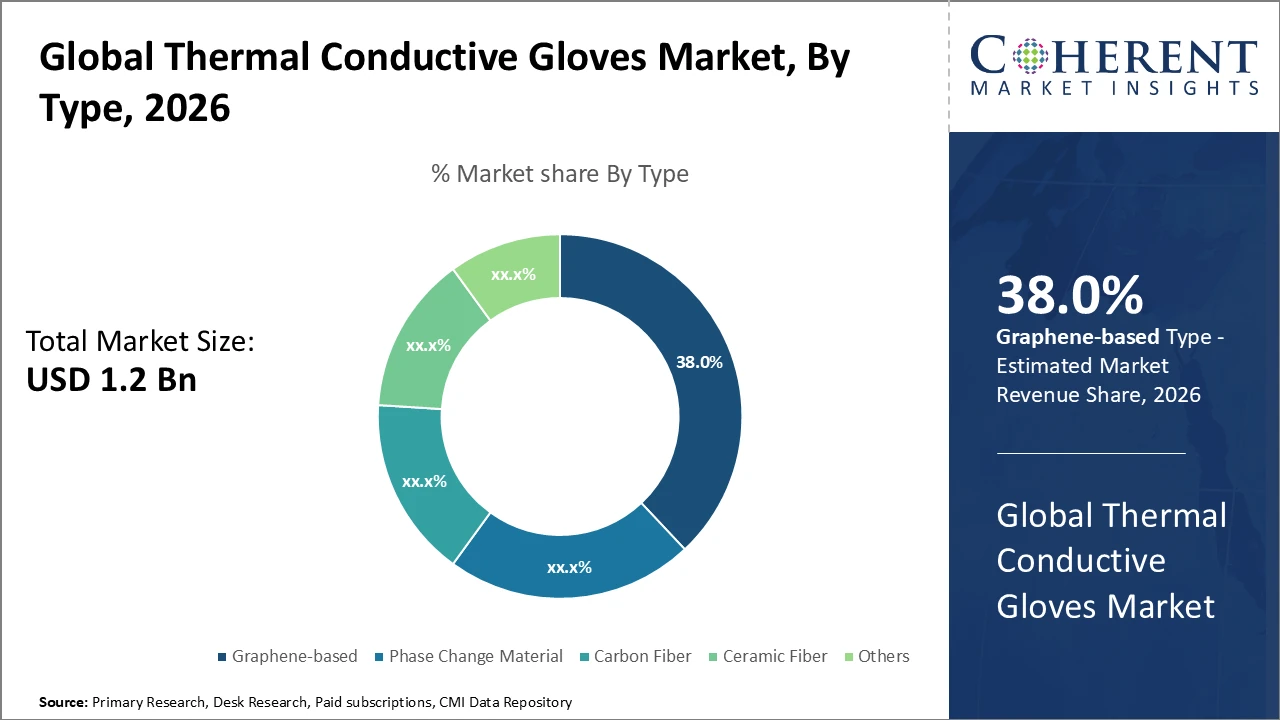
Graphene-based thermal conductive gloves dominate the market with approximately 38% share due to superior thermal conductivity, durability, and high efficiency in industrial heat management applications.
Electronics and semiconductor applications account for nearly 30% of total market consumption, driven by rising microchip manufacturing and precision electronics production across global markets.
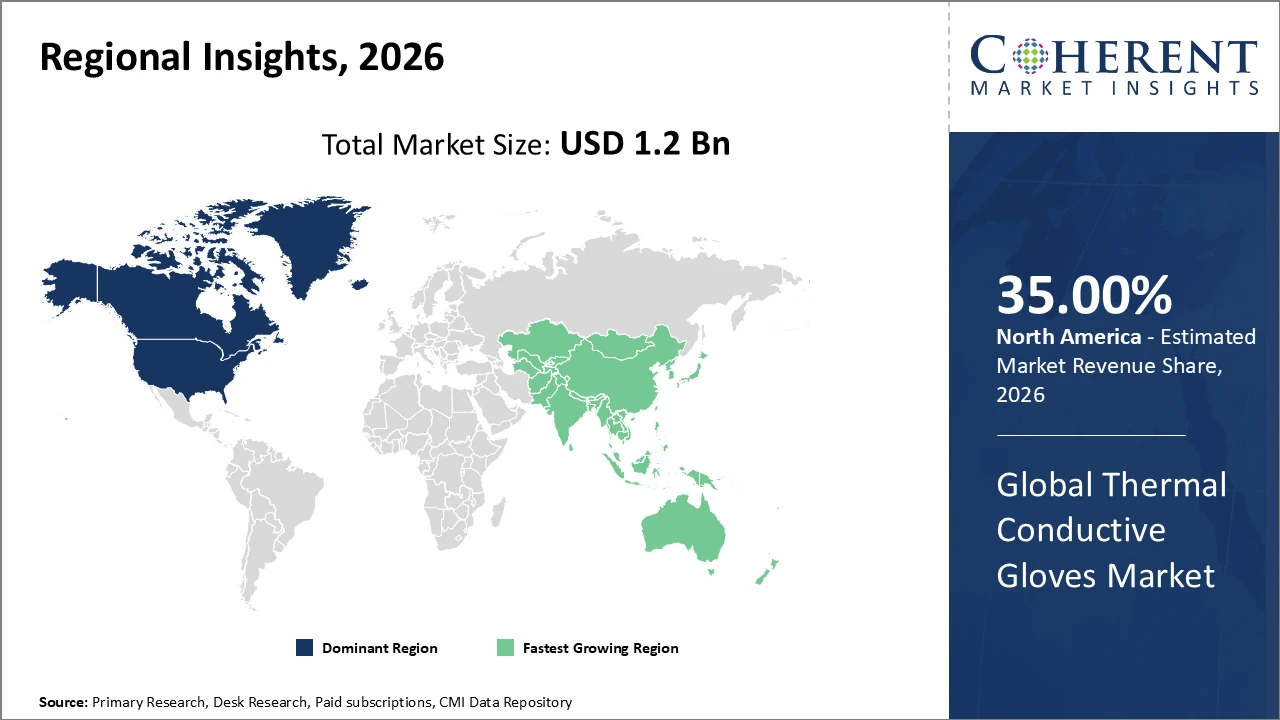
Asia Pacific is the fastest-growing regional market with a CAGR of 9.3%, supported by expanding manufacturing facilities, export-oriented industrialization, and increasing production activities in China and India.
North America holds the largest market share of approximately 35% due to stringent industrial safety regulations and widespread adoption of technologically advanced protective gloves across key industries.
Thermal Conductive Gloves Market Segmentation Analysis
Thermal Conductive Gloves Market Insights, By Type
Graphene-based thermal conductive gloves dominate the market with approximately 38% share owing to graphene’s superior thermal conductivity, durability, and mechanical strength, making these gloves highly effective in electronics manufacturing and automotive fabrication. Their excellent heat dissipation capabilities support precision industrial operations and worker safety. PCM gloves are the fastest-growing subsegment due to their ability to absorb and release heat efficiently, improving user comfort in fluctuating temperature environments. Demand for PCM gloves increased by over 20% during 2025 across construction and oil and gas industries. Carbon fiber gloves provide strong abrasion resistance and moderate conductivity, while ceramic fiber gloves serve extreme high-temperature applications despite higher costs and lower flexibility.
Thermal Conductive Gloves Market Insights, By Application
Electronics and semiconductor applications dominate the thermal conductive gloves market with nearly 30% share, supported by rapid expansion in global microchip manufacturing and increasing need for advanced thermal management solutions during precision handling processes. The automotive segment is the fastest-growing application area, driven by accelerating electric vehicle and battery production activities. Demand for thermal conductive gloves in automotive manufacturing increased by approximately 25% during 2025, particularly across North America and Asia Pacific. Construction applications require gloves offering both heat conductivity and mechanical durability for worker protection. Industrial manufacturing also contributes significantly through metal fabrication and machinery operations, while aerospace and healthcare sectors represent emerging niche opportunities for specialized thermal glove solutions.
Thermal Conductive Gloves Market Insights, By End Use Industry
Electrical and electronics industries dominate the thermal conductive gloves market due to increasing emphasis on miniaturization, thermal management, and worker safety during semiconductor manufacturing and electronics assembly operations. The oil and gas sector is the fastest-growing end-use industry, driven by strict workplace safety regulations requiring advanced heat-resistant gloves for maintenance and operational activities. Demand within this segment increased by nearly 22% during 2025, supported by expanding oil exploration investments across the Middle East, Africa, and North America. Aerospace and defense industries also contribute significantly through demand for high-performance thermal protection equipment. Healthcare applications are growing steadily for laboratory and sterilization use, while food processing industries represent emerging niche demand.
Thermal Conductive Gloves Market Trends
The thermal conductive gloves market is increasingly shifting toward multifunctional products incorporating nanomaterials and advanced thermal management technologies.
Manufacturers integrating graphene layers and sensor-embedded textiles are strengthening their presence in high-value industries such as aerospace and precision electronics manufacturing.
Smart glove technologies with enhanced thermal sensing and monitoring capabilities are gaining traction across industrial safety applications.
Sustainability has emerged as a major market trend, encouraging companies to adopt eco-conscious manufacturing practices and recyclable materials.
Demand for biodegradable thermal conductive glove variants increased by nearly 20% during 2025 due to stricter environmental regulations and rising consumer preference for sustainable industrial safety products.
Thermal Conductive Gloves Market Insights, By Geography
North America Thermal Conductive Gloves Market Analysis and Trends
North America dominates the thermal conductive gloves market due to the strong presence of aerospace, electronics, semiconductor, and advanced automotive manufacturing industries requiring high-performance protective equipment. The United States remains the leading contributor, supported by stringent occupational safety regulations that mandate the use of advanced thermal protection gloves across industrial environments. In 2026, North America accounted for approximately 35% of global market share, driven by increasing investments in industrial safety and automation. Leading companies such as Honeywell and 3M continue focusing on product innovation, advanced materials, and durable thermal glove technologies to strengthen regional market leadership.
Asia Pacific Thermal Conductive Gloves Market Analysis and Trends
The Asia Pacific thermal conductive gloves market is witnessing the fastest growth with a CAGR of 9.3%, primarily driven by rapid industrialization and expanding semiconductor manufacturing facilities across China and India. Rising investments in electronics, electric vehicle production, and automotive manufacturing are significantly increasing demand for advanced thermal protection gloves. Government initiatives promoting workplace safety standards and industrial modernization further support regional market expansion. Major companies such as Superior Gloves Work and Lakeland Industries have expanded manufacturing operations within Asia Pacific to address growing industrial demand and strengthen regional supply capabilities.
Thermal Conductive Gloves Market Outlook for Key Countries
USA Thermal Conductive Gloves Market Analysis and Trends
The United States thermal conductive gloves market is supported by advanced industrial infrastructure and rigorous workplace safety standards across manufacturing sectors. Rapid expansion of semiconductor fabrication facilities in states such as California and Texas contributed to nearly 16% growth in thermal conductive glove consumption during 2025. Major companies including 3M and Honeywell are increasing investments in research and development focused on nanocomposite materials and advanced thermal protection technologies. These innovations have strengthened their market leadership and enabled long-term supply agreements with aerospace, automotive, electronics, and semiconductor manufacturers throughout the country.
Germany Thermal Conductive Gloves Market Analysis and Trends
Germany’s thermal conductive gloves market is expanding steadily due to the country’s strong industrial manufacturing base, particularly in electronics, automotive, aerospace, and semiconductor sectors. Increasing emphasis on worker safety standards and thermal management efficiency in precision manufacturing environments continues to drive demand for advanced protective gloves. German industries are increasingly adopting graphene- and nanocomposite-based gloves to support high-temperature and sensitive electronic handling applications. Sustainability trends are also influencing purchasing decisions, encouraging manufacturers to develop recyclable and eco-friendly glove materials. Companies operating in Germany are investing in technologically advanced safety solutions and automated manufacturing systems, strengthening the country’s position within the European thermal conductive gloves market.
Analyst Opinion
Rising demand from the electronics and semiconductor industries is significantly driving the thermal conductive gloves market, with major electronics manufacturers reporting nearly 15% growth in thermal management equipment demand during 2024.
Semiconductor fabrication facilities across Asia Pacific increased thermal conductive glove procurement by more than 20% in 2025 to comply with stricter thermal safety and handling regulations.
Advancements in graphene-infused and phase change material technologies improved glove heat dissipation performance by approximately 25% in 2026, strengthening adoption in premium industrial applications.
Thermal conductive gloves carried nearly 12% higher average pricing than traditional insulated gloves in 2025 due to enhanced durability, thermal efficiency, and compliance with advanced industrial safety standards.
Asia Pacific accounted for around 45% of global thermal conductive glove exports during 2024, with China and India serving as key manufacturing and export hubs supporting global market expansion.
- Current Industry Events of 2026
- Market Size Estimation
- Regional Breakdown
- Competitive Landscape
- Customer Intelligence
- Segmental Analysis
- Pricing Analysis
- Key Market Drivers, Challenges & Future Trends
- Customized Insights Section
Market Scope
| Report Coverage | Details | ||
|---|---|---|---|
| Base Year: | 2025 | Market Size in 2026: | USD 1.2 billion |
| Historical Data for: | 2020 To 2024 | Forecast Period: | 2026 To 2033 |
| Forecast Period 2026 to 2033 CAGR: | 8.1% | 2033 Value Projection: | USD 2.05 billion |
| Geographies covered: |
| ||
| Segments covered: |
| ||
| Companies covered: | Honeywell International Inc., Ansell Limited, 3M Company, SHOWA Group, MCR Safety, KCL GmbH, Globus Group Ltd., Avon Rubber plc, Lakeland Industries Inc., ATG Gloves | ||
| Growth Drivers: |
| ||
Thermal Conductive Gloves Market Growth Factors
The thermal conductive gloves market is primarily driven by rapid growth in the electronics and semiconductor industries, where advanced thermal management solutions are essential for safe and efficient manufacturing operations. Innovations in materials such as graphene additives and phase change materials are enhancing glove performance, durability, and heat dissipation capabilities, strengthening demand for premium product categories. Increasingly strict workplace safety regulations across oil and gas, automotive, and heavy manufacturing industries are also accelerating market adoption as companies seek compliance with advanced thermal protection standards. Furthermore, the growing global emphasis on occupational safety programs contributed to nearly 14% growth in bulk industrial glove procurement during 2025, supporting continued market expansion worldwide.
Thermal Conductive Gloves Market Development
In July 2025, Avient’s Dyneema launched its third-generation Dyneema® Diamond fiber, offering superior cut protection and lightweight performance. The single-yarn technology provides built-in cut resistance without reinforcement, enhancing glove comfort, dexterity, and user safety.
Key Players
Leading Companies of the Market
Honeywell International Inc.
Ansell Limited
3M Company
SHOWA Group
MCR Safety
KCL GmbH
Globus Group Ltd
Avon Rubber plc
Lakeland Industries Inc.
ATG Gloves
Companies in the thermal conductive gloves market are increasingly focusing on innovation and strategic partnerships to strengthen competitive positioning. Honeywell introduced a new range of gloves featuring advanced nanomaterial coatings in 2025, improving heat dispersion efficiency by nearly 17%. This innovation contributed to approximately 10% growth in the company’s North American market share by enhancing product performance for semiconductor and automotive applications. Meanwhile, Superior Gloves Work expanded its regional collaborations with semiconductor fabrication facilities across Asia Pacific, increasing export volumes by around 22% during 2024. These strategies reinforced global market presence and supported broader adoption across industrial manufacturing sectors.
Thermal Conductive Gloves Market Future Outlook
The thermal conductive gloves market is expected to witness strong growth over the coming years driven by rising demand from semiconductor manufacturing, electronics assembly, automotive battery production, and industrial safety applications. Advancements in graphene-based materials, phase change materials, and nanocomposite coatings will continue improving thermal conductivity, durability, and worker comfort. Sustainability trends are also expected to influence future product development, with increasing focus on recyclable and biodegradable glove materials. Asia Pacific is projected to remain the fastest-growing regional market due to expanding industrialization and manufacturing investments in China and India, while North America will maintain strong demand supported by strict workplace safety regulations.
Thermal Conductive Gloves Market Historical Analysis
The thermal conductive gloves market evolved steadily alongside industrial expansion in electronics, automotive, oil and gas, and heavy manufacturing sectors. Early market demand was primarily driven by the need for worker protection against heat exposure in industrial environments. Over time, advancements in material science introduced improved thermal management technologies such as carbon fiber, ceramic fiber, graphene-based coatings, and phase change materials, significantly enhancing glove performance and durability. Increasing workplace safety regulations across North America and Europe accelerated adoption of high-performance protective gloves. Historically, Asia Pacific emerged as a major manufacturing and export hub due to rapid industrialization, semiconductor production growth, and expanding electronics manufacturing capabilities.
Sources
Primary Research Interviews:
Industrial safety managers, procurement specialists, and plant supervisors from electronics, semiconductor, automotive, and oil & gas industries utilizing thermal conductive gloves.
Product engineers, material scientists, and R&D professionals involved in developing graphene-based, carbon fiber, and phase change material thermal gloves.
Occupational safety consultants, industrial distributors, and manufacturing experts analyzing workplace safety compliance and protective equipment trends.
Magazines:
Occupational Health & Safety Magazine – Updates on industrial safety products, protective equipment technologies, and workplace safety regulations.
ISHN (Industrial Safety & Hygiene News) – Insights into industrial hand protection, thermal safety solutions, and manufacturing safety trends.
Manufacturing Today – Coverage of industrial automation, worker safety technologies, and advanced manufacturing equipment.
Journals:
Journal of Occupational and Environmental Hygiene – Research on workplace protection, heat resistance materials, and industrial safety practices.
Materials Today – Studies on graphene, nanocomposites, and advanced thermal conductive materials used in protective equipment.
International Journal of Industrial Ergonomics – Research related to worker comfort, protective glove efficiency, and industrial ergonomics.
Newspapers:
Reuters – Industrial manufacturing developments, workplace safety regulations, and material technology investments.
Bloomberg – Corporate strategies, industrial expansion, and global manufacturing trends related to safety equipment markets.
The Financial Times – Global industrial production trends, export activities, and technological developments in protective equipment industries.
Associations:
Occupational Safety and Health Administration – Industrial safety standards, workplace regulations, and protective equipment compliance guidelines.
National Safety Council – Workplace injury prevention programs and industrial safety awareness initiatives.
International Safety Equipment Association – Standards, certifications, and market insights for industrial protective equipment including thermal gloves.
Get access to 250+ pages report
Every segment, forecast, competitor profile and data table behind the analysis above — available for instant download.
- ESOMAR Member
- ISO 9001:2015 Certified
- D-U-N-S Registered
- GDPR & CCPA Compliant
Missing comfort of reading report in your local language? Find your preferred language:
Transform your Strategy with Exclusive Trending Reports
Frequently Asked Questions
Leading companies in the market include Honeywell International, Superior Glove Works, Ansell Limited, and 3M Company, which maintain strong market positions through innovation, advanced material technologies, and extensive regional distribution networks.
The Thermal Conductive Gloves market is projected to grow from approximately USD 1.2 billion in 2026 to USD 2.05 billion by 2033, exhibiting a CAGR of 8.1% during the forecast period.
The electronics and semiconductor industry presents the largest growth opportunity due to increasing demand for advanced thermal management solutions and stringent workplace safety requirements in semiconductor fabrication and electronics assembly operations.
Future market trends will emphasize smart glove technologies, eco-friendly manufacturing, graphene-based materials, and multifunctional gloves integrating anti-static, thermal conductive, and sensor-enabled capabilities.
The market is highly competitive with players focusing heavily on product innovation and advanced material development. Key challenges include fluctuating raw material costs, regulatory compliance complexities, and maintaining product performance standards across different industrial applications.
Common strategies include continuous product innovation, regional manufacturing expansion, strategic collaborations with industrial end users, export growth initiatives, and long-term supply agreements with semiconductor, automotive, and electronics manufacturers.