

Vinegar Market Size and Forecast – 2026 To 2033
The global vinegar market is expected to grow from USD 8.43 Bn in 2026 to USD 10.50 Bn by 2033, registering a compound annual growth rate (CAGR) of 3.2%. Rising consumer demand for natural and health-oriented food products has been fueling the market growth. Moreover, India’s organic food ecosystem is expanding rapidly, supported by government-backed initiatives such as the National Programme for Organic Production (NPOP), which highlights that India ranks 1st globally in the number of organic producers and 2nd in total organic agricultural land (Government of India, APEDA)
Key Takeaways of the Global Vinegar Market
- Balsamic vinegar is projected to dominate the global vinegar market with 34.7 % share in 2026. This segment leads due to its strong demand in gourmet cooking, salad dressings, and premium culinary applications. Its rich flavor profile and association with Mediterranean cuisine continue to drive global adoption, particularly in Europe and North America.
- Organic vinegar is expected to hold a commanding 67.9 % share of the market in 2026. Rising consumer preference for clean-label, chemical-free, and health-focused food products is significantly boosting the adoption of organic variants. Increasing awareness of digestive health benefits and natural fermentation processes further supports this segment’s dominance.
- The Food & Beverage application segment is anticipated to account for 46.8 % of the global vinegar market in 2026. Vinegar is widely used across food processing, marinades, sauces, pickling, and salad dressings, making it an essential ingredient in both household and industrial food production.
- Asia Pacific is expected to dominate the global vinegar market with a 58.9 % share in 2026. The region’s leadership is driven by large-scale consumption in traditional cuisines, rapid urbanization, and expanding food processing industries. Growing disposable incomes and increasing demand for packaged and convenience foods across countries such as China, India, and Southeast Asia further strengthen the region’s dominance. In India, Gross National Disposable Income (GNDI) increased by 11.9% year-on-year to USD 3.7 Trillion (₹305.94 lakh crore) in 2023–24, reflecting rising consumer purchasing power and supporting higher spending on processed and packaged food products. (Source: pib.gov)
- North America is emerging as a key growth region in the global vinegar market, accounting for a 19.3% market share in 2026. The regional market’s expansion is driven by rising consumer preference for organic, clean-label, and functional food ingredients, along with strong demand for specialty vinegars such as apple cider and balsamic variants. Growth is also supported by the increasing use of vinegar in ready-to-eat meals, marinades, salad dressings, and preservative applications across the region’s highly developed processed food and foodservice industries.
- Functional and Health-Oriented Product Alignment: Vinegar products, particularly apple cider vinegar and organic variants, are increasingly aligned with rising consumer demand for digestive health support, natural ingredients, and clean-label food consumption trends.
- Market Expansion Catalysts: Product innovation in flavored, organic, and premium specialty vinegars, combined with expanding applications across processed food, condiments, food preservatives, and ready-to-eat meals, is accelerating market growth. Increasing retail penetration and rising demand from the foodservice industry further support market expansion.
Segmental Insights
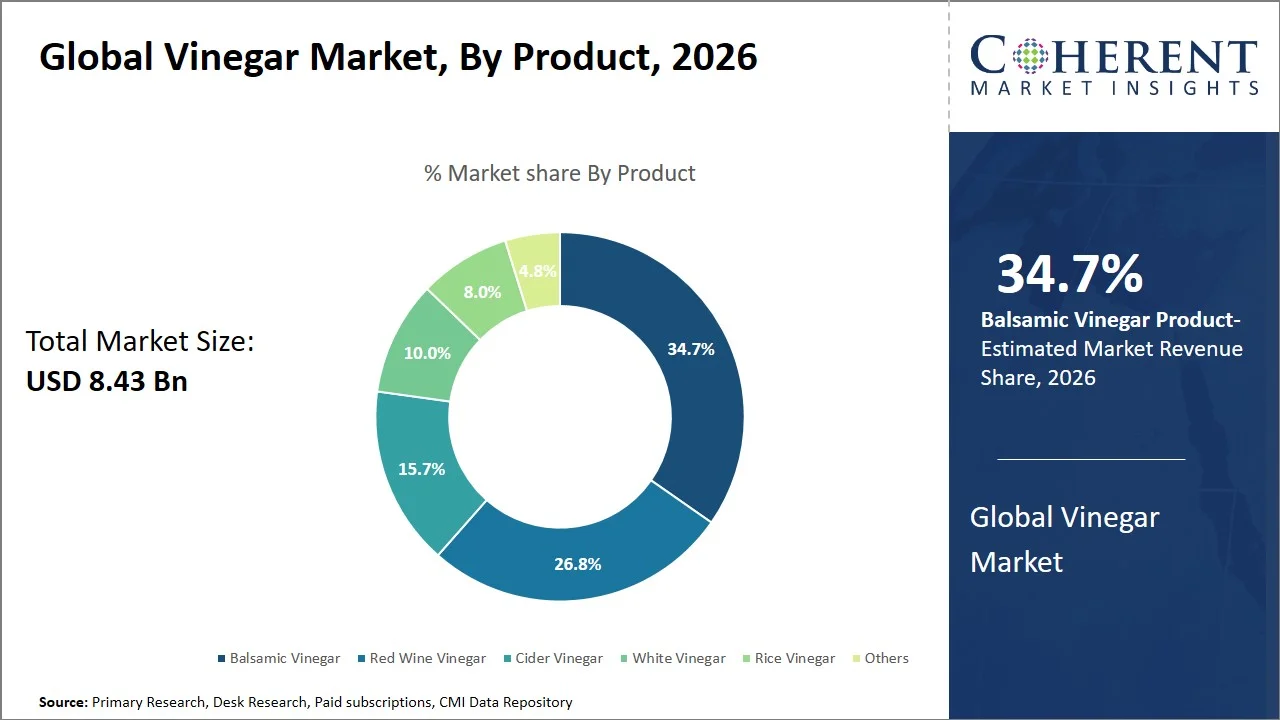
Why Does Balsamic Vinegar Dominate the Global Vinegar Market ?
Balsamic vinegar is expected to hold 34.7% share of the market in 2026, due to its high popularity in gourmet cooking and premium taste. Since balsamic vinegar tastes sweeter and richer than white vinegar, it is popularly used by consumers in salads, marinades, roasted vegetables, pastas, and other restaurant-style dishes. The growing demand for Mediterranean and Italian dishes in the international markets has also boosted its demand in the domestic market and foodservice industry.
Moreover, balsamic vinegar is a healthier alternative to heavy sauces and artificial flavorings, as it is made with a combination of naturally fermented ingredients and antioxidant compounds. The European Union has also recognized the authenticity and geographical value of traditional balsamic vinegar through Protected Geographical Indication (PGI) certifications of products from Modena, Italy, making the world's consumers more ready to trust and demand premium products.
For example, restaurants and gourmet food chains across the U.S. and Asia increasingly use balsamic glaze and aged balsamic vinegar in premium menu offerings due to rising consumer preference for authentic and natural ingredients. (Source: European Commission GI Protection System)
- Current Industry Events of 2026
- Market Size Estimation
- Regional Breakdown
- Competitive Landscape
- Customer Intelligence
- Segmental Analysis
- Pricing Analysis
- Key Market Drivers, Challenges & Future Trends
- Customized Insights Section
Why is the Organic Source of Vinegar Highly Preferred?
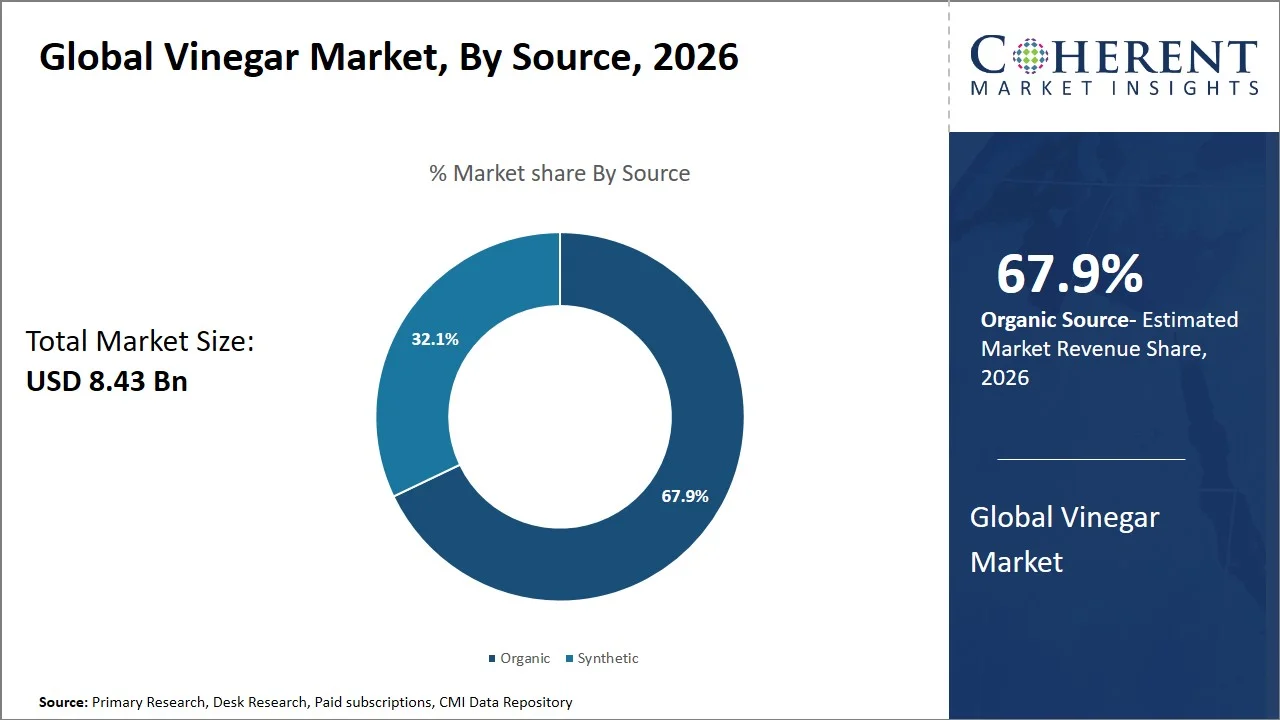
The organic segment is projected to hold 67.9% share of the vinegar market in 2026, as customers are increasingly demanding for natural, organic, and eco-friendly foods. Being made from organically grown fruits, grains and crops, it avoids using any synthetic pesticides, fertilizers, or preservatives and is very appealing to people who are concerned about their health. Demand for organic apple cider vinegar products and organic balsamic vinegar products has been growing especially as the awareness of digestive health, immunity support and clean-label nutrition has increased. This trend has been fueled by a number of factors, including the advocacy of organic agriculture and clear food labelling by government agencies and food regulatory authorities.
For instance, the United States Department of Agriculture control and certifies organic food products through the USDA Organic certification program which assists consumers in determining whether the vinegar is authentic organic food product. (Source: USDA)
Food & Beverage Dominates the Global Vinegar Market
The Food & Beverage segment is expected to hold 46.8% share of the market in 2026, as vinegar is widely used as a flavoring agent, preservative, and acidifying agent in different food products and beverages. Vinegar is used widely in sauces, dressings, pickles, marinades, bakery goods, canned goods, and ready-to-eat foods to add flavor and help preserve them. Vinegar use has also risen significantly with the rise of processed foods, convenience foods, and eating out of the home trend. Moreover, as consumers prefer to see a clean label on food products, food manufacturers are looking into alternative preservatives, such as vinegar, which can be found in nature, to be used in place of synthetic preservatives.
North America, Europe and APAC are the key geographic regions that utilize vinegar in the manufacturing of packaged sauces, sushi making, salad dressing, and pickle manufacturing industries. The Food and Agriculture Organization has called for the adoption of natural food preservation and sustainable food processing, which will indirectly benefit the food manufacturing applications of vinegar.
Currents Events and their Impact
Current Events | Description and its Impact |
Rising Global Health & Wellness Trend Driving Apple Cider Vinegar Consumption |
|
Volatility in Agricultural Raw Material Prices |
|
Vinegar Market Dynamics
Market Drivers
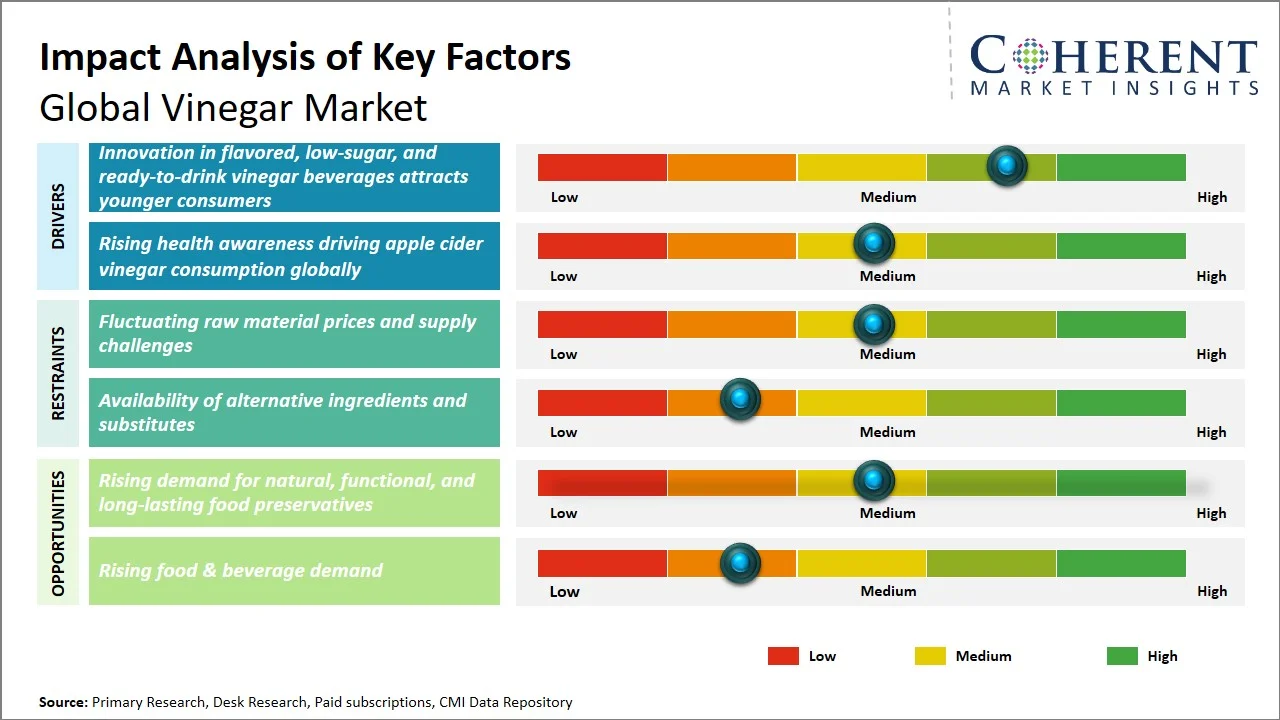
- Innovation in flavored, low-sugar, and ready-to-drink vinegar beverages attracts younger consumers: The products are targeted towards health-conscious millennials and Gen Z consumers, offering them a healthier alternative to sugary sodas and energy drinks. In October 2025, the UK Food Standards Agency implemented their High in Fat, Salt, and Sugar regulations, which will limit the promotion of foods above certain nutrient level. Fruit infusions are not only continuing to be the go-to choice for flavor but have also been expanded to include botanical blends, chili-infused fruity and seasonal varieties. For example, De Nigris introduced its own pumpkin spice vinegar in 2024. This premiumization strategy allows producers to earn better margins while offering a product that is different from commodity white vinegar, which also competes heavily for price. Low-sugar sweetened beverages are gaining traction with younger consumers as diabetes is becoming more and more common, which contributes to the market growth. The International Diabetes Federation (IDF) Diabetes Atlas (2025) estimates that 11.1% of adults (20-79 years old) currently have diabetes. (Source: org)
- Rising health awareness driving apple cider vinegar consumption globally: Apple cider vinegar has long been used as a folk medicine but has now been recognized as a functional ingredient, with research proof demonstrating its effect on postprandial glucose and lipid profiles that has been published and peer-reviewed. According to the Harvard T.H. Chan School of Public Health, the word vinegar derives from the French “vin aigre,” or sour wine. It has been traced back to 5000 B.C.E. in Babylon, not just for cooking but as a medicine, a preservative, and a drink to boost strength and promote wellness. Harvard also notes that intake should generally be limited to 1–2 tablespoons diluted in water because excessive consumption may cause tooth enamel erosion and gastrointestinal discomfort. (Source: Harvard T.H. Chan School of Public Health)
- Based on growing consumer interest in scientifically backed wellness products, brands are expanding their portfolios. In February 2025, Bragg launched apple cider vinegar gummies at Sprouts Farmers Market, targeting consumers seeking more convenient supplement formats. The antimicrobial activity of acetic acid is attractive to consumers, who are increasingly aware of the need for natural alternatives to synthetic preservatives. Even though it is becoming more popular, there are no standard health claims for vinegar, instead there are differing national rules with differing levels of permissiveness.
Emerging Trends
- Premiumization and Culinary Innovation: Vinegar products are increasingly positioned as gourmet and artisanal offerings, with consumers showing strong interest in infused, aged, organic, and craft varieties such as balsamic, apple cider, and fruit-based vinegars. Premium packaging, flavor experimentation, and pairing-focused marketing are helping brands enhance product appeal and command higher price points.
- Rising Demand for Health-Oriented and Functional Vinegars: Growing consumer focus on wellness and natural ingredients is driving demand for vinegar products associated with digestive health, weight management, and clean-label nutrition. This trend is accelerating innovation in organic, raw, unfiltered, low-sodium, and probiotic-rich vinegar variants, particularly in apple cider vinegar and functional beverage applications.
Regional Insights
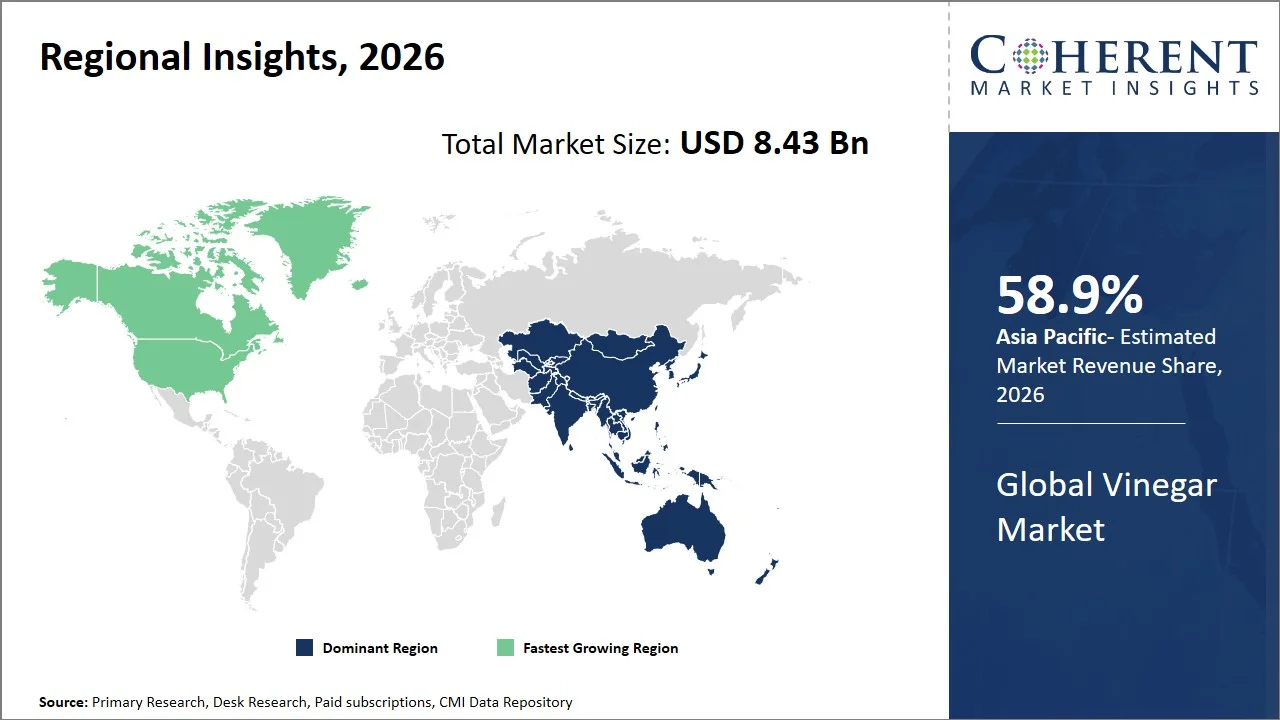
Why is Asia Pacific a Strong Market for Vinegar?
Asia Pacific leads the vinegar market with a projected 58.9% share in 2026, owing to its strong culinary tradition and high demand for vinegar in food preparations, particularly for rice and fermented vinegar. China, Japan and Southeast Asia will account for the highest consumption of vinegar in Asia Pacific, making up the bulk of the region's share of the global market.
One of the important structural factors is the support of the government in food safety and organic agriculture, such as the Ministry of Agriculture and Rural Affairs of China's “Green Food” certification system, to encourage the production of fermented food that is safe and standardized. The Consumer Affairs Agency of Japan also permits functional claims in its Food Function Claim system, which will stimulate innovation in drinking vinegars and health drinks.
Why Does North America Vinegar Market Exhibit High Growth?
The North America vinegar market is expected to exhibit the fastest growth with 19.3% share in 2026. North America is one of the significant regions contributing to the global demand for vinegar, owing to the growing trend of consuming functional foods.
A major catalyst is the increasing interest in food innovation and small-scale entrepreneurship in food, supported by institutions and government bodies, such as the USDA's support for fermentation processes for food needs and natural product value-added opportunities. Further, the U.S. FDA clean label and ingredient transparency have boosted consumer confidence in natural vinegar-based products.
Global Vinegar Market Outlook for Key Countries
Why are the U.S. Leading Innovation and Adoption in the Vinegar Market?
The U.S. vinegar market is growing, with an increasing interest in functional and clean-label foods among consumers, particularly in the case of apple cider vinegar. A significant government trend is providing greater food processing and value-added support for food entrepreneurship and innovation, supporting natural fermentation processes and strengthening local food processing capacity, via USDA programs. The food innovation programs rolled out by the USDA are pushing vinegar functional food development.
Is China Emerging as a Key Growth Hub for the Vinegar Market?
China has the largest market share in vinegar consumption, with its traditional use of black vinegar and rice in the daily diet. One institutional factor is the Chinese government's policy drive to “Green Food” certification and promote the development of organic agriculture under the Ministry of Agriculture and Rural Affairs, which focuses on enhancing food safety standards and competitiveness of fermented food products exportation. Premium vinegar production and exports are getting a boost from government sponsored “Green Food” certification.
Why Does Germany Top the European Vinegar Market?
The growing amount of organic and sustainably produced food products is helping in increasing the demand for vinegar in Germany. One major trend that has been encouraged by the government is the EU Organic Regulation (Regulation EU 2018/848); the regulation was fully introduced in 2025, and has increased the standards for certifications, traceability, and labelling of organic food products such as vinegar. Clean-label vinegar products are gaining popularity thanks to EU organic standards.
Is Japan a Favorable Market for Vinegar Market?
Rice vinegar is a traditional ingredient for Japanese cuisine and the market for Japanese functional health beverages is growing, both of which support the vinegar market in Japan. Japan's Food Function Claim system, introduced by the Consumer Affairs Agency, is a key regulatory trend that enables the labelling of health benefits for functional foods, driving innovation in the area of drinking vinegar and consuming fermented products.
Italy Maintains Leadership in the Global Premium Vinegar Market
Italy is a mature and globally dominant market, particularly in the premium balsamic vinegar segment. The country is widely recognized as a leading producer and exporter of high-quality vinegar products, especially Balsamic Vinegar of Modena. According to European Commission data on Geographical Indications (2024), Italy is the EU’s leading producer of PGI-certified balsamic vinegar, reinforcing its strong position in the premium vinegar industry. Italy is the largest producer and exporter of vinegar globally, producing approximately 95–100 million liters of balsamic vinegar annually.
A major institutional driver supporting Italy’s vinegar sector is the European Union’s Geographical Indication (GI) protection framework, which imposes strict standards on product quality, origin, and authenticity. These protections help preserve traditional production techniques while enabling premium pricing for Italian vinegar products in international markets. Italy continues to strengthen its export leadership by leveraging EU GI protections and growing global demand for authentic, high-quality balsamic vinegar products.
How is the rising demand for natural, functional, and long-lasting food preservatives creating new growth opportunities in the vinegar market?
The increasing need for healthier food preservation methods, clean-label ingredients, and longer shelf-life solutions is significantly reshaping growth opportunities in the global vinegar market. As consumers and food manufacturers move away from synthetic additives, vinegar is gaining prominence as a natural preservative, flavor enhancer, and multifunctional ingredient.
One of the key drivers is the growing preference for organic and minimally processed foods, which is boosting demand for vinegar made through natural fermentation processes. This shift is encouraging producers to expand their organic vinegar portfolios, especially in segments like apple cider vinegar and balsamic vinegar.
Climate & Economic Pressure Index
Factor | Effect on Feedstock | Resulting Market Impact |
Drought | Reduces apples, grapes, sugarcane | Price spikes in vinegar inputs |
Excess rainfall | Spoils grapes, delays harvest | Wine vinegar shortages |
Stable climate season | High supply stability | Lower vinegar prices |
Market Players, Key Development, and Competitive Intelligence
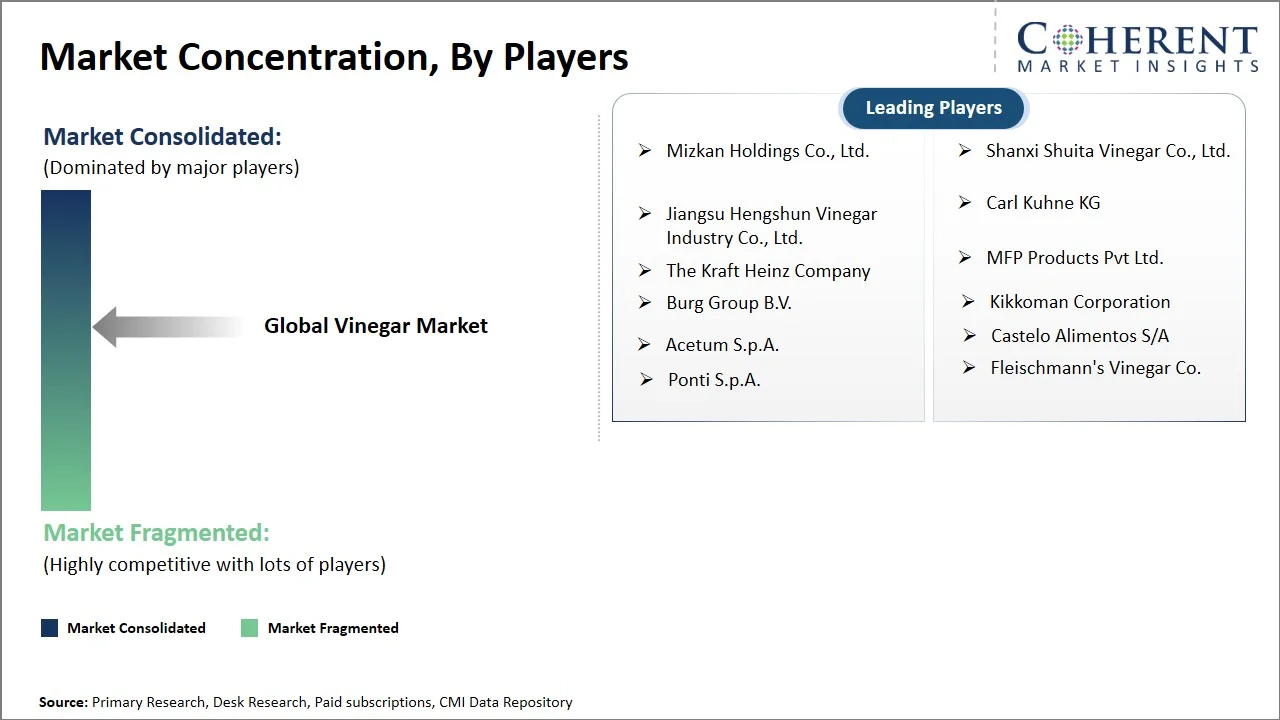
Key Developments
- In February 2026, Daily Dose introduced a cold-pressed Apple Cider Vinegar Shot. The newly unveiled 60ml shot from Daily Dose combines apples, lemon, ginger, agave syrup, and thyme with apple cider vinegar.
- In May 2025, Mizkan America invested USD 156 million to expand its Owensboro, Kentucky plant by an additional 320,000 sq. ft. This expanded facility will bolster the production of pasta sauces and vinegar products, featuring well-known brands such as Ragú, Bertolli, and Holland House.
- In May 2024, Bragg Live Food Products rolled out a new 10 oz. size of its Apple Cider Vinegar (ACV) in all 20,000 Dollar General stores across the U.S. This move boosts the accessibility of Bragg's ACV, reinforcing the brand's commitment to promoting wellness. In addition to the new size, Bragg also provides ACV in 16-, 32-, 64-, and 128-ounce variants.
Competitive Landscape
The market for vinegar is highly competitive, as the demand for functional food ingredients, premium condiments, and health-oriented products grow. Whilst the top brands establish themselves on brand, product innovation, and an extensive distribution network, regional and artisanal producers concentrate on organic products, premium flavors, and niche preferences. The focus areas are:
- Innovation in product creation with organic, flavored, and functional vinegar varieties
- A growth strategy to expand the premium, clean label, and health-oriented product lines.
- Building strategic relationships, acquisitions, and online/retail channels
Market Report Scope
Vinegar Market Report Coverage
| Report Coverage | Details | ||
|---|---|---|---|
| Base Year: | 2025 | Market Size in 2026: | USD 8.43 Bn |
| Historical Data for: | 2020 To 2024 | Forecast Period: | 2026 To 2033 |
| Forecast Period 2026 to 2033 CAGR: | 3.2% | 2033 Value Projection: | USD 10.50 Bn |
| Geographies covered: |
| ||
| Segments covered: |
| ||
| Companies covered: | Mizkan Holdings Co., Ltd., Jiangsu Hengshun Vinegar Industry Co., Ltd., The Kraft Heinz Company, Burg Group B.V., Acetum S.p.A., Ponti S.p.A., Shanxi Shuita Vinegar Co., Ltd., Carl Kuhne KG, MFP Products Pvt Ltd., Kikkoman Corporation, Aspall Cyder and Vinegar (Molson Coors), Castelo Alimentos S/A, and Fleischmann's Vinegar Co. | ||
| Growth Drivers: |
| ||
| Restraints & Challenges: |
| ||
Analyst Opinion (Expert Opinion)
- Vinegar is moving away from the low involvement pantry product and toward a functional ingredient, health and food processing product category. Premiumization will be the major driver of future growth as opposed to pure volume growth. White vinegar will continue to be a big volume product, but the greatest gains in both volume and dollar margin are anticipated in apple cider vinegar (ACV), specialty fermented vinegars, flavored vinegars, and industrial use applications in food preservation and cleaning formulas.
- Consumer demand world-wide is turning to “natural functionality” products, which are ingredients they believe to be “clean label”, preservative free, “probiotic adjacent” and supportive of wellness. This is a good place to be for vinegar, as it is a natural by-product of food preservation, food digestion, immunity perception, and home use. This sets up a structurally positive long-term demand scenario.
- India, Indonesia, Vietnam, and the Philippines are still underpenetrated, especially on branded and premium vinegar consumption, as compared to the growth rate of urbanization and processed foods. The consumption of vinegar moves from a small-scale local production to a large-scale industrial sourcing as modern retail, quick-service restaurants, packaged foods, and organized foodservice grow in scale.
Speak to the analyst
Want personalized insights?
Take the findings above to one of our principal consultants, or have the report rebuilt around the segments, geographies and competitors you actually track.
Market Segmentation
- Product Insights (Revenue, USD Bn, 2021 - 2033)
- Balsamic Vinegar
- Red Wine Vinegar
- Cider Vinegar
- White Vinegar
- Rice Vinegar
- Others
- Source Insights (Revenue, USD Bn, 2021 - 2033)
- Organic
- Synthetic
- Application Insights (Revenue, USD Bn, 2021 - 2033)
- Food & Beverage
- Pharmaceuticals
- Agriculture
- Others
- Regional Insights (Revenue, USD Bn, 2021 - 2033)
- North America
- U.S.
- Canada
- Latin America
- Brazil
- Argentina
- Mexico
- Rest of Latin America
- Europe
- Germany
- U.K.
- Spain
- France
- Italy
- Russia
- Rest of Europe
- Asia Pacific
- China
- India
- Japan
- Australia
- South Korea
- ASEAN
- Rest of Asia Pacific
- Middle East
- GCC Countries
- Israel
- Rest of Middle East
- Africa
- South Africa
- North Africa
- Central Africa
- North America
- Key Players Insights
- Mizkan Holdings Co., Ltd.
- Jiangsu Hengshun Vinegar Industry Co., Ltd.
- The Kraft Heinz Company
- Burg Group B.V.
- Acetum S.p.A.
- Ponti S.p.A.
- Shanxi Shuita Vinegar Co., Ltd.
- Carl Kuhne KG
- MFP Products Pvt Ltd.
- Kikkoman Corporation
- Aspall Cyder and Vinegar (Molson Coors)
- Castelo Alimentos S/A
- Fleischmann's Vinegar Co.
Sources
Primary Research Interviews
- Vinegar manufacturer
- Supply Chain Director of food ingredients producer
- Vinegar Institute (industry specialist)
- Sustainability Officer of food certification authority
Stakeholders
- Manufacturers of vinegar and acetic acid products (e.g., Acetificio Galletti, ACETUM S.p.A., Aspall Cyder Limited, Australian Vinegar Association members)
- End-use Sectors
- Food & Beverage Processors (e.g., Heinz, Unilever)
- Retail Consumer Brands (e.g., Kraft, private labels)
- Restaurants and Foodservice (e.g., McDonald's, catering suppliers)
- Regulatory & Certification Bodies: FDA (vinegar standards), EU Food Safety Authority, Codex Alimentarius (international standards)
- E-commerce Platforms and Retailers: Amazon, Walmart, Specialty food suppliers like Whole Foods.
- Technology Integration Players: Innovators in fermented foods and organic vinegars (e.g., Bragg Live Food Products, BASF food ingredients)
Databases
- UN Comtrade Database (HS Code 2209 for vinegar and substitutes)
- India Import Export (EXIM) Database (HS 2209)
- USITC DataWeb for food product imports (HS 2209)
- Eurostat Trade Statistics for Beverages and Vinegar
- Global Trade Atlas for Vinegar Imports/Exports
Magazines
- Food Processing Magazine – Trends in preservatives and vinegars
- Beverage Industry – Acetic acidulants in drinks
- Prepared Foods – Vinegar in sauces and condiments
Journals
- Journal of Food Science – Vinegar production and quality
- Food Chemistry – Acetic acid fermentation studies
- International Journal of Food Microbiology – Vinegar microbiology
- Trends in Food Science & Technology – Functional vinegars
Newspapers
- The Wall Street Journal – Food commodity markets
- Business Standard (India) – Vinegar imports and food sector growth
- Food Dive – Supply chain for condiments
Associations
- Vinegar Institute (international trade association)
- Sauce and Condiment Manufacturers Association
- International Vinegar Brewers Federation
- Global Specialty Food Association
- American Food Manufacturing Association
Public Domain Sources
- FDA – Standards of identity for vinegar
- EPA – Guidelines for food processing VOCs
- Codex Alimentarius – International vinegar standards
- USDA – Agricultural vinegar applications
Proprietary Elements
- CMI Data Analytics Tool, Proprietary CMI Existing Repository of information for last 10 years.
Get access to 250+ pages report
Every segment, forecast, competitor profile and data table behind the analysis above — available for instant download.
- ESOMAR Member
- ISO 9001:2015 Certified
- D-U-N-S Registered
- GDPR & CCPA Compliant
Missing comfort of reading report in your local language? Find your preferred language:
Transform your Strategy with Exclusive Trending Reports
Frequently Asked Questions
The global vinegar market is estimated to be valued at USD 8.43 Bn in 2026 and is expected to reach USD 10.50 Bn by 2033.
The global vinegar market refers to the production, distribution, and consumption of vinegar products such as white vinegar, apple cider vinegar, balsamic vinegar, rice vinegar, and wine vinegar used across food, healthcare, cleaning, and agricultural applications.
The CAGR of global vinegar market is projected to be 3.2% from 2026 to 2033.
Growing consumer preference for health and wellness products and expanding use in food processing and culinary applications are the major factors driving the growth of the global vinegar market.
Fluctuating raw material prices and supply challenges and availability of alternative ingredients and substitutes are the major factors hampering the growth of the global vinegar market.
In terms of product, balsamic vinegar is estimated to dominate the market revenue share in 2026.
Owens Corning, Glen Raven, Inc., CertainTeed (Saint-Gobain), 3M Company, TAMKO Building Products, Inc., Johns Manville, Henry Company, Wrap-On Company, Inc., BASF SE, Raven Industries, Georgia-Pacific LLC, and Masonite International Corporation are the major players.