

Global Wall Covering Market Size and Forecast – 2026 To 2033
The global wall covering market is expected to grow from USD 41.45 Bn in 2026 to USD 57.16 Bn by 2033, registering a compound annual growth rate (CAGR) of 4.7%. Increasing retrofit activities, rising home renovation spending, and stricter building energy-efficiency regulations worldwide are driving the market growth. According to the International Energy Agency (IEA), combined public and private investment in energy efficiency across buildings, transport, and industry is projected to reach approximately USD 660 billion in 2024, up nearly 50% compared to 2019. (Source: International Energy Agency)
Key Takeaways of the Global Wall Covering Market
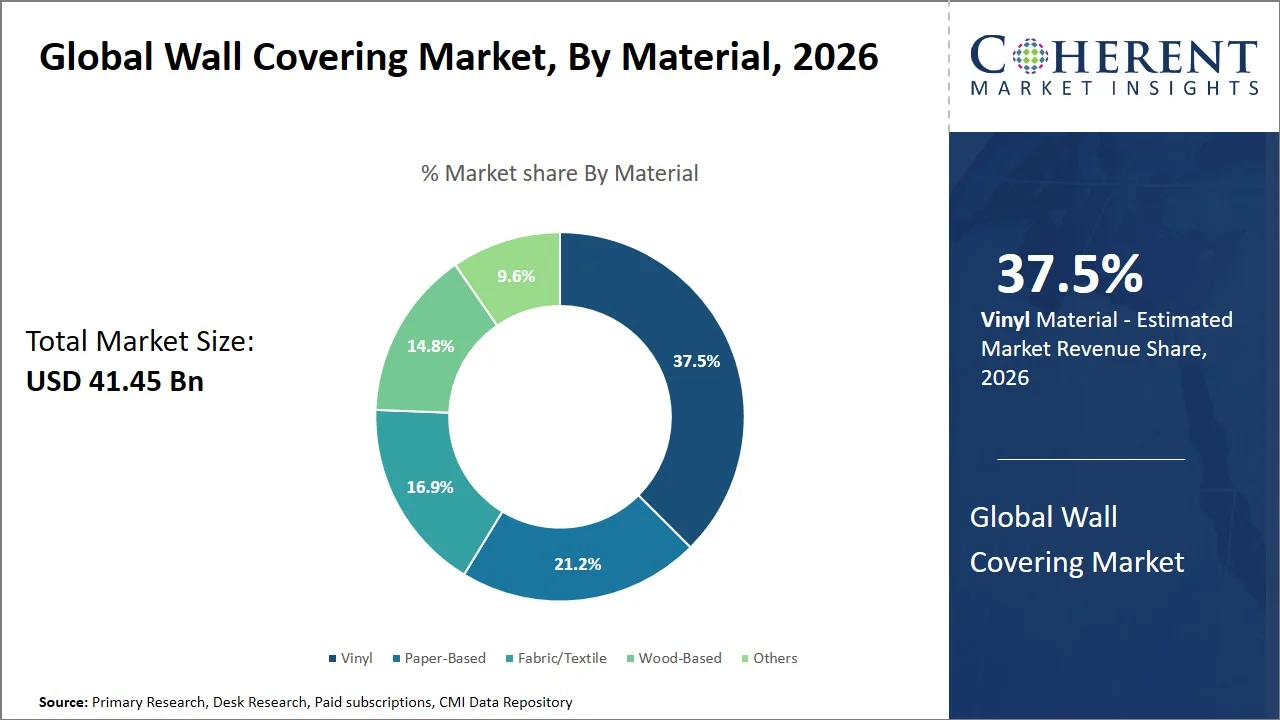
- Vinyl is projected to hold 37.5% share of the global wall covering market in 2026. The durability, ability to withstand moisture, ease of cleaning, and affordability of vinyl makes it the go-to material in residential, commercial, healthcare, and hospitality applications. Vinyl wall coverings are being recommended in high traffic areas like offices, hospitals, and hotels, due to their durability and ease of maintenance. For example, Duracote healthcare facilities commonly use Type II vinyl wall coverings in corridors and patient rooms due to their scrubbability and resistance to stains and microbial growth, helping maintain hygiene standards and reduce maintenance costs. (Source: Duracote)
- Wall panels are projected to account for 41.5% of the global wall covering market share in 2026, supported by strong adoption across premium residential, commercial office, retail, and institutional interiors, driven by their acoustic and thermal performance, modular installation advantages, and high degree of aesthetic customization. For instance, Marina Bay Sands in Singapore incorporates extensive decorative and acoustic wall panel systems across its luxury hotel interiors to enhance guest comfort and noise control. In interior architecture, the demand for 3D decorative panels and acoustic wall systems is increasing. Growing investments in interior refurbishment and smart building designs in developed markets are boosting the market growth. (Source: Marina Bay Sands)
- Hospitality is expected to capture 27.9% of the market share in 2026. Premium wall coverings are more popular in hotels, resorts, restaurants, and luxury commercial spaces as they improve the guest experience and build up the brand. According to the Q4 2025 Global Hotel Construction Pipeline Trend Report, the worldwide hotel construction pipeline now stands at 15,922 projects comprising 2,437,354 rooms, marking a 1% year-on-year increase in projects. Out of these, 6,140 projects with 1,058,945 rooms are currently under construction.
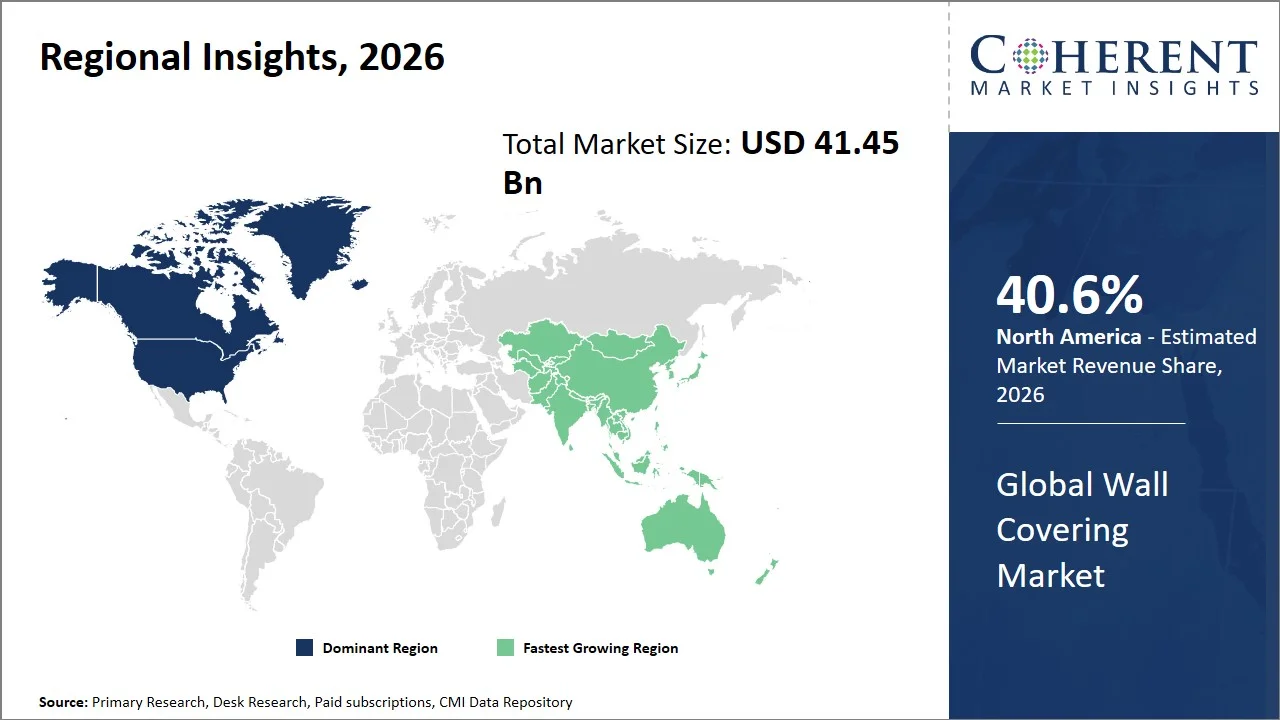
- North America is expected to remain the market leader, accounting for 40.6% of the market share in 2026. The construction sector is well established and there is significant remodeling activity in the area, coupled with the large expenditure by consumers on interior decoration. Residential improvement and commercial renovation expenditures continue to support the market growth across the U.S. and Canada. In particular, major urban centers such as New York City and Toronto are witnessing increased demand for premium wall coverings due to ongoing hospitality refurbishments, luxury residential developments such as the Four Seasons Private Residences Los Angeles, and corporate office modernization projects (Source: Webcor). In Los Angeles, premium wall coverings also continue to gain traction from robust hotel renovation programs and workspace modernization initiatives across North America.
- Asia Pacific is expected to be the fastest-growing regional market, accounting for approximately 24.5% of the market share in 2026. Growth is driven by rapid urbanization, rising disposable incomes, expanding middle-class housing, and increasing investments in commercial infrastructure across China, India, and Southeast Asia. According to the Asian Development Bank, developing Asia Pacific requires around US$ 1.7 trillion annually in infrastructure investment to sustain growth, directly supporting demand for interior finishing materials including wall coverings. (Source: ADB)
- Sustainability & Net-Zero Construction Alignment: Eco-friendly wall coverings are increasingly aligned with green building and net-zero construction goals, driven by the demand for low-VOC, recyclable, and bio-based materials such as bamboo, cork, natural fibers, and recycled substrates. These innovations support improved indoor air quality and reduced embodied carbon, making wall coverings an important component in sustainable building certifications like LEED and similar frameworks.
- Market Expansion Catalysts: The wall covering market is being strongly propelled by a combination of technological innovation and regulatory sustainability pressure. Advancements in digital printing, smart, exterior wall system, and multifunctional panels (acoustic, antimicrobial, moisture-resistant) are expanding application scope across the residential, commercial, hospitality, and healthcare sectors.
Segmental Insights
Why Does the Vinyl Segment Dominate the Global Wall Covering Market ?
Vinyl is expected to hold 37.5% of the global wall covering market share in 2026, due to its ability to offer the best commercial balance of durability, design flexibility, moisture resistance, and lifecycle cost efficiency. Vinyl is a good solution for high traffic areas like hotels, hospitals, offices, retail shops and multi-family homes where walls are subject to constant cleaning, humidity and wear and tear. Vinyl is also compatible with cutting-edge digital printing, embossing and texture replication (wood grain, stone, linen, leather) for the designers to create high-end looks at lower cost.
Production scale is a competitive pace. Capital depth is one of the innovation-minded aspects, shown by IZODEKOR, which produces 750,000 m² of 3-D panels annually. Kirkby Design's 2025 recycled-cotton product combines fabric texture and recycled materials, creating fabric-wall options for niche and boutique hotels.
- Current Industry Events of 2026
- Market Size Estimation
- Regional Breakdown
- Competitive Landscape
- Customer Intelligence
- Segmental Analysis
- Pricing Analysis
- Key Market Drivers, Challenges & Future Trends
- Customized Insights Section
Why is Wall Panel the Most Preferred Product Type?
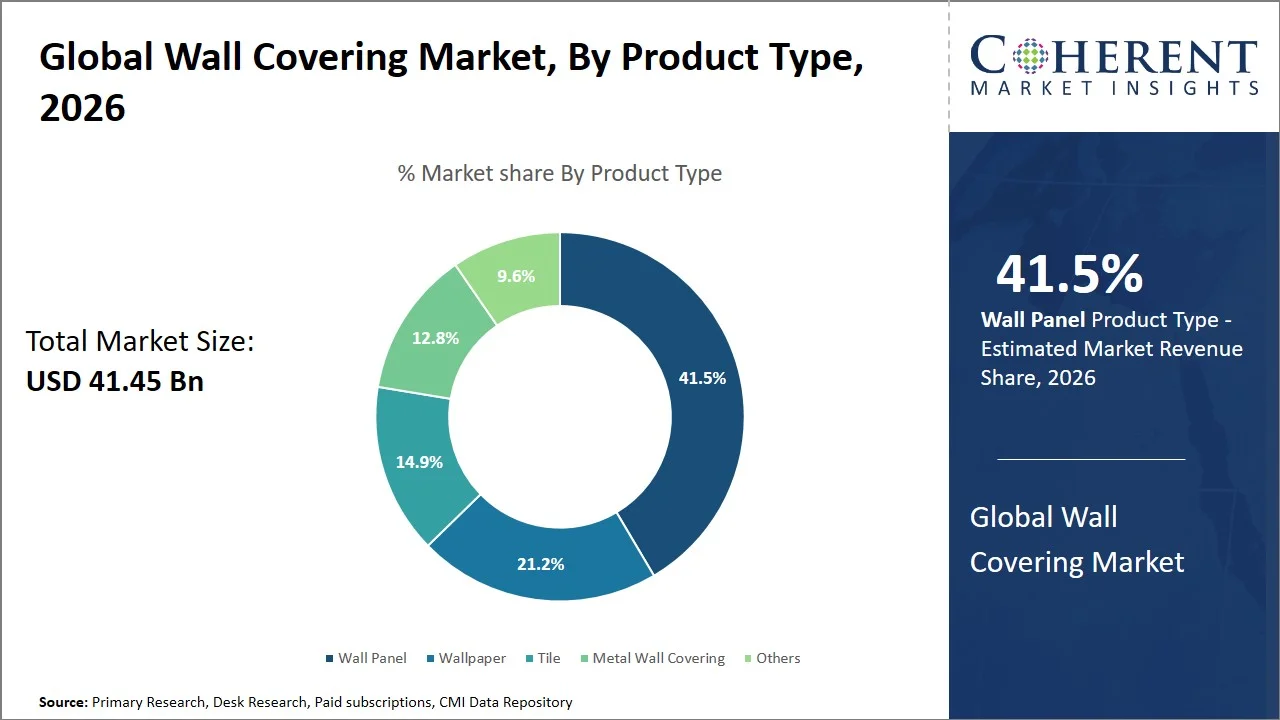
The wall panel segment is projected to hold 41.5% of the wall covering market share in 2026. The growing popularity of wall panel is due to their superior appearance (remain a high-quality finish even after many years), acoustic properties, low maintenance, and the fact that they are easy to install. Panels are very desirable in commercial interiors, as they provide dimensional design, insulating, sound absorption, and in some cases, fire resistant. For instance, luxury hotels such as IBIS Styles Hotel Basel incorporate 3D MDF and acoustic wall panels in their lobby interiors to enhance both aesthetics and acoustic comfort, creating a premium guest experience (Source: Archillects – IBIS Styles Hotel Lobby Transformation in Basel).
Hospitality Segment Dominates the Global Wall Covering Market
The hospitality segment is expected to account for 27.9% of the market share in 2026, driven by ongoing investments in hotel and resort interiors aimed at enhancing guest experiences, elevating aesthetics, and maintaining competitiveness within the hospitality industry. These investments often include the refurbishment of guest rooms and suites, installation of smart room technologies (such as automated lighting and climate control), upgrading luxury furniture and bedding, use of premium wall coverings and décor materials, renovation of lobbies and reception areas, and development of wellness-focused spaces such as spas, gyms, and relaxation lounges. Residential interiors are changed every 8-12 years, whereas hospitality interiors may be changed in 5-7 years.
In the healthcare industry, with its rigorous requirements for hygiene, fire protection and patient comfort, longboard's Baptist MD Anderson Cancer Center project is a clear example of its high earning its place in the premium end of the wall covering market. (Source: Longboard Architectural Products Inc.)
Currents Events and their Impact
Current Events | Description and its Impact |
Macroeconomic Shift: Global Construction Slowdown & Renovation-led Demand |
|
Regulatory Shift: Tightening Low-VOC and Sustainable Building Standards |
|
(Source: U.S. Green Building Council, Inc.)
Global Wall Covering Market Dynamics
Market Drivers
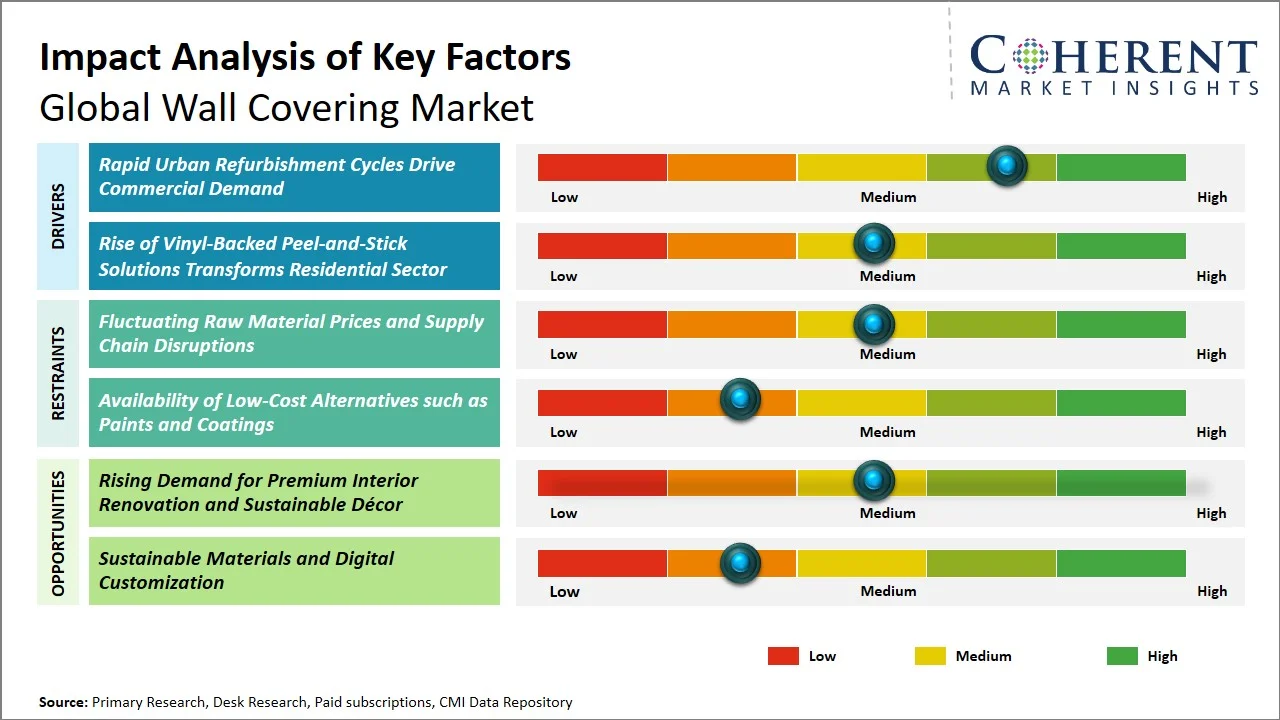
- Rapid Urban Refurbishment Cycles Drive Commercial Demand: Office landlords and hotel operators are aggressively addressing interior refurbishment to expedite vacancies and meet changing workspace expectations. The modular wall systems that reduce downtime and enhance acoustics have been preferred specifications. The 35,000 m² vinyl installation at Joan Kirner Women's and Children's Hospital is a new example of scale advantages for fast-track healthcare projects. These dynamics help ensure a premium on fast installation, phased build-outs, and one-stop material sourcing, which all drive the wall covering market. (Source: Tarkett)
- Rise of Vinyl-Backed Peel-and-Stick Solutions Transforms Residential: Vinyl-backed peel and stick options make them a viable choice for purchase, cutting install time to minutes without requiring adhesives. Brands like Tempaper, RoomMates, and Astek pushed for collections that are “influencer ready,” and eliminate the “perceived complexity” of the market. Drytac's PVC-free Paper Fleece Smooth is keeping up with sustainability buzz without sacrificing consumer convenience. Peel-and-stick has become a marketing strength in the wall covering industry and viral before/after clips prove to be a marketing powerhouse. (Source: DRYTAC)
Emerging Trends
- Diversification Towards Premiumization and Design-Centric Wall Coverings: Wall coverings are progressively going past basic decorative wall coverings to include luxurious and designer options like textured wallpapers, 3D wall panels, fabric-backed wall coverings, metallic wall coverings, and digital murals. Homeowners, hotels, businesses, and high-end retail stores are embracing customized wall coverings to enhance their interior space with innovative wall designs that enable manufacturers to increase their selling price.
- Turn Towards Sustainable & Functional Wall Coverings: Increasing consumer consciousness and the introduction of new green buildings standards are leading towards the adoption of eco-friendly wall coverings made of recycled paper, bamboo fiber, cork, grasscloth, and low volatile organic compound content material. Simultaneously, consumers have shown greater preference for functional wall coverings that can offer noise control, fire resistance, anti-microbial finish, and moisture-resistant properties. Digital printing is helping manufactures customize wall decorations for individual customer preferences. Digital printing technology is further enabling customized, on-demand production of sustainable wall décor solutions.
Regional Insights
Why is North America a Strong Market for Wall Coverings?
North America leads the wall covering market, accounting for an estimated 40.6% of the market share in 2026, as home remodeling is a frequent purchase, commercial refurbishment is proving to be strong, and premium interior décor solutions are fast gaining in acceptance. In 2025, U.S. construction spending was estimated at more than USD 2.2 trillion, a significant level of investment in residential and commercial building construction, which includes direct spending on interior finishing materials, including wall coverings. Further, U.S. homeowners are also investing heavily in renovation and remodeling of their homes, which feeds the replacement market for wallpapers, vinyl wallpaper, and decorative panels. (Source: Construction Coverage)
Why Does the Asia Pacific Wall Covering Market Exhibit High Growth?
Asia Pacific is projected to be the fastest-growing market, accounting for 24.5% of the market share in 2026, driven by rapid urbanization and increasing demand for both decorative and functional wall solutions. The rising middle-class consumers are moving away from traditional paint and towards wall papers, wall panels, and personalized print of wall panels. For example, moisture resistant and peel-and-stick wallpaper is used in high-rise apartments in Shanghai, Bengaluru and Jakarta for their modern interiors.
Global Wall Covering Market Outlook for Key Countries
Why is the U.S. Leading Innovation and Adoption in the Wall Covering Market ?
The U.S. is ahead of the curve because of its sophisticated interior design landscape, consumer spending, and premium manufacturer base. U.S. manufacturers are spending time in developing digital printing, custom textures, antimicrobial surfaces, and sustainable material innovations instead of battling it out in terms of volume. Commercial applications like hospitality, healthcare, education, and luxury residential are among the key markets for performance wall coverings.
For instance, according to Goodrich, healthcare projects are increasingly being fitted with antimicrobial vinyl wall coverings, and luxury residential developments are turning to grasscloth and custom mural solutions. The U.S. is also one of the few countries in the world that has a significant domestic wall covering manufacturing base, and has shorter supply chains. (Source: Goodrich Global Pte Ltd. )
Is Canada a Favorable Market for Wall Coverings ?
Canada's wall covering market is an attractive environment because of high spending on home renovation, urban housing demand, and the focus on high quality home decor. The CMHC reported 248,378 annualized housing starts in March 2026, keeping housing activity robust and helping to drive demand for interior finishing products. The adoption of modern solutions for decorative walls in condo, hotel, and office spaces is being fueled by major urban markets like Toronto, Vancouver, and Montreal. (Source: Canada Mortgage and Housing Corporation (CMHC))
Is China Emerging as a Key Growth Hub for the Wall Covering Market ?
China is already a global center for the production and use of wall coverings. China had the largest amount of wallpaper and wall covering materials production of 349,000 tons in 2024. Domestic demand is ongoing via high rises residential development, smart city projects, and massive urban development. The increasing income of middle class and growing demand for home aesthetics are also driving the market growth.
In luxury residences and premium commercial spaces, particularly in major Chinese design hubs such as Beijing, Shanghai, and Shenzhen, interior designers are increasingly specifying digitally printed vinyl wallpapers and high-performance acoustic wall panels to achieve customized aesthetics, sound insulation, and luxury finishes. This trend is especially visible in high-end apartments, corporate headquarters, and boutique hospitality projects, where bespoke wall textures and digitally printed designs are being used to differentiate interior environments.
Is the Wall Covering Market Developing in India?
Urbanization, increasing disposable income of consumers, and organized interior décor retail are some of the key factors that are making India one of the most available emerging markets for wall coverings. Currently, India is one of the major producers of wall covering products, with production reaching nearly 76,000 tons in 2024.
Increased residential and commercial construction is being propelled by government initiatives like Pradhan Mantri Awas Yojana (PMAY) and smart city development. Metro cities like Mumbai, Bengaluru, and Delhi are driving the market for wallpapers, decorative laminates, and wall panels in apartments, offices, cafes, and retail stores. In some cases, 3D panels and imported wallpapers are now being seen as standard upgraded interior options by premium residential developers.
Impact of Regional Humidity and Moisture Conditions on Wall Covering Material Preferences Across Key Indian Markets
Region / Environment Type | Humidity Level | Moisture Exposure Source | Preferred Wall Covering Types |
Coastal regions (e.g., Mumbai, Chennai, Kochi) | High (70–90%) | Sea air, monsoon rainfall | Vinyl wallpaper, PVC panels, anti-mold coatings |
Tropical inland regions | Moderate–High (60–80%) | Seasonal monsoon humidity | Vinyl-coated wallpaper, laminated panels |
Dry regions (e.g., Rajasthan interior areas) | Low (20–40%) | Minimal moisture exposure | Paper wallpaper, fabric wall coverings |
How is Rising Demand for Premium Interior Renovation and Sustainable Decor Creating New Growth Opportunities in the Global Wall Covering Market?
The growing consumer preference for aesthetically appealing, durable, and sustainable interior solutions are creating significant growth opportunities in the wall covering market. Rising renovation activity across residential housing, hotels, offices, healthcare facilities, and retail spaces are increasing demand for premium wall coverings that offer both decorative appeal and functional benefits such as moisture resistance, scratch resistance, acoustic insulation, and antimicrobial protection. For instance, in luxury hospitality refurbishments such as boutique hotel upgrades in Dubai, designers are increasingly using antimicrobial vinyl wall coverings in guest rooms and digitally printed textured panels in lobbies to enhance durability while maintaining a high-end aesthetic.
Consumers are increasingly moving away from conventional paint toward textured wallpapers, vinyl coverings, fabric-backed wall panels, and digitally printed customized designs that offer longer life and design flexibility.
Market Players, Key Development, and Competitive Intelligence
Key Developments
- In February 2025, Kirkby Design introduced a new range of recycled-cotton wallcoverings designed to support sustainable interior design trends. The collection incorporates environmentally responsible materials and textured finishes aimed at premium residential and hospitality applications, reflecting the growing consumer preference for eco-friendly decorative solutions.
- In January 2025, Shaw Floors launched its Pet Perfect+ and Simply the Best Values carpet collections, specifically developed for stain-resistant and easy DIY home renovation projects. The product line focuses on durability, low maintenance, and enhanced aesthetic appeal, catering to rising demand for practical yet stylish flooring and interior décor solutions in the residential remodeling sector.
- In December 2024, Fine Print NYC expanded its digital printing operations by increasing production capacity to 100,000 square feet per week. The expansion was aimed at meeting growing demand for customized wallcoverings, large-format graphics, and digitally printed interior décor solutions across commercial, retail, and hospitality environments.
Competitive Landscape
The market for wall coverings is extremely competitive and has been fueled by the rising demand for wall covering that is aesthetically pleasing, environmentally friendly, and used for decorative purposes in residential as well as commercial buildings. The established manufacturers already have established brand value, distribution channels, and product lines while regional and niche manufacturers are getting the edge in design innovation, customization ability and cost competitiveness. It focuses on the following areas:
- High quality, long-lasting and easy-to-install wall covering materials development
- Growth in environmentally friendly, digitally printed and usable product offerings
- Collaborating with interior designers, architects, distributors, and expanding sales channels – both online and offline
Market Report Scope
Wall Covering Market Report Coverage
| Report Coverage | Details | ||
|---|---|---|---|
| Base Year: | 2025 | Market Size in 2026: | USD 41.45 Bn |
| Historical Data for: | 2020 To 2024 | Forecast Period: | 2026 To 2033 |
| Forecast Period 2026 to 2033 CAGR: | 4.7% | 2033 Value Projection: | USD 57.16 Bn |
| Geographies covered: |
| ||
| Segments covered: |
| ||
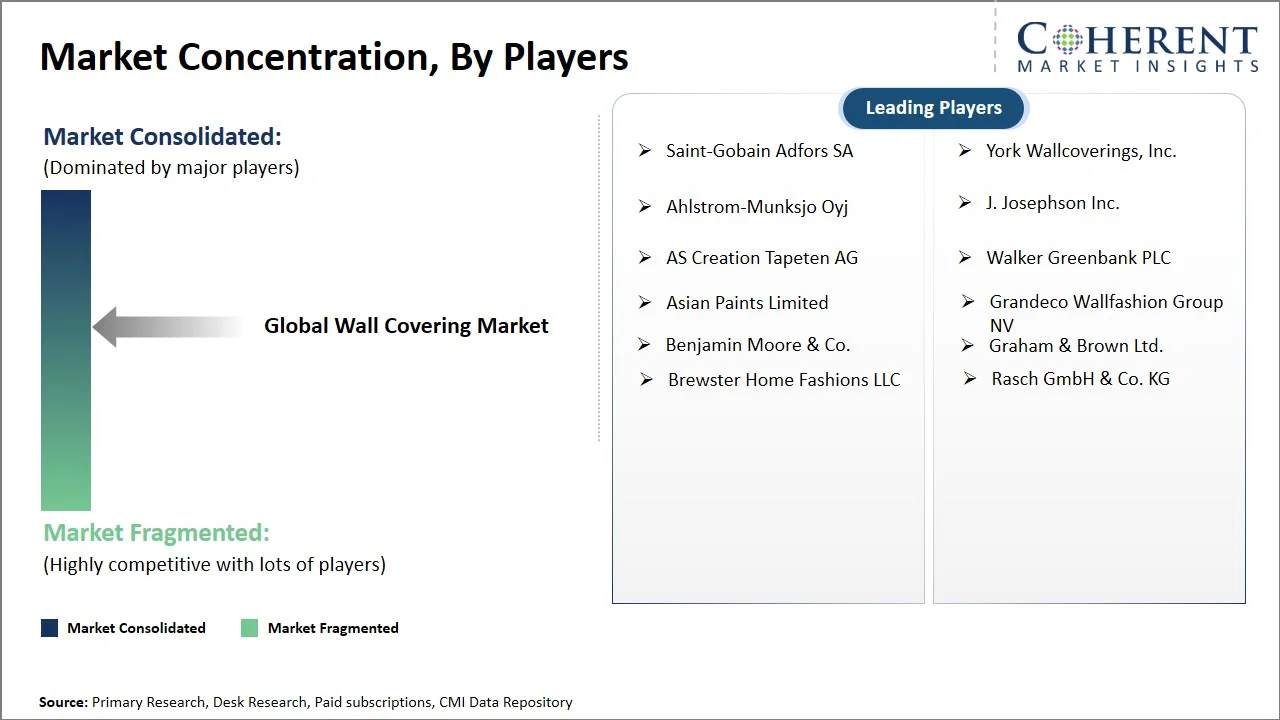
| Companies covered: | Saint-Gobain Adfors SA, Ahlstrom-Munksjo Oyj, AS Création Tapeten AG, Asian Paints Limited, Benjamin Moore & Co., Brewster Home Fashions LLC, York Wallcoverings, Inc., J. Josephson Inc., Walker Greenbank PLC, Grandeco Wallfashion Group NV, Graham & Brown Ltd., and Rasch GmbH & Co. KG | ||
| Growth Drivers: |
| ||
| Restraints & Challenges: |
| ||
Analyst Opinion (Expert Opinion)
- The combination of high-quality interior design, sustainable material choices and performance will define the future of the wall covering industry. Wall coverings are no longer just for looks and are now being specified as interior materials that provide acoustic performance, antimicrobial protection, moisture resistance and enhanced durability. The category is likely to merge more with the smart interiors, hospitality design, healthcare infrastructure and premium residential development over the next 5-8 years.
- Commodity wallpapers will remain under pressure due to thinness of margins, performance-based vinyl, textile-backed wallpapers, digitally printed murals and sustainable bio-based products will be the ones to capture disproportionate value. The business landscape is changing from the selling of products to the selling of designs, which is based on the principle of customization, project consultation and performance over price. Those that can't do without their distributors' volume sales will have lost pricing power; those who have control of design specifications and project relationships will have control of margins.
- The biggest near-to-mid-term opportunity is in premium residential and hospitality applications across India, China, the U.A.E., and Southeast Asia and in vinyl-based, antimicrobial and digitally customisable wall coverings. India is one such market which is one of the least penetrated markets in the interior spaces industry compared to the construction and urbanization curve. The formal developer-led housing projects in the cities are expanding rapidly, and branded hotels and co-living spaces are creating high-quality interiors, as well as ‘Grade-A’ offices.
Speak to the analyst
Want personalized insights?
Take the findings above to one of our principal consultants, or have the report rebuilt around the segments, geographies and competitors you actually track.
Market Segmentation
- Material Insights (Revenue, USD Bn, 2021 - 2033)
- Vinyl
- Paper-Based
- Fabric/Textile
- Wood-Based
- Others
- Product Type Insights (Revenue, USD Bn, 2021 - 2033)
- Wall Panel
- Wallpaper
- Tile
- Metal Wall Covering
- Others
- End-Use Industry Insights (Revenue, USD Bn, 2021 - 2033)
- Hospitality
- Healthcare
- Retail
- Corporate Offices
- Education
- Domestic Housing
- Industrial Facilities
- Others
- Distribution Channel Insights (Revenue, USD Bn, 2021 - 2033)
- Specialty Store
- Franchise store
- E-commerce
- Others
- Regional Insights (Revenue, USD Bn, 2021 - 2033)
- North America
- U.S.
- Canada
- Latin America
- Brazil
- Argentina
- Mexico
- Rest of Latin America
- Europe
- Germany
- U.K.
- Spain
- France
- Italy
- Russia
- Rest of Europe
- Asia Pacific
- China
- India
- Japan
- Australia
- South Korea
- ASEAN
- Rest of Asia Pacific
- Middle East
- GCC Countries
- Israel
- Rest of Middle East
- Africa
- South Africa
- North Africa
- Central Africa
- North America
Sources
Primary Research Interviews
- Wall covering manufacturers
- Supply Chain Director of interior décor materials producer
- Interior designers and architectural consultants
- Sustainability Officer of decorative materials certification authority
Stakeholders
- Manufacturers of wall coverings and decorative surface materials (e.g., A.S. Creation Tapeten AG, York Wallcoverings)
- End-use Sectors
- Residential Construction and Remodeling Companies (e.g., Lennar, D.R. Horton)
- Commercial Real Estate and Hospitality Developers (e.g., Brookfield Properties, Marriott International)
- Regulatory & Certification Bodies: International Code Council (ICC), ASTM International
- E-commerce Platforms and Retailers: Home Depot, Lowe’s, Wayfair
- Technology Integration Players: Innovators in sustainable and digitally printed wall coverings (e.g., 3M, Saint-Gobain)
Databases
- UN Comtrade Database (wall covering and wallpaper trade statistics)
- India Import Export (EXIM) Database
- Eurostat Trade Statistics for interior construction materials
- USITC DataWeb for decorative materials imports
- OECD Construction and Building Materials Database
Magazines
- Walls & Ceilings – Trends in wall covering materials and interior finishes
- Building Design+Construction – Commercial interior renovation trends
- Interior Design – Luxury wall décor innovations
- Architectural Digest – Premium residential interior trends
- Professional Builder – Residential remodeling applications
Journals
- Journal of Building Engineering – Performance and durability of wall materials
- Building and Environment – Indoor environmental quality and sustainable interiors
- Construction and Building Materials – Decorative surface material testing
- Energy and Buildings – Thermal and acoustic wall solutions
- Journal of Interior Design – Consumer trends and aesthetic innovations
Newspapers
- The Wall Street Journal – Construction and housing market trends
- Financial Times – Global consumer spending and décor markets
Associations
- National Association of Home Builders (NAHB)
- International Interior Design Association (IIDA)
- American Society of Interior Designers (ASID)
- Building Owners and Managers Association (BOMA) International
- World Green Building Council
Public Domain Sources
- U.S. Environmental Protection Agency (EPA)– VOC regulations and sustainable interior materials
- International Code Council (ICC) – Building and fire safety standards
- U.S. Department of Energy – Energy-efficient building envelope guidelines
Proprietary Elements
- CMI Data Analytics Tool
- Proprietary CMI Existing Repository of information for last 10 years.
Get access to 250+ pages report
Every segment, forecast, competitor profile and data table behind the analysis above — available for instant download.
- ESOMAR Member
- ISO 9001:2015 Certified
- D-U-N-S Registered
- GDPR & CCPA Compliant
Missing comfort of reading report in your local language? Find your preferred language:
Transform your Strategy with Exclusive Trending Reports
Frequently Asked Questions
The global wall covering market is estimated to be valued at USD 41.45 Bn in 2026 and is expected to reach USD 57.16 Bn by 2033.
The CAGR of global wall covering market is projected to be 4.7% from 2026 to 2033.
Manufacturers are increasingly introducing recyclable, PVC-free, low-VOC, and biodegradable wall covering materials to meet growing consumer demand for sustainable interior products and comply with environmental regulations.
Premium wall coverings include designer wallpapers, textured panels, fabric wall coverings, metallic finishes, and customized decorative solutions used in luxury residential, hospitality, and commercial interiors.
Rapid urban refurbishment cycles driving commercial demand and rise of vinyl-backed peel-and-stick solutions transforming residential are the major factors driving the growth of the global wall covering market.
Fluctuating raw material prices and supply chain disruptions and the availability of low-cost alternatives such as paints and coatings are the major factors hampering the growth of the global wall covering market.
In terms of material, vinyl is estimated to dominate the market revenue share in 2026.