

Western Europe, LATAM and India Military Communication Market Size and Forecast – 2026 To 2033
The Western Europe, LATAM and India military communication market is expected to grow from USD 5,893.6 Mn in 2026 to USD 9,450.8 Mn by 2033, registering a compound annual growth rate (CAGR) of 7% from 2026 to 2033. The Western Europe, LATAM and India military communication market is primarily driven by rising geopolitical tensions and unrest across the globe.
On March 6, 2026, NATO members in the Baltics raised alarms after Lithuania reported that Russia is expanding military units near NATO borders and using Ukraine war experience to strengthen future combat readiness. Lithuanian intelligence warned that Russia could be ready for a broader NATO confrontation within several years if sanctions weaken.
(Source: Reuters)
Key Takeaways of the Western Europe, LATAM and India Military Communication Market
- The hardware segment is expected to account for 61.0 % of the Western Europe, LATAM and India military communication market share in 2026. The armed forces are increasingly prioritizing the replacement of legacy equipment with software-defined radios, mobile command systems and SATCOM terminals. On May 13, 2026, Reuters reported that NATO countries in Eastern and Western Europe accelerated procurement of air-defense radars, tactical radios, and battlefield communication systems after repeated Russian airspace incidents. (Source: Reuters)
- The data and file transfer segment is estimated to capture 35.1 % of the market share in 2026. The rapid transfer of drone footage and satellite imagery has become crucial in moder combat landscapes. On May 4, 2026, GalaxEye announced it is set to launch commercial sales of satellite imagery from its new Mission Drishti satellite in eight weeks. Defense and security agencies are anticipated to be the primary customers. (Source: Economic Times)
- The microwave SATCOM (L / S / C / X / Ku / Ka) segment is estimated to capture 46.4 % of the market share in 2026. Growing use of microwave SATCOM multi-domain mobile military operations for border surveillance and perimeter security is a key factor for the growth of the segment. On January 27, 2026, the Indian Army announced that it has taken charge of monitoring flying objects within 35 km of India’s borders and up to a height of three kilometers to counter enemy drone intrusions, amid the growing use of surveillance and armed drones along the western and northern frontiers. (Source: Economic Times)
- AI-enabled and software-defined communication networks: Militaries are shifting to AI-driven software-defined radios and adaptive networks that improve physical and digital battlefield coordination, anti-jamming capability, and real-time decision-making.
- Integration of drone and autonomous communication systems: Modern warfare relies on unmanned aerial vehicles and autonomous platforms that require continuous high-speed data transfer of live video, sensor feeds, and navigation data.
Segmental Insights
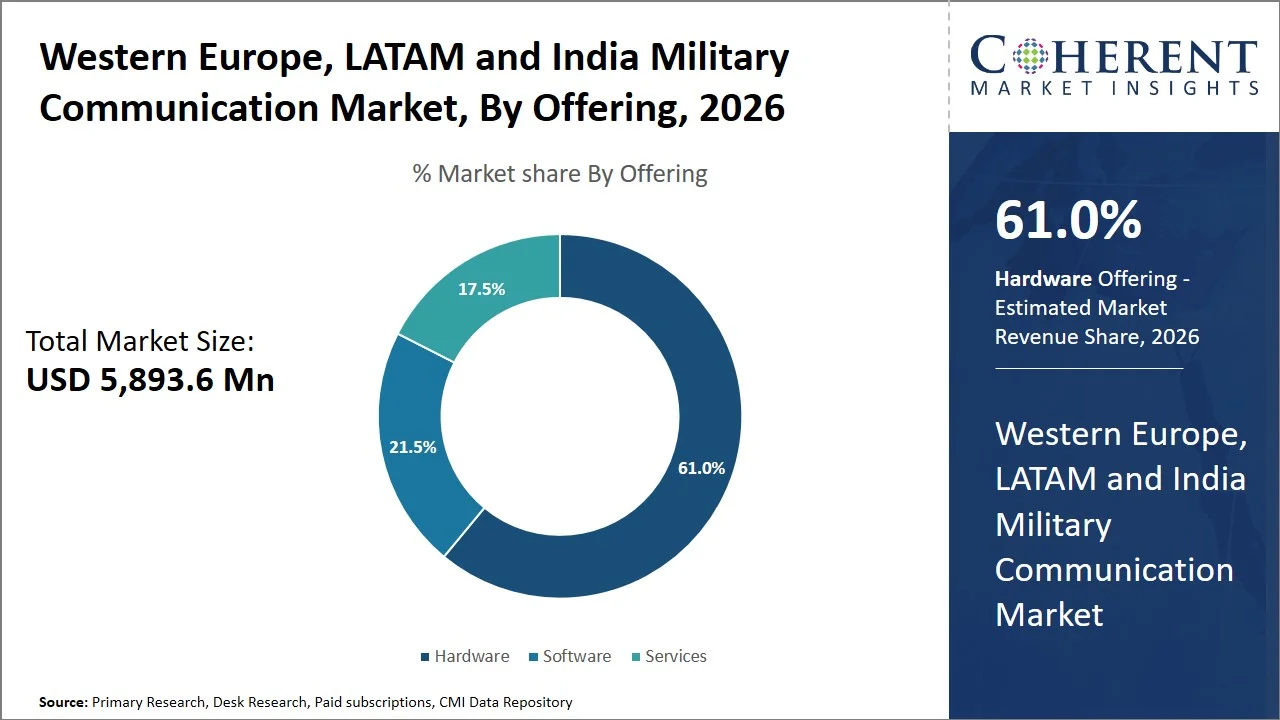
Why Does the Hardware Segment Dominate the Western Europe, LATAM and India Military Communication Market ?
The hardware segment is expected to account for 61.0% of the Western Europe, LATAM and India military communication market share in 2026. The growing integration of embedded communication hardware in battlefield equipment like armored vehicles, naval fleets, satellites and aircraft are major factors driving the growth of the segment. On January 14, 2025, NATO Secretary General, Mr. Mark Rutte co-hosted a Summit of Baltic Sea Allies, along with President Mr. Alexander Stubb of Finland and Prime Minister Mr. Kristen Michal of Estonia. At the meeting in Helsinki, Mr. Rutte announced the launch of a new military activity by NATO to strengthen the protection of critical infrastructure. “Baltic Sentry” will enhance NATO’s military presence in the Baltic Sea and improve Allies’ ability to respond to destabilizing acts. (Source: NATO)
- Current Industry Events of 2026
- Market Size Estimation
- Regional Breakdown
- Competitive Landscape
- Customer Intelligence
- Segmental Analysis
- Pricing Analysis
- Key Market Drivers, Challenges & Future Trends
- Customized Insights Section
Why is Data and File Transfer the Most Crucial Communication Mode?
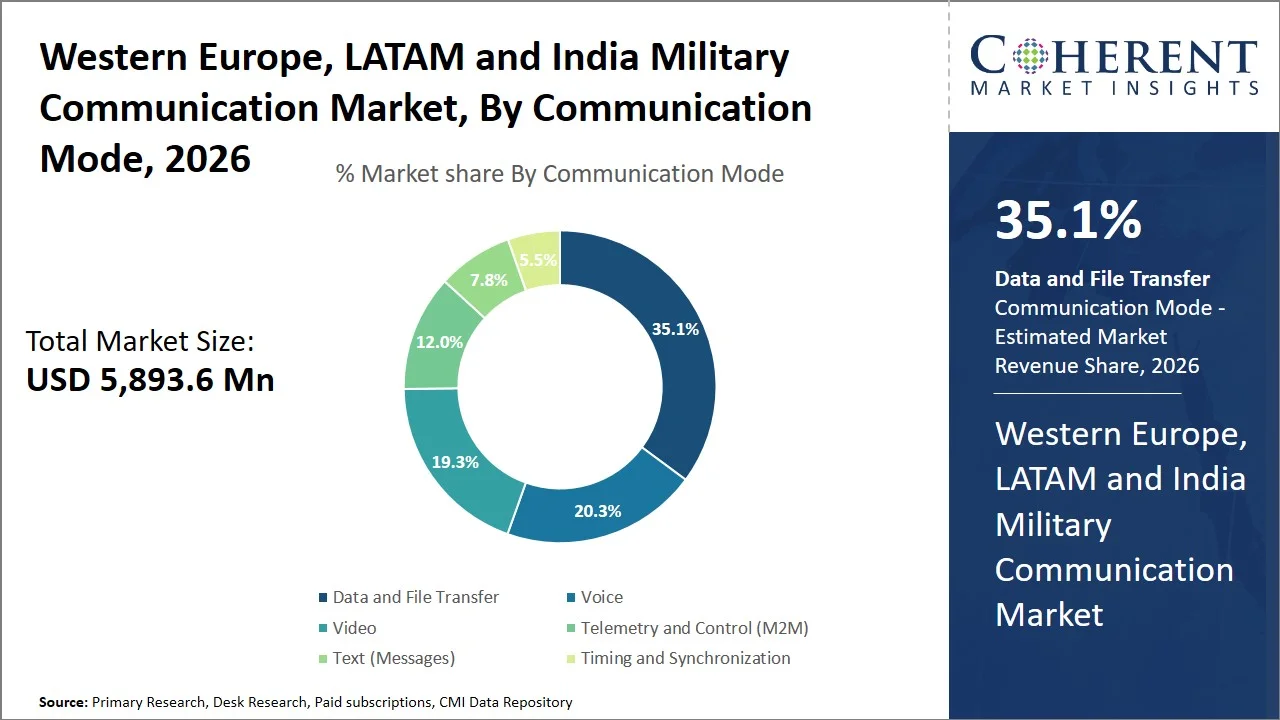
The data and file transfer segment is expected to account for 35.1% of the Western Europe, LATAM and India military communication market share in 2026. The need for secure bandwidth high-speed data transfer for sensor feeds, surveillance footage and navigation information is a key driver for the segmental growth. On February 6, 2025, Satellogic Inc entered into a multi-year agreement with the Brazilian Air Force (Força Aérea Brasileira, FAB) to provide low-latency satellite imagery for defense and security operations within the Brazilian territory. The contract, with an initial one-year term and one-year extension option, underscores Satellogic’s capabilities in delivering timely, mission-critical insights to defense customers. (Source: Satellogic)
Microwave SATCOM (L / S / C / X / Ku / Ka) Segment Dominates the Western Europe, LATAM and India Military Communication Market
The microwave SATCOM (L / S / C / X / Ku / Ka) segment is expected to account for 46.4% of the Western Europe, LATAM and India military communication market share in 2026. The ability of microwave SATCOM bands to support Beyond Line of Sight (BLOS) communication across remote borders, mountains and conflict zones are major factors driving the growth of the segment. On January 15, 2026, Bharat Sanchar Nigam Limited (BSNL) and Viasat, Inc, a global leader in satellite communications, announced they are supporting the next phase of the Indian Navy’s satellite communications upgrade program. Under an agreement signed between BSNL and the Indian Defense Forces, Viasat’s high-capacity Ka-band satellite systems will be used alongside its existing L-band infrastructure to deliver enhanced, resilient, and secure connectivity for Indian naval platforms. (Source: Viasat)
Currents Events and their Impact
Current Events | Description and its Impact |
India - Satellite Communication Regulatory Framework |
|
(Source: Indian Space Research Organization)
Western Europe, LATAM and India Military Communication Market Dynamics
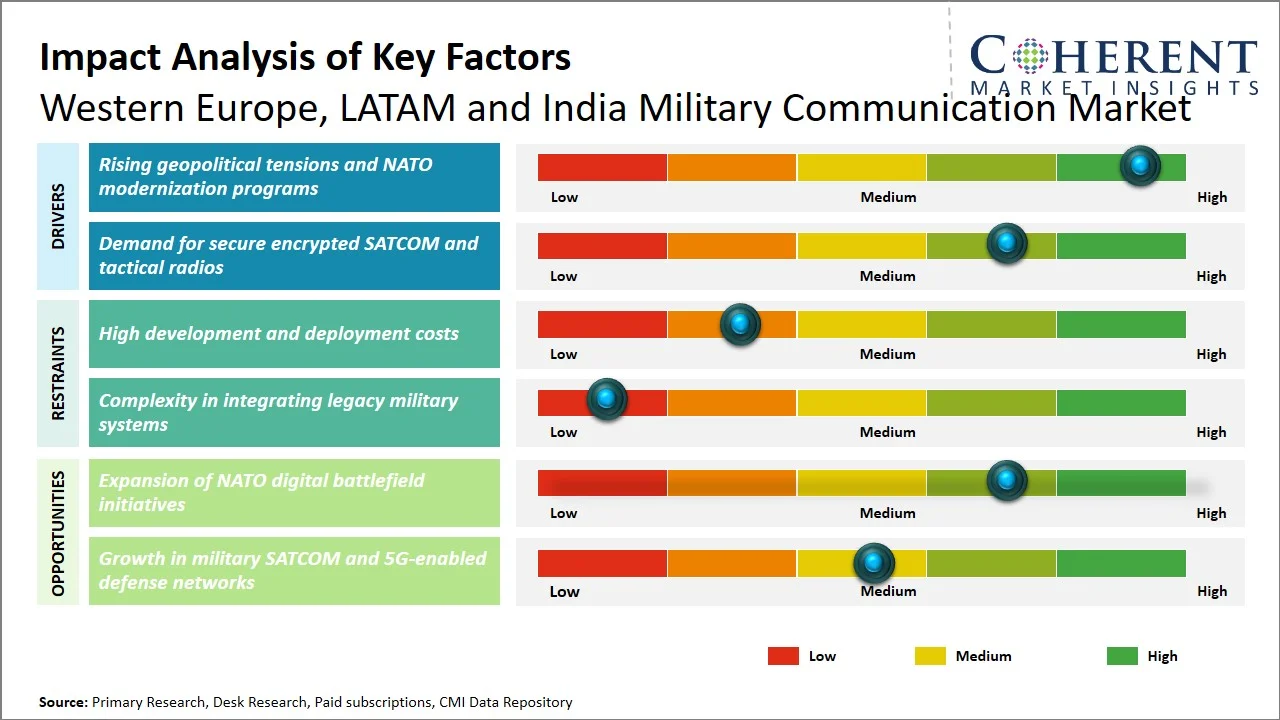
Market Drivers
- Rising geopolitical tensions and NATO modernization programs: Rising geopolitical tensions, particularly linked to the Russia-Ukraine conflict and broader security concerns along NATO’s eastern flank, are driving significant defense communication modernization across Europe. NATO member countries are accelerating investments in secure, interoperable, and resilient military communication systems to ensure real-time coordination across allied forces. On June 30, 2025, India announced plans to fast-track the launch of 52 dedicated satellites for the armed forces. It is also in the process of finalizing a comprehensive military space doctrine. Phase 3 of Space-Based Surveillance (SBS) programme, which was approved by the PM-led cabinet committee on security in October 2024, involves the construction and launch of 21 satellites by ISRO and 31 by three private companies. (Source: Times of India)
- Demand for secure encrypted SATCOM and tactical radios: Demand for secure encrypted SATCOM and tactical radios are rising sharply as modern militaries require highly reliable, jam-resistant, and interception-proof communication systems for battlefield coordination and remote operations. With increasing geopolitical tensions and the shift toward network-centric and multi-domain warfare, armed forces are prioritizing encrypted satellite links and advanced tactical radio systems to ensure secure voice, video, and data transmission across land, air, and naval platforms.
Emerging Trends
- Expansion of SATCOM and multi-orbit connectivity: Defense forces are increasingly using LEO/GEO satellite systems and microwave SATCOM bands to ensure secure, high-bandwidth Beyond Line-of Sight communication in remote and contested areas.
- Cybersecure and electronic warfare-resistant communication: Militaries are focusing on encrypted, anti-jamming, and cyber-resilient communication systems to protect critical battlefield networks from interception and disruption.
How is Expansion of NATO Digital Battlefield Initiatives Creating New Growth Opportunities in the Western Europe, LATAM and India Military Communication Market?
The expansion of NATO digital battlefield initiatives are accelerating demand for advanced military communication systems by promoting real-time, data-driven, and network-centric warfare capabilities across allied forces. In Western Europe, this is driving upgrades in secure SATCOM, tactical radios, and interoperable command-and-control networks to ensure seamless data sharing across NATO members. The spillover effect is influencing LATAM and India, where defense forces are adopting similar digital battlefield architectures to improve border surveillance, joint operations, and ISR data integration, creating new growth opportunities for encrypted communication systems, high-bandwidth data links, and multi-domain connectivity solutions. On December 5, 2025, NATO conducted its largest-ever cyber warfare drill in Tallinn, Estonia, simulating attacks on satellite systems, military communications, power grids and logistics systems. (Source: NATO)
Western Europe, LATAM and India Military Communication Market - Defense Communication Procurement Budgets by Country
Country | Total Defense Budget (Annual) | Procurement | Estimated Communication-Linked Procurement (C4ISR, SATCOM, Radios) |
Germany | ~USD 114 Bn | ~25–35% | ~USD 7–12 Bn |
France | ~USD 65–70 Bn | ~25–30% | ~USD 5–9 Bn |
U.K. | ~USD 89 Bn | ~30%+ | ~USD 6–10 Bn |
India | ~USD 78–92 Bn | ~20–25% | ~USD 10–18 Bn |
Brazil | ~USD 20–25 Bn | ~15–20% | ~USD 2–4 Bn |
Mexico | ~USD 15–18 Bn | ~10–15% | ~USD 1–2.5 Bn |
Market Players, Key Development, and Competitive Intelligence
Key Development
- On July 23, 2025, BlackSky Technology Inc. announced it has won a contract to provide immediate On-Demand subscription-based Gen-3 and Gen-2 monitoring services for Latin American defense and intelligence customers in the fight against transnational organized crime.
Competitive Landscape
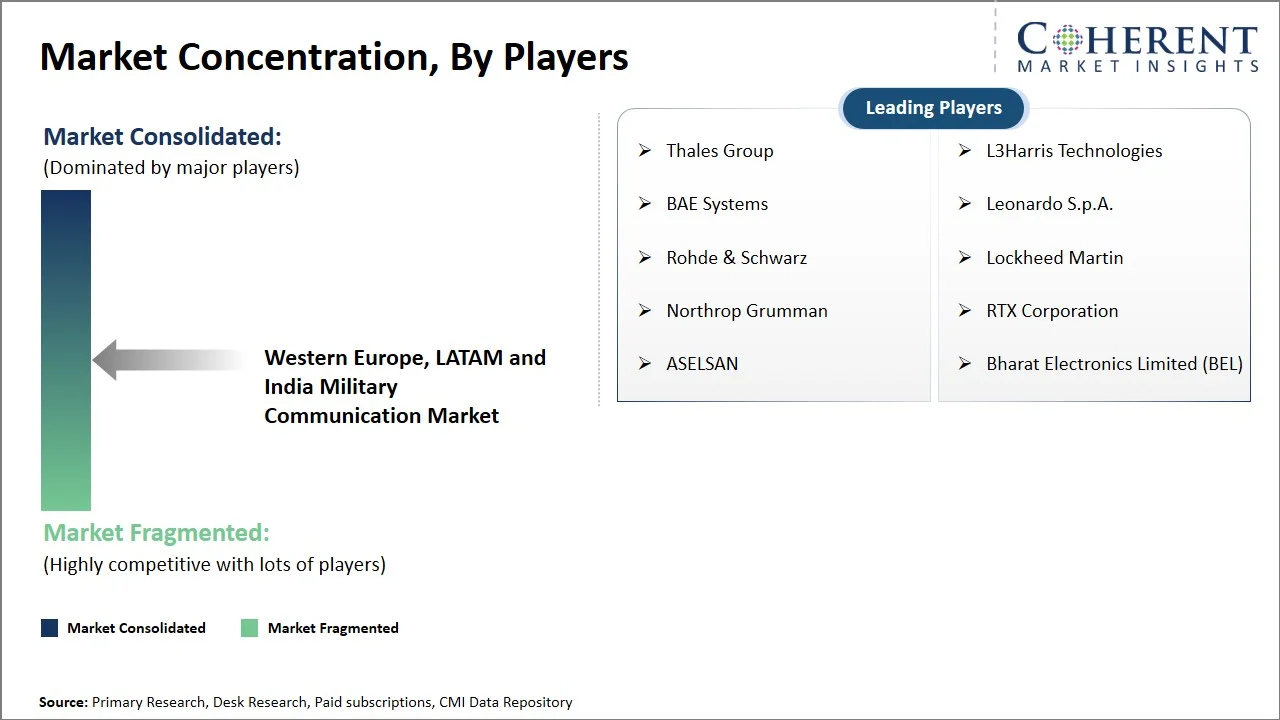
The military communication market in Western Europe, LATAM, and India is highly consolidated and dominated by global defense and aerospace majors such as BAE Systems, Thales Group, Airbus, Lockheed Martin, Northrop Grumman, RTX Corporation, and regional specialists like ASELSAN and Elbit Systems. These players compete primarily on secure SATCOM, software-defined radios (SDRs), encrypted tactical communication systems, and integrated command-and-control platforms.
Market Report Scope
Western Europe, LATAM and India Military Communication Market Report Coverage
| Report Coverage | Details | ||
|---|---|---|---|
| Base Year: | 2025 | Market Size in 2026: | USD 5,893.6 Mn |
| Historical Data for: | 2020 To 2024 | Forecast Period: | 2026 To 2033 |
| Forecast Period 2026 to 2033 CAGR: | 7% | 2033 Value Projection: | USD 9,450.8 Mn |
| Segments covered: |
| ||
| Companies covered: | Thales Group, L3Harris Technologies, BAE Systems, Leonardo S.p.A., Rohde & Schwarz, Lockheed Martin, Northrop Grumman, RTX Corporation, ASELSAN, and Bharat Electronics Limited (BEL) | ||
| Growth Drivers: |
| ||
| Restraints & Challenges: |
| ||
Analyst Opinion (Expert Opinion)
- The Western Europe, LATAM and India military communication market is transitioning from hardware-centric communication systems to data-centric, networked, and space-enabled battlefield communication ecosystems. The strongest growth drivers are rising geopolitical tensions, rapid digitization of defense forces, and the increasing importance of real-time ISR (intelligence, surveillance, reconnaissance) data sharing across land, air, sea, and space domains. Europe is seen as the most mature but fastest-modernizing region due to NATO-led digital battlefield initiatives, while India is considered a high-growth market driven by border security needs and indigenous defense programs.
- The future of the military communication market in Western Europe, LATAM and India is expected to be defined by deep integration of SATCOM (especially LEO constellations), AI-enabled battlefield networking, and fully interoperable multi-domain command systems. Demand will increasingly shift toward secure, high-bandwidth, low-latency communication infrastructure capable of supporting drone swarms, autonomous systems, and real-time satellite imagery transfer. Western Europe will continue leading NATO-driven digital battlefield transformation, India will expand rapidly through indigenous defense modernization and space-based communication programs, and LATAM will see gradual adoption focused on security surveillance and border intelligence.
Speak to the analyst
Want personalized insights?
Take the findings above to one of our principal consultants, or have the report rebuilt around the segments, geographies and competitors you actually track.
Market Segmentation
- Offering Insights (Revenue, USD Million, 2021 - 2033)
- Hardware
- Tactical Radios
- SATCOM Terminals
- Antennas
- Backhaul and Relay Equipment
- Others (Routers, Modems, Multi-bearer Gateways)
- Software
- Waveform and Radio Apps (SDR)
- MANET Routing and Tactical IP Stack
- Multi-bearer Link and Session Control
- Network Management and Orchestration
- Cybersecurity Monitoring and Endpoint or Network Protection
- Crypto and Key Management
- Others (Interoperability Gateways and Protocol Translation, QoS and Traffic Policy Management, etc.)
- Services
- Professional Services
- Managed Services
- Hardware
- Communication Mode Insights (Revenue, USD Million, 2021 - 2033)
- Data and File Transfer
- Voice
- Video
- Telemetry and Control (M2M)
- Text (Messages)
- Timing and Synchronization
- Frequency Band Insights (Revenue, USD Million, 2021 - 2033)
- Low Frequency (VLF / LF / HF)
- Tactical RF (VHF / UHF)
- Microwave SATCOM (L / S / C / X / Ku / Ka)
- EHF / mmWave
- Procurement Authority Insights (Revenue, USD Million, 2021 - 2033)
- MoD and National Defense Acquisition Agency
- Service Procurement (Army, Navy, Air Force, Marines)
- Joint and Strategic C4I Procurement
- Defense Intelligence and ISR Procurement
- Cyber and Signals Procurement
- Border and Paramilitary Procurement
- Key Players Insights
- Thales Group
- L3Harris Technologies
- BAE Systems
- Leonardo S.p.A.
- Rohde & Schwarz
- Lockheed Martin
- Northrop Grumman
- RTX Corporation
- ASELSAN
- Bharat Electronics Limited (BEL)
Sources
Primary Research Interviews
- Defense contractors and equipment manufacturers
- Military communication system integrators
- Government defense procurement officials
- Military technology consultants
Magazines
- Defense News
- Military & Aerospace Electronics
- C4ISRNET
- Defense Technology Review
Journals
- IEEE Military Communications Conference Proceedings
- International Defense Review
- Military Technology Journal
Associations
- European Defense Agency (EDA)
- Association of the United States Army (AUSA)
- International Association of Defense Counsel (IADC)
- Military Communications and Electronics Association (AFCEA)
Public Domain Sources
- Government defense ministry websites and publications
- NATO Allied Command Transformation reports
- UN Office for Disarmament Affairs publications
- Congressional Research Service reports
Proprietary Elements
- CMI Data Analytics Tool
- Proprietary CMI Existing Repository of information for last 10 years
Get access to 250+ pages report
Every segment, forecast, competitor profile and data table behind the analysis above — available for instant download.
- ESOMAR Member
- ISO 9001:2015 Certified
- D-U-N-S Registered
- GDPR & CCPA Compliant
Missing comfort of reading report in your local language? Find your preferred language:
Transform your Strategy with Exclusive Trending Reports
Frequently Asked Questions
The Western Europe, LATAM and India military communication market is expected to stand at USD 5,893.6 Mn in 2026 and is expected to reach USD 9,450.8 Mn by 2033.
The CAGR of the Western Europe, LATAM and India military communication market is projected to be 7% from 2026 to 2033.
Rising geopolitical tensions and NATO modernization programs and demand for secure encrypted SATCOM and tactical radios are the major factors driving the growth of the Western Europe, LATAM and India military communication market.
High development and deployment costs and complexity in integrating legacy military systems are the major factors hampering the growth of the Western Europe, LATAM and India military communication market.
In terms of offering, the hardware segment is estimated to dominate the market revenue share in 2026.
SDRs are flexible radio systems that can be reprogrammed to support multiple frequencies and communication standards.
Beyond Line of Sight (BLOS) is a communication that works over long distances using satellites or relays instead of direct radio links.