

Global Wine Packaging Market Size and Forecast – 2026 to 2033
According to Coherent Market Insights, the global wine packaging market is estimated to be valued at USD 7.34 Bn in 2026 and is expected to reach USD 9.88 Bn by 2033, expanding at a compound annual growth rate (CAGR) of 4.34% from 2026 to 2033.
Key Takeaways of the Wine Packaging Market
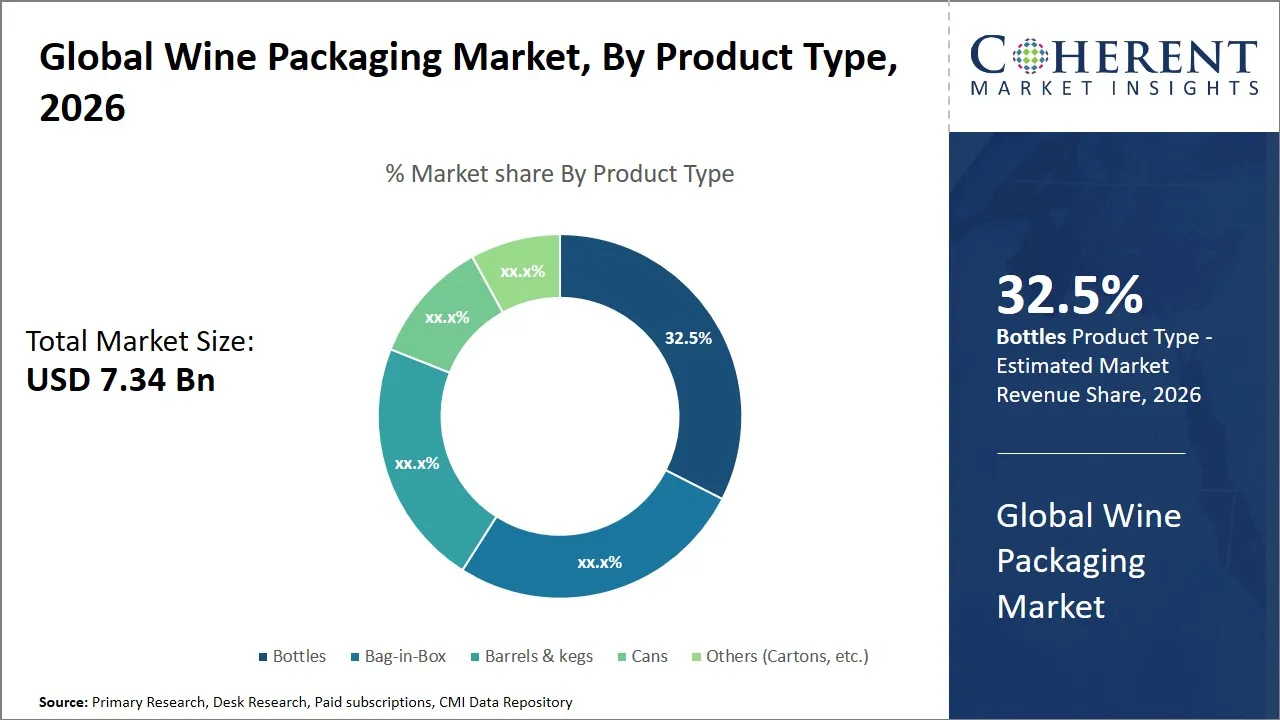
- The bottles segment is expected to account for 32.5% of the market share in 2026.
- The plastic segment is projected to capture 38.7% of the global wine packaging market in 2026.
- The primary segment is expected to represent 59.7% of the wine packaging market share in 2026.
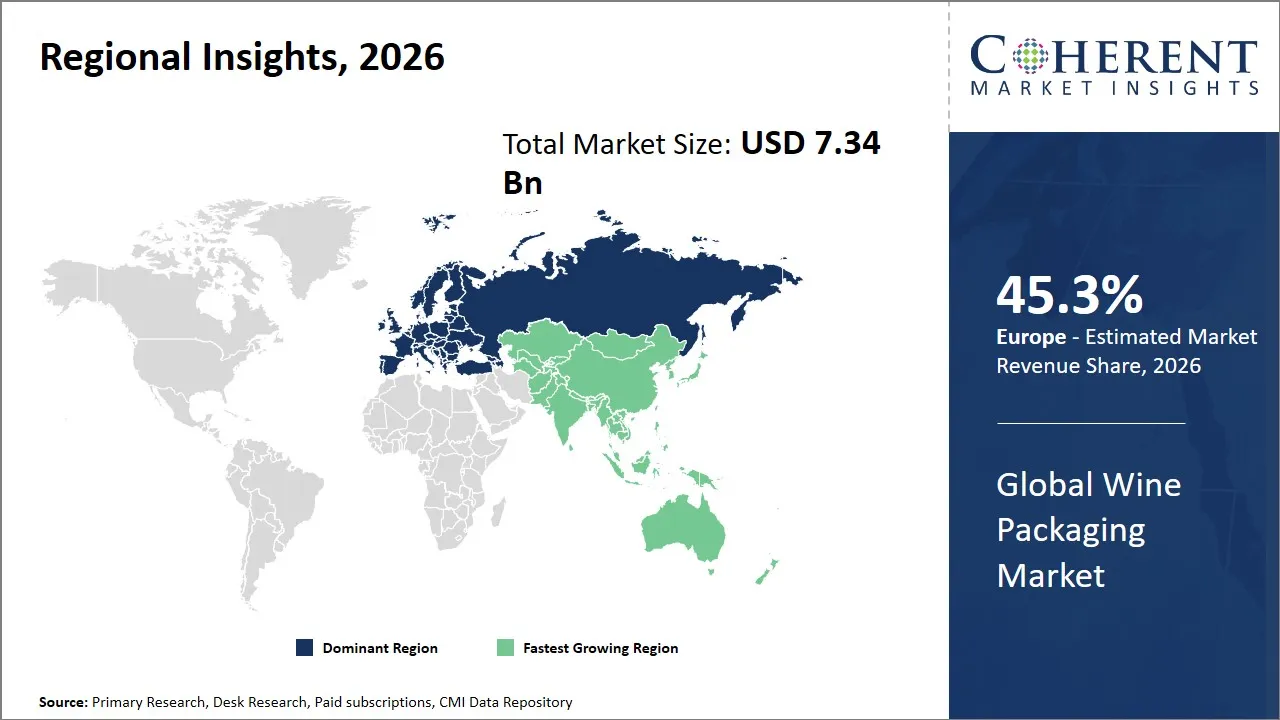
- Europe will dominate the wine packaging market in 2026 with an estimated 45.3% share.
- The Asia Pacific will hold 18.3% share in 2026 and record the fastest growth.
Market Overview
- Current market trends highlight a significant shift towards eco-friendly and recyclable packaging materials as consumers and regulatory bodies prioritize sustainability.
- Additionally, premiumization in wine packaging with enhanced design and functionality is gaining traction to attract discerning buyers.
- Technological advancements such as smart packaging, next generation packaging, including QR codes and NFC tags for product authentication and traceability, are also shaping the future landscape of the wine packaging market, enhancing consumer engagement and brand loyalty.
Currents Events and Its Impacts
Current Events | Description and its Impact |
Sustainability & Alternative Packaging Adoption |
|
Growth of Alternative Formats & Flexible Packaging Trends |
|
Segmental Insights
- Current Industry Events of 2026
- Market Size Estimation
- Regional Breakdown
- Competitive Landscape
- Customer Intelligence
- Segmental Analysis
- Pricing Analysis
- Key Market Drivers, Challenges & Future Trends
- Customized Insights Section
Why Does the Bottles Segment Dominate the Global Wine Packaging Market in 2026?
Bottles segment is expected to hold 32.5% of the global wine packaging market share in 2026, due to their deep-rooted association with wine culture and consumption habits. Glass bottles more specifically have formed the backbone of the wine packaging over centuries as the brand has been associated with quality, heritage and authenticity. Consumers tend to equate the bottled wine with high quality craftsmanship and this makes bottles a stronger packaging format both to the producers and consumers. The feel and the sight of the bottles add to the brand experience and they are irreplaceable in a market where differentiation is central.
For example, bottles' role in enhancing brand identity is Château Margaux, one of the most prestigious wineries in Bordeaux. The distinct bottle design with its intricate label and elegant shape is a key factor in the brand's positioning as a premium wine, attracting loyal customers who value the sensory experience of its packaging.
Why is Plastic the Leading Choice for Wine Packaging Solutions?
Plastic segment is projected to hold 38.7% of the wine packaging market share in 2026, driven by its versatility, light weight, and cost-effective nature. Plastic packaging solutions have caught a lot of fame and particularly, as the wine industry meets the evolving consumer lifestyle in the market, which values convenience, portability, and affordability. Plastic materials also offer a competitive edge to producers who prioritize the efficiency and sustainability attributes of their products unlike heavier glass and are cheaper to transport and less carbon-intensive in terms of logistics.
The flexibility of plastics in terms of the ability to mold into a wide variety of shapes and sizes makes it very versatile to the new packaging designs such as flexible pouches and lightweight bottles. Such forms of packaging are very appealing to the younger generation and casual wine drinkers who want to be able to drink the products on the go without reducing their freshness. Moreover, when applied along with multilayer technologies, plastics can strictly control the moisture and oxygen content and contribute to the shelf life of ready-to-drink wine and more affordable products.
Primary Segment Dominates the Global Wine Packaging Market
Primary segment is projected to hold 59.7% of the wine packaging market share in 2026, reflecting its fundamental role in containing and protecting the wine product. Primary packaging is defined as the immediate container which is directly in contact with the wine, these are bottles, cans or pouches. This part is essential because it will maintain the quality of wine by ensuring that it is not exposed to the outside world such as oxygen, light and other physical damages that deteriorate the taste and personality of the wines.
Primary packaging is not just important in preservation, but this is the main channel of communication with the brand and consumer interaction. The labels, the shape of bottles, the way they are closed and the surface finishing are some of the details that play a role in communicating the identity of the wines, its heritage and its quality status. Powerful graphics and physical appearances on primary packaging will impact on buying decisions made at retail outlets and also assist in the perceived value of product that will help the wineries to price their products at a premium price.
Regional Insights
Europe Wine Packaging Market Analysis and Trends
The Europe region is projected to lead the market with a 45.3% share in 2026, driven by the fact that the regions have a deep-rooted wine culture, well established wine-making production environments, and advanced packaging technologies. France, Italy and Spain are countries with hundreds of years of long history of viticulture, which contributes to the presence of a well-developed and well-integrated wine packaging sector.
Euro-regulations such as the high quality and sustainability measures promote the development of environmental and high-quality packaging. Moreover, Europe is home to numerous major manufacturers of packaging such as Consol Glass and Vetropack that offer high-tech glass bottles, closures, and smart packaging solution. The availability of established distribution channels and trade agreements within the EU also makes it easy to market their products and services throughout the member countries and this makes Europe’s leading role in the market.
Asia Pacific Wine Packaging Market Analysis and Trends
The Asia Pacific region is expected to exhibit the fastest growth in the market contributing 18.3% share in 2026, due to the growth in the number of wine consumers, growth in disposable incomes and change in consumer preference to the high quality and attractive look of packaging. In developing economies, like China, India and Southeast Asian nations, branded wine retails have experienced tremendous growth and this has led to increased interest in such innovative packaging as lightweight bottles, Tetra Paks and sustainable solutions.
The capabilities in the packaging industry have accelerated due to government efforts to strengthen local production and better infrastructure. The major firms, such as Chinas Anhui Gujing Distillery and Japan Asahi Glass Co., are increasing their presence, with the presentation of the cutting-edge of packaging materials and technologies that meet the preferences and logistics requirements of the area.
Global Wine Packaging Market Outlook for Key Countries
France Wine Packaging Market Trends
The France wine packaging market continues to lead Europe with its strong emphasis on premium wine production and packaging craftsmanship. Respected companies like Verallia and Oeneo play a large role in producing advanced glass bottles, cork toppings and ornamental packaging solutions that focus on tradition and luxury. The concern with the environmentally friendly packaging contributes to the innovation of the lightweight glass and biodegradable material, which further influence the market orientation in the country.
What Drives Growth in Italy’s Wine Packaging Market?
The wine packaging market of Italy is flourishing due to the inclusion of a wide range of wine in the country, and the presence of the artisanal producers who focus on the aesthetics and functional packaging. Such enterprises as Bormioli Luigi and Sacmi have critical roles to play in the supply of glass containers of high quality and sophisticated closing systems. The trade-driven strategic position of Italy that is enhanced by export-driven policies and cooperation within the EU facilitates the sustained market development and innovation.
Is China the Next Growth Hub for the Wine Packaging Market?
The wine packaging market in China is growing at a high rate due to growing urbanization as well as growing demands among consumers to have high quality imported wines. The local and multinational companies adjust themselves to the Chinese tastes, where they prefer premiumization and gifting, and use ornate bottle decoration and elaborate labeling methods. Organizations like Anhui Gujing Distillery and China Glass Holdings have been keen on researching packaging materials that are related to the manufacturing capabilities of the country and export/ import laws.
U.S. Wine Packaging Market Trends
The wine packaging market in the U.S. represents the combination of conservative and innovative tendencies, where the emphasis is made on sustainability and convenience. The significant companies, such as Owens-Illinois and Ball Corporation, help to produce the lightweight glass bottles and other forms of packaging, cans, and PET bottles. The state focus on the use of environmentally friendly packaging and recycling projects significantly influences the production decisions. The large retail environment in the USs direct-to-consumer sale promotes flexible packaging and creativity in design.
Australia Wine Packaging Market Trends
The wine packaging market in Australia is an advantage in that it has a well-established wine production industry both in terms of quality and export orientation. Environmental policies and consumer awareness have led to high demand of sustainable solution in packaging. Such firms as O-I Australia and Orora play a central role, finding themselves engaged in glass packaging that can be recycled and novel closures. The market is further fueled by the fact that the country is close to major Asia Pacific markets which increase the chances of exports.
Cost per Bottle Across Packaging Options
Packaging Option | Material | Cost per Bottle (USD) | Key Characteristics |
Glass Bottles | Glass | USD 1.50 | Classic, premium look, durable |
Plastic Bottles | PET (Plastic) | USD 0.50 | Lightweight, cost-effective, easy to ship |
Bag-in-Box | Flexible Plastic | USD 0.30 | Convenient, minimal waste, volume option |
Market Players, Key Development, and Competitive Intelligence
Key Developments
- In May 2025, Ball reported 2.6% shipment growth and reaffirmed double-digit EPS guidance, underlining aluminum’s momentum in the wine packaging market.
- In May 2025, Smurfit Westrock posted USD 7,656 million Q1 sales and added converting plants while closing 500,000 tons of paper capacity to streamline operations.
- In April 2025, FitVine introduced resealable aluminum bottles for active consumers, extending premium positioning beyond glass.
- In February 2025, ProMach launched a Wine & Spirits Solutions Group to integrate packaging lines for D-to-C efficiency.
- In September 2024, ProMach Inc., a worldwide leader in processing and packaging solutions, announces the launch of its Wine & Spirits Solutions group that will provide a complete portfolio of process, equipment, and systems integration solutions for the wine and spirits industry.
Top Strategies Followed by Global Wine Packaging Market Players
Player Type | Strategic Focus | Example |
Established Market Leaders | Heavy investment in R&D and innovation | For example, Owens-Illinois, in an example, has poured a lot of money in sustainable packaging solutions. The company has also launched light glass bottles which have lowered carbon emission and improved efficiency in transporting goods which meet the need of sustainable solutions in wine packaging. |
Mid-Level Players | Cost-effective solutions with balanced quality | Vidrio Formas company is a Mexican based company that focuses on the wine industry in terms of glass packaging. Vidrio Formas provides Latin American consumers that are price-sensitive with modified glass bottles, which are cheaper than other premium counterparts. They also offer such solutions as wine closures that will offer a balance between quality and price. |
Small-Scale Players | Niche specialization & innovative variants | For instance, Green Bottle in this case, the company is based in the U.K., and it sells biodegradable wine bottles that are produced using a special algae starch. It targets the consumers of green wine products who are conscious of the environment and want the sustainability of the whole production process to be incorporated in the packaging as well. |
Market Report Scope
Wine Packaging Market Report Coverage
| Report Coverage | Details | ||
|---|---|---|---|
| Base Year: | 2025 | Market Size in 2026: | USD 7.34 Bn |
| Historical Data for: | 2020 To 2024 | Forecast Period: | 2025 To 2032 |
| Forecast Period 2026 to 2033 CAGR: | 4.34% | 2033 Value Projection: | USD 9.88 Bn |
| Geographies covered: |
| ||
| Segments covered: |
| ||
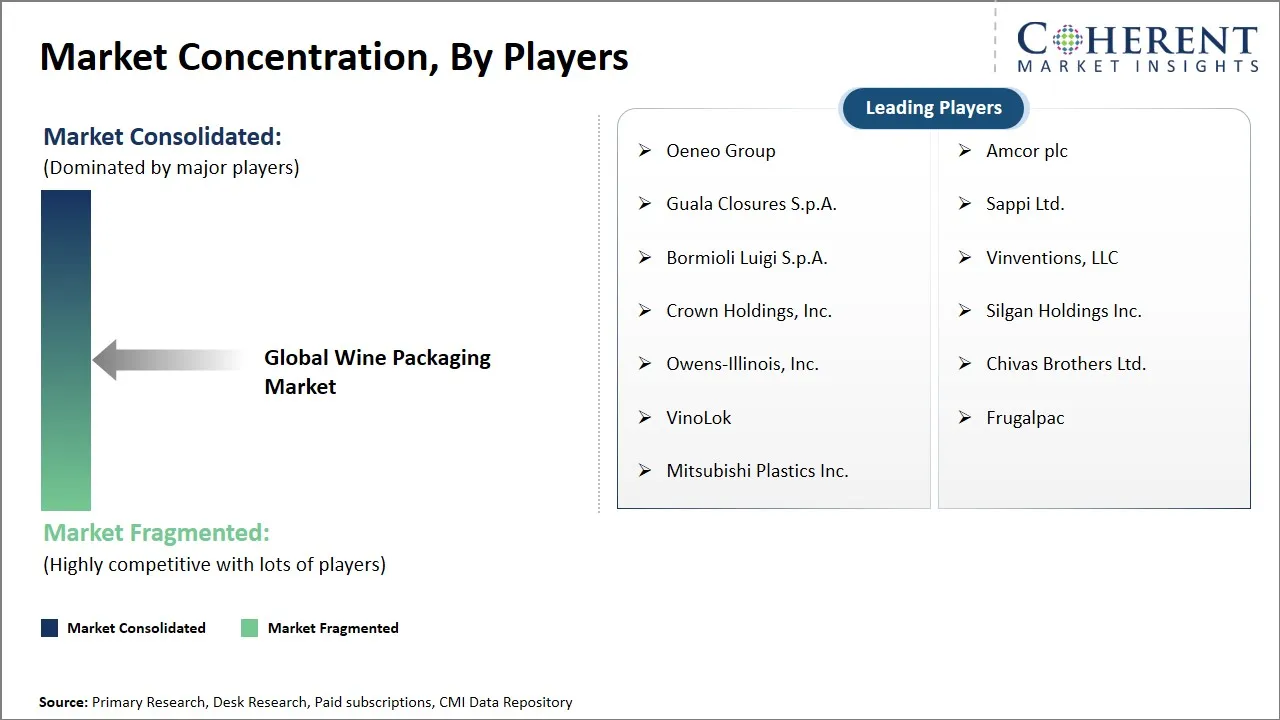
| Companies covered: | Oeneo Group, Amcor plc, Guala Closures S.p.A., Sappi Ltd., Bormioli Luigi S.p.A., Vinventions, LLC, Crown Holdings, Inc., Silgan Holdings Inc., Owens-Illinois, Inc., Chivas Brothers Ltd., VinoLok, Frugalpac, and Mitsubishi Plastics Inc. | ||
| Growth Drivers: |
| ||
| Restraints & Challenges: |
| ||
Wine Packaging Market Dynamics
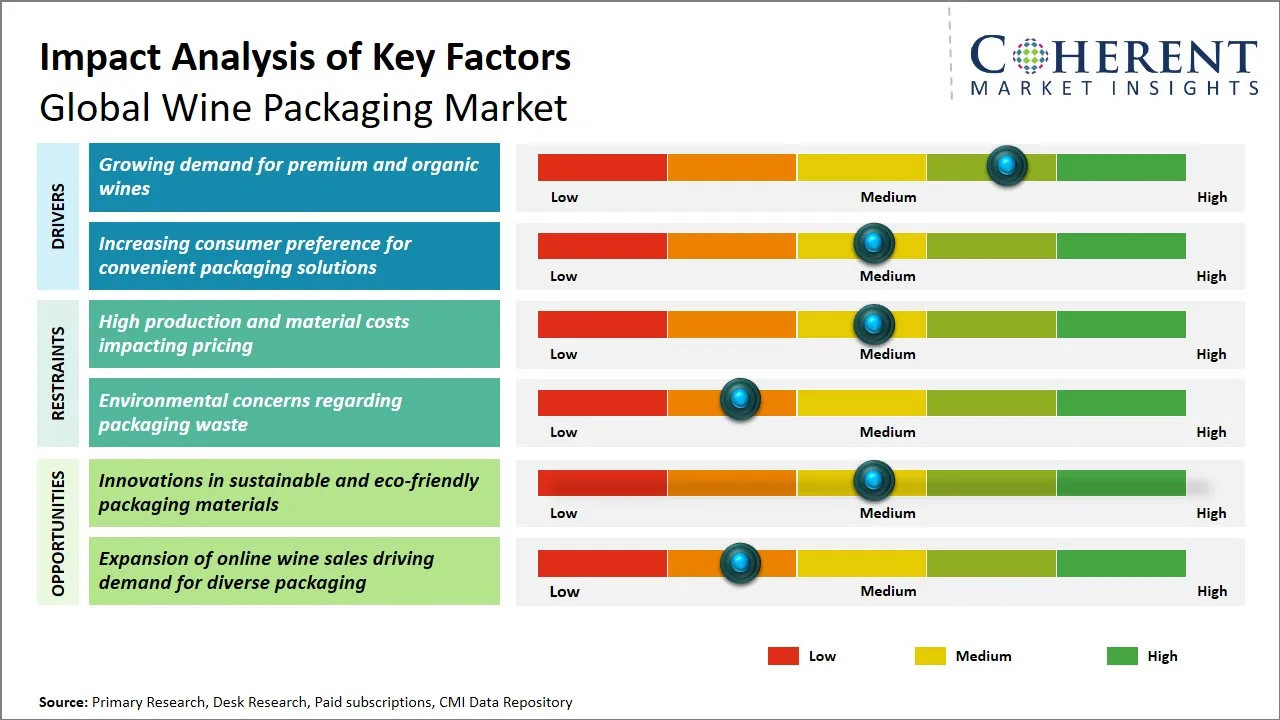
Wine Packaging Market Driver - Growing Demand for Premium and Organic Wines
Growing consumer preference towards high-end wines and organic wines is an important factor in the dynamics of the wine packaging market in the world. Since refined consumers are becoming more demanding in quality, authenticity, and sustainability in their wines, wineries have a reason to invest in the packaging solution that not only helps preserve the integrity of the wines, but also adds value to the perceived value of the same on the shelf. High end wines may need fancy packaging, which communicates the sense of luxury, such as fancy glass bottles with detailed embossing, non-cork preservation, high-end labels crafted of textured or environmentally friendly materials.
For example, the wineries in Napa Valley such as Stags Leap Wine Cellars are integrating advanced packaging, with embossed bottles, cork substitutes, and high quality labelling. They aim at preserving the environment and sustainability and provide a visual experience that builds up the perceived value of the wine.
Wine Packaging Market Opportunity - Innovations in Sustainable and Eco-Friendly Packaging Materials
The global wine packaging market is witnessing a significant opportunity driven by the growing demand for sustainable and eco-friendly packaging solutions. The rise in environmental consciousness among consumers, as well as strict laws governing the use and use of plastics has compelled wine producers and wine packaging companies to be innovative, and resort to the use of greener alternatives. Emerging technologies of biodegradable plastics materials, recycled glass, thin-weight glasses and plant-based plastics are taking shape, presenting both environmental and financial advantages over traditional packaging. Besides minimizing carbon footprints, these developments also support brand image, as they go hand in hand with the values of the eco-conscious consumers.
For example, Concha y Toros Eco-Friendly Initiative: Concha y Toro, who has become one of the largest wine producers in Chile, launched the Casillero del Diablo wine in Eco-friendly packaging (made of 100 percent recycled glass). Not only did this innovation cut down on the carbon emissions but they were also able to serve the increasing market demand of products that were sustainable.
Analyst Opinion (Expert Opinion)
- Wine packaging market is witnessing a significant trend of growth and this has been as a result of the changing consumer taste towards sustainability and the availability of new designs of the packaging that improve user experience. The Global Wine Packaging Conference (2023) and the International Wine and Spirits Expo (2022) have provided insights into the latest developments, with the companies such as Owens-Illinois and Amcor being the first ones to develop sustainable packaging options.
- The recent introduction of lightweight glass bottles by Owens-Illinois is an indication that the industry is taking the right step to minimize carbon footprints without jeopardizing the integrity of its products. Conferencing on these events focused on the growing use of alternative packaging, including bag-in-box and aluminum cans, which appeal to the younger generation who need convenience and portability.
- The issues like consumer unwillingness to alter the conventional view of wine and packaging security were often mentioned when it came to the obstacles toward wider acceptance. The companies that succeed to teach consumers the advantages of new packaging and invest in the design that is easy to use are likely to gain the market share.
Speak to the analyst
Want personalized insights?
Take the findings above to one of our principal consultants, or have the report rebuilt around the segments, geographies and competitors you actually track.
Market Segmentation
- Product Type Insights (Revenue, USD Bn, 2021 - 2033)
- Bottles
- Bag-in-Box
- Barrels & kegs
- Cans
- Others (Cartons, etc.)
- Material Insights (Revenue, USD Bn, 2021 - 2033)
- Plastic
- Glass
- Paper & Paperboard
- Others
- Packaging Type Insights (Revenue, USD Bn, 2021 - 2033)
- Primary
- Secondary
- Regional Insights (Revenue, USD Bn, 2021 - 2033)
- North America
- U.S.
- Canada
- Latin America
- Brazil
- Argentina
- Mexico
- Rest of Latin America
- Europe
- Germany
- U.K.
- Spain
- France
- Italy
- Russia
- Rest of Europe
- Asia Pacific
- China
- India
- Japan
- Australia
- South Korea
- ASEAN
- Rest of Asia Pacific
- Middle East
- GCC Countries
- Israel
- Rest of Middle East
- Africa
- South Africa
- North Africa
- Central Africa
- North America
- Key Players Insights
- Oeneo Group
- Amcor plc
- Guala Closures S.p.A.
- Sappi Ltd.
- Bormioli Luigi S.p.A.
- Vinventions, LLC
- Crown Holdings, Inc.
- Silgan Holdings Inc.
- Owens-Illinois, Inc.
- Chivas Brothers Ltd.
- VinoLok
- Frugalpac
- Mitsubishi Plastics Inc.
Sources
Primary Research Interviews
- CEO – Leading Wine Bottle Manufacturer (e.g., O-I Glass or Verallia equivalent)
- Supply Chain Director – Major Wine Packaging Distributor
- Production Lead – Specialty Wine Closures and Cork Producer
- Sustainability Officer – Wine Packaging Certification Authority
Stakeholders
- Manufacturers
- End-use Sectors
- Wine Producers (Still Wine, Sparkling Wine)
- Beverage Distributors
- Retail and E-commerce Platforms (e.g., Vivino, Wine.com)
- Regulatory & Certification Bodies (e.g., TTB for wine packaging, FDA food contact materials, EU packaging directives)
- E-commerce Platforms and Retailers (Amazon, Total Wine, Specialist Wine Merchants)
- Technology Integration Players: Sustainable packaging innovators (e.g., bag-in-box, can producers)
Databases
- UN Comtrade Database (HS 2204 for wine, packaging materials)
- India Import Export (EXIM) Database (wine packaging imports)
- Eurostat Trade Statistics for Beverages and Packaging
- USITC DataWeb (wine and packaging trade)
- Global Trade Atlas for Wine Packaging
Magazines
- Packaging Digest – Trends in wine packaging innovations
- The Drinks Business – Wine packaging sustainability
- Wine Business International – Packaging market dynamics
- Market Watch Magazine – Alternative wine packaging
- Beverage Industry – Wine sector packaging trends
Journals
- Journal of Wine Research – Packaging impact on wine quality
- Packaging Technology and Science – Sustainable wine packaging materials
- Sustainability – Wine industry packaging trends
- Resources, Conservation and Recycling – Wine packaging lifecycle analysis
- Food Packaging and Shelf Life – Wine closure technologies
Newspapers
- The Wall Street Journal – Global wine market packaging demand
- Decanter – Sustainability in wine packaging
- The Guardian – Eco-friendly alternatives in wine industry
- Business Standard (India) – Wine imports and packaging growth
- Reuters – Wine packaging supply chain disruptions
Associations
- Alternative Packaging Alliance (APA)
- Wine Institute
- Glass Packaging Institute
- International Wine & Spirits Packaging Association
- European Federation of Cork Manufacturers (APCOR)
- Sustainable Winegrowing Organizations (e.g., Australian Grape & Wine)
Public Domain Sources
- TTB – Guidelines for wine packaging and labeling
- FDA – Food contact regulations for wine packaging materials
- European Commission – Packaging and Packaging Waste Directive
- WHO – Safety standards for beverage packaging
Proprietary Elements
- CMI Data Analytics Tool
- Proprietary CMI Existing Repository of information for last 8 years.
Get access to 250+ pages report
Every segment, forecast, competitor profile and data table behind the analysis above — available for instant download.
- ESOMAR Member
- ISO 9001:2015 Certified
- D-U-N-S Registered
- GDPR & CCPA Compliant
Missing comfort of reading report in your local language? Find your preferred language:
Transform your Strategy with Exclusive Trending Reports
Frequently Asked Questions
The global wine packaging market is estimated to be valued at USD 7.34 Bn in 2026 and is expected to reach USD 9.88 Bn by 2033.
Innovations include the use of alternative packaging formats such as bag-in-box, Tetra Pak, and environmentally friendly labels, as well as the introduction of smart packaging with QR codes and interactive elements.
Technology plays a role in improving the functionality and sustainability of wine packaging, such as enhancing packaging material strength, developing digital labels, and implementing automated bottling and labeling processes.
The CAGR of global wine packaging market is projected to be 4.34% from 2026 to 2033.
Growing demand for premium and organic wines and increasing consumer preference for convenient packaging solutions are the major factors driving the growth of the global wine packaging market.
High production and material costs impacting pricing and environmental concerns regarding packaging waste are the major factors hampering the growth of the global wine packaging market.
In terms of product type, bottles are estimated to dominate the market revenue share in 2026.