

Acidity Regulators Market Size and Forecast — 2026 - 2033
The Global Acidity Regulators Market size is estimated to be valued at USD 6.8 billion in 2026 and is projected to reach USD 11.4 billion by 2033, growing at a compound annual growth rate (CAGR) of 8.0% from 2026 to 2033.
Overview
Key drivers of the acidity regulators market include increasing demand for processed and packaged foods, rising consumption of ready-to-eat meals, and growing beverage industry expansion. Urbanization and busy lifestyles are boosting reliance on convenient food products with longer shelf life and stable flavor. Heightened awareness of food safety and stricter regulatory standards are encouraging the use of approved acidity regulators. Additionally, growth in pharmaceuticals and personal care applications, where pH control is essential, is supporting market expansion. Technological advancements in food processing and increasing global trade of packaged goods further contribute to sustained demand across emerging and developed economies globally.
Key Takeaways
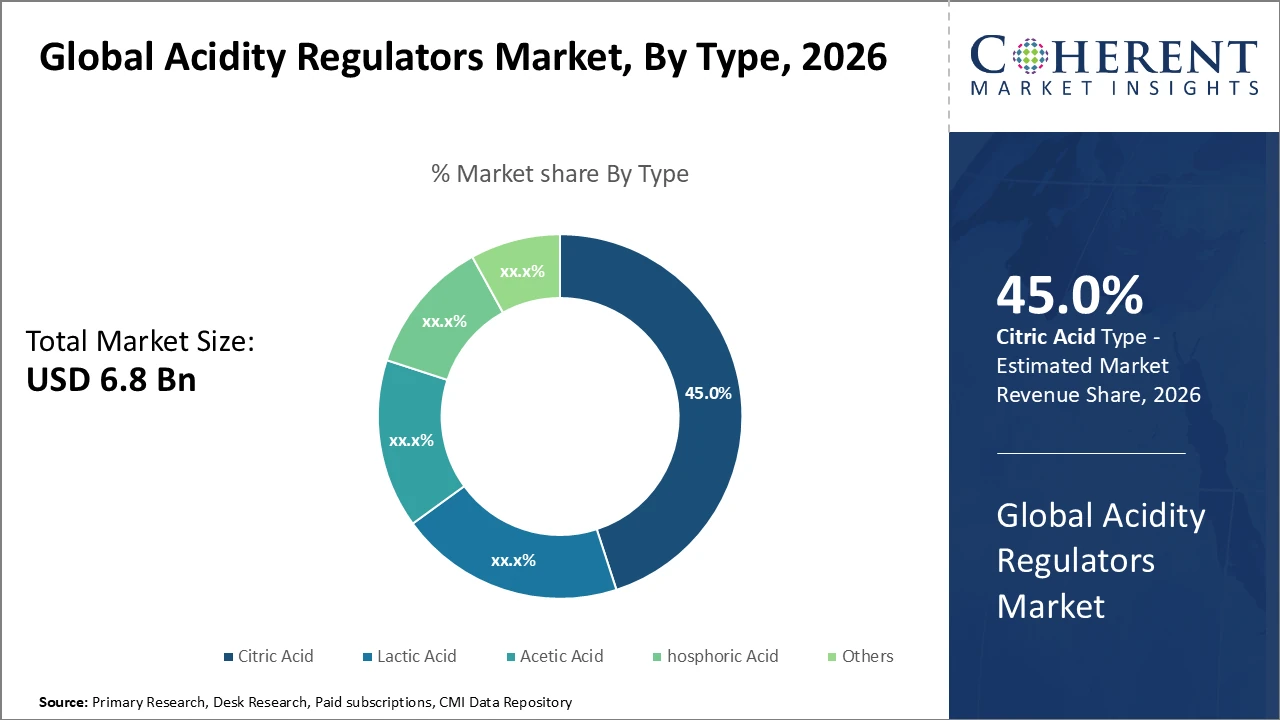
The Citric Acid subsegment dominates the Acidity Regulators Market with a 45% share, driven by versatile applications and cost-effective production. Lactic Acid and Phosphoric Acid are the fastest-growing subsegments due to rising demand in pharmaceuticals and beverages.
Beverages lead market revenue, supported by increased consumption of carbonated drinks and dairy alternatives in 2026. Pharmaceutical formulations are witnessing accelerated growth, driven by advances in biopharmaceuticals and pH-sensitive drug delivery systems.
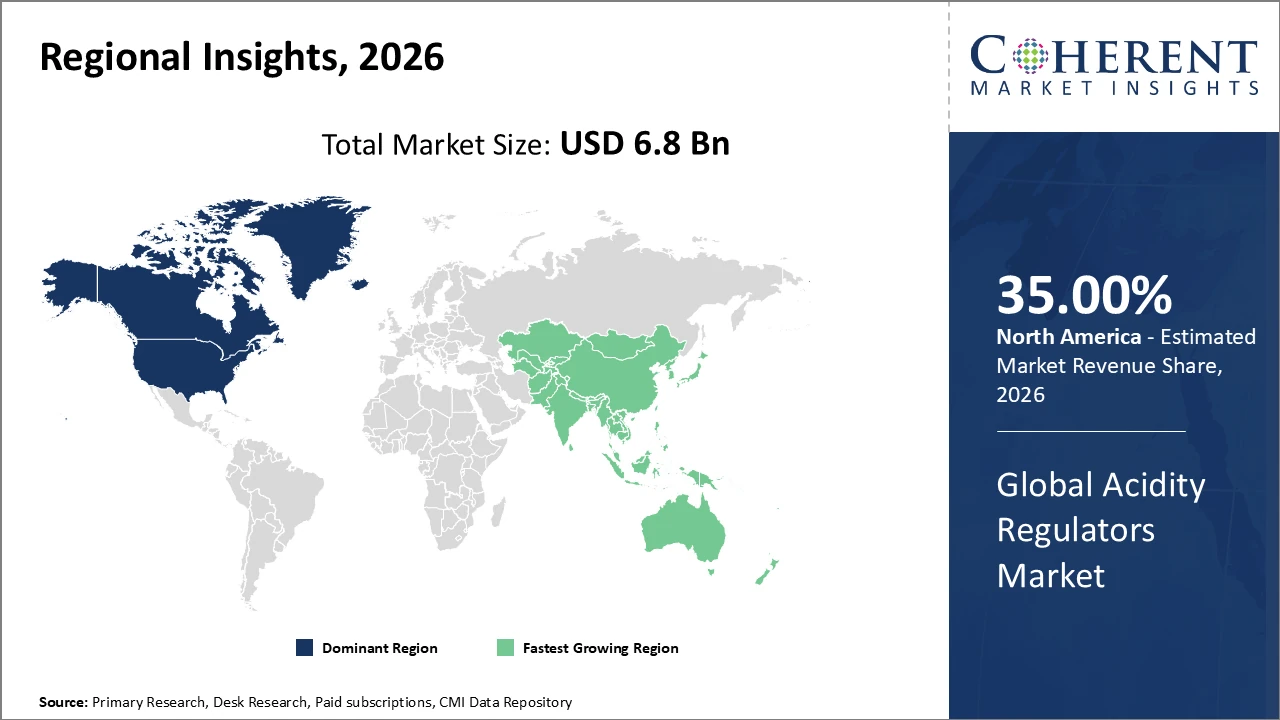
North America holds the largest market share, fueled by high processed food consumption and pharmaceutical manufacturing. Asia Pacific is the fastest-growing region, driven by industrialization, urban population growth, and supportive government policies, with a CAGR above the global average.
Acidity Regulators Market Segmentation Analysis
Acidity Regulators Market Insights, By Type
Citric Acid dominates the market share as a key acidity regulator, valued for its extensive use in food and beverages and cost-effective production via microbial fermentation. It is widely utilized in beverages as a flavor enhancer and preservative, reinforcing its market leadership. Lactic Acid is the fastest-growing subsegment, driven by rising demand in pharmaceuticals and personal care products that prefer naturally derived acidity regulators. Acetic Acid maintains steady demand for pickling and condiments, while Phosphoric Acid is increasingly used in soft drinks and industrial applications. Other acids, such as malic and tartaric, cater to niche applications in specialty foods and cosmetics.
Acidity Regulators Market Insights, By Application
The Beverages segment dominates the market share, generating substantial revenue by using acidity regulators to enhance flavor and maintain product stability. Growth is largely driven by carbonated soft drinks and plant-based beverages, reflecting changing consumer preferences toward functional and flavored drinks. Pharmaceuticals represent the fastest-growing application, as acidity regulators are essential for drug stability and creating targeted pH environments for therapeutic effectiveness. Food Processing contributes steadily through bakery, dairy, and processed foods, employing regulators for texture, preservation, and shelf-life extension. Personal Care applications are emerging, with increasing use in pH-sensitive skincare products, while industrial and agrochemical applications represent additional niche opportunities.
Acidity Regulators Market Insights, By Form
Solid forms of acidity regulators dominate the market share due to their stability, ease of transport, and broad applicability across multiple industries. They are extensively used in industrial food processing and large-scale pharmaceutical manufacturing, ensuring consistent quality and longer shelf life. The liquid form is the fastest-growing segment, favored in beverages and personal care products for its precise dosing, rapid solubility, and convenience in formulation. Powder formats maintain steady demand in baking and dairy applications for functional benefits, while granules offer handling efficiency in certain industrial processes. Other specialty blends serve niche needs in cosmetics and chemical manufacturing.
Acidity Regulators Market Trends
The market is shifting toward eco-friendly acidity regulators, with fermentation-based production methods reducing carbon footprints and environmental impact.
Biodegradable acidity regulators gained prominence in 2026, capturing 22% of total market volume, especially in the EU and North America.
AI-driven quality control systems are increasingly adopted, improving operational efficiency and consistency in production hubs like the U.S. and Germany.
Acidity Regulators Market Insights, By Geography
North America Acidity Regulators Market Analysis and Trends
In North America, the Acidity Regulators market is dominated by the robust processed food and pharmaceutical sectors, alongside growing consumer demand for functional and fortified foods. The U.S. accounted for nearly 40% of the regional market share in 2026, driven by strong domestic production and active import channels. High-quality standards and food safety regulations have prompted manufacturers to adopt reliable acidity regulators, ensuring product stability and compliance. Key regions such as California and the Midwest host major production facilities and R&D centers. Additionally, strategic investments by leading companies in formulation innovation and supply chain optimization continue to reinforce the region’s market leadership.
Asia Pacific Acidity Regulators Market Analysis and Trends
The Asia Pacific region demonstrates the fastest growth in the Acidity Regulators market, with an estimated CAGR of 10.5%, fueled by rapid urbanization, rising disposable incomes, and supportive government policies promoting local production. China and India are leading this expansion through the development of large-scale food processing facilities and increased pharmaceutical manufacturing investments. Strategic partnerships between regional manufacturers and multinational corporations are accelerating technology transfer, improving production efficiency, and broadening product availability. Additionally, growing consumer demand for processed foods and functional beverages further drives market adoption, establishing Asia Pacific as a critical growth engine for the global acidity regulators industry.
Acidity Regulators Market Outlook for Key Countries
USA Acidity Regulators Market Analysis and Trends
The U.S. Acidity Regulators market is driven by large-scale processed food and pharmaceutical industries, with major players like Archer Daniels Midland and Cargill leading in innovation and production capacity. In 2025, imports of acidity regulators rose by 12%, reflecting growing demand for specialty formulations aligned with clean-label and organic product trends. Simultaneously, investments in fermentation-based manufacturing and biotechnological research have strengthened domestic production, gradually reducing import dependency. These efforts enhance supply chain resilience while supporting revenue growth. Additionally, the focus on product diversification and regulatory compliance ensures that U.S. manufacturers remain competitive in both domestic and international markets.
Germany Acidity Regulators Market Analysis and Trends
Germany’s acidity regulators market is driven by its well-established food processing and pharmaceutical sectors, supported by high consumer demand for processed, functional, and organic products. Citric acid dominates usage due to its versatility and cost-effectiveness, while lactic and phosphoric acids are experiencing faster growth, particularly in pharmaceutical and beverage applications. Solid forms lead the market, though liquid forms are gaining traction in beverages and personal care products. Trends include a shift toward eco-friendly, fermentation-based acids and AI-enabled quality control in manufacturing. Strong regulatory frameworks, technological innovation, and export-oriented production further strengthen Germany’s position in the European market.
Analyst Opinion
The rising demand for natural acidity regulators is driving market growth. In 2025, over 34% of new beverage product launches incorporated natural regulators, reflecting consumer preference for clean-label products. Companies increased production capacity by around 22% in 2026 to meet this demand.
Pricing resilience is observed despite raw material volatility, due to cost-effective fermentation technologies. For example, the citric acid price index remained stable from 2024 to 2026, supported by scalable microbial fermentation advancements.
North America shows strong import demand, with the U.S. accounting for 45% of acidity regulator imports in 2025, linked to a 12% growth in processed food manufacturing support.
Diverse end-use industries, such as functional beverages and dairy alternatives, significantly boost demand. Europe’s plant-based beverage sector grew 18% in revenue in 2026, increasing the need for acidity regulators to maintain stability and flavor.
- Current Industry Events of 2026
- Market Size Estimation
- Regional Breakdown
- Competitive Landscape
- Customer Intelligence
- Segmental Analysis
- Pricing Analysis
- Key Market Drivers, Challenges & Future Trends
- Customized Insights Section
Market Scope
| Report Coverage | Details | ||
|---|---|---|---|
| Base Year: | 2025 | Market Size in 2026: | USD 6.8 billion |
| Historical Data for: | 2020 To 2024 | Forecast Period: | 2026 To 2033 |
| Forecast Period 2026 to 2033 CAGR: | 8.0% | 2033 Value Projection: | USD 11.4 billion |
| Geographies covered: |
| ||
| Segments covered: |
| ||
| Companies covered: | Cargill Incorporated, Tate & Lyle PLC, Corbion N.V., BASF SE, Celanese Corporation, S.A.F.I., Lanxess AG, LanzaTech, Inc., Ingredion Incorporated | ||
| Growth Drivers: |
| ||
Acidity Regulators Market Growth Factors
The food and beverage industry’s robust innovation pipeline, particularly in functional and plant-based products, has accelerated the adoption of acidity regulators designed to meet diverse pH and flavor requirements, directly supporting market growth strategies. Stricter global food safety regulations have further increased demand for reliable acidity regulators, with EU regulatory tightening in 2026 driving a 20% rise in certified product consumption. The expanding pharmaceutical segment, fueled by the need for acidity regulators in drug formulation and storage stability, contributed significantly, with Asia Pacific reporting a 14% annual increase in pharmaceutical manufacturing. Rising urbanization and disposable incomes in emerging markets are also boosting processed food consumption, enhancing overall market revenue and size.
Acidity Regulators Market Development
In September 2025, Dr Reddy’s Laboratories Ltd announced the launch of tegoprazan, a patented novel drug for treating acid-related gastrointestinal disorders in the Indian market.
Key Players
Leading Companies of the Market
Cargill Incorporated
Tate & Lyle PLC
Corbion N.V.
BASF SE
Celanese Corporation
S.A.F.I.
Lanxess AG
Ingredion Incorporated
LanzaTech, Inc.
Several market players have pursued strategic partnerships and capacity expansions to strengthen their presence in the acidity regulators market. For example, Archer Daniels Midland Company’s acquisition of a fermentation facility in 2025 increased its organic acidity regulator production capacity by 30%, enhancing supply chain reliability. At the same time, Tate & Lyle PLC utilized advanced biotechnology platforms in 2024 to reduce production costs by 15%, allowing more competitive pricing and a notable increase in market share. These initiatives reflect a broader industry focus on innovation, efficiency, and scaling operations to meet growing global demand.
Acidity Regulators Market Future Outlook
The Acidity Regulators market is poised for steady growth over the coming years, driven by increasing demand from the food and beverage industry for flavor enhancement, preservation, and pH control. Rising consumer preference for processed and convenience foods, along with expanding bakery, dairy, and beverage sectors, is boosting product adoption. Innovations in natural and clean-label acidity regulators are expected to gain traction as health-conscious consumers seek minimally processed ingredients. Additionally, expanding application in pharmaceuticals, personal care, and animal feed presents new revenue streams. Emerging markets in Asia Pacific and Latin America are anticipated to contribute significantly to market expansion.
Acidity Regulators Market Historical Analysis
The Acidity Regulators market has experienced consistent growth over the past decade, primarily driven by the expanding food and beverage industry. Increased consumption of processed foods, soft drinks, dairy products, and baked goods has fueled demand for additives that maintain flavor, stability, and shelf life. Historically, synthetic regulators such as citric acid, phosphoric acid, and lactic acid dominated the market, while natural alternatives gradually gained attention due to consumer preference for clean-label products. North America and Europe led early market development due to mature food industries and strict regulatory standards, while Asia Pacific’s growing population and urbanization began contributing significantly to market expansion.
Sources
Primary Research Interviews:
Food scientists, R&D managers, and product developers from companies manufacturing acidity regulators such as citric acid, phosphoric acid, and lactic acid.
Quality control managers, production supervisors, and procurement specialists using acidity regulators in food and beverage processing.
Industry experts from firms providing natural and clean-label alternatives, functional ingredients, and food additive solutions.
Magazines:
Food Technology – Updates on food processing innovations, additives, and regulatory trends.
Food & Beverage Industry – Insights on new product development, ingredient applications, and consumer preferences.
Nutrition Insight – Case studies, market trends, and ingredient efficacy reports.
Journals:
Journal of Food Science – Research on acidity regulation, shelf life, and food safety.
International Journal of Food Science & Technology – Studies on functional ingredients, chemical interactions, and processing effects.
Food Chemistry – Insights on formulation, stability, and chemical characteristics of acidity regulators.
Newspapers:
The Wall Street Journal – Company strategies, mergers, and investments in the food ingredient sector.
Financial Times – Global food industry spending, regulatory updates, and market trends in additives.
Reuters – News on product launches, technological advancements, and market developments in food ingredients.
Bloomberg – Corporate performance and market insights for global food and beverage companies.
Associations:
International Food Additives Council (IFAC) – Guidelines, best practices, and standards for food additives.
Institute of Food Technologists (IFT) – Protocols, research, and recommendations for functional ingredient applications.
Food and Agriculture Organization (FAO) – Global regulations, research, and safety standards for food ingredients.
Get access to 250+ pages report
Every segment, forecast, competitor profile and data table behind the analysis above — available for instant download.
- ESOMAR Member
- ISO 9001:2015 Certified
- D-U-N-S Registered
- GDPR & CCPA Compliant
Missing comfort of reading report in your local language? Find your preferred language:
Transform your Strategy with Exclusive Trending Reports
Frequently Asked Questions
The dominant players include Corbion N.V., Cargill, Tate & Lyle, Celanese Corporation, all of whom have recently invested significantly in production capacity, technology upgrades, and sustainable manufacturing practices.
The Acidity Regulators market is projected to grow from USD 6.8 billion in 2026 to USD 11.4 billion by 2033, driven by rising demand across food, beverage, and pharmaceutical applications.
The beverage industry holds the largest growth opportunity, particularly driven by functional drinks, plant-based beverages, and carbonated soft drinks.
Emerging trends include sustainable bio-based acidity regulators, digitalized production processes, multifunctional ingredient formulations, and increasing adoption of clean-label products, all reshaping market dynamics.
Competition is driven by strategic investments in fermentation technologies, process optimization, and supply chain diversification, while challenges include raw material price volatility, regulatory compliance, and meeting sustainability expectations.
Common strategies include capacity expansions via acquisitions, partnerships leveraging biotechnology platforms, R&D investments for clean-label and sustainable solutions, and regional market penetration initiatives.