

Vanillin Market Size and Forecast — 2026-2033
Overview
Vanillin (4-Hydroxy-2-mythoxy benzaldehyde) is an organic compound, belonging to the phenol aldehyde group. Vanilla beans is the largest concentrated natural source of vanillin, followed by Leptates bicolor, Chinese red pines, lychee fruit, and raspberry. Vanillin is produced through three ways namely, natural, biosynthesis, and chemical synthesis. Natural and chemical synthesis are two most important means of vanillin production. Vanillin is extensively used in the food industry as a flavoring agent for chocolates, ice-creams, candy, biscuits, and cakes. Ethyl vanillin and methyl vanillin are the two types of vanillin. Ethyl vanillin is a stronger flavoring agent as well as is expensive than methyl vanillin. Vanillin is also used in intermediate applications in the pharmaceuticals and fine chemicals industries.
Use of vanillin as a food additive is widely approved by authorities such as the FDA, which has granted GRAS status to its use. The use of vanillin, is not associated with the any adverse effects or associated with health complications over the past few decades. This ensures its safety, which is expected to increase the demand for vanillin globally. An Acceptable Daily Intake (ADI) of 10 mg/kg has been agreed between the FAO/WHO and EU. Lack of evidences to restrict vanillin consumption as a consumable food additive, influences a large number of manufacturers to invest more in global vanillin market. Growing urbanization, improved standard of living, and continuous research to increase techno-commercial benefits of vanillin are projected to be key drivers for growth of the global vanillin market during the forecast period (2017-2026).
Vanillin Market Size and Forecast – 2026 – 2033
The Vanillin Market size is estimated to be valued at USD 479.7 million in 2026 and is expected to reach USD 750.4 million by 2033, exhibiting a compound annual growth rate (CAGR) of 6.6% from 2026 to 2033.
Key Takeaways
In terms of application segments, Food & Beverages lead with a dominant 59% market share, fueled by robust demand for natural flavorings in bakery and confectionery sectors.
The pharmaceutical sector is the fastest-growing application, driven by increased use of vanillin for taste masking in children’s medicines. From a regional perspective,
Asia Pacific commands the largest industry share at approximately 37%, propelled by manufacturing hubs in China and India.
North America remains a significant region, where stringent regulatory frameworks promote natural ingredient adoption, contributing to a 6.5% CAGR. Europe’s mature flavor industry continues growth through bio-based vanillin adoption, underscoring diverse business growth opportunities.
Vanillin Market – Segmentation Analysis
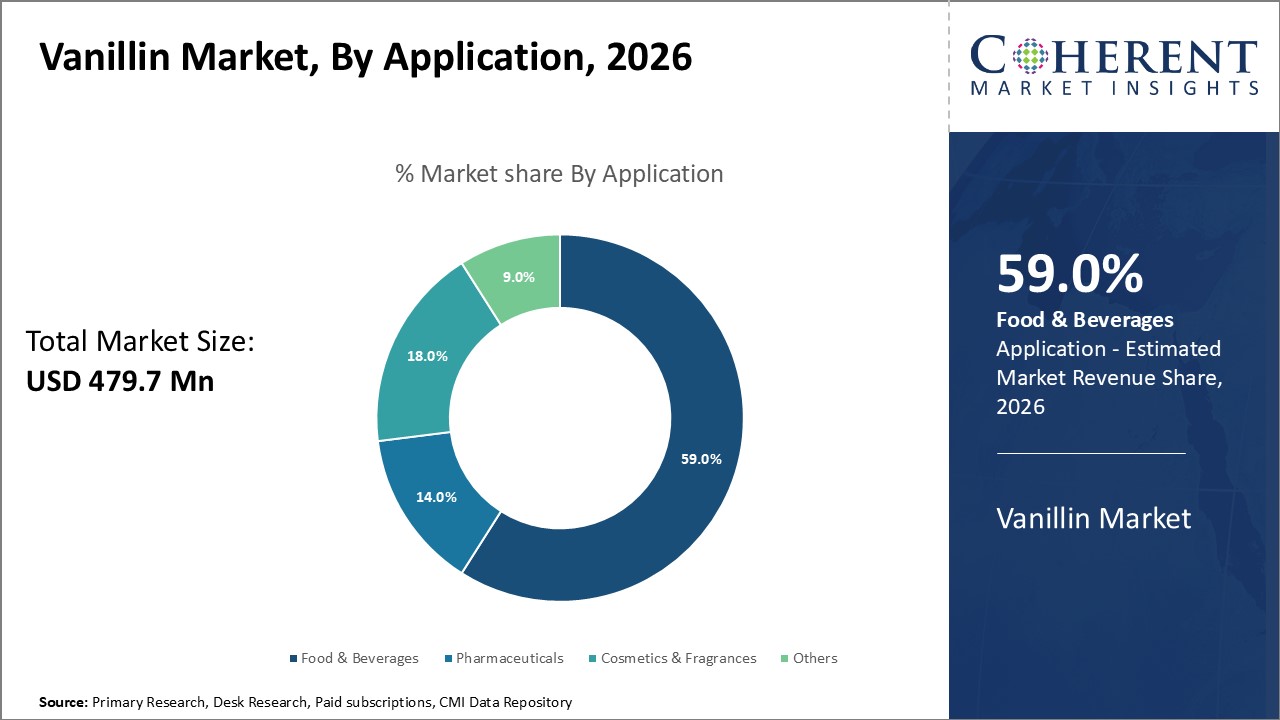
Vanillin Market Insights, By Application
In terms of Application, the market is segmented into Food & Beverages, Pharmaceuticals, Cosmetics & Fragrances, and Others. Food & Beverages dominate with a 58% market share, propelled by extensive use in confectionery, bakery goods, and beverages as a flavor enhancer and masking agent.
Vanillin Market Insights, By Product Type
In terms of Product Type, the market is segmented into Synthetic Vanillin, Natural Vanillin, Bio-based Vanillin, and Others among this Synthetic Vanillin dominates the market share with 65%. This dominance stems from cost-effectiveness and scalability, making synthetic vanillin the most widely used flavoring agent in bulk applications such as bakery and confectionery.
Vanillin Market Insights, By Form
In terms of Form, the market is segmented into Powder, Liquid, Crystals, and Others, with Liquid vanillin dominating the market share at 54%. This is primarily due to ease of incorporation into various formulations across food and pharmaceutical industries.
Vanillin Market Insights, By Geography
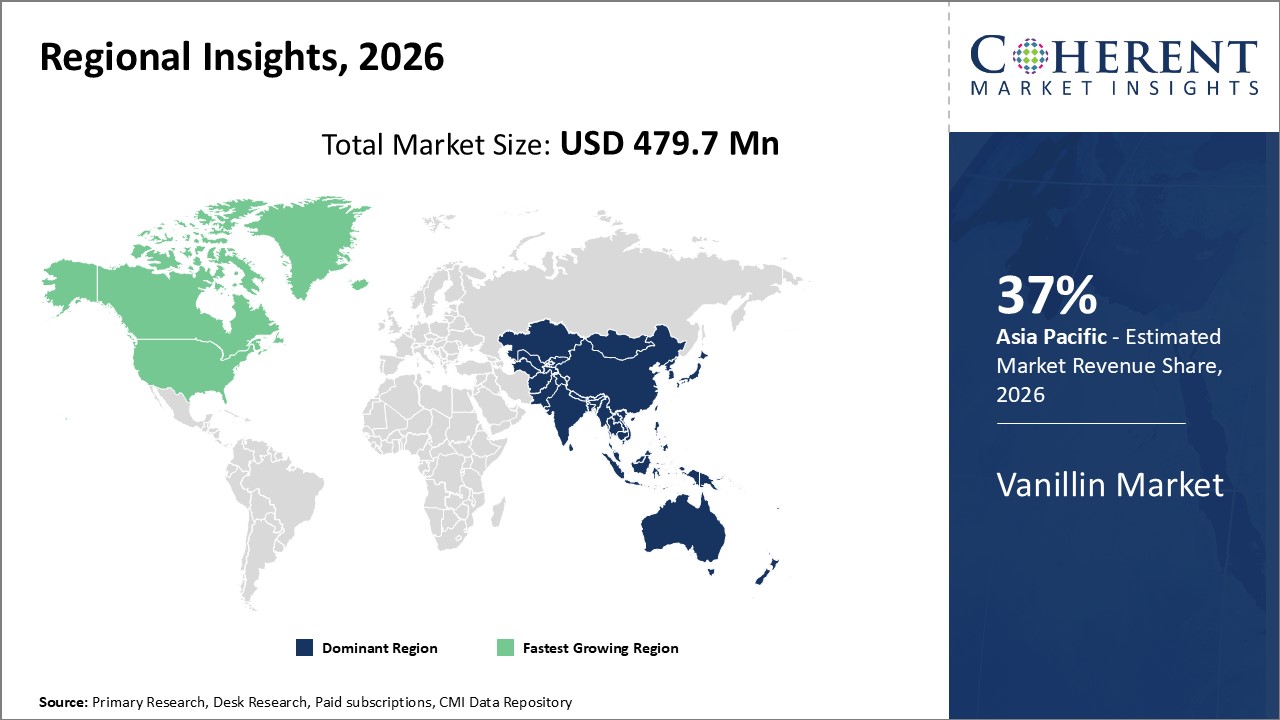
Asia Pacific Vanillin Market Analysis and Trends
Due to its vast industrial infrastructures and growing exports from China and India, Asia Pacific dominates the vanillin industry, accounting for around 37% of the world market. Support from the government in the form of subsidies for the manufacturing of biochemicals and growing food and pharmaceutical end-use sectors is crucial for long-term growth. In order to fulfill the increasing demand, major businesses including Anhui BBCA Biochemical and Privi Organics have made significant investments in capacity development and technological advancements.
North America Vanillin Market Analysis and Trends
In contrast, North America is growing at the quickest rate (CAGR of 6.5%), driven by consumer desire for clean-label and natural components. Bio-based vanillin use has risen due to regulatory frameworks that prioritize sustainability and openness. With a focus on sustainable supply chains and cutting-edge flavor applications, businesses like International Flavors & Fragrances Inc. and Givaudan are spearheading substantial innovation in the U.S., the largest market in North America.
Vanillin Market Outlook for Key Countries
United States Vanillin Market Analysis and Trends
The growing demand for vanillin in the food and pharmaceutical sectors, particularly for natural and organic flavors, has propelled the market's continuous expansion in the United States. Demand for pharmaceutical and bakery formulations increased by about 8% in 2025, helped along by the FDA's more stringent clean labeling regulations. Leading American companies are making significant investments in bio-based vanillin research and development, strengthening the nation's standing as a center of innovation. European and Asian imports support homegrown manufacturing, guaranteeing a steady supply chain and promoting company expansion.
India Vanillin Market Analysis and Trends
Due to its position as a major global producer of both natural and synthetic vanilla ingredients, India's vanillin market is growing quickly. In 2025, the domestic industry's output increased by 14% to meet both home and export demand. Production efficiency has increased due to ongoing advancements in fermentation technology and government incentives for bio-based chemicals. Businesses like Anhui BBCA Biochemical and Privi Organics are essential to raising India's export volumes to Europe and Latin America and expanding its market share internationally.
Analyst Opinion
Supply chain optimization is a pivotal driver in vanillin market size, with increased production capacity in Southeast Asia and Europe enhancing global availability. In 2025, production facilities in China and India reported a 12% increase in output, directly reducing raw material costs and stabilizing market prices. This supply-side improvement has contributed to a 7% increment in market revenue year over year.
Demand-side indicators highlight expanding utilization of vanillin across food flavoring and pharmaceutical formulations. With the U.S. food industry incorporating plant-based and clean-label ingredients, vanillin’s demand rose by 10% in 2025, notably in bakery and confectionery sectors. Additionally, cosmetic applications increased by 7%, as consumer trends shift toward natural fragrance profiles.
Export activities from emerging manufacturing hubs like India have seen a 15% growth in vanillin volumes shipped globally, reflecting robust demand in Latin America and Europe. Trade data from 2025 underscore how import dynamics particularly from Brazil and Germany have surged, increasing the import value by over USD 25 million compared to 2023.
Pricing trends indicate stabilized costs with mild fluctuations, as synthetic vanillin pricing witnessed a 4% decline due to improved production efficiencies, while natural vanillin commands a premium price with a consistent 11% year-on-year growth, catering to organic product lines. This pricing segmentation is influencing market players' revenue diversification strategies.
- Current Industry Events of 2026
- Market Size Estimation
- Regional Breakdown
- Competitive Landscape
- Customer Intelligence
- Segmental Analysis
- Pricing Analysis
- Key Market Drivers, Challenges & Future Trends
- Customized Insights Section
Market Scope
| Report Coverage | Details | ||
|---|---|---|---|
| Base Year: | 2025 | Market Size in 2026: | USD 479.7 million |
| Historical Data for: | 2020 To 2024 | Forecast Period: | 2026 To 2033 |
| Forecast Period 2026 to 2033 CAGR: | 6.6% | 2033 Value Projection: | USD 750.4 million |
| Geographies covered: |
| ||
| Segments covered: |
| ||
| Companies covered: | Givaudan SA, Symrise AG, Firmenich SA, International Flavors & Fragrances Inc., Borregaard AS, Anhui BBCA Biochemical Co., Ltd., Vigon International Inc., Takasago International Corporation, Senomyx, Inc., Solvay S.A., BASF SE | ||
| Growth Drivers: |
| ||
Growth factors
The growing demand for natural and clean-label flavor ingredients is the foremost driver pushing market growth, as consumers increasingly prefer organic alternatives, evidenced by a 13% increase in natural vanillin consumption in North America. Regulatory policies in Europe favoring sustainable production have accelerated bio-based vanillin adoption by 9% in 2025, boosting market revenue in the region. Additionally, the expanding pharmaceutical sector's reliance on vanillin for flavor masking in pediatric formulations has spurred consistent demand, with the segment contributing to over 21% of market revenue growth globally. Lastly, advancements in green chemistry and fermentation technologies have reduced production costs, enabling wider market penetration, particularly in Asia Pacific.
Vanillin Market Development
In September 2022, Solvay, a global leader in natural ingredients, expanded the range of one of its flagship products, Rhovanil Natural CW, with three new natural flavor ingredients: Rhovanil Natural Delica, Alta and Sublima. With these new products, the Group will enable the Food and Beverage industries to cost effectively switch to natural and address growing consumer expectations for healthier, safer, tastier, and more natural products. Rhovanil Natural CW, the industry standard for natural vanillin requirements, is the basis for Rhovanil Natural Delica, Alta, and Sublima. It is made by bioconverting ferulic acid, a naturally occurring substance present in rice bran.
Market Trends
The vanillin market is witnessing a significant trend toward bio-fermentation processes, which are driving a shift from conventional synthetic production to greener alternatives. For example, 2025 saw a 10% rise in bio-fermented vanillin output, particularly in the Asia-Pacific region, responding to stricter environmental regulations. Additionally, the market is experiencing increased integration of vanillin in non-traditional industries such as personal care and pharmaceutical excipients, diversifying applications and enhancing market scope. The rise of e-commerce platforms has also revolutionized market access, expanding reach to niche segments globally. These factors collectively reflect a shift in industry trends favoring sustainability and innovation.
Key Players
Givaudan SA
Symrise AG
Firmenich SA
International Flavors & Fragrances Inc.
Anhui BBCA Biochemical Co., Ltd.
Vigon International Inc.
Takasago International Corporation
Senomyx, Inc.
Solvay S.A.
BASF SE
These leading market players have adopted strategic growth initiatives such as forward integration to control distribution channels and enhance supply chain resilience. For instance, Symrise AG expanded its natural vanillin-focused product line in 2025, resulting in a 16% increase in market share within Europe. Similarly, Givaudan SA's investment in bio-based vanillin R&D has positioned the company competitively in the premium segment, yielding a revenue increase of over USD 20 million in 2025.
Vanillin Market Future Outlook
The target market growth is driven by increasing demand for flavoured food products, expanding applications in pharmaceuticals and cosmetics, and a rising preference for clean-label and natural ingredients. Synthetic vanillin currently dominates the market due to its cost-effectiveness and consistent supply, but natural vanillin is gaining traction owing to consumer preference for sustainable and organic products.
Regional growth is expected to be strong in East Asia, with India projected to have the highest CAGR of 9.3%. Additional factors fuelling the market include technological advancements, increased health awareness, the rise of e-commerce, and adoption in emerging economies for food, beverage, cosmetics, and pharmaceutical sectors. Regulatory frameworks are also ensuring safety and quality standards, facilitating market expansion. Overall, the future outlook for the vanillin market is robust, with steady growth anticipated through 2035 driven by evolving consumer tastes and global industrial demand.
Historical Analysis
In January 2018, Solvay S.A. increased production capacity of natural vanillin by 60 metric tons at its plant based in Saint-Fons (France). The increased capacity helped Solvay to meet increasing customer demand for natural and clean label vanillin products.
In 2017, Solvay S.A. launched its new natural vanillin product Rhovanil Natural CW. The product was derived from non-GMO rice and was a substitute to synthetic vanillin. This helped Solvay to expand its product portfolio.
In June 2019, Borregaard announced capacity expansion of bio-based vanillin at its plant located in Sarpsborg (Norway). The construction was expected to start in the second half of 2019 and to be completed in the first half of 2021. The expansion was set to increase the current capacity by 250 tons.
In 2015, Solvay S.A. opened its new vanillin manufacturing plant in Zhenjiang City, China. The new plant increased Solvay’s overall production capacity by 41% and helped the company to strengthen its position in China’s vanillin market.
Sources
Primary Research interviews:
Flavor & Fragrance Companies
Pharmaceutical Companies
Cosmetic & Personal Care Manufacturers
Databases:
Scopus
Web of Science
FAOSTAT
Magazines:
Food Ingredients First
Chemical & Engineering News
Beverage Industry Magazine
Journals:
Food Chemistry
Flavour and Fragrance Journal
International Journal of Food Science & Technology
Newspapers:
The Hindu Business Line
Financial Times
The Wall Street Journal
Associations:
International Organization of the Flavor Industry (IOFI)
Institute of Food Technologists (IFT)
American Chemical Society (ACS)
Get access to 250+ pages report
Every segment, forecast, competitor profile and data table behind the analysis above — available for instant download.
- ESOMAR Member
- ISO 9001:2015 Certified
- D-U-N-S Registered
- GDPR & CCPA Compliant
Missing comfort of reading report in your local language? Find your preferred language:
Transform your Strategy with Exclusive Trending Reports
Frequently Asked Questions
Leading companies include Givaudan SA, Symrise AG, Firmenich SA, International Flavors & Fragrances, and Borregaard AS, contributing significantly to market share and innovation.
The market size is projected to grow from USD 479.7 million in 2026 to USD 750.4 million by 2033, with a CAGR of 6.6%, driven by rising demand across food and pharmaceutical applications.
The Food & Beverages industry dominates demand, particularly bakery and confectionery, while pharmaceuticals exhibit the fastest growth due to increased use in pediatric formulations.
Trends indicate a significant shift toward bio-based vanillin via fermentation technologies and expanding applications beyond flavoring into personal care and pharmaceutical sectors.
The landscape is characterized by intense competition focusing on product innovation and sustainable production, with challenges including price volatility of raw materials and regulatory compliance.
Strategies involve expanding production capacity for natural and bio-based vanillin, forward integration for supply chain control, and partnerships for R&D in sustainable technologies.