

Soy Lecithin Market Size and Forecast — 2026-2033
Overview
Soy lecithin is an insulator, which reduces heat flow between high and low temperature materials. Soy lecithin is generally used in buildings as window insulating film, in mechanical systems, spacecraft, and automotive. Air being a poor thermal conductor, soy lecithin is used as an alternative to it in many thermal insulation applications. Soy lecithin traps gases and forms a layer of coating against heat. Also, soy lecithin reduces noise and vibrations.
Soy lecithin is used as a wetting, stabilizing, and dispersing agent due to which it is widely used in the pharmaceutical industry. It is rich in fat and protein owing to which it finds application as animal feed. It is also used in paint industry as an antioxidant and wetting, suspending, emulsifying & stabilizing agent.
Soy Lecithin Market Size and Forecast – 2026 – 2033
The Soy Lecithin Market size is estimated to be valued at USD 1.55 billion in 2026 and is expected to reach USD 2.44 billion by 2033, exhibiting a compound annual growth rate (CAGR) of 6.7% from 2026 to 2033.
Key Takeaways
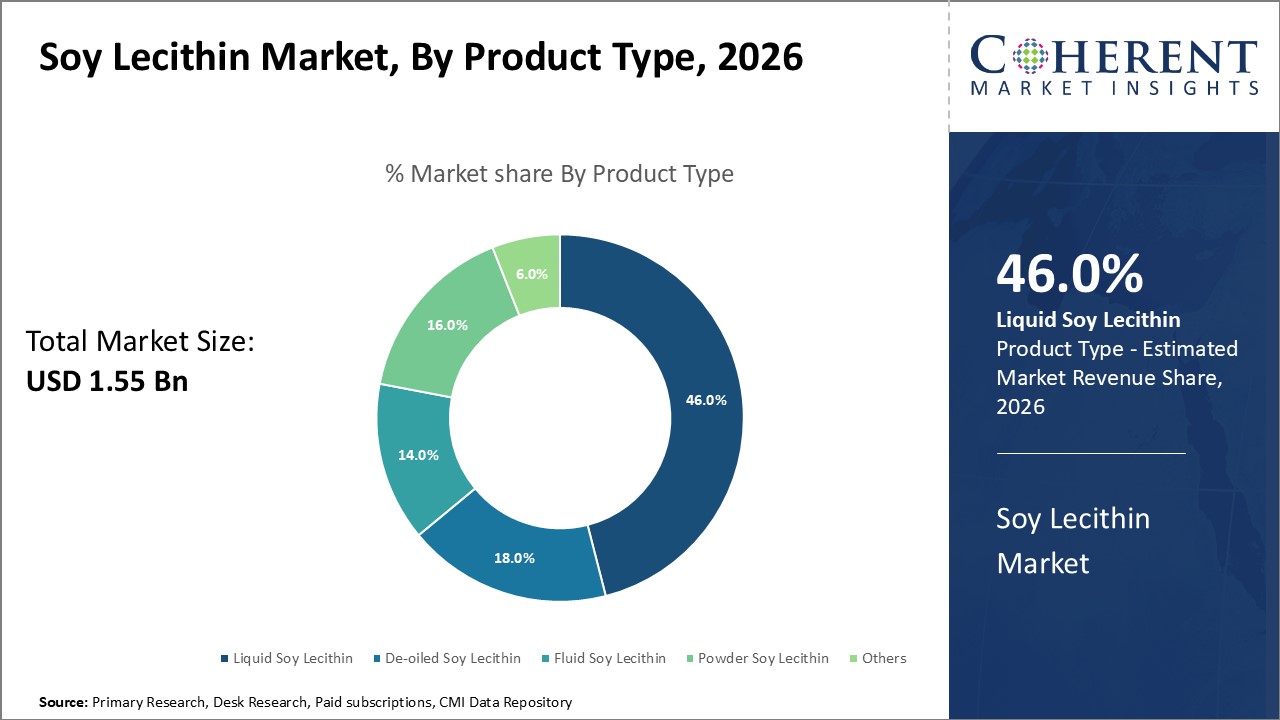
The liquid soy lecithin segment dominates the product type category, accounting for approximately 46% of the market share in 2026 due to its versatility and cost-effectiveness in food and industrial uses. De-oiled soy lecithin is growing fastest, primarily due to its high demand in nutraceutical and pharmaceutical applications.
Food and beverage applications lead the market, representing over 56% of total market revenue, indicating sustained demand driven by the natural emulsifier trend. Cosmetics and pharmaceuticals are notable emerging applications with double-digit growth rates.
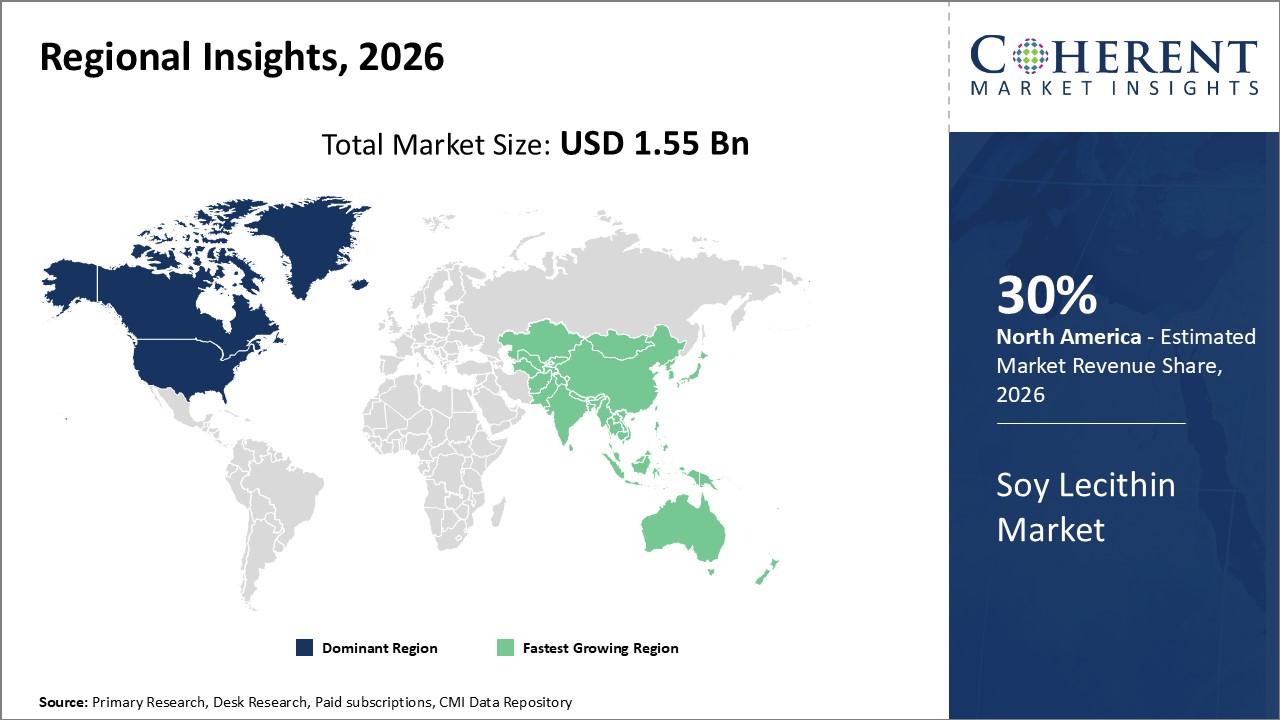
North America holds the commanding 30% market share in terms of regional distribution, heavily influenced by strong regulatory frameworks and advanced industry ecosystems contributing to substantial industry size and business growth.
Asia Pacific exhibits the fastest CAGR, driven by expanding food processing industries and rising health awareness in countries like China and India, where soy lecithin adoption in animal feed and cosmetics is rapidly increasing.
Soy Lecithin Market – Segmentation Analysis
Soy Lecithin Market Insights, By Product Type
In terms of product type, the Soy Lecithin Market is segmented into Liquid Soy Lecithin, De-oiled Soy Lecithin, Fluid Soy Lecithin, Powder Soy Lecithin, and Others among which Liquid Soy Lecithin dominates the market growth. Liquid soy lecithin commands a substantial share due to its ease of handling and strong emulsification properties, making it prevalent in food and industrial applications. Its favorable cost-to-performance ratio sustains its leadership, especially in large-scale bakeries and confectioneries.
Soy Lecithin Market Insights, By Application
The Soy Lecithin Market is segmented into Food and Beverage, Pharmaceuticals, Animal Feed, Cosmetics, Industrial Applications, and Others, where Food and Beverage leads with the largest industrial share. Driven by increased demand for natural emulsifiers and antioxidant agents, the food and beverage segment encompasses bakery, confectionery, dairy, and beverage products. This segment dominates market revenue, underpinned by consistent product innovation and consumer demand for clean-label ingredients.
Soy Lecithin Market Insights, By Function
Within the function segmentation, the Soy Lecithin Market is divided into Emulsifier, Antioxidant, Nutritional Supplement, Processing Aid, and Others with Emulsifier occupying the dominant market share. Emulsification remains the primary application, essential across food, pharmaceutical, and cosmetic industries, driving its dominant position. The emulsifier function supports product stability and texture enhancement, critical for bakery and confectionery products.
Soy Lecithin Market Insights, By Geography
North America Soy Lecithin Market Analysis and Trends
The existence of several major producers, including Archer Daniels Midland and Cargill, is responsible for the domination of the soy lecithin market in North America. Due to strong R&D investments, strict regulatory standards, and consumer awareness that fuels demand for natural additives, the area accounts for more than 30% of the market. The ecosystem is further strengthened by government incentives that promote sustainable agriculture.
Asia Pacific Soy Lecithin Market Analysis and Trends
The fastest-growing region is Asia Pacific, with a compound annual growth rate (CAGR) of above 7%. This region is driven by growing food processing industries and increased health consciousness in nations like China, India, and Indonesia. The production of cosmetics and increased animal husbandry methods also contribute to the need here. Growth is being further accelerated by the modernization of the disjointed supply chains.
Soy Lecithin Market Outlook for Key Countries
United States Soy Lecithin Market Analysis and Trends
A large agricultural base and a well-established processing infrastructure in the USA influence the soy lecithin market. Almost 60% of soy lecithin consumption in North America occurred in the nation in 2025, thanks to the quickly expanding food and nutraceutical industries. Big businesses like Cargill and Archer Daniels Midland have made significant investments in cutting-edge lecithin extraction technology, which have increased their market dominance and production efficiency. Organic and non-GMO lecithin products have proliferated due to clean-label consumer trends. The FDA's regulatory lucidity on health claims related to soy lecithin contributes to stable market revenue growth by enhancing confidence among food and pharmaceutical businesses.
Brazil Soy Lecithin Market Analysis and Trends
Being a major producer and exporter of soybeans, Brazil has one of the most active markets in Latin America. Brazil's soy lecithin business benefits from integrated supply chains that connect soybean farmers and processing facilities, allowing for economical production that underpins competitive pricing. Export growth, which increased by 9% year over year in 2025, mostly to Asia Pacific and Europe, has been a top priority for key corporations in this area. Although the nation has obstacles due to infrastructure constraints, it continues to play a significant role in determining the trends of the global soy lecithin market. Local customer preferences and sustainability trends are driving an increase in domestic investments in bio-based and organic lecithin products.
Analyst Opinion
Supply Chain Optimization Enhancing Market Size: Soy lecithin producers have significantly expanded their extraction and refining capacities in key soybean-producing countries, increasing global availability. For instance, Latin American exporters ramped up exports by over 8% in 2025, leading to improved supply-side market dynamics and margin stabilization. This directly supports the increase in soy lecithin market size and revenue globally.
Demand Surge in Food and Beverage Sector: The rising utilization of soy lecithin as a natural emulsifier in bakery, confectionery, and dairy products drove an 12% growth in food segment consumption in 2025. Consumer shift towards healthier food ingredients has boosted demand, contributing significantly to market growth and influencing market share shifts toward natural lecithins.
Regulatory Impact on Market Dynamics: Favorable health claims approved by agencies like the FDA and EFSA regarding the cholesterol-lowering effects of soy lecithin have expanded its use in nutraceutical applications. This regulatory endorsement translated into a 8% rise in pharmaceutical segment demand, indicating market momentum in therapeutic product formulations.
Pricing Trends and Market Revenue: Global soy lecithin prices experienced a moderate rise of 5.2% in 2025 due to tightening supply in certain Asian markets. Despite price increases, overall market revenue grew healthily due to strong volume sales, reflecting robust market dynamics in current years.
- Current Industry Events of 2026
- Market Size Estimation
- Regional Breakdown
- Competitive Landscape
- Customer Intelligence
- Segmental Analysis
- Pricing Analysis
- Key Market Drivers, Challenges & Future Trends
- Customized Insights Section
Market Scope
| Report Coverage | Details | ||
|---|---|---|---|
| Base Year: | 2025 | Market Size in 2026: | USD 1.55 billion |
| Historical Data for: | 2020 To 2024 | Forecast Period: | 2026 To 2033 |
| Forecast Period 2026 to 2033 CAGR: | 6.7% | 2033 Value Projection: | USD 2.44 billion |
| Geographies covered: |
| ||
| Segments covered: |
| ||
| Companies covered: | Archer Daniels Midland Company, Cargill, Incorporated, Bunge Limited, DuPont de Nemours, Inc., AG Processing Inc., Gushen Biotechnology Co., Ltd., Sime Darby Plantation Berhad, Wilmar International Limited, BASF SE, Wilco Trading Ltd., Kerry Group plc. | ||
| Growth Drivers: |
| ||
Growth factors
The increasing demand for natural emulsifiers in the food & beverage industry is a primary market driver due to rising consumer shift towards clean-label food products. According to recent data, the food and beverage application accounted for over 56% of soy lecithin market revenue in 2025, underscoring its significant contribution. Expansion in the pharmaceutical industry's use of soy lecithin as a drug delivery agent is another growth catalyst, with nutraceutical formulations using soy lecithin increasing by approximately 10% in 2025. Additionally, the rising incorporation of soy and milk protein ingredients in food formulations is enhancing the functional benefits and nutritional profile of many products, further boosting target market demand.
Additionally, legislative support and health recommendations related to cholesterol management drive nutraceutical soy lecithin usage globally. The growing animal feed industry, especially in Asia Pacific, also fuels adoption as soy lecithin improves feed digestibility and nutrient absorption, contributing to overall market revenue growth. Finally, rising cosmetic applications, leveraging soy lecithin's skin conditioning and antioxidant properties, present lucrative prospects for business growth in emerging economies.
Soy Lecithin Market Development
- In March 2026, Louis Dreyfus Company (LDC), a leading global merchant and processor of agricultural goods, introduced its new plant-based Vitamin E products and an expanded food ingredients product line at the 2026 Food Ingredients China exhibition, consolidating its presence in the plant-based ingredients space. To meet China's increasing demand for plant-based components, LDC displayed a range of food ingredient items in addition to plant-based vitamin E.
Market Trends
The shift towards non-GMO and organic soy lecithin varieties is redefining market dynamics as consumers increasingly prefer clean-label ingredients. For example, organic soy lecithin launches rose by 12% in 2025 across North America and Europe, signaling a clear trend toward premium ingredient formulations. Digital transformation in supply chains, including blockchain adoption for traceability in Asia Pacific, has improved transparency and customer trust, further spurring demand. Moreover, innovation in soy lecithin derivatives tailored for specific functionalities in pharmaceuticals and cosmetics represents a significant market shift, as companies focus on value-added products rather than commodity-grade offerings. These trends are crucial in amplifying the soy lecithin market’s scope and expanding business growth opportunities globally.
Key Players
Archer Daniels Midland Company
Cargill, Incorporated
DuPont de Nemours, Inc.
AG Processing Inc.
Gushen Biotechnology Co., Ltd.
Sime Darby Plantation Berhad
Wilmar International Limited
BASF SE
Wilco Trading Ltd.
Kerry Group plc.
Several leading companies have embraced strategic initiatives such as capacity expansion, product innovation, and acquisitions to consolidate their market position. For example, Archer Daniels Midland increased its soy lecithin production by 16% in 2025 by commissioning new extraction facilities in North America, enhancing supply chain resilience. Meanwhile, Cargill leveraged tailored soy lecithin solutions for the pharmaceutical sector, resulting in a 11% revenue increase in that segment.
Soy Lecithin Market Future Outlook
The future outlook for the Soy Lecithin Market is highly positive, with sustained growth expected across diverse sectors such as food processing, pharmaceuticals, cosmetics, and animal feed. Global demand is driven by increasing preference for clean-label, natural ingredients and the use of soy lecithin as a versatile emulsifier and stabilizer in processed foods, bakery, food antioxidants, confectionery, and infant nutrition. Asia-Pacific remains the fastest-growing region, supported by robust soybean cultivation and expanding food and pharmaceutical industries in China and India, while North America and Europe benefit from rising health awareness and demand for plant-based products.
Although supply chains remain anchored by major soybean-producing nations, some volatility may occur due to fluctuations in agricultural output and shifting trade dynamics. Price competitiveness against alternatives like sunflower lecithin and continued innovation in manufacturing keep soy lecithin in demand for cost-effective applications. Overall, the market is forecast to expand steadily, bolstered by the increasing adoption in nutrition, pharmaceuticals, and cosmetic products, with additional support from regulatory standards and health trends favoring non-GMO, allergen-free, and plant-sourced ingredients.
Historical Analysis
In January 2019, Avril Group acquired LECICO GmbH (manufacturer of soy, sunflower, & rapeseed lecithin, phospholipids, and nutraceutical products). The acquisition helped Avril Group to expand its product portfolio and increased its market share in the lecithin market.
In September 2019, Praan Naturals launched its new Organic Soy Lecithin Liquid and Powder for the personal care industry. The new product launch helped Praan Naturals to expand its product portfolio. The new product found application in skin care, lip care, hair care, nail care, and cosmetic products.
In February 2019, Lasenor Emul, S.L. (manufacturer of emulsifiers) and Simmons Grain Co. (organic soybean processor based in Ohio, U.S.) entered into a joint venture to form LASENOR USA LLC. The new company manufactured organic soya lecithin products for food and feed applications.
In September 2019, AAK (Sweden-based manufacturer of vegetable oils & fats) acquired U.K.-based Soya International (manufacturer of soy, sunflower & rapeseed lecithin). The acquisition helped AAK to strengthen its position in the lecithin market.
Sources
Primary Research interviews:
Pharmaceutical formulators
Cosmetics & personal care companies
Soybean processors & refiners
Databases:
ITC Trade Map
UN Comtrade Database
Eurostat
Magazines:
Beverage Industry Magazine
The World of Food Ingredients
Food Business News
Journals:
Food Hydrocolloids
Journal of Food Science and Technology
European Food Research and Technology
Newspapers:
Financial Times
The Hindu Business Line
Business Standard
Associations:
United Soybean Board (USB)
European Lecithin Manufacturers Association (ELMA)
Association of American Oil Chemists’ Society (AOCS)
Get access to 250+ pages report
Every segment, forecast, competitor profile and data table behind the analysis above — available for instant download.
- ESOMAR Member
- ISO 9001:2015 Certified
- D-U-N-S Registered
- GDPR & CCPA Compliant
Missing comfort of reading report in your local language? Find your preferred language:
Transform your Strategy with Exclusive Trending Reports
Frequently Asked Questions
The market is led by industry heavyweights like Archer Daniels Midland Company, Cargill, Incorporated, Bunge Limited, DuPont de Nemours, Inc., AG Processing Inc., Gushen Biotechnology Co., Ltd., Sime Darby Plantation Berhad, Wilmar International Limited, BASF SE, Wilco Trading Ltd., Kerry Group plc., who hold significant production capacities and extensive global distribution networks.
The market size is projected to reach USD 2.44 billion by 2033, growing at a CAGR of 6.7% from 2026 to 2033.
The food and beverage sector remains the largest user segment, fueled by clean-label trends, but pharmaceuticals and cosmetics segments offer high-growth opportunities due to product innovation.
Trends will focus on organic and non-GMO soy lecithin, supply chain digitization, and specialty derivative development, enhancing market scope and revenue streams.
The landscape is highly competitive with players focusing on capacity expansion and technological advancements, while challenges include supply fluctuation and regulatory compliance.
Strategies involve strategic partnerships, product differentiation through specialty lecithins, geographical expansion, and sustainability initiatives to appeal to health-conscious consumers.