Alcohol Breathalyzer and Drug Testing Equipment Market Analysis & Forecast: 2026-2033
The alcohol breathalyzer and drug testing equipment market is estimated to be valued at USD 4,800 Mn in 2026 and is expected to reach USD 7,630 Mn by 2033, growing at a compound annual growth rate (CAGR) of 6.9% from 2026 to 2033.
The alcohol breathalyzer and drug testing equipment market provides advanced diagnostic screening systems and automated detection technologies primarily for law enforcement, workforce safety, and clinical diagnostics. This market includes sophisticated handheld breath analyzers, multi-panel oral fluid and urine testing kits, and integrated biometric verification systems, along with cloud-based management software, industrial IoT connectivity, and long-term calibration and maintenance services.
The global demand for public safety and workplace sobriety is being identified more frequently each year, creating a greater need for real-time, noninvasive screening among transportation hubs, construction sites, and law enforcement agencies. Employers and regulatory bodies recognize the critical importance of regular testing for risk mitigation and long-term workforce productivity. Government regulatory agencies now mandate rigorous occupational health monitoring, establishing high-accuracy forensic testing and digital record keeping as standard requirements in safety-sensitive industries.
With the implementation of stringent tolerance labor laws and road safety standards, the market is growing steadily, mainly in the North America and Asia Pacific regions, where urbanization is rapid and workplace safety infrastructure is expanding. The market is also highly significant in regions with established legal frameworks and high capital expenditure, including the US, Europe, and China. The equipment manufacturers are creating next-generation systems that integrate artificial intelligence for pattern recognition and machine learning algorithms to reduce false positives. Such systems are preferred and used by safety officers and law enforcers since they entail efficient detection, fast processing, and a streamlined follow-up process in the judicial and business compliance systems.
|
Current Event |
Description and the Impact |
|
Regulatory and Legal Reforms on Drug and Alcohol Testing |
|
|
Technological Advancements in Testing Devices
|
|
|
Public Health and Social Behavior Trends |
|
Uncover macros and micros vetted on 75+ parameters: Get instant access to report
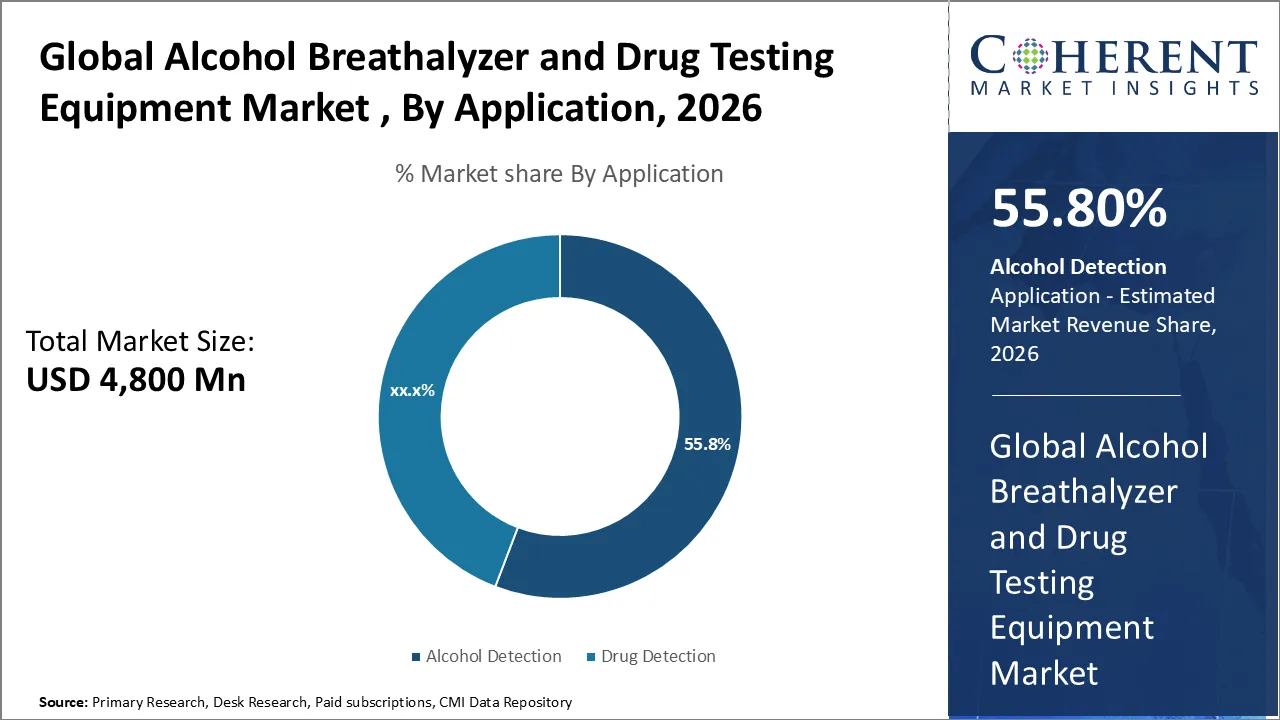
In terms of application, the alcohol detection segment contributes the highest share of 55.80% in 2026 of the market driven by the strict DUI laws and roadside screening mandates. The governments of various nations are enforcing zero tolerance policies and reducing the permissible limits of Blood Alcohol Concentrations to curb the rising number of road deaths. The enforcement of these norms, alongside raising awareness about the necessity of sobriety testing, is fueling the adoption of breathalyzers on handheld as well as in-vehicle systems. Furthermore, the expanding commercial logistics and transportation sectors necessitate constant sobriety monitoring to mitigate liability. These factors make alcohol detection the dominant application compared to broader multi drug screening solutions worldwide.
In terms of equipment type, the alcosensor (fuel cells) segment contributes the highest share of 28.50% in 2026 of the market owing to its widespread usage in enforcement and workplace alcohol testing programs. These devices employ an electrochemical fuel cell that gives them a high specificity to ethanol and can maintain calibration stability over long periods. Fuel cell sensors ignore common contaminants like acetone or tobacco smoke, which ensures they deliver the industry standard for evidentiary results. Their rugged durability and precision and high-volume testing environments make them the preferred choice for safety-sensitive industries. The agencies depend on such systems for providing credible and legally defensible screening results at key points of sobriety screening.
In terms of end user, the federal departments segment contributes the highest share of 38.50% in 2026 of the market, supported by mandatory enforcement and public safety testing programs. The segment encompasses national police forces, border security, and correctional facilities that require high-precision equipment to uphold judicial standards. Large-scale government contracts alongside safety initiatives and federal workplace mandates drive consistent and massive demand for these devices. Additionally, federal investments in public infrastructure and anti-trafficking operations ensure these departments remain the primary consumers. These agencies majorly work on high-end diagnostic and forensic hardware to assist in maintaining stringent compliance with national safety laws.
To learn more about this report, Download Free Sample
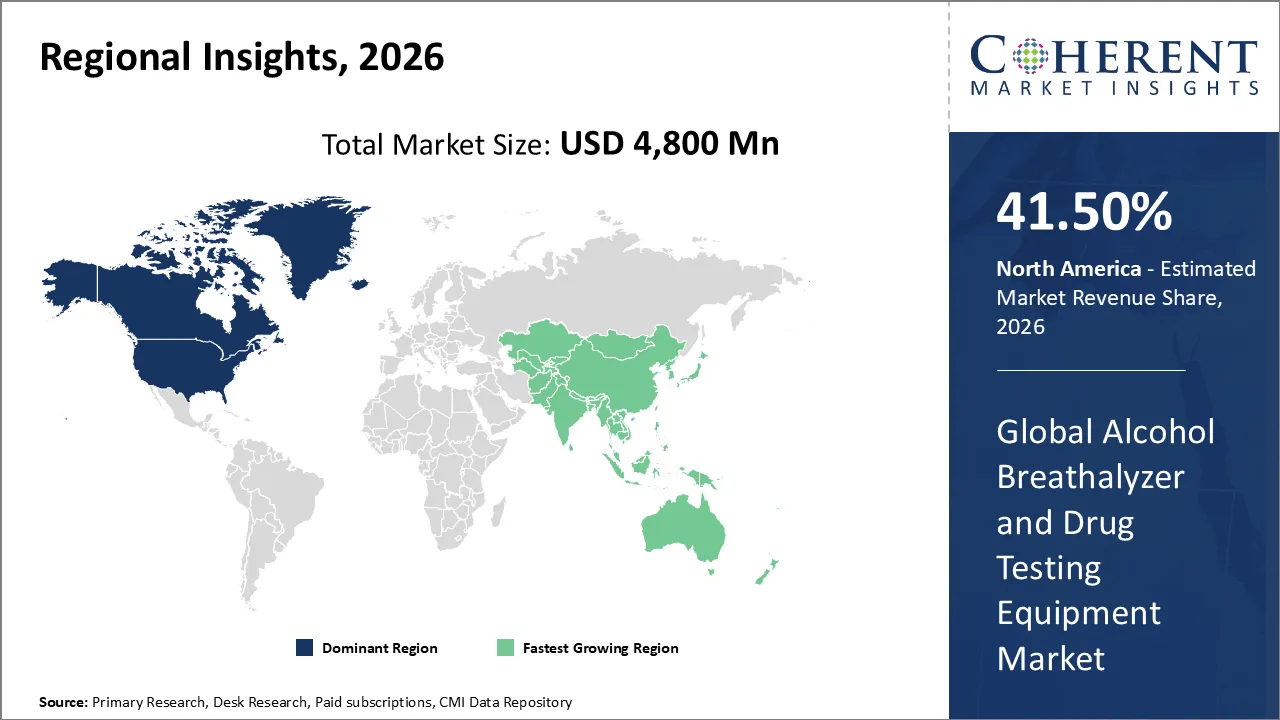
North America has remained the dominant region with 41.50% in 2026 of the global Alcohol Breathalyzer and Drug Testing Equipment Market over the past decade due to strict safety regulations. Federal mandates enforce regular testing in transportation and manufacturing sectors to safeguard public safety. The ongoing opioid crisis and cannabis legalization are speeding up the demand for advanced testing technologies. The main manufacturers focus on producing high-precision fuel cell sensors and comprehensive laboratory screening services. The integration of digital reporting software helps organizations in managing large volumes of employee health data in an effective manner. The government agencies continue to support the industry through rigorous certification standards for all screening hardware.
For instance, in July 2025, Mindr, the foremost provider of substance detection, monitoring, and safety solutions, announced an agreement with OurFamilyWizard, the world's most reputable co-parenting platform. Keepr® provides a discrete, cost-effective breathalyzer designed to assist in fulfilling compliance requirements frequently mandated by family law courts throughout the U.S.
Asia Pacific has become the fastest growing region as governments modernize their road safety enforcement policies. The rapid urbanization in countries like China and India increases the necessity for roadside alcohol monitoring. The law enforcement agencies frequently utilize portable handheld devices to deter driving under the influence. The local manufacturers produce affordable rapid testing kits to serve the expanding industrial and corporate markets. The rising awareness about the workplace safety is encouraging private firms to implement routine substance abuse screenings. The use of smartphone-connected testing tools enhances personal monitoring accessibility for a wider range of consumers in the region.
For instance, in September 2025, Roadcast, a prominent SaaS-based and hardware-agnostic tracking business backed by Jubilant FoodWorks, unveiled its entirely India-manufactured alcohol breath analyzer solution. This solution is aimed at preventing drunk driving, reducing road accidents, and improving workplace safety.
The US market is at the forefront due to its strong judicial system and growing need to ensure workplace safety and security. The law enforcement agencies are fueling the need to install breathalyzer technology in order to ensure road safety and prevent accidents caused by impaired driving. Private enterprises are carrying out screening processes to enhance productivity and prevent any kind of legal issues. The emergence of synthetic drugs has propelled the use of advanced equipment capable of detecting a wide array of substances with superior accuracy. Recent advancements have been in the field of cloud integration and mobile technology, allowing ease of data and tracking and reporting. Such advances enable businesses and law enforcement to achieve effective results.
For instance, in August 2025, Lifeloc Technologies, Inc., a prominent U.S. provider of portable alcohol and drug testing solutions, introduced its SpinDetect™ Centrifugal Drug Analyzer. The product was showcased through live demonstrations at the International Association of Chiefs of Police Impaired Driving and Traffic Safety Conference in Chicago.
China’s market is expanding rapidly, driven by stricter government regulations and a nationwide crackdown on driving under the influence. Public safety campaigns have provided their police forces, wherever located in metropolitan or rural settings, large volumes of portable testing devices. The healthcare sector is increasingly adopting these tools for emergency assessments and ongoing patient monitoring. The local manufacturers are fiercely competing in the market through the development of high-performance fuel cell sensors offering better results compared to older models. With industries such as construction and transportation embracing modernization, the businesses are introducing mandatory screening protocols to align with international safety standards. This evolution underscores a broader dedication to public health and industrial safety.
| Report Coverage | Details | ||
|---|---|---|---|
| Base Year: | 2025 | Market Size in 2026: | USD 4,800 Mn |
| Historical Data for: | 2020 To 2024 | Forecast Period: | 2026 To 2033 |
| Forecast Period 2026 to 2033 CAGR: | 6.9% | 2033 Value Projection: | USD 7,630 Mn |
| Geographies covered: |
|
||
| Segments covered: |
|
||
| Companies covered: |
Dragerwerk AG & Co. KGaA, Quest Products, Inc., Intoximeters, Lion Laboratories Ltd., C4 Development Ltd., Alere, Inc., Lifeloc Technologies, BACtrack, Securetec Detektions-Systeme AG, and Andatech Private Ltd. |
||
| Growth Drivers: |
|
||
| Restraints & Challenges: |
|
||
Uncover macros and micros vetted on 75+ parameters: Get instant access to report
The expansion of government-led workplace safety regulations is a main driver fueling growth in the market. Stricter alcohol and drug testing mandates, particularly in safety-sensitive industries, are compelling employers to institutionalize routine screening programs, thereby increasing long-term adoption rates. Law enforcement agencies must use reliable and accurate devices that meet legal standards for roadside enforcement and criminal proceedings. Continual reductions in legally acceptable blood alcohol thresholds are increasing the demand for precise and reliable testing equipment. Mandatory drug screening programs expand in safety-critical industries as governments prioritize accident prevention and public welfare.
For instance, in June 2025, KSEB has implemented breath analyzer testing to deter employees from consuming alcohol at the workplace. The vigilance cell resolved to carry out the test upon receiving multiple complaints regarding KSEB employees operating under the influence of alcohol.
The Alcohol Breathalyzer and Drug Testing Equipment Market is exhibiting sustained growth, supported by increasing adoption across law enforcement, workplace safety, healthcare, and transportation sectors. Industry assessments consistently indicate a strong upward trajectory, with global demand expected to nearly double over the next decade, reflecting expanding regulatory enforcement and rising emphasis on substance-use monitoring.
Regionally, North America remains the dominant contributor, accounting for over two-fifths of global demand, driven by strict impaired-driving laws, mandated workplace testing, and high institutional spending on public safety infrastructure. Meanwhile, Asia Pacific is emerging as the fastest-expanding regional market, supported by rapid industrialization, growth in commercial transportation, increasing road safety initiatives, and strengthening regulatory frameworks in high-population economies.
From a technology standpoint, fuel cell-based breathalyzers continue to be widely adopted for evidentiary and professional use due to superior accuracy and consistency. At the same time, oral fluid and multi-panel drug testing devices are gaining momentum, as they enable non-invasive sampling and rapid results, which are critical in roadside and workplace screening scenarios. Advances in semiconductor sensors, digital interfaces, and wireless data integration are further improving device reliability and operational efficiency.
End-use analysis indicates that law enforcement agencies remain the largest consumers, accounting for more than 40% of overall deployments. However, growing uptake in workplace safety programs and healthcare diagnostics is broadening the market base, reinforcing long-term demand stability.
*Definition: The Alcohol Breathalyzer and Drug Testing Equipment Market utilizes high-precision sensors and diagnostic software to detect and quantify substances in biological samples. This sector focuses on using advanced technologies such as fuel cell sensors, infrared spectroscopy, and immunoassay analyzers to screen for alcohol and various narcotics with extreme accuracy. These systems are widely used by law enforcement, corporate workplaces, and clinical facilities where rapid results and evidentiary reliability are essential for public safety and legal compliance. Specialized portable devices and integrated screening kits help in minimizing the time required for field testing while reducing the logistic burden of laboratory-based blood or urine analysis. The demand for these solutions comes from the government agencies, transportation firms, and private enterprises that must comply with strict occupational health and safety rules.
Share
Share
About Author
Manisha Vibhute is a consultant with over 5 years of experience in market research and consulting. With a strong understanding of market dynamics, Manisha assists clients in developing effective market access strategies. She helps medical device companies navigate pricing, reimbursement, and regulatory pathways to ensure successful product launches.
Missing comfort of reading report in your local language? Find your preferred language :
Transform your Strategy with Exclusive Trending Reports :
Frequently Asked Questions
Joining thousands of companies around the world committed to making the Excellent Business Solutions.
View All Our Clients
 Schedule a meeting with report Author