

Alcoholic Hepatitis Treatment Market Size and Trends - 2026 to 2033
Alcoholic hepatitis treatment market is estimated to be valued at USD 3.61 Bn in 2026 and is expected to reach USD 5.33 Bn by 2033, exhibiting a compound annual growth rate (CAGR) of 6.5% from 2026 to 2033.
Key Takeaways
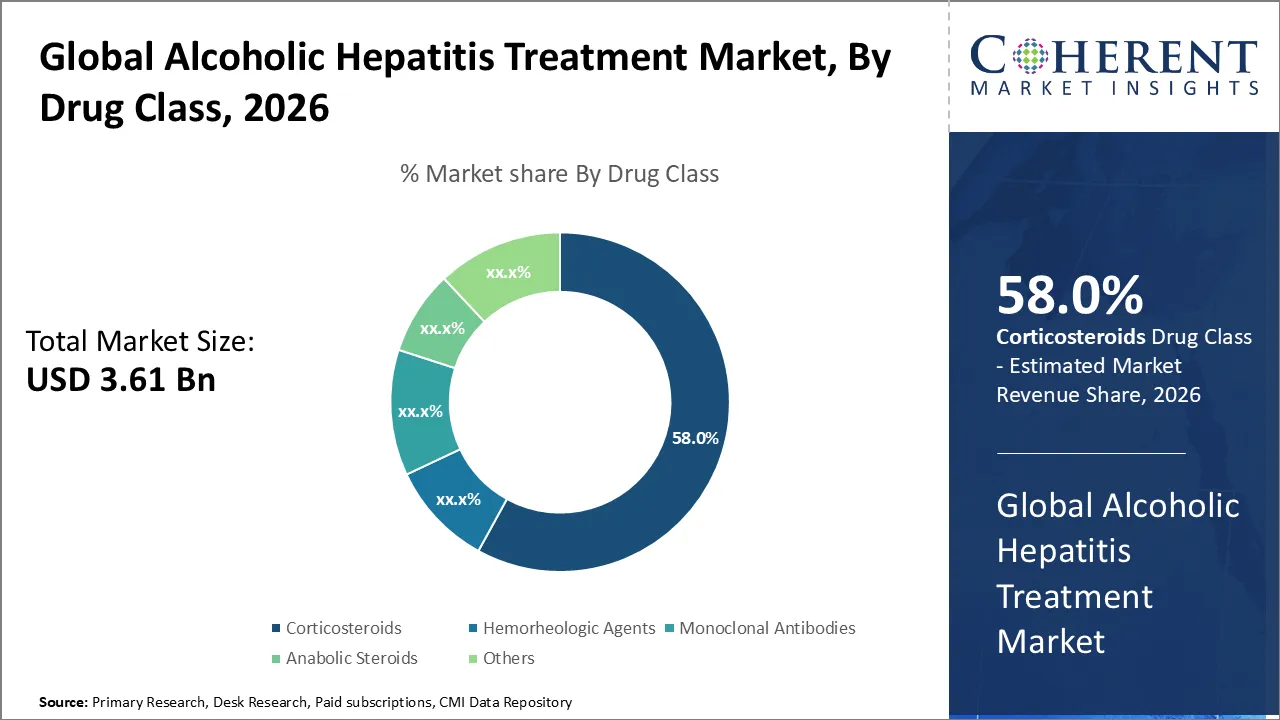
- Based on Drug Class, the Corticosteroids segment is expected to lead the market with approximately 58% share in 2026, due to their established clinical efficacy, widespread adoption as first-line therapy, and strong presence in standard treatment guidelines.
- Based on Distribution Channel, the Hospital Pharmacies segment is expected to dominate the market with around 62% share in 2026, due to the inpatient nature of alcoholic hepatitis management and high dependence on hospital-based treatment protocols.
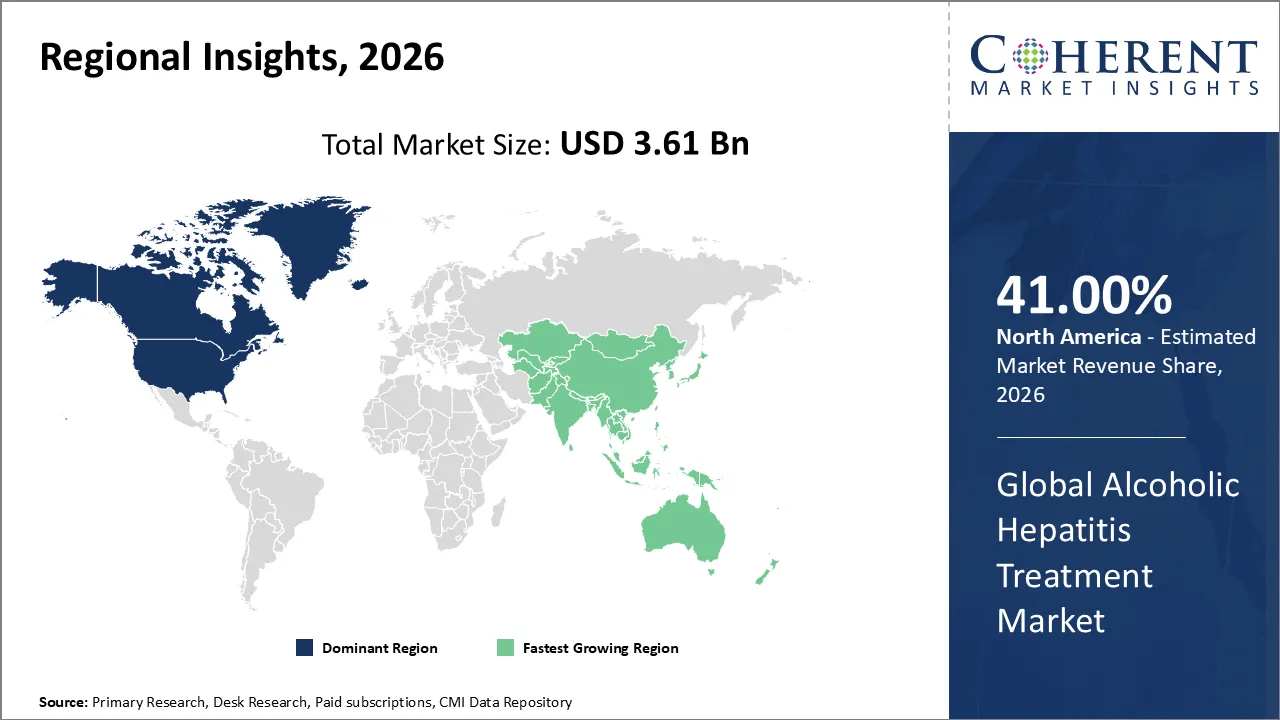
- Based on Region, North America is set to lead the alcoholic hepatitis treatment market with 41% share in 2026. While, Asia Pacific is anticipated to be the fastest growing region.
Market Overview
The increasing prevalence of ALD, as well as rising consumption in both developed and emerging markets, is anticipated to be a driving factor for the growth of the alcoholic hepatitis treatment market. Alcoholic hepatitis is a severe inflammatory liver disease that usually necessitates immediate medical attention, thereby increasing demand for effective pharmacological treatments like corticosteroids and supportive treatment options. This has been further increased by rising awareness among physicians regarding early diagnosis and timely treatment.
Current Events and Its Impact
Current Events | and its impact |
Rising Global Alcohol Consumption Patterns and Policy Responses |
|
Pharmaceutical Innovation and Regulatory Landscape Evolution |
|
Segmental Insights
- Current Industry Events of 2026
- Market Size Estimation
- Regional Breakdown
- Competitive Landscape
- Customer Intelligence
- Segmental Analysis
- Pricing Analysis
- Key Market Drivers, Challenges & Future Trends
- Customized Insights Section
Alcoholic Hepatitis Treatment Market Insights, By Drug Class – Corticosteroids dominate due to established clinical efficacy
Based on drug class, corticosteroids are expected to account for the largest share of about 58% in 2026 because it is a long-standing first-line treatment of moderate to severe alcoholic hepatitis. Corticosteroid medications, such as prednisolone, represent the most common prescriptions owing to their established effectiveness in reducing liver inflammation and enhancing short-term survival in eligible subjects. Their incorporation into standard clinical management recommendations and strong acceptance among medical practitioners have further strengthened their leading position within the market. Additionally, generic availability and well-established dosing regimens have continued to underpin high adoption rates across hospital settings.
For instance, in December 2025, a study published in Scientific Reports showed that corticosteroid therapy in severe alcohol-associated hepatitis patients significantly lowered the risk of acute kidney injury (AKI), highlighting a protective effect beyond liver inflammation control.
Alcoholic Hepatitis Treatment Market Insights, By Distribution Channel – Hospital pharmacies lead due to inpatient treatment dependence
In terms of distribution channel, the hospital pharmacies segment is estimated to account for the highest market share of around 62% in 2026, driven by the acute and life-threatening nature of alcoholic hepatitis, which often necessitates hospitalization. Most of the subjects are going to require intensive medical supervision along with diagnostic evaluation and immediate pharmacological intervention. Hence, the primary point of care is in the hospitals. Hospital pharmacies ensure timely access to corticosteroids and support therapies with strict adherence to the treatment protocols under specialist supervision. Strong reliance on inpatient management has been continuing to place the segment of hospital pharmacies as the dominant distribution channel in the alcoholic hepatitis treatment market.
For instance, in July 2025, the U.S. Centers for Medicare & Medicaid Services (CMS) published a proposed rule revising the Hospital Outpatient Prospective Payment System (OPPS) and related quality reporting programs, which will impact how hospitals manage services and payment structures in 2026.
Regional Insights
North America Alcoholic Hepatitis Treatment Market Analysis & Trends
North America is projected to lead the alcoholic hepatitis treatment market by 2026, with an expected market share of 41%. The alcoholic hepatitis treatment market in the North American region can be associated with factors such as well-developed healthcare systems, a higher number of cases related to alcoholic liver diseases, advanced diagnostic and treatment options, and presence of various pharma giants working on innovative approaches.
For instance, in July 2025, the U.S. Food and Drug Administration (FDA) approved expanded access to corticosteroid and biologic therapies for severe alcoholic hepatitis in hospital settings, enabling wider use through hospital pharmacies and specialty care units. This regulatory support strengthens North America’s position as the leading regional market.
Asia Pacific Alcoholic Hepatitis Treatment Market Analysis & Trends
The Asia Pacific market is expected to be the fastest-growing in terms of alcoholic hepatitis treatments because of increased alcoholic intake, growing knowledge about liver health, and increasing healthcare infrastructure, among other factors. Rising new pharmaceutical manufacturers as well as government initiatives for earlier diagnosis and treatments in Asian nations such as China, India, and Japan can also be credited for the growth.
For instance, in March 2025, the Ministry of Health and Family Welfare in India launched a national liver health program that includes initiatives for early detection and hospital-based management of alcoholic hepatitis, promoting wider access to treatment and supporting regional market growth.
U.S. Alcoholic Hepatitis Treatment Market Outlook
Is the U.S. market for alcoholic hepatitis treatments expanding due to healthcare infrastructure, early diagnosis, and advanced therapies?
The U.S. alcoholic hepatitis treatment market is experiencing steady growth, primarily driven by the high prevalence of alcohol-related liver disorders across the country. he fact that the country’s hospitals have advanced facilities, equipped health centers, and the necessary human resources for diagnosis and proper management of the disease works in favor of the market’s growth. Moreover, the use of standard first-line Alcoholic hepatitis therapies, such as corticosteroids, and the emergence of biologics/immunomodulators, helps in reducing the disease’s outcomes and thus contributes to the growth of the market.
For instance, in July 2025, the U.S. FDA approved expanded access programs for corticosteroid and immune-modulating therapies in hospital settings, enabling broader treatment coverage for severe alcoholic hepatitis patients. This regulatory support strengthens U.S. market growth by combining advanced treatment options with structured hospital pharmacy distribution.
China Alcoholic Hepatitis Treatment Market Outlook
Is China witnessing growth in alcoholic hepatitis treatments due to rising alcohol consumption and liver health awareness?
The Chinese market for alcoholic hepatitis treatment is undergoing substantial growth due to many factors. The rising consumption of alcohol and lifestyle changes among the population have increased the number of liver-related disorders caused by this substance, thereby leading to greater demand for treatment. Increasing awareness among the citizens about liver health, as well as the efforts by the government to promote early treatment and hospitalization, is driving this market.
For instance, in March 2025, China’s National Health Commission (NHC) issued updated clinical guidelines for liver disease management, encouraging hospital-based treatment protocols for alcoholic hepatitis and increasing patient access to corticosteroid and supportive therapies.
Market Report Scope
Alcoholic Hepatitis Treatment Market Report Coverage
| Report Coverage | Details | ||
|---|---|---|---|
| Base Year: | 2025 | Market Size in 2026: | USD 3.61 Bn |
| Historical Data for: | 2020 To 2024 | Forecast Period: | 2026 To 2033 |
| Forecast Period 2026 to 2033 CAGR: | 6.5% | 2033 Value Projection: | USD 5.33 Bn |
| Geographies covered: |
| ||
| Segments covered: |
| ||
| Companies covered: | Apotex Inc., Gilead Sciences, Inc., Johnson & Johnson Services Inc. (Janssen Pharmaceuticals), Alkermes plc, Mallinckrodt Pharmaceuticals, DURECT Corporation, Novartis AG, Teva Pharmaceutical Industries Ltd., Aventis Pharma Ltd., Cipla Ltd., AbbVie Inc., Pfizer Inc., AstraZeneca plc, Intercept Pharmaceuticals, Inc., and Conatus Pharmaceuticals, Inc. | ||
| Growth Drivers: |
| ||
| Restraints & Challenges: |
| ||
Market Dynamics
Alcoholic Hepatitis Treatment Market Driver
The main driving factors for the alcoholic hepatitis treatment market have been the increase in alcohol-related liver disorders across the world. Since there are more patients with a diagnosis of severe alcoholic hepatitis, there is higher demand for effective therapies using corticosteroids, biologics, and supportive care. Hospitals and specialized clinics will take the central role in the management of these patients and hence drive the adoption of hospital-based pharmacologic treatments that boost the market.
Alcoholic Hepatitis Treatment Market Opportunity
Innovations in treatment and increased access to treatment
Market opportunities are provided by the emergence of innovative therapies such as immunomodulating agents, biologic agents, and combinations of therapies that have the potential to make an impact on patient outcomes. Increased access to treatment in developing countries and awareness about early diagnosis programs may help contribute to increased growth of the market. Drug makers can focus on clinical research collaborations and hospital-based projects that have the potential to introduce innovative therapies to AH patients.
Analyst Opinion (Expert Opinion)
The alcoholic hepatitis treatment market is evolving rapidly, driven by growing recognition of alcohol-related liver disorders as a critical public health issue. According to clinical research, almost 20-30% of those consuming heavy amounts of alcohol suffer from severe liver inflammation that needs to be treated through medication. Hospitals and dedicated facilities are being increasingly focused on for the treatment of this disease, which requires close observation while being treated with drugs such as corticosteroids.
Recently, emerging studies have shown that the response rate to conventional corticosteroid treatment is still inconsistent, with about one-third of patients having a poor prognosis. This has triggered an upsurge of clinical trials on the efficacy of biologic agents, monoclonal antibodies, and combination treatment, which marks the beginning of the era of precision medicine. Notably, the integration of hospital pharmacy and sophisticated diagnostic approaches has optimized early treatment and minimized the possibility of complications such as liver failure and acute kidney injury.
Additionally, regional trends are shaping market dynamics. North America demonstrates high adoption of innovative therapies due to robust healthcare infrastructure, while Asia Pacific shows rapid growth potential driven by rising alcohol consumption and government-backed liver health programs.
Speak to the analyst
Want personalized insights?
Take the findings above to one of our principal consultants, or have the report rebuilt around the segments, geographies and competitors you actually track.
Alcoholic Hepatitis Treatment Industry News
- In June 2025, AbbVie announced expanded FDA approval of MAVYRET® (glecaprevir/pibrentasvir) for treatment of acute and chronic hepatitis C virus infection.
- In April 2025, Gilead Sciences announced it will present new liver disease research (including hepatitis B, delta, and primary biliary cholangitis) at the European Association for the Study of the Liver (EASL) Congress.
- In April 2024, DURECT Corporation announced acceptance of a late‑breaking oral presentation of Phase 2b AHFIRM data at the European Association for the Study of the Liver (EASL) Congress, focusing on larsucosterol in alcohol‑associated hepatitis.
Market Segmentation
- Drug Class Insights (Revenue, USD Bn, 2026 - 2033)
- Corticosteroids
- Hemorheologic Agents
- Monoclonal Antibodies
- Anabolic Steroids
- Others
- Distribution Channel Insights (Revenue, USD Bn, 2026 - 2033)
- Hospital Pharmacies
- Retail Pharmacies
- Online Pharmacies
- Regional Insights (Revenue, USD Bn, 2026 - 2033)
- North America
- U.S.
- Canada
- Latin America
- Brazil
- Argentina
- Mexico
- Rest of Latin America
- Europe
- Germany
- U.K.
- Spain
- France
- Italy
- Russia
- Rest of Europe
- Asia Pacific
- China
- India
- Japan
- Australia
- South Korea
- ASEAN
- Rest of Asia Pacific
- Middle East
- GCC Countries
- Israel
- Rest of Middle East
- Africa
- South Africa
- North Africa
- Central Africa
- North America
- Key Players Insights
- Apotex Inc.
- Gilead Sciences, Inc.
- Johnson & Johnson Services Inc. (Janssen Pharmaceuticals)
- Alkermes plc
- Mallinckrodt Pharmaceuticals
- DURECT Corporation
- Novartis AG
- Teva Pharmaceutical Industries Ltd.
- Aventis Pharma Ltd.
- Cipla Ltd.
- AbbVie Inc.
- Pfizer Inc.
- AstraZeneca plc
- Intercept Pharmaceuticals, Inc.
- Conatus Pharmaceuticals, Inc.
Sources
Primary Research Interviews
- Pharmaceutical & Biotechnology Company Executives
- Clinical Researchers & Hepatologists
- Hospital Pharmacy Directors & Managers
- Medical Affairs & Regulatory Professionals
- Clinical Trial Coordinators & Investigators
- Patient Advocacy Groups
- Healthcare Consultants & Advisors
- Others
Databases
- PubMed
- ClinicalTrials.gov
- FDA & EMA Databases
- Web of Science
- Scopus
- WHO Global Health Observatory
- Others
Magazines
- Pharmaceutical Executive
- FiercePharma
- BioPharma Dive
- PharmaVOICE
- Pharmaceutical Technology
- Others
Journals
- Journal of Hepatology
- Hepatology International
- Liver International
- Clinical Gastroenterology and Hepatology
- Alimentary Pharmacology & Therapeutics
- Others
Newspapers
- The Wall Street Journal (Health & Pharmaceuticals Section)
- Financial Times (Healthcare Section)
- Reuters Health
- Bloomberg News (Life Sciences Section)
- The New York Times (Health Section)
- Others
Associations
- American Association for the Study of Liver Diseases (AASLD)
- European Association for the Study of the Liver (EASL)
- International Liver Foundation (ILF)
- American Liver Foundation (ALF)
- Others
Public Domain Sources
- FDA Official Publications & Press Releases
- EMA Official Publications & Reports
- WHO Reports on Liver Disease
- CDC – National Center for Health Statistics (NCHS)
- National Institutes of Health (NIH) Reports
- Others
Proprietary Elements
- CMI Data Analytics Tool
- Proprietary CMI Existing Repository of Information for the Last 8 Years
Get access to 250+ pages report
Every segment, forecast, competitor profile and data table behind the analysis above — available for instant download.
- ESOMAR Member
- ISO 9001:2015 Certified
- D-U-N-S Registered
- GDPR & CCPA Compliant
Missing comfort of reading report in your local language? Find your preferred language:
Transform your Strategy with Exclusive Trending Reports
Frequently Asked Questions
The alcoholic hepatitis treatment market is estimated to be valued at USD 3.61 Bn in 2026, and is expected to reach USD 5.33 Bn by 2033.
The CAGR of the alcoholic hepatitis treatment Market is projected to be 6.5% from 2026 to 2033.
Rising prevalence of alcohol-related liver disorders, increased adoption of hospital-based pharmacological treatments, and ongoing clinical research for novel therapies are the major factors driving market growth.
Limited availability of advanced therapies in emerging markets and side effects or low response rates associated with conventional treatments are the key factors hampering market growth.
Corticosteroids are expected to lead the market in 2026 due to their established clinical efficacy and widespread adoption as first-line therapy.
Gilead Sciences, AbbVie, Johnson & Johnson (Janssen Pharmaceuticals), Novartis AG, Pfizer Inc., AstraZeneca plc, Mallinckrodt Pharmaceuticals, Intercept Pharmaceuticals, DURECT Corporation, Conatus Pharmaceuticals, Apotex Inc., Alkermes plc, Teva Pharmaceutical Industries Ltd., Aventis Pharma Ltd., and Cipla Ltd. are some of the key players.
North America is expected to lead the alcoholic hepatitis treatment market in 2026.