

U.S. Unfractionated Heparin Market Size and Trends: 2026-2033
The U.S. Unfractionated Heparin Market is estimated to be valued at USD 3.1 Bn in 2026 and is expected to reach USD 4.59 Bn by 2033, growing at a compound annual growth The rate (CAGR) of 5.1% from 2026 to 2033.
Key Takeaways
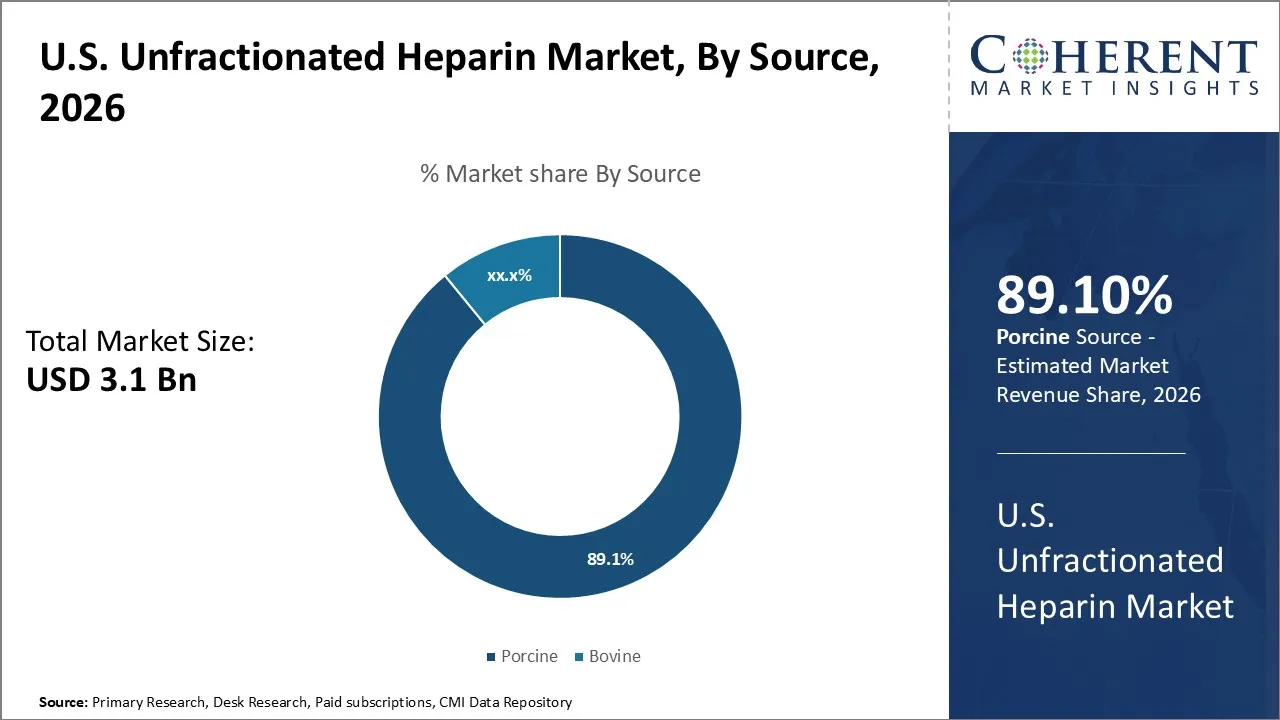
- Based on Source, the Porcine segment is expected to lead the market with 89.10 % share in 2026, due to its established clinical dominance.
- Based on Injection Type, the IV Injection segment is expected to hold 63.40 % share of the market in 2026 reflecting the UFH’s primary use in acute care settings.
- Based on Disease Indication, the Venous Thromboembolism segment is expected to hold 42.70 % share of the market in 2026 supported by high incidence of DVT/PE.
Market Overview
The U.S. unfractionated heparin market is advancing significantly, driven by its critical role in managing anticoagulation during complex cardiovascular procedures, hemodialysis, and the expansion of high-acuity surgical environments. The increasing demand for rapid-onset anticoagulants and tightening clinical safety standards are expected to drive market growth over the forecast period.
Unfractionated heparin (UFH) solutions are high-intensity pharmacological agents mainly utilized in hospital settings to prevent the formation of blood clots, delivering a fast-acting systemic response that allows clinicians to manage blood thinness with a superior role in acute procedural control and safety. These treatments play a crucial role in modern healthcare sectors such as cardiac surgery, vascular surgery, and nephrology. This is owing to their ability to provide precise titration and ensure immediate neutralizability during prolonged or high-risk interventions.
Current Events and Its Impacts on the U.S. Unfractionated Heparin Market
Current Event | Description and the Impact |
Technological and Manufacturing Innovations
|
|
Regulatory Harmonization and Quality Control Initiatives
|
|
Healthcare Sector Digital Transformation and AI Integration
|
|
Segmental Insights
- Current Industry Events of 2026
- Market Size Estimation
- Regional Breakdown
- Competitive Landscape
- Customer Intelligence
- Segmental Analysis
- Pricing Analysis
- Key Market Drivers, Challenges & Future Trends
- Customized Insights Section
U.S. Unfractionated Heparin Market Insights, By Source – Porcine Leads Due to its Established Clinical Dominance
In terms of source, the porcine segment contributes the highest share of 89.10% in 2026 of the U.S. Unfractionated Heparin Market. The growth is owing to strict regulatory standards established by the FDA, which favors heparin sourced from porcine intestinal mucosa because of its established safety profile and potent anticoagulant properties. Historically, the American medical system has prioritized the use of products derived from pigs to maintain consistency and reduce the risks linked to specific bovine diseases. This focus has fostered the creation of advanced and centralized supply chains capable of processing large volumes of porcine materials to meet ongoing clinical demands.
The preference for porcine-sourced heparin is also attributable its dependable performance in critical medical settings like cardiac surgeries and dialysis treatments. The healthcare professionals depend on the consistent nature of this source to maintain blood fluidity during complex procedures. The porcine segment continues to be the main driver of the market. The transition to alternative sources presents substantial regulatory challenges and requires demonstrating biological equivalence. It is a benchmark that the porcine source has successfully established over decades of use.
U.S. Unfractionated Heparin Market Insights, By Injection Type – IV Injection Leads with UFH’s Primary Use in Acute Care Settings
In terms of injection type, the IV injection segment contributes the highest share of 63.40% in the U.S. Unfractionated Heparin Market in 2026. The growth is owing to the clinical need for immediate anticoagulation in acute care settings. Heparin bypasses the absorption phase which is necessary for other delivery methods when it is given intravenously. This allows it to act on the blood's clotting factors almost immediately. This rapid onset is crucial for surgeons and interventionalists conducting high-risk procedures, where the opportunity to prevent thrombus formation is very limited. Consequently, the majority of heparin administered in American hospitals is given through IV bolus or continuous infusion. The common use of IV administration is also due to its compatibility with specialized medical equipment.
Heparin is frequently introduced directly into the blood circuit through IV access points for patients undergoing hemodialysis or those supported by extracorporeal membrane oxygenation. This method ensures that the anticoagulant is distributed evenly throughout the external machinery, preventing the blood from clotting as it passes through filters and tubing. The ability to accurately adjust medication dosing through continual intravenous titration allows healthcare providers to maintain a patient's anticoagulation levels within a designated therapeutic range.
U.S. Unfractionated Heparin Market Insights, By Disease Indication – Venous Thromboembolism Leads with High Incidence of DVT/PE
In terms of disease indication, the venous thromboembolism segment contributes the highest share of 42.70% in the U.S. Unfractionated Heparin Market in 2026. The growth is owing to high clinical prevalence of deep vein thrombosis and pulmonary embolism in the U.S. Unfractionated heparin is the main treatment option for the initial management of acute venous thromboembolism (VTE) because it provides an immediate anticoagulant effect. The clinicians prioritize its use for patients who are hemodynamically unstable or those who may require rapid surgical intervention, as its effects can be quickly reversed. The adaptability of unfractionated heparin is crucial for meeting the complex needs of patients transitioning between medical and surgical care.
The growth is also owing to the established standard of care for surgical prophylaxis. The patients undergoing major orthopedic, abdominal, or thoracic surgeries face a substantially increased risk of developing blood clots mainly due to prolonged immobility and tissue trauma. In these situations, unfractionated heparin is often administered to prevent the onset of VTE. The rising number of these surgeries in the US driven by an aging population and an increase in chronic comorbidities, ensures a consistent and growing demand for heparin.
Market Report Scope
U.S. Unfractionated Heparin Market Report Coverage
| Report Coverage | Details | ||
|---|---|---|---|
| Base Year: | 2025 | Market Size in 2026: | USD 3.1 Bn |
| Historical Data for: | 2020 To 2024 | Forecast Period: | 2026 To 2033 |
| Forecast Period 2026 to 2033 CAGR: | 5.1% | 2033 Value Projection: | USD 4.59 Bn |
| Segments covered: |
| ||
| Companies covered: | Pfizer, Inc., Sagent Pharmaceuticals, Inc., B. Braun Melsungen AG, Baxter International Inc., and Bayer AG. | ||
| Growth Drivers: |
| ||
| Restraints & Challenges: |
| ||
U.S. Unfractionated Heparin Market Drivers
Rising demand for anticoagulants in surgeries and dialysis
The U.S. unfractionated heparin (UFH) market is experiencing growth owing to the rising demand for anticoagulants in high-stakes clinical settings. Unfractionated heparin is preferred for acute surgical interventions, particularly in cardiovascular and orthopedic procedures. This is attributable to its rapid onset of action and the existence of a reliable reversal agent named protamine. The critical role heparin plays in maintaining circuit patency for life-support technologies like Extra-Corporeal Membrane Oxygenation (ECMO) and cardiopulmonary bypass is also contributing to the market growth.
The U.S. dialysis sector serves as a massive and consistent volume driver for the UFH market. UFH remains the primary anticoagulant for maintenance hemodialysis in the United States. With over 37 million U.S. adults affected by chronic kidney disease (CKD), the demand for dialysis services is growing. Approximately 71% of U.S. dialysis patients rely on heparin to prevent clotting within the dialysis machine's filter and tubing. UFH is a cost-effective treatment that can be easily monitored using aPTT tests. It is crucial for patients with end-stage renal disease. It maintains an indispensable foothold in the American healthcare system. The increasing aging population and the prevalence of chronic conditions is propelling the need of heparin in both surgical suites and dialysis centers ensures the market's robust expansion throughout the forecast period.
Analyst Opinion (Expert Opinion)
- The U.S. unfractionated heparin (UFH) market demonstrates sustained momentum due to its indispensable role in acute and procedural anticoagulation. UFH remains widely utilized across hospitals, accounting for a significant share of inpatient anticoagulant use, particularly in intensive care units, cardiac catheterization laboratories, and operating rooms. Its rapid onset of action and full reversibility with protamine sulfate continue to support preference in high-risk and time-sensitive clinical settings.
- Epidemiological indicators strongly support demand fundamentals. The U.S. reports hundreds of thousands of venous thromboembolism cases annually, with incidence rising sharply among older populations and patients undergoing major surgery or prolonged hospitalization. UFH is routinely integrated into treatment pathways for these patients, reinforcing consistent consumption volumes. Additionally, extracorporeal procedures such as hemodialysis and cardiopulmonary bypass rely heavily on UFH due to predictable anticoagulant control and extensive clinical familiarity.
- From a supply perspective, the market is influenced by dependence on biologically derived active pharmaceutical ingredients, primarily sourced from porcine intestinal mucosa. These characteristic drives heightened regulatory oversight, quality audits, and traceability requirements across the value chain. On the demand side, hospitals increasingly favor prefilled syringes and infusion-ready formulations to minimize dosing errors and improve workflow efficiency.
- Overall, the U.S. unfractionated heparin market remains structurally resilient, supported by entrenched clinical protocols, high procedural volumes, and the continued necessity for tightly controlled anticoagulation in critical care environments.
Speak to the analyst
Want personalized insights?
Take the findings above to one of our principal consultants, or have the report rebuilt around the segments, geographies and competitors you actually track.
U.S. Unfractionated Heparin Industry News
- In July 2025, Braun Medical Inc. has announced the availability of its new Heparin Sodium Injections in the U.S. market, thus broadening its product lineup to include 25,000 Units of Heparin in 0.45% Sodium Chloride Injection.
- In April 2025, Baebies has been granted Breakthrough Device Designation by the U.S. Food and Drug Administration (FDA) for its Anti-Factor Xa test on the FINDER® platform, marking it as the first point-of-care assay for heparin monitoring.
- In January 2022, Optimvia and Ginkgo Bioworks have formed a joint venture aimed at improving the manufacturing efficiency of biosynthetic heparin, an important drug that is currently produced from industrial animal agriculture.
- In February 2020, Meitheal Pharmaceuticals has received approval from the U.S. Food and Drug Administration (FDA) for a new vial manufacturing line at the facility owned by its majority shareholder, Nanjing King-Friend Biochemical Pharmaceutical Co., Ltd., located in Nanjing, China. The company also revealed plans to broaden its manufacturing capacity to boost heparin production amid global supply issues.
Market Segmentation
- Source Insights (Revenue, USD Bn, 2026 - 2033)
- Porcine
- Bovine
- Injection Type Insights (Revenue, USD Bn, 2026 - 2033)
- IV Injection
- Subcutaneous Injection
- Disease Indication Channel Insights (Revenue, USD Bn, 2026 - 2033)
- Venous Thromboembolism
- Cardioversion of Atrial Fibrillation
- Pulmonary Embolism & Arterial Embolism
- Key Players Insights
- Pfizer, Inc.
- Sagent Pharmaceuticals, Inc.
- Braun Melsungen AG
- Baxter International Inc.
- Bayer AG
Sources
Primary Research Interviews
- Unfractionated Heparin API Manufacturers
- Finished Dosage Form (Injectables) Manufacturers
- Contract Manufacturing Organizations (CMOs)
- Hospital Pharmacy Procurement Heads
- Hematologists & Thrombosis Specialists
- Regulatory & Quality Assurance Professionals
- Others
Databases
- Bloomberg Terminal
- Thomson Reuters Eikon
- IQVIA MIDAS & National Sales Perspectives
- Others
Magazines
- Pharmaceutical Technology
- BioPharma Dive
- Contract Pharma
- Pharmaceutical Manufacturing
- American Journal of Health-System Pharmacy (AJHP) News
- Others
Journals
- Thrombosis Research
- Journal of Thrombosis and Haemostasis
- Blood (ASH Publications)
- Clinical and Applied Thrombosis/Hemostasis
- International Journal of Pharmaceutics
- Others
Newspapers
- The Wall Street Journal
- Financial Times
- The New York Times – Health Section
- Reuters
- Bloomberg News
- Others
Associations
- American Society of Hematology (ASH)
- International Society on Thrombosis and Haemostasis (ISTH)
- Pharmaceutical Research and Manufacturers of America (PhRMA)
- U.S. Pharmacopeia (USP)
- Healthcare Distribution Alliance (HDA)
- Others
Public Domain Sources
- U.S. Food and Drug Administration (FDA) – Drug Shortage & DMF Databases
- Centers for Disease Control and Prevention (CDC)
- National Institutes of Health (NIH)
- Centers for Medicare & Medicaid Services (CMS)
- U.S. International Trade Commission (USITC)
- Others
Proprietary Elements
- CMI Data Analytics Tool
- Proprietary CMI Existing Repository of Information for the Last 8 Years
Get access to 250+ pages report
Every segment, forecast, competitor profile and data table behind the analysis above — available for instant download.
- ESOMAR Member
- ISO 9001:2015 Certified
- D-U-N-S Registered
- GDPR & CCPA Compliant
Missing comfort of reading report in your local language? Find your preferred language:
Transform your Strategy with Exclusive Trending Reports
Frequently Asked Questions
The U.S. Unfractionated Heparin Market is estimated to be valued at USD 3.1 Bn in 2026, and is expected to reach USD 4.59 Bn by 2033.
The CAGR of the U.S. Unfractionated Heparin Market is projected to be 5.1% from 2026 to 2033.
Favorable government regulations for heparin and increasing cases of thrombosis are some of the major factors that are expected to drive growth of the U.S. Unfractionated Heparin Market.
The superior clinical adoption of Low-Molecular Weight Heparin (LMWH) for its better safety profile and risks of Heparin-Induced Thrombocytopenia (HIT) and severe bleeding are the major factors that are expected to hamper the growth of the U.S. Unfractionated Heparin Market.
In terms of source, the porcine segment is estimated to dominate the market revenue share in 2026.
Major player operating in the U.S. Unfractionated Heparin Market include Pfizer, Inc., Sagent Pharmaceuticals, Inc., B. Braun Melsungen AG, Baxter International Inc., and Bayer AG.
In terms of injection type, the IV injection segment is estimated to dominate the market revenue share in 2026.