

U.S. Medical Foods Market Size and Trends - 2026 to 2033
The U.S. Medical Foods Market is estimated to be valued at USD 9.2 Bn in 2026 and is expected to reach USD 13.19 Bn by 2033, growing at a compound annual growth The rate (CAGR) of 5.3% from 2026 to 2033.
Key Takeaways
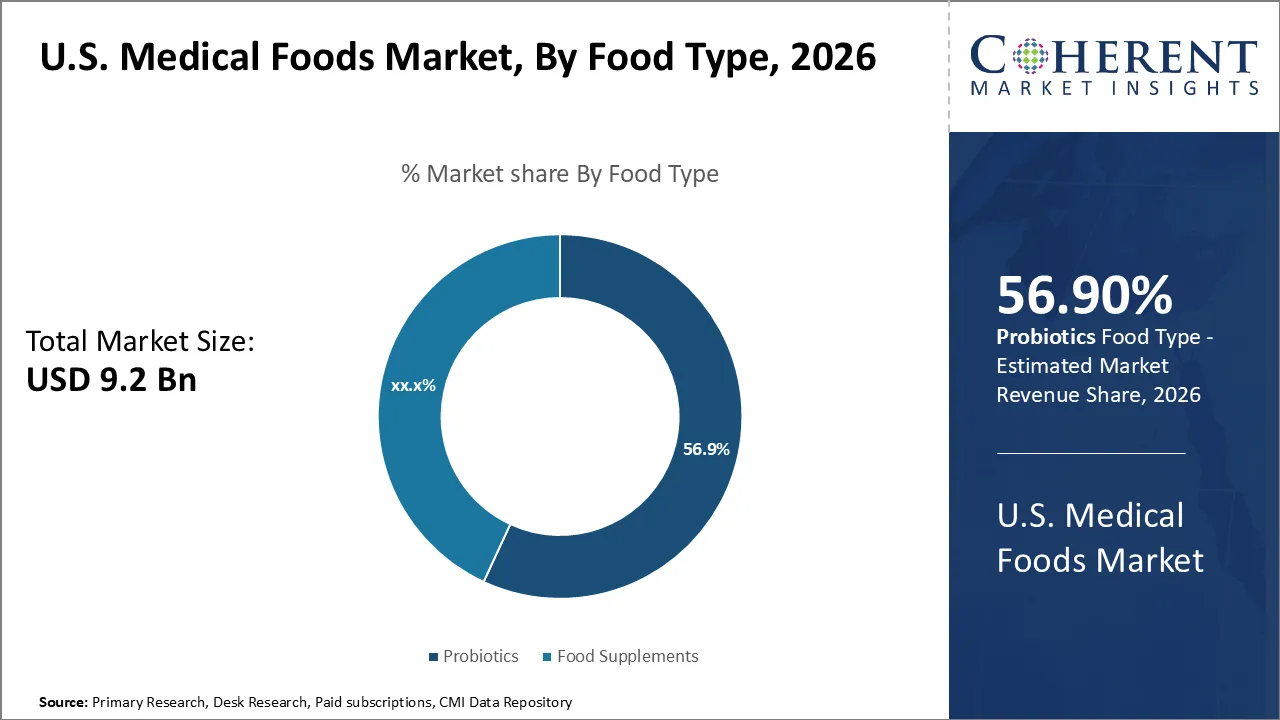
- Based on Food Type, the Probiotics segment is expected to lead the market with 56.90% share in 2026, due to high adoption of probiotics and increasing clinical recommendations for gut‑health targeted medical foods.
- Based on Disease Indication, the Irritable Bowel Syndrome segment is expected to hold 38.90% share of the market in 2026 reflecting the high prevalence of IBS in the U.S. and strong medical food utilization for symptomatic relief.
- Based on Distribution Channel, the Hospitals segment is expected to hold 36.40% share of the market in 2026 due to clinical prescription and physician guidance.
Market Overview
The U.S. Medical Foods Market is advancing significantly, driven by the rising use in the dietary management of chronic conditions and personalized clinical nutrition. An aging geriatric population, expanding research into the gut microbiome, and the growing prevalence of metabolic disorders are expected to drive market growth over the forecast period.
Medical foods are specialized formulations intended for the specific dietary management of a disease or condition that has specific nutritional requirements. Medical food analysis and formulation are important processes in the healthcare and nutritional science industries to ensure products meet required FDA regulatory standards under the Orphan Drug Act.
The medical food industry is undergoing a strong growth phase. This is owing to improvements in nutrigenomics and the adoption of improved enteral delivery systems. There is a growing demand for specialized nutritional therapy targeting conditions such as Alzheimer's disease, diabetes, and gastrointestinal disorders. These advancements have enhanced the therapeutic potential of medical foods and increased both their effectiveness and patient compliance. This marks an important pause in the US healthcare industry.
Current Events and their Impacts on the U.S. Medical Foods Market
Current Event | Description and the Impact |
Technological Innovations and R&D Advances |
|
Demographic and Epidemiological Trends |
|
Competitive and Market Landscape Shifts
|
|
Segmental Insights
- Current Industry Events of 2026
- Market Size Estimation
- Regional Breakdown
- Competitive Landscape
- Customer Intelligence
- Segmental Analysis
- Pricing Analysis
- Key Market Drivers, Challenges & Future Trends
- Customized Insights Section
U.S. Medical Foods Market Insights, By Food Type – Probiotics Leads Due to its High Adoption of Probiotics
In terms of food type, the probiotics segment contributes the highest share of 56.90% in 2026 of the U.S. medical foods market as attention shifts toward using the gut microbiome for chronic condition management. The growth is owing to the growing consumer preference for preventive healthcare and targeted nutritional solutions that promote long-term wellness. The modern formulations emphasize high-potency, multi-strain bacteria that are specifically engineered to survive the digestive process and restore microbial balance within the body. These products have transformed from general supplements into therapies that physicians trust and recommend, as research continues to validate the link between gut health and systemic immunity. This growth is also supported by innovations in shelf-stable packaging, thereby making probiotics a convenient and essential component of daily medical nutrition.
For instance, in September 2025, Lifeway Foods, Inc. unveiled the Muscle Mates, an innovative ready-to-drink functional beverage. This product combines 20 grams of protein with 5 grams of creatine, as well as Lifeway's 12 live and active probiotic cultures. Muscle Mates™ is well-positioned to meet the increasing consumer demand for performance-oriented and wellness-focused products.
U.S. Medical Foods Market Insights, By Disease Indication – Irritable Bowel Syndrome Leads with its High Prevalence
In terms of disease indication, the irritable bowel syndrome segment contributes the highest share of 38.90% in the U.S. Medical Foods Market in 2026. The growth is due to the rising prevalence of gastrointestinal disorders and the limits of traditional pharmaceuticals.
The medical foods for IBS focus on dietary management, such as low FODMAP formulations and specific fibers, to address root causes like visceral hypersensitivity and gut mobility. Because IBS requires long-term noninvasive management, there is a significant shift toward personalized nutrition plans that effectively reduce symptoms like bloating and abdominal pain. The integration of digital health tools and diet tracking apps has also improved patient adherence. This has made medical foods a treatment of choice as a first-line therapy for patients looking to control their condition via specialized clinical nutrition.
In February 2026, Wake Forest University School of Medicine has made a strategic investment in Postbiotics, Inc. (PBI), a start-up company in the fields of clinical nutrition, longevity, and biotechnology. The firm concentrates on developing solutions for age-related diseases such as Irritable Bowel Syndrome (IBS) and gut-brain health.
U.S. Medical Foods Market Insights, By Distribution Channel – Hospitals Leads with Clinical Prescription and Physician Guidance
In terms of distribution channel, the hospitals segment contributes the highest share of 36.40% in the U.S. Medical Foods Market in 2026. This segment serves as the central hub for acute care and clinical supervision. The growth is due to the important role nutrition plays in patient recovery and in reducing hospital readmission rates across the country. The medical foods are often vital for patients needing enteral feeding or specialized metabolic support, which must be provided by healthcare professionals in a controlled setting. In addition, the hospitals provide the necessary infrastructure for registered dietitians to prescribe and monitor complex nutritional regimens tailored to individual needs. The ongoing docuseries on patient-centered care and the necessity of specialized diets for managing chronic illnesses during inpatient stays ensures that hospitals remain the most significant point of access.
Market Report Scope
U.S. Medical Foods Market Report Coverage
| Report Coverage | Details | ||
|---|---|---|---|
| Base Year: | 2025 | Market Size in 2026: | USD 9.2 Bn |
| Historical Data for: | 2020 To 2024 | Forecast Period: | 2026 To 2033 |
| Forecast Period 2026 to 2033 CAGR: | 5.3% | 2033 Value Projection: | USD 13.19 Bn |
| Segments covered: |
| ||
| Companies covered: | Enterome SA, Yakult Honsha Co., Ltd., Abbott, ExeGi Pharma, LLC, VSL Pharmaceuticals, Inc., Entera Health, Inc., Meiji Holdings Co., Ltd., Danone, and Nestlé S.A. | ||
| Growth Drivers: |
| ||
| Restraints & Challenges: |
| ||
U.S. Medical Foods Market Drivers
Increasing prevalence of chronic diseases
The rising global prevalence of chronic diseases is a primary driver of growth in the U.S. medical foods market. The growing prevalence of complex conditions like Alzheimer’s, diabetes, and gastrointestinal disorders makes normal diets unable to meet the unique metabolic needs of patients. In the US, an aging population and increasing long-term metabolic imbalances have also strengthened the demand for specialized clinical nutrition. These chronic diseases often cause physiological impairments that require clinically validated formulations administered under careful medical supervision. Consequently, healthcare providers are using medical foods in comprehensive treatment plans to enhance patient outcomes and address nutritional deficiencies. This trend toward personalized, disease-focused nutrition is establishing the US market as a key part of modern chronic disease management.
Analyst Opinion (Expert Opinion)
The U.S. Medical Foods Market is supported by measurable shifts in clinical nutrition demand and disease prevalence. Industry assessments indicate consistent expansion through 2030, driven by the growing burden of chronic conditions requiring dietary management. According to the Centers for Disease Control and Prevention (CDC), approximately 6 in 10 adults in the United States live with at least one chronic disease, while 4 in 10 manage two or more. These statistics directly correlate with increased utilization of condition-specific nutritional formulations in therapeutic protocols.
Neurological disorders represent a key demand driver. The Parkinson’s Foundation estimates that nearly 1 million individuals in the U.S. are living with Parkinson’s disease, a figure projected to rise significantly in the coming decade. Similarly, cancer incidence remains substantial, with the American Cancer Society reporting over 1.9 million new cases annually. Such patient populations frequently require targeted nutritional support to manage metabolic stress and treatment-related side effects.
Oral medical foods continue to dominate usage due to ease of administration, while enteral formulations are increasingly adopted in hospital and long-term care settings. Additionally, the U.S. population aged 65 and older exceeds 58 million, intensifying demand for age-specific nutrition management. Collectively, these data points indicate structurally sustained demand for clinically validated, disease-specific nutritional solutions across healthcare settings.
Speak to the analyst
Want personalized insights?
Take the findings above to one of our principal consultants, or have the report rebuilt around the segments, geographies and competitors you actually track.
U.S. Medical Foods Industry News
- In June 2024, Nestlé Health Science has released a full GLP-1 nutrition support platform in the U.S. This new site provides holistic and personalized care for consumers, emphasizing their entire diet with customized products from brands such as Garden of Life, Nature’s Bounty, and BOOST.
- In April 2024, a health and wellness brand from KetoSwiss called Brain Ritual has brought MigraKet to the US market. This special blend of natural medical foods is developed to fix issues with brain energy metabolism, which could be one of the main causes of migraines.
- In January 2024, The Rockefeller Foundation has announced an additional investment of USD 80 million over the next 5 years to further develop Food is Medicine programs in the US.
- In May 2022, Abbott announced that a limited supply of its EleCare® specialty amino acid-based formulas will be available. These hypoallergenic EleCare formulas are designed for infants and children who suffer from severe food allergies or gastrointestinal (GI) issues that necessitate amino acid-based nutrition.
Market Segmentation
- Food Type Insights (Revenue, USD Bn, 2026 - 2033)
- Probiotics
- Probiotic Foods
- Probiotic Supplements
- Food Supplements
- Probiotics
- Disease Indication Insights (Revenue, USD Bn, 2026 - 2033)
- Inflammatory Bowel Disease
- Ulcerative Colitis
- Cohn’s Disease
- Irritable Bowel Syndrome
- Others
- Inflammatory Bowel Disease
- Distribution Channel Insights (Revenue, USD Bn, 2026 - 2033)
- Hospitals
- Retail Channel
- Online Channel
- Key Players Insights
- Enterome SA
- Yakult Honsha Co., Ltd.
- Abbott
- ExeGi Pharma, LLC.
- VSL Pharmaceuticals, Inc.
- Entera Health, Inc.
- Meiji Holdings Co., Ltd.
- Danone
- Nestle S.A.
Sources
Primary Research Interviews
- Clinical Nutrition Product Manufacturers
- Medical Foods Formulation & R&D Experts
- Hospital Clinical Nutritionists & Dietitians
- Gastroenterologists & Metabolic Disorder Specialists
- Retail & Institutional Pharmacy Procurement Heads
- Healthcare Reimbursement & Regulatory Consultants
- Others
Databases
- Bloomberg Terminal
- Thomson Reuters Eikon
- Others
Magazines
- Nutritional Outlook Magazine
- Food Technology Magazine
- Nutrition Business Journal
- Pharmaceutical Executive Magazine
- Prepared Foods Magazine
- Others
Journals
- Journal of Parenteral and Enteral Nutrition (JPEN)
- The American Journal of Clinical Nutrition
- Nutrition Reviews
- Clinical Nutrition Journal
- Journal of the Academy of Nutrition and Dietetics
- Others
Newspapers
- The Wall Street Journal
- Financial Times
- Reuters
- Bloomberg News
- USA Today
- Others
Associations
- Food and Nutrition Board (National Academies of Sciences)
- Academy of Nutrition and Dietetics
- American Society for Parenteral and Enteral Nutrition (ASPEN)
- Council for Responsible Nutrition (CRN)
- Biotechnology Innovation Organization (BIO)
- Others
Public Domain Sources
- U.S. Food and Drug Administration (FDA)
- U.S. Department of Health & Human Services (HHS)
- Centers for Medicare & Medicaid Services (CMS)
- National Institutes of Health (NIH)
- U.S. Department of Agriculture (USDA)
- Others
Proprietary Elements
- CMI Data Analytics Tool
- Proprietary CMI Existing Repository of Information for the Last 8 Years
Get access to 250+ pages report
Every segment, forecast, competitor profile and data table behind the analysis above — available for instant download.
- ESOMAR Member
- ISO 9001:2015 Certified
- D-U-N-S Registered
- GDPR & CCPA Compliant
Missing comfort of reading report in your local language? Find your preferred language:
Transform your Strategy with Exclusive Trending Reports
Frequently Asked Questions
The U.S. Medical Foods Market is estimated to be valued at USD 9.2 Bn in 2026, and is expected to reach USD 13.19 Bn by 2033.
The CAGR of the U.S. Medical Foods Market is projected to be 5.3% from 2026 to 2033.
Factors such as increasing incidence and prevalence of Crohn’s disease and Increasing awareness regarding prebiotics and probiotic products is one of the major factors that are expected to drive growth of the U.S. Medical Foods Market.
Stringent regulations for product approval is expected to hamper the growth of the U.S. Medical Foods Market.
In terms of food type, the probiotics segment is estimated to dominate the market revenue share in 2026.
Major player operating in the U.S. Medical Foods Market include Enterome SA, Yakult Honsha Co., Ltd., Abbott, ExeGi Pharma, LLC, VSL Pharmaceuticals, Inc., Entera Health, Inc., Meiji Holdings Co., Ltd., Danone, and Nestlé S.A.
In terms of disease indication, the irritable bowel syndrome segment is estimated to dominate the market revenue share in 2026.