

Monoclonal Antibody Diagnostic Reagents Market Size and Forecast – 2026 to 2033
The Monoclonal Antibody Diagnostic Reagents Market is anticipated to grow at a CAGR of 10.6% with USD 10.6 Bn share in 2026 and is expected to reach USD 24.7 Bn in 2033. The Monoclonal Antibody Diagnostic Reagents Market grows as healthcare providers demand accurate disease detection, immunoassay applications expand, and researchers advance antibody engineering. According to the Biomedical Journal of Scientific & Technical Research, monoclonal antibodies play a key role in diagnostic tests by detecting microbial antigens or antibodies.
Key Takeaways
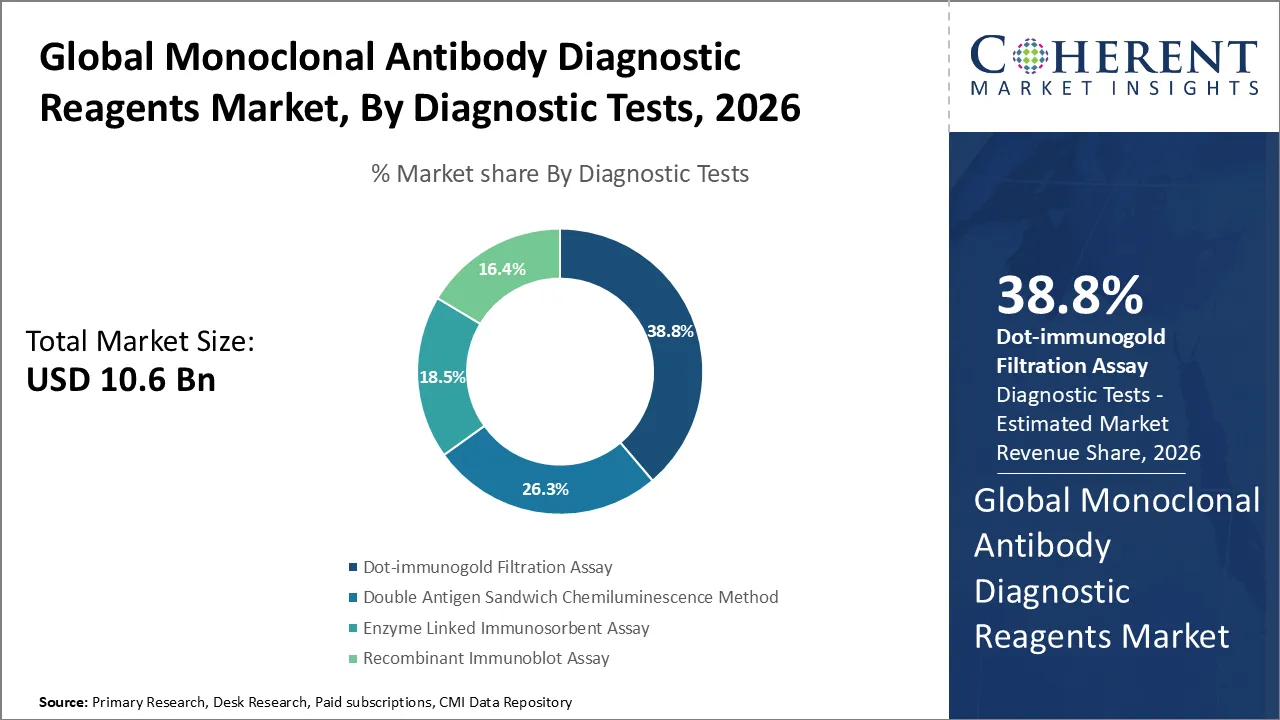
- Dot-immunogold Filtration Assay hold the largest market share of 38.8% in 2026 owing to the growing demand for rapid diagnostic testing. According to a study published by the National Library of Medicine, DIGFA is a rapid and simple method for the diagnosis of echinococcosis.
- Hormones Diagnosis expected to hold largest market share of 37.9% in 2026 owing to its increasing prevalence of endocrine and thyroid disorders. Common endocrine disorders affecting at least 5% of U.S. adults include diabetes, impaired glucose regulation, obesity, metabolic syndrome, osteoporosis, osteopenia, vitamin D deficiency, erectile dysfunction, dyslipidemia, and thyroiditis.
- North America is expected to acquire the dominant share of 43.3% in 2026 owing to the advanced healthcare and diagnostic infrastructure.
Current Events and Their Impact on the Monoclonal Antibody Diagnostic Reagents Market
Current Event | Description and its Impact |
WHO Prioritizes Rapid Diagnostics for Bacterial Priority Pathogens |
|
WHO Sets New Requirements for Neonatal Bacterial Infection Diagnostics |
|
Segmental Insights
- Current Industry Events of 2026
- Market Size Estimation
- Regional Breakdown
- Competitive Landscape
- Customer Intelligence
- Segmental Analysis
- Pricing Analysis
- Key Market Drivers, Challenges & Future Trends
- Customized Insights Section
Why is Dot-immunogold Filtration Assay Acquiring the Largest Market Share?
Dot-immunogold Filtration Assay hold the largest market share of 38.8% in 2026. The Dot-immunogold Filtration Assay (DIGFA) market benefits from rising demand for rapid, simple, and cost-effective diagnostic testing. Healthcare providers use DIGFA in basic laboratories, decentralized facilities, and field settings because it delivers visible results without expensive equipment. Monoclonal antibodies improve target specificity, while colloidal gold enables straightforward visual detection. Growing infectious-disease screening, expanding point-of-care testing, and increasing demand for portable diagnostic solutions further drive the adoption of DIGFA in monoclonal antibody-based diagnostic applications. In November 2025, an ICMR study found that 11.1% of 450,000 tested patients were positive for various pathogens, highlighting the need for stronger infectious disease surveillance in India.
Which Application segment dominates the market?
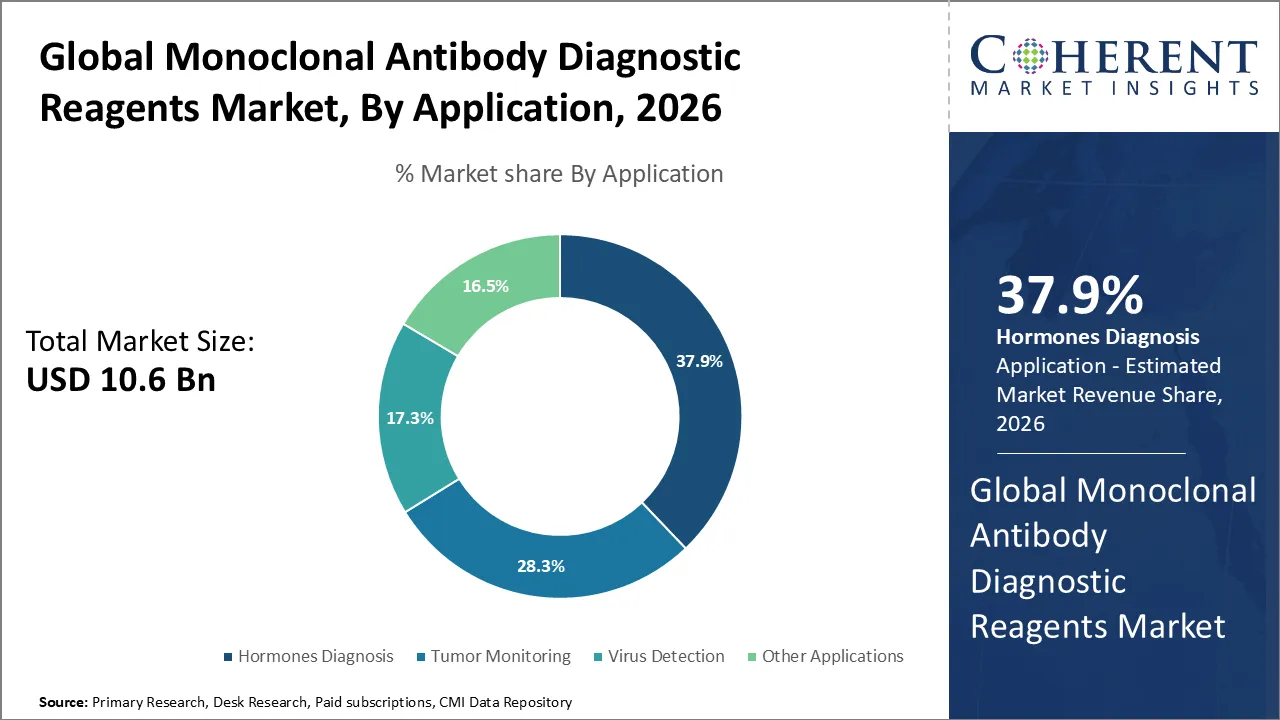
Hormones Diagnosis expected to hold largest market share of 37.9% in 2026. The Hormones Diagnosis segment benefits from the growing prevalence of endocrine, thyroid, metabolic, and reproductive disorders that require routine hormone testing. An estimated 42 million people in India have thyroid disorders, with hypothyroidism affecting nearly 10% of adults. Healthcare providers increasingly use hormone tests for fertility assessment, pregnancy monitoring, and personalized endocrine care, which drives testing demand. Monoclonal antibody-based immunoassays deliver high specificity and sensitivity while supporting automation and rapid results for hormones such as TSH, insulin, cortisol, testosterone, and reproductive hormones. Expanding laboratory infrastructure and wider adoption of automated immunoassay platforms further strengthen demand for hormone diagnostic reagents. Waters Corporation launched the Xevo TQ Absolute XR IVD Mass Spectrometer at the ADLM 2026 Annual Meeting, targeting clinical laboratories performing low-concentration hormone assays and hair-based toxicology testing.
Monoclonal Antibody Diagnostic Reagents Market Trends
- Growing Adoption of Rapid and Point-of-Care Diagnostics: The increasing need for timely diagnosis is supporting the use of rapid and decentralized testing technologies, particularly for infectious diseases. In 2024, an estimated 10.7 million people developed tuberculosis globally, highlighting the continuing need for accessible diagnostic testing.
- Expansion of Companion Diagnostics in Oncology: FDA-authorized companion diagnostics are increasingly linked to specific cancer therapies and biomarkers, including PD-L1, HER2, EGFR, KRAS, RET, and BRCA-related biomarkers. This reinforces the role of highly specific diagnostic reagents in treatment selection and precision oncology.
- Rising Cancer Burden Supports Diagnostic Demand: In 2025, an estimated 21.1 million new cancer cases are projected worldwide, up from 20.6 million in 2024. This growing disease burden supports demand for diagnostic assays used for cancer detection, biomarker identification, and treatment selection.
Regional Insights
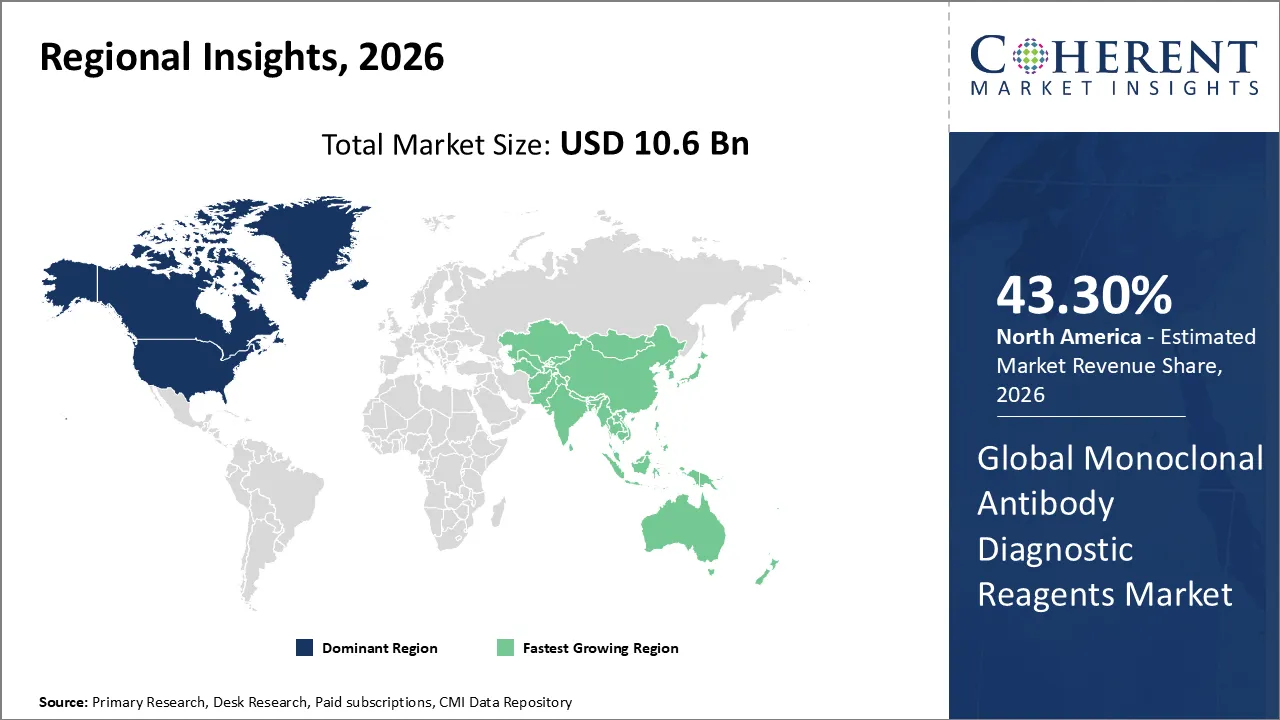
North America dominates owing to high healthcare expenditure and diagnostic testing volumes
North America is expected to acquire the dominant share of 43.30% in 2026. North America’s monoclonal antibody diagnostic reagents market benefits from advanced healthcare infrastructure, widespread adoption of automated immunoassay platforms, and well-established diagnostic laboratory networks. Healthcare providers increasingly use antibody-based tests as cancer, infectious diseases, autoimmune disorders, and endocrine conditions become more prevalent. Deaths from infectious and parasitic diseases in Canada increased from 4,475 in 2020 to 5,687 in 2024. Biotechnology and pharmaceutical companies strengthen market growth through robust R&D, while precision medicine and biomarker-based diagnostics expand applications. Favorable reimbursement policies, rapid adoption of innovative diagnostic technologies, and established regulatory frameworks further encourage healthcare organizations to use monoclonal antibody diagnostic reagents.
Asia Pacific Monoclonal Antibody Diagnostic Reagents Market Trends
The Asia Pacific monoclonal antibody diagnostic reagents market is expanding as healthcare providers increase demand for advanced disease detection and address the growing burden of cancer, infectious diseases, and autoimmune disorders. Countries such as China, Japan, India, and South Korea are investing heavily in biotechnology and diagnostic research, supporting local reagent development and manufacturing. Laboratories are adopting automated immunoassay platforms, precision medicine, modern diagnostic technologies, and point-of-care testing, while governments expand screening programs and improve healthcare access, further driving diagnostic testing demand across the region. In July 2025, India’s Translational Research Facility announced plans to support vaccine, monoclonal antibody, diagnostic, and biotherapeutic development through multiple Centres of Excellence established in collaboration with industry and academia.
United States Monoclonal Antibody Diagnostic Reagents Market Trends
Rising demand for early and accurate disease detection drives the United States monoclonal antibody diagnostic reagents market, especially in oncology, infectious diseases, and chronic conditions. Pharmaceutical and biotechnology companies continue to invest in research, accelerating reagent development and adoption. Precision medicine and biomarker-based diagnostics further increase demand for highly specific antibodies. Advanced laboratory infrastructure and automation also support market expansion, while growing diagnostic testing volumes and established regulatory and reimbursement systems encourage wider clinical and research applications.
China Monoclonal Antibody Diagnostic Reagents Market Trends
China’s monoclonal antibody diagnostic reagents market benefits from expanding healthcare infrastructure, increasing demand for precise disease detection, and wider adoption of immunoassay-based diagnostics. The Chinese government supports biotechnology and domestic medical-device innovation, encouraging companies to expand R&D and manufacturing activities. The National Medical Products Administration facilitates product development through evolving regulatory pathways. Rising cancer and chronic disease cases, increased laboratory testing, advances in diagnostic technologies, and greater investment in biopharmaceutical capabilities continue to drive demand for monoclonal antibody-based diagnostic reagents. In 2024, China was estimated to have 5.15 million new cancer cases and 2.58 million cancer-related deaths.
Who are the Major Companies in Monoclonal Antibody Diagnostic Reagents Industry
Some of the major key players in Monoclonal Antibody Diagnostic Reagents are AnaSpec, BioGenex, Bio-Rad, Biocare Medical, BioVision, Celltrion, Creative Diagnostics, GenWay Biotech, Innovent Biologics, Medix Biochemica, Qiagen, and Teva Pharmaceutical Ltd.
Key News
- In September 2025, Leinco Technologies acquired Genovis-owned QED Biosciences, expanding its portfolio of antibodies, kits, recombinant proteins, antigens, and IVD raw materials.
Market Report Scope
Monoclonal Antibody Diagnostic Reagents Market Report Coverage
Report Coverage | Details | ||
Base Year: | 2025 | Market Size in 2026: | USD 10.6 Bn |
Historical Data for: | 2020 to 2024 | Forecast Period: | 2026 to 2033 |
Forecast Period 2026 to 2033 CAGR: | 10.6% | 2033 Value Projection: | USD 24.7 Bn |
Geographies covered: |
| ||
Segments covered: |
| ||
Companies covered: | AnaSpec, BioGenex, Bio-Rad, Biocare Medical, BioVision, Celltrion, Creative Diagnostics, GenWay Biotech, Innovent Biologics, Medix Biochemica, Qiagen, and Teva Pharmaceutical Ltd. | ||
Analyst Opinion
- The monoclonal antibody diagnostic reagents market is being driven by the increasing need for highly specific biomarker detection, particularly in oncology. Nearly 20 million new cancer cases were recorded globally in 2022, creating a substantial clinical requirement for reliable diagnostic tools that can identify disease-associated proteins and guide treatment decisions. In our view, oncology will remain the most commercially important application area because antibody-based diagnostics can directly support biomarker-driven clinical decision-making.
- The rapid expansion of antibody-based therapeutics is strengthening the diagnostic ecosystem rather than creating demand in isolation. The FDA approved 13 monoclonal antibodies in 2024, including six for oncology, representing the highest annual number of mAb approvals since 2015. This pipeline increasingly requires precise biomarker identification and patient selection, making monoclonal antibody reagents strategically important for companion and immunohistochemistry diagnostics.
- In our assessment, companion diagnostics represent the strongest value driver for monoclonal antibody diagnostic reagents because they convert testing from a routine laboratory activity into a treatment-enabling requirement. FDA data show that oncology authorities authorized 27 IVDs in 2024, including four new IVDs carrying a combined 11 companion-diagnostic claims, while nine additional companion-diagnostic indications were added to previously authorized IVDs. Examples such as Agilent’s MAGE-A4 IHC assay demonstrate how antibody-based biomarker testing can become directly linked to eligibility for advanced therapies.
- We believe the market’s next phase will favor highly validated, application-specific reagents rather than undifferentiated antibody products. Diagnostic accuracy directly influences treatment selection, and the FDA explicitly recognizes that an inaccurate companion diagnostic can lead to suboptimal treatment decisions. With cancer incidence projected to exceed 35 million new cases annually by 2050, laboratories and drug developers will increasingly prioritize reagents that deliver reproducible biomarker detection, regulatory acceptance, and compatibility with precision-medicine workflows.
Speak to the analyst
Want personalized insights?
Take the findings above to one of our principal consultants, or have the report rebuilt around the segments, geographies and competitors you actually track.
Market Segmentation
- By Diagnostic tests (Revenue, USD Bn, 2021-2033)
- Dot-immunogold Filtration Assay
- Double Antigen Sandwich Chemiluminescence Method
- Enzyme Linked Immunosorbent Assay
- Recombinant Immunoblot Assay
- By Application (Revenue, USD Bn, 2021-2033)
- Hormones Diagnosis
- Tumor Monitoring
- Virus Detection
- Other Applications
- By Region (Revenue, USD Bn, 2021-2033)
- North America
- U.S.
- Canada
- Latin America
- Brazil
- Mexico
- Argentina
- Rest of Latin America
- Europe
- Germany
- U.K.
- France
- Italy
- Spain
- Russia
- Rest of Europe
- Asia Pacific
- China
- India
- Japan
- Australia
- South Korea
- ASEAN
- Rest of Asia Pacific
- Middle East
- GCC
- Israel
- Rest of Middle East
- Africa
- South Africa
- Central Africa
- North Africa
- North America
Sources
Primary Research interviews
- Interviews with diagnostic reagent manufacturers and product development specialists
- Discussions with laboratory directors, clinical laboratory professionals, pathologists, and diagnostic testing specialists
- Interviews with research scientists involved in monoclonal antibody development, validation, and assay development
- Discussions with procurement and sourcing professionals from clinical laboratories, hospitals, diagnostic centers, and research institutions
- Interviews with regulatory and quality-assurance professionals involved in IVD and diagnostic reagent commercialization
- Discussions with distributors and channel partners specializing in laboratory diagnostics and life-science products
Databases
- U.S. Food and Drug Administration (FDA) – In Vitro Diagnostic Product Database and device databases
- FDA 510(k), De Novo, PMA, CLIA, and IVD-related regulatory databases
- National Library of Medicine (NLM) / PubMed
- National Center for Biotechnology Information (NCBI)
- World Health Organization (WHO) – IVD and diagnostic product databases
- WHO Prequalification – In Vitro Diagnostics database
- ClinicalTrials.gov
- European Union medical device and IVD regulatory databases
- European Medicines Agency (EMA) databases and scientific resources
- National health and statistical databases
- UN Comtrade and other international trade databases for relevant diagnostic reagent and laboratory product categories
Magazines
- Clinical Laboratory International
- Medical Laboratory Observer
- Lab Manager
- Diagnostic Products
- CAP Today
- The Scientist
- GEN – Genetic Engineering & Biotechnology News
- BioPharm International
- Laboratory Equipment
Journals
- Journal of Clinical Microbiology
- Clinical Chemistry
- Clinical Chemistry and Laboratory Medicine
- Journal of Immunological Methods
- Journal of Clinical Laboratory Analysis
- Diagnostic Microbiology and Infectious Disease
- Journal of Immunology
- Nature Biotechnology
- mAbs
- Biotechnology and Bioengineering
- Vox Sanguinis
- The Journal of Applied Laboratory Medicine
- PLOS ONE
- Scientific Reports
- Frontiers in Immunology
- Frontiers in Bioengineering and Biotechnology
Newspapers
- The New York Times
- The Wall Street Journal
- Financial Times
- Reuters
- Bloomberg
- The Economic Times
- The Hindu
- The Times of India
- Business Standard
Associations
- American Association for Clinical Chemistry (AACC)
- Association for Diagnostics & Laboratory Medicine (ADLM)
- American Society for Microbiology (ASM)
- American Society for Clinical Pathology (ASCP)
- Association of Public Health Laboratories (APHL)
- International Federation of Clinical Chemistry and Laboratory Medicine (IFCC)
- International Federation of Biomedical Laboratory Science (IFBLS)
- World Association of Societies of Pathology and Laboratory Medicine (WASPaLM)
- International Society for Blood Transfusion (ISBT)
- Association for Molecular Pathology (AMP)
- European Society for Clinical Chemistry and Laboratory Medicine (EFLM)
- European Society of Pathology (ESP)
Public Domain sources
- U.S. Food and Drug Administration (FDA) – IVD regulatory guidance, device clearances, approvals, recalls, and safety communications
- World Health Organization (WHO) – IVD guidelines, prequalification information, technical standards, and essential diagnostics resources
- National Institutes of Health (NIH)
- National Library of Medicine (NLM) / PubMed
- National Center for Biotechnology Information (NCBI)
- Centers for Disease Control and Prevention (CDC)
- European Medicines Agency (EMA)
- European Commission – Medical Devices and IVD regulatory information
- U.S. Centers for Medicare & Medicaid Services (CMS) – CLIA information
- U.S. National Institute of Standards and Technology (NIST)
- U.S. Census Bureau
- World Bank
- OECD
- United Nations databases
- Government health ministries and national regulatory authorities
- National statistical offices and publicly available healthcare datasets
- WHO Model List of Essential In Vitro Diagnostics and WHO prequalified IVD resources
- Publicly available scientific publications, clinical-trial records, regulatory filings, product documentation, and government reports
Proprietary Elements
- CMI Data Analytics Tool
- Proprietary CMI Existing Repository of Information for the Last 10 Years
Get access to 250+ pages report
Every segment, forecast, competitor profile and data table behind the analysis above — available for instant download.
- ESOMAR Member
- ISO 9001:2015 Certified
- D-U-N-S Registered
- GDPR & CCPA Compliant
Missing comfort of reading report in your local language? Find your preferred language:
Transform your Strategy with Exclusive Trending Reports
Frequently Asked Questions
The market is primarily driven by the growing need for highly specific disease and biomarker detection, and advances in antibody engineering and diagnostic technologies.
The Dot-immunogold Filtration Assay segment is expected to lead the market in 2026.
Dot-immunogold Filtration Assay provides visible results without requiring sophisticated laboratory equipment.
Hormones Diagnosis is expected to hold the leading position in 2026.
Monoclonal antibodies provide selective recognition of specific hormone targets, supporting sensitive and reproducible immunoassays.