

Androgenetic Alopecia Treatment Market Size and Share Analysis- 2026 To 2033
The androgenetic alopecia treatment market size is anticipated to grow at a CAGR of 8.4% with USD 2.62 Bn in 2026 and is expected to reach USD 4.5 Bn in 2033. The market is growing with the rising diagnosis of pattern hair loss, topical minoxidil use, oral prescription therapies, hair transplant procedures, and dermatology clinic visits. As per NIH MedlinePlus, androgenetic , thereby contributing to the treatment uptake.
Key Takeaways
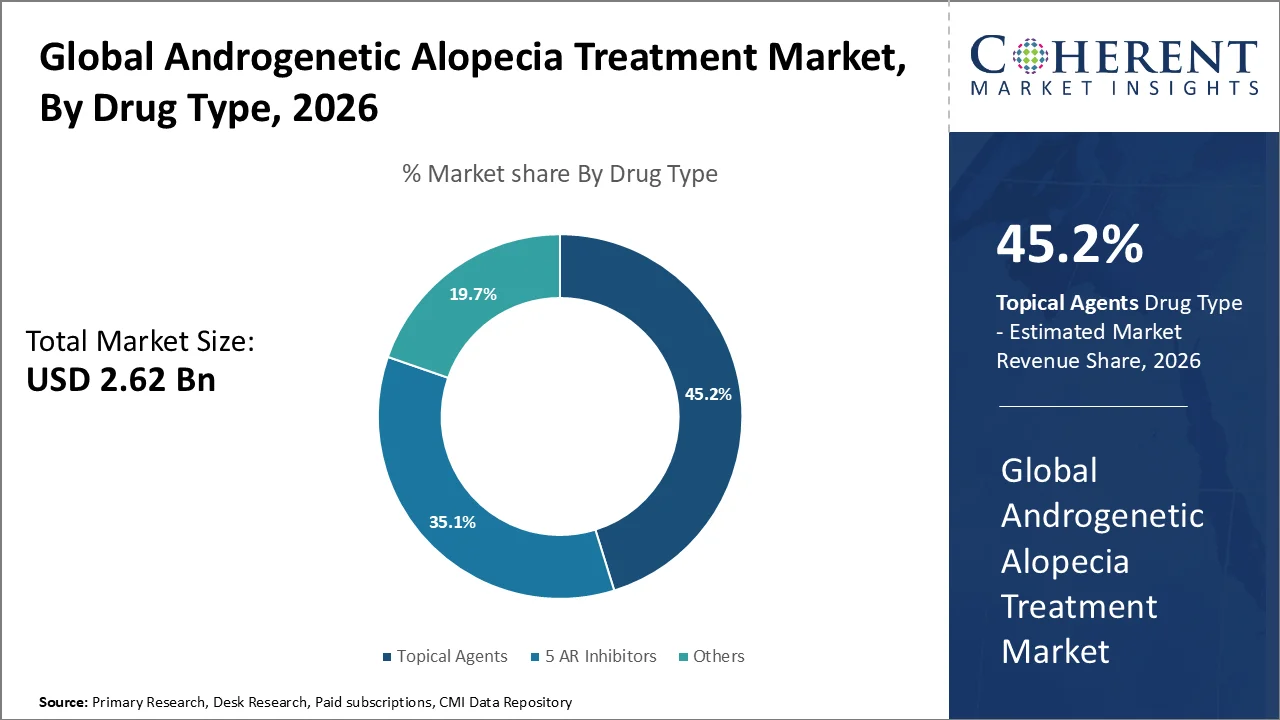
- On the basis of drug type, the topical agents’ segment is projected to account for the largest share of 45.20% in 2026. The growth is owing to the increasing use of over-the-counter treatments like minoxidil. According to MedlinePlus (NIH), minoxidil is a widely used topical treatment for androgenetic alopecia, thus demonstrating effectiveness in promoting hair regrowth in both men as well as women.
- By route of administration, the topical segment is projected to account for the largest share of 64.5% in 2026. The growth is attributable to the preference for non-invasive treatments which can be conveniently applied at home.
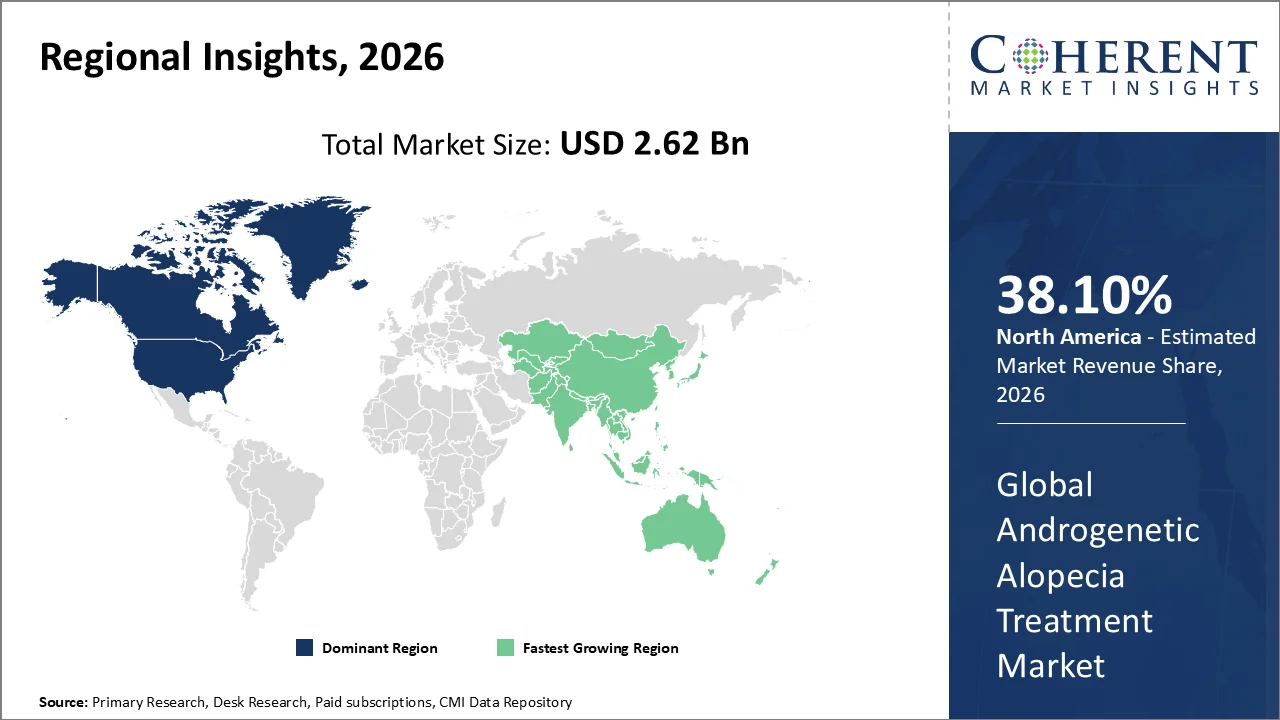
- North America is expected to secure the highest proportion of 38.10% in 2026, attributable to high awareness and accessibility of hair loss treatments. The National Library of Medicine notes that approximately 30-50% of men over the age of 50 are affected by androgenetic alopecia, contributing to the strong demand for both prescription and over-the-counter hair loss treatments in the region.
Segmental Insights
Which Drug Type Segment Dominates the Market?
On the basis of drug type, the topical agents segment accounts for the largest androgenetic alopecia treatment market share of 45.20% in 2026. The segment’s growth is because topical therapies, especially minoxidil-based foams and solutions, remain the most widely accessible, non-invasive, and label-supported treatment option for male and female pattern hair loss. DailyMed, maintained by the U.S. National Library of Medicine, lists 5% minoxidil foam as a hair regrowth treatment for men and women, while 2% minoxidil topical solution is also shown to regrow hair in women with thinning on the top of the scalp.
The segment is also supported by repeat-use requirements and ongoing topical innovation. According to the data from DailyMed, minoxidil results may be visible after 2 months with twice-daily use, while some men may need at least 4 months. The continual use is necessary to maintain the regrowth. In April 2026, ClinicalTrials.gov listed new topical androgenetic alopecia studies comparing peptide-based hair serum and topical 2-deoxy-D-ribose hydrogel against topical minoxidil, thereby showing that minoxidil is still the key benchmark for next-generation topical therapies.
- Current Industry Events of 2026
- Market Size Estimation
- Regional Breakdown
- Competitive Landscape
- Customer Intelligence
- Segmental Analysis
- Pricing Analysis
- Key Market Drivers, Challenges & Future Trends
- Customized Insights Section
Topical Segment to Secure the Largest Share
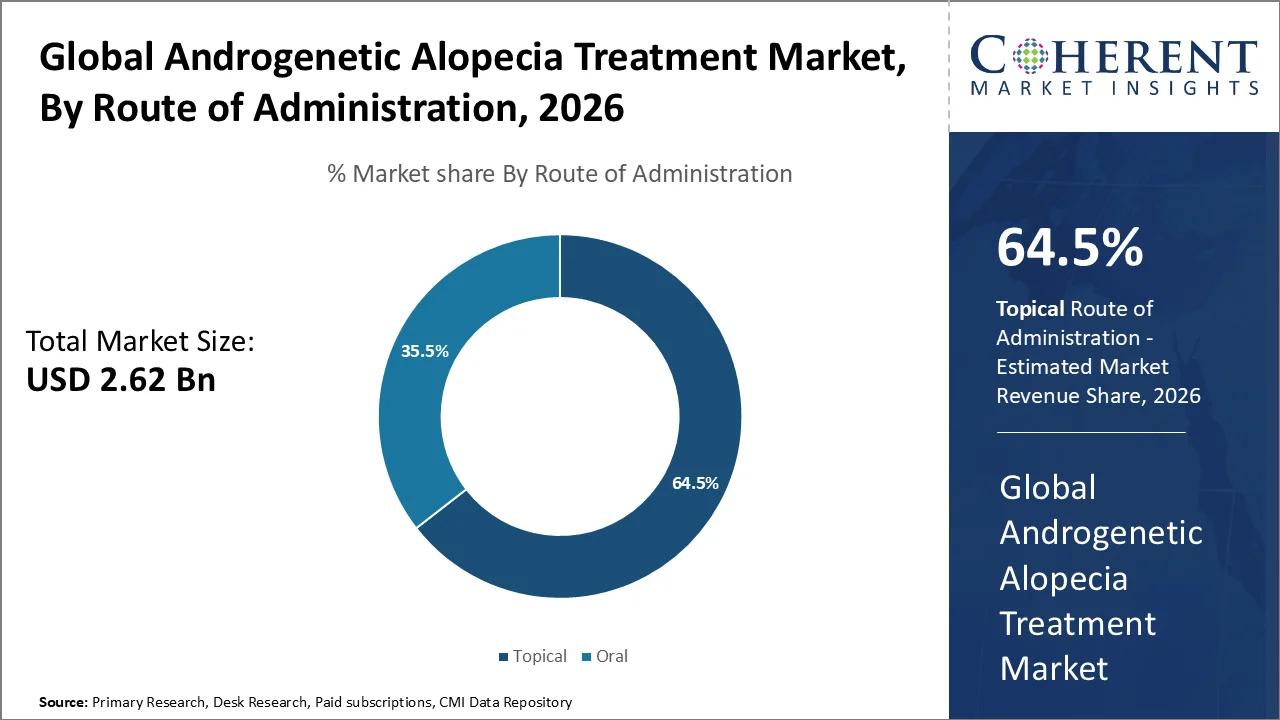
The topical segment accounts for the largest androgenetic alopecia treatment market share of 64.5% in 2026. The segment’s growth is driven by increasing awareness of early intervention benefits, higher dermatology consultations, and a growing preference for non‑invasive regimens. Topical therapies are the most accessible and frequently adopted treatment for androgenetic alopecia mainly owing to ease of application, minimal systemic effects compared with oral drugs, as well as the widespread availability of FDA‑approved minoxidil solutions and foams. The topical administration allows direct delivery to affected scalp regions, supports long‑term compliance, and reduces risks associated with systemic treatment modalities.
The male pattern hair loss prevalence increases with age, with 16% of men aged 18, thereby emphasizing the demand for topical treatments in age groups. The research also indicates that 67.1% of men as well as 23.9% of women are affected by androgenetic alopecia in population, thus underlining the widespread need for effective treatments. The female pattern hair loss, thereby constituting to the demand for topical products.
In December 2025, Cosmo Pharmaceuticals N.V. announced strong topline results from its two pivotal Phase III trials of clascoterone 5% topical solution for male androgenetic alopecia (AGA), also known as male-pattern hair loss. These results represent a potential first major therapeutic breakthrough in hair-loss treatment in over three decades.
Market Driver
Strong Late-stage Innovation Pipeline is Transforming the Androgenetic Alopecia Treatment Market in the United States
U.S. demand is rising as androgenetic alopecia remains a common, progressive, and long-term condition, encouraging wider use of topical therapies, oral DHT-blocking drugs, hair restoration procedures, and dermatologist-led treatment plans.
MedlinePlus Genetics, from NIH/NLM, states that more than 50% of men above age 50 have some degree of hair loss. This shift is also backed by stronger late-stage clinical activity. ClinicalTrials.gov lists a Phase 3 clascoterone solution study for male pattern hair loss, with 703 participants, U.S. trial locations, FDA-regulated drug oversight, along with March 2026 status verification.
Drug developers are therefore moving toward scalp-targeted, topical, and anti-androgen approaches designed to improve local delivery, adherence, and cosmetic acceptability. This pipeline activity is making innovation central to U.S. market growth with patients and dermatologists opting for alternatives beyond older minoxidil- and finasteride-based treatment routes.
In April 2026, Veradermics announced positive Phase 2/3 results for VDPHL01, an extended-release oral minoxidil formula particularly for male pattern hair loss. The study showed important hair-count improvement versus placebo at Month 6, thereby suggesting the product as a potential first FDA-approved oral non-hormonal treatment for pattern hair loss if approved.
Stem-Cell Reactivation Therapy: Major Breakthrough in Androgenetic Alopecia Treatment
A substantial shift is emerging in androgenetic alopecia treatment with the development of stem-cell reactivation therapies which aim to stimulate new hair growth rather than only preserving existing follicles. PP405, a topical regenerative therapy developed by Pelage Pharmaceuticals, is one of the most promising candidates. It is designed to reactivate dormant hair follicle stem cells and is advancing through the FDA clinical development pathway.
In July 2025, Pelage Pharmaceuticals announced positive Phase 2a trial results for PP405 in 78 men as well as women with androgenetic alopecia. In the Phase 2a trial, PP405 was tested in 78 men as well as women with androgenetic alopecia, thus showing groundbreaking results. The early findings revealed that 31% of treated men with higher hair loss severity achieved more than 20% improvement in hair density by week 8, compared to 0% in the placebo group.
This breakthrough could change how AGA is treated by focusing on reactivating hair follicles instead of just managing the symptoms. Currently, no treatments on the market reawaken dormant follicles. This makes PP405 a promising advancement that could provide hope for those struggling with hair loss.
Current Events and Their Impact on the Androgenetic Alopecia Treatment Market
Current Event | Description and its Impact |
FDA Safety Alert on Compounded Topical Finasteride Products |
|
FDA Warning Letter on Unapproved Minoxidil Hair Regrowth Products |
|
Androgenetic Alopecia Treatment Market Trends
- Rising prevalence of androgenetic alopecia is increasing demand for early diagnosis and treatment. NIH/NCBI states that androgenetic alopecia affects up to 50% of males and females, while male androgenetic alopecia affects around 30–50% of men by age 50, thereby propelling the demand for topical, oral, and procedural therapies.
- Topical treatment adoption is rising as patients prefer non-invasive and OTC-accessible options. DailyMed notes that 5% minoxidil topical solution is used as a hair regrowth treatment, and results may occur in 2 months with twice-daily use, though some men may need at least 4 months.
- Prescription-based therapy remains important, especially for male pattern hair loss. DailyMed states that finasteride 1 mg is indicated for androgenetic alopecia in men only, with one tablet taken daily; generally, three months or more of daily use is required before visible benefit is observed.
- Innovation is moving toward regenerative, combination, and next-generation topical therapies. ClinicalTrials.gov lists active androgenetic alopecia studies like PP405 for safety, pharmacokinetics, and efficacy, along with topical combinations containing minoxidil and finasteride, showing continued movement beyond conventional single-agent therapies.
- Regulatory safety scrutiny is influencing prescribing practices for finasteride-based therapies. In April 2025, the FDA stated that there is no FDA-approved topical finasteride formulation and reported 32 FAERS cases linked to compounded topical finasteride from 2019–2024.
Regional Insights
North America Leads Owing to Strong Treatment Access and Regulated Hair-loss Therapies
The North America region accounts for 38.10% of the market in 2026. The region’s growth is owing to a high prevalence of hair loss, widespread access to dermatology services, alongside the availability of FDA and Health Canada-regulated treatments. According to the NIH, AGA is one of the most common forms of hair loss in men as well as women, thereby contributing to a large patient base which seeks medical treatment.
In addition, access to dermatology consultations plays a crucial role in treatment uptake. The CDC's National Ambulatory Medical Care Survey reported that 44 million annual visits were made to office-based dermatologists. This focuses the need for professional guidance in androgenetic alopecia management.
Moreover, the regulatory oversight has a considerable impact on treatment choices. The FDA has cautioned against the use of compounded topical finasteride, which is not FDA-approved for treating AGA, thus urging the consumers as well as healthcare providers to prefer medically supervised therapies. This regulatory stance strengthens the demand for FDA-approved and reliable treatments.
Canada’s contribution to the market is also substantial, with Health Canada regulating finasteride 1 mg as the standard for male hair loss treatments. In addition to this, the growing presence of clinical trials like the PP405 trial for regenerative treatments, signals the potential for new therapies in the market. The combination of regulatory backing coupled with cutting-edge research keeps North America at the forefront of AGA treatment.
In March 2026, Xtresse announced that the U.S. Food and Drug Administration (FDA) has accepted its Investigational New Drug (IND) application for Xvie, a regenerative therapy for androgenetic alopecia.
Asia Pacific Androgenetic Alopecia Treatment Market Trends
The Asia Pacific region is poised to be as the fastest-growing region through 2026-2033, driven by the increasing prevalence of androgenetic alopecia (AGA) and the growing demand for effective treatments. A large communityThe prevalence increases substantially with age, from 2.8% in men aged 18. This highlights a clear age‑related disease escalation.
AGA prevalence in Asia is generally lower than in Caucasian populations, but it rises steadily with age and family history. This regional epidemiological trend underscores the growing burden of AGA, particularly among younger adults, thereby contributing to the increased healthcare consultations as well as a higher demand for dermatological services.
In terms of clinical management, minoxidil and finasteride is still the dominant treatment options in the region, with both topical as well as oral therapies widely adopted in dermatology practices. The emerging preferences for more advanced treatments like low‑level laser therapy (LLLT) and follicular unit extraction (FUE), also reflect the rising patient interest in combination pharmacologic and device-based strategies for managing AGA.
Shift Toward Clinically Validated, FDA-Regulated Options is Accelerating the Androgenetic Alopecia Treatment Demand in United States
The U.S. Androgenetic Alopecia Treatment Market is gaining demand as patients shift toward clinically validated, FDA-regulated options rather than informal compounded hair-loss formulations. The data from NIH’s Endotext notes that male androgenetic alopecia affects 30–50% of men by age 50, while topical minoxidil and oral finasteride remain the only FDA-approved treatments for male AGA, requiring continual use and often 6–12 months to show response. This creates sustained demand for repeat-use topical as well as oral therapies in dermatology clinics, online care models, and pharmacy channels. The market is also being shaped by stronger safety scrutiny. For example, in April 2025, the FDA issued a warning stating that there is no FDA-approved topical finasteride and also highlighted 32 reports of adverse events associated to compounded topical finasteride from 2019 to 2024. Meanwhile, ClinicalTrials.gov-listed VDPHL01 studies indicate the rising innovation in oral AGA treatments for both male and female patients.
In January 2025, Eirion Therapeutics Inc., a biopharmaceutical company dedicated to developing innovative aesthetic prescription products, announced the successful results of its first-in-man clinical trial for the treatment of androgenic alopecia (age-related hair loss) using its topical pharmaceutical, ET-02.
China Androgenetic Alopecia Treatment Market Trends
China’s Androgenetic Alopecia Treatment Market is experiencing growth, driven by an aging population and an increasing prevalence of AGA. A population-based study found that AGA prevalence in men rose from 2.8% in those aged 18–29 to 41.4% in those aged 70+. It also notes that women show a similar trend, increasing from 1.3% to 11.8% as age progresses. According to the National Bureau of Statistics, China’s elderly population reached 323.38 million in 2025, thus representing 23% of the total population. These demographic trends, coupled with rising consultations for hair loss treatments, are fueling demand for both topical as well as oral AGA therapies. Additionally, recent clinical trials have shown increasing use of advanced treatments, such as minoxidil, finasteride, and innovative laser therapies, further propelling market growth.
Who are the Major Companies in Androgenetic Alopecia Treatment Market
Some of the major key players in Androgenetic Alopecia Treatment are Histogen Inc., Cipla Limited, Aclaris Therapeutics, Inc., Merck & Co., Inc., Daiichi-Sankyo Co., Ltd., Johnson and Johnson Services, Inc., Lexington International LLC, Vita-Cos-Med Klett-Loch GmbH, PureTech, Vitabiotics, Dr. Reddy’s Laboratories, HCell Inc., Follica, Inc. and Ranbaxy Laboratories Ltd.
Key News
- In October 2025, Veradermics, Incorporated announced the completion of an oversubscribed USD 150 million Series C financing. The funds will support the registrational development and planned New Drug Application submission for Veradermics’ lead investigational product, VDPHL01, a potential first and only extended-release oral minoxidil treatment specifically designed for hair regrowth in both women and men.
- In February 2024, Pelage Pharmaceuticals, a clinical-stage regenerative medicine company pioneering a new generation of treatments for hair loss, announced the closure of a USD 16.75 million Series A financing round. The funds will be used to advance a first-in-class treatment for androgenetic alopecia (pattern baldness) and other types of alopecia, including chemotherapy-induced hair loss.
Market Report Scope
Androgenetic Alopecia Treatment Market Report Coverage
| Report Coverage | Details | ||
|---|---|---|---|
| Base Year: | 2025 | Market Size in 2026: | USD 2.62 Bn |
| Historical Data for: | 2020 To 2024 | Forecast Period: | 2026 To 2033 |
| Forecast Period 2026 to 2033 CAGR: | 8.4% | 2033 Value Projection: | USD 4.5 Bn |
| Geographies covered: |
| ||
| Segments covered: |
| ||
| Companies covered: | Histogen Inc., Cipla Limited, Aclaris Therapeutics, Inc., Merck & Co., Inc., Daiichi-Sankyo Co., Ltd., Johnson and Johnson Services, Inc., Lexington International LLC, Vita-Cos-Med Klett-Loch GmbH, PureTech, Vitabiotics, Dr. Reddy’s Laboratories, HCell Inc., Follica, Inc. and Ranbaxy Laboratories Ltd. | ||
| Growth Drivers: |
| ||
| Restraints & Challenges: |
| ||
Analyst Opinion
- The androgenetic alopecia treatment market is growing due to high disease visibility, chronic treatment needs, and wider use of regulated hair regrowth therapies. NIH states that topical minoxidil and finasteride are FDA-approved treatments for pattern baldness, but visible improvement usually needs 4 to 6 months of consistent use and ongoing therapy, supporting repeat purchases, adherence programs, and dermatologist-led follow-up.
- The growing safety concerns are also boosting the demand for FDA-approved treatments and the regulatory focus on non-approved compounded therapies. The U.S. Food and Drug Administration (FDA) issued a warning in 2024 regarding the unapproved use of compounded finasteride for hair loss, thereby highlighting the adverse events reported by users. This has led to increased consumer preference for approved solutions, thus promoting trust in well-regulated products as well as enhancing market stability.
- Looking ahead, the market is expected to benefit from advancements in treatment formulations, including combination therapies and personalized regimens. With the growing FDA focus on monitoring the efficacy as well as safety of emerging hair loss treatments, particularly those associated with genetic markers as well as tailored solutions, the industry is poised to see a shift toward highly targeted, patient-specific therapies. The regulatory advancements and innovations in treatment delivery methods like topical minoxidil with enhanced absorption technologies, will likely continue to shape the future landscape of the androgenetic alopecia treatment market.
Speak to the analyst
Want personalized insights?
Take the findings above to one of our principal consultants, or have the report rebuilt around the segments, geographies and competitors you actually track.
Market Segmentation
- By Drug Type (Revenue, USD Bn, 2021-2033)
- Topical Agents
- 5 AR Inhibitors
- Others
- By Route of Administration (Revenue, USD Bn, 2021-2033)
- Oral
- Topical
- By Gender (Revenue, USD Bn, 2021-2033)
- Male
- Female
- By Distribution Channel (Revenue, USD Bn, 2021-2033)
- Hospital Pharmacies
- Retail Pharmacies
- Online Pharmacies
- By Region (Revenue, USD Bn, 2021-2033)
- North America
- U.S.
- Canada
- Latin America
- Brazil
- Mexico
- Argentina
- Rest of Latin America
- Europe
- Germany
- U.K.
- France
- Italy
- Spain
- Russia
- Rest of Europe
- Asia Pacific
- China
- India
- Japan
- Australia
- South Korea
- ASEAN
- Rest of Asia Pacific
- Middle East
- GCC
- Israel
- Rest of Middle East
- Africa
- South Africa
- Central Africa
- North Africa
- North America
Sources
Primary Research Interviews
- Dermatologists & Trichologists
- Hair Transplant Surgeons & Hair Restoration Clinics
- Androgenetic Alopecia Treatment Manufacturers
- Pharmaceutical & Cosmeceutical Product Developers
- Dermatology Clinic Chains & Aesthetic Centers
- Retail Pharmacy & E-pharmacy Distributors
- Hair Care Product Formulators
- Patients / Consumer Panels
- Others
Databases
- Bloomberg Terminal
- Thomson Reuters Eikon
- IQVIA
- Evaluate Pharma
- PubMed / NCBI
- ClinicalTrials.gov
- Others
Magazines
- Dermatology Times
- Practical Dermatology
- Modern Aesthetics
- The Aesthetic Guide
- Pharmaceutical Technology Magazine
- MedTech Outlook
- Others
Journals
- Journal of the American Academy of Dermatology
- International Journal of Trichology
- Dermatologic Therapy
- Journal of Cosmetic Dermatology
- Clinical, Cosmetic and Investigational Dermatology
- Skin Appendage Disorders
- Others
Newspapers
- Financial Times
- The Wall Street Journal
- Reuters
- Bloomberg News
- The Economic Times
- Business Standard
- Others
Associations
- American Academy of Dermatology Association
- International Society of Hair Restoration Surgery
- European Academy of Dermatology and Venereology
- British Association of Dermatologists
- Indian Association of Dermatologists, Venereologists and Leprologists
- American Hair Loss Association
- Others
Public Domain Sources
- U.S. Food and Drug Administration
- European Medicines Agency
- National Institutes of Health
- National Library of Medicine / PubMed
- ClinicalTrials.gov
- World Health Organization
- NHS
- U.S. Census Bureau
- World Bank Open Data
- Others
Proprietary Elements
- CMI Data Analytics Tool
- Proprietary CMI Existing Repository of Information for the Last 8 Years
Get access to 250+ pages report
Every segment, forecast, competitor profile and data table behind the analysis above — available for instant download.
- ESOMAR Member
- ISO 9001:2015 Certified
- D-U-N-S Registered
- GDPR & CCPA Compliant
Missing comfort of reading report in your local language? Find your preferred language:
Transform your Strategy with Exclusive Trending Reports
Frequently Asked Questions
The Androgenetic Alopecia Treatment Market is expected to reach USD 4.5 Bn in 2033.
Major players operating in the global Androgenetic Alopecia Treatment Market include Histogen Inc., Cipla Limited, Aclaris Therapeutics, Inc., Merck & Co., Inc., Daiichi-Sankyo Co., Ltd., Johnson and Johnson Services, Inc., Lexington International LLC, Vita-Cos-Med Klett-Loch GmbH, PureTech, Vitabiotics, Dr. Reddy’s Laboratories, HCell Inc., Follica, Inc. and Ranbaxy Laboratories Ltd.
The high cost of advanced treatments, significant side effects associated with FDA-approved drugs (like finasteride and minoxidil), and limited insurance coverage for hair loss procedures are the key factors hampering growth of the market.
The increasing incidence of male and female pattern baldness, rising aesthetic consciousness, and the development of innovative, non-invasive therapies is boosting demand for Androgenetic Alopecia Treatment services.
The Androgenetic Alopecia Treatment Market is anticipated to grow at a CAGR of 8.4% between 2026 and 2033.
Among regions, North America is expected to account for a largest market share in the global Androgenetic Alopecia Treatment Market over the forecast period.
The most effective treatments for androgenetic alopecia (pattern hair loss) are FDA-approved medications like topical minoxidil (Rogaine) and oral finasteride, often used together.