

Anesthesia Endotracheal Tube Market Analysis & Forecast 2026- 2033
The global anesthesia endotracheal tube market was valued at USD 227 Mn in 2026 and is forecast to reach a value of USD 345.9 Mn by 2033 at a CAGR of 6.2% between 2026 and 2033.
Key Takeaways
- Based on Product Type, the orotracheal tubes segment is expected to hold 72.4% share in 2026.
- Based on End User, the hospital segment is expected to lead the 67.8% share of the market in 2026.
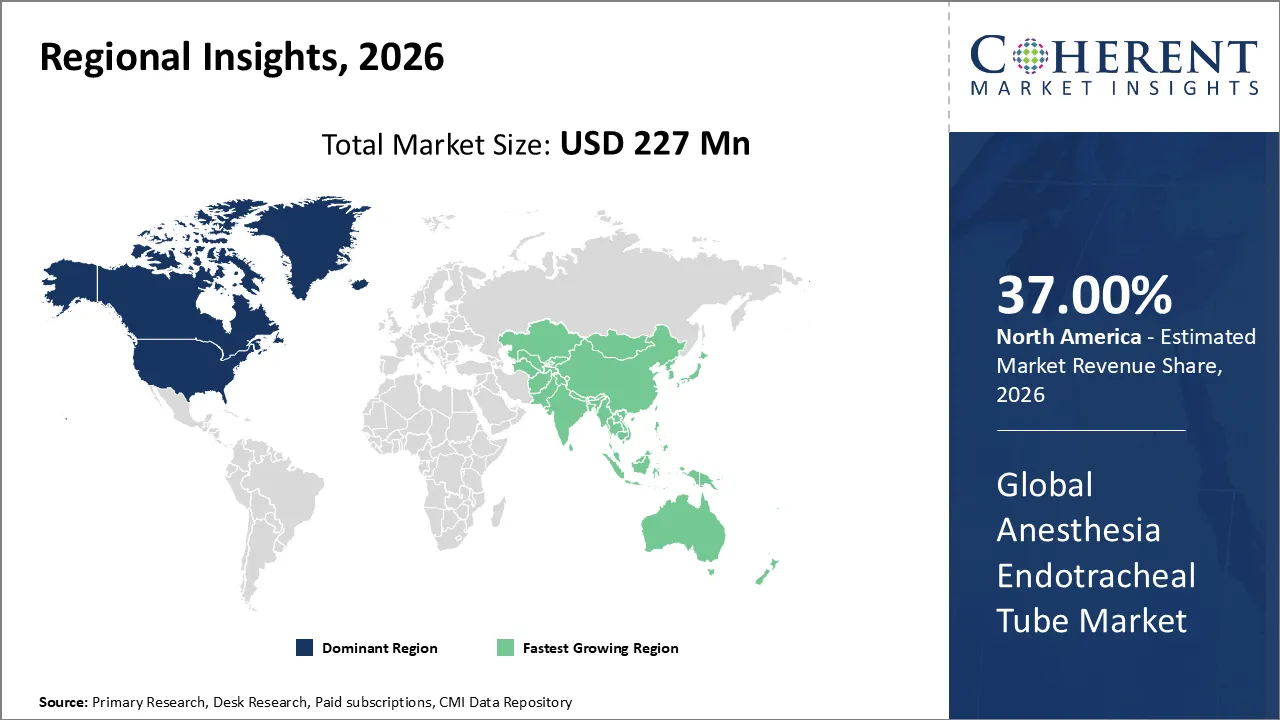
- Based on Region, North America is set to lead the anesthesia endotracheal tube market with 37% share in 2026. While, Asia Pacific is anticipated to be the fastest growing.
Market Overview
Anesthesia endotracheal tubes are a type of catheter inserted in the trachea during endotracheal intubation to produce an anesthesia effect by introducing gaseous mixture through a tube. There are two types of endotracheal tubes for anesthesia management, the orotracheal tube and the nasotracheal tube. The nasotracheal tube is embedded through the nose into the trachea and the orotracheal tube is embedded through the mouth into the trachea.
Current Events and Its Impacts on the Anesthesia Endotracheal Tube Market
Current Event | Description and its Impacts |
Aging Demographics and Rising Surgical Volumes |
|
Technological Innovation and Smart Medical Devices |
|
How Do Over 300 million Annual Surgeries Worldwide Depend on Endotracheal Intubation for Safe Anesthesia?
Category | Examples of Procedures | Estimated Annual Surgeries (Millions) | Notes on Intubation Use |
General Surgery | Appendectomy, hernia repair, gallbladder removal | ~90M | Intubation ensures airway safety during abdominal procedures. |
Orthopedic Surgery | Joint replacements, fracture repairs, spinal surgery | ~50M | Intubation critical for long-duration procedures, especially spine. |
Cardiothoracic Surgery | Open-heart surgery, lung resections, bypass grafts | ~30M | Requires advanced airway management; double-lumen tubes often used. |
Neurosurgery | Brain tumor removal, aneurysm repair | ~20M | Intubation essential due to long operative times and need for controlled ventilation. |
Obstetrics & Gynecology | Cesarean sections, hysterectomies | ~40M | Intubation used in emergency C-sections and major gynecologic surgeries. |
ENT & Maxillofacial Surgery | Tonsillectomy, sinus surgery, jaw reconstruction | ~15M | Specialized tubes (reinforced or nasal) often required. |
Emergency & Trauma Surgery | Road traffic accidents, penetrating injuries | ~30M | Rapid sequence intubation is lifesaving in trauma cases. |
Pediatric Surgery | Congenital defect repair, pediatric abdominal surgery | ~15M | Smaller-sized tubes used; higher risk of airway complications. |
- Current Industry Events of 2026
- Market Size Estimation
- Regional Breakdown
- Competitive Landscape
- Customer Intelligence
- Segmental Analysis
- Pricing Analysis
- Key Market Drivers, Challenges & Future Trends
- Customized Insights Section
Segmental Insights
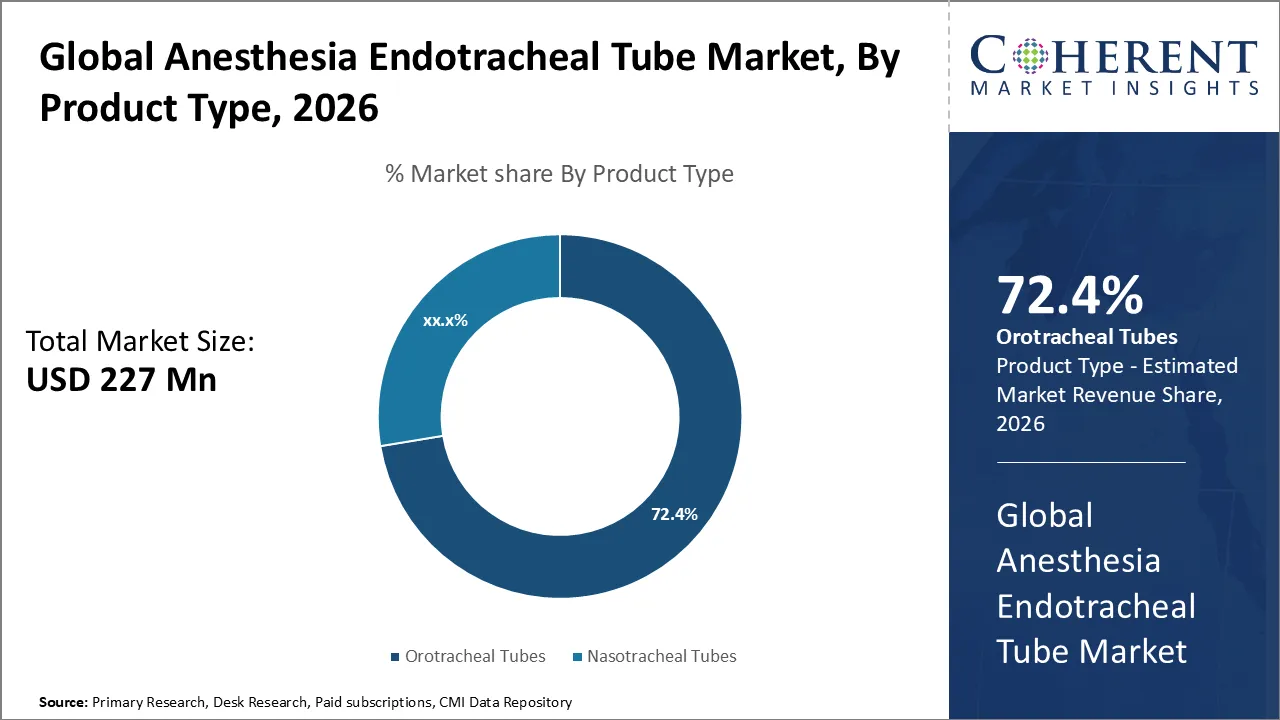
Anesthesia Endotracheal Tube Market Insights, By Product Type: Orotracheal Tubes dominate due to being the standard choice for anesthesia and emergency intubation
In terms of product type, the orotracheal tubes segment is expected to hold 72.4% share in 2026. Oral intubation is the standard way to do most surgeries and emergencies, so they are used more often. Orotracheal tubes are easier to insert, and they are better for visualizing during placement. They are also more effective for critical care and anesthesia settings. People do not utilize nasotracheal tubes as much, mostly in certain situations like maxillofacial surgeries or when oral access is restricted.
Anesthesia Endotracheal Tube Market Insights, By End User: Hospitals lead as the primary setting for surgeries and critical care requiring endotracheal tubes
In terms of end user, the hospital segment is expected to lead the 67.8% share of the market in 2026. Most surgeries that need general anesthesia are performed in hospitals, and they also handle most critical care cases. This means that there is a higher demand for endotracheal tubes. Ambulatory Surgical Centers (ASCs) are growing quickly due to more people are getting procedures done outside of the hospital, but they still have a smaller market share than hospitals.
For instance, in May 2025, Students in biomedical engineering at Ohio State showcased an AI-assisted intubation project at the 2025 Capstone Showcase. The new idea uses artificial intelligence to make managing airways safer and more accurate. The project focuses on teamwork, creativity, and possible clinical impact, which is in line with the program's goal of using engineering to solve real-world healthcare problems.
Regional Insights
North America Anesthesia Endotracheal Tube Market Analysis & Trends
North America is expected to lead the anesthesia endotracheal tube market with 37% share in 2026, driven by high volume of surgeries, the healthcare system is advanced, and new airway management technologies are being used a lot. The region's dominant market position is getting stronger with rising prevalence of chronic diseases that need surgery and well-established reimbursement systems.
For instance, in April 2025, the KARL STORZ launch of the Slimline C-MAC S Single-Use Video Laryngoscope introduces a lightweight, disposable device designed to enhance airway visualization during intubation. It helps hospitals safely place anesthesia endotracheal tubes, improves infection control, and makes advanced video laryngoscopy technology available to more people around the world.
Asia Pacific Anesthesia Endotracheal Tube Market Analysis & Trends
Asia Pacific is expected to exhibit the fastest growth, driven by the rapid growth of healthcare infrastructure, more surgeries, and strong investment into medical technology. The region is growing the fastest due to increasing awareness about advanced airway management and there are a lot of patients in countries like China and India.
For instance, in September 2025, a doctor at King George's Medical University (KGMU), Lucknow, India, has secured a patent for a Anti-Radial Deviation Device that makes laryngoscopy safer. This new technology makes it easier to see the airway and helps make intubation safer, which is a direct benefit for hospitals that use endotracheal tubes for anesthesia.
Anesthesia Endotracheal Tube Market Outlook Country-Wise
The U.S. Anesthesia Endotracheal Tube Market Trends
In 2026, the United States are going to require an enormous number of anesthesia endotracheal tubes because of high healthcare costs, advanced surgical infrastructure, and the widespread use of new airway management technologies. The U.S. market is even stronger because there are more chronic diseases, more surgeries, and stricter rules that protect patients.
For instance, in August 2025, Verathon released the GlideScope ClearFit Single-Use Video Laryngoscope, an affordable method to manage airways. It helps with safe placement of anesthesia endotracheal tubes in hospitals by making it easier to see during intubation. The single-use design makes it easier to control infections while keeping performance, which makes advanced video laryngoscopy more available around the world.
China Anesthesia Endotracheal Tube Market Trends
In 2026, China's anesthesia endotracheal tube market will grow because of the rapid growth of healthcare infrastructure, more surgeries, and the government's investment in cutting-edge medical technologies. The country's strong market growth is helped by a large number of patients, a rise in chronic diseases, and a growing awareness of modern airway management solutions.
Market Report Scope
Anesthesia Endotracheal Tube Market Report Coverage
| Report Coverage | Details | ||
|---|---|---|---|
| Base Year: | 2025 | Market Size in 2026: | USD 227 Mn |
| Historical Data for: | 2020 To 2024 | Forecast Period: | 2026 To 2033 |
| Forecast Period 2026 to 2033 CAGR: | 6.2% | 2033 Value Projection: | USD 345.9 Mn |
| Geographies covered: |
| ||
| Segments covered: |
| ||
| Companies covered: | Medtronic Plc, General Electric Company, C. R. Bard, Inc., ConvaTec Group plc, Smith Medical, Inc., KindWell Medical Equipment Co.,Ltd, Royax, Fuji Systems Corp., Teleflex Incorporated., Neurovision Medical Products, and Intersurgical GmbH | ||
| Growth Drivers: |
| ||
| Restraints & Challenges: |
| ||
Anesthesia Endotracheal Tube Market Driver
Rising Surgical Procedures
The Anesthesia Endotracheal Tube Market growth is observed due to more and increasing surgical procedures around the world. Intubation is often needed during surgeries like elective operations, trauma interventions, and emergency treatments to keep the airway open and make sure the patient is safe while under anesthesia. with aging population and rising incidence of chronic illnesses, the number of surgeries globally keeps going up. This trend directly increases the need for endotracheal tubes, making them important in modern operating rooms and critical care settings.
Growth in ICU Admissions & Critical Care
The growing number of patients admitted to intensive care units (ICUs) has greatly the demand for Anesthesia Endotracheal Tube market demand. People with critically ill and have respiratory failure, severe infections, or complications after surgery often need mechanical ventilation. Endotracheal tubes are the main way to provide ventilation support. As healthcare systems increase ICU capacity and improve critical care infrastructure, the need for intubation devices grows, making them even more important for saving lives.
For instance, in December 2025, the Landmark RSI trial, which was led by Vanderbilt University Medical Center in the U.S., rshaping selection of sedatives for managing airways in emergencies. The multicenter study, which was published in the New England Journal of Medicine, examined the different drugs used during rapid sequence intubation, influencing critical care practices and had a direct effect on the use of anesthesia endotracheal tubes.
Anesthesia Endotracheal Tube Market Opportunity
Pediatric & Specialized Applications
There is a strong niche opportunity in the growing demand for pediatric-sized endotracheal tubes and specialized intubation types like nasotracheal, hybrid, and armored tubes. Pediatric patients need carefully designed devices to keep them safe and comfortable while they are under anesthesia. Specialized tubes, on the other hand, are used for complicated surgical and critical care needs. Increasingly, hospitals and ambulatory surgical centers are looking for custom solutions for different types of patients. This trend is likely to have a positive effect on the anesthesia endotracheal tube market forecast, leading to more innovation and use in specialized healthcare areas.
Analyst Opinion (Expert Opinion)
The anesthesia endotracheal tube (ETT) market is based on the fact that doctors and nurses use airway management during surgery and critical care. Global data show that anesthesia ETTs are a distinct subset within the broader endotracheal tube category. Their market volume has been estimated to be in the low hundreds of millions in recent years, which shows that they are used in controlled anesthesia settings. The larger endotracheal tube market backs this trend, with millions of intubation procedures happening every year around the world, where orotracheal placement is remains the predominant approach.
People's preferences for materials still affect how many products they buy. Polyvinyl chloride (PVC) is still the most popular raw material due to its balance of flexibility and cost. However, alternatives like silicone and polyurethane are getting more attention because they are better for biocompatibility in some clinical settings. Increasingly, hospitals are using antimicrobial and pressure-sensing tube variants to improve infection control and safety during anesthesia procedures.
Overall, the market for anesthesia endotracheal tubes is shifting by more procedures are being done, new materials are being made, and evolving clinical preferences for advanced airway management solutions.
Speak to the analyst
Want personalized insights?
Take the findings above to one of our principal consultants, or have the report rebuilt around the segments, geographies and competitors you actually track.
Global Anesthesia Endotracheal Tube Market: Key Developments
- In November 2025, Dynarex has added the Vortex 72 Closed Suction Catheter to its Resp-O-Line. These catheters are made to safely and effectively remove secretions from patients on a ventilator. The system allows ventilate while suctioning, which improves infection control and patient safety. This new technology helps hospitals take care of patients who have endotracheal tubes and are intubated.
- In March 2025, Surgicure Technologies, which is based in Boston, Massachusetts, has raised $1.785 million in seed funding to help develop new ways to manage airways. The female-owned business aims to bring safe and effective intubation, which will have a direct effect on hospitals practices involding anesthesia endotracheal tubes. The funding will help make new airway solutions for healthcare around the world.
Market Segmentation
- By Product Type
- Nasotracheal Tubes
- Orotracheal Tubes
- By End User
- Hospitals
- Ambulatory Surgical Centers
- By Region
- North America
- U.S.
- Canada
- Latin America
- Brazil
- Argentina
- Mexico
- Rest of Latin America
- Europe
- Germany
- U.K.
- Spain
- France
- Italy
- Russia
- Rest of Europe
- Asia Pacific
- China
- India
- Japan
- Australia
- South Korea
- ASEAN
- Rest of Asia Pacific
- Middle East & Africa
- GCC Countries
- Israel
- Rest of Middle East & Africa
- North America
- Key Players
- Medtronic Plc
- General Electric Company
- C.R. Bard, Inc.
- ConvaTec Group plc
- Smith Medical, Inc.
- KindWell Medical Equipment Co.,Ltd
- Royax, Fuji Systems Corp.
- Teleflex Incorporated
- Neurovision Medical Products
- Intersurgical GmbH
Sources
Primary Research Interviews
- Anesthesiologists & Critical Care Specialists
- ENT & Thoracic Surgeons
- Certified Registered Nurse Anesthetists (CRNAs)
- Hospital Procurement & Biomedical Managers
- Medical Device Distributors & OEM Sales Heads
- Others
Databases
- Bloomberg Terminal
- IQVIA
- Others
Magazines
- Anesthesiology News
- Outpatient Surgery Magazine
- Medical Design & Outsourcing
- MedTech Dive
- Healthcare Purchasing News
- Others
Journals
- Anesthesiology
- British Journal of Anaesthesia
- Journal of Clinical Anesthesia
- Respiratory Care Journal
- European Journal of Anaesthesiology
- Others
Newspapers
- Financial Times
- The Wall Street Journal
- Reuters
- Bloomberg News
- Business Standard
- Others
Associations
- American Society of Anesthesiologists (ASA)
- World Federation of Societies of Anaesthesiologists (WFSA)
- American Association of Nurse Anesthetists (AANA)
- European Society of Anaesthesiology and Intensive Care (ESAIC)
- Indian Society of Anaesthesiologists (ISA)
- Others
Public Domain Sources
- U.S. Food and Drug Administration (FDA)
- Centers for Disease Control and Prevention (CDC)
- World Health Organization (WHO)
- National Institutes of Health (NIH)
- Organisation for Economic Co-operation and Development (OECD) Health Data
- Others
Proprietary Elements
- CMI Data Analytics Tool
- Proprietary CMI Existing Repository of Information for the Last 8 Years
Get access to 250+ pages report
Every segment, forecast, competitor profile and data table behind the analysis above — available for instant download.
- ESOMAR Member
- ISO 9001:2015 Certified
- D-U-N-S Registered
- GDPR & CCPA Compliant
Missing comfort of reading report in your local language? Find your preferred language:
Transform your Strategy with Exclusive Trending Reports
Frequently Asked Questions
The global Anesthesia Endotracheal Tube Market size was valued at USD 227 Mn in 2026 and is expected to reach USD 345.9 Mn in 2036.
Factors such as rising surgical procedures and growth in ICU admissions & critical care are expected to drive the market growth.
Hospitals is the leading end user segment in the market.
The major factors hampering growth of the market include risk of ventilator-associated infections and high cost of advanced tubes.
Major players operating in the market include Medtronic Plc, General Electric Company, C. R. Bard, Inc., ConvaTec Group plc, Smith Medical, Inc., KindWell Medical Equipment Co.,Ltd, Royax, Fuji Systems Corp., Teleflex Incorporated., Neurovision Medical Products, and Intersurgical GmbH.