

Angioimmunoblastic T-Cell Lymphoma Market Analysis & Forecast: (2026-2033)
Angioimmunoblastic T-Cell lymphoma market size is estimated to be valued at USD 1.28 Bn in 2026 and is expected to reach USD 2.20 Bn in 2033, exhibiting a compound annual growth rate (CAGR) of 8.1% from 2026 to 2033.
Key Takeaways
- Based on Drug, the Brentuximab Vedotin segment is expected to 37% share of the market in 2026.
- Based on Distribution Channel, the Hospital Pharmacies segment is projected to lead with 68% share in 2026.
- Based on Region, the North America is set to lead the angioimmunoblastic T-Cell lymphoma market with 42% share in 2026. While, Asia Pacific is anticipated to be the fastest growing region.
Market Overview
Lymphomas are a type of cancer that affects lymphocytes which are further divided into two categories based on the type of cell into T-lymphocytes and B-lymphocytes. Angioimmunoblastic T-cell lymphoma (AITL) is rare form of non-Hodgkin lymphoma which effects the T-lymphocytes of lymphatic system. The AITL is characterised by transformation of T-lymphocytes into malignant cell which leads to enlargement of a specific lymph node region. The disease leads to dysfunction of the immune system, causing symptoms such as persistent fever, development of rash, weight loss, and tissue swelling among others. The major treatment for individuals suffering from AITL includes corticosteroids, single-agent chemotherapy, and multiagent chemotherapy.
Current Events and Its Impacts on the Angioimmunoblastic T-Cell Lymphoma Market
Current Event | Description and its Impact |
Regulatory and Drug Approval Developments |
|
Technological and Scientific Breakthroughs |
|
How Does Angioimmunoblastic T‑Cell Lymphoma Epidemiology Differ Across Global Regions?
Region | Prevalence within PTCL | Key Demographics | Clinical Outcomes |
North America (U.S./Canada) | ~15–18% of PTCL cases | Median age: 60–65; slight male predominance | Median OS: ~36 months; 5‑year survival <30% |
Europe | ~20% of PTCL cases (highest globally) | Median age: 62; male > female | Median OS: ~40 months; relapse rate ~70% |
Asia (China, Japan, Korea) | ~10–15% of PTCL cases | Median age: 58–62; male predominance | Median OS: ~30–35 months; outcomes poorer than Europe |
Latin America | ~8–12% of PTCL cases | Median age: ~60; limited data | Median OS: ~30 months; survival rates lower |
Middle East & Africa | ~5–10% of PTCL cases | Median age: ~55–60 | Median OS: <30 months |
- Current Industry Events of 2026
- Market Size Estimation
- Regional Breakdown
- Competitive Landscape
- Customer Intelligence
- Segmental Analysis
- Pricing Analysis
- Key Market Drivers, Challenges & Future Trends
- Customized Insights Section
Segmental Insights
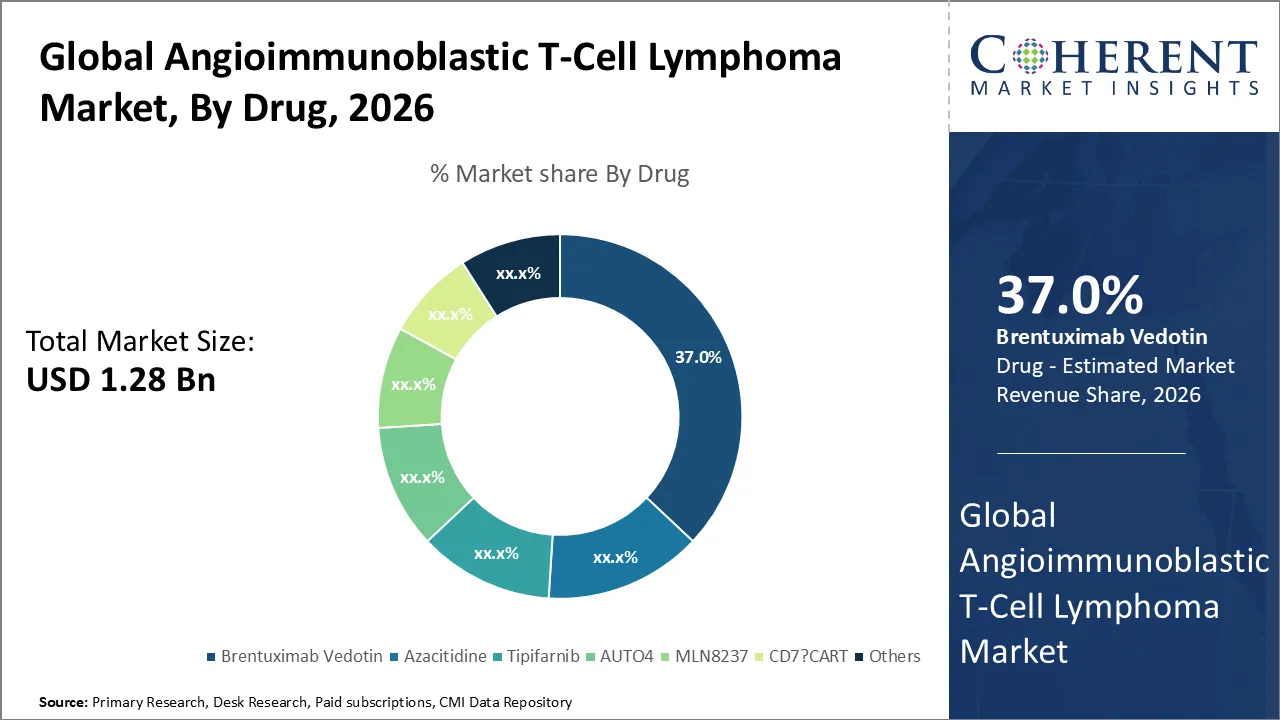
Angioimmunoblastic T-Cell Lymphoma Market Insights, By Drug - Brentuximab Vedotin leads due to proven efficacy and approvals
In terms of drug, the brentuximab Vedotin segment is expected to lead the market with 37% share in 2026, driven by its proven efficacy, FDA/EMA approvals, and widespread adoption in relapsed or refractory T‑cell lymphomas. Its targeted mechanism, survival benefits, and established clinical trust make it the preferred therapy over emerging pipeline drugs.
For instance, in February 2025, Pfizer confirms that the FDA has approved ADCETRIS® (Brentuximab Vedotin) to be used with lenalidomide and rituximab to treat large B-cell lymphoma that has come back or is not responding to treatment. This decision strengthens Brentuximab's broader role in oncology, showing that it works and can be used to treat more types of lymphoma, even though it is not specific to angioimmunoblastic T-cell lymphoma.
Angioimmunoblastic T-Cell Lymphoma Market Insights, By Distribution Channel - Hospital Pharmacies dominate as complex biologics require specialized oncology facilities
In terms of distribution channel, the hospital pharmacies segment is expected to hold 68% share in 2026, as most AITL treatments require infusion, monitoring, and specialized oncology facilities. Complex biologics like Brentuximab and CAR‑T therapies are administered in controlled hospital settings, ensuring patient safety, regulatory compliance, and effective management of adverse events during treatment delivery.
Regional Insights
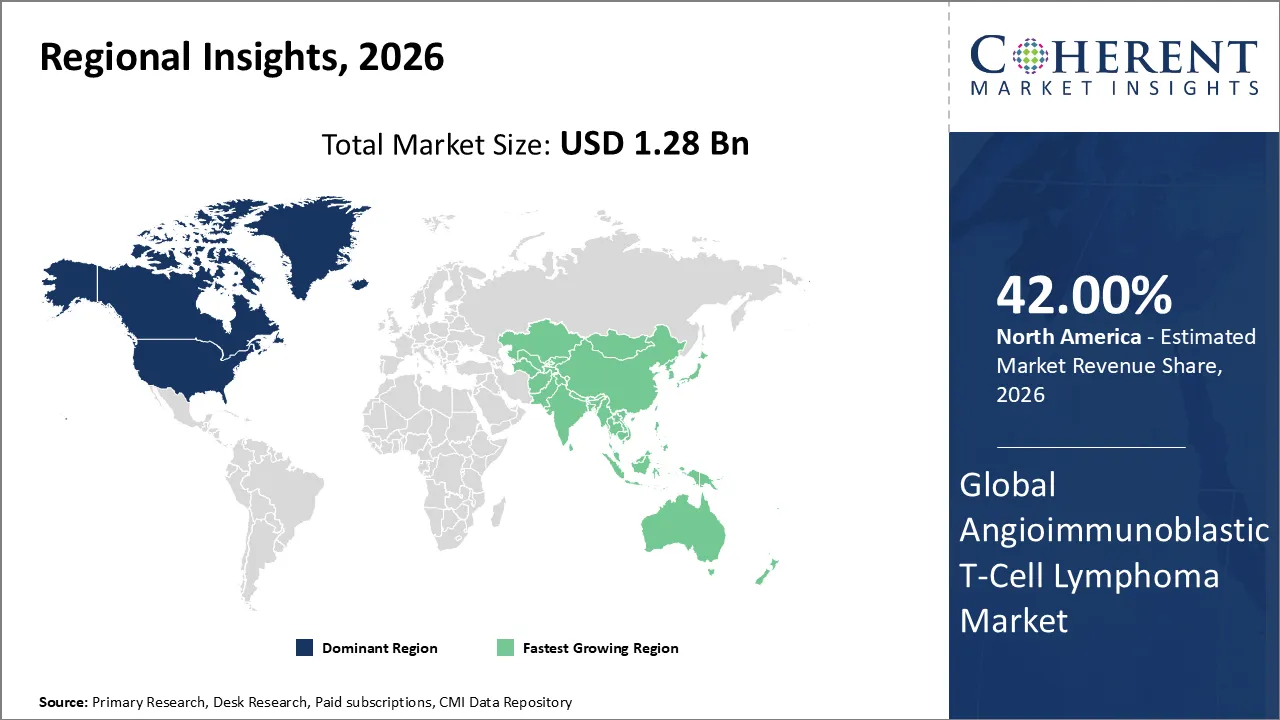
North America Angioimmunoblastic T-Cell Lymphoma Market Analysis & Trends
North America is expected to dominating the angioimmunoblastic T-cell lymphoma market with 42% share in 2026, due to advanced oncology infrastructure, strong FDA approvals for targeted therapies like Brentuximab Vedotin, widespread adoption of biologics, and robust biopharma presence. High diagnosis rates, reimbursement support, and ongoing clinical trials further drive regional dominance and patient treatment demand.
For instance, in August 2025, Researchers at the University of Nebraska Medical Center published a paper on Angioimmunoblastic T‑Cell Lymphomas, a rare and aggressive subtype of peripheral T‑cell lymphoma. The study advances understanding of disease biology, clinical features, and treatment strategies, reinforcing North America’s leadership in oncology research and supporting innovation in lymphoma care.
Asia Pacific Angioimmunoblastic T-Cell Lymphoma Market Analysis & Trends
Asia Pacific is anticipated to be the fastest growing region, due to rising cancer prevalence, expanding healthcare infrastructure, and increasing access to advanced therapies. Government initiatives, growing clinical trials, and pharmaceutical investments drive adoption of biologics and CAR‑T treatments, making the region the fastest‑growing market for innovative lymphoma care.
For instance, in June 2024, Daiichi Sankyo’s EZHARMIA® (valemetostat tosilate) gained approval in Japan for relapsed or refractory Peripheral T‑Cell Lymphoma, including Angioimmunoblastic T‑Cell Lymphoma. Based on Phase 2 VALENTINE‑PTCL01 trial results, it showed strong response rates. This milestone highlights Asia‑Pacific’s leadership in advancing innovative therapies for rare, aggressive T‑cell lymphomas.
Angioimmunoblastic T-Cell Lymphoma Market Outlook Country-Wise
The U.S. Angioimmunoblastic T-Cell Lymphoma Market Trends
In 2026, the U.S. Angioimmunoblastic T‑Cell Lymphoma market is demanding due to advanced oncology infrastructure, FDA approvals of targeted therapies like Brentuximab Vedotin, and expanding CAR‑T trials. High diagnosis rates, strong reimbursement policies, and leading academic research centers drive innovation, ensuring North America remains the largest global market.
For instance, in December 2025, At ASH 2025, MD Anderson researchers addressed about CD40 as a possible biomarker for nodal T-cell lymphomas, such as Angioimmunoblastic T-Cell Lymphoma. This finding could make it easier to diagnose, predict, and target treatments. It demonstrates that North America is leading the way in precision oncology and coming up with new ways to treat rare, aggressive lymphoma subtypes.
China Angioimmunoblastic T-Cell Lymphoma Market Trends
In 2026, China’s Angioimmunoblastic T‑Cell Lymphoma market is demanding due to rising cancer incidence, expanding healthcare infrastructure, and government support for oncology innovation. Breakthrough Therapy Designations, strong clinical trial activity, and adoption of novel drugs like EZH2 inhibitors drive rapid growth, positioning China as a leader in Asia‑Pacific lymphoma care.
For instance, in June 2025, Evopoint Biosciences reported that Igermetostat, a selective EZH2 inhibitor, showed good results in treating Angioimmunoblastic T‑Cell Lymphoma. At ASCO 2025, the trial showed a 68.2% response rate and a median progression-free survival of 15.7 months. With China's Breakthrough Therapy Designation, Asia-Pacific is now the leader in developing new treatments for lymphoma.
Market Report Scope
Angioimmunoblastic T-Cell Lymphoma Market Report Coverage
| Report Coverage | Details | ||
|---|---|---|---|
| Base Year: | 2025 | Market Size in 2026: | USD 1.28 Bn |
| Historical Data for: | 2020 To 2024 | Forecast Period: | 2026 To 2033 |
| Forecast Period 2026 to 2033 CAGR: | 8.1% | 2033 Value Projection: | USD 2.20 Bn |
| Geographies covered: |
| ||
| Segments covered: |
| ||
| Companies covered: | Bristol-Myers Squibb, Millennium Pharmaceuticals, Inc., Autolus Limited, Eisai Inc., Novartis, Kura Oncology, and PersonGen BioTherapeutics (Suzhou) Co., Ltd. | ||
| Growth Drivers: |
| ||
| Restraints & Challenges: |
| ||
Angioimmunoblastic T-Cell Lymphoma Market Driver
Advancements in Targeted Therapies & Immunotherapies
Advancements in targeted therapies and immunotherapies are transforming treatment landscapes for rare lymphomas. The development of EZH2 inhibitors such as valemetostat and igermetostat, alongside monoclonal antibodies, has broadened therapeutic options for patients. Meanwhile, CAR‑T cell therapies and checkpoint inhibitors under clinical investigation promise personalized approaches. These innovations significantly influence the angioimmunoblastic T‑cell lymphoma market share, driving growth as effective, precision‑based treatments gain adoption across major regions, reinforcing demand and reshaping competitive dynamics in global oncology markets.
Rising Prevalence of Lymphomas
The rising prevalence of lymphomas, particularly Peripheral T‑Cell Lymphomas (PTCL) such as Angioimmunoblastic T‑Cell Lymphoma, is a major growth driver. In Asia‑Pacific, especially China and Japan, increasing incidence rates are fueling treatment adoption. Enhanced awareness campaigns and improved diagnostic technologies enable earlier patient identification, ensuring timely intervention. These factors significantly boost angioimmunoblastic T‑cell lymphoma market demand, as healthcare systems prioritize advanced therapies and clinical trials, positioning the region as a critical hub for innovation and expanding global oncology care. According to Blood Cancer United, it is estimated that 192,070 people in the US are expected to be diagnosed with leukemia, lymphoma, or myeloma in 2025.
It is predicted that 9.4% of the 2,041,910 new cancer cases that are going to be diagnosed in the US in 2025 are going to be leukemia, lymphoma, or myeloma.
Angioimmunoblastic T-Cell Lymphoma Market Opportunity
Biomarker Research & Precision Medicine
Biomarker research and precision medicine are reshaping rare lymphoma care. The identification of biomarkers such as CD40 enhances diagnostic accuracy and patient stratification, ensuring treatments are tailored to individual profiles. This approach enables personalized therapies, improving outcomes and survival rates. As advanced therapies gain traction, biomarker-driven strategies significantly influence the angioimmunoblastic T‑cell lymphoma market forecast, supporting growth by expanding clinical adoption, accelerating drug development, and reinforcing the role of precision oncology in shaping future treatment landscapes worldwide.
Expansion of Targeted Therapies
The expansion of targeted therapies is reshaping treatment strategies for Angioimmunoblastic T‑Cell Lymphoma. Novel EZH2 inhibitors like valemetostat and igermetostat demonstrate strong efficacy, offering new hope for patients with limited options. Additionally, combination approaches using monoclonal antibodies and checkpoint inhibitors broaden therapeutic possibilities, enhancing survival outcomes. These innovations significantly contribute to angioimmunoblastic T‑cell lymphoma market growth, as precision medicine adoption accelerates across regions, driving demand for advanced treatments and reinforcing the global oncology market’s focus on rare T‑cell lymphomas
Analyst Opinion (Expert Opinion)
- The angioimmunoblastic T-cell lymphoma (AITL) market is a small part of the larger T-cell lymphoma treatment market. This is due to this type of lymphoma is rare and hard to treat. AITL makes up about 1–2% of all cases of non-Hodgkin lymphoma. It is also a significant part of peripheral T-cell lymphomas, coming in second only to a few other subtypes in terms of how common it is. Its common diagnosis in older adults and complicated systemic presentation highlight the necessity for enhanced therapeutic alternatives.
- Current treatment paradigms predominantly utilize multi-agent chemotherapy regimens as first-line options; however, outcomes are still limited, with frontline responses frequently being suboptimal and long-term survival rates relatively low for advanced disease. Prognostic research shows that five-year survival rates stay low, demonstrating that there is still a clinical need in this rare oncology group.
- New therapies are changing the way we treat diseases, and targeted agents, monoclonal antibodies, and precision immunotherapies are getting a lot of attention in clinical settings. Regulatory and healthcare policy frameworks that prioritize rare disease designations are facilitating expedited approval processes and enhanced access to innovative compounds, especially in developed markets with established oncology research infrastructure.
- Access to treatment varies greatly by region. North America is the best at diagnosing diseases, getting people to participate in clinical trials, and getting people to try new therapies. Europe is next, with structured guideline-based adoption. Asia-Pacific markets are growing owing to more trial networks and more funds being put into healthcare, but the way diagnoses and treatments are done is still not consistent.
- In general, the AITL market is defined by its specialized nature, which has changed from general chemotherapy to targeted and biologic treatment options. Ongoing progress in genomic profiling and innovative therapeutic mechanisms are set to impact clinical practice and broaden options in both frontline and subsequent treatment settings.
Speak to the analyst
Want personalized insights?
Take the findings above to one of our principal consultants, or have the report rebuilt around the segments, geographies and competitors you actually track.
Recent Developments
- In December 2025, At ASH 2025, Secura Bio presented more follow-up data from the Phase 2 PRIMO trial, which showed that duvelisib had long-lasting effects on relapsed/refractory Peripheral T-Cell Lymphoma. Angioimmunoblastic T-Cell Lymphoma is a type of PTCL, so these results show that duvelisib could help AITL patients have better outcomes and more treatment options.
Market Segmentation
- By Drug
- Azacitidine
- Brentuximab Vedotin
- Tipifarnib
- AUTO4
- MLN8237
- CD7-CART
- Others
- By Distribution Channel
- Hospital Pharmacies
- Retail Pharmacies
- Online Pharmacies
- By Region
- North America
- U.S.
- Canada
- Latin America
- Brazil
- Argentina
- Mexico
- Rest of Latin America
- Europe
- Germany
- U.K.
- Spain
- France
- Italy
- Russia
- Rest of Europe
- Asia Pacific
- China
- India
- Japan
- Australia
- South Korea
- ASEAN
- Rest of Asia Pacific
- Middle East
- GCC
- Israel
- Rest of Middle East
- Africa
- South Africa
- North Africa
- Central Africa
- North America
- Global Angioimmunoblastic T-Cell Lymphoma Market – Competitive landscape
- Bristol-Myers Squibb
- Millennium Pharmaceuticals, Inc.
- Autolus Limited
- Eisai Inc.
- Novartis
- Kura Oncology
- PersonGen BioTherapeutics (Suzhou) Co., Ltd.
Sources
Primary Research Interviews
- Hematologists & Oncologists (Lymphoma Specialists)
- Hospital Oncology Department Heads
- Clinical Researchers & Trial Investigators
- Pathologists & Diagnostic Laboratory Experts
- Pharmaceutical & Biotechnology Company Executives
- Others
Databases
- Bloomberg Terminal
- Thomson Reuters Eikon
- IQVIA Database
- GlobalData Healthcare
- S&P Global Market Intelligence
- Others
Magazines
- Cancer Therapy Advisor
- Oncology Times
- The Lancet Oncology (Magazine & News Section)
- Pharmaceutical Executive
- Others
Journals
- Blood Journal
- Journal of Clinical Oncology
- Leukemia & Lymphoma Journal
- The Lancet Oncology
- Haematologica
- Others
Newspapers
- Financial Times
- The Wall Street Journal
- Reuters
- Bloomberg News
- Others
Associations
- American Society of Hematology (ASH)
- European Hematology Association (EHA)
- American Society of Clinical Oncology (ASCO)
- Leukemia & Lymphoma Society (LLS)
- World Health Organization (WHO) – Cancer Classification
- Others
Public Domain Sources
- U.S. National Cancer Institute (NCI)
- National Institutes of Health (NIH)
- World Health Organization (WHO)
- ClinicalTrials.gov
- Surveillance, Epidemiology, and End Results (SEER) Program
- Others
Proprietary Elements
- CMI Data Analytics Tool
- Proprietary CMI Existing Repository of Information for the Last 8 Years
Get access to 250+ pages report
Every segment, forecast, competitor profile and data table behind the analysis above — available for instant download.
- ESOMAR Member
- ISO 9001:2015 Certified
- D-U-N-S Registered
- GDPR & CCPA Compliant
Missing comfort of reading report in your local language? Find your preferred language:
Transform your Strategy with Exclusive Trending Reports
Frequently Asked Questions
The Angioimmunoblastic T-Cell Lymphoma Market is estimated to be valued at USD 1.28 Bn in 2026, and is expected to reach USD 2.20 Bn by 2033.
The CAGR of the Angioimmunoblastic T-Cell Lymphoma Market is projected to be 8.1% from 2026 to 2033.
Advancements in Targeted Therapies & Immunotherapies and Rising Prevalence of Lymphomas are expected to drive the market growth.
The Brentuximab Vedotin is the leading product type segment in the market.
High Cost of Therapies is expected to hinder the global Angioimmunoblastic T-Cell Lymphoma Market over the forecast period.
The major players operating in the market include Bristol-Myers Squibb, Millennium Pharmaceuticals, Inc., Autolus Limited, Eisai Inc., Novartis, Kura Oncology, and PersonGen BioTherapeutics (Suzhou) Co., Ltd.