

Artificial Sperm Market Size and Share Analysis: (2026 - 2033)
The global artificial sperm market size is projected to grow from USD 2.6 Bn in 2026 to USD 4.2 Bn by 2033, registering a compound annual growth rate (CAGR) of 7.1% during the forecast period (2026-2033). The major factors that have contributed to this growth include the increasing instances of infertility, increased acceptance of ARTs, growing demand for fertility treatments, delays in child-bearing, and the steady development of technologies in reproductive health care. According to the WHO, infertility is a significant and growing public health issue influenced by biological, environmental, and socioeconomic factors, affecting about 1 in 6 adults worldwide. Clinical evidence indicates that its prevalence continues to rise.
Key Takeaways from the Artificial Sperm Market Report
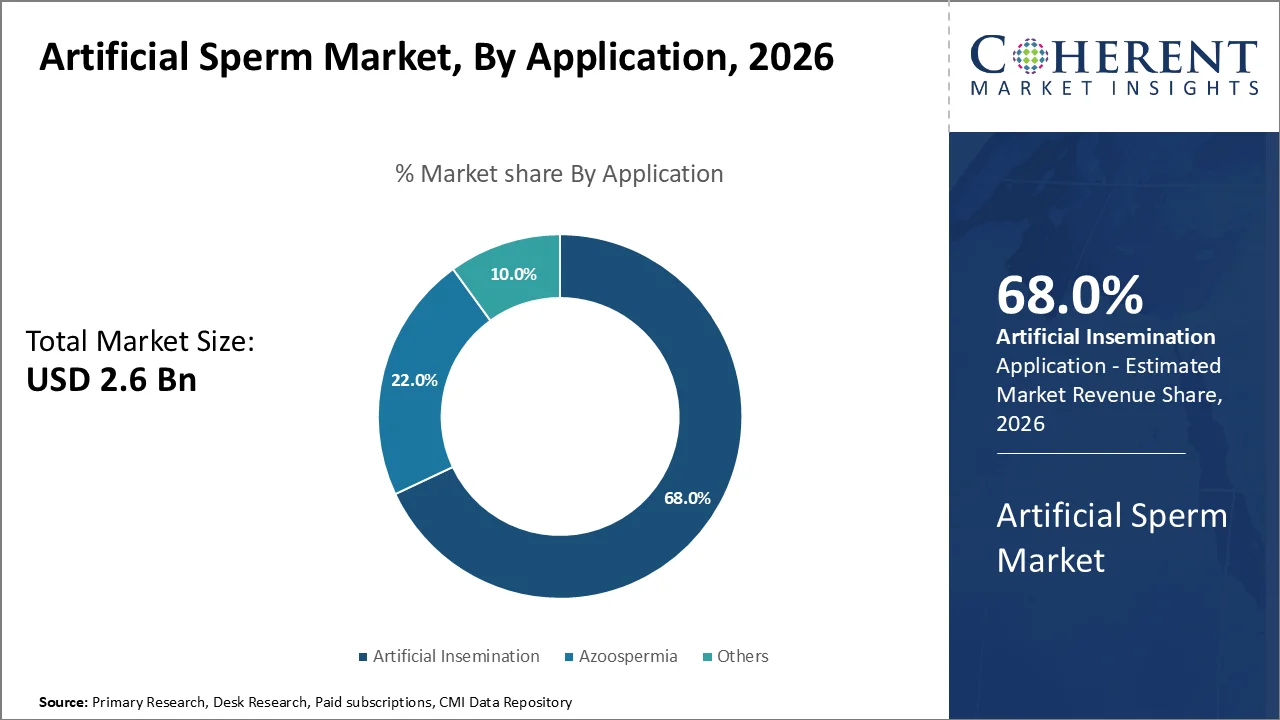
- The artificial insemination segment is estimated to lead the market with a 68.0% share by 2026, driven by the widespread use of assisted reproduction techniques (ARTs), an increase in infertility rates, and the rising popularity of fertility treatments across the world. As per the statistics by the World Health Organization (WHO), almost 17.5% of adults around the world suffer from infertility in their lifetime.
- By end user, fertility centers segment is expected to have the highest market share of 57.0% in 2026, attributed to the rising number of specialized fertility centers, improved success rate of ART procedures, and increased demand for such fertility healthcare facilities. As per the statistics of the World Health Organization (WHO Infertility Fact Sheet), infertility persists to be a significant global health issue impacting millions of people of reproductive age.
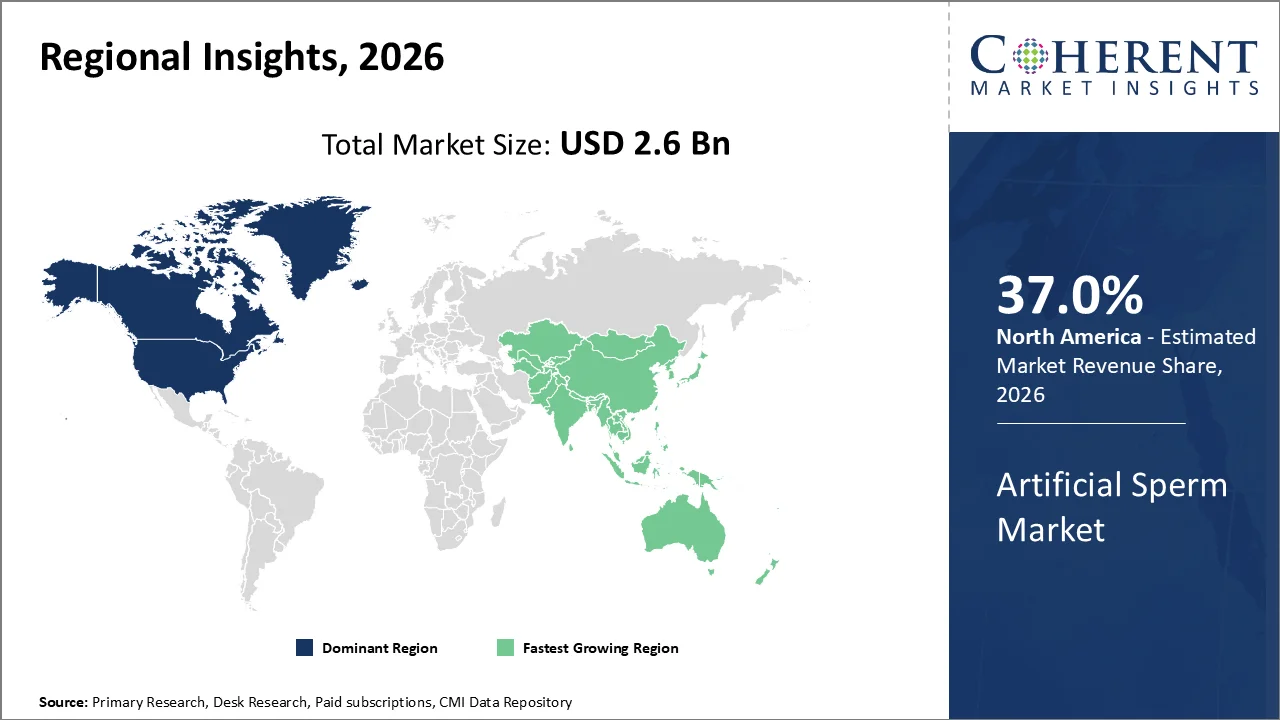
- North America is anticipated to rule the artificial sperm market, contributing significantly in terms of market share with 37.0% in 2026, owing to the high incidence rate of infertility, adoption of ART, advanced healthcare systems, and the availability of numerous fertility clinics and sperm banks. About 1 in 6 Canadian couples experience infertility, defined as the inability to conceive after 12 months of unprotected intercourse, or after 6 months if the woman is over 35.
Market Drivers
Advancements in Assisted Reproductive Technologies (ART) are Supporting Market Growth
Advancements in ART technologies is expected to create new opportunities for the development of the artificial sperm industry. Advancements in IVF, sperm generation through stem cells, reproductive genetics, and laboratory methods of conception will increase the chances of success and provide more options to infertile patients suffering from male infertility problems. The technology to develop artificial sperms is emerging as a significant area in regenerative medicine.
Based on the research results provided by the International Committee for Monitoring Assisted Reproductive Technologies (ICMART), there have been over 13 million babies born using the method of IVF technology around the world.
Current Events and Their Impact on the Artificial Sperm Market
Current Event | Description and its Impact |
Growing Investment in Stem Cell-Derived Sperm Research (2025–2026) |
|
Expansion of Fertility Treatment Access and ART Adoption Worldwide (2025–2026) |
|
- Current Industry Events of 2026
- Market Size Estimation
- Regional Breakdown
- Competitive Landscape
- Customer Intelligence
- Segmental Analysis
- Pricing Analysis
- Key Market Drivers, Challenges & Future Trends
- Customized Insights Section
Segmental Insights
Why is Artificial Insemination Acquiring the Largest Market Share?
Artificial insemination is expected to dominate the artificial sperm market by 2026, contributing 68.0% of the total market. The reasons for the dominance include rising use of ARTs, increasing cases of infertility, and growing preference for fertility treatments worldwide. Artificial insemination continues to be one of the most commonly employed fertility methods because it is inexpensive, non-invasive, and applicable to various cases of infertility.
In September 2025, Femasys Inc. expanded its FemSperm™ product portfolio with the launch of the FemSperm™ Insemination Prep Kit, designed to support sperm preparation for FemaSeed® Intratubal Insemination procedures.
Which End User Segment Dominates the Market?
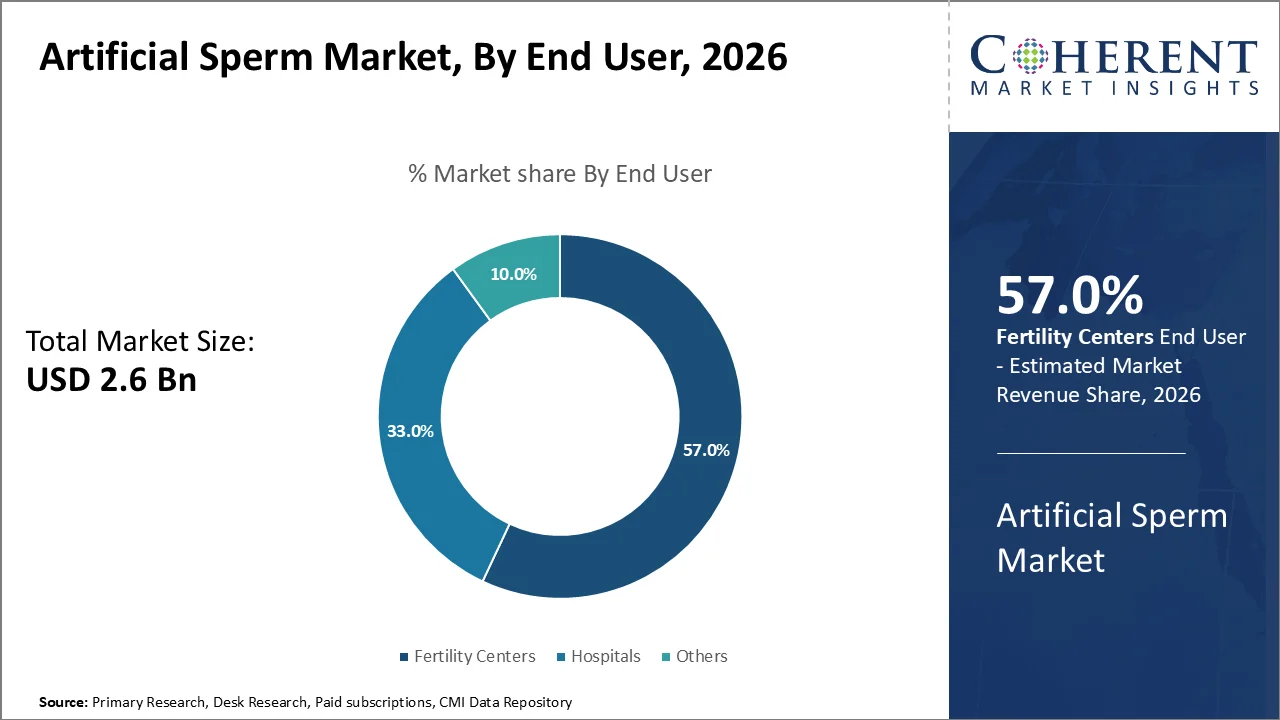
Fertility centers are expected to be the dominant players in the artificial sperm market during 2026, accounting for about 57.0%. The dominant position of the fertility centers can be attributed to rising fertility centers worldwide, high demand from patients for such fertility centers, and better results obtained by means of specific ART treatment. Fertility centers offer diagnosis of infertility, counseling, spermatogenesis therapy, and other reproductive procedures.
Moreover, increased consciousness about infertility treatments, trends of delaying parenthood, and higher investments in healthcare for reproductive health are likely to keep the influx of patients in the fertility centers strong over the coming years.
In November 2025, Birla Fertility & IVF launched its new fertility center in Gachibowli, Hyderabad, expanding its reproductive healthcare network in India.
Artificial Sperm Market Trends
- Rising global infertility rates are increasing demand for artificial sperm and advanced fertility treatments. According to WHO, 1 in 6 people worldwide experience infertility during their lifetime.
- The rapid development in stem cell-based sperm and regenerative medicine is contributing to advances in artificial sperm technology.
- The increase in fertility clinics and specialist reproduction centers is enhancing access to infertility care facilities worldwide.
- Increasing usage of IVF and ART techniques is a catalyst for growth in the market. According to ICMART, over 13 million babies have been born using IVF globally.
- The progress in reproductive genetics and embryo screening technology is improving success rates in fertility treatments.
- The growing government assistance and fertility reimbursement programs are increasing access to fertility care services.
Regional Insights
North America Dominates the Artificial Sperm Market Owing to Strong Adoption of Fertility Treatments
The North American region is forecast to capture 37.0% of the global market share of artificial sperms in 2026 on account of the prevalent infertility among men, adoption of assisted reproductive technologies (ART), developed health care facilities, and availability of many sperm banks in this region.
Technological innovation continues to strengthen regional growth. For instance, in September 2025, Femasys Inc. launched the FemSperm Analysis Kit for use with the FemaSeed Intratubal Insemination platform, enabling in-office sperm analysis and preparation.
Asia Pacific Artificial Sperm Market Trends
The Asia Pacific region is expected to emerge as the fastest-growing region between 2026-2033, owing to rising fertility awareness, proliferation of fertility clinics, increase in healthcare spending, and greater use of assisted reproductive technologies. Several countries like India, China, and Japan are reporting a higher demand for in vitro fertilization and other reproductive procedures, owing to delayed parenthood.
In July 2025, Nova IVF Fertility opened its 100th fertility clinic in India, highlighting the region's growing fertility care infrastructure. Such investments and expanding treatment accessibility are expected to accelerate growth in the Asia Pacific artificial sperm market over the forecast period.
U.S. Artificial Sperm Market Trends
The artificial sperm market in the U.S. is likely to grow considerably over the forecast period owing to high prevalence of infertility, use of ARTs, rising fertility awareness, and increased research activities in reproductive medicine. It has one of the most developed facilities for fertility treatments in the world, including numerous fertility centers and sperm banks.
A key growth driver is the increasing adoption of IVF and artificial insemination procedures. According to the Centers for Disease Control and Prevention, more than 413,000 ART cycles are performed annually in the United States, reflecting strong demand for fertility treatment services.
China Artificial Sperm Market Forecast
China will continue to be one of the leading markets for artificial sperms through the forecast period. Growth of the market is due to decreasing birth rates, prevalence of infertility problems, late childbearing, higher investment in health care, and advancements in assisted reproductive technology.
Growth in demand for fertility treatments is becoming a catalyst for industry growth. China’s government has become increasingly supportive of fertility care programs owing to their demography issues and low fertility rates. It is poised to be a major center for artificial sperm market growth in the Asia-Pacific region.
Who are the Major Companies in Artificial Sperm Industry
Some of the major key players in Artificial Sperm are University of California San Diego School of Medicine, Kallistem, Nanjing Medical University and Institute of Zoology, Chinese Academy of Sciences.
Industry News
- In October 2025, Nanjing Medical University collaborated on a study published in Cell Metabolism demonstrating that sperm microRNAs can transmit exercise-related metabolic traits to offspring.
- In June 2025, Institute of Zoology, Chinese Academy of Sciences and collaborating researchers published a major study in Cell Research revealing the high-resolution structure of the mammalian sperm central apparatus.
Market Report Scope
Artificial Sperm Market Report Coverage
| Report Coverage | Details | ||
|---|---|---|---|
| Base Year: | 2025 | Market Size in 2026: | USD 2.6 Bn |
| Historical Data for: | 2020 To 2024 | Forecast Period: | 2026 To 2033 |
| Forecast Period 2026 to 2033 CAGR: | 7.1% | 2033 Value Projection: | USD 4.2 Bn |
| Geographies covered: |
| ||
| Segments covered: |
| ||
| Companies covered: | University of California San Diego School of Medicine, Kallistem, Nanjing Medical University and Institute of Zoology, Chinese Academy of Sciences. | ||
| Growth Drivers: |
| ||
| Restraints & Challenges: |
| ||
Analyst Opinion
- The demand for artificial sperm will be fueled by an increased infertility burden around the world. The WHO states that 1 in 6 individuals suffer from infertility issues, thus highlighting the significance of infertility as a health issue.
- The male side of infertility accounts for approximately 40-50% of all infertility issues worldwide, thus increasing the need for more innovations and inventions like artificial sperm.
- The increased uptake of assisted reproductive techniques, including IVF, is improving the environment for developing artificial sperm, with many million IVF cycles done yearly around the world.
- The development of gametes from stem cells is advancing quickly, with several preclinical trials achieving success in creating sperm-like cells in laboratories, which highlights the promising prospects for clinical applications in the future.
- Although science has advanced considerably, artificial sperm is still at an early stage of development, and it has not yet been fully developed to clinical scale, so commercialization is expected to take time.
Speak to the analyst
Want personalized insights?
Take the findings above to one of our principal consultants, or have the report rebuilt around the segments, geographies and competitors you actually track.
Market Segmentation
- By Application (Revenue, USD Bn, 2026-2033)
- Artificial Insemination
- Azoospermia
- Others
- By End User (Revenue, USD Bn, 2026-2033)
- Hospitals
- Fertility Centers
- Others
- By Region: (Revenue, USD Bn, 2026-2033)
- North America
- U.S.
- Canada
- Latin America
- Brazil
- Mexico
- Argentina
- Rest of Latin America
- Europe
- Germany
- U.K.
- France
- Italy
- Spain
- Russia
- Rest of Europe
- Asia Pacific
- China
- India
- Japan
- Australia
- South Korea
- ASEAN
- Rest of Asia Pacific
- Middle East
- GCC
- Israel
- Rest of Middle East
- Africa
- South Africa
- Central Africa
- North Africa
- North America
- Key Players
- University of California San Diego School of Medicine
- Kallistem
- Nanjing Medical University
- Institute of Zoology, Chinese Academy of Sciences
Sources
Primary Research Interviews
- Interviews with fertility clinic directors, reproductive medicine specialists, embryologists, IVF lab technicians, biotechnology researchers, and assisted reproductive technology (ART) industry experts
Databases
- World Health Organization (WHO) infertility and reproductive health databases
- Centers for Disease Control and Prevention (CDC) ART surveillance data
- European Society of Human Reproduction and Embryology (ESHRE) database
- International Committee Monitoring Assisted Reproductive Technologies (ICMART) registry
- National health and fertility treatment statistical databases
Magazines
- Reproductive Biomedicine Online publications
- Fertility and Sterility industry magazine
- Biotechnology and reproductive health industry journals
- Life sciences and regenerative medicine trade publications
Journals
- Peer-reviewed reproductive medicine journals (e.g., Human Reproduction Journal)
- Stem cell research journals
- Developmental biology and reproductive genetics journals
- Assisted reproductive technology (ART) clinical research journals
Newspapers
- Leading international newspapers covering healthcare and biotechnology developments
- Global health and medical innovation news publications
- Business newspapers reporting on biotech and fertility industry trends
Associations
- American Society for Reproductive Medicine (ASRM)
- European Society of Human Reproduction and Embryology (ESHRE)
- International Federation of Fertility Societies (IFFS)
- World Health Organization (WHO) reproductive health division
- Society for Reproductive Investigation (SRI)
Public Domain Sources
- WHO infertility and reproductive health reports
- CDC ART Success Rate Reports
- Government health ministry fertility and population reports (U.S., China, India, EU)
- Clinical trial registries (ClinicalTrials.gov)
- Patent databases related to reproductive biotechnology and stem cell-derived gametes
- Published academic research from universities and public medical institutions
Proprietary Elements
- CMI Data Analytics Tool
- Proprietary CMI Reproductive & Fertility Market Repository (8+ years historical database)
Get access to 250+ pages report
Every segment, forecast, competitor profile and data table behind the analysis above — available for instant download.
- ESOMAR Member
- ISO 9001:2015 Certified
- D-U-N-S Registered
- GDPR & CCPA Compliant
Missing comfort of reading report in your local language? Find your preferred language:
Transform your Strategy with Exclusive Trending Reports
Frequently Asked Questions
The global Artificial Sperm Market is estimated to be valued at USD 2.6 Bn in 2026.
The market is projected to reach USD 4.2 Bn by 2033.
The global market is expected to grow at a CAGR of 7.1% from 2026 to 2033.
Key drivers include rising infertility rates, increasing adoption of ART and IVF procedures, and advancements in stem cell-based reproductive technologies.
Key players include University of California San Diego School of Medicine, Kallistem, Nanjing Medical University, and Institute of Zoology, Chinese Academy of Sciences.
North America, with about 37.0% share in 2026, is expected to lead the market due to advanced healthcare infrastructure and strong ART adoption.