

Asia Textile Chemicals Market Size and Share Analysis - 2026 to 2033
Asia textile chemicals market is estimated to be valued at USD 16,256.6 Mn in 2026 and is expected to reach USD 24,443.8 Mn in 2033, exhibiting a compound annual growth rate (CAGR) of 6% from 2026 to 2033.
Key Takeaways
- Based on Product Type, the auxiliaries segment is expected to hold 54.7% share of the market in 2026.
- Based on End User Type, the apparel segment is expected to lead the market with 66.2% share in 2026.
- Based on Process Type, the pre-treatment segment is projected to account for 47.6% share of the market in 2026.
Market Overview
Textile chemicals are the chemical compound that is widely used in the different stages of textile production. They can be classified as coating & sizing chemicals, colorants & auxiliaries, finishing agents, surfactants, yarn lubricants, bleaching agents, and desizing agents. They are widely used across apparel, home furnishings, and industrial chemicals. They are used to offer an aesthetic look and enhance the property of the fabrics. They are mainly produced from coal and petroleum products and the process includes pre-treatment of textile and coating the fabrics.
Current Events and Its Impacts on the Asia Textile Chemicals Market
Current Event | Description and its Impact |
Bangladesh and Vietnam Textile Industry Expansion |
|
Energy Crisis and Petrochemical Feedstock Price Volatility |
|
End Users and Unmet Needs in the Asia Textile Chemicals Market
End Users
- Apparel Manufacturers – Fast fashion, sportswear, and casual wear producers needing cost‑efficient dyes and auxiliaries.
- Home Textiles – Bedding, upholstery, and carpets needing durable finishing agents and flame‑retardant chemicals.
- Footwear & Accessories – Adhesives, coatings, and specialty chemicals for leather and synthetic materials.
- Recycling & Circular Economy Players – Polyester recyclers and eco‑friendly textile startups using catalysts and sustainable auxiliaries.
Unmet Needs
- Eco‑Friendly Alternatives: Strong demand for non‑toxic dyes, waterless processing chemicals, and biodegradable auxiliaries.
- Cost Efficiency: Smaller manufacturers in Bangladesh, Vietnam, and India struggle with high costs of specialty chemicals.
- Regulatory Compliance: Need for chemicals that meet EU REACH and US EPA standards, especially for exporters.
- Digital Printing Chemicals: Fast fashion demands high‑quality inks and auxiliaries for digital textile printing, but adoption is limited by cost and availability.
- Current Industry Events of 2026
- Market Size Estimation
- Regional Breakdown
- Competitive Landscape
- Customer Intelligence
- Segmental Analysis
- Pricing Analysis
- Key Market Drivers, Challenges & Future Trends
- Customized Insights Section
Segmental Insights
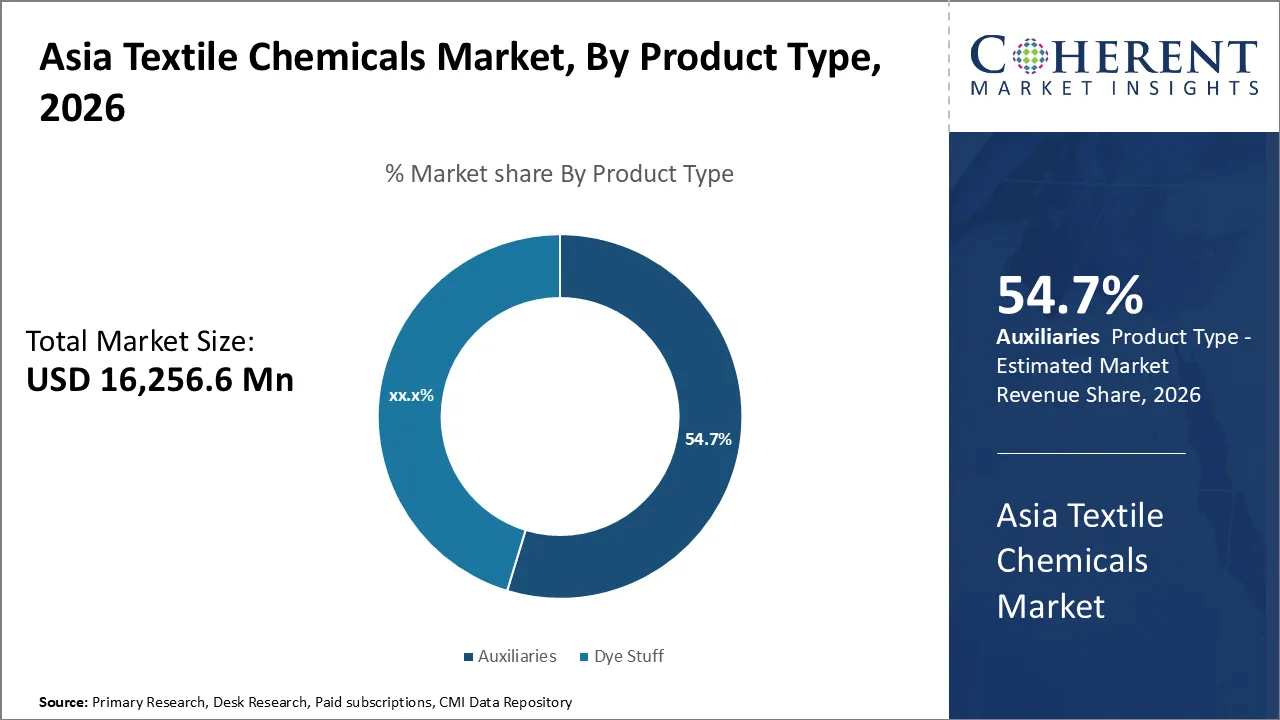
Asia Textile Chemicals Market Insights, By Product Type: Auxiliaries dominate with eco‑friendly, performance‑enhancing textile chemicals
In terms of product type, the auxiliaries segment is expected to hold 54.7% share of the market in 2026, as they make textiles perform better, last longer, and be more environmentally friendly. Softeners, finishing agents, and functional chemicals that make things more comfortable, repel water, and resist microbes. As increasingly people want eco-friendly solutions and smart textiles, chemicals will still be used in Asia's textile industry mostly as auxiliaries.
Jay Chemicals' move into Bangladesh in October 2025 is an example of how the company is focused on making dyes and other chemicals for textiles that are good for the environment. The company sells eco-friendly products that make fabrics work better while having less of an impact on the environment. This step makes the supply chain for Bangladesh's clothing industry stronger, which is in line with global goals for sustainability.
Asia Textile Chemicals Market Insights, By End Use: Apparel leads demand, fueled by Asia’s garment manufacturing and exports
In terms of end use, the apparel segment is expected to lead the market with 66.2% share in 2026, driven by China's, India's, Bangladesh's, and Vietnam's huge garment factories. The need for chemicals for dyeing, finishing, and functional improvements is growing owing to fast fashion, global exports, and rising middle-class consumption. Clothing is the most significant user of textile chemicals in the area considering its size and variety.
For instance, the Intertextile Shanghai 2026 Pet Boutique Zone is directly related to clothing in textile chemicals. Clothing is the most prevalent end-use group, and new styles like pet fashion need textile chemicals for durability, comfort, and have functional finishes.
Asia Textile Chemicals Market Insights, By Process Type: Pre‑treatment dominates, ensuring fabric quality before dyeing and finishing
In terms of process type, the pre-treatment segment is projected to account for 47.6% share of the market in 2026, because it prepares fabrics ready for dyeing and finishing. Essential steps like scouring, bleaching, and desizing make sure that the color and quality are the same. As growing populations use bio-based and low-water technologies, pre-treatment is still important for the textile industry in Asia to be efficient, sustainable, and follow environmental rules.
For example, the release of Turbo Coat by Pooja Enterprises at ITMA Asia 2025 in October 2025 will be a significant event for pre-treating textiles. This new coating technology makes getting fabric ready better, which means better dye absorption, more efficiency, and longer-lasting results. Turbo Coat makes pre-treatment even more important in Asia's textile chemicals market by using fewer resources and making things better.
Asia Textile Chemicals Market Outlook Country-Wise
China Asia Textile Chemicals Market Trends
In 2026, the demand for textile chemicals in Asia is high in China as it has an extensive number of textile factories, clothing exports are going up, and the government is supporting modernization programs. China is at the top of the list for sustainable innovation and global textile chemical consumption due to its focuses on eco-friendly production and advanced finishing agents.
For example, the Cinte Techtextil China 2026 announcement is linked to textile chemicals through technical textile innovation in February 2026. They need special coatings, additives, and finishing agents to make AI-driven improvements last longer, be better for the environment, and work better. These chemicals are needed to make next-generation fabrics, which shows how important textile chemicals are for making technical textiles.
India Asia Textile Chemicals Market Trends
The demand for Asia Textile Chemicals in India will continue to go up in 2026 due to clothing exports are strong, textile hubs are growing quickly, and the government is backing programs to modernize the industry. India's push for eco-friendly production and advanced finishing agents makes it more competitive and a key growth driver in the regional textile chemicals industry.
For instance, the Archroma and HeiQ partnership is based on antimicrobial and odor-control textile auxiliaries, which are directly related to textile chemicals. The partnership strengthens the textile industry in India and South Asia by providing eco-friendly, performance-enhancing solutions that meet global sustainability standards and increase demand for clothing and technical textiles.
Market Report Scope
Asia Textile Chemicals Market Report Coverage
| Report Coverage | Details | ||
|---|---|---|---|
| Base Year: | 2025 | Market Size in 2026: | USD 16,256.6 Mn |
| Historical Data for: | 2020 To 2024 | Forecast Period: | 2026 To 2033 |
| Forecast Period 2026 to 2033 CAGR: | 6% | 2033 Value Projection: | USD 24,443.8 Mn |
| Geographies covered: |
| ||
| Segments covered: |
| ||
| Companies covered: | Huntsman Corporation, Archroma Management LLC, and DyStar Group. | ||
| Growth Drivers: |
| ||
| Restraints & Challenges: |
| ||
Asia Textile Chemicals Market Driver
Booming Apparel Exports
The Asia Textile Chemicals Market share is greatly affected by the fact that the region is the largest exporter of clothing in the world. The majority of the clothes individuals in North America and Europe wear clothes produced from China, India, Bangladesh, and Vietnam. This growing demand needs a lot of textile chemicals for dyeing, finishing, and coating in order to meet international quality standards. As exports go up, so does the use of chemicals. This makes Asia the world's top textile producer and keeps the chemicals market growing steadily for a wide range of uses.
Textile Industry Modernization
Due to modernization efforts throughout the region, the Asia Textile Chemicals Market demand is growing quickly. To make their economies more competitive, governments are putting money into better machines, automation, and eco-friendly production lines. This modernization makes it necessary to use specialized textile chemicals like auxiliaries, finishing agents, and functional coatings that make things more efficient, last longer, and be more environmentally friendly. Manufacturers can meet global compliance standards, lower their impact on the environment, and strengthen their position in international trade by using these new technologies. This leads to steady growth in demand for textile chemicals.
Asia Textile Chemicals Market Opportunity
Eco-Friendly & Sustainable Chemicals
The textile chemicals industry is experiencing shifts as a growing number of people prefer chemicals that are biodegradable, low-VOC, and water-efficient. People and governments all over the world want eco-friendly solutions, which is a great chance for Asian producers to make a profit. Companies can get long-term contracts with international buyers by following these eco-friendly trends. This change is likely to greatly improve the Asia Textile Chemicals Market forecast, making companies that focus on sustainability leaders in capturing high-end markets and growing their global reach.
Analyst Opinion (Expert Opinion)
The Asia textile chemicals market value is strong as the region makes the most textiles in the world. Chemicals are used in important steps like pre-treatment, dyeing, and finishing. China has the most demand in the region as the nation has a large manufacturing base and is focused on exports. India and other up-and-coming centers like Bangladesh and Vietnam are also becoming more important consumers of textile chemical inputs. China's role is due to its long textile value chain, which goes from fiber to finished goods. This creates a steady need for colorants, auxiliaries, and functional treatments.
A large amount of funds has gone into building new processing plants and automating them in Asia, which has made the region stronger. This has led to higher throughput and more advanced chemical applications. The region uses significantly more textile chemicals than other parts of the world. This is because both traditional clothing production and the growing technical textile segments need special formulations for flame retardancy, water repellency, and durability.
One important trend is the growing focus on chemical solutions that are low-impact and environmentally friendly. As environmental rules get stricter and customers expect more from brands and manufacturers, more and more of them are using eco-friendly dyes and biodegradable additives. This also supports the move toward digital printing technologies and less water use in processing.
Distribution patterns show that major textile clusters have well-established supply chains. Leading chemical companies are also expanding their partnerships and research and development activities in these areas. All of these trends make Asia the main driver of textile chemical demand and innovation. This will lead to long-term structural growth in both traditional and performance-oriented textile applications.
Speak to the analyst
Want personalized insights?
Take the findings above to one of our principal consultants, or have the report rebuilt around the segments, geographies and competitors you actually track.
Recent Developments
- In December 2025, Pidilite's work on new technical textiles is based in India, where the company is based. Pidilite strengthens India's textile chemicals sector by promoting leadership in chemistry and sustainability. These new ideas make technical textiles enhance durbaility, eco-friendly for the environment, and work better, which helps meet Asia's growing need for sustainable solutions in clothing and industrial uses.
- In October 2025, the launch of a sustainable catalyst for recycled polyester by Clariant is directly related to textile chemicals. Catalysts and auxiliaries are essential for recycling polyester as they make chemical processes work better and have less of an impact on the environment. This new idea helps the textile chemicals industry in Asia's growing clothing and technical textile industries by making production more eco-friendly and supporting circularity.
Market Segmentation
- By Product Type
- Auxiliaries
- Dye Stuff
- By End Use Type
- Apparel
- Home Furnishing
- Others
- By Process Type
- Pre-treatment
- Finishing
- Dyeing
- Others
- By Region
- China
- India
- Bangladesh
- Vietnam
- Indonesia
- Rest of the Asia
- Asia Textile Chemicals Market Companies
- Huntsman Corporation
- Archroma Management LLC
- DyStar Group
Sources
Primary Research Interviews
- Textile Chemical Manufacturers
- Fabric & Apparel Industry Experts
- Dye & Pigment Producers
- Industrial Textile Processing Engineers
- Textile Chemical Distributors & Traders
- Consultants in Textile Finishing & Coating Technologies
- Others
Databases
- Bloomberg Terminal
- Thomson Reuters Eikon
- IHS Markit
- Euromonitor International
- S&P Global Market Intelligence
- Fibre2Fashion Database
- Others
Magazines
- Textile World Magazine
- Textile Today
- Chemical Engineering Magazine
- Fibre2Fashion News
- Textile Outlook International
- Others
Journals
- Journal of Textile Science & Engineering
- International Journal of Fibers and Textiles
- Dyes and Pigments Journal
- Textile Research Journal
- Journal of Industrial Textiles
- Others
Newspapers
- Financial Times
- The Wall Street Journal
- Reuters
- Bloomberg News
- Textile Focus News
- Others
Associations
- Asian Textile Manufacturers Federation (ATMF)
- World Textile Information Network (WTiN)
- International Textile Manufacturers Federation (ITMF)
- Textile Chemical Suppliers Association (TCSA)
- Others
Public Domain Sources
- World Bank Open Data – Textile & Apparel Sector
- United Nations Industrial Development Organization (UNIDO)
- International Trade Centre (ITC) – Trade Statistics
- Organisation for Economic Co-operation and Development (OECD)
- FAO – Textile-related Agricultural Raw Materials
- Others
Proprietary Elements
- CMI Data Analytics Tool
- Proprietary CMI Existing Repository of Information for the Last 8 Years
Get access to 250+ pages report
Every segment, forecast, competitor profile and data table behind the analysis above — available for instant download.
- ESOMAR Member
- ISO 9001:2015 Certified
- D-U-N-S Registered
- GDPR & CCPA Compliant
Missing comfort of reading report in your local language? Find your preferred language:
Transform your Strategy with Exclusive Trending Reports
Frequently Asked Questions
The is Asia textile chemicals market is estimated to be valued at USD 16,256.6 Mn in 2026, and is expected to reach USD 24,443.8 Mn by 2033.
Major players operating in the Asia textile chemicals market include Huntsman Corporation, Archroma Management LLC, and DyStar Group
Environmental regulations & compliance cost is expected to hamper growth of the market over the forecast period.
Booming apparel exports and textile industry modernization are expected to propel growth of the market over the forecast period.
The increasing demand for branded and high-quality fabric is one of the major trends that is observed in the market.
Among product type, auxiliaries’ segment is expected to hold a dominant position in the Asia textile chemicals market.