

Automatic Pill Dispenser Market Size and Share Analysis – 2026 To 2033
The Automatic Pill Dispenser Market size is anticipated to grow at a CAGR of 6.7%, valued at USD 3.70 Bn in 2026, and is expected to reach approximately USD 5.83 Bn by 2033. The primary drivers are largely defined by the rising prevalence of chronic diseases, increasing medication adherence requirements, rapid growth in the elderly population, expanding adoption of home healthcare solutions, and wider integration of connected technologies in medication management. According to the World Health Organization, as of February 2025, the number of people aged 60 years and above globally was expected to rise from 1.1 Bn in 2023 to 1.4 Bn by 2030.
Key Takeaways
- The centralized automated dispensing segment would dominate the market share, accounting for 64.2% in 2026. The segment’s leadership is attributed to its ability to process high medication volumes, consolidate pharmacy inventory, reduce repetitive manual work, support barcode-scanning verification, and integrate with hospital information systems. According to reports published in May 2024, Medway NHS Foundation Trust has invested nearly £850,000 in a new centralized pharmacy-dispensing robot that can handle about 20,000 packs of medication, up from 12,000 handled by the old robot, thus giving a 66.7% improvement in capacity.
- Hospitals will dominate the market in 2026 at 56.0%. Growth in this segment can be attributed to increased usage of automated dispensing cabinets, high volume of medications dispensed among inpatients, increasing awareness about the need to prevent medication dispensing errors, and integration of automated medication systems into pharmacy and nursing workflows. In the 2024 American Society of Health-System Pharmacists National Survey, it was found that 86.1% of all responding hospitals had automated dispensing cabinets as their method for distributing maintenance medication doses.
- The North America region is likely to dominate the automatic pill dispenser market with 39.2% in 2026. The region’s growth is owing to its advanced hospital and pharmacy automation infrastructure, high prescription-drug utilization, expanding home healthcare services, and large elderly population requiring long-term medication management. The latest Centers for Medicare & Medicaid Services enrollment data show that the U.S. has approximately 70.2 million Medicare beneficiaries, of whom 90.6% are aged 65 years and above and 81.3% have Medicare Part D prescription-drug coverage.
Market Drivers
Growing Polypharmacy Among Chronic-Disease Patients is Expanding Automatic Dispensing Requirements
The automatic pill dispenser market is gaining momentum owing to the rising number of patients managing multiple chronic conditions and complex medication schedules. Automatic dispensers allow medicines to be organized by dosage and administration time, thereby reducing the burden of manually managing several prescriptions.
According to the United States Centers for Disease Control and Prevention report released in 2025, in 2023, there were 93.0 percent of adult U.S. residents aged 65 years or older with at least one chronic illness. In the same year, 78.8% of these residents had two or more chronic illnesses.
In February 2025, the Organisation for Economic Co-operation and Development reported that more than 70% of people with multiple chronic conditions regularly take at least three different medicines, while over 35% take four or more medicines. The increasing complexity of medication regimens is strengthening demand for automatic pill dispensers with multiple compartments, programmable schedules, dose verification, and missed-dose alerts.
Increasing Focus on Medication Safety and Timely Dose Administration is Driving Product Adoption
The automatic pill dispensers market has seen increased growth due to medication safety which involves the reduction of missed dosages, wrong medication, accidental double dosages, as well as dosages at the wrong time. This can be done by providing timely access, audio-visual prompts, controlled release of medicine, and caregiver alerts.
In addition to this, a 2024 study carried out by the National Center for Health Statistics shows that 88.6% of adults who lived in their communities in the U.S. and were aged 65 and above took prescription drugs. Medication consumption was usually in the range of 80%-90% among older-adult groups.
In November 2024, the U.S. Center for Disease Control and Prevention stated that adverse drug events, which include cases of over-medication and mistakes when administering drugs, are a significant patient safety issue. It is recommended that people use timers, reminders, and digital applications to ensure they take their drugs on time.
Current Events and Their Impact on the Automatic Pill Dispenser Market
Current Event | Description and its Impact |
FDA Quality Management System Regulation Becomes Effective for Medical Devices (2026) |
|
FDA Strengthens Cybersecurity Requirements for Connected Medical Devices (2025–2026) |
|
- Current Industry Events of 2026
- Market Size Estimation
- Regional Breakdown
- Competitive Landscape
- Customer Intelligence
- Segmental Analysis
- Pricing Analysis
- Key Market Drivers, Challenges & Future Trends
- Customized Insights Section
Segmental Insights
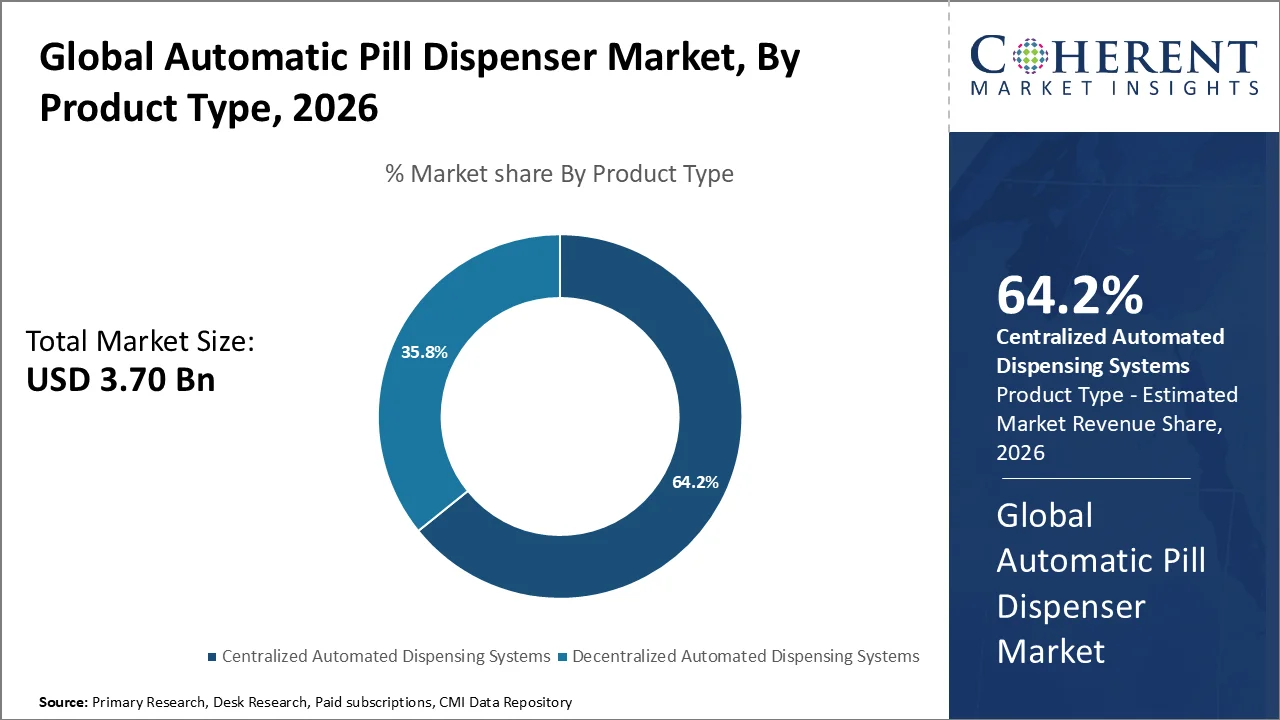
Why are Centralized Automated Dispensing Systems Acquiring the Largest Share?
On the basis of product type, the centralized automated dispensing systems segment is projected to account for the largest automatic pill dispenser market share of 64.2% in 2026. The segment’s growth is owing to its ability to consolidate medication storage, automate high-volume prescription processing, improve inventory visibility, capture batch and expiry information, and reduce repetitive manual activities within central hospital pharmacies.
Government policy is also supporting centralized dispensing infrastructure. The UK Department of Health and Social Care expanded the hub-and-spoke dispensing framework to make centralized dispensing models available to pharmacies under different ownership structures. The government highlighted that existing dispensing hubs generally use automation to achieve economies of scale and release pharmacists from routine back-office activities.
In April 2026, Doncaster and Bassetlaw Teaching Hospitals NHS Foundation Trust reported that the introduction of automated dispensing at Doncaster Royal Infirmary had reduced dispensing times by 50%.
Hospitals Hold the Largest Market Share
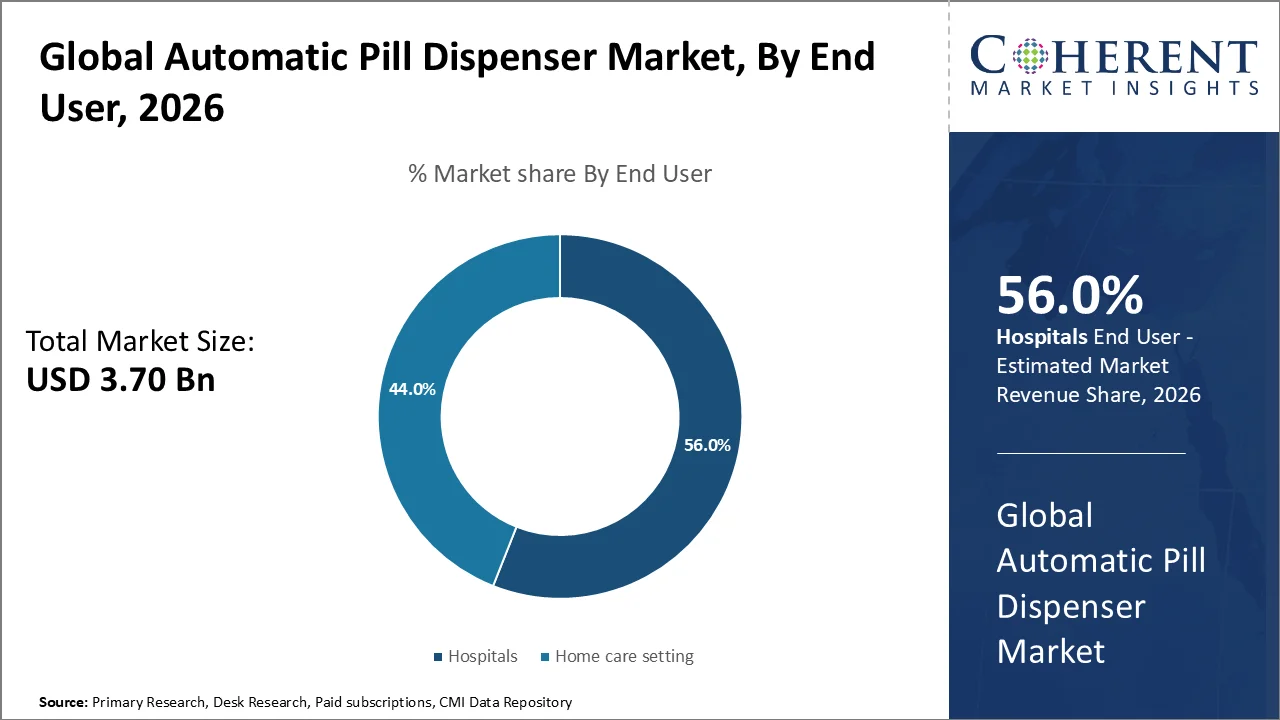
On the basis of end user, the hospitals segment is set to lead with a major 56.0% share in 2026. The segment’s growth is owing to high inpatient and outpatient medication volumes, the need for secure drug storage, increasing pressure to reduce dispensing errors, and the integration of automated dispensing systems with hospital pharmacy and nursing workflows.
According to a report by the U.S. Agency for Healthcare Research and Quality, there have been over 1.3 million medication errors per year in the United States since July 2024, costing more than USD 21 billion in avoidable expenses. The high level of risk and cost associated with this issue has spurred hospitals to adopt automated drug dispensers.
In February 2026, NHS England reported that the Queen’s Hospital in Romford had installed two pharmacy robots which have been fitted with 13 dispensing chutes, compared to the initial five, translating to a 160% increase. The robots were fitted with 2D barcode scanners for expiration dates, batching, and drug recall purposes.
Automatic Pill Dispenser Market Trends
- The incorporation of apps, sound alarms, missed dose alerts, and notifications to caregivers is changing ordinary pill organizers into smart adherence medication tools. In a study carried out in 2025 among 60 patients aged between 60 and 80 years old using at least three oral medications, there was an increase in adherence to medications due to forgetfulness from 52% to 65% initially to 90%-100% when using the pill organizers and reminder apps.
- The focus on aging-in-place and domiciliary care among dementia patients is leading to increased demand for secure, pre-programmed dispensers that would enable the patient to self-medicate while minimizing caregiver assistance. As of June 2026, the GUIDE dementia care approach by the Centers for Medicare & Medicaid Services in the U.S. comprised 320 collaborating organizations. The CMS also stated that over 6 million Americans suffer from dementia, which is expected to rise to 14 million in 2060.
- The increasing use of automated pill dispensers in conjunction with electronic prescriptions, pharmacy computer systems, digital drug profiles, and barcodes is leading to increased precision and efficiency in the prescribing process. In October 2025, the NHS Business Services Authority confirmed that 1.13 billion prescription items had been issued using England’s Electronic Prescription Service in 2024-2025, which accounted for 97% of all items issued. This growing electronic prescription network facilitates the creation of dispensers able to receive information on new dosages from pharmacies and healthcare providers.
Regional Insights
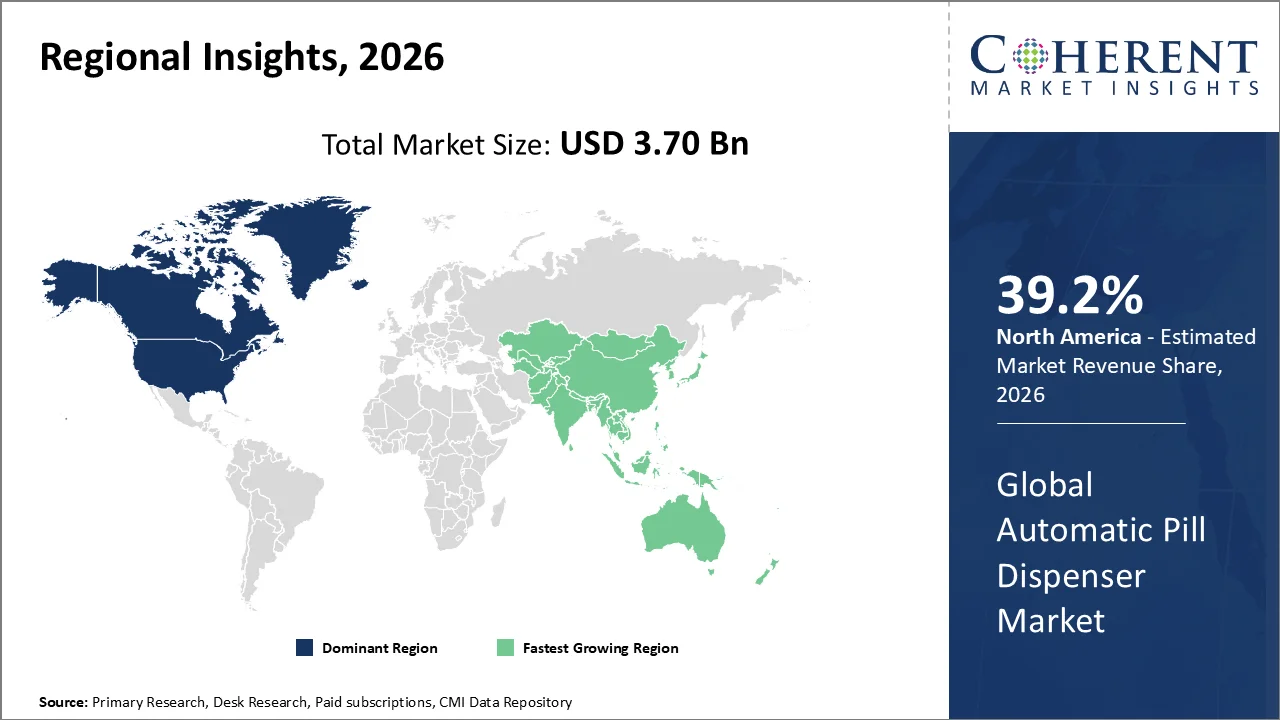
North America Dominates Owing to its Large Elderly Population and Advanced Home Healthcare Infrastructure
The North America region is projected to account for the largest automatic pill dispenser market share of 39.2% in 2026. The region’s dominance is owing to the large medication-dependent elderly population, advanced hospital and pharmacy infrastructure, growing preference for aging at home, and early adoption of connected medication-management technologies across the U.S. and Canada.
Statistics Canada reported that home care, community support, and informal care were used by approximately 17.2%–33.2% of Canadians aged 80 years and above. The growing reliance on home-based assistance is creating opportunities for automatic pill dispensers that allow older adults to manage complex medication schedules while remaining in their homes.
In June 2025, the U.S. Census Bureau reported that the U.S. population aged 65 years and above increased by 3.1% between 2023 and 2024, reaching 61.2 million people. Older adults also outnumbered children in 11 states and nearly half of U.S. counties. The expanding elderly population is increasing the requirement for scheduled medication dispensing, missed-dose alerts, controlled access, and caregiver-supported adherence monitoring.
Asia Pacific is Expected to be the Fastest-Growing Region
The Asia Pacific automatic pill dispenser market is expected to record the fastest growth during 2026–2033. The regional growth is owing to the rapidly aging populations in China, Japan, and South Korea, increasing prevalence of chronic diseases, rising demand for home-based elderly care, and gradual modernization of hospital and pharmacy medication-management systems.
Moreover, the Statistics Bureau of Japan reported that the country had 36.24 million people aged 65 years and above in 2024, representing 29.3% of the total population. Japan’s exceptionally high elderly-population concentration strengthens the demand for dispensers that support independent living, multiple-medication management, and remote caregiver oversight.
In December 2024, the Ministry of the Interior and Safety of South Korea released a statement that indicated that there are 10.24 million South Koreans who are 65 years and older. This represents more than 20% of the population, the highest such proportion ever in South Korean history. It is anticipated that the rise of South Korea into a super-aged society will increase usage of connected pill dispensers.
Home-Based Care Expansion and Connected Medication Management are Accelerating the Automatic Pill Dispenser Market in the United States
The U.S. market for automatic pill dispensers is experiencing robust growth due to the growing provision of healthcare services at home, medication management needs amongst elderly patients, and the increasing use of connected devices that help caregivers track doses from a distance.
In June 2025, the Medicare Payment Advisory Commission estimated that approximately 2.7 million fee-for-service Medicare patients utilized home health care services in 2023, while Medicare payments for home health care services were USD 15.7 billion. The large scale of publicly funded home healthcare creates a substantial addressable setting for automatic pill dispensers that provide scheduled dispensing, dose reminders, locked medication access, and caregiver alerts.
China Automatic Pill Dispenser Market Trends
China is expected to witness strong growth in the automatic pill dispenser market owing to the expansion of home-based medical services, rising use of long-term prescriptions for chronic diseases, and government support for community-based elderly care infrastructure.
Furthermore, in September 2025, the Chinese government announced plans to develop 10,000 “15-minute community life circles” by 2030, including elderly-care and healthcare services, across 100 pilot cities. China had already established 4,335 community life circles by 2024, benefiting approximately 107 million people.
Who are the Major Companies in Automatic Pill Dispenser Industry
Some of the major key players in Automatic Pill Dispenser Market are Becton, Dickinson and Company, Baxter International Inc., Capsa Healthcare, Cerner Corporation, McKesson Corporation, Omnicell Inc., Swisslog Holdings AG, ScriptPro LLC, Yuyama Co. Ltd., and Talyst, Inc.
Key News
- In April 2026, BD launched the BD Pyxis Pro Dispensing Solution and BD Incada Connected Care Platform in Europe. The system combines automated medication storage with AI-enabled analytics and connected inventory data.
- In July 2025, Capsa Healthcare launched its Consolidated Services Pharmacy Platform, which integrates centralized mail-order prescription fulfilment and enterprise-wide medication distribution into one scalable system.
Market Report Scope
Automatic Pill Dispenser Market Report Coverage
| Report Coverage | Details | ||
|---|---|---|---|
| Base Year: | 2025 | Market Size in 2026: | USD 3.70 Bn |
| Historical Data for: | 2020 To 2024 | Forecast Period: | 2026 To 2033 |
| Forecast Period 2026 to 2033 CAGR: | 6.7% | 2033 Value Projection: | USD 5.83 Bn |
| Geographies covered: |
| ||
| Segments covered: |
| ||
| Companies covered: | Becton, Dickinson and Company, Baxter International Inc., Capsa Healthcare, Cerner Corporation, McKesson Corporation, Omnicell Inc., Swisslog Holdings AG, ScriptPro LLC, Yuyama Co. Ltd., and Talyst, Inc. | ||
| Growth Drivers: |
| ||
| Restraints & Challenges: |
| ||
Analyst Opinion
- The automatic pill dispenser market is expected to gain sustained demand from healthcare systems seeking to reduce medication-administration errors, particularly in home care and long-term care facilities. According to a July 2025 government review by the UK government, there have been an estimated 240 million cases of medication errors per year, with 40 percent related to improper drug administration in care homes. Thus, the use of locked dispensing, dosage confirmation, scheduled dispensation, and caregiver alerts is justified.
- The process of automation in pharmacies is slowly moving from hospitals’ dispensaries to community pharmacies, automated pick-up points, and even delivery services. The government of the United Kingdom’s consultation on supervision of pharmacies resulted in a proposal for legislation based on automated lockers and pick-up points, receiving 5,054 responses.
- Connected automatic pill dispensers are expected to command higher commercial value than basic reminder devices, but cybersecurity compliance will become a critical competitive requirement. In February 2026, the FDA issued updated guidance covering cybersecurity design, labeling, and premarket documentation for medical devices with cybersecurity risk. Manufacturers with secure software updates, data encryption, vulnerability-management systems, and reliable caregiver connectivity are likely to gain stronger healthcare-provider confidence.
Speak to the analyst
Want personalized insights?
Take the findings above to one of our principal consultants, or have the report rebuilt around the segments, geographies and competitors you actually track.
Market Segmentation
- By Product Type (Revenue, USD Bn, 2021-2033)
- Centralized Automated Dispensing Systems
- Decentralized Automated Dispensing Systems
- By End User (Revenue, USD Bn, 2021-2033)
- Hospitals
- Home care setting
- By Region (Revenue, USD Bn, 2021-2033)
- North America
- U.S.
- Canada
- Latin America
- Brazil
- Mexico
- Argentina
- Rest of Latin America
- Europe
- Germany
- U.K.
- France
- Italy
- Spain
- Russia
- Rest of Europe
- Asia Pacific
- China
- India
- Japan
- Australia
- South Korea
- ASEAN
- Rest of Asia Pacific
- Middle East
- GCC
- Israel
- Rest of Middle East
- Africa
- South Africa
- Central Africa
- North Africa
- North America
Sources
Primary Research Interviews
- Hospital pharmacists and chief pharmacy officers
- Pharmacy automation and medication-management specialists
- Procurement heads from hospitals and health systems
- Home healthcare service providers and caregivers
- Long-term care and assisted-living facility administrators
- Automatic pill dispenser manufacturers and technology developers
- Community and retail pharmacy operators
- Clinical informatics and hospital IT integration professionals
- Medication-safety experts and clinical pharmacists
- Geriatricians and chronic-disease management specialists
- Medical device distributors and pharmacy equipment suppliers
- Key opinion leaders in medication adherence and pharmacy automation
Databases
- World Health Organization
- World Bank
- Organisation for Economic Co-operation and Development
- U.S. Centers for Medicare & Medicaid Services
- U.S. Centers for Disease Control and Prevention
- U.S. Food and Drug Administration
- U.S. Census Bureau
- Eurosta
- Statistics Canada
- National Bureau of Statistics of China
- Statistics Bureau of Japan
- NHS Business Services Authority
- ClinicalTrials.gov
- European Commission EUDAMED
Magazines
- Pharmacy Times
- Drug Topics
- Pharmacy Practice News
- Healthcare IT News
- Becker’s Hospital Review
- Medical Device Network
- Healthcare Packaging
- Modern Healthcare
- The Pharmaceutical Journal
- Robotics & Automation Magazine
Journals
- Research in Social and Administrative Pharmacy
- Journal of the American Medical Informatics Association
- International Journal of Medical Informatics
- BMJ Quality & Safety
- BMC Health Services Research
- Patient Preference and Adherence
- Journal of Medical Internet Research
- Drugs & Aging
- Journal of the American Geriatrics Society
- American Journal of Health-System Pharmacy
- International Journal for Quality in Health Care
- Journal of Pharmacy Practice and Research
Newspapers
- Reuters
- The Wall Street Journal
- Financial Times
- The Guardian
- The New York Times
- The Economic Times
- The Washington Post
- China Daily
- The Japan Times
Associations
- American Society of Health-System Pharmacists
- Institute for Safe Medication Practices
- International Pharmaceutical Federation
- Healthcare Information and Management Systems Society
- National Association of Boards of Pharmacy
- European Association of Hospital Pharmacists
- American Pharmacists Association
- National Community Pharmacists Association
- Medication Safety Officers Society
- Association for Packaging and Processing Technologies
- International Society for Medication Adherence
- LeadingAge
Public Domain Sources
- Company annual reports and investor presentations
- Product brochures and technical specification documents
- Hospital pharmacy automation implementation reports
- Government medication-safety publications
- National elderly-care and home healthcare statistics
- Regulatory filings and medical device databases
- Public procurement and hospital tender documents
- Clinical studies on medication adherence and dispensing systems
- Government healthcare digitalization policies
- Patent databases such as WIPO, USPTO, Espacenet, and Google Patents
- Company product-launch and partnership announcements
- Hospital and pharmacy automation case studies
Proprietary Elements
- CMI Data Analytics Tool
- Proprietary CMI Existing Repository of Information for the Last 10 Years
Get access to 250+ pages report
Every segment, forecast, competitor profile and data table behind the analysis above — available for instant download.
- ESOMAR Member
- ISO 9001:2015 Certified
- D-U-N-S Registered
- GDPR & CCPA Compliant
Missing comfort of reading report in your local language? Find your preferred language:
Transform your Strategy with Exclusive Trending Reports
Frequently Asked Questions
The Automatic Pill Dispenser Market is expected to reach approximately USD 5.83 Bn by 2033, increasing from USD 3.70 Bn in 2026.
Major players operating in the global Automatic Pill Dispenser Market include Becton, Dickinson and Company, Baxter International Inc., Capsa Healthcare, Cerner Corporation, McKesson Corporation, Omnicell Inc., Swisslog Holdings AG, ScriptPro LLC, Yuyama Co. Ltd., and Talyst, Inc.
High initial investment, maintenance expenses, software-integration challenges, cybersecurity concerns, technical failures, and limited affordability in developing markets are the key factors hampering market growth.
The increasing adoption of automated medication dispensing in hospitals, rising demand for medication-adherence solutions, growing elderly population, increasing polypharmacy, and expansion of home healthcare services are driving market growth.
The Automatic Pill Dispenser Market is anticipated to grow at a CAGR of 6.7% between 2026 and 2033.
North America is expected to account for the largest share of the global Automatic Pill Dispenser Market, representing approximately 39.2% in 2026.
Asia Pacific is expected to be the fastest-growing region during the forecast period owing to rapidly aging populations, expanding home-based elderly care, and modernization of hospital and pharmacy infrastructure.